Country classification
145
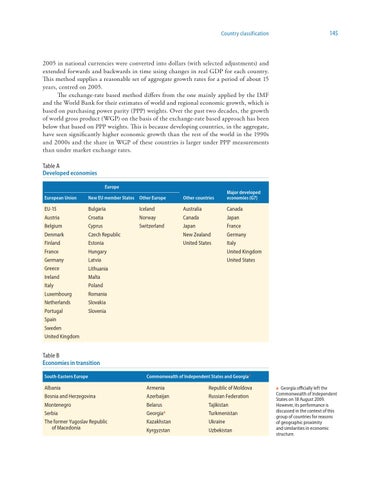
2005 in national currencies were converted into dollars (with selected adjustments) and extended forwards and backwards in time using changes in real GDP for each country. This method supplies a reasonable set of aggregate growth rates for a period of about 15 years, centred on 2005. The exchange-rate based method differs from the one mainly applied by the IMF and the World Bank for their estimates of world and regional economic growth, which is based on purchasing power parity (PPP) weights. Over the past two decades, the growth of world gross product (WGP) on the basis of the exchange-rate based approach has been below that based on PPP weights. This is because developing countries, in the aggregate, have seen significantly higher economic growth than the rest of the world in the 1990s and 2000s and the share in WGP of these countries is larger under PPP measurements than under market exchange rates. Table A Developed economies Europe European Union
New EU member States
Other Europe
Other countries
Major developed economies (G7)
EU-15
Bulgaria
Iceland
Australia
Canada
Austria
Croatia
Norway
Canada
Japan
Belgium
Cyprus
Switzerland
Japan
France
Denmark
Czech Republic
New Zealand
Germany
Finland
Estonia
United States
Italy
France
Hungary
United Kingdom
Germany
Latvia
United States
Greece
Lithuania
Ireland
Malta
Italy
Poland
Luxembourg
Romania
Netherlands
Slovakia
Portugal
Slovenia
Spain Sweden United Kingdom
Table B Economies in transition South-Eastern Europe
Commonwealth of Independent States and Georgiaa
Albania
Armenia
Republic of Moldova
Bosnia and Herzegovina
Azerbaijan
Russian Federation
Montenegro
Belarus
Tajikistan
Serbia
Georgiaa
Turkmenistan
The former Yugoslav Republic of Macedonia
Kazakhstan
Ukraine
Kyrgyzstan
Uzbekistan
a  Georgia officially left the Commonwealth of Independent States on 18 August 2009. However, its performance is discussed in the context of this group of countries for reasons of geographic proximity and similarities in economic structure.