25
Chapter I. Global economic outlook
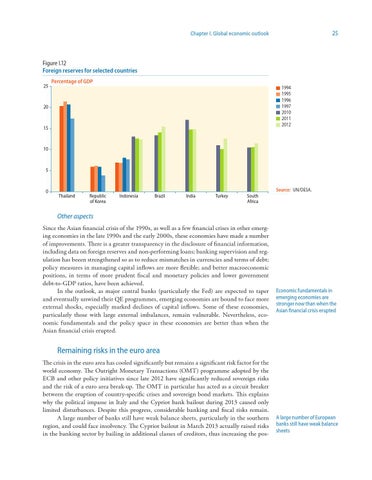
Figure I.12 Foreign reserves for selected countries 25
Percentage of GDP 1994 1995 1996 1997 2010 2011 2012
20
15
10
5
0
Source: UN/DESA. Thailand
Republic of Korea
Indonesia
Brazil
India
Turkey
South Africa
Other aspects Since the Asian financial crisis of the 1990s, as well as a few financial crises in other emerging economies in the late 1990s and the early 2000s, these economies have made a number of improvements. There is a greater transparency in the disclosure of financial information, including data on foreign reserves and non-performing loans; banking supervision and regulation has beeen strengthened so as to reduce mismatches in currencies and terms of debt; policy measures in managing capital inflows are more flexible; and better macroeconomic positions, in terms of more prudent fiscal and monetary policies and lower government debt-to-GDP ratios, have been achieved. In the outlook, as major central banks (particularly the Fed) are expected to taper and eventually unwind their QE programmes, emerging economies are bound to face more external shocks, especially marked declines of capital inflows. Some of these economies, particularly those with large external imbalances, remain vulnerable. Nevertheless, economic fundamentals and the policy space in these economies are better than when the Asian financial crisis erupted.
Economic fundamentals in emerging economies are stronger now than when the Asian financial crisis erupted
Remaining risks in the euro area The crisis in the euro area has cooled significantly but remains a significant risk factor for the world economy. The Outright Monetary Transactions (OMT) programme adopted by the ECB and other policy initiatives since late 2012 have significantly reduced sovereign risks and the risk of a euro area break-up. The OMT in particular has acted as a circuit breaker between the eruption of country-specific crises and sovereign bond markets. This explains why the political impasse in Italy and the Cypriot bank bailout during 2013 caused only limited disturbances. Despite this progress, considerable banking and fiscal risks remain. A large number of banks still have weak balance sheets, particularly in the southern region, and could face insolvency. The Cypriot bailout in March 2013 actually raised risks in the banking sector by bailing in additional classes of creditors, thus increasing the pos-
A large number of European banks still have weak balance sheets