24
World Economic Situation and Prospects 2014
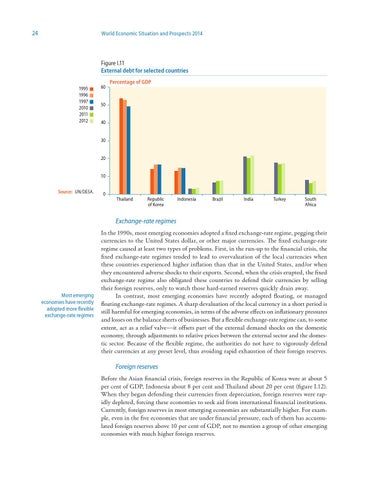
Figure I.11 External debt for selected countries 1995 1996 1997 2010 2011 2012
60
Percentage of GDP
50
40
30
20
10 Source: UN/DESA.
0
Thailand
Republic of Korea
Indonesia
Brazil
India
Turkey
South Africa
Exchange-rate regimes
Most emerging economies have recently adopted more flexible exchange-rate regimes
In the 1990s, most emerging economies adopted a fixed exchange-rate regime, pegging their currencies to the United States dollar, or other major currencies. The fixed exchange-rate regime caused at least two types of problems. First, in the run-up to the financial crisis, the fixed exchange-rate regimes tended to lead to overvaluation of the local currencies when these countries experienced higher inflation than that in the United States, and/or when they encountered adverse shocks to their exports. Second, when the crisis erupted, the fixed exchange-rate regime also obligated these countries to defend their currencies by selling their foreign reserves, only to watch those hard-earned reserves quickly drain away. In contrast, most emerging economies have recently adopted floating, or managed floating exchange-rate regimes. A sharp devaluation of the local currency in a short period is still harmful for emerging economies, in terms of the adverse effects on inflationary pressures and losses on the balance sheets of businesses. But a flexible exchange-rate regime can, to some extent, act as a relief valve—it offsets part of the external demand shocks on the domestic economy, through adjustments to relative prices between the external sector and the domestic sector. Because of the flexible regime, the authorities do not have to vigorously defend their currencies at any preset level, thus avoiding rapid exhaustion of their foreign reserves.
Foreign reserves Before the Asian financial crisis, foreign reserves in the Republic of Korea were at about 5 per cent of GDP, Indonesia about 8 per cent and Thailand about 20 per cent (figure I.12). When they began defending their currencies from depreciation, foreign reserves were rapidly depleted, forcing these economies to seek aid from international financial institutions. Currently, foreign reserves in most emerging economies are substantially higher. For example, even in the five economies that are under financial pressure, each of them has accumulated foreign reserves above 10 per cent of GDP, not to mention a group of other emerging economies with much higher foreign reserves.