19
Chapter I. Global economic outlook
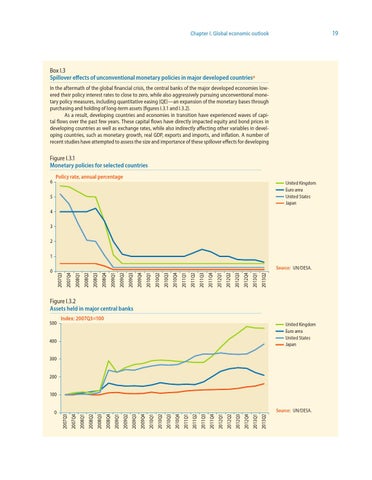
Box I.3 Spillover effects of unconventional monetary policies in major developed countriesa In the aftermath of the global financial crisis, the central banks of the major developed economies lowered their policy interest rates to close to zero, while also aggressively pursuing unconventional monetary policy measures, including quantitative easing (QE)—an expansion of the monetary bases through purchasing and holding of long-term assets (figures I.3.1 and I.3.2). As a result, developing countries and economies in transition have experienced waves of capital flows over the past few years. These capital flows have directly impacted equity and bond prices in developing countries as well as exchange rates, while also indirectly affecting other variables in developing countries, such as monetary growth, real GDP, exports and imports, and inflation. A number of recent studies have attempted to assess the size and importance of these spillover effects for developing
Figure I.3.1 Monetary policies for selected countries 6
Policy rate, annual percentage United Kingdom Euro area United States Japan
5 4 3 2 1
2013Q2
2013Q1
2012Q4
2012Q3
2012Q2
2012Q1
2011Q4
2011Q3
2011Q2
2011Q1
2010Q4
2010Q3
2010Q2
2010Q1
2009Q4
2009Q3
2009Q2
2009Q1
2008Q4
2008Q3
2008Q2
2008Q1
2007Q3
2007Q4
Source: UN/DESA.
0
Figure I.3.2 Assets held in major central banks 500
Index: 2007Q3=100 United Kingdom Euro area United States Japan
400
300
200
100
2013Q2
2013Q1
2012Q4
2012Q3
2012Q2
2012Q1
2011Q4
2011Q3
2011Q2
2011Q1
2010Q4
2010Q3
2010Q2
2010Q1
2009Q4
2009Q3
2009Q2
2009Q1
2008Q4
2008Q3
2008Q2
2008Q1
2007Q4
Source: UN/DESA. 2007Q3
0