16
World Economic Situation and Prospects 2014
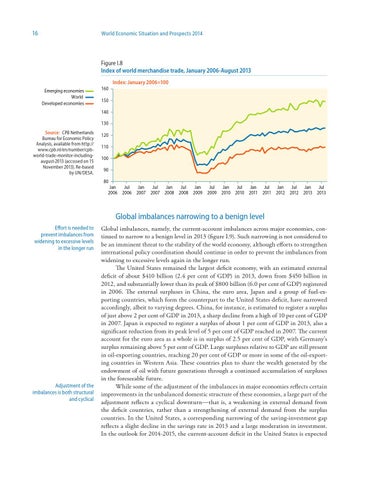
Figure I.8 Index of world merchandise trade, January 2006-August 2013 Index: January 2006=100 Emerging economies World Developed economies
160 150 140 130
Source: CPB Netherlands Bureau for Economic Policy Analysis, available from http:// www.cpb.nl/en/number/cpbworld-trade-monitor-includingaugust-2013 (accsssed on 15 November 2013). Re-based by UN/DESA.
120 110 100 90 80 Jan Jul Jan Jul Jan Jul Jan Jul Jan Jul Jan Jul Jan Jul Jan Jul 2006 2006 2007 2007 2008 2008 2009 2009 2010 2010 2011 2011 2012 2012 2013 2013
Global imbalances narrowing to a benign level Effort is needed to prevent imbalances from widening to excessive levels in the longer run
Adjustment of the imbalances is both structural and cyclical
Global imbalances, namely, the current-account imbalances across major economies, continued to narrow to a benign level in 2013 (figure I.9). Such narrowing is not considered to be an imminent threat to the stability of the world economy, although efforts to strengthen international policy coordination should continue in order to prevent the imbalances from widening to excessive levels again in the longer run. The United States remained the largest deficit economy, with an estimated external deficit of about $410 billion (2.4 per cent of GDP) in 2013, down from $450 billion in 2012, and substantially lower than its peak of $800 billion (6.0 per cent of GDP) registered in 2006. The external surpluses in China, the euro area, Japan and a group of fuel-exporting countries, which form the counterpart to the United States deficit, have narrowed accordingly, albeit to varying degrees. China, for instance, is estimated to register a surplus of just above 2 per cent of GDP in 2013, a sharp decline from a high of 10 per cent of GDP in 2007. Japan is expected to register a surplus of about 1 per cent of GDP in 2013, also a significant reduction from its peak level of 5 per cent of GDP reached in 2007. The current account for the euro area as a whole is in surplus of 2.5 per cent of GDP, with Germany’s surplus remaining above 5 per cent of GDP. Large surpluses relative to GDP are still present in oil-exporting countries, reaching 20 per cent of GDP or more in some of the oil-exporting countries in Western Asia. These countries plan to share the wealth generated by the endowment of oil with future generations through a continued accumulation of surpluses in the foreseeable future. While some of the adjustment of the imbalances in major economies reflects certain improvements in the unbalanced domestic structure of these economies, a large part of the adjustment reflects a cyclical downturn—that is, a weakening in external demand from the deficit countries, rather than a strengthening of external demand from the surplus countries. In the United States, a corresponding narrowing of the saving-investment gap reflects a slight decline in the savings rate in 2013 and a large moderation in investment. In the outlook for 2014-2015, the current-account deficit in the United States is expected