14
World Economic Situation and Prospects 2014
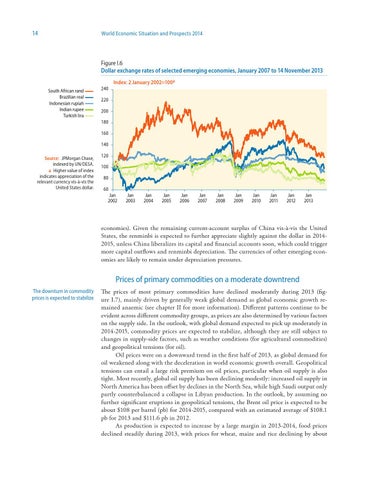
Figure I.6 Dollar exchange rates of selected emerging economies, January 2007 to 14 November 2013 Index: 2 January 2002=100a South African rand Brazilian real Indonesian rupiah Indian rupee Turkish lira
240 220 200 180 160 140
Source: JPMorgan Chase, indexed by UN/DESA. a Higher value of index indicates appreciation of the relevant currency vis-à-vis the United States dollar.
120 100 80 60 Jan 2002
Jan 2003
Jan 2004
Jan 2005
Jan 2006
Jan 2007
Jan 2008
Jan 2009
Jan 2010
Jan 2011
Jan 2012
Jan 2013
economies). Given the remaining current-account surplus of China vis-à-vis the United States, the renminbi is expected to further appreciate slightly against the dollar in 20142015, unless China liberalizes its capital and financial accounts soon, which could trigger more capital outflows and renminbi depreciation. The currencies of other emerging economies are likely to remain under depreciation pressures.
Prices of primary commodities on a moderate downtrend The downturn in commodity prices is expected to stabilize
The prices of most primary commodities have declined moderately during 2013 (figure I.7), mainly driven by generally weak global demand as global economic growth remained anaemic (see chapter II for more information). Different patterns continue to be evident across different commodity groups, as prices are also determined by various factors on the supply side. In the outlook, with global demand expected to pick up moderately in 2014-2015, commodity prices are expected to stabilize, although they are still subject to changes in supply-side factors, such as weather conditions (for agricultural commodities) and geopolitical tensions (for oil). Oil prices were on a downward trend in the first half of 2013, as global demand for oil weakened along with the deceleration in world economic growth overall. Geopolitical tensions can entail a large risk premium on oil prices, particular when oil supply is also tight. Most recently, global oil supply has been declining modestly: increased oil supply in North America has been offset by declines in the North Sea, while high Saudi output only partly counterbalanced a collapse in Libyan production. In the outlook, by assuming no further significant eruptions in geopolitical tensions, the Brent oil price is expected to be about $108 per barrel (pb) for 2014-2015, compared with an estimated average of $108.1 pb for 2013 and $111.6 pb in 2012. As production is expected to increase by a large margin in 2013-2014, food prices declined steadily during 2013, with prices for wheat, maize and rice declining by about