13
Chapter I. Global economic outlook
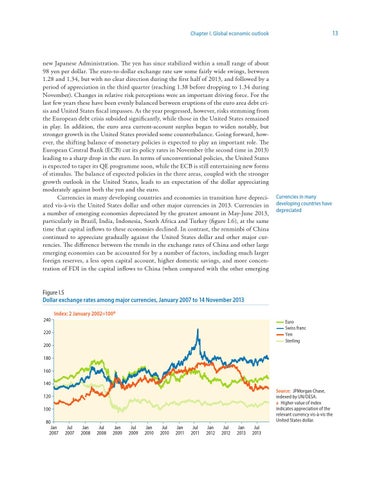
new Japanese Administration. The yen has since stabilized within a small range of about 98 yen per dollar. The euro-to-dollar exchange rate saw some fairly wide swings, between 1.28 and 1.34, but with no clear direction during the first half of 2013, and followed by a period of appreciation in the third quarter (reaching 1.38 before dropping to 1.34 during November). Changes in relative risk perceptions were an important driving force. For the last few years these have been evenly balanced between eruptions of the euro area debt crisis and United States fiscal impasses. As the year progressed, however, risks stemming from the European debt crisis subsided significantly, while those in the United States remained in play. In addition, the euro area current-account surplus began to widen notably, but stronger growth in the United States provided some counterbalance. Going forward, however, the shifting balance of monetary policies is expected to play an important role. The European Central Bank (ECB) cut its policy rates in November (the second time in 2013) leading to a sharp drop in the euro. In terms of unconventional policies, the United States is expected to taper its QE programme soon, while the ECB is still entertaining new forms of stimulus. The balance of expected policies in the three areas, coupled with the stronger growth outlook in the United States, leads to an expectation of the dollar appreciating moderately against both the yen and the euro. Currencies in many developing countries and economies in transition have depreciated vis-à-vis the United States dollar and other major currencies in 2013. Currencies in a number of emerging economies depreciated by the greatest amount in May-June 2013, particularly in Brazil, India, Indonesia, South Africa and Turkey (figure I.6), at the same time that capital inflows to these economies declined. In contrast, the renminbi of China continued to appreciate gradually against the United States dollar and other major currencies. The difference between the trends in the exchange rates of China and other large emerging economies can be accounted for by a number of factors, including much larger foreign reserves, a less open capital account, higher domestic savings, and more concentration of FDI in the capital inflows to China (when compared with the other emerging
Currencies in many developing countries have depreciated
Figure I.5 Dollar exchange rates among major currencies, January 2007 to 14 November 2013 Index: 2 January 2002=100a 240
Euro Swiss franc Yen Sterling
220 200 180 160 140
Source: JPMorgan Chase, indexed by UN/DESA. a Higher value of index indicates appreciation of the relevant currency vis-à-vis the United States dollar.
120 100 80 Jan 2007
Jul 2007
Jan 2008
Jul 2008
Jan 2009
Jul 2009
Jan 2010
Jul 2010
Jan 2011
Jul 2011
Jan 2012
Jul 2012
Jan 2013
Jul 2013