9
Chapter I. Global economic outlook
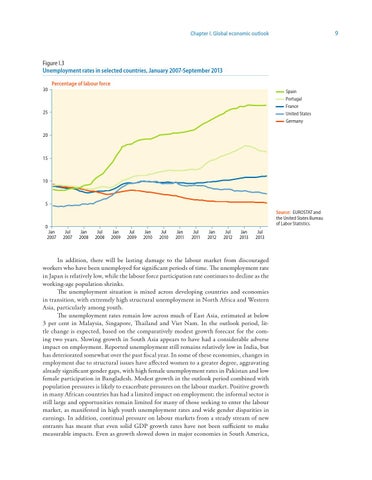
Figure I.3 Unemployment rates in selected countries, January 2007-September 2013 Percentage of labour force 30
Spain Portugal France
25
United States Germany
20
15
10
5
0
Jan 2007
Source:  EUROSTAT and the United States Bureau of Labor Statistics. Jul 2007
Jan 2008
Jul 2008
Jan 2009
Jul 2009
Jan 2010
Jul 2010
Jan 2011
Jul 2011
Jan 2012
Jul 2012
Jan 2013
Jul 2013
In addition, there will be lasting damage to the labour market from discouraged workers who have been unemployed for significant periods of time. The unemployment rate in Japan is relatively low, while the labour force participation rate continues to decline as the working-age population shrinks. The unemployment situation is mixed across developing countries and economies in transition, with extremely high structural unemployment in North Africa and Western Asia, particularly among youth. The unemployment rates remain low across much of East Asia, estimated at below 3 per cent in Malaysia, Singapore, Thailand and Viet Nam. In the outlook period, little change is expected, based on the comparatively modest growth forecast for the coming two years. Slowing growth in South Asia appears to have had a considerable adverse impact on employment. Reported unemployment still remains relatively low in India, but has deteriorated somewhat over the past fiscal year. In some of these economies, changes in employment due to structural issues have affected women to a greater degree, aggravating already significant gender gaps, with high female unemployment rates in Pakistan and low female participation in Bangladesh. Modest growth in the outlook period combined with population pressures is likely to exacerbate pressures on the labour market. Positive growth in many African countries has had a limited impact on employment; the informal sector is still large and opportunities remain limited for many of those seeking to enter the labour market, as manifested in high youth unemployment rates and wide gender disparities in earnings. In addition, continual pressure on labour markets from a steady stream of new entrants has meant that even solid GDP growth rates have not been sufficient to make measurable impacts. Even as growth slowed down in major economies in South America,