5
Chapter I. Global economic outlook
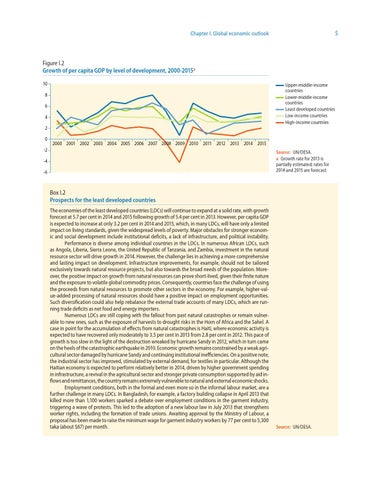
Figure I.2 Growth of per capita GDP by level of development, 2000-2015a 10
Upper-middle-income countries Lower-middle-income countries Least developed countries Low-income countries High-income countries
8 6 4 2 0
2000 2001 2002 2003 2004 2005 2006 2007 2008 2009 2010 2011 2012 2013 2014 2015
-2
Source: UN/DESA. a  Growth rate for 2013 is partially estimated; rates for 2014 and 2015 are forecast.
-4 -6
Box I.2 Prospects for the least developed countries The economies of the least developed countries (LDCs) will continue to expand at a solid rate, with growth forecast at 5.7 per cent in 2014 and 2015 following growth of 5.4 per cent in 2013. However, per capita GDP is expected to increase at only 3.2 per cent in 2014 and 2015, which, in many LDCs, will have only a limited impact on living standards, given the widespread levels of poverty. Major obstacles for stronger economic and social development include institutional deficits, a lack of infrastructure, and political instability. Performance is diverse among individual countries in the LDCs. In numerous African LDCs, such as Angola, Liberia, Sierra Leone, the United Republic of Tanzania, and Zambia, investment in the natural resource sector will drive growth in 2014. However, the challenge lies in achieving a more comprehensive and lasting impact on development. Infrastructure improvements, for example, should not be tailored exclusively towards natural resource projects, but also towards the broad needs of the population. Moreover, the positive impact on growth from natural resources can prove short-lived, given their finite nature and the exposure to volatile global commodity prices. Consequently, countries face the challenge of using the proceeds from natural resources to promote other sectors in the economy. For example, higher-value-added processing of natural resources should have a positive impact on employment opportunities. Such diversification could also help rebalance the external trade accounts of many LDCs, which are running trade deficits as net food and energy importers. Numerous LDCs are still coping with the fallout from past natural catastrophes or remain vulnerable to new ones, such as the exposure of harvests to drought risks in the Horn of Africa and the Sahel. A case in point for the accumulation of effects from natural catastrophes is Haiti, where economic activity is expected to have recovered only moderately to 3.5 per cent in 2013 from 2.8 per cent in 2012. This pace of growth is too slow in the light of the destruction wreaked by hurricane Sandy in 2012, which in turn came on the heels of the catastrophic earthquake in 2010. Economic growth remains constrained by a weak agricultural sector damaged by hurricane Sandy and continuing institutional inefficiencies. On a positive note, the industrial sector has improved, stimulated by external demand, for textiles in particular. Although the Haitian economy is expected to perform relatively better in 2014, driven by higher government spending in infrastructure, a revival in the agricultural sector and stronger private consumption supported by aid inflows and remittances, the country remains extremely vulnerable to natural and external economic shocks. Employment conditions, both in the formal and even more so in the informal labour market, are a further challenge in many LDCs. In Bangladesh, for example, a factory building collapse in April 2013 that killed more than 1,100 workers sparked a debate over employment conditions in the garment industry, triggering a wave of protests. This led to the adoption of a new labour law in July 2013 that strengthens worker rights, including the formation of trade unions. Awaiting approval by the Ministry of Labour, a proposal has been made to raise the minimum wage for garment industry workers by 77 per cent to 5,300 taka (about $67) per month.
Source: UN/DESA.