Spring Summer 2014 E c o n o m i c &
Inequality Matters
A f f a i r s
Built on positive examples of what can work and what has worked in different countries, the Report offers a series of key policy recommendations for consideration, illustrating that countries that have used redistributed fiscal policy measures, developed universal social protection programmes, with emphasis on education and health spending, and those that have increased labour market opportunities for those at the bottom, have better weathered the general trend towards growing within-country inequality. The analysis and policy conclusions contained in the Report seeks to provide useful inputs for the ongoing multi-shareholder consultations to elaborate the post-2015 global development agenda, and serve as a policy-making guide on social-economic issues.
S o c i a l
The 2013 Report on World Social Situation follows the 2005 Report, which warned the world of an inequality predicament causing all to pay the price. The 2013 Report puts greater emphasis on the consequences of high inequality. A unique contribution of the 2013 Report is that it draws special attention to the challenges facing disadvantaged and marginalized social groups, pointing out that inequality is also an issue of social justice. People want to live in societies that are fair, where hard work is rewarded, and where one’s socioeconomic position can be improved regardless of one’s background. However, economic, social, political and cultural inequalities interact, generating persistent disadvantage among members of certain social groups which makes the reduction of inequality a more difficult and complex task. While the Report calls for policy approach to pay attention to the needs of marginalized social groups to achieve equality, it emphasizes that targeted intervention should not become a substitute for universal coverage.
Inequality Matters
The 2013 Report on World Social Situation: Inequality Matters brings attention to inequality, with a particular focus on policies and the disadvantaged social groups. Tracing recent trends, the Report shows that inequality matters not only for people living in poverty, but also for the overall wellbeing of society at large. The Report demonstrates that growing inequality is neither destiny nor a necessary price to pay for economic growth. It examines the experience of some countries that have defied the general trend and have managed to reduce inequality, showing that policies and institutions can make a difference. Domestic policies especially play a crucial role. The Report shows positive examples in some countries in reducing inequalities even under an uncertain and volatile global environment during the latest global economic and financial crises.
Report on the World Social Situation 2013
United Nations publication ST/ESA/345 Sales No. 13.IV.2 ISBN: 978-92-1-130322-3 eISBN: 978-92-1-056503-5
Copyright Š United Nations, 2013 All rights reserved
J040653_cvr.indd 1
Motherhood in Childhood Facing the challenge of adolescent pregnancy
state of world population 2013
United Nations
1/23/14 3:06 PM
Table of Contents Featured Titles. . . . . . . . . . . . . . . . . . . . . .. . . . . . . . . . . . . . . . . . . .2-3 Subjects. . . . . . . . . . . . . . . . . . . .. . . . . . . . . . . . . . . . . . . . . . . . . . .4-31 Environment and Urban Issues . . . . . . . . . . . . . . . . . . . . . . . . .4-5 Economic and Social Studies. . . . . . . . . . . . . . . . . . . . . . . . . . 6-11 Human Rights and Gender Studies. . . . . . . . . . . . . . . . . . . 12-13 International Law/Governance. . . . . . . . . . . . . . . . . . . . . . . 14-17 International Trade. . . . . . . . . . . . . . . . . . . . . . . . . . . . . . . . . . 18-21 Public Health/Population. . . . . . . . . . . . . . . . . . . . . . . . . . . . 22-23 Statistics. . . . . . . . . . . . . . . . . . . . . . . . . . . . . . . . . . . . . . . . . . . . 24-28 United Nations/International Peace and Security. . . . . . . . . .29-31 Digital Products. . . . . . . . . . . . . . . . . . . . . . . . . . . . . . . . . . . . . . . . . . . . . . 32-34 Periodicals. . . . . . . . . . . . . . . . . . . . . . . . . . . . . . . . . . . . . . . . . . . . . . . . . . . . . 35-36 Distributors . . . . . . . . . . . . . . . . . . . . . . . . . . . . . . . . . . . . . . . . . . . . . . . . . . . . . . 37 Index. . . . . . . . . . . . . . . . . . . . . . . . . . . . . . . . . . . . . . . . . . . . . . . . . . . . . . . . . . 38-40 How to Order. . . . . . . . . . . . . . . . . . . . . . . . . . . . . . . . . . . . . . . . . . . . . . . . . . . . . 41
Every effort has been made to ensure that the information in this catalogue is accurate at the time of printing. Prices and dates may occasionally vary and are subject to change without notice. New and forthcoming title information is updated continuously on our website at un.org/publications
F E ATURE D TITL E S
F E ATURE D TITLE S
World Economic and Social Prospects 2014
World Youth Report 2013: Youth and Migration
January 2014 9789211091687 196pp $42.00
July 2014 9789211303254 140pp $40.00
See page 7
See page 10
Human Development Report 2014: Sustaining Human Progress Reducing Vulnerability and Building Resilience
Realizing the Right to Development: Essays in Commemoration of 25 Years of the United NationsDeclaration on the Right to Development
July 2014 9789211263688 216pp $36.00
January 2014 9789211541946 580pp $49.00
See page 10
See page 12
E c o n o m i c &
Annuaire démographique
Demographic Yearbook Annuaire démographique
The Core International Human Rights Treaties
Inequality Matters
The 2013 Report on World Social Situation follows the 2005 Report, which warned the world of an inequality predicament causing all to pay the price. The 2013 Report puts greater emphasis on the consequences of high inequality. A unique contribution of the 2013 Report is that it draws special attention to the challenges facing disadvantaged and marginalized social groups, pointing out that inequality is also an issue of social justice. People want to live in societies that are fair, where hard work is rewarded, and where one’s socioeconomic position can be improved regardless of one’s background. However, economic, social, political and cultural inequalities interact, generating persistent disadvantage among members of certain social groups which makes the reduction of inequality a more difficult and complex task. While the Report calls for policy approach to pay attention to the needs of marginalized social groups to achieve equality, it emphasizes that targeted intervention should not become a substitute for universal coverage. Built on positive examples of what can work and what has worked in different countries, the Report offers a series of key policy recommendations for consideration, illustrating that countries that have used redistributed fiscal policy measures, developed universal social protection programmes, with emphasis on education and health spending, and those that have increased labour market opportunities for those at the bottom, have better weathered the general trend towards growing within-country inequality. The analysis and policy conclusions contained in the Report seeks to provide useful inputs for the ongoing multi-shareholder consultations to elaborate the post-2015 global development agenda, and serve as a policy-making guide on social-economic issues.
A f f a i r s
Nations Unies
63e édition Tableaux de caractère général
13-48973 ISBN: 978-92-1-154202-8
The 2013 Report on World Social Situation: Inequality Matters brings attention to inequality, with a particular focus on policies and the disadvantaged social groups. Tracing recent trends, the Report shows that inequality matters not only for people living in poverty, but also for the overall wellbeing of society at large. The Report demonstrates that growing inequality is neither destiny nor a necessary price to pay for economic growth. It examines the experience of some countries that have defied the general trend and have managed to reduce inequality, showing that policies and institutions can make a difference. Domestic policies especially play a crucial role. The Report shows positive examples in some countries in reducing inequalities even under an uncertain and volatile global environment during the latest global economic and financial crises.
S o c i a l
United Nations
Demographic Yearbook
Inequality Matters
2012 63nd Issue General Tables
The Core International Human Rights Treaties
UNITED NATIONS
Report on the World Social Situation 2013
United Nations publication ST/ESA/345 Sales No. 13.IV.2 ISBN: 978-92-1-130322-3 eISBN: 978-92-1-056503-5
13-36942 ISBN 978-92-1-051106-3 12000
United Nations Nations Unies
9 789210 511063
United Nations
The Core International Human Rights Treaties
United Nations Demographic Yearbook 2012
June 2014 9789211542028 324pp $38.00
March 2014 9789210511063 744pp $120.00
See page 16
See page 22
Copyright © United Nations, 2013 All rights reserved
United Nations
The State of the World’s Children 2014 in Numbers: Every Child Counts - Revealing Disparities, Advancing Children’s Rights
Report World Social Situation 2013: Inequality Matters
J040653_cvr.indd 1
1/23/14 3:06 PM
March 2014 9789211303223 128pp $35.00
March 2014 9789280647310 112pp $15.00
See page 7
See page 12
Spring Summer 2014
4
un.org/publications
Tel: 1 703 661 1571
5
order@un.org
EN V I RO N ME N T AN D URBAN ISSUE S
This publication is the first UN-led effort to make a comprehensive assessment of the state of transboundary surface and groundwater resources in the Middle East. It follows a standardized structure, with eight surface water chapters and 19 groundwater chapters that systematically address hydrology, hydrogeology, water resources development and use, international water agreements and transboundary water management efforts. The chapters cover all rivers and groundwater resources shared between Arab countries in the Middle East and include data on water resources that are shared with Iran, Israel and Turkey. Boasting over 50 new maps and 200 figures, tables and boxes with recent, comprehensive data series, the Inventory provides an up-to-date view of the state and evolution of shared water resources in the region.
This publication is a completely revised, second edition of the popular book of the same title. Aside from being fully updated, this new edition includes the dimension of adaptation to climate change and new risks resulting from climate change. The text provides and combines practical examples from Africa, Asia, the Americas and Europe with theoretical and conceptual frameworks. It is key reading for all those interested in improving risk reduction and adaptation strategies to extreme events and gradual changes in the context of climate change and natural hazards. Measuring vulnerability and evaluating adaptation are essential prerequisites to strengthening the capacities of communities in building resilience through knowledgebased approaches.
October 2013 9789211283617 624pp $90.00
United Nations University
January 2014 9789280812022 460pp $42.00
This publication argues that the development of sustainable urban transport systems requires a conceptual leap. The purpose of ‘transportation’ and ‘mobility’ is to gain access to destinations, activities, services and goods. As a result, urban planning and design should focus on creating cities that focus on accessibility, rather than simply increasing the length of urban transport infrastructure or increasing the movement of people or goods. Urban form and the functionality of the city are therefore a major focus of this report, which highlights the importance of integrated land-use and transport planning.
April 2014 9789280812350 412pp $40.00
Arab Water Development Report 5: Issues in Sustainable Water Resources Management and Water Services
United Nations
This series aims to improve environmental management by recommending ways to achieve better policy implementation in different countries. They cover issues related to policymaking, planning and implementation, the financing of environmental policies and projects, and the integration of environmental concerns into economic sectors. Presented here is the first review for Morocco, the second for Croatia and the third for the Republic of Moldova.
Morocco July 2014 9789211170740 270pp $40.00
Croatia July 2014 9789211170764 240pp $40.00
Republic of Moldova July 2014 9789211170757 240pp $40.00
United Nations
July 2014 9789211283662 96pp $20.00
The Arab Ministerial Water Council (AMWC) took the initiative to establish a regional monitoring mechanism for water and sanitation services that builds upon indicators globally monitored under the UNICEF-WHO Joint Monitoring Program (JMP), and tasked ESCWA to lead its development and implementation. This regional initiative coincides in time, and reflects in context, the recent resolutions of the United Nations General Assembly and the Human Rights Council declaring the right to safe and clean drinking water and sanitation as a human right. This development will in turn influence the orientation of the anticipated water and sanitation target that will be included in the post-2015 development agenda based on the Rio+20 outcome document, “The Future We Want.”
United Nations Development Programme
This book focuses on the rural and urban environments, and the wide-ranging representations of various players’ interacting activities that preserve or destroy these environments. The key issues contemporary to the rural and urban communities include appropriate overall environmental governance involving collaboration and competition among different actors; preservation or creation of a rich and lively living environment, and a search for ways to ensure the inheritance of our greatest assets for following generations. This volume presents current key academic findings, while also considering interactions between humans and nature, such as local resource management through the commons, and rural–urban interdependence.
July 2014 9789211170733 64pp $18.00
United Nations The United Nations Framework Classification for Fossil Energy and Mineral Reserves and Resources 2009 (UNFC-2009) is a universally acceptable and internationally applicable scheme for the classification and reporting of fossil energy and mineral reserves and resources and is currently the only classification in the world to do so. The Specifications, on the other hand, make UNFC-2009 operational. They set out the basic rules that are considered necessary to ensure an appropriate level of consistency in application. It is a strong code that paves the way for improved global communications which will aid stability and security of supplies, governed by fewer and more widely understood rules and guidelines.
Water Governance in the Arab Region: Managing Scarcity and Securing the Future
United Nations University
Spring Summer 2014
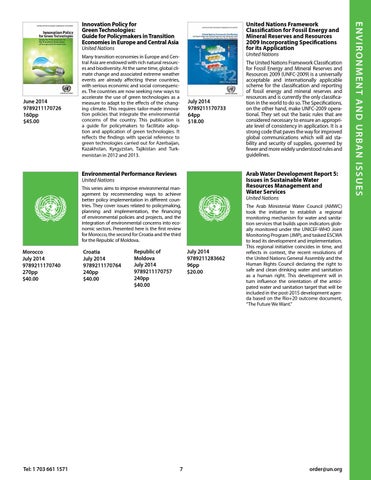
Many transition economies in Europe and Central Asia are endowed with rich natural resources and biodiversity. At the same time, global climate change and associated extreme weather events are already affecting these countries, with serious economic and social consequences. The countries are now seeking new ways to accelerate the use of green technologies as a measure to adapt to the effects of the changing climate. This requires tailor-made innovation policies that integrate the environmental concerns of the country. This publication is a guide for policymakers to facilitate adoption and application of green technologies. It reflects the findings with special reference to green technologies carried out for Azerbaijan, Kazakhstan, Kyrgyzstan, Tajikistan and Turkmenistan in 2012 and 2013.
Environmental Performance Reviews
In this publication, a more comprehensive international regime for the post-Kyoto Protocol world is pursued, based on the experience obtained from the first commitment period set forth in the Protocol. It is through emissions targets set for each country and the policies toward meeting the targets that a de facto low-carbon economy will be constructed. This volume focuses primarily on the following aspects: the role of local government bodies, the selection of domestic policies, the combination of policies, the integration of policies, the political and administrative systems that serve as a basis for policies, the technological innovations related to the policies, and the revenue sources to rebuild infrastructure.
Rural and Urban Sustainability Governance
April 2014 9789280812336 332pp $37.00
June 2014 9789211170726 160pp $45.00
United Nations University
United Nations Human Settlements Programme
United Nations Framework Classification for Fossil Energy and Mineral Reserves and Resources 2009 Incorporating Specifications for its Application
United Nations
Governing Low-Carbon Development and the Economy
Global Report on Human Settlements 2013: Planning and Design for Sustainable Urban Mobility
March 2014 9789211325683 344pp $58.00
Innovation Policy for Green Technologies: Guide for Policymakers in Transition Economies in Europe and Central Asia
This report provides an extensive understanding of the water situation in the Arab region and stimulates discussion on improving water governance. Going beyond the traditional debates on availability, uses and dependency of water resources, the report places the issue in a socioeconomic and environmental context and lays out the building blocks of good water management, including: cost effectiveness analysis as a tool for weighing the options and competing interests involved in complex water decisions; setting up and enabling environments through legislation, regulations and institutions; supporting shifts in patterns of water demand; and creating incentives for investment in more sustainable approaches. Effective water governance systems can serve as catalyst for sustainable human development.
April 2014 9789211263664 184pp $18.00
6
un.org/publications
Tel: 1 703 661 1571
7
order@un.org
E N V IRO N ME N T AN D URBAN IS S UES
United Nations
Measuring Vulnerability to Natural Hazards: Towards Disaster Resilient Societies (Second Edition)
Inventory of Shared Water Resources in Western Asia
EN VECON I R ONO ME N T AN ANDD SO URBAN ISSUEIE SS MIC C IAL STUD
Financing Human Development in Africa, Asia and the Middle East
World Economic Situation and Prospects 2014
This report presents the yearly assessment of global progress towards the Millennium Development Goals (MDGs), determining the areas where progress has been made, and those that are lagging behind. It pinpoints the areas where accelerated efforts are needed to meet the MDGs by 2015. The report is based on a master set of data compiled by the Inter-Agency and Expert Group on MDG indicators led by the Statistics Division of the Department of Economic and Social Affairs of the United Nations.
The world is in the midst of profound social and economic change driven by the dynamic emerging powers of the developing world. The 2013 Human Development Report, “The Rise of the South: Human Progress in a Diverse World” analyzes this phenomenon in detail, examining the development strategies, policies and future prospects of more than 40 developing nations that experienced remarkably strong human development gains over the past two decades. This publication is the companion volume to the 2013 Report. It is an edited collection of nine original research papers commissioned during the writing of the 2013 report from some of the world’s most eminent economists, demographers and social scientists, representing different yet complementary disciplines in the field of human development.
This book assesses feasible financing strategies for policymakers to follow in pursuance of human development, taking as reference the United Nations’ Millennium Development Goals (MDGs) and their achievement by 2015. These strategies are analyzed in the context of broader concerns of economic development with special reference to nine countries from Africa, Asia and the Middle East; that is, how to make macroeconomic policies support more effectively sustained growth while reducing widespread poverty and inequalities and other human development gaps in low- and middle-income countries, especially in times of global economic crises or external shocks. This book adds new evidence regarding the social deficits in these countries and suggests policy options to overcome them.
The World Economic Situation and Prospects (WESP) is the definitive report of the United Nations on the state of the world economy. One of the most highly anticipated economic reports from the United Nations, it is jointly produced by the Department of Economic and Social Affairs, the United Nations Conference on Trade and Development and the five United Nations Regional Commissions.
United Nations
September 2013 9789211012842 64pp $15.00
October 2013 9789211263657 376pp $25.00
Alternative Development Strategies for the Post-2015 Era The global economic crisis of 2008-2009 exposed systemic failings at the core of economic policymaking worldwide. The crisis came on top of several other crises, including skyrocketing and highly volatile world food and energy prices and climate change. This book argues that new policy approaches are needed to address such devastating global development challenges and avoid the potentially catastrophic consequences to livelihoods worldwide likely resulting from present approaches. The contributors to the book aim to identify a development strategy capable of promoting a broad-based economic recovery, guaranteeing social equity and environmental sustainability both within countries and internationally. This new development approach seeks to promote the reforms needed to improve global governance, providing a more equitable distribution of global public goods.
Spring Summer 2014
Although migration was not factored into the Millennium Development Goals (for which the target date nears in 2015), it plays an integral role in the most crucial development questions facing the world today, including: how to generate inclusive growth and create employment for a growing world population; how to manage new global risks, such as vulnerability to shocks and disasters, and adaptation to climate change; and how to mobilize financing for development in a world of decreasing aid budgets. This publication gathers recent research findings outlining the links between migration and development and proposing how migration can best be factored into the future development framework, offering a timely contribution to the argument for migration’s inclusion in the coming development agenda.
United Nations
This report argues that for African countries to reap developmental gains from intra-African trade and regional integration, they need to place the building of productive capacities and domestic entrepreneurship at the heart of the policy agenda for boosting intra-regional trade. It also analyzes the range of strategies and complementary policies that will be needed, besides trade policies, to ensure that regional integration enhances African enterprise development and economic development in general. It explores, among others, the role of national and regional industrial policy and the scope for developing regional development corridors. Lessons are drawn from other developmental regional experiences.
November 2013 9789211128666 154pp $28.00
8
un.org/publications
January 2014 9789211128697 134pp $38.00
Job Name:1737273 Color: Cyan
E c o n o m i c &
The 2013 Report on World Social Situation: Inequality Matters brings attention to inequality, with a particular focus on policies and the disadvantaged social groups. Tracing recent trends, the Report shows that inequality matters not only for people living in poverty, but also for the overall wellbeing of society at large. The Report demonstrates that growing inequality is neither destiny nor a necessary price to pay for economic growth. It examines the experience of some countries that have defied the general trend and have managed to reduce inequality, showing that policies and institutions can make a difference. Domestic policies especially play a crucial role. The Report shows positive examples in some countries in reducing inequalities even under an uncertain and volatile global environment during the latest global economic and financial crises. The 2013 Report on World Social Situation follows the 2005 Report, which warned the world of an inequality predicament causing all to pay the price. The 2013 Report puts greater emphasis on the consequences of high inequality. A unique contribution of the 2013 Report is that it draws special attention to the challenges facing disadvantaged and marginalized social groups, pointing out that inequality is also an issue of social justice. People want to live in societies that are fair, where hard work is rewarded, and where one’s socioeconomic position can be improved regardless of one’s background. However, economic, social, political and cultural inequalities interact, generating persistent disadvantage among members of certain social groups which makes the reduction of inequality a more difficult and complex task. While the Report calls for policy approach to pay attention to the needs of marginalized social groups to achieve equality, it emphasizes that targeted intervention should not become a substitute for universal coverage. Built on positive examples of what can work and what has worked in different countries, the Report offers a series of key policy recommendations for consideration, illustrating that countries that have used redistributed fiscal policy measures, developed universal social protection programmes, with emphasis on education and health spending, and those that have increased labour market opportunities for those at the bottom, have better weathered the general trend towards growing within-country inequality. The analysis and policy conclusions contained in the Report seeks to provide useful inputs for the ongoing multi-shareholder consultations to elaborate the post-2015 global development agenda, and serve as a policy-making guide on social-economic issues.
Inequality Matters
A f f a i r s
International Organization for Migration
The Least Developed Countries Report 2013: Growth with Employment for Inclusive and Sustainable Development
Report on the World Social Situation 2013
United Nations publication ST/ESA/345 Sales No. 13.IV.2 ISBN: 978-92-1-130322-3 eISBN: 978-92-1-056503-5
Copyright © United Nations, 2013 All rights reserved
United Nations
J040653_cvr.indd 1
1/23/14 3:06 PM
March 2014 9789211303223 128pp $35.00
United Nations
This publication contributes a nuanced appraisal of the potential role and value of cloud computing in developing and transition economies. It does so by looking at the current status of the cloud economy in developing countries, potential impacts and, building on these, elaborates on policy and regulatory approaches to facilitate adoption and use of the cloud in order to maximize gains from it. This is the first time a United Nations Secretariat report examines the implications of cloud computing for developing countries.
S o c i a l
Economic Development in Africa Report 2013: Intra-African Trade - Unlocking Private Sector Dynamism
January 2014 9789211091687 196pp $42.00
United Nations
This book analyzes the policies required to improve the perspectives of sustainable regional growth. It reviews the links between economic growth, investment and employment, as well as the fiscal and monetary policies, and industrial, trade and social policies relevant for short and long-term growth. Special attention is given to regional key issues such as structural heterogeneity, the high levels of inequality and the challenges of environmental sustainability. Additionally, the region’s economic evolution during the first semester of 2013 is analyzed in this survey.
October 2013 9789211218336 210pp $50.00
United Nations
Information Economy Report 2013: The Cloud Economy and Developing Countries
United Nations
Migration and the United Nations Post-2015 Development Agenda
October 2013 9789290686811 140pp $20.00
December 2013 9781780932200 328pp $38.00
Economic Survey of Latin America and the Caribbean 2013: Three Decades of Uneven and Unstable Growth
United Nations
October 2013 9781472523259 456pp $38.00
United Nations
United Nations Development Programme
Tel: 1 703 661 1571
January 2014 9789211128642 150pp $50.00
PDF Page:1737273pbc.p1.pdf Date:13-12-05 Magenta Yellow Black
Report on the World Social Situation 2013: Inequality Matters
Industrial Development Report 2013: Sustaining Employment Growth The Role of Manufacturing and Structural Change
United Nations
United Nations Industrial Development Organization
The 2013 report examines key drivers of inequality that have emerged in the recent past and the impact of rising inequality. It examines trends in social, economic and spatial inequalities and assesses why inequality matters in order to propose policy solutions to this persistent problem, paying particular attention to the potential role of empowerment and participation. The report highlights inequalities within and across countries and shows the cumulative, mutually-reinforcing effects these inequalities have on the systematic lack of participation and disadvantage of some social groups and on the intergenerational transmission of poverty. It discusses the role of economic and political institutions in promoting participation and empowerment.
This publication analyses the employment challenge of the Least Developed Countries (LDCs). Demographic projections indicate that around 225 million people in LDCs will be entering the labour force until 2030. Hence, creating sufficient and decent employment opportunities for all will be a real challenge. However, recent experience shows that the link between growth and employment in LDCs is not automatic. The LDC Report 2013 aims to raise awareness and galvanize the attention of policymakers to the magnitude of the problem. It also reviews and analyses recent labour market performance of the LDCs, compares it with the future needs in relation to job creation, and elaborates concrete policy recommendations for growth with employment.
March 2014 9789211064513 250pp $57.00
9
This book explores the underlying drivers of structural change in manufacturing. While manufacturing employment is growing in developing countries, its decrease in developed countries is being mitigated by the rise in manufacturing-related services employment. The food and beverages and textiles and garments industries offer least developed countries potential for industrialization, whereas high-tech industries hold numerous opportunities for developed countries to invest and innovate and to thus sustain jobs. The impact of the critical drivers of structural change and industrialization to sustain employment hinges on the industrial policies adopted, and will only be effective if the policy-making process plays as important a role as the policy content.
order@un.org
E CO N O MIC AN D SO C IAL ST UD I ES
Human Progress and the Rising South
Inequality Matters
The Millennium Development Goals Report 2013
EN VECON I R ONO ME N T AN ANDD SO URBAN ISSUEIE SS MIC C IAL STUD
Transition Management for Sustainable Development
Redistributing Care: The Policy Challenge
This book aims firstly to examine the implications of the idea of sustainable development for institutional and policy designs. Secondly, it aims to clarify the political, social and economic conditions for successful sustainability transitions, by means of the detailed empirical analysis of a host of challenging social experiments for sustainable development. Finally, it searches for, and formulates, a viable theory of transition management for sustainable development.
This publication offers a representative sample of the thinking developed over recent years in relation to time use, time-use measurement and related policies in Latin America. The issue of care and its importance and meaning have become part of the gender agenda in the region, especially since the tenth session of the Region Conference on Women in Latin America and the Caribbean, held in Quito in 2007.
United Nations University
Ed i t Ed by
Kazuhiro uEta yuKio adachi
March 2014 9789280812343 376pp $38.00
United Nations
April 2014 9789212210629 420pp $35.00
Survey of Economic and Social Developments in the Arab Region 2012-2013
April 2014 9789211283631 112pp $25.00
2/19/14 9:27 AM
United Nations
Compendium of Innovative Practices of Citizen Engagement for Public Accountability through Supreme Audit Institutions
This publication assesses the most recent economic and social developments in Arab countries, using the data that became available by the 2nd quarter of 2013. The immediate policy challenge for most of the Arab countries is to create employment without relying on an expansionary fiscal and monetary policy mix. The Survey finds that several policy options are available for this policy challenge even in the current highly uncertain situation surrounding the region’s socioeconomic development. In parallel to the specific policy proposals, the Survey emphasizes the importance of policy dialogue in the area of employment and more constructive regional integration framework on this subject.
This publication provides an overview of successful examples and innovations in the engagement of citizen in public accountability processes through Supreme Audit Institutions. The purpose of this book is to disseminate, through comparative case studies and analysis, and conceptual framework, information about innovative and successful practices. Learning more about how Supreme Audit Institutions from around the world have successfully collaborated with citizens and civil society groups in the audit of how public resources are allocated and spent can be a powerful and inspirational tool for those engaged in improving public accountability.
April 2014 9789211231953 110pp $35.00
Spring Summer 2014
10
un.org/publications
This publication is based on highlights of the discussion held by the UN Committee of Experts on Public Administration, in 2013, on “The Role of Responsive and Accountable Public Governance in achieving the Millennium Development Goals (MDGs) and the Post-2015 Development Agenda,” which observed that responsive and accountable governance, including effective, responsive and accountable public administration, is key in accelerating the progress on the MDGs and in the implementation of the post-2015 development agenda. It also encompasses research and analysis of the United Nations Public Administration Country Studies on themes such as codes of conduct, information and communication technologies in the work of e-government, and citizen engagement for public policy definition and development management planning.
May 2014 9789211615753 220pp $35.00
May 2014 9789211615791 150pp $52.00
United Nations
The System of Environmental-Economic Accounting 2012 - Applications and Extensions (SEEA Applications and Extensions) provides potential compilers and users of SEEA-based environmental-economic accounts with material to show how this information can be used in decision-making, policy review and formulation, analysis and research. This publication on SEEA Applications and Extensions provides a bridge between compilers and analysts allowing each to recognise both the potential uses and the related measurement considerations. It is a companion document to the SEEA Central Framework which was adopted as the initial international statistical standard for environmental – economic accounting in 2012.
May 2014 9789211251227 250pp $60.00
Tel: 1 703 661 1571
For millions of Africans, growth is yet to translate into jobs and better living conditions. Africa’s largely commodity-driven growth has not been matched by the much needed structural change that can lead to economic transformation, employment, and reduced poverty. Market failures necessitate industrial policy interventions. Yet, in the absence of the right processes and institutions, good industrial policies will fail. Indeed, weak institutions and poor policy design have hindered industrial policy. This report gives a framework for getting the policy process right to foster industrialization. It uses 11 country case studies to assess the critical ingredients for spurring industrialization – innovative institutions, effective processes and flexible mechanisms – and structural transformation.
Compendium of Innovative E-government Practices: Volume V
Economic and Social Survey of Asia and the Pacific 2014
As information and communication technologies (ICTs) are dramatically changing the lives of people around the world, governments must come to grips with finding solutions that will increase public value to their citizens. This publication creates a venue for promoting innovative e-government solutions, services and products developed by public institutions across the world. It also enables South-South and North-South information-sharing of their respective experiences and innovative practices. In both cases, the focus is on hastening innovation and creating public value for the citizenry. It covers a wide range of innovative practices, such as citizens service delivery, e-participation, information access, e-health, crisis management, e-accounting, e-commerce, e-environment, gender equality, sustainable development, open government data, and so much more.
The Survey 2014 examines the region’s challenges to support its economic growth and to promote inclusive and sustainable development. Part I of the report focuses on the region’s outlook as it contends with the ongoing global economic uncertainty and assesses the region’s policy response to remaining and emerging vulnerabilities. It also examines the role of sustainable agriculture in closing the development gaps in least developed countries. A special theme is domestic resource mobilization in the region, which explores the challenges on strengthening tax revenues. Part II of the report discusses strategic approaches to strengthen regional connectivity to achieve shared prosperity, particularly the ways in which various networks facilitate trade, production networks and investment flows within the region.
United Nations
June 2014 9789211232004 240pp $50.00
The System of Environmental-Economic Accounting (SEEA)-Experimental Ecosystem Accounting provides a synthesis of the current knowledge in the area of ecosystem accounting. This publication on the SEEA provides a starting point for the development of ecosystem accounting at national and sub-national levels. It represents an important step forward on ecosystem accounting, providing a common set of terms, concepts, accounting principles and classifications; an integrated accounting structure of ecosystem services and ecosystem condition in both physical and monetary terms; and the recognition of spatial areas as forming the basic focus for measurement.
Economic Report on Africa 2014: Dynamic Industrialization in Africa Innovative Institutions, Effective Processes and Flexible Mechanisms
United Nations
This book provides a concise yet comprehensive summary of the proceedings that take place at the annual global internet governance gatherings. It includes edited transcripts of all of the main sessions that took place during the meeting held in Baku, Azerbaidjan, and the reports of the workshops and other events that were submitted. The theme of the forum for the seventh meeting was ‘Internet Governance for Sustainable Human, Economic and Social Development’. As per standard IGF practice, the entire meeting was webcasted and the possibility of remote participation was offered, which doubled the active participation in both main sessions and workshops and other events.
May 2014 9789211231977 500pp $38.00
United Nations
System of Environmental-Economic Accounting 2012: Applications and Extensions
United Nations
This publication is to understand why countries in the Asia and Pacific region were significantly less affected by the global financial crisis than the world’s most advanced economies of Europe and the United States, and what are the main lessons from their experience for building resilience from future crises. The majority of the essays collected in this volume are revised and updated versions of papers presented by experts from the region at a conference organized by the Economic and Social Commission of Asia and the Pacific in Manila in September 2011.
May 2014 9789211231960 60pp $22.00
Internet Governance for Sustainable Human, Economic and Social Development
United Nations
System of Environmental-Economic Accounting: Experimental Ecosystem Accounting
United Nations
United Nations
Asia-Pacific Economies after the Global Financial Crisis: Lessons Learnt and the Way Forward
May 2014 9789211206630 200pp $30.00
World Public Sector Brief 2013: Responsive and Accountable Governance for the Post-2015 Development Agenda
United Nations
June 2014 9789211206753 300pp $85.00
11
order@un.org
E CO N O MIC AN D SO C IAL ST UD I ES
Multilevel Environmental Governance for Sustainable Development
TransiTion ManageMenT for susTainable DevelopMenT
EN VECON I R ONO ME N T AN ANDD SO URBAN ISSUEIE SS MIC C IAL STUD
Financing for Overcoming Economic Insecurity
United Nations
UNITED NATIONS
July 2014 9789211303254 140pp $40.00
United Nations
The World Youth Report 2013 focuses on the topic of youth and migration. It delivers a synopsis of the basic facts on youth migration and development discussing who is migrating, where they are coming from, where they are going to and why. The report looks at the entire process involved in migration including the planning and preparations and the drivers behind the decisions that young people make. It examines the impact migration has on young people – those on the move as well as those who have been left behind - their experiences in transit and the lives of migrants in their destination countries and the challenges they face. First-hand experiences of youth are woven into the report, adding another dimension to the material covered.
July 2014 9781849665346 256pp $38.00
July 2014 9789212211190 228pp $35.00
The 2013 edition of this publication presents official measurements for the analysis of income poverty and seeks fresh approaches to poverty and well-being, placing special emphasis on multidimensional approaches. These approaches are exploratory and therefore not comprehensive. They have nevertheless been tackled in this year’s edition of Social Panorama because one thing is certain: the need is emerging in social policy design, in the evaluation of social development and in new demands of society for a more nuanced analysis of social progress and lags to underpin more integrated public policy design in the region.
The focus of this publication is on technological innovation for social development, with a particular focus on ageing, civil society, disability, poverty, indigenous, social protection, social entrepreneurship and youth employment. It offers a fair perspective on the role of innovation and technology in promoting social development and its impact on social groups. Governments, civil society, academic institutions and the private sector need to raise awareness and promote good practices in this emerging area. This publication is organized in eight chapters that present how innovation and technology can be utilized to promote social development. The overview chapter highlights in a holistic way why innovation and technology are becoming drivers for social change and how they can empower people, especially social groups.
July 2014 9789211303230 172pp $20.00
Human Development Report 2014: Sustaining Human Progress - Reducing Vulnerability and Building Resilience
United Nations
The 2013 edition of this publication reviews the main features of a persistently weak global economy and world trade and then turns to global and regional trade trends and prospects. The publication considers the main changes in the organization of production and global trade associated with international production networks, which are at the heart of current megaregional negotiations. It looks at how the the region’s countries are positioned in international production networks and value chains. It analyzes the main factors underpinning participation in production networks and value chains, as well as the implications they have for integration.
July 2014 9789211218398 92pp $20.00
This publication highlights a regional slowdown in GDP growth. It argues that the currency depreciation seen in several countries in the region could, if sustained, increase incentives for investment in tradeable sectors other than the region’s traditional exports (commodities), while redirecting expenditure to ease pressure on the current account. Growth-supporting industrial, trade, environmental, social and labour policies that take into account the needs of small and medium-sized enterprises, could help lessen the region’s structural heterogeneity. Growth combined with greater equality would thus gain economic and social sustainability, with greater reliance from investment and exports than before. It is argued that this combination would be aided by social covenants for investment.
United Nations
This report aims to revive the project of Arab integration conferring a new dimension to the concept of integration to include all aspects of social structure and civilization. It also calls for expanding economic integration beyond the narrow scope of trade liberalization to laying out the foundations for production and diversification. It argues for building knowledge-based economies through cooperation in the development of integrated human, technological and productive capacities in the Arab region. Using the best available scientific methods, this report presents standard quantitative estimates of the consequences of keeping current modalities of integration, which are limited to trade liberalization and the establishment of an Arab customs union.
Latin America and the Caribbean in the World Economy 2012-2013
Spring Summer 2014
United Nations
Innovation and Technology for Social Development
United Nations
July 2014 9789212211169 122pp $28.00
Social Panorama of Latin America 2013
United Nations
Despite the rise in recent decades in the average income level, economic insecurity has also increased. True for both developing and developed countries, this increase of economic insecurity is harmful for human welfare for several reasons. Job and income insecurity directly affect the material and psychological well-being of people. Economic volatility and high uncertainty also tend to exert negative influence on productive investment, thereby hurting long-term development. This book sheds light on the causes of economic insecurity and how better functioning financial systems, more effective macroeconomic policies and extended micro-financing schemes could mitigate the degree of economic insecurity and overcome many of its negative consequences.
Arab Integration Report
July 2014 9789211283655 250pp $50.00
Preliminary Overview of the Economies of Latin America and the Caribbean 2013
United Nations Development Programme Over the last decades, most countries have improved levels of human development. But progress maybe slowing as uncertainty intensifies globally. This report examines vulnerabilities that endanger human development, focusing especially on the poorest. Most threats are structural and persistent and linked with life cycle vulnerabilities. Identifying policy measures to reduce threats and increase human resilience is therefore a high priority. The report sets out synergistic proposals including universal public provisioning of basic services over the life cycle to maintain and strengthen human capabilities, full employment and social protection policies. It highlights collective action and international cooperation to address global vulnerabilities and ensure sustainable progress.
July 2014 9789211263688 216pp $36.00
12
un.org/publications
Tel: 1 703 661 1571
13
order@un.org
E CO N O MIC AN D SO C IAL ST UD I ES
World Youth Report 2013: Youth and Migration
HUMA N RIGHTS AN D GE N D E R STUD IE S
Championing Children’s Rights: A Global Study of Independent Human Rights Institutions for Children
United Nations
December 2010 9789211012293 20pp $2.00
Independent institutions bring an explicit child focus to traditional adult-oriented governance systems. Acting as direct mechanisms for accountability, they fill gaps in checks and balances making sure that the impact of policy and practice on children’s rights is understood and recognized. At a time of global economic uncertainty inequities between rich and poor are widening, and in defining what sustainable and equitable goals should come after, these institutions are key players in promoting systems that are effective in delivering results for children.
October 2013 9788889129876 344pp $35.00
December 2010 9789211012309 Set of 100 $150.00
Realizing the Right to Development: Essays in Commemoration of 25 Years of the United Nations Declaration on the Right to Development
January 2014 9789211541946 580pp $49.00
This book is devoted to the 25th anniversary of the United Nations Declaration on the Right to Development. It contains a collection of analytical studies of various aspects of the right to development, which include the rule of law and good governance, aid, trade, debt, technology transfer, intellectual property, access to medicines and climate change in the context of an enabling environment at the local, regional and international levels. It also explores the issues of poverty, women and indigenous peoples within the theme of social justice and equity. The book considers the strides that have been made over the years in measuring progress in implementing the right to development and realizing that right.
Spring Summer 2014
Inequality has emerged as a major source of concern for those who find it unacceptable that poverty should persist in a world of plenty. Reducing inequality is needed – first and foremost – in order to fulfill people’s universal aspiration to dignity and respect. But there are also more instrumental reasons to address excessive and growing inequalities as high levels of inequality are detrimental to economic growth. However, the experience of many countries that have managed to significantly reduce gaps in human well-being over the last decade shows that political space for resolute action can be created. This Report represents an important contribution to this debate and will assist policy makers in identifying pathways towards greater social justice, prosperity and sustainability.
July 2014 9789211232011 170pp $38.00
The Convention on the Rights of Persons with Disabilities: A Training Guide
Racism and racial discrimination hinder progress and cause suffering for millions of people in all countries around the world. Lasting improvements to counter racial discrimination at the national level require political will and a sustained and comprehensive approach. This publication is a tool for national human rights institutions (NHRIs), non-governmental organizations (NGOs), as well as individuals and groups affected by racial discrimination. It focuses on the need for comprehensive strategies and policies in the fight against racial discrimination, provides background information on the concept of national human rights action plans, and describes in detail the different phases for producing a national action plan with examples on how to set realistic objectives, clear targets and specific goals.
The premise of this report is that most humanitarian crises are to some extent predictable and preventable. With new and old risks increasing the pressure on the international humanitarian system, it looks at ways in which the system can be improved and transformed to better anticipate, prevent and manage crises.
This publication challenges customs and behaviour based on stereotypes, prejudices, harmful practices and stigma relating to persons with disabilities, and promotes their full participation in all spheres of life. It is already applicable in 137 countries around the world. The Training Guide’s methodology is interactive and promotes a participatory approach. Its modules can be used to develop tailored training courses to meet the needs of specific audiences (government officials, health professionals, civil society, employers’ organizations, etc.). It is also helpful as a general information resource on the Convention and its Optional Protocol.
April 2014 9789211320398 56pp $18.00
July 2014 9789211542035 140pp $25.00
un.org/publications
Tel: 1 703 661 1571
This publication provides a toolkit to assess national e-Government readiness for gender equality and women’s empowerment, and generate an e-government readiness index for gender equality. Through further data collection and research, this publication includes more gender-sensitive approaches in e-Government development and assessment. This is one of the first comparative, significant, and analytical attempts to discuss gender equality and women’s empowerment in relation to current e-Government development. It also serves as a tool to assess and guide policies and strategies, suggesting steps to formulate a national action plan to carry out e-Government initiatives for greater gender inclusion.
Transitional Justice and Economic, Social and Cultural Rights United Nations
United Nations
United Nations
United Nations
July 2014 9789210580106 DVD $50.00
Saving Lives Today and Tomorrow: Managing the Risk of Humanitarian Crises
14
From Promoting Gender Equality to Empowering Women: Role of E-Government in Asia and the Pacific
This compilation is part of the tribunal legacy and contains all ICTR jurisprudence since 1995. The DVD-Rom is offered as a reference tool search for legal professionals, law students, historians, and general public to access indictments, decisions and orders, judgements and other relevant resources produced by the Tribunal.
Developing National Action Plans against Racial Discrimination: A Practical Guide
April 2014 9789211263671 280pp $42.00
International Criminal Tribunal for Rwanda
This special edition of The State of the World’s Children highlights the critical role data and their monitoring can play in the realization of children’s rights. The gathering, analysis, dissemination and monitoring of reliable data are fundamental to upholding children’s rights around the globe. The pursuit and refinement of data collection is a real driver for change. It opens up possibilities by identifying needs, supporting human rights advocacy, gauging progress and holding those in positions of authority to account. What matters most, it is argued, is that decision-makers use the data to garner momentum for positive change. The publication also calls for greater targeted investments and efforts in order to advance the lives of children in many parts of the world.
March 2014 9789280647310 112pp $15.00
This publication presents global and countrylevel data and trend analysis relevant to humanitarian assistance. Its purpose is to bring this information together in one place and present it in an accessible way. It is intended to establish a common baseline of humanitarian data that allow for comparisons across time. This data can be used to help support humanitarian policy decisions and provide country-level context that can support operational decision-making.
United Nations Development Programme
Basic Documents and Case Law 1995-2013
United Nations Children’s Fund
United Nations
April 2014 9789211541991 72pp $18.00
April 2014 9789211320404 56pp $18.00
The State of the World’s Children 2014 in Numbers: Every Child Counts - Revealing Disparities, Advancing Children’s Rights
United Nations
Humanity Divided: Confronting Inequality in Developing Countries
United Nations
UNICEF Innocenti Research Centre
The Universal Declaration of Human Rights, adopted by the United Nations General Assembly on 10 December 1948, is the first international agreement setting out freedoms, rights and entitlements for all humanity to claim. It emphasizes the inextricable relationship between fundamental freedoms and social justice, and their connection with peace and security.
World Humanitarian Data and Trends 2013
July 2014 9789211542042 38pp $15.00
15
The failure to fulfil economic, social and cultural rights and the outright violation of these rights are often at the root of conflict. Furthermore, the actions and omissions by States and non-State actors during conflict can also amount to violations of economic, social and cultural rights, and particularly affect the most vulnerable. Yet, there has been no widespread move in transitional justice processes to examine the root causes of the conflict or to look into violations of economic, social and cultural rights. The Office of the United Nations High Commissioner for Human Rights has explored in greater depth the ways in which transitional justice processes have addressed or could address violations of economic, social and cultural rights. This publication presents the outcome of that work.
order@un.org
HUMAN RIGHTS AN D GE N D E R S T U D I ES
Universal Declaration of Human Rights: Dignity and Justice for All of Us
EN I R ON ME NNTAL ANLD URBANE ISSUE SE I NV T ER N ATIO AW/GOV RN AN C
Globally Harmonized System of Classification and Labelling of Chemicals (GHS): Fifth Revised Edition
United Nations
June 2013 9789211391466 844pp $160.00
This publication covers the classification of dangerous goods and their listing, the use, construction, testing and approval of packagings and portable tanks, and the consignment procedures. They aim at ensuring a high level of safety by preventing accidents to persons and property and damage to the environment during transport. This revised edition contains new and revised provisions concerning, inter alia: classification of solid oxidizing substances; transport of absorbed gases; lithium batteries; asymmetric capacitors; discarded packagings; ammonium nitrate and radioactive material; testing of gas cartridges and fuel cell cartridges; marking of bundles of cylinders; and the applicability of ISO standards to the manufacture of new pressure receptacles.
This publication addresses classification and labelling of chemicals by types of hazards and provides the basis for worldwide harmonization of rules and regulations used in various sectors. It aims at enhancing the protection of human health and the environment during the handling, transport and use of these chemicals by ensuring that the information about their physical, chemical and environmental hazards is available. The fifth revised edition includes a new test method for oxidizing solids, new miscellaneous changes to further clarify the criteria for the hazard classes skin corrosion/irritation, severe eye damage/irritation and aerosols; revised and simplified classification and labelling summary tables; a new codification system for pictograms and revised and further rationalized precautionary statements.
June 2013 9789211170672 536pp $115.00
African Governance Report III: Elections and the Management of Diversity
United Nations Practical Manual on Transfer Pricing for Developing Countries
This report is the most comprehensive report yet on governance in Africa. It assesses and monitors the progress African countries are making on governance; identifies capacity gaps in governance institutions, and proposes policies and strategic interventions aimed at promoting good governance on the continent. It focuses on political and economic governance, development of the private sector and corporate governance, checks and balances in political power, institutional effectiveness and accountability of the executive, human rights and the rule of law, corruption and institutional capacity building. The theme of this edition revolves around elections in Africa becoming a significant tool for political change and genuine democratization.
This publication responds to the need expressed by developing countries for clearer guidance on the policy and administrative aspects of applying transfer pricing analysis to some of the transactions of multinational enterprises (MNEs) in particular. Such guidance should not only assist policy makers and administrators in dealing with complex transfer pricing issues, but should also assist taxpayers in their dealings with tax administrations. Without an effective response to transfer pricing issues, profits earned in one jurisdiction might appear to be shifted to another jurisdiction. This may have the net effect of minimizing tax revenues in a country where economic activity of the MNE takes place, and therefore the ability to finance the country’s development.
United Nations Handbook on Selected Issues in Administration of Double Tax Treaties for Developing Countries
Spring Summer 2014
April 2014 9789211170696 350pp $55.00
Asian countries have introduced major reforms and new institutional mechanisms to promote the engagement of elected local governments, civil society and the private sector. This book attempts to examine emerging issues in democratic local governance and factors that influenced the impetus for and the substance of reforms. It asks: What have been challenges in designing and implementing decentralization policies and programs? What are the constraints on strengthening citizen participation? What is the impact of reforms to promote gender and rights perspectives in local governance? What is the role of local government in service delivery and access? How effective have the mechanisms for accountability and transparency in local governance been? What are the driving forces influencing democratic local governance reform?
January 2014 9789280812329 388pp $38.00
16
un.org/publications
This state-of-the-art volume on local governance, decentralization and local democracy summarizes original research conducted in the last decade. It is a future-looking volume with explicit policy relevance, that paves the way for innovative thinking (and acting) related to development in the field. From a theoretical perspective it adjoins top–down and bottom–up rationalities, which are illustrated by a variety of case studies. The case studies are selected for their relevance to the current global evolution of decentralized policies and politics. This volume concludes that local politics have a huge potential that needs to be explored. It gives valuable insights into how this can be achieved.
January 2014 9781780932316 256pp $38.00
The Aarhus Convention is an international legally binding instrument giving the public the rights of participation in decision making, access to information and justice regarding the environment. These rights were emphasized in the outcome document of the Rio+20 UN Conference on Sustainable Development. The Convention’s twin protections for environmental and human rights, and its focus on involving the public, provide a mechanism for holding governments to account in their efforts to address the multidimensional challenges facing our world today, including climate change, biodiversity loss, poverty reduction, increasing energy demands, rapid urbanization, and pollution. The Guide is designed for policy-makers, legislators, NGOs, academics and civil society.
United Nations
April 2014 9789211338164 340pp $49.00
Tel: 1 703 661 1571
This series contains summaries of judgments, advisory opinions and orders of a substantive nature issued by the International Court of Justice, the principal judicial organ of the United Nations. The present volume includes summaries of all the judgments, advisory opinions and orders issued by the Permanent Court of International Justice, the predecessor of the International Court of Justice. From 1922 to 1946, the Permanent Court dealt with 29 contentious cases and delivered 27 advisory opinions, thus participating in the settlement of numerous international disputes and contributing to the development of international law. The decisions summarized in the present volume have played and continue to play an important role in understanding the jurisprudence of the International Court of Justice.
United Nations Commission on International Trade Law (UNCITRAL): Yearbook 2010
UNCITRAL Legislative Guide on Insolvency Law, Part Four: Directors’ Obligations in the Period Approaching Insolvency
The United Nations Commission on International Trade Law (UNCITRAL) is the core legal body of the United Nations system in the field of international trade law. It specializes in the modernization and harmonization of rules on international business. The Commission is composed of 60 Member States elected by the General Assembly. This Yearbook reproduces the substantive documents prepared each year for the Commission and its working groups. It also includes the annual report of the Commission, meeting records, General Assembly resolutions and Sixth Committee reports related to UNCITRAL’s work, as well as a bibliography of recent scholarly writings examining the legal texts prepared by UNCITRAL.
This book focuses on the obligations regarding management of an enterprise when it faces imminent insolvency or insolvency becomes unavoidable. The aim of imposing such obligations, which become enforceable once insolvency proceedings commence, is to protect the legitimate interests of creditors and other stakeholders and encourage timely action to address financial distress and minimize its effects. This publication addresses the key elements of provisions imposing such obligations, as well as the nature of the obligations, the time at which the obligations should arise, the persons to whom the obligations would attach, and related issues.
United Nations
April 2014 9789211338157 CD $80.00
This publication provides ideas on overcoming deficiencies in the ongoing process of globalization and in existing mechanisms for global economic governance. Promising directions for reform include: strengthening government capacities for formulating and implementing national development strategies; ensuring that official development assistance is aligned with national priorities; strengthening the international trade and financial systems so countries with limited capabilities can integrate into the global economy; and creating new mechanisms for dealing with deficiencies. The authors do not offer a blueprint, but aim at presenting ideas to become the basis for guiding development policies and international cooperation.
Summaries of Judgments, Advisory Opinions and Orders of the Permanent Court of International Justice
United Nations
United Nations University
Double tax treaties play a key role in the context of international taxation, by reducing or eliminating double taxation over cross-border income, thus encouraging international investment and global economic growth, and by enhancing cooperation among tax administrations, especially in tackling international tax evasion and avoidance. This publication, which is designed especially for developing countries, aims at providing practical guidance to effectively implement double tax treaties and, in particular, those drawing upon the United Nations Model Double Taxation Convention between Developed and Developing Countries. Primary audiences are officials of national tax authorities and other tax professionals, the general public, media and universities.
United Nations
The Aarhus Convention: An Implementation Guide
Democratic Local Governance: Reforms and Innovations in Asia
United Nations
December 2013 9789211591057 432pp $45.00
January 2014 9789280812299 460pp $40.00
United Nations
November 2013 9789211591033 496pp $40.00
Retooling Global Economic Governance
United Nations University
United Nations
United Nations
October 2013 9789211251203 260pp $45.00
The Imperative of Good Local Governance: Challenges for the Next Decade of Decentralization
United Nations
April 2014 9789211338188 30pp $18.00
17
order@un.org
IN T E RN ATIO N AL L AW/GOV E RN A N CE
Recommendations on the Transport of Dangerous Goods: Model Regulations (18th Revised Edition)
EN I R ON ME NNTAL ANLD URBANE ISSUE SE I NV T ER N ATIO AW/GOV RN AN C
The publication includes a new Guide to Enactment and Interpretation of the Model Law on Cross-Border Insolvency that provides more information and guidance on the interpretation and application of selected aspects of the Model Law, in particular the concept of the debtor’s “centre of main interests” and the factors relevant to rebuttal of the presumption in article 16(3), the use of the word “insolvency” in the Model Law and various elements of the definition of “foreign proceeding” in article 2. The revisions do not in any way affect the text of the Model Law as drafted.
May 2014 9789211700862 450pp $50.00
The Core International Human Rights Treaties This publication reproduces the Universal Declaration of Human Rights, and the nine core international human rights treaties and their optional protocols in a user-friendly format to make them more accessible, in particular to government officials, civil society, human rights defenders, legal practitioners, scholars, individual citizens and others with an interest in human rights norms and standards.
Compiled by the Division for Ocean Affairs and the Law of the Sea of the United Nations Office of Legal Affairs, this bibliography covers 20 subject categories based on the major topics of the United Nations Convention of the Law of the Sea. It is intended for the use of those interested in ocean affairs and the law of the sea matters in general, as well as in the UN Convention on the Law in the Sea in particular.
Competent National Authorities under the International Drug Control Treaties 2013 United Nations
Good Practices and Innovations in Public Governance: United Nations Public Service Awards Winners 2012-2013
This directory lists competent national authorities empowered to issue certificates and authorization for the import and export of narcotic drugs and psychotropic substances; and competent national authorities empowered to regulate or enforce national controls over precursors and essential chemicals; International bodies that might assist national competent authorities in case no authority is listed for a given country or region, or in case contact cannot be established with the listed authorities. The directory also includes contact details of national competent authorities or international bodies and is issued annually. Introductory texts in Arabic, Chinese, English, French, Russian and Spanish.
This publication provides an overview of successful innovations in governance and public administration from countries that received the United Nations Public Service Awards, which is the most prestigious international recognition of excellence in public service. This book disseminates, through descriptive case studies, information on innovative practices; the solutions; the actors and steps involved in the innovation process, and lessons learned. Learning more about how public institutions around the world solve difficult governance challenges can be a powerful tool for those engaged in improving public sector performance.
United Nations
July 2014 9789211338225 524pp $55.00
July 2014 9789211303261 170pp $48.00
The present collection of materials reproduces the text of the State responsibility articles, with commentaries thereto, as presented in the Yearbook of the International Law Commission, together with the compilation of decisions recording 209 instances in which international courts, tribunals and other bodies referred to the articles and commentaries during the period from 1973 to 1996 when the draft articles were adopted on first reading, from 1996 to their adoption on second reading in 2001, and up to 31 January 2013. The book also includes a CD-Rom.
Handbook on Women and Imprisonment (Second Edition)
Yearbook of the International Law Commission 2008
This handbook aims to assist legislators, policymakers, prison managers, staff and non-governmental organizations in implementing international standards and norms related to the gender-specific needs of women prisoners, in particular the United Nations Rules for the Treatment of Women Offenders and Non-Custodial Measures for Women Offenders (‘the Bangkok Rules’). It further aims to increase awareness about the profile of female offenders and to suggest ways in which to reduce their unnecessary imprisonment. The handbook forms part of a series of tools to support countries in implementing the rule of law and the development of criminal justice reform.
The Yearbook is an indispensable tool for the preservation of the legislative history of the International Law Commission (ILC), as well as for the teaching, study, dissemination and wider appreciation of the efforts undertaken by the ILC in the progressive development of international law and its codification. This edition contains summary records of the ILC on its 60th session in 2008. Information regarding Part 2, Volume 2 will be available in the next catalogue.
United Nations
United Nations
In accordance with provisions contained in Article 12 of the United Nations Convention against Illicit Traffic in Narcotic Drugs and Psychotropic Substances of 1988, this annual report on the work of the Board contains an analysis of the information at its disposal and, in appropriate cases, an account of the explanations, if any, given by or required of Parties, together with any observations and recommendations which the Board desires to make. It is submitted to the Economic and Social Council through the Commission which may make such comments as it sees fit. It is also communicated to the Parties and subsequently published by the Secretary-General.
July 2014 9789211482751 70pp $25.00
July 2014 9789211338126 104pp $25.00
United Nations
June 2014 9789211542028 324pp $38.00
Spring Summer 2014
The international Court of Justice (ICJ) is the principal judicial organ of the United Nations. The Court’s role is to settle, in accordance with international law, legal disputes submitted to it by States and to give advisory options on legal questions referred to it by authorized United Nations organs and specialized agencies. This publication is an annual record of the work of the Court during the period from 1 August of the preceding year to 31 July of the current year. It discusses a wide range of topics and cases before the Court pertaining to subjects such as territorial rights, law of the sea and treaty interpretation.
Materials on the Responsibility of States for Internationally Wrongful Acts (Second Edition)
United Nations
Precursors and Chemicals Frequently Used in the Illicit Manufacture of Narcotic Drugs and Psychotropic Substances 2013
United Nations
July 2014 9789210481564 110pp $38.00
The Law of the Sea: A Select Bibliography 2012
United Nations
United Nations
May 2014 9789211338195 96pp $20.00
Yearbook of the International Court of Justice 2008-2009
August 2014 Vol. I 9789211338119 493pp $75.00
August 2014 Vol. II, Part 1 9789211338096 288pp $42.00
United Nations
July 2014 9789211231946 200pp $45.00
18
un.org/publications
Tel: 1 703 661 1571
19
order@un.org
IN T E RN ATIO N AL L AW/GOV E RN A N CE
UNCITRAL Model Law on Cross-Border Insolvency with Guide to Enactment and Interpretation
IN TE RN ATIO N AL TR AD E
Recommendations on the Transport of Dangerous Goods: Manual of Tests and Criteria Amendment 2 of the 5th Revised Edition
The Agreement on the International Carriage of Perishable Foodstuffs and the Special Equipment to Be Used for Such Carriage (ATP) is an Agreement between States, for which there is no overall enforcing authority. In practice, however, highway checks are carried out by Contracting Parties, and noncompliance may then result in legal action by national authorities against offenders in accordance with their relevant domestic legislation. The ATP is published by the United Nations Economic Commission for Europe. The newly published version is applicable as from 23 September 2013.
The amendments listed in this publication were adopted on 14 December 2012. The amendments listed include: Amendments to test series 7 for the classification as extremely insensitive explosive article; Amendments to test series 8 for the classification as ammonium nitrate emulsion or suspension or gel, intermediate for blasting explosives (ANE); Amendments to test series H, used to determine the self-accelerating decomposition temperature of organic peroxides and selfreactive substances; Amendments to the procedures to be followed for the classification of liquid desensitized explosives and flammable liquids of class 3; A new test method for oxidizing solids, and Amendments to test T6 for lithium batteries.
United Nations
October 2013 9789211391473 92pp $35.00
October 2013 9789211391480 20pp $10.00
This publication is a guide aimed at foreign trade representatives and trade diplomats to promote trade, organize successful trade promotion events, enhance trade facilitation services, and develop networks. There is extensive coverage of facilitation services such as export intelligence, trade displays, trade missions, buyer missions, investment promotion, market entry strategies, partner identification and public relations. The content covers goal setting at both the national and Post level, prioritization of countries and industries, prioritization of clients and work programs; strategies for managing workloads, networking including the use of social media.
From Corporate Social Responsibility to Corporate Sustainability: Moving the Agenda Forward in Asia and the Pacific
Promoting Sustainable and Responsible Business in Asia and the Pacific: The Role of Government
This publication looks at recent developments in corporate social responsibility (CSR) with particular attention to the growing role of impact investment and the need for greater convergence of global CSR instruments. It provides recommendations to policymakers to enhance the adoption of CSR as an integral part of business strategy and operations. Increasingly, companies are adopting sustainable business practices as an integral element of their corporate strategies, going beyond the traditional interpretation of CSR and engage in social or impact investment and/or play active roles in development cooperation, including the provision of disaster relief and humanitarian assistance.
This policy-oriented paper identifies initiatives that policy-makers in the Asia Pacific region should duly consider for promoting corporate social responsibility practices, at both the regional and national levels, and spanning domestic small and medium enterprises to large multinational enterprises. The initiatives are diverse in focus and scope, although there is one common denominator: virtually none can be enacted by government alone. Any initiative to promote sustainable and responsible business needs to be sustainable in itself, and that in turn necessitates the active engagement and tangible inputs of the business community.
Spring Summer 2014
March 2014 9789211128727 202pp $95.00
20
un.org/publications
As in previous issues since 1968, this publication contains a wealth of analysis and unique data. The Review is the renowned United Nations source of statistics and analysis on seaborne trade, the world fleet, freight costs, port traffic and the latest trends in the legal and regulatory environment for international maritime transport. This year’s Review includes the 10-year time series of unique data on liner shipping connectivity. Underlining recent research that suggests that containerization had a stronger impact on driving globalization than trade liberalization, the Review discusses global developments in containership deployment, and then looks at trends liner shipping connectivity in Latin America, Africa and Asia.
United Nations
March 2014 9789211206685 180pp $25.00
Tel: 1 703 661 1571
United Nations
This publication provides general and statistical information on forest products markets and related policies in Europe, North America and the Commonwealth of Independent States. The Review begins with an overview chapter, followed by analysis of government and industry policies and market-based implements affecting forest products markets. The third chapter is on innovation in the forest sector. Five chapters are based on annual country-supplied statistics, describing: wood raw materials, sawn softwood, sawn hardwood, wood-based panels, and paper, paperboard and woodpulp. Additional chapters discuss markets for wood energy, value-added wood products, and housing. In each chapter, production, trade and consumption are analysed and relevant material on specific markets is included. Tables and graphs provided throughout the text present summary information.
This book brings together chapters that explore various aspects of trade and financial integration in Asia and the Pacific, the reasons for the lack of it, and potential benefits of strengthening such integration. The book focuses on the exploration of challenges and opportunities that exist in intraregional trade in goods, integration in services trade, availability of trade finance as well as inflows of portfolio investments. The papers have been written by researchers who have applied their extensive expertise and analytical skills to studying the impacts of regional trade liberalization and motivation for financial flows.
Trade and Development Report 2013: Adjusting to the Changing Dynamics of the World Economy
United Nations
April 2014 9789211170702 180pp $45.00
The main message of this report is that the region’s dominant export-led growth model should not be abandoned. However, it does need some adjustment. While regional economies have largely succeeded in achieving sustained economic growth, additional policies are required to spread the benefits of that growth more fairly: to reduce poverty, limit rises in inequality, widen access to productive opportunities and bring excluded groups in from the margins. It is not enough simply to hope that rising wealth will eventually work for the benefit of all. The era of “trade and invest now, distribute gains later” has thus come to its end; we need to promote “inclusive trade and investment”.
Challenges and Opportunities for Trade and Financial Integration in Asia and the Pacific
Forest Products Annual Market Review 2012-2013
United Nations
January 2014 9789211206692 48pp $25.00
March 2014 9789211206661 212pp $50.00
United Nations
Continuing rural poverty, persistent hunger, growing populations, and mounting environmental concerns must be treated as a collective crisis. Urgent and far-reaching action is needed before climate change begins to cause major disruptions to agriculture. This report cites a number of trends that collectively suggest a mounting crisis, including increasing food prices, increased fertilizer use, and a decline in the agriculture growth rate. But most important of all are the persistent problems with hunger, malnutrition, and access to food. Almost 1 billion people currently suffer from hunger, and another 1 billion are malnourished, even though current global agricultural production already provides sufficient calories to feed a population of 12 to 14 billion.
January 2014 9789211128703 350pp $40.00
United Nations
The Asia-Pacific region is both a major consumer and producer of agricultural products. Its growth in both imports and exports is accelerating, but not to its full potential. There is significant opportunity in this region to expand agro-trade, especially due to population growth, dietary change of consumers and trade of high-value products. This publication examines a number of constraints that act as barriers to realizing the trade potential of the Asia-Pacific region: cumbersome trade procedures, inadequate compliance to product standards, poor trade logistics and lack of financing for agricultural trade. Some Asia-Pacific countries have adopted effective measures to deal with the problems presented. Still, many countries in this region lag behind in facilitating agricultural trade and will need to adopt similar measures.
Review of Maritime Transport 2013
United Nations
United Nations
January 2014 9789211206715 140pp $25.00
January 2014 9789211206708 78pp $25.00
Trade and Environment Review 2013: Wake Up Before It Is Too Late - Make Agriculture Truly Sustainable Now for Food Security in a Changing Climate
International Trade Centre
Asia-Pacific Trade and Investment Report 2013: Promoting Inclusive Trade and Investment
United Nations
United Nations
Entering New Markets: A Guide for Trade Representatives
January 2014 9789291374113 204pp $35.00
Facilitating Agricultural Trade in Asia and the Pacific
April 2014 9789211128673 170pp $55.00
21
The shape of the world economy has changed significantly over the last two decades, with a rising importance of several developing countries and regions driving global economic growth. The main objective of this report is to assess the systemic changes in the underlying structure of the world economy and to analyse the resulting policy challenges. In order to achieve high, sustained and inclusive growth, developing and transition economies need to move towards a new form of development, away from seeking net-export advantages on the back of global imbalances. Strengthening domestic income and demand and reinvigorating regional coordination are needed.
order@un.org
IN T E RN ATIO N AL TR AD E
Agreement on the International Carriage of Perishable Foodstuffs and on the Special Equipment to Be Used for Such Carriage: (ATP) As Amended on 23 September 2013
EN V I R ON ME NIN T TE ANRN D URBAN ATIO N AL ISSUE TR AD SE
Investor-State Dispute Settlement
United Nations
April 2014 9789211218350 140pp $25.00
This publication examines how external debt financing has evolved in the past three decades (1982-2012). It looks back 30 years and analyses the Latin American and Caribbean region’s trajectory from the unique perspective of access to international financial markets. As the title implies, this trajectory has been a rollercoaster ride, with many ups and downs, and moments of anticipation and panic. The developments of the past three decades as described in this book suggest that more widespread and cheaper access to international capital markets can play a role in the long process of achieving sustainable growth with equality, by broadening the options for financing investment and social initiatives.
April 2014 9789211128710 200pp $25.00
Mobilizing Business for Trade in Services
April 2014 9789211170719 58pp $28.00
July 2014 9789211218367 348pp $24.00
United Nations
July 2014 9789211128734 256pp $85.00
The World Investment Report series provides the latest data and analysis foreign direct investment and other activities of transnational corporations, as well as the policies to regulate them at the national and international levels. The 2014 edition of the report traces the key developments in 2013 and, in its thematic part, presents a framework for facilitating the mobilization of private sector finance for the Sustainable Development Goals (SDGs). In addition to policy guidance, the report proposes a number of concrete initiatives for enhancing the role of the private sector. The report provides a useful tool for governments, the international community and the business community in their efforts towards contributing to the SDGs.
External Trade Bulletin of the Arab Region, Issue No. 22 United Nations
This publication comes at a time of renewed enthusiasm for shortening the period of the vision of the Abuja Treaty. The publication’s overall objective is to provide analytical research that defines frameworks for African governments, the African Union and the Regional Economic Communities, towards accelerating the establishment of the African Common Market through: the speedy removal of all tariff and non-tariff barriers, obstacles to free movement of people, investments and factors of production in general across Africa, and through fast-tracking the creation of an African continental Free Trade Area.
The policy analyses and proposals presented in this book focus on national programmes to foster universal broadband access and the debate on Internet neutrality. The study of the current trends highlights the progress of cloud computing and the new developments induced by the entrance of over-the-top operators in the Latin American and Caribbean region. This book underscores the need to expand regional and national Internet traffic exchange points (IXPs) and the relevance of the increasing demand gap, which poses new challenges beyond those related to access and connectivity.
United Nations
Payment for Environment Services (PES) describes the situation where the user of an environmental service, such as water purification, pays the landowners who provide that service. For PES to exist, there must be a clearly defined user and supplier, as well as a number of other necessary conditions, which are defined in this document using a summary of current sources. Particular attention is paid to how these conditions currently obtain within the UNECE region. The range of forest environment services is explored through fourteen detailed case studies, which examine best practice in promoting PES. Political and public relations implications of PES are discussed at length, and recommendations include the need for clarity about where PES may be a useful tool in moving towards a green economy and where other methods may be more appropriate.
United Nations
Spring Summer 2014
Section I of this publication briefly sets out the historic background of ISDS, and then identifies the salient features of the system and the main criticisms of it. Section II undertakes a review of treaty practice with respect to individual ISDS issues, such as consent to arbitration, the scope of ISDS, available dispute settlement forums, frivolous claims, applicable substantive law, the role of States in the interpretative process, remedies, and many others. Section III sets out a menu of policy options for IIA negotiators and takes a broader look at the current state of the ISDS system in order to highlight possible improvements and alternatives.
World Investment Report 2014: Investing in the SDGs - A Global Framework for Mobilizing Corporate Contribution
United Nations
This book helps government and business to collaborate effectively, and can assist in training on trade negotiations and export strategies. It summarizes key arguments on the role of services in development, providing analysis and explanation of the regulatory reforms and trade negotiations needed to foster a vibrant services sector in developing countries. The book also reviews the following individual sectors: tourism; transport and logistics; communications; audiovisual; computer and business process outsourcing; financial services; professional and other business services; construction; distribution; and cultural and recreational services.
Assessing Regional Integration in Africa VI: Harmonizing Policies to Transform the Trading Environment
May 2014 9789211251210 250pp $55.00
Broadband in Latin America: Beyond Connectivity
The Value of Forests: Payment for Ecosystem Services for a Green Economy
International Trade Centre
April 2014 9789291374120 180pp $35.00
United Nations
The Bulletin presents data and statistical indicators on external trade in goods of Arab Countries. Data are presented in time series until 2012 and were drawn primarily from national sources, as well as from secondary sources where appropriate. It provides total and detailed data on intraregional and international trade of Arab countries, which are useful to policy makers, analysts and researchers and other users at the national, regional and international levels.
July 2014 9789211283723 124pp $30.00
22
un.org/publications
Tel: 1 703 661 1571
23
order@un.org
IN T E RN ATIO N AL TR AD E
Debt Financing Rollercoaster: Latin American and Caribbean Access to International Bond Markets since the Debt Crisis, 1982-2012
PUB PUL ATIOS N EN V I R ON MELIC N T HE ANALTH/PO D URBAN ISSUE
Sources, Effects and Risks of Ionizing Radiation, UNSCEAR 2013 Report, Part II: Scientific Annex B Effects of Radiation Exposure of Children
International Organization for Migration
November 2013 9789290686682 216pp $40.00
This publication, the seventh report in IOM’s World Migration Report (WMR) series, explores the positive and negative effects of migration on individual well-being. It is published amidst a growing debate on how the benefits of migration can best be harnessed for development. This report contributes to the global debate on migration and development in three ways, specifically, by presenting a more holistic picture of development, by assessing the well-being of migrants worldwide for the first time using findings of the Gallup World Poll conducted in more than 150 countries, and by analysing how migration outcomes differ depending on the origin and destination of migrants.
The United Nations Scientific Committee on the Effects of Atomic Radiation (UNSCEAR) assesses the levels and effects of exposure to ionizing radiation. UNSCEAR’s scientific findings underpin radiation risk evaluation and international protection standards. This is the second of two parts of scientific annexes that provide the supporting scientific assessment for UNSCEAR’s 2013 report to the General Assembly. This publication provides a detailed review of scientific material that deals with special aspects of radiation dosimetry in children, cancer incidence after radiation exposure in childhood and their direct effects. It examines the differences between the effects occurring after radiation exposure in childhood and those in adulthood.
February 2014 9789211422931 280pp $60.00
Motherhood in Childhood Facing the challenge of adolescent pregnancy
March 2014 9780897140140 128pp $24.00
Spring Summer 2014
March 2014 9789211515114 538pp $85.00
This report provides a comprehensive overview of key aspects of population policies and dynamics for 197 countries since the mid-1970s. Updated biennially, it documents changes in key aspects of Government views and policies related to population size and growth, population age structure, fertility, reproductive health and family planning, health and mortality, spatial distribution and internal migration, and international migration. The report also includes two-page country profiles, with the first page containing information on changes in the Government views and policies and the second page containing data on selected population indicators corresponding to 1985, 1995, 2005 and 2013, the most recent revision year.
United Nations
April 2014 9789211422917 260pp $60.00
This publication, the first of two volumes of scientific annexes, provides a detailed review of scientific material that underpins the Committee’s evaluation of the radiation doses and effects due to the accident which occurred at the Fukushima Daiichi nuclear power station on 11 March 2011. It covers the amount and composition of radioactive material released to the environment, the pattern of dispersion and deposition of the radioactive material over land and sea, the radiation doses received by the general public and workers, the radiation effects on the environment, the radioactivity in foodstuffs and the implications of the radiation exposures for human health and the environment.
Latin America and the Caribbean Demographic Observatory 2012: Population Projections
United Nations Demographic Yearbook 2012
Global Study on Homicide 2013: Trends, Contexts, Data
Report of the International Narcotics Control Board for 2013
In this issue, Demographic Observatory presents estimates and projections of the population of the 20 countries of Latin America, for the period 1950-2100. The figures contained in this publication are a revision of those presented in the Demographic Observatory No. 12. From this edition, Demographic Observatory will follow a standard format containing information that will be updated annually and were prepared by CELADE-Population Division of ECLAC.
Demographic Yearbook 2012 is the the sixty-third in a series published since 1948. Through the cooperation with the National Statistical Offices, official demographic statistics are compiled in theYearbook, as available, for more than 230 countries and areas of the world up to the reference year 2012. This edition of the Yearbook contains chapters on the population size and distribution, the population of capital cities, fertility, foetal mortality, infant and maternal mortality, general mortality, nuptiality and divorce.
The Global Study on Homicide 2013 is based on comprehensive data from more than 200 countries/territories, and examines and analyses patterns and trends in homicide at the global, regional, national and sub-national levels. Such analysis is fundamental to understanding the various factors and dynamics that drive homicide, so that measures can be developed to reduce violent crime. The Study provides a typology of homicide, including homicide related to crime, coexistence-related homicide, and socio-political homicide. The nature of crime in several countries emerging from conflict, the role of various mechanisms in killing, and the response of the criminal justice system to homicide are also analysed. A further chapter examines homicide at the sub-national level, and includes analysis at the city-level for selected global cities.
The report contains an analysis of the drug control situation worldwide so that Governments are kept aware of existing and potential situations that may endanger the objectives of the international drug control treaties. Divided into four parts, it covers the following topics: drugs and corruption, functioning of the international drug control system, analysis of the world situation and finally, a set of recommendations to Governments, the United Nations and other relevant international and regional organizations. A set of Annexes follows as well.
United Nations
March 2014 9789210511063 744pp $120.00
State of World Population 2013: Motherhood in Childhood Facing the Challenge of Adolescent Pregnancy
Population and Development Report: Development Policy Implications of Age-Structural Transitions in the Arab Countries
The newest edition of the United Nations Population Fund (UNFPA) flagship report The State of World Population 2013, titled “Motherhood in Childhood: Facing the Challenge of Adolescent Pregnancy,” offers a wide range of insights on the impact that teenage pregnancies can have on the health of young girls, their education and their lives. In this publication, a certain number of necessary recommendations are made, more precisely actions that governments, civil society and international organizations can take to address the underlying causes of adolescent pregnancy in various contexts around the world.
This report shows that the Arab countries are currently undergoing profound age-structural transitions which will have significant implications for their development. It argues that countries can best manage and benefit from the consequences of the age structural transitions taking place across the Arab region by adopting a life course approach in analysis and policy. However, social and economic policies in the Arab countries have not succeeded in integrating this approach. This report therefore suggests reforms across social and economic policy areas, including labour market and social protection reforms, and suggests how the post-2015 UN Development Agenda can integrate a life course perspective.
United Nations Population Fund
state of world population 2013
Sources, Effects and Risks of Ionizing Radiation, UNSCEAR 2013 Report, Part I: - Levels and Effects of Radiation Exposure due to the Nuclear Accident after the 2011 Great EastJapan Earthquake and Tsunami
United Nations
United Nations
United Nations
February 2014 9789210210898 140pp $15.00
World Population Policies 2013
United Nations
June 2014 9789211482720 100pp $32.00
United Nations
July 2014 9789211482744 150pp $40.00
United Nations
March 2014 9789211283648 176pp $20.00
24
un.org/publications
Tel: 1 703 661 1571
25
order@un.org
PUB LIC HE ALTH/PO PUL ATIO N
World Migration Report 2013: Migrant Well-being and Development
STATIST EN V I R ON ME N T AN D URBAN ISSUEIC SS
Energy Statistics Yearbook 2010
United Nations
January 2014 9789210613347 690pp $95.00
The 2010 Energy Balances and Electricity Profiles contains energy balances for about 115 developing countries, showing production, trade, conversion and consumption in energy units for all energy products; and electricity profiles for about 190 countries, providing detailed information on production, trade and consumption of electricity, net installed capacity and thermal power plant input for selected developing and developed countries.
This is the fifty-fourth issue in a series of annual compilations of internationally comparable statistics summarizing world energy trends. Annual data for 224 countries and areas for the period 2007 to 2010 are presented on production, trade and consumption of energy: solids, liquids, gaseous fuels and electricity. In addition, per capita consumption series are also provided for all energy products. Graphs are included to illustrate historic trends and/or changes in composition of production and/or consumption of major energy products. Special tables of interest include: international trade tables for coal, crude petroleum and natural gas by partner countries – providing information on direction of trade; selected series of statistics on renewables and wastes; refinery distillation capacity; and a table on selected energy resources.
January 2014 9789210613361 632pp $130.00
Statistical Yearbook 2011: Fifty-sixth Issue
UNCTAD Handbook of Statistics 2013
The Statistical Yearbook is an annual compilation of a wide range of international economic, social and environmental statistics on over 200 countries and areas, compiled from sources including UN agencies and other international, national and specialized organizations. The 56th edition contains data available to the Statistics Division as of 31 December 2012, and presents them in 65 tables on topics such as: agriculture, forestry and fishing; communication; development assistance; education; energy; environment; finance; gender; international merchandise trade; international tourism; labour force; manufacturing; national accounts; population; prices; and science and technology. The number of years of data shown in the tables varies from one to ten, with most tables covering the period up to 2010 or 2011.
This publication provides a comprehensive collection of statistical data. The data are relevant for the analysis of international trade, investment and development of individual countries and trade groupings. The publication presents consolidated reference statistics for particular importance in describing how developing countries have evolved in the context of globalization for the following: international merchandise trade, export and import structure by products, regions of origin and destination, related concentration and diversification indices; volume and unit value indices of exports and imports, terms of trade and purchasing power indices of exports; international trade in services; commodity prices and relevant price indices; international financial data, and current accounts.
United Nations
January 2014 9789210613330 698pp $160.00
March 2014 9789210120760 500pp $130.00
Spring Summer 2014
This publication provides statistics on the production of about 600 major industrial commodities. Data was provided for the ten-year period of 2001-2010 for approximately 200 countries and territories. The commodities have been selected on the basis of their importance in world production and trade. The Yearbook is organized in two volumes, and contains correspondence tables that allow the user to link the information provided to other internationally-used product classifications.
March 2014 9789211615722 250pp $25.00
March 2014 9789211615715 280pp $20.00
26
This revised publication is an international standard on the design and operation of an efficient and accurate vital statistics system at national level. It provides guidelines on collection, compiling and disseminating vital statistics. It contains basic principles for a vital statistics system; uses of vital statistics and civil registration records; topics to be covered in a vital statistics system; sources of vital statistics and how they function; quality assurance in the vital statistics system and strategies in improving civil registration and vital statistics systems in countries. This publication also informs policy makers and the general public on the importance of vital statistics and further improving the vital statistics system.
March 2014 9789211615760 302pp $80.00
March 2014 9789211615746 3980pp $350.00
International Merchandise Trade Statistics: Compilers Manual - Revision 1
The publication contains detailed official national accounts data for over 200 countries or areas of the World for the years 2001 to 2012. Each country chapter presents a write-up on the methodology and data sources which are used to compile the national accounts. It contains statistics on gross domestic product by expenditure at current and constant prices and the relations among product, income, saving and net lending; value added by kind of activity at current and constant prices, and output, gross value added and fixed assets by industry; classification of consumption expenditure of general government, households, and non-profit institutions serving households according to purpose; production account through the financial account for the institutional sectors; and cross classification of gross value added by industry and institutional sector.
The International Merchandise Trade Statistics: Compilers Manual, Revision 1 (IMTS 2010-CM) supports statisticians in countries in the implementation of the new and updated recommendations contained in International Merchandise Trade Statistics: Concepts and Definitions, Revision 3 (IMTS 2010). The Manual contains detailed explanations of certain recommendations and provides practical guidance for trade statistics compilers by describing good or best practices applicable under different circumstances. It is a valuable source of information for all users and analysts of trade statistics as it highlights critical issues of trade statistics and compilation and describes existing country practises with examples.
Statistical Yearbook for Asia and the Pacific 2013
The primary objective of this manual is to foster a gender perspective in national statistics. Recognizing that systematic integration of gender in regular statistical activities is still missing in many countries, the manual has been designed to guide a sustainable development of gender statistics. The manual provides concrete information needed to accomplish three main goals: to achieve a comprehensive coverage of gender issues in data production activities; to incorporate a gender perspective into the design of surveys or censuses, by taking into account gender issues and gender-biases in measurement; and to improve data analysis and data presentation and deliver gender statistics in a format easy to use by policy makers and planners.
The Statistical Yearbook for Asia and the Pacific contains about 400 data series published in 94 statistical data tables covering the 58 regional members and associate members of ESCAP. Time series data cover a wide range of socio-economic issues: demography, urbanization, migration, health, education, poverty and inequalities, environment, economy (macroeconomic trends, employment, international trade), transport, information and communication technology, and tourism. Data are compiled primarily from authoritative international sources across the UN system in order to ensure an acceptable degree of comparability across countries.
United Nations
April 2014 9789211615692 300 $38.00
United Nations E-Government Survey 2014: E-Government for the Future We Want
United Nations
April 2014 9789211206593 320pp $95.00
Tel: 1 703 661 1571
This publication is a summary of the principal national accounting aggregates based on official national accounts data for more than 200 countries and areas, covering the years from 1970 to 2012. Tables include analysis of data on gross domestic product (GDP) by different structural components, which are classified into: 1) analysis of the level of total and per capita GDP; 2) analysis of the percentage shares of GDP by type of expenditure and gross value added by kind of economic activity; 3) analysis of economic development expressed in terms of real growth of GDP and its components by type of expenditure and gross value added by kind of economic activity, and 4) analysis of price development reflected by implicit price deflators of GDP.
National Accounts Statistics: Main Aggregates and Detailed Tables 2012 (Five-volume Set)
Integrating a Gender Perspective into Statistics
un.org/publications
United Nations
United Nations
United Nations
United Nations
National Accounts Statistics: Analysis of Main Aggregates 2012
United Nations
United Nations
Industrial Commodity Statistics Yearbook 2010: Physical Quantity Data (Vol.I) and Monetary Value Data (Vol.II)
March 2014 9789210613378 1308pp $160.00
Principles and Recommendations for a Vital Statistics System, Revision 3
United Nations
United Nations
April 2014 9789211231984 150pp $45.00
27
The UN E-Government Survey serves as a tool for decision-makers to identify their areas of strength and challenges. The Survey assesses the e-government readiness of the 193 Member States of the UN according to a quantitative composite index of e-readiness based on website assessment, telecommunication infrastructure, and human resource endowment. ICTs can help reinvent government in such a way that existing institutional arrangements can be restructured and new innovative arrangements can flourish, paving the way for a a collaborative, effective, inclusive, transparent and accountable government, which is critical for sustainable development. DPADM, as a global hub for innovation in public governance, promotes knowledge sharing of innovative approaches and practices in public management, particularly in the area of e-government.
order@un.org
STATISTIC S
Energy Balances and Electricity Profiles 2010
STATIST EN V I R ON ME N T AN D URBAN ISSUEIC SS
Guidelines for Producing Statistics on Violence against Women: Statistical Surveys
International Trade Statistics Yearbook 2012, Volume I: Trade by Country
International Trade Statistics Yearbook 2012, Volume II: Trade by Commodity
This publication on Narcotic Drugs contains information about the licit movement of the internationally controlled narcotic drugs included in the Schedules of the 1961 Convention on Narcotic Drugs. This includes information on cultivation of opiate raw materials, on extraction of alkaloids from opium and from poppy straw and concentrate of poppy straw, on the manufacture of and international trade in narcotic drugs and on consumption of narcotic drugs globally as well as in individual countries/territories. The publication also contains the estimated requirements in narcotic drugs for each country and territory.
Violence against women is an obstacle to achieve equality, development and peace. It violates human rights and fundamental freedoms. In all societies, women and girls are subjected to abuse that cuts across lines of income, class and culture. Data on various forms of violence against women, the causes and consequences of violence, are the starting point for developing effective mechanisms at policy levels to eradicate this phenomenon. Properly designed and executed, surveys produce the most reliable data on the prevalence of violence and shed light on the scope, nature and consequences of such violence. Surveys also collect information on circumstances surrounding violence, health consequences and the actions women took to seek help.
The 2012 International Trade Statistics Yearbook, Volume I provides an overview of the international trade merchandise trade in 2012 and detailed information on the trade performance for numerous countries up to 2012. Overall, data for a total of 175 countries (or areas) are shown with the 2012 data on imports and exports by commodity and trading partner provided for approximately 90 countries (or areas), representing more than 70% of world trade of 2012. The goal is to provide a more analytical and condensed view of trade by using graphs, overview tables and descriptive text.
The 2012 International Trade Statistics Yearbook, Volume II - Trade by Commodity contains detailed tables showing international trade for 258 individual commodities and eleven world trade tables covering trade values and indices up to the year 2012. The information contained is based on data provided by approximately 140 countries (areas), representing more than 90% of world trade of 2012. Volume II has been compiled approximately six months after the submission of Volume I (in November 2013) as the preparation of these tables requires and benefits from the additional country data which, normally, become available later in the year.
United Nations
May 2014 9789210481540 270pp $55.00
United Nations
June 2014 9789211615678 240pp $38.00
Financial Production, Flows and Stocks in the System of National Accounts
Spring Summer 2014
The Compendium of Social Statistics and Indicators is a biennial publication published by the Statistics Division of the Economic and Social Commission for Western Asia (ESCWA). It typically focuses on such areas as population, education, households and family, human settlements, health and economic activity. In the hope of widening the audience of this publication, the eleventh issue is intended not only as a reference for policymakers and other officials, but also as a snapshot of trends in the region for readers with an interest in the social climate of Western Asia, including academics, students, journalists and the general public.
June 2014 9789211283679 90pp $25.00
28
un.org/publications
Bulletin on Population and Vital Statistics in the Arab Region, Sixteenth Issue United Nations
The publication presents time series statistics and indicators on economic and social issues in all fourteen Arab Region member countries. The Abstract is divided into twelve chapters addressing the following topics: population; labour force; education and illiteracy; health; gender equality; national accounts; energy; industry; transport; foreign trade; financial statistics and prices; and information and communications technology. Data contained in the Abstract were primarily collected from national statistical sources in the Arab Region, either through responses to questionnaires or from statistical abstracts and bulletins issued by official authorities in member countries. The Abstract also relies on data issued by international organizations and agencies, with priority given to United Nations sources.
July 2014 9789211283730 124pp $30.00
July 2014 9789211283709 114pp $25.00
Tel: 1 703 661 1571
The Bulletin on Population and Vital Statistics in the ESCWA Region, issue 16, disseminates data on population, fertility, mortality, marriages and divorces from different national sources: surveys, censuses as well as from the vital registration system. This issue includes vital statistics and indicators for the years 2000 to 2012. The Bulletin has been revised where some changes have been introduced in each of its three sections. The first section presents data on population size and composition in the ESCWA region; the second section presents data on fertility and mortality; and the third section provides statistics and indicators related to marriage and divorce.
National Accounts Studies of the Arab Region, Bulletin No.33
Statistical Yearbook for Latin America and the Caribbean 2013
This publication presents available data and estimates of GDP at both current and constant prices, in addition to the consolidated national accounts for each Arab Region member country during a five years period, and the estimated real GDP growth for year of publication. It is a reference for accurate, reliable data and statistical indicators from national sources covering entire Arab region and intended for the public and private sectors, experts and researchers in the field and regional and international organizations.
This publication presents a set of basic statistics on the economic, sociodemographic and environmental situation of the region during a specific time period. This edition of the Yearbook includes information available up to mid-December 2013. A new feature this year is the inclusion of regional profiles giving an overview of each area. These offer the reader a thematic regional snapshot with a selected set of indicators. The Yearbook comprises of four chapters that cover a range of subjects such as: demographic and social indicators; economic statistics relating to trade, balance of payments and domestic prices, and national accounts; quantitative information on environment; and methodology.
United Nations
United Nations
For the successful implementation of the revised classification of economic activities, a substantial amount of work has to be carried out to adapt business registers, business surveys, certain household surveys and general statistical programmes including the national accounts. The national statistical offices will therefore face several major challenges in carrying out and coordinating this work. This manual provides national statistical offices (and other entities that are tasked with implementing the new classification) with general advice and specific recommendations, methodologies, common practices, “check lists� and similar tools that can be used during the complex project of implementing ISIC Rev. 4.
July 2014 9789211283693 282pp $50.00
Compendium of Social Statistics and Indicators, 2011-2012: Arab Society Issue No.11
United Nations
July 2014 9789211615807 450pp $125.00
United Nations
This publication from the United Nations Office on Drugs and Crime (UNODC) provides statistics and assessments of annual medical and scientific requirements for psychotropic substances, levels of consumption of groups of the substances, prohibitions and restrictions on their export and import. This trilingual publication is in English, French and Spanish.
June 2014 9789210481557 250pp $55.00
United Nations
Statistical Abstract of the Arab Region, Issue No. 33
United Nations
This Handbook aims to provide practical guidance on the calculation and allocation of the production of various types of financial services and issues related to the compilation of the financial account and balance sheets by institutional sector in the context of from-whomto-whom relationships. It complements the 2008 SNA and related manuals, handbooks and guides. Where appropriate, illustrative worked examples with step-by-step guidance are provided in the Handbook to give compilers and users a better picture of how to apply and interpret the various concepts.
Implementation Guide for International Standard Industrial Classification of All Economic Activities (ISIC) Rev. 4
June 2014 9789211615838 90pp $18.00
June 2014 9789211615739 426pp $125.00
Psychotropic Substances 2013: Statistics for 2012 Assessments of Annual Medical and Scientific Requirements
United Nations
June 2014 9789211615777 570pp $70.00
United Nations
United Nations
July 2014 9789212211138 226pp $95.00
29
order@un.org
STATISTIC S
Narcotic Drugs 2013: Estimated World Requirements for 2014 - Statistics for 2012
STATIST EN V I R ON ME N T AN D URBAN ISSUEIC SS
International Recommendations for Energy Statistics
Basic Facts about the United Nations 2014
Year in Review 2012: United Nations Peace Operations
This multi-purpose conceptual and statistical framework provides an organizing structure to guide the collection and compilation of environment statistics at the national level. Though recommended for use by countries at any stage of development, its primary objective is to guide countries at early stages in the development of their environment statistics programmes. It adequately responds to the increasing demand for information in the follow-up to Rio+20 and the Post-2015 Development Agenda.
This publication was developed to assist countries in the establishment and strengthening of their energy statistical programmes. In particular, it provides data compilers with a complete set of recommendations covering all aspects of the statistical production process from basic concepts, definitions, classifications and measurement units to data sources, institutional and legal framework, data compilation strategies, energy balances, data quality and statistical dissemination. It also contains the Standard International Energy Product Classification (SIEC) which is the first internationally agreed classification of energy products. This multipurpose document is intended to address the need of various user groups including data producers and data users.
This comprehensive handbook designed for the general public explains the structure of the United Nations, how the Organization works, the main issues it addresses and its importance for people everywhere. In addition to setting out the various roles played by principle UN organs and related organizations, Basic Facts about the United Nations documents the Organization’s contributions to international peace and security, economic and social development, human rights, humanitarian action, international law and decolonization. Appendices contain current data on UN membership and peacekeeping operations, as well as contact information for UN information centres, services and offices. This latest edition has been revised to take account of significant developments in the world and the Organization itself since 2011.
No day is quite the same in the life of a peacekeeper and working in the field has its demands and rewards. Peace operations continue to evolve with more robust and multidimensional mandates requiring expertise in human rights, justice, rule of law, security and political diplomacy, to name a few. The Year in Review features the activities of the UN Peacekeeping Missions in 2012, highlighting the successes and challenges that emerge throughout the year. It looks at how these challenges-- many times unforeseen, always under difficult conditions --are met by the peacekeepers on the ground as they work towards maintaining peace and security, protecting civilians, and providing support to fragile societies and governments in post-conflict settings.
United Nations
July 2014 9789211615821 330pp $40.00
United Nations
July 2014 9789211615845 230pp $35.00
United Nations
October 2013 9789211012798 296pp $15.00
United Nations
October 2013 9789211012866 74pp $10.00
Transforming the United Nations System: Designs for a Workable World
Index to Proceedings of the Economic and Social Council 2012 United Nations
United Nations University
November 2013 9789280812305 460pp $40.00
In this publication it is argued that one nation–one vote decision-making in most United Nations agencies fails to reflect the distribution of power in the world at large. Hence, nations are reluctant to endow the UN with the authority and the resources it needs. It is proposed that systemic improvements, largely through weighted voting formulae that balance the needs of stakeholders in diverse UN agencies be introduced. It indicates ways by which the interests of regions can supplement those of nations. It also proposes that NGOs and ordinary citizens be given a greater voice. The aim is not to create an unrealistic utopia, but rather to establish a workable world where law supplants force and where sustainable development prevails.
November 2013 9789211012880 120pp $21.00
Index to Proceedings of the Security Council: Sixty-seventh Year, 2012
Yearbook of the United Nations 2009
The Index to Proceedings of the United Nations Security Council is a bibliographic guide to the proceedings and documentation of the Security Council. This issue covers the sixty-seventh year of the Council including its commissions, committees and ad hoc committees. The Index is divided in two parts comprising the Subject Index and Index to Speeches. The Index is prepared by the Dag Hammarskjöld Library, Department of Public Information, at UN Headquarters in New York, as one of the products of the United Nations Bibliographic Information System (UNBIS).
With its comprehensive coverage of political and security matters, human rights issues, economic and social questions, legal issues, and institutional, administrative and budgetary matters, the Yearbook of the United Nations is the principal reference work on the United Nations and provides a detailed overview of the Organization’s concerns and activities. Each Yearbook is fully indexed and includes all major General Assembly, Security Council and Economic and Social Council resolutions.
United Nations
January 2014 9789211012811 282pp $54.00
Spring Summer 2014
30
un.org/publications
Tel: 1 703 661 1571
The Index to Proceedings of the Economic and Social Council is a bibliographic guide to the proceedings and documentation of the Economic and Social Council. This issue covers the 2012 session of the Council including the organizational and substantive session. The Index is divided in two parts comprising the Subject Index and Index to Speeches. The Index is prepared by the Dag Hammarskjöld Library, Department of Public Information, at UN Headquarters in New York, as one of the products of the United Nations Bibliographic Information System (UNBIS).
United Nations
January 2014 9789211012750 1610pp $175.00
31
order@un.org
UN ITE D N ATIO N S/IN TE RN AT ION A L PEACE A N D S ECUR I T Y
Framework for the Development of Environment Statistics 2013
UN I T ED N AT I ON S/I N TEN ERVNI RAT IOME N AL AC AN D SEISSUE C URITS Y ON N TPE AN DEURBAN
Viewing Nuclear Weapons through a Humanitarian Lens United Nations
This publication contains the statements by representatives of non-governmental organizations that were delivered from 14 to 23 May 2013 during the informal thematic discussions at the meeting, held in Geneva, of the Open-ended Working Group to develop proposals to take forward multilateral nuclear disarmament negotiations for the achievement and maintenance of a world without nuclear weapons.
January 2014 9789211422962 70pp $15.00
January 2014 9789290452027 170pp $22.00
Gun-Free Zones: A Tool to Prevent and Reduce Armed Violence
This study focuses on the 2013 report of the Group of Governmental Experts on Transparency and Confidence-Building Measures in Outer Space Activities that contains the Group’s conclusions and recommendations. Part 2 includes the final report of the Secretary-General containing concrete proposals from Member States on international outer space transparency and confidence-building measures, and background papers submitted by experts from Australia, Brazil, Italy, Japan, Kazakhstan and Nigeria.
UNODA Occasional Papers is a series of ad hoc publications that deal with topical issues in the field of arms limitation, disarmament and international security and are intended primarily for those concerned with these matters in Government, civil society and in the academic community. This paper brings together existing information and experiences from practitioners and policy makers and analyzes the impact of Gun-Free Zones (GFZs) in order to determine when and where GFZs can be a valuable measure to prevent and reduce armed violence. It gives national governments, local authorities and international development and peacebuilding agencies and organizations a better understanding of GFZ in order to incorporate, where applicable, this tool into their strategies.
United Nations
United Nations
There is renewed and deep international concern about the catastrophic humanitarian consequences that would result from the detonation of nuclear weapons in populated areas. Yet 25 years after the end of the Cold War, nuclear weapons and nuclear deterrence remain central to the security doctrines of a significant number of states. Drawing on a range of perspectives, this volume explores what viewing nuclear weapons through a humanitarian lens entails, and why it is of value. Recent developments in this respect are also examined, and what these could mean for nuclear arms control in the near future.
United Nations
Transparency and Confidence-Building Measures in Outer Space Activities
April 2014 9789211422948 106pp $20.00
April 2014 9789211422979 46pp $15.00
IONS PAPERS SEMINARS STATEMENTS SYMPOSIA WORKSHOPS MEETINGS PRESENTATIONS PAPERS SEMI-
MPOSIA WORKSHOPS MEETINGS PRESENTATIONS PAPERS SEMINARS STATEMENTS SYMPOSIA WORK-
SENTATIONS PAPERS SEMINARS STATEMENTS SYMPOSIA WORKSHOPS MEETINGS PRESENTATIONS PA-
Contrasting Perspectives on Tactical Nuclear Weapons in Europe: Understanding the Current Debates - UNODA Occasional Papers No.24
MENTS SYMPOSIA WORKSHOPS MEETINGS PRESENTATIONS PAPERS SEMINARS STATEMENTS SYMPOSIA
UNODA Occasional Papers
GS PRESENTATIONS PAPERS SEMINARS STATEMENTS SYMPOSIA WORKSHOPS MEETINGS PRESENTATIONS No. 24, December 2013
TEMENTS SYMPOSIA WORKSHOPS MEETINGS PRESENTATIONS PAPERS SEMINARS STATEMENTS SYMPOSIA
TEMENTS SYMPOSIA WORKSHOPS MEETINGS PRESENTATIONS PAPERS SEMINARS STATEMENTS SYMPOSIA
GS PRESENTATIONS PAPERS SEMINARS STATEMENTS SYMPOSIA WORKSHOPS MEETINGS PRESENTATIONS
TEMENTS SYMPOSIA WORKSHOPS MEETINGS PRESENTATIONS PAPERS SEMINARS STATEMENTS SYMPOSIA
CONTRASTING ON GS PRESENTATIONS PAPERS SEMINARS STATEMENTSPERSPECTIVES SYMPOSIA WORKSHOPS MEETINGS PRESENTATIONS TACTICAL NUCLEAR WEAPONS IN TEMENTS SYMPOSIA WORKSHOPS MEETINGS PRESENTATIONS PAPERS SEMINARS STATEMENTS SYMPOSIA EUROPE: UNDERSTANDING THE GS PRESENTATIONS PAPERS SEMINARS STATEMENTS CURRENTSYMPOSIA DEBATES WORKSHOPS MEETINGS PRESENTATIONS
United Nations
This series of ad hoc publications deals with topical issues in the field of arms limitation, disarmament and international security and are intended primarily for those concerned with these matters in Government, civil society and in the academic community. This issue focuses on tactical nuclear weapon (TNW) reduction, both in the US and Europe. Despite the many debates, little has been done in recent years to reduce or eliminate the forward-deployed NATO nuclear weapons. This paper presents an overview of relevant discussion points ranging from a brief historic outline, theoretical and practical arguments for TNW disarmament, the logic of nuclear disarmament, and the provision of a clear description of the different positions of relevant NATO member States on the TNW issue.
TEMENTS SYMPOSIA WORKSHOPS MEETINGS PRESENTATIONS PAPERS SEMINARS STATEMENTS SYMPOSIA
GS PRESENTATIONS PAPERS SEMINARS STATEMENTS SYMPOSIA WORKSHOPS MEETINGS PRESENTATIONS By Bram Wannes Vercamer
TEMENTS SYMPOSIA WORKSHOPS MEETINGS PRESENTATIONS PAPERS SEMINARS STATEMENTS SYMPOSIA
GS PRESENTATIONS PAPERS SEMINARS STATEMENTS SYMPOSIA WORKSHOPS MEETINGS PRESENTATIONS
TEMENTS SYMPOSIA WORKSHOPS MEETINGS PRESENTATIONS PAPERS SEMINARS STATEMENTS SYMPOSIA
GS PRESENTATIONS PAPERS SEMINARS STATEMENTS SYMPOSIA WORKSHOPS MEETINGS PRESENTATIONS ISBN 978-92-1-142295-5
TEMENTS SYMPOSIA WORKSHOPS MEETINGS PRESENTATIONS PAPERS SEMINARS STATEMENTS SYMPOSIA
6 GS PRESENTATIONS PAPERS SEMINARS STATEMENTS SYMPOSIA WORKSHOPS MEETINGS PRESENTATIONS
TEMENTS SYMPOSIA WORKSHOPS MEETINGS PRESENTATIONS PAPERS SEMINARS STATEMENTS SYMPOSIA
GS PRESENTATIONS PAPERS SEMINARS STATEMENTS SYMPOSIA WORKSHOPS MEETINGS PRESENTATIONS
April 2014 9789211422870 168pp $28.00
TEMENTS SYMPOSIA WORKSHOPS MEETINGS PRESENTATIONS PAPERS SEMINARS STATEMENTS SYMPOSIA
20/12/2013 2:13:26 PM
Spring Summer 2014
This publication speaks to young people by encouraging them to engage in an active and thoughtful way in this important issue for all of humankind. It is full of practical ideas including starting a discussion group, hosting a film screening, or creating an event where students and their friends can become informed, express their opinions and reach out to others on this important subject. It provides a vision to help alleviate violence through awareness raising and taking action. This publication aims to help students become agents for positive social change and a better world for all.
This publication has been a rich source of historical knowledge on developments, trends and achievements of multilateral disarmament for more than 30 years. Part I of the Yearbook compiles the resolutions and decisions of the sixty-eighth session of the General Assembly, the voting patterns in the General Assembly and the First Committee report, and dates of their adoption. It also contains a snapshot of votes by thematic cluster of resolution numbers, titles and votes in the sixty-eighth session of the General Assembly and in the First Committee. Part II, which presents the main topics of multilateral conditions during the year, will be available in October 2014.
April 2014 9789211422986 240pp $50.00
Index to Proceedings of the General Assembly 2012/2013 Part II - Index to Speeches
Charter of the United Nations and Statute of the International Court of Justice
The Index to Proceedings of the General Assembly is a bibliographic guide to the proceedings and documentation of the General Assembly. This issue covers the sixty-seventh session of the Assembly including its Main and ad hoc committees. The Index is prepared by the Dag Hammarskjöld Library, Department of Public Information, as one of the products of the United Nations Bibliographic Information System (UNBIS).
The Index to Proceedings of the General Assembly is a bibliThe Index to Proceedings of the General Assembly is a bibliographic guide to the proceedings and documentation of the General Assembly. This issue covers the sixty-seventh session of the Assembly including its Main and ad hoc committees. The Index is prepared by the Dag Hammarskjöld Library, Department of Public Information, as one of the products of the United Nations Bibliographic Information System (UNBIS).
The Charter of the United Nations was signed in 1945 by 51 countries representing all continents, paving the way for the creation of the United Nations on 24 October 1945. The Statute of the International Court of Justice forms part of the Charter. The aim of the Charter is to prevent war; to reaffirm human rights and the dignity and worth of the human person; to proclaim equal rights for men and women from both large and small nations; and to promote the prosperity of all humankind. The Charter is the foundation of international peace and security.
United Nations
April 2014 9789211012996 540pp $70.00
32
un.org/publications
Repertoire of the Practice of the Security Council: Supplement 2004-2007
United Nations
Index to Proceedings of the General Assembly 2012/2013 Part I - Subject Index United Nations
April 2014 9789211012989 280pp $54.00
United Nations Disarmament Yearbook 2013
United Nations
GS PRESENTATIONS PAPERS SEMINARS STATEMENTS SYMPOSIA WORKSHOPS MEETINGS PRESENTATIONS
January 2014 9789211422955 46pp $15.00
Action for Disarmament: 10 Things You Can Do!
United Nations
July 2014 9789211370416 1300pp $75.00
Millennium Development Goals Gap Task Force Report 2014 United Nations
United Nations
August 2014 9789211012835 128pp $6.00
Tel: 1 703 661 1571
The Repertoire of the Practice of the Security Council provides UN Member States, UN entities, researchers and the general public a comprehensive, reliable, objective and readily accessible source of information regarding the evolving practice of the Security Council on constitutional, procedural and substantive matters since inception in 1946. The Repertoire covers in particular the Council’s interpretation and application of the UN Charter and its own Provisional Rules of Procedure and features case studies as well as summaries of its official documents.
August 2014 9789211013047 85pp $15.00
33
This publication systematically tracks existing international commitments and their fulfillment at the international level in the areas of official development assistance, trade, debt relief, and access to essential medicines and technology as defined by the targets and indicators of MDG 8. The 2014 edition will build on the 2013 report, by drawing lessons learned from monitoring MDG 8 and analysing conceptual gaps created by how MDG was originally defined. This should provide insight to discussions on the post-2015 agenda. The Task Force consists of more than 30 UN entities, including participation from the World Bank and the IMF, as well as the OECD and WTO.
order@un.org
UN ITE D N ATIO N S/IN TE RN AT ION A L PEACE A N D S ECUR I T Y
Civil Society and Disarmament 2013: NGO Presentations to the Open-Ended Working Group on Taking Forward Multilateral Nuclear Disarmament Negotiations
D IGITAL PRO D UC TS
D IGITAL PRO D UC TS
United Nations Comtrade The United Nations Comtrade database, compiled by the United Nations Statistics Division (UNSD) offers scholars and commerce professionals over 1,858 records of annual merchandise trade statistics for approximately 200 countries and regions representing more than 95% of the world's trade volume. Contents are continuously updated with an average of 175 country statistical periods added to the database each year. UN Comtrade offers its users several query options for data extraction as well as advanced API developer tools enabling institutions to embed UN Comtrade within their institutional infrastructure. Premium account holders are capable of personalizing their account settings and queries even further, thus allowing for increased efficiency and specificity in their data extracting activities. All UN Comtrade subscribers have access to the UN Comtrade Knowledge Base section which contains a collection of useful articles, reference materials, forums and a comprehensive user guide. In addition, users may send any questions regarding the database to UNSD's help line at comtrade@un.org. Lately, UNSD has launched UN Monthly Comtrade, which offers worldwide trade statistics and analysis for a specific month. UN Comtrade Plus, an advanced, upgraded version of UN Comtrade, is in advanced development stages and is expected to be launched shortly. Try UN Comtrade for FREE at: http://comtrade.un.org/db/default.aspx For any further questions regarding subscription to UN Comtrade, discounts, licensing, etc. contact us at subscriptions@un.org.
Spring Summer 2014
34
un.org/publications
Tel: 1 703 661 1571
35
order@un.org
D IGITAL PRO D UC TS
developmentbusiness united-nations-development-business
Development Business, a subscription-based online database, provides access to timely announcements on project opportunities and contract awards in 180 countries. It is the official vehicle for dissemination of procurement information from the UN, the World Bank and other development banks as well as national governments. The publication is a one-stop portal for companies and consultants interested in doing business at the global level.
PE RIO D IC ALS
@devbusiness
for Europe, Africa and the Middle East:
United Nations Publications Turpin Distribution Service PO Box 486 New Milford, Connecticut 06776-0486 United States of America Tel: +1 860 350 0041 Fax: +1 860 350 0039 Email: unitednations@turpin-distribution.com Web: ebiz.turpin-distribution.com
Turpin Distribution Service Pegasus Drive, Stratton Business Park Biggleswade SG18 8TQ United Kingdom Tel: +44 (0)1767 604951 Fax: +44 (0)1767 601640 Email: custserv@turpin-distribution.com Web: ebiz.turpin-distribution.com
Periodicals published by UN Publications provide a unique standpoint based on the authoritative research conducted by the Organization covering a wide range of pressing global issues. At readers fingertips are current statistics and population data and trends, newest economic and social development reports, important international law updates, and transnational corporations news.
Vol. 27, No. 2, December 2012
The official source for international tenders and contract awards for the World Bank, Inter-American Development Bank, Asian Development Bank, African Development Bank, European Bank for Reconstruction and Development, Caribbean Development Bank, Millennium Development Corporation, United Nations System and Government Agencies
Published since 1986 by the United Nations Economic and Social Commission for Asia and the Pacific (ESCAP), the Asia-Pacific Population Journal (APPJ) brings out highquality, evidence-based and forward-looking articles on a wide rage of population and development issues in Asia and the Pacific. This issue of the Asia-Pacific Population Journal contains the following articles:
By Subatra Mukherjee and Jean-Frederic Levesque
A Turnaround in India’s Urbanisation By R.B. Bhagat
By Bang Nguyen Pham, Peter S. Hill, Wayne Hall and Chalapati Rao
December 2012
The Evolution of Population Policy in Viet Nam
Vol. 27, No. 2
dbusiness@un.org • www.devbusiness.com
The role of the public and private sectors in responding to the Older persons’ needs for inpatient care: Evidence from Kerala, South India
Asia-Pacific Population Journal Issued twice a year, this journal is an invaluable resource containing opinions and analysis by experts on important issues related to population. It provides a medium for the international exchange of knowledge, experience, ideas, technical information and data on all aspects of population.
Asia-Pacific Poupulation Journal
for North America, Latin America, Asia & the Pacific:
USD 18
ISBN 978-92-1-120662-3
CEPAL Review Cepal Review is the leading journal for the study of economic and social development issues in Latin America and the Caribbean. Edited by the Economic Commission for Latin America and the Caribbean, each issue focuses on economic trends, industrialization, income distribution, technological development and monetary systems, as well as the implementation of economic reform and transfer of technology. Written in English and Spanish (Revista de la Cepal), each triannual issue offers approximately 12 studies and essays undertaken by authoritative experts or gathered from conference proceedings. The Spanish edition of Cepal Review is also available.
DSAR
International Trade Forum This magazine on trade promotion, export development and import methods is published by the International Trade Center. It is part of the technical cooperation programme between the United Nations Conference on Trade and Development (UNCTAD), the World Trade Organization (WTO), and developing countries and economies in transition. The magazine is published quarterly in English, French and Spanish.
DSAR - Daily Subsistence Allowance Rates Daily Subsistence Allowance Rates (DSAR), accumulated and maintained by the International Civil Service Commission (ICSC) is a database which contains rates which relate to good-level commercial hotels and restaurants at various locations in more than 900 cities around the world. These rates are meant to be used as guidelines for business travellers, human resources managers, travel coordinators, etc. These rates include an extra 15% on top of lodging and meal costs to accommodate for incidental expenses. In general, DSA rates relate to specific cities within each country. Additionally, users can refer to an "elsewhere" rate, provided to encompass all remaining areas of a country.
Bulletin No. 80
Law of the Sea
For additional information and multi-site licensing, contact us at subscriptions@un.org.
Division for Ocean Affairs
and the Law of the Sea Office of Legal Affairs
Law of the Sea Bulletin The Law of the Sea Bulletin provides cogent and timely information on important issues related to the United Nations Convention on the Law of the Sea. Issued three times a year, it provides legal material relevant to the Law of the Sea including National legislation, bilateral agreements and multilateral treaties, as well as, information on decisions of the International Court of Justice, arbitral tribunals and other dispute settlement procedures.
USD 30 ISBN 978-92-1-133810-2
United Nations
13-22303
Job Name:1568065 Color: Cyan
Spring Summer 2014
36
un.org/publications
PDF Page:9789211338102_cvr.p1.pdf Date:13-05-29 Magenta Yellow Black
Tel: 1 703 661 1571
37
order@un.org
.59316
A f f a i r s 284472pbc.p1.pdf
Bulletin mensuel de statistique
Monthly Bulletin of
STATISTICS
■
sente des statistiques u monde. Il contient onnées annuelles et y compris la population, rgie, les industries truction, le commerce inances.
January – Janvier 2014
Issue No. 1111
Bulletin mensuel de
STATISTIQUE Édition n° 1111
Monthly Bulletin of Statistics (MBS)
EUROPE, AFRICA, WESTERN ASIA/MIDDLE EAST, CHINA and the territorities of HONG KONG and TAIWAN
MBS presents current economic and social statistics for more than 200 countries and territories of the world. It contains over 50 tables of monthly and/or annual and quarterly data on a variety of subjects illustrating important economic long-term trends and developments, including population, prices, employment and earnings, energy, manufacturing, transport, construction, international merchandise, trade and finance. A subscription to the printed version of MBS includes access to the MBS Online.
PRINCIPAL DISTRIBUTOR Eurospan Group 3 Henrietta Street Covent Garden London WC2E BLU United Kingdom Tel: + 44 (0) 1767 604972 Fax: + 44 (0) 1767 604940 eurospan@turpin-distribution.com www.eurospanbookstore.com /unpublications
ISBN 978-92-1-061338-5
Job Name:284472
9316"Color: x 11."Cyan
United Nations
PDF Page:284472pbc.p1.pdf Date:14-02-13 Magenta Yellow Black
284472-2
•
Nations Unies
MBS Vol 68 No 1 January 2014
A unique resource, Permanent Missions to the United Nations lists the names, addresses, e-mail and phone numbers of all representatives to the United Nations. Published once a year, this publication is produced by the Protocol and Liaison Service of the United Nations and is released in English.
PDF Page:41755pbc.p1.pdf 0 Yellow Black
S o c i a l
Population and Vital Statistics Report
A f f a i r s
&
Statistical Papers Series A Vol. LXV
Population and Vital Statistics Report This annual journal in English, presents estimates of world and regional populations as well as estimates for 218 countries and territories. Information is derived from each country's latest population, national census and from nationally representative statistics on birth and mortality. Population and Vital Statistics Reports are also available online to recipients of the printed publication.
United Nations
ISBN 978-92-1-161568-5
Randy Giraulo, 38095 12-65744- 24 pages CMYK
ST/LEG/SER.A/795
Statement of Treaties and International Agreements This monthly publication contains the statement of treaties and international agreements registered in accordance with Article 102 of the United Nations Charter. The annex contains ratifications, accessions, supplementary agreements and other subsequent actions concerning the treaties and international agreements. This is a bilingual publication in English and French.
STATEMENT OF TREATIES AND INTERNATIONAL AGREEMENTS Registered or filed and recorded with the Secretariat during the month of May 2013
¯¯¯¯¯¯¯¯¯¯¯¯¯¯¯¯¯¯
RELEVÉ DES TRAITÉS ET ACCORDS INTERNATIONAUX
UNITED NATIONS © NATIONS UNIES
ISBN: 978-92-1-980012-0
Transnational Corporations This journal takes a fresh look at major legal, sectorial, regional and environmental issues facing corporations operating internationally. Released three times a year, it provides in-depth, policy-oriented research findings on significant issues relating to the activities of transnational corporations, whose importance in the international economy is clearly increasing.
asdf
7PMVNF - t /VNCFS t
I
O N
UN Chronicle The UN Chronicle is a must-read for every concerned world citizen. Produced by the United Nations Department of Public Information, this quarterly journal is your connection to the major political and social issues of concern around the world today. In each issue, you will read about international developments on a wide range of topics including: human rights, economic, social and political issues, peacekeeping operations, international conferences and upcoming events.
01
2
3
4
5
6
7
8
9
10
E D U C A T
KnoRus/ Knizhnaya logistika LLC Prospect Mira Street 105/1 Moscow 12908-5, Russia E-mail: mte@knorus.ru www.knorus.ru
SPAIN
WESTERN ASIA & THE MIDDLE EAST EGYPT
The Middle East Readers Information Center - MERIC 2 Bahgat Aly St. Appt. 24 El Masry Tower D Cairo / Zamalek, Egypt Tel: + (20) 2 2736 3824-27353818 Fax: + (20) 2 27369355 info@mericonline.com www.mericonline.com
IRAN, Islamic Rep. of
Katibeh Information Services Unit 2. NO. 13 . Marjan Alley. Sadaf Street. West Sarv Street. Saadat Abad P.O. Box 14665-749 Tehran, Iran Tel: + (98) 21 22 09 8840 2 Fax: + (98) 21 22 09 8843 mirzababaee@gmail.com
ISRAEL
TELDAN Information Systems 7 Derech Hashalom IL, 67892 Tel Aviv, Israel Tel: + (972) 3 6950073 Fax: + (972) 3 6956359 teldan@teldan.com
ASIA & PACIFIC AUSTRALIA
Coinfo 648 Whitehorse Road Mitcham, Victoria 3132, Australia. Phone: +61 3 9210 7777 E-mail: trade@coinfo.com.au https://www.coinfo.com.au/ Inbooks c/o- James Bennett Locked Bag 537 Frenchs Forest NSW 2086, Australia Tel: + (61) 2 8988 5082 Fax: + (61) 2 8988 5090 orders@inbooks.com.au www.inbooks.com.au
CHINA
China National Publications Import & Export Corporation (CNPIEC) 16 Gongti East Road Beijing 100020, China ITALY Tel: + (86) 1 6506 3050 Licosa, Libreria Commissionaria Mallory International LTD Fax: + (86) 1 6506 3101 Sansoni S.p.A. Aylesbeare Common Business Park Franck.Zhang@cnpiecsb.com Via Duca Di Calabria 1/1 Exmouth Road, Aylesbeare 50125, Firenze, Italy Devon EX5 2DG, UK China National Publications Import Tel: + (39) 055 6483215 Tel: + (44) 1395 239199 & Export Corporation Shanghai Fax: + (39) 055 641257 Fax: + (44) 1395 239168 Branch info@deamediagroup.com julian@malloryint.co.uk 88 Guang Zhong Road www.licosa.com www.malloryint.co.uk P.O. Box 083-101 Shanghai 200083, China The Charlesworth Group DEA Mediagroup SpA Tel: + (86) 21 3635 7891 Flanshaw Way, Flanshaw Lane Via Pietro Boccanelli 27 Fax: + (86) 21 3635 7896 Wakefield, WF2 9LP UK 00138, Roma RM Italy Franck.Zhang@cnpiecsb.com Tel: + (44) (0) 1924204830 Tel: + (39) 06 85 21 21 Fax: + (44) (0) 1924 332637 Fax: + (39) 06 85 43 228 Tycoon Information Inc. info@charlesworth-group.com info@mediagroup.com 5th Floor, No. 500 www.charlesworth-group.com Chang-Chun Road NETHERLANDS Taipei, Taiwan The Stationery Office Ltd. Roodveldt Publidis Tel: + (886) 2 8712 8886 Customer Services Wilhelminalaan 49 Fax: + (886) 2 8712 4747 PO Box 29 1161 TW, Zwanenburg, eileen.chen@tycoon-info.com.tw Norwich NR3 1GN, UK Netherlands Tel: + (44) 870 6005522 Tel.: + (31) 20 497 3779 HONG KONG Fax: + (44) 870 6005533 Fax.: + (31) 20 497 0096 Bloomsbury Books Ltd customer.services@tso.co.uk publidis@ziggo.nl 2302 Bonham Trade Centre www.tsoshop.co.uk www.publidis.org 50 Bonham Strand Sheung Wan, Hong Kong NORWAY Tel: + (852) 2526 5387, AFRICA FN-sambandet (852) 2110 9828 Østlandsavdelingen Fax: + (852) 2877 0755 Besøksadr: Storgata 33 A books@bloomsbury.com.hk SOUTH AFRICA 0184, Oslo, Norway www.bloomsbury.com.hk Bevan Group Tel: + (47) 22 86 84 30 8 Nobel Street, Fax: + (47) 22 86 84 31 INDIA The Interchange, Somerset West, fn-sambandet@fn.no Anand Associates 7129, South Africa 1219, Stock Exchange Tower, 12th Floor Tel: + (27) (0) 82 411 7183 POLAND Dalal Street, Mumbai 400 023, India IPS International Publishing Service Fax: + (27) (0) 86 680 7177 Tel: + (91) 2272 3065, 2272 3066 rob@bevan.co.za Ul. Piekna 31/37 Fax: + (91) 2272 3067 www.bevan.co.za 00-677 Warszawa, Poland E-mail: thrupti@vsnl.com Tel: + (48) 22 6286089 www.myown.org Fax: + (48) 22 6217255 books@ips.com.pl www.ips.com.pl
Enregistrés ou classés et inscrits au répertoire au Secrétariat pendant le mois de mai 2013
USD $ 20
Ves Mir Publishers1, Stroenie 52, Sophii Kovalevskoi ulitza, 127214 Moscow, Russian Federation Tel + (7) 495 739 0971 Fax + (7) 495 334 8591 orders@vesmirbooks.ru www.vesmirbooks.ru
Diaz de Santos Albasanz, 2, 28037, Madrid, Spain EUROPE Tel: + (91) 743 4890 DENMARK Fax: + (91) 743 4023 jpinilla@diazdesantos.es Gad Import Booksellers www.diazdesantos.es c/o GAD Direct 31-33 Fiolstraede Libreria Juridica 1171 Copenhagen K, Denmark Marquez de la Ensenada, 4 Tel: + (45) 33 13 72 33 28004 Madrid, Spain Fax: + (45) 33 12 54 94 Tel: + (91) 319 5610 info@gaddirect.dk Fax: + (91) 319 0229 E-mail: cbena@librerialexnova.com FINLAND www.librerialexnova.com Stockmann/Academic Bookstore Keskuskatu 1 SWITZERLAND 00100 Helsinki, Finland Planetis Sarl Tel: + (358) 9 12141 16, chemin des Pins Fax: +(358) 9 121 4441 1273 Arziers, Switzerland tiedustelut@akateeminen.com Tel. + (41) (22) 366 51 77 www.akateeminenkirjakauppa.fi Fax + (41) (22) 366 51 78 info@planetis.ch FRANCE www.planetis.ch UBIFRANCE - Librairie du Commerce International UNITED KINGDOM 77 Boulevard Saint Jacques Dandy Booksellers, Unit 3 & 4 75014 Paris, France 31-33 Priory Park Road Tel: + (33) 1 40733460 London NW67UP, UK Fax: + (33) 1 40733898 francoise.scheydecker@ubifrance.fr Tel: + (44) 020 7624 2993 Fax: + (44) 020 7624 5049 www.ubifrance.fr enquiries@dandybooksellers.com www.dandybooksellers.com GREECE ANACO LTD Labeline International Ltd Vouliagmenis Ave 117 & Midas House Kritonos str Chivenor Business Park Nr. Barnstaple 16674 Glyfada-Athens, Greece N Devon EX 31 4AY, UK Tel: + (30) 210-9600915 Tel: + (44) (0) 870 850 50 51 Fax: + (30) 210-9648128 Fax: + (44) (0) 870 240 80 72 sales@anaco.gr E-mail: sales@labeline.com www.labeline.com
Permanent Missions
E c o n o m i c
RUSSIAN FEDERATION
Bookwell 24/4800 Ansari Road, Darya Ganj New Delhi 110002, India Tel: + (91) 2326 8786, (91) 11 2325 7264 Fax: + (91) 2328 1315 bookwell@vsnl.net www.bookwellindia.com
UBS Library Services Pte Ltd Blk 1008 Toa Payoh North #03-18 Toa Payoh Ind Estate 318996, Singapore Tel: + (65) 6 353 6682 EXT.146 Fax: + (65) 6 353 6683 enquiries@ubspress.com www.ubspress.com
Viva Books Private Limited 4737/23 Ansari Road Daryaganj New Delhi 110002 India Tel: 91 11 42242200 Fax: 91 11 42242240 pradeep@vivagroupindia.net www.vivagroupindia.com
THAILAND
INDONESIA CV. ADA UTAMA RT 01 No. 28A Dongkelan - Bantul Yogyakarta 55188, Indonesia Tel: + (62) 274 377 169, + (62) 274 944 7433 adautamayogya@cbn.net.id
JAPAN
Booknet Co., Ltd No. 8 Soi Krungthep Kreetha 8 Yaek 8 Huamark, Bangkapi Bangkok 10240, Thailand Tel : + (66-2) 769 3888 Fax : + (66-2) 2379 5183 booknet@book.co.th www.booknet.co.th
LATIN AMERICA & THE CARRIBEAN ARGENTINA SBS, Libreria Internacional Avelino Diaz 533
Parque Chacabuco C1424CUE
Far Eastern Book-Sellers P.O. Box 72 Kanda Tokyo, Japan Tel: + (81) 3 3265 7531 Fax: + (81) 3 3265 4656 info@kyokuto-bk.co.jp www.kyokuto-bk.co.jp
Kinokuniya Company Ltd Book Import Department P.O. Box 55 Chitose Tokyo 156, Japan Tel: + (81) 3 3439 0161 Fax: + (81) 3 3439 0839 psale@kinokuniya.co.jp bookweb.kinokuniya.co.jp Maruzen Company Ltd Nihombashi 3-9-2, Chuo-ku Tokyo 103-8244, Japan Tel: + (81) 3 3273 3601 Fax: + (81) 3 3273 3608 www.maruzen.co.jp
KOREA, REPUBLIC OF
Eulyoo Publishing Co. Ltd 46-1 Susong-Dong Jongro-gu Seoul 110, Rep. of Korea Tel: + (82) 2 733 8150-3 Fax: + (82) 2 732 9154 eulyoo@chollian.net
MALAYSIA
MDC Publishers Sdn Bhd MDC Building, 2717 & 2718, Jalan Permata Empat, Taman Permata, Hulu Kelang, 53300, Kuala Lumpur, Malaysia Tel: + (60) 3 4108 7744 Fax: + (60) 3 4108 1506 E-mail: International@mdcp.com.my http://www.mdcppd.com.my
NEW ZEALAND
Legislation Direct, C/O Securacopy 33-43 Jackson Street Petone, Wellington, New Zealand Tel: + (61) 4 568 0024 Fax: + (61) 4 568 0003 E-mail: Jeanette@legislationdirect.co.nz www.legislationdirect.co.nz
PAKISTAN
Pak Book Corporation Aziz Chambers 21 Queen’s Road Lahore 54000, Pakistan Tel: + (92) 11 163 6636, 042 636 3222 Fax: + (92) 042 636 2328 info@pakbook.com www.pakbook.com
SINGAPORE Select Books Ltd 19 Tanglin Road N06-07 Tanglin Shopping Centre 247909, Singapore Tel: + (65) 6 732 1515 Fax: + (65) 6 736 0855 orders@selectbooks.com.sg www.selectbooks.com.sg
Ciudad Autonoma de Buenos Aires Argentina Tel/Fax: + (54) 11 4926 0194 sbs@sbs.com.ar www.sbs.com.ar
BARBADOS University of the West Indies Bookshop Cave Hill Campus P.O. Box 64 Bridgetown, Barbados Tel: + (246) 424 5476 Fax: + (246) 425 1327
MEXICO
Valher Promociones y Representaciones Hilario Medina N16 Local1 Col. Constitucion de 1917 CP Iztapalapa, Mexico Tel: + (52) 55 5970 7532 Tel/Fax: + (52) 55 5970 4208 valherpry@prodigy.net.mx
TRINIDAD & TOBAGO
Systematics Studies Limited The Emerald Plaza - Unit #2 11 Eastern Main Road St. Augustine, Trinidad and Tobago Tel: + (868) 645 8466 Fax: + (868) 645 8467 shirleyssl@tstt.net.tt
URUGUAY
Librería Técnica Uruguaya Colonia 1543 Oficina 702 7mo. Piso 11200 Montevideo, Uruguay Tel: + (598) 2 409 0072 Fax: + (598) 2 401 3448 ltu@cs.com.uy
NORTH AMERICA CANADA
Renouf Publishing Co. Ltd 5369 Canotek Road, Unit 1 Ottawa, Ontario K1J 9J3, Canada Tel: + (613) 745 2665 Fax: + (613) 745 7660 E-mail: order@renoufbooks.com www.renoufbooks.com
UNITED STATES OF AMERICA Bernan 15200 NBN WAY Blue Ridge Summit, PA 17214, USA Tel: + 1 (800) 865 3457w Fax: + 1 (800) 865 3450 E-mail: customercare@bernan.com
Spring Summer 2014
38
un.org/publications
Tel: 1 703 661 1571
39
order@un.org
D ISTRIB UTO RS
Vol. LXVIII • No. 1
■
UE
S o c i a l
No. 1
&
284472
E c o n o m i c
JAnUAry – JAnvIEr
2014
sents statistics for es of the world. It conterly data on a variety ces, employment and sport, construction, inance.
el de
8.5"
2014
Monthly Bulletin of Statistics
of
S
PE RIO D IC AL S
5"
IN D E X
15 30 14 18 6 10 5 8 19 20 13 29 21 27 19 12 31 30 9 8 26 16 30 13 16 20 14 12 9 6 9 6 24 24 18 5 20 19 26 10 7 19 28 18 13 14 4 23 16 4 26
31 17 10 13 6 15 26 29 30 30 29 24 7 7 10 5 24 25 27 27 28 8 4 20 22 10 17 7 17 4 6 6 31 20 26 25 25 27 22 11 16 25 18 26 12 18 14 8 23 7 31 15 19 4 12 11 23
Aarhus Convention: An Implementation Guide, The Action for Disarmament: 10 Things You Can Do! African Governance Report III: Elections and the Management of Diversity Agreement on the International Carriage of Perishable Foodstuffs and on the Special Equipment to Be Used for Such Carriage: (ATP) As Amended on 23 September 2013 Alternative Development Strategies for the Post-2015 Era Arab Integration Report Arab Water Development Report 5: Issues in Sustainable Water Resources Management and Water Services Asia-Pacific Economies after the Global Financial Crisis: Lessons Learnt and the Way Forward Asia-Pacific Trade and Investment Report 2013: Promoting Inclusive Trade and Investment Assessing Regional Integration in Africa VI: Harmonizing Policies to Transform the Trading Environment Basic Documents and Case Law 1995-2013 Basic Facts about the United Nations 2014 Broadband in Latin America: Beyond Connectivity Bulletin on Population and Vital Statistics in the Arab Region, Sixteenth Issue Challenges and Opportunities for Trade and Financial Integration in Asia and the Pacific Championing Children’s Rights: A Global Study of Independent Human Rights Institutions for Children Charter of the United Nations and Statute of the International Court of Justice Civil Society and Disarmament 2013: NGO Presentations to the Open-Ended Working Group on Taking Forward Multilateral Nuclear Disarmament Negotiations Compendium of Innovative E-government Practices: Volume V Compendium of Innovative Practices of Citizen Engagement for Public Accountability through Supreme Audit Institutions Compendium of Social Statistics and Indicators, 2011-2012: Arab Society Issue No.11 Competent National Authorities under the International Drug Control Treaties 2013 Contrasting Perspectives on Tactical Nuclear Weapons in Europe: Understanding the Current Debates - UNODA Occasional Papers No.24 Convention on the Rights of Persons with Disabilities: A Training Guide, The Core International Human Rights Treaties, The Debt Financing Rollercoaster: Latin American and Caribbean Access to International Bond Markets since the Debt Crisis, 1982-2012 Democratic Local Governance: Reforms and Innovations in Asia Developing National Action Plans against Racial Discrimination: A Practical Guide Economic and Social Survey of Asia and the Pacific 2014 Economic Development in Africa Report 2013: Intra-African Trade - Unlocking Private Sector Dynamism Economic Report on Africa 2014: Dynamic Industrialization in Africa - Innovative Institutions, Effective Processes and Flexible Mechanisms Economic Survey of Latin America and the Caribbean 2013: Three Decades of Uneven and Unstable Growth Energy Balances and Electricity Profiles 2010 Energy Statistics Yearbook 2010 Entering New Markets: A Guide for Trade Representatives Environmental Performance Reviews External Trade Bulletin of the Arab Region, Issue No. 22 Facilitating Agricultural Trade in Asia and the Pacific Financial Production, Flows and Stocks in the System of National Accounts Financing for Overcoming Economic Insecurity Financing Human Development in Africa, Asia and the Middle East Forest Products Annual Market Review 2012-2013 Framework for the Development of Environment Statistics 2013 From Corporate Social Responsibility to Corporate Sustainability: Moving the Agenda Forward in Asia and the Pacific From Promoting Gender Equality to Empowering Women: Role of E-Government in Asia and the Pacific Globally Harmonized System of Classification and Labelling of Chemicals (GHS): Fifth Revised Edition Global Report on Human Settlements 2013: Planning and Design for Sustainable Urban Mobility Global Study on Homicide 2013: Trends, Contexts, Data Good Practices and Innovations in Public Governance: United Nations Public Service Awards Winners 2012-2013 Governing Low-Carbon Development and the Economy Guidelines for Producing Statistics on Violence against Women: Statistical Surveys
Spring Summer 2014
40
un.org/publications
Gun-Free Zones: A Tool to Prevent and Reduce Armed Violence Handbook on Women and Imprisonment (Second Edition) Human Development Report 2014: Sustaining Human Progress - Reducing Vulnerability and Building Resilience Humanity Divided: Confronting Inequality in Developing Countries Human Progress and the Rising South Imperative of Good Local Governance, The: Challenges for the Next Decade of Decentralization Implementation Guide for International Standard Industrial Classification of All Economic Activities (ISIC) Rev. 4 Index to Proceedings of the Economic and Social Council 2012 Index to Proceedings of the General Assembly 2012/2013 Part I - Subject Index Index to Proceedings of the General Assembly 2012/2013 Part II - Index to Speeches Index to Proceedings of the Security Council: Sixty-seventh Year, 2012 Industrial Commodity Statistics Yearbook 2010: Physical Quantity Data (Vol.I) and Monetary Value Data (Vol.II) Industrial Development Report 2013: Sustaining Employment Growth - The Role of Manufacturing and Structural Change Information Economy Report 2013: The Cloud Economy and Developing Countries Innovation and Technology for Social Development Innovation Policy for Green Technologies: Guide for Policymakers in Transition Economies in Europe and Central Asia Integrating a Gender Perspective into Statistics International Merchandise Trade Statistics: Compilers Manual - Revision 1 International Trade Statistics Yearbook 2012, Volume I: Trade by Country International Trade Statistics Yearbook 2012, Volume II: Trade by Commodity International Recommendations for Energy Statistics Internet Governance for Sustainable Human, Economic and Social Development Inventory of Shared Water Resources in Western Asia Investor-State Dispute Settlement Latin America and the Caribbean Demographic Observatory 2012: Population Projections Latin America and the Caribbean in the World Economy 2012-2013 Law of the Sea, The: A Select Bibliography 2012 Least Developed Countries Report 2013: Growth with Employment for Inclusive and Sustainable Development, The Materials on the Responsibility of States for Internationally Wrongful Acts (Second Edition) Measuring Vulnerability to Natural Hazards: Towards Disaster Resilient Societies (Second Edition) Migration and the United Nations Post-2015 Development Agenda Millennium Development Goals Report 2013, The Millennium Development Goals Gap Task Force Report 2014 Mobilizing Business for Trade in Services Narcotic Drugs 2013: Estimated World Requirements for 2014 - Statistics for 2012 National Accounts Statistics: Analysis of Main Aggregates 2012 National Accounts Statistics: Main Aggregates and Detailed Tables 2012 (Five-volume Set) National Accounts Studies of the Arab Region, Bulletin No.33 Population and Development Report: Development Policy Implications of Age-Structural Transitions in the Arab Countries Preliminary Overview of the Economies of Latin America and the Caribbean 2013 Precursors and Chemicals Frequently Used in the Illicit Manufacture of Narcotic Drugs and Psychotropic Substances 2013 Principles and Recommendations for a Vital Statistics System, Revision 3 Promoting Sustainable and Responsible Business in Asia and the Pacific: The Role of Government Psychotropic Substances 2013: Statistics for 2012 - Assessments of Annual Medical and Scientific Requirements Realizing the Right to Development: Essays in Commemoration of 25 Years of the United Nations Declaration on the Right to Development Recommendations on the Transport of Dangerous Goods: Manual of Tests and Criteria - Amendment 2 of the 5th Revised Edition Recommendations on the Transport of Dangerous Goods: Model Regulations (18th Revised Edition) Redistributing Care: The Policy Challenge Report of the International Narcotics Control Board for 2013 Report on the World Social Situation 2013: Inequality Matters Repertoire of the Practice of the Security Council: Supplement 2004-2007 Retooling Global Economic Governance Review of Maritime Transport 2013 Rural and Urban Sustainability Governance Saving Lives Today and Tomorrow: Managing the Risk of Humanitarian Crises Social Panorama of Latin America 2013 Sources, Effects and Risks of Ionizing Radiation, UNSCEAR 2013 Report, Part I: - Levels and Effects of Radiation Exposure due to the Nuclear Accident after the 2011 Great East-Japan Earthquake and Tsunami
Tel: 1 703 661 1571
41
order@un.org
IN D E X
Index
IN D E X
Sources, Effects and Risks of Ionizing Radiation, UNSCEAR 2013 Report, Part II: Scientific Annex B - Effects of Radiation Exposure of Children 2011 Great East-Japan Earthquake and Tsunami State of the World’s Children 2014 in Numbers: Every Child Counts - Revealing Disparities, Advancing Children’s Rights, The State of World Population 2013: Motherhood in Childhood - Facing the Challenge of Adolescent Pregnancy Statistical Abstract of the Arab Region, Issue No. 33 Statistical Yearbook 2011: Fifty-sixth Issue Statistical Yearbook for Asia and the Pacific 2013 Statistical Yearbook for Latin America and the Caribbean 2013 Summaries of Judgments, Advisory Opinions and Orders of the Permanent Court of International Justice Survey of Economic and Social Developments in the Arab Region 2012-2013 System of Environmental-Economic Accounting 2012: Applications and Extensions System of Environmental-Economic Accounting: Experimental Ecosystem Accounting Trade and Development Report 2013: Adjusting to the Changing Dynamics of the World Economy Trade and Environment Review 2013: Wake Up Before It Is Too Late - Make Agriculture Truly Sustainable Now for Food Security in a Changing Climate Transforming the United Nations System: Designs for a Workable World Transparency and Confidence-Building Measures in Outer Space Activities Transitional Justice and Economic, Social and Cultural Rights Transition Management for Sustainable Development UNCITRAL Legislative Guide on Insolvency Law, Part Four: Directors’ Obligations in the Period Approaching Insolvency UNCITRAL Model Law on Cross-Border Insolvency with Guide to Enactment and Interpretation UNCTAD Handbook of Statistics 2013 United Nations Commission on International Trade Law (UNCITRAL): Yearbook 2010 United Nations Demographic Yearbook 2012 United Nations Disarmament Yearbook 2013 United Nations E-Government Survey 2014: E-Government for the Future We Want United Nations Framework Classification for Fossil Energy and Mineral Reserves and Resources 2009 Incorporating Specifications for its Application United Nations Handbook on Selected Issues in Administration of Double Tax Treaties for Developing Countries United Nations Practical Manual on Transfer Pricing for Developing Countries Universal Declaration of Human Rights: Dignity and Justice for All of Us Value of Forests, The: Payment for Ecosystem Services for a Green Economy Viewing Nuclear Weapons through a Humanitarian Lens Water Governance in the Arab Region: Managing Scarcity and Securing the Future World Economic Situation and Prospects 2014 World Humanitarian Data and Trends 2013 World Investment Report 2014: Investing in the SDGs - A Global Framework for Mobilizing Corporate Contribution World Migration Report 2013: Migrant Well-being and Development World Population Policies 2013 World Public Sector Brief 2013: Responsive and Accountable Governance for the Post-2015 Development Agenda World Youth Report 2013: Youth and Migration Yearbook of the International Court of Justice 2008-2009 Yearbook of the International Law Commission 2008 Yearbook of the United Nations 2009 Year in Review 2012: United Nations Peace Operations
HOW TO O RD E R
22 12 22 27 24 25 27 15 8 9 9 19 18 29 31 13 8 15 16 24 15 22 31 25 5 14 14 12 20 30 4 7 13 21 22 23 9 10 16 17 29 29
CUSTOMER SERVICE Web: un.org/publications Tel: 1 703 661 1571 Fax: 1 703 996 1010 Email: order@un.org Mail orders to: United Nations Publications PO Box 960 Herndon, Virginia 20172 United States of America
Geographic Discounts
Standing Orders
UN Publications offers a 50% discount off the list price to customers in selected developing countries. For a list of eligible countries, please visit unp.un.org/DiscountPricing.aspx. The discount applies only to titles published by UN Publications and does not include titles published by specialized agencies, funds and programmes.
UN Publications provides a wide selection of subjects, series and titles on standing order. Publications are automatically shipped to customers as soon as they become available. The Standing Order service includes several options: overall, subject, series and individual titles. For orders and inquiries please contact Customer Service.
Payment
Academic Review Copies
We accept all standard methods of payment, including credit and debit cards, cheques, money orders and wire transfers. To set up an account, please contact Customer Service.
UN Publications is pleased to provide academic review copies of any title in our catalogue at a 50% discount off the list price and free shipping. You may purchase up to five review copies per year. Please contact Customer Service to order.
Returns
If you decide to adopt the title as a course textbook, a refund may be claimed for the review copy purchased. To request a refund, please contact Customer Service.
Returns are permitted for books purchased directly from UN Publications under the following conditions: 1. Account holders: books must be returned no later than one year from date of invoice. 2. All other customers: books must be returned no later than 60 days from date of invoice. 4. For full credit, a copy of the invoice must be enclosed with returns. Returns without invoice will be credited at 40% of the list price. 5. CD-ROMs, posters and other non-book merchandise are non-returnable. 6. All items must be returned at customer’s expense. To ensure receipt, all returns must be shipped via traceable means. UN Publications is not responsible for lost shipments.
7. Returns should be sent by traceable means to:
Returns Department United Nations Publications 22883 Quicksilver Drive Dulles, Virginia 20166 United States of America
8. Books purchased from other sources will be discarded and no credit will be issued. 9. A refund cheque for any orders paid by cheque or money order will be issued upon request. Credit and debit card purchases will be refunded to the same card. Returns from account holders will be credited to their account.
Claims All claims for shortages or damaged items must be made within 30 days of order date. Claims regarding payments and non-receipt of orders must be made within 30 days of receipt of statement.
Spring Summer 2014
42
un.org/publications
Review copies are available upon request at the discretion of UN Publications. Please write to: publications@un.org.
Rights, Licencing and Permissions
3. Books must be in resalable condition.
Media Review Copies
UN Publications grants rights to translate, reproduce, or republish UN content. Please write to permissions@un.org or send mail to:
United Nations Publications Rights, Licencing and Permissions Office 300 East 42nd Street Room IN-917B New York, New York 10017 United States of America
un.org/publications Follow us: unpublications @unpublications UN Publications
Multilevel Environmental Governance for Sustainable Development
TransiTion ManageMenT for susTainable DevelopMenT
UNITED NATIONS EditEd by
Kazuhiro uEta yuKio adachi