U n i t e d n at i o n s C o n f e r e n C e o n t r a d e a n d d e v e l o p m e n t
UNCTAD
UNICEF Innocenti Report Card 12 Children in the Developed World
United Nations
2013
Demographic Yearbook
64th Issue General Tables
Nations Unies
For further information on UNCTAD’s work on trade logistics, please visit: http://unctad.org/ttl
E-mail: rmt@unctad.org
The impact of the economic crisis on child well-being in rich countries
To read more and to subscribe to the UNCTAD Transport Newsletter, please visit: http://unctad.org/transportnews
of MaRitiMe tRanspoRt Women’s Rights are Human Rights
Children of the Recession
Review
Review of MaRitiMe tRanspoRt tRanspoRt 2014
Annuaire démographique
and for the Review of Maritime Transport 2014: http://unctad.org/rmt
Fatal Journeys: Tracking Lives Lost during Migration
64e édition Tableaux de caractère général
Demographic Yearbook Annuaire démographique
2014
ISBN 978-92-9068-698-9
14-60887
UNCTAD/RMT/2014
United Nations
United Nations publication Sales No. E.14.II.D.5
IOM OIM
UNITED NATIONS
ISBN 978-92-1-112878-9
United Nations Nations Unies
Photo credit : © Jan Hoffmann
ISBN 978-92-1-051107-0
United Nations publication Sales No. E.14.XIV.5 ISBN 978-92-1-154206-6
fatal journey cover spread.indd 1
07/10/2014 17:40
GEO-5 FOR YOUTH
ISBN 978-92-8-073322-8
The Forest Products Annual Market Review 2013-2014 provides a comprehensive analysis of markets in the UNECE region and reports on the main market influences outside the UNECE region. It covers the range of products from the forest to the end-user: from roundwood and primary processed products to value-added and innovative wood products. Statistics-based chapters of the Review analyse the markets for wood raw materials, sawn softwood, sawn hardwood, wood-based panels, paper, paperboard and woodpulp. Other chapters analyse policies, innovative wood products and markets for wood energy, value-added wood products and housing. Underlying the analysis is a comprehensive collection of data. The Review highlights the role of sustainable forest products in international markets. Policies concerning forests and forest products are discussed, as well as the main drivers and trends. The Review also analyses the effects of the current economic situation on forest products markets. The Review is a key background document for the Market Discussions held at the annual session of the UNECE Committee on Forests and the Forest Industry, and it also provides valuable and objective information for other policymakers, researchers and investors. Further information on forest products markets, as well as on the UNECE Committee on Forests and the Forest Industry and the FAO European Forestry Commission, is available at: www.unece.org/forests.
Innocenti Insight
ISBN 978-92-8-073344-0
Forest Products
ACTING FOR A BETTER WORLD:
Annual Market Review 2013-2014
IN PERSONS
Forest Products - Annual Market Review 2013-2014
GLOBAL REPORT ON
TRAFFICKING
The Review has a statistical annex, which is available at: www.unece.org/forests/fpamr2014-annex.html.
UNICEF Office of Research - Innocenti Piazza SS. Annunziata, 12 50122 Florence, Italy Tel: (+39) 055 20 330 Fax: (+39) 055 2033 220 florence@unicef.org www.unicef-irc.org
Information Service United Nations Economic Commission for Europe
ISBN 978-92-1-117081-8
UNITED NATIONS
Palais des Nations CH - 1211 Geneva 10, Switzerland Telephone: +41(0)22 917 44 44 Fax: +41(0)22 917 05 05 E-mail: info.ece@unece.org Website: http://www.unece.org
ISBN 978 8865 220 29 0
01 Family_planning_cover.indd 1
20/10/2014 11:43:28
10/15/2014 4:58:20 PM
IOM OUTLOOK ON MIGRATION, ENVIRONMENT AND CLIMATE CHANGE
Family and Parenting Support: Policy and Provision in a Global Context
UNECE
Forest Products
Annual Market Review 2013-2014
2014
88-6522-030-6
Spring Summer 2015
Family and Parenting Support Policy and Provision in a Global Context Innocenti Insight 13/02/2015 13:22
Table of Contents Featured Titles. . . . . . . . . . . . . . . . . . . . . . . . . . . . . . . . . . . 2-3 Subjects. . . . . . . . . . . . . . . . . . . . . . . . . . . . . . . . . . . . . . . . .4-40 Environment and Urban Issues . . . . . . . . . . . . . .. . . . . . . . . . 4-12 Economic and Social Studies . . . . . . . . . . . . . . . . . . . . . . . . 13-17 Human Rights and Gender Studies . . . . . . . . . . . . . . . . . . . 18-23 International Law/Governance. . . . . . . . . . . . . . . . . . . . . . . 24-25 International Trade. . . . . . . . . . . . . . . . . . . . . . . . . . . . . . . . .26-29 Public Health/Population. . . . .. . . . . . . . . . . . . . . . . . . . . . 30-32 Statistics. . . . . . . . . . . .. . . . . . . . . . . . . . . . . . . . . . . . . . . . . . 33-36 United Nations/International Peace and Security.. . . . . . . . .37-40 Digital Products. . . . . .. . . . . . . . . . . . . . . . . . . . . . . . . . . . . . . . . . . 41-43 Periodicals. . . . . . . . . . . .. . . . . . . . . . . . . . . . . . . . . . . . . . . . . . . . . . .44-45 Distributors. . . . . . . . . . .. . . . . . . . . . . . . . . . .. . . . . . . . . . . . . . . . . . . . . 46 Index. . . . . . . . . . . . . . . . .. . . . . . . . . . . . . . . . .. . . . . . . . . . . . . . . . . . 47-48 Customer Service / How to Order. . . . . . . . . . . . . . . .. . . . . . . . . . . . 49
Every effort has been made to ensure that the information in this catalogue is accurate at the time of printing. Prices and dates may occasionally vary and are subject to change without notice. New and forthcoming title information is updated continuously on our website at un.org/publications
A time capsule of diplomacy in action ISBN 9789211012767 $175.00
UNITED NATIONS PUBLICATIONS / SPRING SUMMER 2015
SOURCES, EFFECTS AND RISKS OF IONIZING RADIATION
-MAKING
UNSCEAR 2013 REPORT — VOLUME I
FE AT U R E D TITLES
United Nations Scientific Committee on the Effects of Atomic Radiation
Fukushima Radiation Effects and Risks
S O U R C E S , E F F E C T S A N D R I S K S O F I O N I Z I N G R A D I AT I O N
UNSCEAR 2013 Report Volume I REPORT TO THE GENERAL ASSEMBLY SCIENTIFIC ANNEX A: Levels and effects of radiation exposure due to the nuclear accident after the 2011 great east-Japan earthquake and tsunami
Sources, Effects and Risks of Ionizing Radiation, UNSCEAR 2013 Report, Part I: Levels and Effects of Radiation Exposure due to the Nuclear Accident after the 2011 Great East-Japan Earthquake and Tsunami United Nations
ISBN 978-92-1-142291-7
Publication Date: November 2014 ISBN: 9789211422917 02/10/2014 08:30:29
See Page: 31
Women’s Rights are Human Rights
Achieving Equality Requires Understanding
Pages: 318 Price: $60.00
Women’s Rights are Human Rights United Nations Publication Date: January 2015 ISBN: 9789211542066 United Nations publication Sales No. E.14.XIV.5 ISBN 978-92-1-154206-6
Pages: 122 Price: $18.00
See Page: 20
SPRING SUMMER 2015
2
UN.ORG/PUBLICATIONS
United Nations
2013
Demographic Yearbook
64th Issue General Tables
Nations Unies
64e édition Tableaux de caractère général
Annuaire démographique
Demographic Yearbook Annuaire démographique
Quantifying the World Population
United Nations Demographic Yearbook, 2013 United Nations Publication Date: March 2015 ISBN: 9789210511070
United Nations Nations Unies
United Nations
Pages: 922 Price: $135.00
See Page: 32
A rich source of historical knowledge of developments, trends and achievements of multilateral disarmament for more than 30 years. Part I contains an annual compilation of text and statistics of disarmament-related resolutions and decisions of the General Assembly. Part II presents the main topics of multilateral consideration during the year and a convenient issues-oriented timeline.
Recording Progress Towards Peace Available online at www.un.org/disarmament.
UNODA Update
A quarterly electronic newsletter giving information on the activities of UNODA in all relevant areas of disarmament.
The United Nations DISARMAMENT YEARBOOK
United Nations Office for Disarmament Affairs United Nations Disarmament Yearbook
The United Nations
DISARMAMENT YEARBOOK
Available at www.un.org/disarmament.
asdf
ODA Occasional Papers
A biannual publication with edited presentations made at international meetings, symposia, seminars or workshops organized by UNODA or its regional centres in Lima, Lomé or Kathmandu. Available at www.un.org/disarmament.
UNODA Website—www.disarmament.un.org A comprehensive website on all issues in the purview of UNODA in the field of disarmament, non-proliferation and arms control, featuring: •
Searchable database of disarmament resolutions and decisions going back to the fifty-second session (1997)
•
United Nations Register of Conventional Arms—unique information exchange on international arms transfers
•
Text and status of treaties and agreements—database
•
Dedicated working websites for conferences and meetings (NPT and Small Arms)
•
Education resources
•
and more ...
United Nations Human Settlements Programme ISBN 978-92-1-142298-6
Publication Date: May 2014 ISBN: 9789211422986
Pages: 240 Price: $50.00
Volume 38 (Part I): 2013
The United Nations Disarmament Yearbook, Part 1
Volume 38 (Part I): 2013
Disarmament Resolutions and Decisions of the Sixty-eighth Session of the United Nations General Assembly
asdf
See Page: 38 DY2013-Part-I_Cover.indd 2
TEL: 1 703 661 1571
11/03/2014 2:18:01 PM
3
ORDER@UN.ORG
FE AT U R E D TITLES
UNITED NATIONS PUBLICATIONS / SPRING SUMMER 2015
E NV I RONM E NT A ND U R BA N ISS U ES
UNITED NATIONS PUBLICATIONS / SPRING SUMMER 2015
Green Economy and Trade Trends, Challenges and Opportunities United Nations Environment Programme
By addressing the critical nexus between a green economy and international trade, this report responds to the calls made by world leaders at Rio+20 for supporting the transition to a green economy that contributes to poverty eradication and sustainable development. Acknowledging international trade as an engine for development and sustained economic growth, this report provides an overview and examples on how the transition to a greener economy can create sustainable trade opportunities for developing countries. It also points to the main challenges related to the realisation of these opportunities and sets out enabling conditions for trade to contribute to environmental objectives while advancing economic and social development.
ISBN 978-92-1-158726-5
nce in 2012 that the global lopment Goals had been met the water-scarce Arab region sufficient water, and improved riability in access to drinking e countries nearly fully rely on nt investments to meet basic
ort examines developments in he Arab region, in the light of opment agenda. It particularly pproach to the access to water
Publication Date: October 2014 ISBN: 9789211587265
ESCWA WATER DEVELOPMENT REPORT 5 Issues in Sustainable Water Resources Management and Water Services in the Arab Region
5 ISBN-13. 978-92-1-128366-2 e-ISBN. 978-92-1-056547-9
UN Photo/Evan Schneider
© HappyAlex - Fotolia.com
© TravelPhotography - Fotolia.com
Pages: 298 Price: $55.00
ESCWA Water Development Report 5: Issues in Sustainable Water Resources Management and Water Services in the Arab Region United Nations
The Arab Ministerial Water Council (AMWC) took the initiative to establish a regional monitoring mechanism for water and sanitation services that builds upon indicators globally monitored under the UNICEF-WHO Joint Monitoring Program (JMP), and tasked the Economic and Social Commission for Western Asia (ESCWA) to lead its development and implementation. This regional initiative coincides in time, and reflects in context, the recent resolutions of the United Nations General Assembly and the Human Rights Council declaring the right to safe and clean drinking water and sanitation as a human right. This development will in turn influence the orientation of the anticipated water and sanitation target of the post-2015 development agenda.
© radub85 - Fotolia.com
Publication Date: October 2014 ISBN: 9789211283662
Pages: 98 Price: $20.00
Community Protocols for Environmental Sustainability: A Guide for Policymakers United Nations Environment Programme
This guide assists policymakers and other stakeholders understand the meaning and importance of community protocols and, how they support development and recognition within formal environmental, legal and policy frameworks. Community protocols are an emerging concept in international environmental law and policy. The term encompasses a broad range of practices and procedures, written and unwritten, developed by international land coalitions (ILC) in relation to their traditional knowledge. These practices and procedures cover a broad range of issues, including how ILCs expect external actors to engage with them.
Publication Date: November 2014 ISBN: 9789211587258
SPRING SUMMER 2015
4
Pages: 96 Price: $20.00
UN.ORG/PUBLICATIONS
Technical Background Report for the Global Mercury Assessment 2013 United Nations
This report provides best available data on mercury atmospheric emissions and trends including where possible an analysis by country, region and sector, including a consideration of factors driving such trends and applicable regulatory mechanisms. Included are current results from modelling on a global scale and from other information sources on the contribution of regional emissions to deposition which may result in adverse effects and the potential benefits from reducing such emissions, taking into account the efforts of the Fate and Transport partnership established under the United Nations Environment Programme mercury programme. The main focus of this report is on mercury (Hg) emissions to the air and pathways and fate of atmospheric Hg. It includes information on Hg releases to water and pathways and fate in aquatic environments. ISBN 978-82-7-971080-6
Publication Date: November 2014 ISBN: 9788279710806
Pages: 270 Price: $75.00
City-level Decoupling: Urban Resource Flows and the Governance of Infrastructure Transitions United Nations Environment Programme
The core argument of the Decoupling Report is that a transition to a green economy depends on finding ways to sustain economic growth rates without escalating rates of resource use. To achieve this decoupling, appropriate sustainability-oriented innovation will need to be initiated, promoted and applied on a large scale. Because the majority of the world’s population now live in cities where most resource consumption takes place, the pressures and potentials to find ways to reconcile economic growth, well-being and the sustainable use of natural resources will be greatest in cities. Indeed, many significant sustainability-oriented innovations are already being applied at scale in cities throughout the world. Spurred on by a wide range of socioeconomic and ecological threats, cities provide fertile ground for innovation and creativity. Publication Date: November 2014 ISBN: 9789280732986
Pages: 96 Price: $45.00
Africa Environment Outlook 3: Our Environment, Our Health
United Nations Environment Programme Environment risks are blamed for about 28 percent of Africa’s disease burden, including diarrhoea, respiratory infections and malaria, which account for 60 percent of known environmental health impacts in the region. This publication analyses the importance of, and interlinkages between, health and environment and the opportunities and synergies that might be derived from intensified collaboration between the two sectors. It undertakes an integrated analysis of the state and trends covering the themes of air quality, biodiversity, chemicals and waste, climate change, marine resources, freshwater and sanitation. It illustrates how socio-economic driving forces can generate environmental pressures, leading to altered ecosystem states, personal exposure to risks and adverse health effects. ISBN 978-92-8-073315-0
Publication Date: December 2014 ISBN: 9789280733150
TEL: 1 703 661 1571
Pages: 256 Price: $60.00
5
ORDER@UN.ORG
E NV I RONM E NT A ND U R BA N ISS U ES
UNITED NATIONS PUBLICATIONS / SPRING SUMMER 2015
UNITED NATIONS PUBLICATIONS / SPRING SUMMER 2015
E NV I RONM E NT A ND U R BA N ISS U ES
Environmental Risks and Challenges of Anthropogenic Metals Flows and Cycles United Nations Environment Programme
Metals and their compounds are part of modern society due to their unique properties, such as their conductivity, malleability, hardness, lustre, or recyclability. These properties impart a variety of functionality in present products as well as future “sustainability� enabling solutions. Most of the valued products of modern technology, such as computers, MRI scanners, aircraft engines, and satellites would not be possible without metals. Nonetheless, their production and use are associated with potential environmental impacts. In this report, an assessment is made of the literature on metals flows and cycles in nature and society, their connection, and related potential impacts. Four important areas of attention emerge from this assessment for sustainable metals management.
Publication Date: December 2014 ISBN: 9789280732665
Pages: 230 Price: $60.00
Adaptation to Climate-change Induced Water Stress in the Nile Basin: A Vulnerability Assessment Report United Nations Environment Programme
This publication uses satellite data, maps and other illustrations to highlight areas of environmental change in the Nile basin. It describes, analyses, and demonstrates how climate change is affecting the water resources of the region. The information culled from a variety of sources, provides a rich synthesis of qualitative and quantitative policy and scientific data in one place. Policy makers in the Nile Basin region are faced with the challenges that climate change is presenting. They frequently grapple with questions such as: What are the potential future impacts of climate change on our water systems? What can be done to manage or avert the effects of climate change? What are the implications for water management? This report attempts to answer these questions. ISBN 978-92-8-073328-0
Publication Date: December 2014 ISBN: 9789280733280
Pages: 174 Price: $95.00
Elephants in the Dust: The African Elephant Crisis - A Rapid Response Assessment United Nations Environment Programme
The African elephant, the largest remaining land mammal on the planet, is facing the greatest crisis in decades. Reports of mass elephant killings in the media illustrate the situation in African elephant range States. This publication provides an overview of the current state of the African elephant with recommendations for action ensuring their protection. It provides evidence that human and financial resources, sharing of know-how, raising public awareness in consumer countries, and strong law enforcement must be in place to curb the rise in poaching and illegal trade. The International Consortium on Combating Wildlife Crime (ICCWC) will play an important role in supporting range States, in tackling transnational organized criminal networks and rebel militia.
Publication Date: December 2014 ISBN: 9788277011110
SPRING SUMMER 2015
6
Pages: 76 Price: $35.00
UN.ORG/PUBLICATIONS
/www.unep.org/yearbook/), a special
fresh look at ten issues highlighted over of the latest technology, providing a
lenges we face today and some of the
es. Video, animations, data visualization
UNE P YEAR B OOK EMERGING ISSUES IN OUR GLOBAL ENVIRONMENT
2014
www.unep.org United Nations Environment Programme P.O. Box 30552 - 00100 Nairobi, Kenya Tel.: +254 20 762 1234 Fax: +254 20 762 3927 e-mail: uneppub@unep.org www.unep.org
UNEP Year Book 2014: Emerging Issues in Our Global Environment United Nations Environment Programme
The UNEP Year Book series examines emerging environmental issues and policy-relevant events and developments. It also presents the latest trends using key environmental indicators. This 2014 edition shows that changes in the Arctic will have consequences far beyond this fragile region and that they require an urgent international response. The volume of chemicals in the world continues to grow, with a shift in production from developed to developing countries. To meet the goal of producing and using chemicals in ways that minimize significant impacts on health and the environment by 2020, efforts must be made to reduce the use of toxic chemicals, promote safer alternatives and build capacity for sound chemicals management. Adequate information for minimizing chemical risks is essential to support these efforts.
United Nations Environment Programme 978-92-807-3381-5 DEW/1793/NA
Publication Date: January 2015 ISBN: 9789280733815
Pages: 68 Price: $28.00
TUNZA: Acting for a Better World - GEO 5 for Youth United Nations Environment Programme
ACTING FOR A BETTER WORLD:
GEO-5 FOR YOUTH
ISBN 978-92-8-073322-8
This publication, designed for young people, examines a variety of trends related to the Earth’s system, and explores whether internationally agreed environmental goals – such as those on climate change, biodiversity loss and dangerous chemicals – are being achieved. Despite numerous global, regional and national commitments, there has been little significant progress in reversing environmental decline in almost all areas of scrutiny. Yet, there is a note of hope. TUNZA: Acting for a Better World highlights the efforts of young people to protect the Earth’s atmosphere, land, water and biological diversity. It shows how youth are taking action – today – to build a better tomorrow.
Publication Date: January 2015 ISBN: 9789280733228
Pages: 136 Price: $25.00
Metal Recycling: Opportunities, Limits, Infrastructure United Nations Environment Programme
Metal recycling is a complex business that is becoming increasingly difficult. Recycling started long ago, when people realized that it was more resource- and cost-efficient than just throwing away the resources and starting all over again. In this report, experts discuss how to increase metal-recycling rates – and thus resource efficiency – from both quantity and quality viewpoints. The discussion is based on data about recycling input, and the technological infrastructure and worldwide economic realities of recycling. Decision-makers set increasingly ambitious targets for recycling, but far too much valuable metal today is lost because of the imperfect collection of end-of-life (EoL) products, improper practices, or structural deficiencies within the recycling chain, which hinder achieving goals of high resource efficiency and resource security, and of better recycling rates. Publication Date: January 2015 ISBN: 9789280732672
TEL: 1 703 661 1571
Pages: 316 Price: $65.00
7
ORDER@UN.ORG
E NV I RONM E NT A ND U R BA N ISS U ES
UNITED NATIONS PUBLICATIONS / SPRING SUMMER 2015
inal
$Via
moUe
can
that
ninJ
eUn
oXVe
E NV I RONM E NT A ND U R BA N ISS U ES
UNITED NATIONS PUBLICATIONS / SPRING SUMMER 2015
)25 025( ,1)250$7,21 &217$&7 8niteG 1ationV (nYiUonment 3UoJUamme 5eJional 2I¿ce IoU $Via anG the 3aci¿c 8 1 BXilGinJ ÀooU 5aMGamneUn 1oN $YenXe BanJNoN 7hailanG 7el )a[ ( mail XneSUoaS#Xn oUJ 85/ www XneS oUJ UoaS
Global Mercury Assessment 2013: Sources, Emissions, Releases and Environmental Transport
United Nations Environment Programme
United Nations Environment Programme
This report provides the most recent information available on worldwide atmospheric mercury emissions, releases to the aquatic environment, and the transport and fate of mercury in the global environment. It emphasizes emissions to air from human (anthropogenic) activities, but includes releases to water because the aquatic environment is the main route of exposure to humans and wildlife. It is in aquatic systems that the inorganic mercury is transformed into the more toxic form, methylmercury, which can accumulate in fish and marine mammals consumed by humans.
Global Mercury Assessment 2013 Sources, Emissions, Releases and Environmental Transport
Publication Date: January 2015 ISBN: 9789211587272
Pages: 38 Price: $25.00
Resource Efficiency: Economics and Outlook for China Sftpvsdf!Fggjdjfodz;!! Fdpopnjdt!boe! Pvumppl!gps!Dijob
United Nations Environment Programme
This report provides detailed data and analysis, specific to China, following a regional report published by UNEP in 2011 on Asia and the Pacific. It can be thought of as a single country focus version of the regional report, and therefore the structure is broadly similar. For most sections the base data used is simply the China specific data assembled for the production of the 2011 report, and covers the same time period of 1970 to 2005. The exception is the material flows data, which has been significantly updated and revised. In addition, the time series for material flows data has been extended to cover 1970 to 2008 in this publication.
ISBN 978-92-8-073318-1
www.unep.org 8niteG 1ationV (nYiUonment 3UoJUamme 3 2 Bo[ 1aiUoEi .en\a 7el ( 4 4 )a[ ( 4 ( mail XneSSXE#XneS oUJ weE www XneS oUJ
Publication Date: January 2015 ISBN: 9789280733181
Pages: 44 Price: $28.00
Arab Region: Atlas of our Changing Environment United Nations Environment Programme
%6%& 6)+-32 %XPEW SJ 3YV 'LERKMRK )RZMVSRQIRX
Print to PDF without this message by purchasing novaPDF (http://www.novapdf.com/)
SPRING SUMMER 2015
This comprehensively illustrated and edited atlas documents environmental change in the Arab region over the past several decades. It uses state-of-the-art space borne and aerial images, maps, graphics, and photographs along with informative narratives to highlight natural and human-caused landscape changes in the 22 League of Arab States member countries. Earth observation technologies, which include airborne and satellite sensing systems, play important roles in the assessment and management of natural resources. The hundreds of compelling images in this atlas clearly depict landscape-level changes over time and highlight the challenges facing the region.
Publication Date: March 2015 ISBN: 9789280731583
8
Pages: 224 Price: $175.00
UN.ORG/PUBLICATIONS
GEO-5 for Business: Impacts of a Changing Environment on the Corporate Sector United Nations Environment Programme
The GEO-5 for Business builds on the findings of UNEP’s fifth Global Environment Outlook (GEO-5) report, released in June 2012. GEO-5 assessed the current state and trends of the global environment, in which population growth, economic development, urbanization, and globalization are driving degradation across numerous environmental indicators. Out of 90 environmental goals and objectives assessed in GEO-5, significant progress could only be shown for four. Chapter 2 of the report briefly summarizes the drivers and trends described in GEO-5. Both the specific trends in GEO-5 and the broader picture of decline have significant implications for companies around the world, regardless of size or sector, some of which are reflected in the areas of Greenhouse gases, Severe Weather, Land Conversion, Water Availability, Water Pollution, Biodiversity, Chemical Exposure, and Waste. ISBN 978-92-8-073344-0
Publication Date: March 2015 ISBN: 9789280733440
Pages: 64 Price: $20.00
Integrating the Environment in Urban Planning and Management: Key Principles and Approaches for Cities in the 21st Century United Nations Environment Programme
This report is intended to encourage and support urban decision-makers as it recognizes that action taken in towns and cities is essential for addressing global environmental problems, and with an increasing proportion of the world’s population living in urban areas in low- and middle-income countries, these are important sites for engaging with the environment. Recognizing the increasing role of cities, it builds on the 2007 report, Liveable Cities: the benefits of urban environmental planning. Since the launch of the Liveable Cities report in 2007, cities have become increasingly prominent in terms of addressing global environmental issues. Much of this has been around climate change, with the expansion of initiatives such as the C40 Cities Climate Leadership Group, the launch of the Carbon Cities Climate Registry in 2010, and the initiation of the Durban Adaptation Charter in 2011.
78-92-8-073350-1
Publication Date: April 2015 ISBN: 9789280733501
Pages: 84 Price: $20.00
Global Chemicals Outlook: Towards Sound Management of Chemicals United Nations Environment Programme
This is a comprehensive and practical publication that assembles scientific, technical and socio-economic information on the sound management of chemicals. It is targeted to decision makers in order to build capacity and to implement policy change to protect the environment and human health. As such, the Global Chemicals Outlook covers three broad interlinked areas building upon the findings of existing and concurrent studies; 1. Trends and indicators for chemical production, transport, use and disposal, and, associated health and environment impacts. 2. Economic implications of these trends, including costs of inaction and benefits of action on sound management of chemicals; and 3. Instruments and approaches for sound management of chemicals, including promotion of safer alternatives and guidance to accelerate the achievement of the Strategic Approach to International Chemicals Management goals by 2020. Publication Date: April 2015 ISBN: 9789280733204
TEL: 1 703 661 1571
Pages: 266 Price: $48.00
9
ORDER@UN.ORG
E NV I RONM E NT A ND U R BA N ISS U ES
UNITED NATIONS PUBLICATIONS / SPRING SUMMER 2015
UNITED NATIONS PUBLICATIONS / SPRING SUMMER 2015
E NV I RONM E NT A ND U R BA N ISS U ES
Guidelines for National Waste Management Strategies: Moving from Challenges to Opportunities United Nations Environment Programme
In June 2012 the United Nations Conference on Sustainable Development adopted, as part of the main outcome document, “The Future we Want”, a call for countries to develop and enforce comprehensive national and local waste management policies, strategies, laws, and regulations. This call was a response to the challenges presented by unsustainable production and consumption, including the clear and unavoidable evidence of that unsustainability in the generation of waste. Increasingly, that challenge will come to be faced most acutely in developing countries. The objective of this guidance document is to help countries respond to that call: to develop and implement national waste management strategies, or, if they already have such strategies, to help them review, revise and update them.
Publication Date: April 2015 ISBN: 9789280733334
Pages: 108 Price: $24.00
The Emissions Gap Report 2013: A UNEP Synthesis Report United Nations Environment Programme
This report confirms and strengthens the conclusions of previous analyses that current pledges and commitments fall short of set goals. It further says that, as emissions of greenhouse gases continue to rise rather than decline, it becomes less likely that emissions will be low enough by 2020 to be on a least-cost pathway towards meeting the 2° C target. As a result, after 2020, the world will have to rely on more difficult, costlier and riskier means of meeting the target. The further from the least-cost level in 2020, the higher these costs and the greater the risks will be. If the gap is not closed or significantly narrowed by 2020, the door to many options to limit temperature increase to 1.5° C at the end of this century will be closed, further increasing the need to rely on accelerated energy-efficiency increases and biomass with carbon capture and storage for reaching the target. ISBN 978-92-8-073353-2
Publication Date: April 2015 ISBN: 9789280733532
Pages: 60 Price: $20.00
Sustainable Public Procurement: A Global Review United Nations Environment Programme
Sustainable Public Procurement : A Global Review
With governments responsible for significant portions of national spending, the promise of including sustainability considerations into that spending can enable policy makers to lead by example with sustainable public procurement (SPP). The report examines the state of sustainable public procurement policies and practices being undertaken by national governments worldwide in the last five years. The research included a comprehensive literature and desktop review, 19 interviews, six country case studies and a survey of 273 SPP experts worldwide. The objective was to create a baseline analysis that examines the evolving field of SPP and the drivers, barriers, needs and opportunities in SPP.
Publication Date: April 2015 ISBN: 9789280733327
SPRING SUMMER 2015
10
Pages: 78 Price: $25.00
UN.ORG/PUBLICATIONS
PROVIA Guidance on Assessing Vulnerability, Impacts and Adaptation to Climate Change United Nations Environment Programme
PROVIA Guidance on Assessing Vulnerability, Impacts and Adaptation to Climate Change
The Global Programme of Research on Climate Change Vulnerability, Impacts and Adaptation (PROVIA) aims to meet a growing demand for knowledge on climate change vulnerability, impacts and adaptation by providing clear technical guidance that combines robust science with explicit consideration of user needs at the local, national and international levels, in both developed and developing countries. This document updates and improves existing guidance, discussing key issues at each stage of the adaptation cycle and covering the wide array of approaches, methods and tools available to address them. The resulting guidance should be useful to researchers, adaptation practitioners, planners and policy-makers alike.
CO N S U LTAT I O N D O C U M E N T
Publication Date: April 2015 ISBN: 9789280733358
Pages: 204 Price: $45.00
Guidebook for the Development of a Nationally Appropriate Mitigation Action on Efficient Lighting United Nations Environment Programme
This guidebook emphasizes the role of energy efficient lighting and its potential for rapidly reducing carbon emissions and delivering economic and environmental benefits through Nationally Appropriate Mitigation Actions (NAMAs). It has been designed to assist governments, international agencies and other stakeholders shape national efficient lighting strategies into NAMAs. The guidebook encompasses the entire process from developing a basic checklist to forming a national efficient lighting strategy. It also addresses other critical elements required to establish a successful efficient lighting NAMA by providing the most up-to-date information and case studies related specifically to energy efficient lighting.
Publication Date: April 2015 ISBN: 9789280733365
Pages: 54 Price: $18.00
Drawing Down N2O to Protect Climate and the Ozone Layer: A UNEP Synthesis Report United Nations Environment Programme To Protect Climate and the Ozone Layer : A UNEP Synthesis Report
This report addresses the benefits of drawing down nitrous oxide (N2O) emissions. N2O is now the most significant ozone-depleting substance emission and the third most important greenhouse gas released into the atmosphere. Global anthropogenic N2O emissions are rapidly increasing and are expected to almost double by 2050. The continued build-up of N2O in the atmosphere will continue to deplete the stratospheric ozone layer. The build-up of N2O will also make it more difficult to achieve climate targets. Two-thirds of current anthropogenic N2O emissions originate from agriculture and these can be reduced by boosting nitrogen use efficiency, especially by making the use of fertilizer, manure and feed more efficient. Improving nitrogen use efficiency can be accomplished through a wide variety of feasible options. Publication Date: April 2015 ISBN: 9789280733587
TEL: 1 703 661 1571
Pages: 76 Price: $25.00
11
ORDER@UN.ORG
E NV I RONM E NT A ND U R BA N ISS U ES
UNITED NATIONS PUBLICATIONS / SPRING SUMMER 2015
Outlook on Migration, Environment and Climate Change
IOM OUTLOOK ON MIGRATION, ENVIRONMENT AND CLIMATE CHANGE
International Organization for Migration
This publication aims to bring together in one easy-to-access reference document the knowledge accrued by the International Organization for Migration (IOM) and to present IOM’s role, understanding and approach to environmental migration. It builds on IOM’s expertise on the topic at the policy, research, international migration law, advocacy and operational levels. It takes stock of IOM’s action and institutional approach on the topic; gives visibility to the work of the Organization on the topic and serves as a knowledge-sharing tool for this work; and provides insights into the state of the knowledge, legal debates, and links between environmental migration and other policy areas such as adaptation, development, humanitarian response, human rights, disaster risk reduction and security.
Publication Date: April 2015 ISBN: 9789290687030
Pages: 144 Price: $30.00
19.05
50.8
69.9
40 °
120 °
E NV I RONM E NT A ND U R BA N ISS U ES
UNITED NATIONS PUBLICATIONS / SPRING SUMMER 2015
Transport the precarious with confidence European Agreement Concerning the International Carriage of Dangerous Goods by Road (ADR) 2015
Globally Harmonized System of Classification and Labelling of Chemicals (GHS)
European Agreement Concerning the International Carriage of Dangerous Goods by Inland Waterways (ADN) 2015
Recommendations on the Transport of Dangerous Goods
Applicable as from 1 January 2015 ISBN: 9789211391497 | $175
Including the Annexed Regulations, Applicable as from 1 January 2015 ISBN: 9789211391527 | $165
Agreement on the International Carriage of Perishable Foodstuffs and on the Special Equipment to Be Used for Such Carriage (ATP) As amended on 23 September 2013 ISBN: 9789211391473 | $35
SPRING SUMMER 2015
Fifth Revised Edition ISBN: 9789211170672 | $115
Model Regulations, 18th Revised Edition ISBN: 9789211391466 | $160 Manual of Tests and Criteria 5th Revised Edition ISBN: 9789211391350 | $100 Amendment 1 of the 5th Revised Edition ISBN: 9789211391428 | $14 Amendment 2 of the 5th Revised Edition ISBN: 9789211391480 | $10
12
UN.ORG/PUBLICATIONS
World Investment Report 2014: Investing in the SDGs - An Action Plan United Nations
The World Investment Report series provides the latest data and analysis of foreign direct investment (FDI) and other activities of transnational corporations, as well as the policies to regulate them at the national and international levels. The 2014 edition of the report traces the key developments in FDI over 2013 and, in its thematic part, presents a framework for facilitating the mobilization of private sector finance for the Sustainable Development Goals (SDGs). In addition to policy guidance, the report proposes a number of concrete initiatives for enhancing the role of the private sector. The report should prove a useful tool for governments, the international community and the business community in their efforts towards contributing to the SDGs.
Publication Date: October 2014 ISBN: 9789211128734 UNECE
UNITED NATIONS ECONOMIC COMMISSION FOR EUROPE
Innovation Performance Review
Innovation Performance Review - Armenia
UNITED NATIONS
978-92-1-117079-5
Pages: 264 Price: 95.00
Innovation Performance Review of Armenia United Nations
The Innovation Performance Review of Armenia contains the outcomes of a policy advisory exercise that drew on the experience accumulated by the UNECE in the identification of good practices and policy lessons in the area of knowledge-based development, with particular reference to the problems of countries with economies in transition. It provides a set of recommendations and policy options to stimulate innovation activity in the country, enhance its innovation capacity and improve the overall efficiency of the national innovation system.
ARMENIA
UNITED NATIONS
Publication Date: October 2014 ISBN: 9789211170795
Pages: 154 Price: 30.00
The Least Developed Countries Report 2014: Growth with Structural Transformation - Post-2015 Development Agenda United Nations
As we reach the target date to meet the Millennium Development Goals (MDGs), the Report analyses the performance of the Least Developed Countries (LDCs) in progressing towards these goals and provides a framework for their development policies after 2015. Due to the high degree of differentiation among the LDCs’ performance in achieving these goals it seems that most of the MDGs’ will be unattainable. This disappointing outcome is surprising given that LDCs have experienced high economic growth rates over the last 20 years, and domestic and international policies for LDCs have set MDGs as a top priority. In the coming post-2015 period, the LDCs will face the challenge of achieving the sustainable development goals (SDGs), for which structural transformation will be a precondition. Publication Date: December 2014 ISBN: 9789211128802
TEL: 1 703 661 1571
Pages: 198 Price: 50.00
13
ORDER@UN.ORG
ECO NOM IC A ND SOCIA L STU D IES
UNITED NATIONS PUBLICATIONS / SPRING SUMMER 2015
ECO NOM IC A ND SOCIA L STU D IES
UNITED NATIONS PUBLICATIONS / SPRING SUMMER 2015
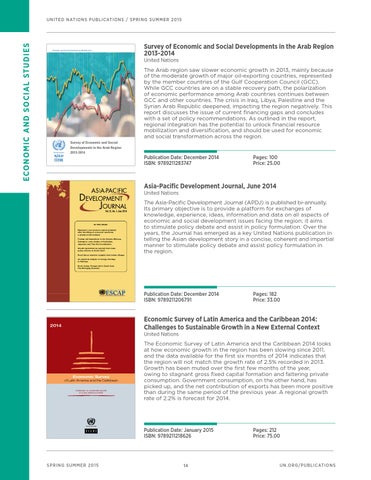
Survey of Economic and Social Developments in the Arab Region 2013-2014
Economic and Social Commission for Western Asia Economic and Social Commission for Western Asia
growth in 2013 compared to n oil revenues of major oilof the Gulf Cooperation Council zation of economic performance hand, and all other Arab urity and humanitarian crisis in ublic deepened, impacting the stability remained in Egypt, the ngly seen as fragile and chaotic s, despite its vast energy, and
The Arab region saw slower economic growth in 2013, mainly because of the moderate growth of major oil-exporting countries, represented by the member countries of the Gulf Cooperation Council (GCC). While GCC countries are on a stable recovery path, the polarization of economic performance among Arab countries continues between GCC and other countries. The crisis in Iraq, Libya, Palestine and the Syrian Arab Republic deepened, impacting the region negatively. This report discusses the issue of current financing gaps and concludes with a set of policy recommendations. As outlined in the report, regional integration has the potential to unlock financial resource mobilization and diversification, and should be used for economic and social transformation across the region.
Survey of Economic and Social Developments in the Arab Region 2013-2014
es recently revealed in the development, both in terms s, particularly in energyre compelled to undergo fiscal nge constraints. In the light of urvey of Economic and Social addresses the theme of financing aps to achieve full employment dations, particularly regarding as outlined in this Survey, l to unlock financial resource be used as a tool for economic ion.
United Nations
Survey of Economic and Social Developments in the Arab Region 2013-2014
ISBN 978-92-1-128374-7
Publication Date: December 2014 ISBN: 9789211283747
Pages: 100 Price: 25.00
Asia-Pacific Development Journal, June 2014 United Nations
(APDJ) is published twice nd Development Division of al Commission for Asia and
sian and Pacific region has e of what can be achieved and people at large harness ght. The APDJ has been ding a scholarly means for minent social scientists and gion and beyond for use by rs, the Journal has emerged telling the Asian and Pacific ent and impartial manner to the formulation of policy in
Asia-Pacific Development Journal
o provide a platform for the deas, information and data al development issues and ate policy debate and assist
Vol. 21, No. 1, June 2014
IN THIS ISSUE: Myanmar’s non-resource export potential after the lifting of economic sanctions: a gravity model analysis Foreign aid imperatives in the Greater Mekong Subregion: case studies of Australian, Japanese and Thai Aid Coordination Should agriculture be exempt from trade policy reforms in South Asia? Rural labour markets: insights from Indian villages An empirical analysis of energy shortage in Pakistan
Vol. 21, No. 1, June 2014
ISBN 978-92-1-120679-1
The Asia-Pacific Development Journal (APDJ) is published bi-annually. Its primary objective is to provide a platform for exchanges of knowledge, experience, ideas, information and data on all aspects of economic and social development issues facing the region; it aims to stimulate policy debate and assist in policy formulation. Over the years, the Journal has emerged as a key United Nations publication in telling the Asian development story in a concise, coherent and impartial manner to stimulate policy debate and assist policy formulation in the region.
Book review: Foreign Aid in South Asia: The Emerging Scenario
N (ECLAC)
L)
ISBN 978-92-1-121862-6 E-ISBN 978-92-1-056542-4 Sales No. E.14.II.G.3 ISSN printed version 0257-2184 Copyright Š United Nations 2014
Economic Survey of Latin America and the Caribbean
2014
Publication Date: December 2014 ISBN: 9789211206791
Pages: 182 Price: 33.00
Economic Survey of Latin America and the Caribbean 2014: Challenges to Sustainable Growth in a New External Context
2014
United Nations
Economic Survey of Latin America and the Caribbean Challenges to sustainable growth in a new external context
The Economic Survey of Latin America and the Caribbean 2014 looks at how economic growth in the region has been slowing since 2011, and the data available for the first six months of 2014 indicates that the region will not match the growth rate of 2.5% recorded in 2013. Growth has been muted over the first few months of the year, owing to stagnant gross fixed capital formation and faltering private consumption. Government consumption, on the other hand, has picked up, and the net contribution of exports has been more positive than during the same period of the previous year. A regional growth rate of 2.2% is forecast for 2014.
Publication Date: January 2015 ISBN: 9789211218626
c.org
SPRING SUMMER 2015
14
Pages: 212 Price: 75.00
UN.ORG/PUBLICATIONS
Structural change and growth in Central America and the Dominican Republic An overview of two decades, 1990-2011
Structural Change and Growth in Central America and theDominican Republic: An Overview of Two Decades, 1990-2011
Economic Development
Structural change and growth in Central America and the Dominican Republic
122
United Nations
The Economic Commission for Latin America and the Caribbean (ECLAC), which is headquartered in Santiago, is one of the five regional commissions of the United Nations.
This publication looks at changes that have occurred with the production structure, trade and society in Central America and the Dominican Republic, and how they have influenced the countries’ growth trajectories. One of the conclusions it reaches is that the subregion has enjoyed faster economic growth overall than the rest of Latin America over both decades examined, 1990-2011; this has helped to raise incomes and living standards. Yet this progress falls short of what is needed, given the high levels of poverty and indigence and the glaring inequalities suffered by much of the population in Central America and the Dominican Republic.
ECLAC is committed to the development of Latin America and the Caribbean. For the Commission, development is a comprehensive process, originating in and designed for the region, in which economic and social dimensions are closely interwoven with concerns for environmental sustainability. For over 60 years, ECLAC has helped to shape Latin American and Caribbean thinking, drawing on its capacity for analysis and its wealth of new ideas and conducting technical cooperation activities that have directly benefited the countries of the region.
HUGO E. BETETA JUAN CARLOS MORENO-BRID
Publication Date: January 2015 ISBN: 9789211218640
(ECLAC)
Latin America and the Caribbean in the World Economy 2014: Regional Integration and Value Chains in a Challenging External Environment
2014
2014
Latin America and the Caribbean in the World Economy
Pages: 380 Price: 30.00
United Nations
Latin America and the Caribbean in the World Economy Regional integration and value chains in a challenging external environment
The 2014 edition of this publication reviews the main features of a persistently weak global economy and world trade, then turning to global and regional trade trends and prospects. The publication considers the main changes in the organization of production and global trade associated with international production networks, which are at the heart of current mega-regional negotiations. It looks at how the region’s countries are positioned in international production networks and value chains. It analyzes the main factors underpinning participation in production networks and value chains, as well as the implications they have for integration.
Publication Date: January 2015 ISBN: 9789211218688
Pages: 140 Price: Price: $28.00
devising a ong terms. have been tainability, sessions of
proposed velopment n required ng, as well inclusion, at included
ral Change Salvador, towards a hange that ternal and e principle
d by ECLAC ommission olume, the onomically, ong terms
Compacts for Equality Towards a Sustainable Future
Compacts for Equality: Towards a Sustainable Future Compacts for Equality Towards a Sustainable Future
United Nations
This publication was presented at the thirty-fifth session of the Commission (Lima, 5 - 9 May 2014) by the Economic Commission for Latin America and the Caribbean (ECLAC). In this third volume, the aim of equality dovetails with development that is more economically, socially and environmentally sustainable in the medium and long terms in Latin America and the Caribbean. This new proposal firmly embraces the gender perspective, natural resource governance and the dynamics of labour and consumption. It also advocates mediumand long-term social covenants, engaging a broad range of actors in the exercise of citizenship, as a condition for successful development.
2014
ve, natural nsumption, ngaging a ndition for
Thirty-fifth session of ECLAC Lima, 5-9 May
periododesesiones.cepal.org/en
TEL: 1 703 661 1571
Publication Date: March 2015 ISBN: 9789211218503
Pages: 328 Price: 45.00
15
ORDER@UN.ORG
ECO NOM IC A ND SOCIA L STU D IES
UNITED NATIONS PUBLICATIONS / SPRING SUMMER 2015
World Economic Situation Prospects
This publication is the definitive report of the United Nations on the state of the world economy. It is jointly produced by the Department of Economic and Social Affairs, the United Nations Conference on Trade and Development and the five United Nations Regional Commissions. Global economic growth is forecast to increase marginally over the next two years at 3.1% in 2015 and 3.3% in 2016, compared with an estimated growth of 2.6 per cent for 2014. An expected US interest rate increase, remaining euro area fragility, a further slowdown in developing economies and several geopolitical conflicts pose major concerns for the global economic outlook today.
2015
ECO NOM IC A ND SOCIA L STU D IES
United Nations
and
United Nations
ISBN 978-92-1-109170-0
World Economic Situation and Prospects 2015 World Economic Situation and Prospects 2015
olicy/wesp
UNITED NATIONS PUBLICATIONS / SPRING SUMMER 2015
United Nations
Publication Date: March 2015 ISBN: 9789211091700
Pages: 192 Price: $42.00
Financing for Overcoming Economic Insecurity United Nations
Despite the rise in recent decades in the average income level, economic insecurity has also increased. True for both developing and developed countries, this increasing economic insecurity is harmful for human welfare for several reasons. Job and income insecurity directly affect the material and psychological well-being of people. Economic volatility and high uncertainty also tend to exert negative influence on productive investment, thereby hurting long-term development. This book sheds light on the causes of economic insecurity and how better functioning financial systems, more effective macroeconomic policies and extended micro-financing schemes could mitigate the degree of economic insecurity in developing countries and overcome many of its negative consequences.
Publication Date: April 2015 ISBN: 9781849665346
Pages: 256 Price: $38.00
Guidance Manual on Value Transfer Methods for Ecosystem Services United Nations Environment Programme
The purpose of this guidance manual is to show how the value of ecosystem services can be estimated and incorporated into decision making. Specifically, it is designed to help a broad audience of conservation managers, government officials, private sector managers, NGOs, and statisticians to understand the available information on the values of ecosystem services and how this information can be used in their decisions. It explains why you would undertake a study, who should be involved, how to implement the study and how to use the results. The development of this guidance manual was funded by the United Nations Environment Programme.
Publication Date: April 2015 ISBN: 9789280733624
SPRING SUMMER 2015
16
Pages: 76 Price: $25.00
UN.ORG/PUBLICATIONS
World Survey on the Role of Women in Development
United Nations Entity for Gender Equality and the Empowerment of Women Ensuring economic empowerment of women and their access to - and control over - resources requires an integrated approach to growth and development. This publication argues that this should be focused on gender-responsive employment promotion and should take into account the interdependency between economic and social development. Social objectives need to be incorporated into economic policies. Economic growth strategies should take into account the real economy. Focus should be on creating gender-sensitive environments, full employment and decent work. Women’s access to land, property, and other productive resources, as well as financial services, and full social protection must also be addressed. This publication contains concrete recommendations in these critical areas, which if adopted, will facilitate women’s equitable access to - and control over - resources.
WORLD SURVEY ON THE ROLE OF WOMEN IN DEVELOPMENT 2014
GENDER EQUALITY AND SUSTAINABLE DEVELOPMENT
1
TEL: 1 703 661 1571
Publication Date: April 2015 ISBN: 9789211303308
Pages: 132 Price: $28.00
17
ECO NOM IC A ND SOCIA L STU D IES
UNITED NATIONS PUBLICATIONS / SPRING SUMMER 2015
ORDER@UN.ORG
UNITED NATIONS PUBLICATIONS / SPRING SUMMER 2015
H U M A N R I GHTS A ND GE ND E R STU D IES
The Core International Human Rights Treaties United Nations
There are ten core international human rights instruments. Each of these instruments (9 human rights treaties and the Optional Protocol to the CAT) has established a committee of experts to monitor implementation of the treaty provisions by its States parties. Some of the treaties are supplemented by optional protocols dealing with specific concerns. This publication reproduces the Universal Declaration of Human Rights, and the nine core international human rights treaties and their optional protocols in a user-friendly format to make them more accessible, in particular to government officials, civil society, human rights defenders, legal practitioners, scholars, individual citizens and others with an interest in human rights norms and standards.
Publication Date: May 2014 ISBN: 9789211542028
The Economic, Social and Cultural Rights of Migrants in an Irregular Situation United Nations
This publication aims to fill a significant knowledge gap on the human rights of irregular migrants. It seeks to describe barriers faced by irregular migrants in the exercise of such fundamental rights as the right to health, to education, to an adequate standard of living, to social security, and to just and favourable conditions of work, as well as trends and national policies, highlighting possible examples of promising practice from around the world. It also draws attention to the guidance provided by international human rights law as well as related legal frameworks such as international labour law, and provides key messages on a human rights-based response to irregular migration.
Publication Date: October 2014 ISBN: 9789211542059
E c o n o m i c
The Role of e-Government in Asia and the Pacific
United Nations
SPRING SUMMER 2015
A f f a i r s
From Promoting Gender Equality to Empowering Women
& S o c i a l
ISBN 978-92-1-123201-1
From Promoting Gender Equality to Empowering Women: The Role of e-Government in Asia and the Pacific
ffice on Governance (UNPOG) gree to which the e-Government he Pacific contribute to promote a toolkit to assess national or gender equality and women’s e an e-Government readiness index provides a foundation for further to include more gender-sensitive t development and assessment. ng one of the first comparative, scuss the gender equality and relation to current e-Government is targeted for decision makers, sentatives from the civil society ell as academia and international orld who are interested in gender powerment in relation to current nt. It also serves as a tool to nd strategies, suggesting steps to plan to carry out e-Government r inclusion.
Pages: 338 Price: $38.00
Pages: 140 Price: $30.00
From Promoting Gender Equality to Empowering Women: Role of E-Government in Asia and the Pacific United Nations
This publication analyses the degree to which the e-government development in Asia and the Pacific contributes to promote gender equality. It provides a toolkit to assess national e-government readiness for gender equality and women’s empowerment, and generates an e-government readiness index for gender equality which provides a foundation for further data collection and research to include more gender-sensitive approach in e-government development and assessment. Its significance lies in being one of the first comparative, analytical attempts to discuss the gender equality and women’s empowerment in relation to current e-government development. This report is targeted for decision makers, governments, civil society and the private sector, academia and international organizations. Publication Date: November 2014 ISBN: 9789211232011
18
Pages: 174 Price: $38.00
UN.ORG/PUBLICATIONS
Fatal Journeys: Tracking Lives Lost during Migration International Organization for Migration
Fatal Journeys: Tracking Lives Lost during Migration
Estimates in 2013 and 2014 reach close to 6,500 lost lives of migrants in border regions around the world. Many deaths occur in remote areas and are never reported. This publication investigates how border-related deaths are documented, who is documenting them, and what can be done to improve the evidence base to encourage informed accountability, policy and practice. Included are migration routes through Central America to the United States, with a focus on the United States–Mexico border region, the southern European Union bordering the Mediterranean, routes from sub-Saharan Africa to North Africa, routes taken by migrants emigrating from the Horn of Africa towards the Gulf or Southern Africa, and the waters surrounding Australia.
ISBN 978-92-9068-698-9 IOM OIM
Publication Date: December 2014 ISBN: 9789290686989
Pages: 212 Price: $30.00
10/15/2014 4:58:20 PM
Children of the Recession: The Impact of the Economic Crisis on Child Well-being in Rich Countries
UNICEF Innocenti Report Card 12 Children in the Developed World
United Nations Children’s Fund - Innocenti Research Centre
The data and observations in this Innocenti Report Card reveal a strong and multifaceted correlation between the impact of the Great Recession on national economies and a decline in children’s well-being since 2008. Children are suffering most, and will bear the consequences longest, in countries where the recession has hit hardest. For each country, the extent and character of the crisis’s impact on children has been shaped by the depth of the recession, pre-existing economic conditions, the strength of the social safety net and, most importantly, policy responses. Remarkably, amid this unprecedented social crisis, many countries have managed to limit – or even reduce – child poverty. It was by no means inevitable, then, that children would be the most enduring victims of the recession.
Children of the Recession ISBN: 978-88-6522-030-6
The impact of the economic crisis on child well-being in rich countries
07/10/2014 17:40
UNITED NATIONS
NATIONS UNIES
Mechanism for International Criminal Tribunals
Mécanisme pour les Tribunaux pénaux internationaux MICT · MTPI
Special Bibliography on ICTR
Bibliographie spéciale sur le TPIR
Publication Date: December 2014 ISBN: 9788865220306
Pages: 48 Price: $20.00
International Criminal Tribunal for Rwanda (ICTR) Special Bibliography 2014 International Criminal Tribunal for Rwanda
This third bibliography is compiled by the Mechanism for International Criminal Tribunals’ (MICT) Legal Library in order to facilitate researchers’ access to the increasing volume of published documents on the work of the tribunal. The bibliography includes references from books, journals and periodicals, theses, comments and notes on judicial cases, with a focus on the ICTR and its jurisprudence. With an author and title index that enables users to easily locate references throughout the booklet, it is an invaluable tool for researchers to be able to quickly access literature published on the work of the ICTR throughout its existence –its establishment, achievements and contribution to the development of international criminal justice.
ISBN: 978-92-1-058011-3
9 789210 580113
MICT Legal Library - Bibliothèque Juridique du MTPI Edition 2014
TEL: 1 703 661 1571
Publication Date: December 2014 ISBN: 9789210580113
Pages: 162 Price: $25.00
19
ORDER@UN.ORG
H U M A N RI GHTS A ND GE ND E R STU D IES
UNITED NATIONS PUBLICATIONS / SPRING SUMMER 2015
Guidelines for Producing Statistics on Violence against Women: Statistical Surveys Guidelines for Producing Statistics on Violence against Women
H U M A N R I GHTS A ND GE ND E R STU D IES
UNITED NATIONS PUBLICATIONS / SPRING SUMMER 2015
United Nations
Guidelines
Violence against women is an obstacle to equality, development and peace and violates human rights. Women and girls are subjected to physical, sexual and psychological abuse that cuts across lines of income, class and culture. Data on the prevalence and incidence of various forms of violence against women, as well as the causes and consequences of violence, are the starting point for developing effective mechanisms at policy levels to eradicate this phenomenon. Properly designed and executed, surveys produce the most reliable data on the prevalence of violence and shed light on the scope, nature and consequences of many types of violence against women. Surveys also collect information on circumstances surrounding violence, health consequences and actions women take to seek help.
for Producing
Statistics
on Violence against Women
Statistical Surveys
ISBN 978-92-1-161567-8
United Nations
Publication Date: January 2015 ISBN: 9789211615678
Pages: 216 Price: $38.00
Women’s Rights are Human Rights United Nations
Women’s Rights are Human Rights
Attaining equality between women and men and eliminating all forms of discrimination against women are fundamental human rights and United Nations values. Women around the world nevertheless regularly suffer violations of their human rights throughout their life, and realizing women’s human rights has not always been prioritized. Achieving equality between women and men requires a comprehensive understanding of the ways in which women experience discrimination and are denied equality so as to develop appropriate strategies to eliminate such discrimination. This publication provides an introduction to women’s human rights, beginning with the main provisions in international human rights law and going on to explain particularly relevant concepts for fully understanding women’s human rights.
Publication Date: January 2015 ISBN: 9789211542066
Pages: 122 Price: $18.00
Global Report on Trafficking in Persons 2014 United Nations
IN PERSONS
2014
GLOBAL REPORT ON
TRAFFICKING
Trafficking in persons is a crime that affects nearly every country in the world. The 2014 Global Report on Trafficking in Persons is the second in a biennial series of UNODC reports on this topic. The Report, which is primarily based on officially reported information from Governments across the world, focuses on patterns and flows of trafficking in persons at the global, regional and national levels. The aim of the Report is twofold: firstly, to foster a better understanding of this crime, and secondly, to strengthen the collective response to it. This edition also includes the Country Profiles showing statistical data for the years 2010 through to 2013 in some cases.
Publication Date: January 2015 ISBN: 9789211338300
Pages: 346 Price: $60.00
20/10/2014 11:43:28
SPRING SUMMER 2015
20
UN.ORG/PUBLICATIONS
Handbook on effective prosecution responses to violence against women and girls
Handbook on Effective Prosecution Responses to Violence against Women and Girls United Nations
Prosecutors play a critical role in the criminal justice response to violence against women and girls. Prosecuting gender based violent crime can be challenging due to the private nature of the offence, substandard police investigations, victims may be uncooperative, and Judges or juries may employ gender bias. Drawing upon the updated Model Strategies and Practical Measures on the Elimination of Violence against Women in the Field of Crime Prevention and Criminal Justice (General Assembly resolution 65/228, annex), The United Nations Office on Drugs and Crime (UNODC) and UN Women have drafted the Handbook on Effective Prosecution Responses to Violence against Women and Girls. Recognizing that prosecutors work in different legal systems, it is meant to be a helpful resource for individual prosecutors and prosecution services.
Handbook on effective prosecution responses to violence against women and girls
ISBN 978-92-1-130331-5
CRIMINAL JUSTICE HANDBOOK SERIES
Publication Date: March 2015 ISBN: 9789211303315
Pages: 188 Price: $28.00
15/01/2015 16:20:31
From Exclusion to Equality: Realizing tHe RigHts Of PeRsOns witH Disabilities
un|oHcHr|iPu
From Exclusion to Equality: Realizing the Rights of Persons with Disabilities United Nations
Parliaments and parliamentarians have a key role to play in promoting and protecting human rights. This handbook aims to assist parliamentarians and others in efforts to realize the Convention so that persons with disabilities can achieve the transition from exclusion to equality. It seeks to raise awareness of the Convention and its provisions, promote an appreciation of disability concerns, and assist parliaments in understanding the mechanisms and frameworks needed to translate the Convention into practice. By providing examples and insights, it is hoped that this handbook will serve as a useful tool for parliamentarians to promote and protect the rights of persons with disabilities all over the world.
Nº 14 — 2007
HANDBOOK FOR PARLIAMENTARIANS
Publication Date: April 2015 ISBN: 9789211542103
Pages: 160 Price: $25.00
Guidelines on Indigenous Peoples’ Issues
U n it ed
n at io n s
d ev el o pm en t
G r o U p
United Nations
This publication aims to assist the United Nations to mainstream and integrate indigenous peoples’ issues in operational activities and programmes at the country level. It sets out the broad normative, policy and operational framework for implementing a human rightsbased and culturally sensitive approach to development for and with indigenous peoples, provide lines of action for planning, implementation and evaluation of programmes and integrating the principles of cultural diversity into programmes. It provides an overview of the situation of indigenous peoples and the international norms and standards adopted to ensure the realization of their rights. It also presents a checklist of key issues and related rights, and discusses programmatic implications for mainstreaming indigenous peoples’ issues.
Publication Date: April 2015 ISBN: 9789211542110
R/P/PT/16
TEL: 1 703 661 1571
Pages: 68 Price: $18.00
21
ORDER@UN.ORG
H U M A N RI GHTS A ND GE ND E R STU D IES
UNITED NATIONS PUBLICATIONS / SPRING SUMMER 2015
Monitoring the Convention on the Rights of Persons with Disabilities
Guidance for human Rights Monitors Professional training series No. 17
Designed and printed by the Publishing Service, United Nations, Geneva — GE.09-17481 — March 2010 — 2,115 — HR/P/PT/17
H U M A N R I GHTS A ND GE ND E R STU D IES
United Nations
Human rights work requires preparation, technical skills and substantive knowledge in order to be effectively conducted. This publication aims to assist United Nations human rights officers and other human rights monitors—including from governments, national human rights institutions and non-governmental organizations—to engage in monitoring the rights of persons with disabilities, in line with the Convention. It provides an explanation of the paradigm shift that the Convention enshrines and of the scope, standards and principles recognized by it. Furthermore, it proposes a methodology for monitoring the rights of persons with disabilities, and provides useful advice on issues to consider when working with persons with disabilities.
Publication Date: April 2015 ISBN: 9789211542134
Pages: 68 Price: $18.00
Family and Parenting Support: Policy and Provision in a Global Context
United Nations Children’s Fund - Innocenti Research Centre
Innocenti Insight
8865 220 29 0
Monitoring the Convention of the Rights of Persons with Disabilities: Guidance for Human Rights Monitors
Family and Parenting Support: Policy and Provision in a Global Context
Research - Innocenti Annunziata, 12 orence, Italy 055 20 330 055 2033 220 @unicef.org icef-irc.org
UNITED NATIONS PUBLICATIONS / SPRING SUMMER 2015
Family and Parenting Support Policy and Provision in a Global Context Innocenti Insight
Family and parenting support is increasingly recognized as an important part of national social policies and social investment packages aimed at reducing poverty, decreasing inequality, and promoting positive parental and child well-being. Over the past 15 to 20 years different models of family-related services have evolved in different parts of the world. Much less documented is what drives the development of national policies and programmes in low- and middle-income countries and how the provision of family and parenting support impacts on child and adolescent well-being in these contexts. This publication aims to build the evidence base on what kind of family and parenting support works, under what conditions, and for whom. Included are case studies included from Belarus, Chile, China, Croatia, England, Jamaica, The Philippines, South Africa, and Sweden. Publication Date: April 2015 ISBN: 9788865220290
Pages: 104 Price: $25.00
13/02/2015 13:22
Transitional Justice and Economic, Social and Cultural Rights United Nations
TRANSITIONAL JUSTICE AND
The failure to fulfil economic, social and cultural rights and the outright violation of these rights are often at the root of conflict. Actions and omissions by States and non-State actors during conflict can also amount to violations of economic, social and cultural rights, and particularly affect the most vulnerable. Yet, there has been no widespread move in transitional justice processes to examine the root causes of the conflict or to look into violations of economic, social and cultural rights. The Office of the United Nations High Commissioner for Human Rights has explored ways in which transitional justice processes have or could address violations of economic, social and cultural rights. This publication presents the outcome of that work.
ECONOMIC, SOCIAL AND CULTURAL RIGHTS
New York and Geneva, 2014
SPRING SUMMER 2015
Publication Date: April 2015 ISBN: 9789211542042
22
Pages: 64 Price: $15.00
UN.ORG/PUBLICATIONS
25 Years of the Convention on the Rights of the Child: Is the World a Better Place for Children? United Nations Children’s Fund
This publication contains a collection of essays and viewpoints marking the 25th anniversary of the Convention on the Rights of the Child. There is much to celebrate since the Convention was adopted in 1989, from declining infant mortality to rising school enrolment. This milestone must serve as an urgent reminder of the millions of children not yet reached, and puts emphasis on the responsibility to find new ways of overcoming challenges that have not been tackled yet. It represents a remarkable milestone in the journey to build a more just world.
YEARS OF THE CONVENTION ON THE RIGHTS OF THE CHILD
Is the world a better place for children?
Publication Date: April 2015 ISBN: 9789280647655
Pages: 124 Price: $20.00
Human Rights
Professional Training Series Authoriative training for human rights practitioners
0RQLWRULQJ WKH &RQYHQWLRQ RQ WKH 5LJKWV RI 3HUVRQV ZLWK 'LVDELOLWLHV
*XLGDQFH IRU +XPDQ 5LJKWV 0RQLWRUV 3URIHVVLRQDO WUDLQLQJ VHULHV 1R
?8E;9FFB =FI G8IC@8D<EK8I@8EJ
Monitoring the Convention of the Rights of Persons with Disabilities: Guidance for Human Rights Monitors
E² (+ Ç )''.
From Exclusion to Equality: Realizing the Rights of Persons with Disabilities ISBN: 9789211542103 $25.00
ISBN: 9789211542134 $18.00
TEL: 1 703 661 1571
23
ORDER@UN.ORG
H U M A N RI GHTS A ND GE ND E R STU D IES
UNITED NATIONS PUBLICATIONS / SPRING SUMMER 2015
cessful innovations in governance eceived the United Nations Public rnational recognition of excellence o disseminate, through descriptive ces by looking at the problem that ed and implemented to respond to ved in the innovation process, and institutions from around the world e a powerful and inspirational tool formance.
European Agreement Concerning the International Carriage of Dangerous Goods by Road: ADR - Applicable as from 1 January 2015 (Two-volume Set) United Nations
This publication is intended to increase the safety of international transport of dangerous goods by road. Regularly amended and updated since its entry into force, it contains the conditions under which dangerous goods may be carried internationally. This version has been prepared on the basis of amendments applicable as from 1 January 2015. It contains in particular new or revised provisions concerning transport of absorbed gases; lithium batteries (including damaged or defective); assymetrical capacitors; discarded packagings; ammonium nitrate and radioactive material; testing of gas cartridges and fuel cell cartridges; marking of bundles of cylinders; and the applicability of ISO standards to the manufacturing of new pressure receptacles or service equipment. Publication Date: September 2014 ISBN: 9789211391497
United Nations
This publication provides an overview of 91 successful innovations in governance and public administration from 38 countries that received the United Nations Public Service Awards, which is the most prestigious international recognition of excellence in public service. The purpose of this book is to disseminate, through descriptive case studies, information about innovative practices by looking at the problem that led to an innovation; the solution that was designed and implemented to respond to the specific challenge; the actors and steps involved in the innovation process, and lessons learned. Learning more about how public institutions from around the world have solved difficult governance challenges can be a powerful and inspirational tool for those engaged in improving public sector performance.
United Nations Public Service Awards Winners, 2012-2013
asdf United Nations
by the United Nations 92-1-123194-6 978-92-1-054193-0 13.II.H.1
Pages: 1254 Price: $175.00
Good Practices and Innovations in Public Governance: United Nations Public Service Awards Winners and Finalists 2012-2013
Good Practices and Innovations in Public Governance
Good Practices and Innovations in Public Governance 2012-2013
I NT E R NAT I ONA L LAW / GOV E R NA NCE
UNITED NATIONS PUBLICATIONS / SPRING SUMMER 2015
Publication Date: November 2014 ISBN: 9789211231946
Pages: 252 Price: $45.00
Model Law against the Illicit Manufacturing of and Trafficking in Firearms, their Parts and Components and Ammunition, Second Revised Edition
500, 1400 Vienna, Austria 060-5866, www.unodc.org
United Nations
It is hoped that the Model Law, as revised, remains a useful and practical voluntary tool, to facilitate the provision of legislative assistance to Member States, as well to guide policy makers, legal advisors and legislators, who wish to review or amend their domestic legal framework or adopt new legislation in a manner consistent with the Firearms Protocol and other relevant regional and international instruments, and will promote and facilitate international cooperation in preventing and combating criminal activity relating to firearms. The model legislative provisions contained in the Model Law are not meant to be transposed as such, but require careful consideration and customization to the specific domestic legal system in which they are supposed to operate.
ISBN 978-92-1-133826-3
Model Law against the Illicit Manufacturing of and Trafficking in Firearms
Model Law against the Illicit Manufacturing of and Trafficking in Firearms, Their Parts and Components and Ammunition
Publication Date: November 2014 ISBN: 9789211338263
Second revised edition
Pages: 194 Price: $32.00
24/06/2014 16:27:19
SPRING SUMMER 2015
24
UN.ORG/PUBLICATIONS
UNITED NATIONS ECONOMIC COMMISSION FOR EUROPE
UNECE
European Agreement concerning the International Carriage of Dangerous Goods by Inland Waterways
European Agreement Concerning the International Carriage of Dangerous Goods by Inland Waterways (ADN) 2015, Including the Annexed Regulations, Applicable as from 1 January 2015 (Two-volume Set) United Nations
Carriage of Dangerous 26 May 2000 under the or Europe (UNECE) and ne (CCNR) entered into the Agreement became e Agreement, namely on
on, the Agreement had lgaria, Croatia, Czech Netherlands, Poland, ion, Serbia, Slovakia,
s concerning dangerous arriage on board inland visions concerning the o address requirements of approval, recognition xamination of experts.
2015 2015 Vol.I
UNITED NATIONS
Volume I
UNITED NATIONS
The ADN has been in force since February 2008. This version has been prepared on the basis of amendments applicable as from 1 January 2015. The Regulations annexed to the ADN contain provisions concerning dangerous substances and articles, their carriage in packages and in bulk on board inland navigation vessels or tank vessels, as well as provisions concerning the construction and operation of such vessels. They also address requirements and procedures for inspections, the issue of certificates of approval, recognition of classification societies, monitoring, and training and examination of experts. They are harmonized to the greatest possible extent with the dangerous goods agreements for other modes of transport. Publication Date: January 2015 ISBN: 9789211391527
Pages: 1016 Price: $165.00
Yearbook of the International Court of Justice 2010-2011 United Nations
The International Court of Justice (ICJ) is the principal judicial organ of the United Nations. The Court’s role is to settle, in accordance with international law, legal disputes submitted to it by States and to give advisory options on legal questions referred to it by authorized United Nations organs and specialized agencies. This publication is an annual record of the work of the Court during the period from 1 August of the preceding year to 31 July of the current year. It discusses a wide range of topics and cases before the Court pertaining to subjects such as territorial rights, law of the sea and treaty interpretation.
Publication Date: January 2015 ISBN: 9789211700886
Pages: 326 Price: $30.00
The Permanent Court of International Justice, 1922-2012 United Nations
This publication commemorates the 90th anniversary of the inauguration, in 1922, of the Permanent Court of International Justice, the predecessor of the principal judicial organ of the United Nations. It offers the reader a clear and concise overview of the origins and the creation of the Permanent Court, a general description of its remit and the way in which it functioned, summaries of all its judgments and advisory opinions, as well as various statistics. It also includes a list of all the judges of the Permanent court, numerous original photographs (some of which have never been published), and an afterword, providing a link between the principal judicial organ of the United Nations and its prestigious predecessor of the last century.
Publication Date: January 2015 ISBN: 9789210711265
TEL: 1 703 661 1571
Pages: 252 Price: $67.00
25
ORDER@UN.ORG
I NT E R NAT I ONA L LAW / GOV E R NA NCE
UNITED NATIONS PUBLICATIONS / SPRING SUMMER 2015
E c o n o m i c
VOLUME I Trade by Country
& S o c i a l
2013 International Trade Statistics Yearbook Volume I Trade by Country
A f f a i r s
2013 International Trade Statistics Yearbook
INT E R NAT IONA L TR A D E
UNITED NATIONS PUBLICATIONS / SPRING SUMMER 2015
International Trade and Statistics Yearbook 2013 United Nations
This publication is issued in two volumes which offer a comprehensive view of the topic. Volume I: Trade by Country, compiled in May 2013, presents detailed data of 175 countries (or areas) with data on imports and exports by commodity and trading partner provided for 90 countries (or areas), representing approximately 70% of world trade in 2013. Volume II: Trade by Commodity contains the detailed tables showing international trade for 258 commodities and eleven world trade tables covering trade values and indices up to the year 2013.
Volume I - Trade by Country Publication Date: September 2014 ISBN: 9789211615876
Pages: 426 Price: $125.00
Volume II - Trade by Commodity Publication Date: March 2015 ISBN: 9789211615906
Pages: 466 Price: $125.00
ISBN 978-92-1-161587-6
United Nations
United Nations
ASIA-PACIFIC TRADE AND INVESTMENT REPORT 2014
ISBN 978-92-1-120682-1
Asia-Pacific Trade and Investment Report 2014: Recent Trends and Developments United Nations
ASIA-PACIFIC TRADE AND INVESTMENT REPORT 2014 RECENT TRENDS AND DEVELOPMENTS
This annual publication of the United Nations Economic and Social Commission for Asia and the Pacific provides information and independent analyses of trends and developments in: (a) intra- and inter-regional trade in goods and services; (b) foreign direct investment; (c) trade facilitation measures; (d) trade policy measures; and (e) preferential trade policies and agreements. It provides insights on the impact of recent and emerging developments on countries’ abilities to meet the challenges of achieving inclusive and sustainable development. It also identifies and studies emerging issues in these areas offering innovative policy options towards building capacities of governments in the region. This report includes separate country and sub-regional country briefs. Publication Date: October 2014 ISBN: 9789211206821
Pages: 122 Price: $50.00
Empowering Women through Public Procurement International Trade Centre
Women-owned businesses represent one third of the small and medium-sized enterprises of developing countries, but only a fraction of government procurement opportunities for goods and services. This guide, published by the International Trade Centre, helps governments understand what measures to put in place so that more womenowned businesses have access to this important market, which often accounts for 15-20% of GDP. It includes practical national case examples, checklists and overviews for busy decision-makers as well as guidelines for implementation.
Publication Date: October 2014 ISBN: 9789291374199
SPRING SUMMER 2015
26
Pages: 84 Price: $35.00
UN.ORG/PUBLICATIONS
The Rovaniemi Action Plan for the Forest Sector in a Green Economy Food and Agriculture Organization of the United Nations
Rovaniemi Action Plan
for the Forest Sector in a Green Economy
e Forest Sector in a Green cember 2013 in Finland, n the UNECE region could ing green economy at the rall vision, objectives and potential actors who might ed objectives. It is not a contain prescriptive rnments, international ho are free to adopt, adapt, ent the Action Plan as they the Action Plan will be orestry and Timber Section d means to measure the the forest sector towards
nd the Forest Industry and sion
est products and services, he UNECE Committee on y and the FAO European ailable on the website
sts
overnment Offices of Sweden
United Nations
The Rovaniemi Action Plan, adopted in 2013 in Finland, describes how the forest sector in the United Nations Economic Commission for Europe (UNECE) region could lead the way towards the emerging green economy at the global level. It provides an overall vision, objectives and specific activities, and identifies potential actors, who might contribute to achieving the stated objectives. It is not a binding plan, nor does it contain prescriptive recommendations to governments, international organizations or stakeholders, who are free to adopt, adapt, in full or in part, or not to implement the Action Plan as they wish. The implementation of the Action Plan will explore ways and means to measure the contribution and the progress of the forest sector towards a Green Economy.
ISBN 978-92-1-117078-8
UNITED NATIONS
Publication Date: October 2014 ISBN: 9789211170788
Pages: 54 Price: $18.00
Papers on Selected Topics in Negotiation of Tax Treaties for Developing Countries United Nations
Double tax treaties play a key role in international taxation, by reducing or eliminating double taxation over cross-border income, thus encouraging international investment and global economic growth, and by enhancing cooperation among tax administrations, especially in tackling international tax evasion and avoidance. This publication, designed for developing countries, aims at providing practical guidance to negotiate double tax treaties and, in particular, those drawing upon the United Nations Model Double Taxation Convention between Developed and Developing Countries. It is the companion of the already released United Nations Handbook on Selected Issues in Administration of Double Tax Treaties for Developing Countries. ISBN 978-92-1-159106-4
Publication Date: November 2014 ISBN: 9789211591064
Pages: 154 Price: $35.00
50 Years of Unlocking SME Competitiveness: Lessons for the Future International Trade Centre
Published on the occasion of International Trade Centre’s 50th anniversary, this publication traces the history of the organization since its inception in 1964. It reflects on five decades of global growth and illustrates how the world economy is rebalancing. It identifies and analyses the three major drivers of trade growth: technological change, policy reform and competitiveness. It also summarizes ITC’s assistance in four primary areas: trade and market intelligence, institutional support, enterprise-oriented programmes, and public-private partnerships. Furthermore, it highlights key trends to watch for the future of international business, and elaborates on how dynamics and new trends will impact on ITC’s efforts to strengthen SME competitiveness and to foster inclusive and sustainable growth in developing countries.
Publication Date: November 2014 ISBN: 9789291374182
TEL: 1 703 661 1571
Pages: 144 Price: $35.00
27
ORDER@UN.ORG
INT E R NAT IONA L TR A D E
UNITED NATIONS PUBLICATIONS / SPRING SUMMER 2015
INT E R NAT IONA L TR A D E
UNITED NATIONS PUBLICATIONS /SPRING SUMMER 2015
UNCITRAL
UNITED NATIONS COMMISSION ON INTERNATIONAL TRADE LAW
United Nations YEARBOOK
The United Nations Commission on International Trade Law (UNCITRAL) is the core legal body of the United Nations system in the field of international trade law. It specializes in the modernization and harmonization of rules on international business. This publication reproduces the substantive documents prepared each year for the Commission and its working groups, and is divided into three parts. Part One deals with the Commission’s report. Part Two covers studies and reports on specific subjects. Part Three contains meeting records, the bibliography and checklists of UNCITRAL documents prepared in the current and previous years. It also includes General Assembly resolutions and Sixth Committee reports related to UNCITRAL’s work.
Volume XLII: 2011
Publication Date: December 2014 ISBN: 9789211338294
UNITED NATIONS
UNECE
United Nations
Forest Products
Forest Products - Annual Market Review 2013-2014
ket Review 2013-2014 provides a comprehensive region and reports on the main market influences vers the range of products from the forest to the primary processed products to value-added and
eview analyse the markets for wood raw materials, d, wood-based panels, paper, paperboard and e policies, innovative wood products and markets od products and housing. Underlying the analysis data.
of sustainable forest products in international sts and forest products are discussed, as well as Review also analyses the effects of the current ucts markets.
d document for the Market Discussions held at E Committee on Forests and the Forest Industry, nd objective information for other policymakers,
ucts markets, as well as on the UNECE Committee ry and the FAO European Forestry Commission, rests.
ex, which is available at: 4-annex.html.
UNITED NATIONS
ISBN 978-92-1-117081-8
UNCTAD
Review of MaRitiMe tRanspoRt tRanspoRt 2014
n on UNCTAD’s work ogistics, //unctad.org/ttl
aritime Transport 2014: ad.org/rmt
ail: tad.org
This publication provides general and statistical information on forest products markets and related policies in the UN Economic Commission for Europe region (Europe, North America and the Commonwealth of Independent States). It analyses government and industry policies and market-based implements affecting forest products markets. It also describes wood raw materials, sawn softwood, sawn hardwood, wood-based panels, and paper, paperboard and woodpulp based on annual country-supplied statistics. Additional chapters discuss markets for wood energy, value-added wood products, and housing, and in each chapter, production, trade and consumption are analysed and relevant material on specific markets is included.
Publication Date: December 2014 ISBN: 9789211170818
U n i t e d n at i o n s C o n f e r e n C e o n t r a d e a n d d e v e l o p m e n t
Pages: 152 Price: $45.00
Review of Maritime Transport 2014 United Nations
Review
of MaRitiMe tRanspoRt
2014
UNITED NATIONS
Photo credit : © Jan Hoffmann
o subscribe to the wsletter, please visit: /transportnews
CD Price: $95.00
Forest Products Annual Market Review 2013-2014
Annual Market Review 2013-2014
ISBN 978-92-1-112878-9
United Nations Commission on International Trade Law (UNCITRAL): Yearbook 2011
As in previous issues since 1968, the 2014 Review of Maritime Transport contains a wealth of analysis and unique data. This publication is the renowned United Nations source of statistics and analysis on seaborne trade, the world fleet, freight costs, port traffic and the latest trends in the legal and regulatory environment for international maritime transport. This year’s Review includes a special chapter on maritime transport challenges for Small Island Developing States (SIDS), covering issues such as the impact of climate change, port investment, shipping connectivity and transport costs.
Publication Date: January 2015 ISBN: 9789211128789
SPRING SUMMER 2015
28
Pages: 134 Price: $95.00
UN.ORG/PUBLICATIONS
World Tariff Profiles 2014 International Trade Centre
World Tariff Profiles 2014 Applied MF
Nt
ar
iff s
This is a joint publication of the World Trade Organization (WTO), the International Trade Centre (ITC), and the UN Conference on Trade and Development (UNCTAD). It is devoted to market access for goods, and contains a comprehensive compilation of the main tariff parameters for each of the 160 WTO members plus other countries and customs territories where data is available. Each country profile presents information on tariffs imposed by each economy on its imports complemented with an analysis of the market access conditions it faces in its major export markets. Statistics for all countries are given in standardized tables which allow easy comparisons between countries, between sectors and, specifically for WTO members, between bound and applied tariffs as well.
0<2 2<4 4<6 6<8 8<10
10<15
15<20
Publication Date: April 2015 ISBN: 9789287039743
20<
African, Caribbean and Pacific Trade: Prospects for Stronger Performance and Cooperation
AFRICAN, CARIBBEAN AND PACIFIC TRADE PROSPECTS FOR STRONGER PERFORMANCE AND COOPERATION
International Trade Centre
This paper analyses the export structure of the African, Caribbean, and Pacific (ACP) countries by region covering both products and services trade, with a focus on the structure of the exporting sector by company sizes. It assesses product and market diversification, and the development of transformation activities. It discusses trade integration in regional vs. global markets, and concludes that lower barriers to trade could facilitate trade by SMEs and the development of transformation activities. The discussion of trade performance is complemented by an analysis of trade policy frameworks within the ACP group to help identify areas where increased cooperation among ACP Member States has the potential to contribute to greater trade performance and stronger sustainable growth.
Publication Date: April 2015 ISBN: 9789213149799
TEL: 1 703 661 1571
Pages: 202 Price: $40.00
Pages: 66 Price: $25.00
29
ORDER@UN.ORG
INT E R NAT IONA L TR A D E
UNITED NATIONS PUBLICATIONS / SPRING SUMMER 2015
ISBN 978-92-1-151523-7
Compendium of Recommendations on Population and Development: Commission on Population and Development, 1994 –2014 (Volume I)
United Nations
14-55077
Compendium of Recommendations on Population and Development: Commission on Population and Development, 1994 –2014 (Volume I) Compendium of Recommendations on Population and Development (Volume I)
P U B L I C HE A LT H A ND P OP U LATION
UNITED NATIONS PUBLICATIONS / SPRING SUMMER 2015
Compendium of Recommendations on Population and Development (Volume II) United Nations
ISBN 978-92-1-151524-4
Compendium of Recommendations on Population and Development: Regional Conferences on Population and Development Held in Preparation for the Review of the Programme of Action of the International Conference on Population and Development beyond 2014 (Volume II)
United Nations
The Compendium of Recommendations on Population and Development: Commission on Population and Development (Vol. I) compares recommendations emanating from the Programme of Action of the International Conference on Population and Development with resolutions from the Commission on Population and Development. In addition, General Assembly resolutions on population and development since 1994 will be included in the Compendium as well.
Publication Date: October 2014 ISBN: 9789211515237
United Nations
14-56327
United Nations
Pages: 252 Price: $35.00
Compendium of Recommendations on Population and Development: Regional Conferences on Population and Development Held in Preparation for the Review of the Programme of Action of the International Conference on Population and Development beyond 2014 (Volume II) United Nations
This second volume of the Compendium of Recommendations on Population and Development provides recommendations emanating from recent outcome documents of five regional conferences on population and development in preparation for the special session of the General Assembly on 22 September 2014 on the follow-up to the Programme of Action of the International Conference on Population and Development beyond 2014. The special session marks the 20-year anniversary of the Programme of Action, and the Compendium is an important and highly visible contribution to the event, informing Member States and the global public now and in the future. Publication Date: October 2014 ISBN: 9789211515244
Pages: 124 Price: $25.00
The State of World Population 2014: The Power of 1.8 Billion - Adolescents, Youth and the Transformation of the Future United Nations Population Fund
Our world is home to 1.8 billion young people between the ages of 10 and 24, and the youth population is growing fastest in the poorest nations. With 600 million adolescent girls with specific needs, challenges and aspirations for the future within this generation, calls for investments in young people have increased dramatically. This year’s The State of World Population is significant because it frames investments in youth not solely as responding to the needs of young people, but also as an imperative for sustainable development. The perspective and data that are being presented in this report can be a very valuable asset for the advocacy and programming of youth-led organizations and youth activists.
Publication Date: November 2014 ISBN: 9780897149723
SPRING SUMMER 2015
30
Pages: 132 Price: $24.00
UN.ORG/PUBLICATIONS
Sources, Effects and Risks of Ionizing Radiation, UNSCEAR 2013 Report, Part I: Levels and Effects of Radiation Exposure due to the Nuclear Accident after the 2011 Great East-Japan Earthquake and Tsunami
United Nations Scientific Committee on the Effects of Atomic Radiation
UNSCEAR 2013 REPORT — VOLUME I
Radiation
nt
on the Effects
izing radiation
clear weapons and evaluate
entific grounds
s testing was
e global levels
tive evaluation
cision-making
SOURCES, EFFECTS AND RISKS OF IONIZING RADIATION
DECISION-MAKING
S O U R C E S , E F F E C T S A N D R I S K S O F I O N I Z I N G R A D I AT I O N
UNSCEAR 2013 Report
United Nations
This publication, the first of two volumes of scientific annexes, provides a detailed review of scientific material that underpins the Committee’s evaluation of the radiation doses and effects due to the accident which occurred at the Fukushima Daiichi nuclear power station on 11 March 2011. It covers the amount and composition of radioactive material released to the environment, the pattern of dispersion and deposition of the radioactive material over land and sea, the radiation doses received by the general public and workers, the radiation effects on the environment, the radioactivity in food, and the implications of the radiation exposures for human health and the environment.
Volume I REPORT TO THE GENERAL ASSEMBLY SCIENTIFIC ANNEX A: Levels and effects of radiation exposure due to the nuclear accident after the 2011 great east-Japan earthquake and tsunami
ISBN 978-92-1-142291-7
Publication Date: November 2014 ISBN: 9789211422917
Pages: 318 Price: $60.00
02/10/2014 08:30:29
Abortion Policies and Reproductive Health Around the World United Nations
Abortion Policies and Reproductive Health around the World
This report provides up-to-date information on government policies on abortion and related reproductive health issues for all 193 Member States, 2 Observer States and 2 non-member States of the United Nations. The report provides changes between 1996 and 2013 on legal grounds on which induced abortion is permitted in each country. Seven critical legal grounds for abortion are included. It also includes the latest available information on government policies and programmes related to fertility, family planning, access to reproductive health services, and maternal mortality. In addition, this report provides information on how abortion policies are associated with selected reproductive health indicators.
ISBN 978-92-1-151521-3
United Nations Department of Economic and Social Affairs Population Division
Publication Date: December 2014 ISBN: 9789211515213
Pages: 48 Price: $18.00
Latin America and the Caribbean Demographic Observatory 2013: Population Projections United Nations
This issue of the Demographic Observatory presents estimates and projections of the population of the 20 countries of Latin America, for the period of 1950 to 2100. The figures contained in this publication are a revision of those presented in the Demographic Observatory No. 13. From this edition, Demographic Observatory will follow a standard format containing information that will be updated annually and were prepared by CELADE-Population Division of the Economic Commission for Latin America and the Caribbean.
Publication Date: January 2015 ISBN: 9789211218589
1-056535-6 -P ons, 2014
TEL: 1 703 661 1571
Pages: 142 Price: $25.00
31
ORDER@UN.ORG
P U B L I C HE A LT H A ND P OP U LATION
UNITED NATIONS PUBLICATIONS / SPRING SUMMER 2015
P U B L I C HE A LT H A ND P OP U LATION
UNITED NATIONS PUBLICATIONS / SPRING SUMMER 2015
United Nations Demographic Yearbook 2013 United Nations 2013
64th Issue General Tables
64e édition Tableaux de caractère général
United Nations
Demographic Yearbook Nations Unies
Annuaire démographique
Demographic Yearbook Annuaire démographique
ISBN 978-92-1-051107-0
United Nations Nations Unies
United Nations
SPRING SUMMER 2015
The 2013 edition of the United Nations Demographic Yearbook is the the sixty-fourth in a series published since 1948. Through the cooperation with the National Statistical Offices, official demographic statistics are compiled in the Yearbook, as available, for more than 230 countries and areas of the world up to the reference year 2013. This edition of the Yearbook contains chapters on the population size and distribution, the population of capital cities, fertility, foetal mortality, infant and maternal mortality, general mortality, nuptiality and divorce.
Publication Date: March 2015 ISBN: 9789210511070
32
Pages: 922 Price: $135.00
UN.ORG/PUBLICATIONS
International Accounting and Reporting Issues: 2013 Review United Nations
This volume is dedicated to the topic of human capacity development in relation to high-quality corporate reporting. The Accounting Development Tool (ADT) dedicates one of its four pillars to the human capacity for achieving high-quality corporate reporting. There are a number of human capacity related challenges that countries face when implementing corporate reporting standards and codes developed at a global level. This publication highlights trends such as the adoption and implementation of international standards and codes, the increasing regional and international cooperation among regulators of the accounting profession, and the emergence of education initiatives.
Publication Date: October 2014 ISBN: 9789211128758
Pages: 242 Price: $75.00
Principles and Recommendations for a Vital Statistics System, Revision 3 United Nations PRINCIPLES AND RECOMMENDATIONS FOR A VITAL STATISTICS SYSTEM, REVISION 3
Principles and Recommendations for a Vital Statistics System, Revision 3
This publication is an international standard on the design and operation of an efficient and accurate vital statistics system at national level. It provides guidelines on collection, compiling and disseminating vital statistics. More specifically it contains (a) basic principles for a vital statistics system; (b) usage of vital statistics and civil registration records; (c) topics to be covered in a vital statistics system; (d) sources of vital statistics and how they function; (e) quality assurance in the vital statistics system, and (f) strategies in improving civil registration and vital statistics systems in countries. It also informs policy makers and the general public on the importance of vital statistics and hence further improving the vital statistics system.
13-27975 ISBN 978-92-1-161572-2
Publication Date: October 2014 ISBN: 9789211615722
Pages: 238 Price: $25.00
Arab Society: A Compendium of Social Statistics - Issue No.11
a series of biennial mission for Western offices, it focuses on lth and culture. The in ESCWA member er countries.
ublication. A more nth issue is intended snapshot of trends cluding academics,
United Nations Arab Society:
A COMPENDIUM OF SOCIAL STATISTICS
Issue No. 11
11 ISBN-13: 978-92-1-128367-9 e-ISBN: 978-92-1-056547-9
© Jasmin Merdan - Fotolia.com
This eleventh issue of the Compendium of Social Statistics and Indicators is a biennial publication of the Statistics Division of the Economic and Social Commission for Western Asia (ESCWA), which typically focuses on such areas as population, education, households and family, human settlements, health and economic activity. In the hope of widening the audience of this publication, the eleventh issue is intended not only as a reference for policymakers and other officials, but also as a snapshot of trends in the region for readers with an interest in the social climate of Arab countries, including academics, students, journalists and the general public.
© xy - Fotolia.com
© viperagp - Fotolia.com
Publication Date: October 2014 ISBN: 9789211283679
TEL: 1 703 661 1571
Pages: 86 Price: $25.00
33
ORDER@UN.ORG
STATISTICS
UNITED NATIONS PUBLICATIONS / SPRING SUMMER 2015
Economic & Social Affairs
Energy Statistics Yearbook 2011 Annuaire des statistiques de l’énergie
STATISTICS
UNITED NATIONS PUBLICATIONS / SPRING SUMMER 2015
2011 Energy Statistics Yearbook Annuaire des statistiques de l’énergie
Energy Statistics Yearbook 2011 United Nations
This Yearbook is the fifty-fifth issue in a series of annual compilations of internationally comparable statistics summarizing world energy trends. Annual data for 224 countries and areas for the period 2008 to 2011 are presented on production, trade and consumption of energy (solids, liquids, gaseous fuels and electricity). In addition, per capita consumption series are also provided for all energy products. Graphs are included to illustrate historic trends and/or changes in composition of production and/or consumption of major energy products. Special tables of interest include: international trade tables for coal, crude petroleum and natural gas by partner countries – providing information on direction of trade; selected series of statistics on renewables and wastes; refinery distillation capacity; and a table on selected energy resources.
ISBN 978-92-1-061354-5
Part I
United Nations
Pages: 640 Price: $145.00
This publication contains detailed official national accounts data for over 200 countries or areas of the World for the years 2001 to 2013. It is a valuable source of information on the state and structure of economies worldwide. The data for each country or area are presented in separate chapters with uniform table headings and classifications as recommended in the System of National Accounts 1993 (1993 SNA). Each country chapter also contains a write-up on the methodology and data sources which are used to compile the national accounts. A summary of the SNA conceptual framework, classifications, and definitions is also included. This publication also contains statistics on gross domestic product.
United Nations
Publication Date: December 2014 ISBN: 9789211615890
UNECE UNECE / FAO
UNITED NATIONS ECONOMIC COMMISSION FOR EUROPE
Human Resources Management and Training Compilation of good practices in statistical offices
Human Resources Management and Training
UNITED NATIONS
074 – June 2013 – 668 – ECE/CES/28
Publication Date: December 2014 ISBN: 9789210613545
United Nations National Accounts Statistics: Main Aggregates and Detailed Tables, 2013
Part I
e online at
stats
Nations Unies
National Accounts Statistics: Main Aggregates and Detailed Tables 2013 (Five-volume Set) National Accounts Statistics: Main Aggregates and Detailed Tables, 2013
s 24 papers on good urces management offices from across rouped into three ssues, training, and gement. The papers om recruitment and setting up training nce mapping and nt.
United Nations
United Nations Nations Unies
SPRING SUMMER 2015
UNITED NATIONS
Pages: 4146 Price: $385.00
Human Resouces Management and Training: Compilation of Good Practices in Statistical Offices United Nations
The Conference of European Statisticians (CES) at its plenary session in 2006 conducted a seminar on human resources and training in statistical offices. The seminar concluded that human resources and training are crucial elements for the successful fulfilment of the mission of the offices. As a follow-up to the seminar, workshops on human resources management and training (HRMT) were organized in 2008, 2010 and 2012 where HRMT issues were discussed. This paper provides an outline of the future challenges in the area of HRMT for statistical offices. Included are workshop discussions from 2012 and issues that were raised by countries, as well as information collected through a survey to CES member countries on their practices and plans in HRMT.
Publication Date: December 2014 ISBN: 9789211170825
34
Pages: 280 Price: $40.00
UN.ORG/PUBLICATIONS
UNCTAD
U N I T E D N AT I O N S C O N F E R E N C E O N T R A D E A N D D E V E L O P M E N T CONFERENCE DES NATIONS UNIES SUR LE COMMERCE ET LE DÉVELOPPEMENT
UNCTAD HANDBOOK OF STATISTICS MANUEL DE STATISTIQUES DE LA CNUCED
MANUEL DE STATISTIQUES DE LA CNUCED
UNCTAD HANDBOOK OF STATISTICS
UNCTAD Handbook of Statistics 2014 United Nations
This publication provides a comprehensive collection of statistical data relevant to the analysis of international trade, investment and development for individual countries, regions and economic groupings. It presents consolidated reference statistics on International merchandise trade, exports and imports structure by products and by regions of origin and destination; volume and unit value indices of exports and imports, terms of trade; applied import tariff rates; international trade in services, exports and imports of services by categories; world merchant fleet; commodity prices and price indices; international financial data: current account of balance of payments, foreign direct investment, migrants’ remittances, and indicators of development: gross domestic product, and population.
2014 UNITED NATIONS
ISBN 978-92-1-012077-7
UNITED NATIONS NATIONS UNIES
Publication Date: January 2015 ISBN: 9789210120777
Pages: 382 Price: $130.00
World Humanitarian Data and Trends 2014 United Nations
This publication presents global and country-level data and trend analysis relevant to humanitarian assistance. Its purpose is to bring this information together in one place and present it in an accessible way. It is intended to establish a common baseline of humanitarian data that allow for comparisons across time. This data can be used to help support humanitarian policy decisions and provide a countrylevel context that can support operational decision-making.
WORLD HUMANITARIAN DATA AND TRENDS 2014
Publication Date: January 2015 ISBN: 9789211320411
Pages: 68 Price: $20.00
African Statistical Yearbook 2013 and 2014 United Nations
The Yearbook series is a result of collaborative efforts by major African regional organizations to set up a joint data collection mechanism of socioeconomic data on African countries, as well as the development of a harmonized database. It seeks to promote wider use of country data, reduce costs, significantly improve the availability and quality of the data, and lead to better monitoring of development initiatives on the continent. The 2013 edition is arranged for the years 2004-2012, while the 2014 edition is arranged for the years 2005-2013. They are published in single-volume publications consisting of two parts: a set of summary tables followed by country profiles.
TEL: 1 703 661 1571
Edition 2013 Publication Date: January 2015 ISBN: 9789210251693
Pages: 360 Price: $65.00
Edition 2014 Publication Date: April 2015 ISBN: 9789210251709
Pages: 372.00 Price: $65.00
35
ORDER@UN.ORG
STATISTICS
UNITED NATIONS PUBLICATIONS / SPRING SUMMER 2015
E c o n o m i c
Bilans énergétiques et profils du secteur de l’électricité
A f f a i r s
2011 Energy Balances and Electricity Profiles
& S o c i a l
2011 Energy Balances and Electricity Profiles Bilans énergétiques et profils du secteur de l’électricité
STATISTICS
UNITED NATIONS PUBLICATIONS / SPRING SUMMER 2015
Energy Balances and Electricity Profiles 2011 United Nations
This bilingual publication (English and French) contains energy balances for about 125 developing countries, showing production, trade, conversion and consumption in energy units for all energy products. It also contains electricity profiles for about 180 selected developing and developed countries, providing detailed information on production, trade and consumption of electricity, net installed capacity and thermal power plant input.
ISBN 978-92-1-061355-2
United Nations Nations Unies
United Nations • Nations Unies
Publication Date: January 2015 ISBN: 9789210613552
Economic &
Industrial Commodity Statistics Yearbook Annuaire de statistiques industrielles par produit
Volume I
Physical Quantity Data Données sur les quantités physiques
Social Affairs
2011
2011
Industrial Commodity Statistics Yearbook Annuaire de statistiques industrielles par produit
Pages: 832 Price: $95.00
Industrial Commodity Statistics Yearbook 2011: Physical Quantity Data (Vol.I) and Monetary Value Data (Vol.II) United Nations
This publication provides statistics on the production of about 600 major industrial commodities. Data was provided for the ten-year period ranging from 2002 to 2011 for approximately 200 countries and territories. The commodities have been selected on the basis of their importance in world production and trade. The Yearbook is organized in two volumes, and contains correspondence tables that allow the user to link the information provided to other internationallyused product classifications.
Volume I United Nations
Nations Unies
United Nations
Nations Unies
SPRING SUMMER 2015
Publication Date: March 2015 ISBN: 9789210613538
36
Pages: 1312 Price: $175.00
UN.ORG/PUBLICATIONS
Universal Declaration of Human Rights: Dignity and Justice for All of Us United Nations
The Universal Declaration of Human Rights, adopted by the United Nations General Assembly on 10 December 1948, is the first international agreement setting out freedoms, rights and entitlements for all humanity to claim. It emphasizes the inextricable relationship between fundamental freedoms and social justice, and their connection with peace and security.
Publication Date: December 2010 ISBN: 9789211012293
Pages: 20 Price: $2.00
Publication Date: December 2010 ISBN: 9789211012309
Set of 100 Price: $150.00
United Nations at a Glance United Nations
United Nations does, how occurred. Illustrated with
k of the United Nations in
pment, human rights, and
ures include definitions of
s, and the building blocks
bout the world’s foremost the perfect place to start.
UNITED NATIONS AT A GLANCE
eaders who are new to the
This simple, authoritative guide provides a starting point for readers who are new to the UN. In clear language, this book explains what the UN does, how the UN does it, who the actors are, and when historical milestones occurred. Illustrated with photos and stories from the field, the guide examines the work of the UN in international peace and security, economic and social development, human rights and humanitarian action. As a resource to students and teachers alike, additional features include definitions of frequently used terms, rich statistics, questions and answers, and the building blocks of international law. For anyone who wants to learn more about the world’s foremost intergovernmental organisation, The United Nations at a Glance is the perfect place to start.
STER INSIDE
USD 20 ISBN 9789211012521
Publication Date: December 2012 ISBN: 9789211012521
Basic Facts about the United Nations
d Nations serves ational organizasential resource alike presents a k in support of social developnternational law. UN membership perations in their unt of the most zation and in the N’s global efforts.
Pages: 224 Price: $20.00
Basic Facts about the United Nations 2014 United Nations
Basic Facts about the
2014
United Nations 2014
13-23713
This comprehensive handbook designed for the general public explains the structure of the United Nations, how the Organization works, the main issues it addresses and its importance for people everywhere. In addition to setting out the various roles played by principle UN organs and related organizations, Basic Facts about the United Nations documents the Organization’s contributions to international peace and security, economic and social development, human rights, humanitarian action, international law and decolonization. Appendices contain current data on UN membership and peacekeeping operations, as well as contact information for UN information centres, services and offices. This latest edition has been revised to take account of significant developments in the world and the Ogranization itself since 2011.
ISBN 978-92-1-101279-8
9 789211
Publication Date: October 2013 ISBN: 9789211012798
012798
TEL: 1 703 661 1571
Pages: 296 Price: $15.00
37
ORDER@UN.ORG
U NI T E D NAT I O NS / I NT E R NAT I ONA L P E ACE A ND S ECU R ITY
UNITED NATIONS PUBLICATIONS / SPRING SUMMER 2015
OR
ENT
OU
DO!
DISARMAMENT
10 THINGS YOU CAN DO UNITED NATIONS
around the peace and people, in ical role to rticipate in he threats as well as ation helps ublic aware o keep the nd. In ten help them ment ideals d national armament e actively tions.
ACTION FOR ACTION FOR DISARMAMENT
NGS
U NI T E D NAT I O NS / I NT E R NAT I ONA L P E ACE A ND S ECU R ITY
UNITED NATIONS PUBLICATIONS / SPRING SUMMER 2015
ISBN 978-92-1-142287-0
The United Nations DISARMAMENT YEARBOOK
mation on the activities of UNODA
United Nations
This publication has been a rich source of historical knowledge on developments, trends and achievements of multilateral disarmament for more than 30 years. In early spring of each year, Part I of the Yearbook is published containing an annual compilation of text and statistics on disarmament-related resolutions and decisions of the General Assembly. It also contains a snapshot of votes by thematic cluster of resolution numbers, titles and votes in the sixty-eighth session of the General Assembly and in the First Committee. In early Autumn, Part II is published presenting the main topics of multilateral consideration during the year, along with a convenient issues-oriented timeline.
The United Nations
DISARMAMENT YEARBOOK
asdf
purview of UNODA in the field of ol, featuring:
tions and decisions going back to the
Arms—unique information exchange
—database
Pages: 152 Price: $28.00
The United Nations Disarmament Yearbook 2013
ons made at international meetings, by UNODA or its regional centres
t.un.org
This illustrated, educational and thought-provoking book calls on the world’s youngest people to actively mobilise and promote disarmament in 10 practical ways. It focuses on the risks posed by nuclear arms and small weapons. This book is a tool for young people to get involved in mobilising the public at large to participate in developing new strategies to reduce the threats posed by weapons. It will help young people to raise awareness of why disarmament is important for the future of all humankind as well as their own lives. It is recommended as a resource for teenagers and their parents, young adults, as well as high school and university professors, civil society and community leaders.
3/17/14 11:01 AM
elopments, trends and achievements 30 years. Part I contains an annual armament-related resolutions and sents the main topics of multilateral ent issues-oriented timeline.
ent.
United Nations
Publication Date: April 2014 ISBN: 9789211422870
UNITED NATIONS
Disarmament Affairs
ok
Action for Disarmament: 10 Things You Can Do!
Volume 38 (Part I): 2013
and meetings (NPT and Small Arms)
Volume 38 (Part I): 2013
ISBN 978-92-1-142298-6
Disarmament Resolutions and Decisions of the Sixty-eighth Session of the United Nations General Assembly
asdf
Part I Publication Date: May 2014 ISBN: 9789211422986
Pages: 240 Price: $50.00
Part II Publication Date: March 2015 ISBN: 9789211423013
Pages: 348 Price: $60.00
11/03/2014 2:18:01 PM
United Nations General Assembly Sixty-HLJKWK session Supplement No. 49 (Vol. ,)
A/6 /49 (Vol. ,)
Resolutions and Decisions Adopted by the General Assembly during its Sixty-eighth Session United Nations
These are the official records of the Resolutions and Decisions adopted by the General Assembly during its sixty-eighth session. The General Assembly is the main deliberative organ of the United Nations. It is composed of representatives of all Member States, each of which has one vote. Decisions on the most important questions the Organization faces, such as those on international peace and security, admission of new members and budgetary matters, require a two-thirds majority. Decisions on other questions are by simple majority.
United Nations
Resolutions and Decisions adopted by the General Assembly during its sixty-HLJKWK session Volume , Resolutions 6HSWHPEHU – 'HFHPEHU
General Assembly
Official Records Sixty-HLJKWK Session Supplement No. 49
ISBN 978-92-1-8300 -
Please recycle
SPRING SUMMER 2015
Volume I Publication Date: October 2014 ISBN: 9789218300744
Pages: 912 Price: $60.00
Volume II Publication Date: October 2014 ISBN: 9789218300829
Pages: 42 Price: $15.00
38
UN.ORG/PUBLICATIONS
Resolutions and Decisions of the Economic and Social Council: Sessions 2013
E/2013/99
United Nations
These are the official records of the Resolutions and Decisions of the Economic and Social Council for Organizational and Resumed Organizational and Substantive and Resumed Substantive Sessions of 2013. The Charter of the United Nations established the Economic and Social Council (ECOSOC) as the principal organ to coordinate the economic, social and related work of the United Nations and its specialized agencies and institutions. The Council has 54 members, who serve for three-year terms. Voting in the Council is by simple majority; each member has one vote.
United Nations
Resolutions and Decisions of the Economic and Social Council Organizational session for 2013 New York, 28 January and 12–15 and 28 February 2013 Resumed organizational session for 2013 New York, 25 April and 6 May 2013 Substantive session of 2013 Geneva, 1–26 July 2013 Reconvened substantive session of 2013 New York, 22 October, 6-8 November and 16 December 2013 and 14 January 2014
Economic and Social Council Official Records, 2013 Supplement No. 1
ISBN 978-92-1-880261-3
Publication Date: November 2014 ISBN: 9789218802613
Pages: 208 Price: $25.00
Resolutions and Decisions of the Security Council 2012-2013 8
� � �� � y y� � � � � � � � y � � � 2 J 3y #$�%#&8
ISBN 978-92-1-890034-0
United Nations
These are the official documents of Resolutions and Decisions of the Security Council. The Security Council has primary responsibility, under the Charter of the United Nations, for the maintenance of international peace and security. The Council has 15 members: five permanent — China, France, the Russian Federation, the United Kingdom and the United States — and 10 members elected by the General Assembly for two-year terms. Each member has one vote. Decisions on procedural matters are made by an affirmative vote of at least 9 of the 15 members. Decisions on substantive matters require nine votes and the absence of a negative vote by any of the five permanent members.
� � �� �
ďż˝ ďż˝ ďż˝ ďż˝ ďż˝ ďż˝ ďż˝ ďż˝
ďż˝ ďż˝ ďż˝ 2 3
! � � ��
" ��
Publication Date: November 2014 ISBN: 9789218900340
Pages: 330 Price: $40.00
Yearbook of the United Nations 2010 United Nations
With its comprehensive coverage of political and security matters, human rights issues, economic and social questions, legal issues, and institutional, administrative and budgetary matters, the Yearbook of the United Nations stands as the most authoritative reference work on the activities and concerns of the Organization. Fully indexed, the Yearbook includes the texts of all major General Assembly, Security Council and Economic and Social Council resolutions and decisions, putting all of these in a narrative context of United Nations consideration, decision and action.
his sixty-fourth volume of the Yearbook of the United Nations records the work of the Organization in 2010 as it took up challenges and opportunities worldwide in maintaining international peace and security; fostering economic and social development, and providing humanitarian assistance; promoting and protecting human rights; and advancing international law.
During the year, the United Nations experienced progress and setbacks in implementing peace agreements in the Democratic Republic of the Congo; supporting national elections in the Sudan; and consolidating peace and facilitating political processes in Burundi, Côte d’Ivoire, Guinea-Bissau, Liberia and Sierra Leone. The Organization also strengthened international cooperation in fighting piracy off the coast of Somalia, and completed the mandate of the United Nations Mission in the Central African Republic and Chad. The General Assembly established the United Nations Office to the African Union in Addis Ababa, Ethiopia, to better support that organization in addressing conflicts and managing peacekeeping operations.
The United Nations continued to assist Afghanistan, Iraq and Timor-Leste as well as other countries around the world in restoring peace and stability and rebuilding national institutions. The Security Council imposed further sanctions on Iran for its failure to cooperate with the International Atomic Energy Agency and implement safeguards agreements related to its nuclear programme. The Panel of Inquiry established by the Secretary-General on Israel’s military operation against a humanitarian flotilla sailing to Gaza in May submitted its first progress report in September. In 2010, 15 peacekeeping operations served by some 121,000 uniformed and civilian personnel, along with 12 political and peacebuilding missions with more than 4,000 staff, were deployed worldwide. World leaders participating in the High-level Plenary Meeting of the General Assembly on the Millennium Development Goals (MDGs) in September—five years in advance of the 2015 target date for achieving the MDGs—put forward a road map outlining the remaining measures necessary for meeting the goals. In the first resolution adopted by the Assembly in its sixty-fifth session, entitled “Keeping the promise: united to achieve the Millennium Development Goals�, Heads of State and Government, concerned about the continuing impact of the global financial and economic crisis, called for scaling up successful approaches to achieving the MDGs, and reaffirmed their resolve to work together for the promotion of the economic and social advancement of all peoples.
Publication Date: December 2014 ISBN: 9789211012767
TEL: 1 703 661 1571
Pages: 1608 Price: $175.00
39
ORDER@UN.ORG
U NI T E D NAT I O NS / I NT E R NAT I ONA L P E ACE A ND S ECU R ITY
UNITED NATIONS PUBLICATIONS / SPRING SUMMER 2015
U NI T E D NAT I O NS / I NT E R NAT I ONA L P E ACE A ND S ECU R ITY
UNITED NATIONS PUBLICATIONS / SPRING SUMMER 2015
Women and Natural Resources: Unlocking the Peace Building Potential United Nations Environment Programme
Women and Natural Resources Unlocking the Peacebuilding Potential
Thirteen years after adopting UN Security Council Resolution 1325, investment in women as agents of change in peacebuilding remains inadequate. One unexplored entry point for strengthening women’s contributions to peacebuilding relates to the way they use, manage, and benefit from natural resources. Indeed, women’s relationship to natural resources, coupled with shifting gender norms in conflictaffected settings, provides opportunities for enhancing their political participation and enabling them to engage more productively in economic revitalization. With this report, the United Nations invites the international community, national governments and civil society to ensure that peacebuilding efforts fully include women, especially when it comes to managing natural resources.
Empowered lives. Resilient nations.
United Nations Environment Programme, United Nations Entity for Gender Equality and the Empowerment of Women, United Nations Peacebuilding Support Office and United Nations Development Programme
Publication Date: April 2015 ISBN: 9789280733617
Pages: 74 Price: $25.00
Charter of the United Nations and the Statute of the International Court of Justice United Nations
The Charter of the United Nations was signed in 1945 by 51 countries representing all continents, paving the way for the creation of the United Nations on 24 October 1945. The Statute of the International Court of Justice forms part of the Charter. The aim of the Charter is to save humanity from war; to reaffirm human rights and the dignity and worth of the human person; to proclaim the equal rights of men and women, and of nations large and small; and to promote the prosperity of all humankind. The Charter is the foundation of international peace and security.
Publication Date: Autumn 2015 ISBN: 9789211012835
SPRING SUMMER 2015
40
Pages: 128 Price: $6.00
UN.ORG/PUBLICATIONS
D IGITA L P R OD U CTS
UNITED NATIONS PUBLICATIONS / SPRING SUMMER 2015
TEL: 1 703 661 1571
41
ORDER@UN.ORG
nes; Live trees, plants, bulbs, roots, cut flowers etc; Edible vegetables and certain roots and tubers; Edible fruit, nuts, peel of citrus fruit, melons; Coffee, tea, mate and spices; Cereals Milling products, malt, starches, inulin, wheat gluten; Oil seed, oleagic fruits, grain, seed, fruit, etc, nes; Lac, gums, resins, vegetable saps and extracts nes; Vegetable plaiting materi als, vegetable products nes; Animal,vegetable fats and oils, cleavage products, etc; Meat, fish and seafood food preparations nes; Sugars and sugar confectionery; Cocoa and cocoa preparations; Cereal, flour, starch, milk preparations and products; Vegetable, fruit, nut, etc food preparations; Miscellaneous edible preparations; Beverages, spirits and vinegar; Resfood industry dues, wastes of animal fodder; Tobacco and manufactured tobacco sub stitutes; Salt, sulphur, earth stone, plaster, lime and cement ash; Minera Ores, slag and uels, oils, distillation products etc; Inorganic chemicals precious metal compound, iso opes; Organic chemicals; Phar maceutical products; Fertilizers Tanning, dyeing extracts, tannins etc; Essentia derivs,pigments oils, perfumes, cosmetics, toi eteries; Soaps, lubricants waxes, candles, modelling pastes; Albuminoids, modified starches, glues, enzymes; Explo nics, matches sives, pyrotechpyrophorics, etc; Photographic o goods; Miscel cinematographic aneous chemical products Plastics and articles thereof ticles thereof Rubber and arRaw hides and skins (other than urskins) and leather; Articles gut, harness of leather, animal ravel goods; Furskins and artificial fur, manufactures there of; Wood and articles of wood wood charcoal; Cork and articles ufactures o of cork; Manplaiting material, basketwork, etc. Pulp of wood, fibrous cellulosic etc; Paper & material, waste paperboard, articles of pulp paper and board; Printed books newspapers, pictures etc; Silk hair, horsehai Wool, animal yarn and fabric thereof; Cotton Vegetable textile fibres nes, pape ric; Manmade yarn, woven fabfilaments; Manmade staple fibres; Wadding, felt, nonwovens cordage, etc yarns, twine, other textile Carpets and floor coverings; Special woven or tufted fabric, lace, tapestry etc; Impregnated, coated o aminated textile fabric; Knitted o Knitted or cro crocheted fabric; cheted fabric; Articles of apparel The United Nations Comtrade database makes available billions of annual merchanknit or crochet accessories, not dise trade statistics for scholars and commerce professionals. Data compiled by the Other made textile articles, sets etc; Footwear worn clothing United Nations Statistics Division covers approximately 200 countries and represents gaiters and the like, parts there over 95% of the world’s trade volume. It can be extracted in a variety of formats includparts thereof of; Headgear and ing API developer tools that allow integration into customer applications and workflows. Umbrellas, walking-sticks, seat sticks, whips, etc; Bird skin Subscribers receive access to additional functionality to improve efficiency and specificeathers, artificial flowers, human ity, including lower limits on data exports. ter, cement, as hair; Stone, plasbestos, mica, etc articles; Ceramic and glassware products; Glass Contact subscriptions@un.org for information and licensing Pearls, precious stones, metals coins, etc; Iron and steel; Ar icles of iron or steel; Coppe and articles thereof; Nicke and articles thereof; Aluminium and articles thereof; Lead and articles thereof; Zinc and articles thereof; Tin and articles thereof; Other base metals, cermets, articles thereof; Tools mplements, cutlery, etc of base metal; Miscellaneous articles of base metal; Nuclear reactors, boilers, machinery, etc; Electrical, electronic equipment; Railway, tramway locomotives rolling stock, equipment; Vehicles other than railway, tramway; Aircraft, spacecraft, and parts thereof; Ships, boats and other floating structures; Optical, photo, technical, medical
UN Comtrade Database comtrade.un.org
One of the most comprehensive world trade statistics collections available
UNITED NATIONS PUBLICATIONS / SPRING SUMMER 2015
@devbusiness developmentbusiness united-nations-development-business
Development Business, a subscription-based online database, provides access to timely announcements on project opportunities and contract awards in 180 countries. It is the official vehicle for dissemination of procurement information from the UN, the World Bank and other development banks as well as national governments. The publication is a one-stop portal for companies and consultants interested in doing business at the global level.
The official source for international tenders and contract awards for the World Bank, Inter-American Development Bank, Asian Development Bank, African Development Bank, European Bank for Reconstruction and Development, Caribbean Development Bank, Millennium Development Corporation, United Nations System and Government Agencies
dbusiness@un.org • www.devbusiness.com
DSAR DSAR - Daily Subsistence Allowance Rates Daily Subsistence Allowance Rates (DSAR), accumulated and maintained by the International Civil Service Commission (ICSC) is a database which contains rates which relate to good-level commercial hotels and restaurants at various locations in more than 900 cities around the world. These rates are meant to be used as guidelines for business travellers, human resources managers, travel coordinators, etc. These rates include an extra 15% on top of lodging and meal costs to accommodate for incidental expenses. In general, DSA rates relate to specific cities within each country. Additionally, users can refer to an "elsewhere" rate, provided to encompass all remaining areas of a country. For additional information and multi-site licensing, contact us at subscriptions@un.org.
TEL: 1 703 661 1571
43
ORDER@UN.ORG
D IGITA L P R OD U CTS
s; ia y, d bh, t; al s, s, ors; s, al i, g d os, or ls; f; f; n s s, d ed, s of .; c & p, s, k; ir n; er e e s, c; e n y or or ol, t; s, r, ef; tn, n sc e; s, rer el s, s, l,
P E R IOD ICA LS
UNITED NATIONS PUBLICATIONS / SPRING SUMMER 2015
CUSTOMER SERVICE AND HOW TO ORDER PERIODICALS
United Nations Publications Turpin Distribution Service PO Box 486 New Milford, Connecticut 06776-0486 United States of America Email: unitednations@turpin-distribution.com Web: ebiz.turpin-distribution.com Tel: +1 860 350 0041 Fax: +1 860 350 0039
Vol. 29, No. 2, December 2014
This issue of the Asia-Pacific Population Journal contains the following articles: Lowest-low fertility in the Republic of Korea: Variations by locality, 2000-2010 By Minja Choe and Hyung-Seog Kim Internal Migration in the Upper Mekong Delta, Viet Nam: What is the role of climate-related stressors? By Kees van der Geest, Nguyen Viet Khoa, and Nguyen Cong Thao Will Bangladesh seize or squander the economic opportunity offered by the Demographic Dividend? By Rafiqul Huda Chaudhury
United Nations Publications Turpin Distribution Service Pegasus Drive, Stratton Business Park Biggleswade SG18 8TQ United Kingdom Email: custserv@turpin-distribution.com Web: ebiz.turpin-distribution.com Tel: +44 (0)1767 604951 Fax: +44 (0)1767 601640
Asia-Pacific Population Journal Issued twice a year, this journal is an invaluable resource containing opinions and analysis by experts on important issues related to population. It provides a medium for the international exchange of knowledge, experience, ideas, technical information and data on all aspects of population.
Asia-Pacific Population Journal
Published since 1986 by the United Nations Economic and Social Commission for Asia and the Pacific (ESCAP), the Asia-Pacific Population Journal (APPJ) brings out high-quality, evidence-based and forward-looking articles on a wide rage of population and development issues in Asia and the Pacific.
CUSTOMER SERVICE IN THE UK:
CUSTOMER SERVICE IN THE US:
Vol. 29, No.
ISBN 978-92-1-120684-5
2
United Nations publication
CEPAL Review CEPAL Review is the leading journal for the study of economic and social development issues in Latin America and the Caribbean. Edited by the Economic Commission for Latin America and the Caribbean, each issue focuses on economic trends, industrialization, income distribution, technological development and monetary systems, as well as the implementation of economic reform and transfer of technology. Written in English and Spanish (Revista de la CEPAL), each tri-annual issue offers approximately 12 studies and essays undertaken by authoritative experts or gathered from conference proceedings. A Spanish edition of CEPAL Review is also available.
International Trade Forum This magazine on trade promotion, export development and import methods is published by the International Trade Center. It is part of the technical cooperation programme between the United Nations Conference on Trade and Development (UNCTAD), the World Trade Organization (WTO), developing countries and economies in transition. The magazine is published quarterly in English, French and Spanish.
Bulletin No. 83
Law of the Sea
Division for Ocean Affairs
and the Law of the Sea Office of Legal Affairs
Law of the Sea Bulletin The Law of the Sea Bulletin provides cogent and timely information on important issues related to the United Nations Convention on the Law of the Sea. Issued three times a year, it provides legal material relevant to the Law of the Sea including national legislation, bilateral agreements and multilateral treaties as well as information on decisions of the International Court of Justice, arbitration tribunals and other dispute settlement procedures.
ISBN 978-92-1-133820-1
13-12696
United Nations
SPRING SUMMER 2015
44
UN.ORG/PUBLICATIONS
E c o n o m i c
Vol. LXVIII • No. 12
■
etin of Statistics presents statistics for ountries and territories of the world. It cond/or annual and quarterly data on a variety ding population, prices, employment and manufacturing, transport, construction, chandise trade and finance.
A f f a i r s
Monthly Bulletin of Statistics
TISTICS
S o c i a l
No. 12
y Bulletin of
&
2014
DECEMBER – DÉCEMBRE
2014
Bulletin mensuel de statistique
n mensuel de
TISTIQUE
Monthly Bulletin of
STATISTICS
■
uel de statistique présente des statistiques pays et territoires du monde. Il contient nsuelles et/ou des données annuelles et une série de sujets, y compris la population, et les revenus, l’énergie, les industries le transport, la construction, le commerce marchandises et les finances.
December – Décembre 2014
unsd/mbs
Issue No. 1122
Bulletin mensuel de
STATISTIQUE Édition n° 1122
Monthly Bulletin of Statistics (MBS) MBS presents current economic and social statistics for more than 200 countries and territories of the world. It contains over 50 tables of monthly, annual and quarterly data on a variety of subjects illustrating important economic long-term trends and developments, including population, prices, employment and earnings, energy, manufacturing, transport, construction, international merchandise, trade and finance. A subscription to the printed version of MBS includes access to the MBS Online.
ISBN 978-92-1-061350-7
United Nations
Permanent Missions to the United Nations
Nations Unies
ST/PLS/SER.A/304
Permanent Missions Permanent Missions to the United Nations lists the names, addresses, e-mail and phone numbers of all representatives to the United Nations. Published once a year, this publication is produced by the Protocol and Liaison Service of the United Nations and is released in English.
Permanent
Missions to theUnitedNations Nº 304 March 2014
March 2014
ISBN 978-92-1-101306-1
•
United Nations 12:12 PM
E c o n o m i c
& S o c i a l A f f a i r s
Population and Vital Statistics Report Statistical Papers Series A Vol. LXVII
Population and Vital Statistics Report This annual journal in English, presents estimates of world and regional populations as well as estimates for 218 countries and territories. Information is derived from each country's latest population, estimate census and from nationally representative statistics on birth and mortality. Population and vital statistics reports are also available online to recipients of the printed publication.
978-92-1-161593-7
United Nations
ST/LEG/SER.A/808
Statement of Treaties and International Agreements This monthly publication contains the statements of treaties and international agreements registered in accordance with Article 102 of the United Nations Charter. The annex contains ratifications, accessions, supplementary agreements and other subsequent actions concerning the treaties and international agreements. This is a bilingual publication in English and French.
STATEMENT OF TREATIES AND INTERNATIONAL AGREEMENTS Registered or filed and recorded with the Secretariat during the month of June 2014
¯¯¯¯¯¯¯¯¯¯¯¯¯¯¯¯¯¯
RELEVÉ DES TRAITÉS ET ACCORDS INTERNATIONAUX
Enregistrés ou classés et inscrits au répertoire au Secrétariat pendant le mois de juin 2014
ISBN 978-92-1-980025-0
UNITED NATIONS © NATIONS UNIES
Transnational Corporations This journal takes a fresh look at major legal, sectorial, regional and environmental issues facing corporations operating internationally. Released three times a year, it provides in-depth, policy-oriented research findings on significant issues relating to the activities of transnational corporations.
asdf
The magazine of the United Nations
UN Chronicle Volume L I • Number 3 • 2014
CONFERENCE DIPLOMACY 1815 - 2015
COVER9B.indd 3
UN Chronicle Produced by the United Nations Department of Public Information, this quarterly journal covers major political and social issues of concern around the world today. Each issue focuses on international developments on a wide range of topics including: human rights, economic, social and political issues, peacekeeping operations, international conferences and upcoming events.
12/11/14 10:35 AM
TEL: 1 703 661 1571
45
ORDER@UN.ORG
P E R IOD ICA LS
UNITED NATIONS PUBLICATIONS / SPRING SUMMER 2015
D IST R IBU TOR S
UNITED NATIONS PUBLICATIONS / SPRING SUMMER 2015
EUROPE, AFRICA, WESTERN ASIA/MIDDLE EAST, CHINA and the territories of HONG KONG and TAIWAN PRINCIPAL DISTRIBUTOR Eurospan Group 3 Henrietta Street Covent Garden London WC2E BLU United Kingdom Tel: + 44 (0) 1767 604972 Fax: + 44 (0) 1767 604940 eurospan@turpin-distribution. com www.eurospanbookstore.com /unpublications
EUROPE DENMARK Gad Import Booksellers c/o GAD Direct 31-33 Fiolstraede 1171 Copenhagen K, Denmark Tel: + (45) 33 13 72 33 Fax: + (45) 33 12 54 94 info@gaddirect.dk FINLAND Stockmann/Academic Bookstore Keskuskatu 1 00100 Helsinki, Finland Tel: + (358) 9 12141 Fax: +(358) 9 121 4441 tiedustelut@akateeminen.com www.akateeminenkirjakauppa.fi FRANCE UBIFRANCE - Librairie du Commerce International 77 Boulevard Saint Jacques 75014 Paris, France Tel: + (33) 1 40733460 Fax: + (33) 1 40733898 francoise.scheydecker@ubifrance.fr www.ubifrance.fr GREECE ANACO LTD Vouliagmenis Ave 117 & Kritonos str 16674 Glyfada-Athens, Greece Tel: + (30) 210-9600915 Fax: + (30) 210-9648128 sales@anaco.gr ITALY Licosa, Libreria Commissionaria Sansoni S.p.A. Via Duca Di Calabria 1/1 50125, Firenze, Italy Tel: + (39) 055 6483215 Fax: + (39) 055 641257 info@deamediagroup.com www.licosa.com DEA Mediagroup S.p.A. Via Pietro Boccanelli 27 00138, Roma RM Italy Tel: + (39) 06 85 21 21 Fax: + (39) 06 85 43 228 info@mediagroup.com NETHERLANDS Roodveldt Publidis Wilhelminalaan 49 1161 TW, Zwanenburg, Netherlands Tel.: + (31) 20 497 3779 Fax.: + (31) 20 497 0096 publidis@ziggo.nl www.publidis.org NORWAY FN-sambandet Østlandsavdelingen Besøksadr: Storgata 33 A 0184, Oslo, Norway Tel: + (47) 22 86 84 30 Fax: + (47) 22 86 84 31 fn-sambandet@fn.no POLAND IPS International Publishing Service Ul. Piekna 31/37 00-677 Warszawa, Poland
SPRING SUMMER 2015
Tel: + (48) 22 6286089 Fax: + (48) 22 6217255 books@ips.com.pl www.ips.com.pl RUSSIAN FEDERATION Ves Mir Publishers 1, Stroenie 52, Sophii Kovalevskoi ulitza, 127214 Moscow, Russian Federation Tel + (7) 495 739 0971 Fax + (7) 495 334 8591 orders@vesmirbooks.ru www.vesmirbooks.ru KnoRus/ Knizhnaya logistika LLC Prospect Mira Street 105/1 Moscow 12908-5, Russian Federation E-mail: mte@knorus.ru www.knorus.ru SPAIN Diaz de Santos Albasanz, 2, 28037, Madrid, Spain Tel: + (91) 743 4890 Fax: + (91) 743 4023 jpinilla@diazdesantos.es www.diazdesantos.es Libreria Juridica Marquez de la Ensenada, 4 28004 Madrid, Spain Tel: + (91) 319 5610 Fax: + (91) 319 0229 E-mail: cbena@librerialexnova.com www.librerialexnova.com SWITZERLAND Planetis Sarl 16, chemin des Pins 1273 Arziers, Switzerland Tel. + (41) (22) 366 51 77 Fax + (41) (22) 366 51 78 info@planetis.ch www.planetis.ch UNITED KINGDOM Dandy Booksellers, Unit 3 & 4 31-33 Priory Park Road London NW67UP, UK Tel: + (44) 020 7624 2993 Fax: + (44) 020 7624 5049 enquiries@dandybooksellers.com www.dandybooksellers.com Labeline International Ltd Midas House Chivenor Business Park Nr. Barnstaple N Devon EX 31 4AY, UK Tel: + (44) (0) 870 850 50 51 Fax: + (44) (0) 870 240 80 72 E-mail: sales@labeline.com www.labeline.com Mallory International LTD Aylesbeare Common Business Park Exmouth Road, Aylesbeare Devon EX5 2DG, UK Tel: + (44) 1395 239199 Fax: + (44) 1395 239168 julian@malloryint.co.uk www.malloryint.co.uk The Charlesworth Group Flanshaw Way, Flanshaw Lane Wakefield, WF2 9LP UK Tel: + (44) (0) 1924204830 Fax: + (44) (0) 1924 332637 info@charlesworth-group.com www.charlesworth-group.com The Stationery Office Ltd. Customer Services PO Box 29 Norwich NR3 1GN, UK Tel: + (44) 870 6005522 Fax: + (44) 870 6005533 customer.services@tso.co.uk www.tsoshop.co.uk
AFRICA SOUTH AFRICA Bevan Group 8 Nobel Street, The Interchange, Somerset West, 7129, South Africa
Tel: + (27) (0) 82 411 7183 Fax: + (27) (0) 86 680 7177 rob@bevan.co.za www.bevan.co.za
WESTERN ASIA & THE MIDDLE EAST EGYPT The Middle East Readers Information Center - MERIC, Orders Processing & Suppliers Relations 9, Ebad El Rahman Street, - Masaken Sheraton -Third Floor Heliopolis - Cairo - Egypt. - Po.Box. 3007 Office (202) 22681640 Fax (202) 22677016 info@mericonline.com www.mericonline.com IRAN, Islamic Rep. of Katibeh Information Services Unit 2. NO. 13 . Marjan Alley. Sadaf Street. West Sarv Street. Saadat Abad P.O. Box 14665-749 Tehran, Iran Tel: + (98) 21 22 09 8840 2 Fax: + (98) 21 22 09 8843 mirzababaee@gmail.com ISRAEL TELDAN Information Systems 7 Derech Hashalom IL, 67892 Tel Aviv, Israel Tel: + (972) 3 6950073 Fax: + (972) 3 6956359 teldan@teldan.com
ASIA & PACIFIC AUSTRALIA Coinfo 648 Whitehorse Road Mitcham, Victoria 3132, Australia. Phone: +61 3 9210 7777 E-mail: trade@coinfo.com.au https://www.coinfo.com.au/ Inbooks c/o- James Bennett Locked Bag 537 Frenchs Forest NSW 2086, Australia Tel: + (61) 2 8988 5082 Fax: + (61) 2 8988 5090 orders@inbooks.com.au www.inbooks.com.au CHINA China National Publications Import & Export Corporation (CNPIEC) 16 Gongti East Road Beijing 100020, China Tel: + (86) 1 6506 3050 Fax: + (86) 1 6506 3101 Franck.Zhang@cnpiecsb.com China National Publications Import & Export Corporation Shanghai Branch 88 Guang Zhong Road P.O. Box 083-101 Shanghai 200083, China Tel: + (86) 21 3635 7891 Fax: + (86) 21 3635 7896 Franck.Zhang@cnpiecsb.com Tycoon Information Inc. 5th Floor, No. 500 Chang-Chun Road Taipei, Taiwan Tel: + (886) 2 8712 8886 Fax: + (886) 2 8712 4747 eileen.chen@tycoon-info.com.tw HONG KONG Bloomsbury Books Ltd 2302 Bonham Trade Centre 50 Bonham Strand Sheung Wan, Hong Kong Tel: + (852) 2526 5387, (852) 2110 9828 Fax: + (852) 2877 0755 books@bloomsbury.com.hk www.bloomsbury.com.hk
46
INDIA Anand Associate 1219, Stock Exchange Tower, 12th Floor Dalal Street, Mumbai 400 023, India Tel: + (91) 2272 3065, + (91) 2272 3066 Fax: + (91) 2272 3067 E-mail: thrupti@vsnl.com www.myown.org Bookwell 24/4800 Ansari Road, Darya Ganj New Delhi 110002, India Tel: + (91) 2326 8786, + (91) 11 2325 7264 Fax: + (91) 2328 1315 bookwell@vsnl.net www.bookwellindia.com Viva Books Private Limited 4737/23 Ansari Road Daryaganj New Delhi 110002 India Tel: + (91) 11 42242200 Fax: + (91) 11 42242240 pradeep@vivagroupindia.net www.vivagroupindia.com INDONESIA CV. ADA UTAMA RT 01 No. 28A Dongkelan - Bantul Yogyakarta 55188, Indonesia Tel: + (62) 274 377 169, + (62) 274 944 7433 adautamayogya@cbn.net.id JAPAN Far Eastern Book-Sellers P.O. Box 72 Kanda Tokyo, Japan Tel: + (81) 3 3265 7531 Fax: + (81) 3 3265 4656 info@kyokuto-bk.co.jp www.kyokuto-bk.co.jp Kinokuniya Company Ltd Book Import Department P.O. Box 55 Chitose Tokyo 156, Japan Tel: + (81) 3 3439 0161 Fax: + (81) 3 3439 0839 psale@kinokuniya.co.jp bookweb.kinokuniya.co.jp Maruzen Company Ltd Nihombashi 3-9-2, Chuo-ku Tokyo 103-8244, Japan Tel: + (81) 3 3273 3601 Fax: + (81) 3 3273 3608 www.maruzen.co.jp KOREA, REPUBLIC OF Eulyoo Publishing Co. Ltd 46-1 Susong-Dong Jongro-gu Seoul 110, Rep. of Korea Tel: + (82) 2 733 8150-3 Fax: + (82) 2 732 9154 eulyoo@chollian.net MALAYSIA MDC Publishers Sdn Bhd MDC Building, 2717 & 2718, Jalan Permata Empat, Taman Permata, Hulu Kelang, 53300, Kuala Lumpur, Malaysia Tel: + (60) 3 4108 7744 Fax: + (60) 3 4108 1506 E-mail: International@mdcp.com.my http://www.mdcppd.com.my NEW ZEALAND Legislation Direct, C/O Securacopy 33-43 Jackson Street Petone, Wellington, New Zealand Tel: + (61) 4 568 0024 Fax: + (61) 4 568 0003 E-mail: Jeanette@legislationdirect.co.nz www.legislationdirect.co.nz PAKISTAN Pak Book Corporation Aziz Chambers 21 Queen’s Road Lahore 54000, Pakistan Tel: + (92) 11 163 6636, + (92) 042 636 3222 Fax: + (92) 042 636 2328 info@pakbook.com www.pakbook.com
SINGAPORE Select Books Ltd 19 Tanglin Road N06-07 Tanglin Shopping Centre 247909, Singapore Tel: + (65) 6 732 1515 Fax: + (65) 6 736 0855 orders@selectbooks.com.sg www.selectbooks.com.sg UBS Library Services Pte Ltd Blk 1008 Toa Payoh North #03-18 Toa Payoh Ind Estate 318996, Singapore Tel: + (65) 6 353 6682 EXT.146 Fax: + (65) 6 353 6683 enquiries@ubspress.com www.ubspress.com THAILAND Booknet Co., Ltd No. 8 Soi Krungthep Kreetha 8 Yaek 8 Huamark, Bangkapi Bangkok 10240, Thailand Tel : + (66-2) 769 3888 Fax : + (66-2) 2379 5183 booknet@book.co.th www.booknet.co.th
LATIN AMERICA & THE CARRIBEAN ARGENTINA SBS, Libreria Internacional Avelino Diaz 533 Parque Chacabuco C1424CUE Ciudad Autonoma de Buenos Aires Argentina Tel/Fax: + (54) 11 4926 0194 sbs@sbs.com.ar www.sbs.com.ar BARBADOS University of the West Indies Bookshop Cave Hill Campus P.O. Box 64 Bridgetown, Barbados Tel: + (246) 424 5476 Fax: + (246) 425 1327 MEXICO Correo de la UNESCO s.a. Guanajuato 72 Colonia Roma. CP. 06700. México D.F. MÉXICO Tel: (52)(55) 55747579- ext 229. anibalg@correounesco.com.mx www.correounesco.com.mx TRINIDAD & TOBAGO Systematics Studies Limited The Emerald Plaza - Unit #2 11 Eastern Main Road St. Augustine, Trinidad and Tobago Tel: + (868) 645 8466 Fax: + (868) 645 8467 shirleyssl@tstt.net.tt URUGUAY Librería Técnica Uruguaya Colonia 1543 Oficina 702 7mo. Piso 11200 Montevideo, Uruguay Tel: + (598) 2 409 0072 Fax: + (598) 2 401 3448 ltu@cs.com.uy
NORTH AMERICA CANADA Renouf Publishing Co. Ltd 5369 Canotek Road, Unit 1 Ottawa, Ontario K1J 9J3, Canada Tel: + ( 1 ) 613 745 2665 Fax: + ( 1 ) 613 745 7660 E-mail: order@renoufbooks.com www.renoufbooks.com UNITED STATES OF AMERICA Bernan 15200 NBN WAY Blue Ridge Summit, PA 17214, USA Tel: + ( 1 ) 800 865 3457 Fax: + ( 1 ) 800 865 3450 E-mail: customercare@bernan.com
UN.ORG/PUBLICATIONS
31 38 6 29 5 35 8 33 44 26 14 37 44 40 19 5 4 15 30 30 18 11 18 14 6 10 26 34 36 6 4 25 24 27 22 19 16 28 21 18 9 9 8 20 24 4 16 11 20 21 10 21 34 36 13
Abortion Policies and Reproductive Health Around the World Action for Disarmament: 10 Things You Can Do! Adaptation to Climate-change Induced Water Stress in the Nile Basin: A Vulnerability Assessment Report African, Caribbean and Pacific Trade: Prospects for Stronger Performance and Cooperation Africa Environment Outlook 3: Our Environment, Our Health African Statistical Yearbook 2013 and 2014 Arab Region: Atlas of our Changing Environment Arab Society: A Compendium of Social Statistics - Issue No.11 Asia-Pacific Population Journal Asia-Pacific Trade and Investment Report 2014: Recent Trends and Developments Asia-Pacific Development Journal, June 2014 Basic Facts about the United Nations 2014 CEPAL Review Charter of the United Nations and the Statute of the International Court of Justice Children of the Recession: The Impact of the Economic Crisis on Child Well-being in Rich Countries City-level Decoupling: Urban Resource Flows and the Governance of Infrastructure Transitions Community Protocols for Environmental Sustainability: A Guide for Policymakers Compacts for Equality: Towards a Sustainable Future Compendium of Recommendations on Population and Development: Commission on Population and Development, 1994 –2014 (Volume I) Compendium of Recommendations on Population and Development: Regional Conferences on Population and Development Held in Preparation for the Review of the Programme of Action of the International Conference on Population and Development beyond 2014 (Volume II) Core International Human Rights Treaties Drawing Down N2O to Protect Climate and the Ozone Layer: A UNEP Synthesis Report Compendium of Recommendations on Population and Development: Commission on Population and Development, 1994 –2014 (Volume I) Economic, Social and Cultural Rights of Migrants in an Irregular Situation, The Economic Survey of Latin America and the Caribbean 2014: Challenges to Sustainable Growth in a New External Context Elephants in the Dust: The African Elephant Crisis - A Rapid Response Assessment Emissions Gap Report 2013, The: A UNEP Synthesis Report Empowering Women through Public Procurement Energy Statistics Yearbook 2011 Energy Balances and Electricity Profiles 2011 Environmental Risks and Challenges of Anthropogenic Metals Flows and Cycles ESCWA Water Development Report 5: Issues in Sustainable Water Resources Management and Water Services in the Arab Region European Agreement Concerning the International Carriage of Dangerous Goods by Inland Waterways (ADN) 2015, Including the Annexed Regulations, Applicable as from 1 January 2015 (Two-volume Set) European Agreement Concerning the International Carriage of Dangerous Goods by Road: ADR - Applicable as from 1 January 2015 (Two-volume Set) 50 Years of Unlocking SME Competitiveness: Lessons for the Future Family and Parenting Support: Policy and Provision in a Global Context Fatal Journeys: Tracking Lives Lost during Migration Financing for Overcoming Economic Insecurity Forest Products Annual Market Review 2013-2014 From Exclusion to Equality: Realizing the Rights of Persons with Disabilities From Promoting Gender Equality to Empowering Women: Role of E-Government in Asia and the Pacific GEO-5 for Business: Impacts of a Changing Environment on the Corporate Sector Global Chemicals Outlook: Towards Sound Management of Chemicals Global Mercury Assessment 2013: Sources, Emissions, Releases and Environmental Transport Global Report on Trafficking in Persons 2014 Good Practices and Innovations in Public Governance: United Nations Public Service Awards Winners and Finalists 2012-2013 Green Economy and Trade Trends, Challenges and Opportunities Guidance Manual on Value Transfer Methods for Ecosystem Services Guidebook for the Development of a Nationally Appropriate Mitigation Action on Efficient Lighting Guidelines for Producing Statistics on Violence against Women: Statistical Surveys Guidelines on Indigenous Peoples’ Issues Guidelines for National Waste Management Strategies: Moving from Challenges to Opportunities Handbook on Effective Prosecution Responses to Violence against Women and Girls Human Resouces Management and Training: Compilation of Good Practices in Statistical Offices Industrial Commodity Statistics Yearbook 2011: Physical Quantity Data (Vol.I) and Monetary Value Data (Vol.II) Innovation Performance Review of Armenia
TEL: 1 703 661 1571
47
ORDER@UN.ORG
IND EX
UNITED NATIONS PUBLICATIONS / SPRING SUMMER 2015
IND EX
UNITED NATIONS PUBLICATIONS / SPRING SUMMER 2015
9 33 19 44 26 31 15 44 13 7 24 22 45 34 12 27 25 45 45 33 11 8 38 39 39 28 27 31 30 45 15 14 10 5 45 22 7 23 45 35 37 7 32 38 37 28 35 40 20 16 13 17 29 25 39
Integrating the Environment in Urban Planning and Management: Key Principles and Approaches for Cities in the 21st Century International Accounting and Reporting Issues: 2013 Review International Criminal Tribunal for Rwanda (ICTR) Special Bibliography 2014 International Trade Forum International Trade and Statistics Yearbook 2013 Latin America and the Caribbean Demographic Observatory 2013: Population Projections Latin America and the Caribbean in the World Economy 2014: Regional Integration and Value Chains in a Challenging External Environment Law of the Sea Bulletin Least Developed Countries Report 2014, The: Growth with Structural Transformation - Post-2015 Development Agenda Metal Recycling: Opportunities, Limits, Infrastructure Model Law against the Illicit Manufacturing of and Trafficking in Firearms, their Parts and Components and Ammunition, Second Revised Edition Monitoring the Convention of the Rights of Persons with Disabilities: Guidance for Human Rights Monitors Monthly Bulletin of Statistics (MBS) National Accounts Statistics: Main Aggregates and Detailed Tables 2013 (Five-volume Set) Outlook on Migration, Environment and Climate Change Papers on Selected Topics in Negotiation of Tax Treaties for Developing Countries Permanent Court of International Justice, The, 1922-2012 Permanent Missions Population and Vital Statistics Report Principles and Recommendations for a Vital Statistics System, Revision 3 PROVIA Guidance on Assessing Vulnerability, Impacts and Adaptation to Climate Change Resource Efficiency: Economics and Outlook for China Resolutions and Decisions Adopted by the General Assembly during its Sixty-eighth Session Resolutions and Decisions of the Economic and Social Council: Sessions 2013 Resolutions and Decisions of the Security Council 2012-2013 Review of Maritime Transport 2014 Rovaniemi Action Plan for the Forest Sector in a Green Economy, The Sources, Effects and Risks of Ionizing Radiation, UNSCEAR 2013 Report, Part I: - Levels and Effects of Radiation Exposure due to the Nuclear Accident after the 2011 Great East-Japan Earthquake and Tsunami State of World Population 2014, The: The Power of 1.8 Billion - Adolescents, Youth and the Transformation of the Future Statement of Treaties and International Agreements Structural Change and Growth in Central America and the Dominican Republic: An Overview of Two Decades, 1990-2011 Survey of Economic and Social Developments in the Arab Region 2013-2014 Sustainable Public Procurement: A Global Review Technical Background Report for the Global Mercury Assessment 2013 Transnational Corporations Transitional Justice and Economic, Social and Cultural Rights TUNZA: Acting for a Better World - GEO 5 for Youth 25 Years of the Convention on the Rights of the Child: Is the World a Better Place for Children? UN Chronicle UNCTAD Handbook of Statistics 2014 United Nations at a Glance UNEP Year Book 2014: Emerging Issues in Our Global Environment United Nations Demographic Yearbook 2013 United Nations Disarmament Yearbook 2013 Universal Declaration of Human Rights: Dignity and Justice for All of Us United Nations Commission on International Trade Law (UNCITRAL): Yearbook 2011 World Humanitarian Data and Trends 2014 Women and Natural Resources: Unlocking the Peace Building Potential Women’s Rights are Human Rights World Economic Situation and Prospects 2015 World Investment Report 2014: Investing in the SDGs - An Action Plan World Survey on the Role of Women in Development World Tariff Profiles 2014 Yearbook of the International Court of Justice 2010-2011 Yearbook of the United Nations 2010
SPRING SUMMER 2015
48
UN.ORG/PUBLICATIONS
CUSTOMER SERVICE AND HOW TO ORDER Email: order@un.org Web: un.org/publications Tel: +1 703 661 1571 Fax: +1 703 996 1010
Mail orders to: United Nations Publications PO Box 960 Herndon, Virginia 20172 United States of America
Standing Orders Geographic Discounts UN Publications offers a 50% discount off the list price to customers in select developing countries. For a list of eligible countries, please visit unp.un.org/DiscountPricing.aspx. The discount applies only to titles published by UN Publications and excludes titles published by specialized agencies, funds and programmes.
UN Publications provides a wide selection of subjects, series and titles on standing order. Publications are automatically shipped to customers as soon as they become available. For orders and inquiries, please contact Customer Service.
Rights, Licensing and Permissions UN Publications grants rights to translate, reproduce or republish UN content. Please write to permissions@un.org or send mail to:
Payment We accept all standard methods of payment, including credit and debit cards, cheques, money orders and wire transfers. To set up an account, please contact Customer Service.
Claims and Disputes All claims for shortages or damaged items must be made within 30 days of the order date. For account holders, all account statement disputes must be made within 30 days of the statement date.
Returns Returns are permitted for books purchased directly from UN Publications under the following conditions: 1. Account holders: books must be returned no later than one year from date of invoice. 2. All other customers: books must be returned no later than 60 days from date of invoice.
United Nations Publications Rights, Licensing and Permissions 300 East 42nd Street 9th Floor New York, New York 10017 United States of America
Academic Review Copies UN Publications provides academic review copies at a 50% discount off the list price and free shipping. You may purchase up to five review copies per year. Please contact Customer Service to order. If the title is adopted as a course textbook, a refund may be claimed for the review copy when accompanied by a proof of purchase from the institution or bookstore. To request a refund, please contact Customer Service.
3. Books must be in resalable condition.
Media Review Copies
4. A copy of the invoice, or the invoice number, must be enclosed.
Media review copies are available upon request at the discretion of UN Publications. Please write to publications@un.org.
5. CD-ROMs, posters and other non-book merchandise are non-returnable. 6. All items must be returned at customer’s expense. To ensure receipt, it is recommended to ship via traceable means. UN Publications is not responsible for lost shipments. 7. Returns should be sent to:
Returns Department United Nations Publications 22883 Quicksilver Drive Dulles, Virginia 20166 United States of America
8. Books purchased from other sources will be discarded and no credit will be issued. 9. Credit and debit card purchases will be refunded to the same card. Account holders will be credited to their account. A refund cheque will be issued for orders paid by cheque or money order.
Tel: 1 703 661 1571
49
order@un.org
Customer service / How to order
UNITED NATIONS PUBLICATIONS / SPRING SUMMER 2015
Follow us: unpublications @unpublications UN Publications
14-65118
G r o U p d ev el o pm en t U n it ed
UNITED NATIONS
Principles and Recommendations for a Vital Statistics System, Revision 3
13-27975 ISBN 978-92-1-161572-2
Designed and printed by the Publishing Service, United Nations, Geneva — GE.08-45130 — April 2009 — 2050 — HR/P/PT/16
United Nations Environment Programme
World Tariff Profiles 2014 Applied MF
Commission on Population and Development, 1994 –2014 (Volume I)
ISBN 978-92-8-073353-2
ISBN 978-92-8-073315-0
Division of Technology, Industry and Economics (DTIE) Chemicals Branch Geneva 0<2 Switzerland January, 2013
ar
iff s
Sources, Emissions, Releases and Environmental Transport
2<4 4<6 8<10
Job number: DTI/1636/GE
Nt
Global Mercury Assessment 2013 6<8
United Nations
15/01/2015 16:20:31
UNITED NATIONS
CRIMINAL JUSTICE HANDBOOK SERIES
Professional training series No. 17
Compendium of Recommendations on Population and Development:
United Nations
ISBN 978-92-1-151523-7
Compendium of Recommendations on Population and Development (Volume I)
Handbook on effective prosecution responses to violence against women and girls
14-55077
978-92-1-130331-5
United Nations
Printed at United Nations, Geneva – GE.13-22074 – June 2013 – 668 – ECE/CES/28
Guidance for human Rights Monitors
Designed and printed by the Publishing Service, United Nations, Geneva — GE.09-17481 — March 2010 — 2,115 — HR/P/PT/17
Compilation of good practices in statistical offices
Human Resources Management and Training
2015
UNITED NATIONS
Handbook on effective prosecution responses to violence against women and girls
United Nations
ISBN 978-92-1-109170-0
Monitoring the Convention on the Rights of Persons with Disabilities
PRINCIPLES AND RECOMMENDATIONS FOR A VITAL STATISTICS SYSTEM, REVISION 3
www.unece.org/stats
2014 UNITED NATIONS NATIONS UNIES
PROSPECTS FOR STRONGER PERFORMANCE AND COOPERATION
Human Resources Management and Training
Human Resources Management and Training
The publication is available online at
www.un.org/en/development/desa/policy/wesp
AFRICAN, CARIBBEAN AND PACIFIC TRADE
UNITED NATIONS ECONOMIC COMMISSION FOR EUROPE
Compilation of good practices in statistical offices
This compilation provides 24 papers on good practices in human resources management and training in statistical offices from across the UNECE region, grouped into three sections: cross cutting issues, training, and human resources management. The papers cover a range of issues from recruitment and retaining of staff and setting up training programs, to competence mapping and management development.
and
World Economic Situation and Prospects 2015
UNCTAD HANDBOOK OF STATISTICS MANUEL DE STATISTIQUES DE LA CNUCED
MANUEL DE STATISTIQUES DE LA CNUCED
UNCTAD HANDBOOK OF STATISTICS
World Economic Situation Prospects
n at io n s
UNECE UNECE / FAO
U N I T E D N AT I O N S C O N F E R E N C E O N T R A D E A N D D E V E L O P M E N T CONFERENCE DES NATIONS UNIES SUR LE COMMERCE ET LE DÉVELOPPEMENT
UNCTAD
077-7
un.org/publications
10<15
15<20
20<