TOWARDS AN AIDS-FREE GENERATION Children and AIDS
Sixth Stocktaking Report, 2013
INTERACTIVE FEATURES This interactive version of Children and AIDS, Sixth Stocktaking Report, 2013, contains additional content and enhanced functionality.
We hope that these features will encourage you to use and share the report’s data and findings. We would be really grateful if you would mention us when sharing content using the suggested citation on the inside front cover of the report. We invite you to join and start conversations about our content on LinkedIn and Twitter, using the #AIDSfree hashtag.
Additional content PHOTOS
GRAPHS FIGURE 2.1 Estimated number of adolescents aged 10–19 living with HIV, by country, and male/female percentages, by UNICEF region, 2012 Total adolescents: 2.1 million (1.7 million–2.8 million). Females: 1.2 million; males: 930,000 CEE/CIS Total: 22,000
Female Male
1
Latin America and the Caribbean Total: 82,000
2
57%
3
48%
East Asia and the Pacific Total: 110,000
52%
49% 51%
43%
44% 1–999 1,000–9,999
Click the 1, 2, 3 buttons to see more photos.
48% 52% Middle East and North Africa Total: 17,000
10,000–49,999 50,000–99,999 100,000–149,999
Less than 10,000 10,001–50,000 50,001–100,000 100,001–150,000 150,001 and above Data unavailable
51% 49%
56%
West and Central Africa Total: 390,000
41%
South Asia Total: 130,000 59%
Eastern and Southern Africa Total: 1,300,000
150,000–311,,385
1
Data unavailable
2
3
4
Click the 1, 2, 3, 4 buttons to see more graphs.
Enhanced functionality NAVIGATING THE DOCUMENT
CONTENTS ii
About this report
1
Executive summary: Towards an AIDS-free generation
4
Chapter 1 Responding to HIV in the first decade of life
6
The first decade: Progress and challenges
15
New paradigms, opportunities and innovations
17
Strategies to accelerate progress in the first decade of life
Click the contents you want to see … and return to this Contents page by clicking the ‘Home’ button in the top-right corner of any of the main pages.
ACCESSING ADDITIONAL INFORMATION
i
Text Throughout this report, the term ’children‘ applies to all children below the age of 18 years, including adolescents, as defined in the Convention on the Rights of the Child. The United Nations defines adolescents as persons aged 10–19 years, and young people as persons aged 15–24 years.
Bold blue text is hyperlinked to an external website or document.
Information button
Click on the information button for details. Click on the feature to close it.
Click on the map pin to link to a country-level example, initiative or further information on our website: <www.childrenandaids.org/initiative>.
Map pin
ENLARGING GRAPHS FIGURE 2.2
Click on the magnifying glass to enlarge the graph
Estimated number of AIDS-related deaths among children aged 0–4, younger adolescents aged 10–14, older adolescents aged 15–19 and young people aged 20–24, 2000–2012 Children aged 0–4 Younger adolescents aged 10–14
FIGURE 2.2
… and on the X button to close it
Older adolescents aged 15–19 Young people aged 20–24
250,000 200,000
Estimated number of AIDS-related deaths among children aged 0–4, younger adolescents aged 10–14, older adolescents 150,000 aged 15–19 and young people aged 20–24, 2000–2012 100,000
Children aged 0–4 Younger adolescents aged 10–14
Older adolescents aged 15–19 Young people aged 20–24
50,000 0
2000
250,000
2001
2002
2003
2004
2005
2006
2007
2008
2009
2010
2011
Source: UNICEF analysis of UNAIDS 2012 HIV and AIDS estimates.
200,000 150,000 100,000 50,000 0 2000
2001
2002
2003
2004
2005
2006
2007
2008
2009
2010
2011
2012
Source: UNICEF analysis of UNAIDS 2012 HIV and AIDS estimates.
DOWNLOADING, SAVING AND SHARING GRAPHS
ii
Click on the download button to view the graph in your web browser, then right click to: • save the graph as an image file (.png) • print • email.
You have to be connected to the Internet for the external hyperlinks and downloads to work … but the internal navigation, additional photos, graphs and information feature, all work offline.
i
You have to be online for the text and map pin features to work.
ii
2012
UNITE FOR CHILDREN
UNITE AGAINST AIDS
Stocktaking reports on children and AIDS are the flagship publications of the Unite for Children, Unite against AIDS campaign. The United Nations Children’s Fund (UNICEF) leads the development of these publications as part of its commitment to the Joint United Nations Programme on HIV/AIDS (UNAIDS), in collaboration with the 10 other UNAIDS co-sponsors. UNAIDS brings together the resources of the UNAIDS Secretariat and 11 United Nations system organizations for coordinated and accountable efforts to unite the world against AIDS. The division of labour is as follows:
Convening agencies and partners
Division of labour
WHO, UNICEF, ILO, UNDP, UNESCO, UNFPA, UNHCR, WFP, World Bank.
Prevent mothers from dying and babies from becoming infected with HIV.
WHO, ILO, UNDP, UNHCR, UNICEF, WFP.
Ensure that people living with HIV receive treatment.
WHO, ILO, UNICEF, WFP.
Prevent people living with HIV from dying of tuberculosis.
UNODC, UNDP, UNESCO, UNFPA, UNICEF,
Protect drug users from becoming infected with HIV and ensure access to comprehensive HIV services in prisons and closed settings.
WHO, World Bank.
UNDP, UNFPA, UNESCO, WHO, World Bank.
UNDP, ILO, UNESCO, UNFPA, UNHCR, UNICEF, UNODC, UN Women, WHO.
UNDP, UNFPA, UN Women, ILO, UNESCO, UNHCR,
Empower men who have sex with men, sex workers and transgender people to protect themselves and to fully access antiretroviral therapy. Remove punitive laws, policies, practices, stigma and discrimination that block effective responses to AIDS.
UNICEF, UNODC, WFP, WHO.
Meet the HIV needs of women and girls, and stop sexual and gender-based violence.
UNICEF, UNFPA, ILO, UNESCO, UNHCR, WFP, WHO.
Empower young people to protect themselves from HIV.
UNICEF, World Bank, ILO, UNDP, UNHCR, WFP.
Enhance social protection for people affected by HIV.
UNHCR, WFP, UNDP, UNFPA, UNICEF, UNODC, WHO.
Address HIV in humanitarian emergencies.
WFP, UNHCR, UNICEF, WHO.
Integrate food and nutrition within the HIV response.
UNESCO, ILO, UNFPA, UNICEF, WHO.
Ensure high-quality education for a more effective HIV response.
World Bank, ILO, UNDP, UNESCO, UNFPA, UNHCR,
Support strategic, prioritized and costed multi-sectoral AIDS plans.
UNICEF, UNODC, WHO, WFP.
The findings, interpretations, quotations, conclusions and opinions expressed within this report and/or on the <www.childrenandaids.org> website cannot necessarily be attributed to any individual organization involved in the production of this report. Because HIV-related stigma persists, UNICEF takes steps to safeguard the identities of children and their mothers in accordance with their wishes and with global standards of child rights and protection. UNICEF obtains written consent from people living with the virus before identifying them as such in photographs and other media. Unless otherwise stated, people depicted in this publication, and in the accompanying materials online, should not be assumed to be living with HIV. © United Nations Children’s Fund (UNICEF), 2013 Permission to reproduce any part of this publication will be freely granted to educational and non-profit organizations. Suggested citation: United Nations Children’s Fund, Towards an AIDS-Free Generation – Children and AIDS: Sixth Stocktaking Report, 2013, UNICEF, New York, 2013. upporting materials and data are available at: <www.childrenandaids.org>. S For any corrigenda subsequent to printing, please visit the UNICEF website at <www.unicef.org/publications>. Cover photo: In northern Rwanda, children run home after school. Students took part in a discussion group that was organized to raise awareness of important social issues such as health, hygiene, sanitation and HIV. © UNICEF/RWAA2011-00631/Noorani
TOWARDS AN AIDS-FREE GENERATION Children and AIDS: Sixth Stocktaking Report, 2013
CONTENTS ii
About this report
1
Executive summary: Towards an AIDS-free generation
4
Chapter 1 Responding to HIV in the first decade of life
6
24 Chapter 2 Responding to HIV in the second decade of life
26
The second decade: Transition and vulnerability
29
Inequities and barriers to services
15
The first decade: Progress and challenges New paradigms, opportunities and innovations
17 Strategies to accelerate progress in the first decade of life
32 Strategies to accelerate progress in the second decade of life 39 Sustaining the gains achieved in the first decade of life
40 Chapter 3 Partnerships for an AIDS-free generation
42 T wo decades, many sectors 44 A ddressing HIV among children in emergency situations: A case for enhanced partnership
45 Towards an AIDS-free generation:
Addressing gaps, sustaining gains
46 References 53 Annex: Statistical tables
53
Notes on the data
54 S tatistical table 1: Elimination of new HIV infections among children by 2015 and keeping their mothers alive
58 Statistical table 2: Providing paediatric HIV care and treatment 66 Statistical table 3: Demography and epidemiology of HIV among adolescents
70 S tatistical table 4: Knowledge, HIV testing and sexual behaviour among adolescents
74 S tatistical table 5: Epidemiology, knowledge, HIV testing and
sexual behaviour among key affected populations aged below 25 years
78 Statistical table 6: Protection, care and support for children affected by HIV and AIDS
82 Photo captions and credits 83 Acronyms
ABOUT THIS REPORT
This Sixth Stocktaking Report focuses on the response to HIV and AIDS among children in low- and middle-income countries.1 It is structured around the first and second decades of a child’s life, and has the following objectives:
•
to review the HIV burden among children and adolescents and the progress being made in addressing it
•
to identify key strategies to accelerate access to HIV prevention, treatment, protection, care and support for children and adolescents
•
to summarize opportunities arising from recent scientific advances, new technology and emerging practice innovations
•
to mobilize national and international efforts to keep children HIV-free and ensure that those living with HIV remain AIDS-free.
While national governments are ultimately accountable for their international and domestic commitments, this report is intended to inform the coordinated efforts of all stakeholders striving to achieve the goal of an AIDS-free generation, including donors, technical experts, United Nations organizations, implementing partners, civil society and communities in diverse settings worldwide. The involvement of adults and adolescents living with HIV is essential for the success of the strategies described in this report. Responding to HIV is a shared responsibility, and achieving an AIDS-free generation will be a shared triumph. Throughout this report, the term ’children‘ applies to all children below the age of 18 years, including adolescents, as defined in the Convention on the Rights of the Child. The United Nations defines adolescents as persons aged 10–19 years, and young people as persons aged 15–24 years.
Major global commitments and strategies relating to children and AIDS
Getting to Zero: 2011–2015 Strategy Scaling Up Nutrition (SUN): A Framework for Action
Millennium Development Goals (MDGs) United Nations Millennium Declaration
2000
ii
Declaration of Commitment on HIV/AIDS
2001
Political Declaration on HIV and AIDS
2006
United Nations Secretary-General’s Global Strategy for Women’s and Children’s Health and the Every Woman Every Child movement Global Commission on HIV and the Law
2010
EXECUTIVE SUMMARY
TOWARDS AN AIDS-FREE GENERATION
An AIDS-free generation begins in the first decade of life The major components of the HIV response for young children – elimination of mother-to-child transmission (EMTCT) of HIV, treatment of children living with HIV and mitigation of the social and economic
”
An AIDS-free generation means a generation in which all children are born free of HIV and remain so for the first two decades of life, from birth through adolescence. It also means that children living with and affected by HIV have access to the treatment, care and support they need to remain alive and well. For the first time in the history of the HIV epidemic, the global community has accumulated the knowledge, experience and tools to achieve an AIDS-free generation.
Children should be the first to benefit from our successes in defeating HIV, and the last to suffer from our failures.” Anthony Lake, Executive Director, UNICEF
impact of HIV and AIDS on children – are well established. The challenge today is to apply existing knowledge and pursue new opportunities and innovations – while using finite resources as efficiently and effectively as possible – to ensure that children survive and thrive in their first decade of life.
Political Declaration on HIV and AIDS: Intensifying Our Efforts to Eliminate HIV and AIDS Global Plan Towards the Elimination of New HIV Infections Among Children by 2015 and Keeping Their Mothers Alive Investment Approach for an Effective Response to HIV/AIDS
2011
Committing to Child Survival: A Promise Renewed
Global Plan target year
Family Planning 2020
MDG deadline
2012
2015
1
TOWARDS AN AIDS-FREE GENERATION – Children and AIDS: Sixth Stocktaking Report, 2013
© UNICEF Malawi/2013/Marinovich
© UNICEF/NYHQ2012-1507/Jayasuriya
More progress has been made between 2009 and 2012 than during the previous decade, according to 2012 data, which show a 35 per cent decline in new HIV infections among children under the age of 15 years, compared with 2009.2 In 2012, coverage of antiretroviral drugs (ARVs) for pregnant women living with HIV reached 62 per cent in the 22 priority countries in the Global Plan Towards the Elimination of New HIV Infections Among Children by 2015 and Keeping Their Mothers Alive (the ‘Global Plan’).3 Yet, approximately 230,000 (180,000–300,000) children – or 630 (540–760) per day – were newly infected with HIV in these countries during 2012.4 While the world is currently reducing new HIV infections among children faster than at any other time in history, the pace will have to be accelerated even more to achieve the Global Plan 2015 target.
Ensuring the health of pregnant and breastfeeding women living with HIV is central to achieving an AIDS-free generation In the past three years, countries have begun moving towards early initiation of triple-drug regimens and simplified programming for eliminating mother-to-child transmission of HIV. This approach emphasizes the long-term health of pregnant and breastfeeding women living with HIV as well as the prevention of HIV infection among their children. The World Health Organization’s 2013 Consolidated Guidelines on
2
© UNICEF/ZIMA2011-00003/Pirozzi
the Use of Antiretroviral Drugs for Treating and Preventing HIV Infection recommend initiating antiretroviral therapy (ART), either lifelong or during the mother-to-child transmission risk period, for all pregnant and breastfeeding women living with HIV. All children under 5 years of age diagnosed with HIV should also be provided with lifelong ART, regardless of their CD4 count.5 The move to providing ART for all pregnant and breastfeeding women represents an important paradigm shift that places women’s health and well-being at the centre of preventing HIV in children. Keeping mothers alive and healthy is one of the most important factors for early child survival. Preventing HIV infection among women and girls of childbearing age and helping women and girls who are living with HIV to avoid unwanted pregnancies remain priorities towards preventing HIV infections among children.
More children are accessing ART, but progress for children lags behind progress for adults Overall, ART coverage for children under 15 years old living with HIV in low- and middle-income countries has consistently been around half that for adults – 34 per cent of children in 2012 compared with 64 per cent of adults in 2012.6 Children under 15 years old who need ART to survive are significantly less likely than adults to receive it. In the
absence of HIV testing and timely ART initiation, one third of infants living with HIV die before their first birthday, and more than half die before the age of 2 years.7 A huge effort will therefore be needed to reach the global goal of providing ART to all eligible children by 2015.
Much more attention is needed to prevent and treat HIV during adolescence, so that children remain AIDS-free in the second decade of life As the international community reflects on the gains made in the first decade of a child’s life, it cannot continue to neglect the crucial second decade of childhood. Approximately 2.1 million (1.7 million– 2.8 million) adolescents were living with HIV globally at the end of 2012,8 and approximately two thirds of new HIV infections in adolescents aged 15–19 years were among girls.9 Adolescents experience a second wave of vulnerability to HIV that is driven by many factors, and they encounter numerous barriers to accessing services. As children living with HIV grow older, their treatment, care and support needs also change, and they face new challenges in adhering to medications, taking greater responsibility for their own health and accessing the services and information they need to lead healthy and productive lives. Worldwide, disproportionately high HIV prevalence is reported among key adolescent populations – males who have sex with males, adolescents who inject drugs and sexually exploited adolescents.10 A comprehensive strategy is needed to address these diverse needs.
Social protection and child protection, care and support must underpin efforts to scale up high-impact interventions through the first two decades of life Creating an AIDS-free generation is more than a biomedical endeavour. Economic and social drivers of HIV – such as poverty, food insecurity, drug and alcohol use, social marginalization, gender inequality, violence and sexual exploitation, and
lack of access to education, including comprehensive sexuality education – need to be addressed concurrently as part of a multi-sectoral approach to HIV among children. Efforts to address the needs of children living with HIV, or in households affected by HIV, through comprehensive protection, care and support interventions have not achieved broad coverage.11 Much greater collaboration across sectors is required. Economic and psychosocial support is particularly important for the estimated 17.8 million (16.1 million–21.6 million) children who have lost one or both parents to AIDS.12 These measures not only alleviate hardship but can help reduce the risk of HIV infection and support longterm adherence to medication and continuity of care for children and their families.13
Two decades, many sectors This report highlights both gains and gaps in the response to HIV among children in the first and second decades of life and stresses the urgency of achieving results more quickly with the resources available. While it emphasizes high-prevalence settings, there is no less concern for lower-prevalence settings and the clear challenge to maintain and expand upon progress made. To this end, innovations and new paradigms are presented along with key strategies designed to accelerate the pace of progress. An AIDS-free generation will only be achieved through strong leadership from government, with partners aligning their support to common objectives. The wholehearted participation of civil society and affected communities will also be required, not only as implementing partners but also in planning, decision-making, awareness raising, advocacy and strengthening accountability. The path to an AIDS-free generation is clear. The world must now strongly commit to sustaining the hard-won gains and to addressing the remaining inequities and gaps in the response to HIV among children.
3
CHAPTER 1
RESPONDING TO HIV IN THE FIRST DECADE OF LIFE
Eliminating new HIV infections
” TOWARDS AN AIDS-FREE GENERATION – Children and AIDS: Sixth Stocktaking Report, 2013
among children is an ambitious but achievable goal. With the support of the Every Woman Every Child movement, an AIDSfree generation can be ours. There is no better investment than the health of women and children.”
© UNICEF Malawi/2013/Marinovich
Ban Ki-moon, Secretary-General of the United Nations
4
5
THE FIRST DECADE: PROGRESS AND CHALLENGES
Plan.16 This means reaching an estimated 1.5 million (1.4 million–1.7 million) pregnant women living with HIV annually, based on 2012 estimates (see Figure 1.1).17 Without any interventions, between 15 per cent and 45 per cent of infants born to these women will acquire HIV: 5–10 per cent during pregnancy, 10–20 per cent during labour and delivery, and 5–20 per cent through breastfeeding.18
TOWARDS AN AIDS-FREE GENERATION – Children and AIDS: Sixth Stocktaking Report, 2013
Since the first effective ARV regimen for the prevention of mother-to-child transmission (PMTCT) of HIV was reported in 1994, the outlook for children born to mothers living with HIV has improved dramatically. In high-income countries, mother-to-child transmission of HIV has been virtually eliminated.14 Today, steadily expanding coverage of the most effective ARVs, together with new approaches to providing them, offer hope that mother-to-child HIV transmission can also be virtually eliminated in low- and middle-income countries.
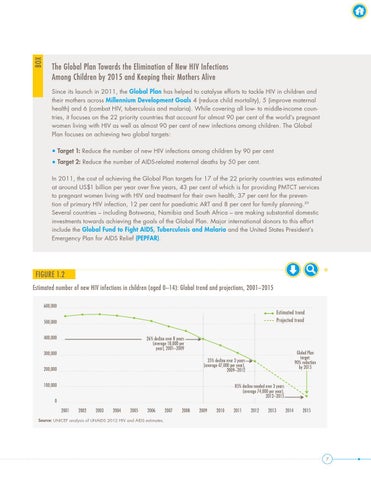
Significant progress is being made in expanding access to ARVs for PMTCT Encouraging progress has been made in scaling up and improving the quality of programmes. In 2012, approximately 900,000 pregnant women living with HIV in low- and middle-income countries received ARVs to prevent mother-to-child transmission – either ART primarily for their own health or the most efficacious antiretroviral prophylaxis.19 This represents one third more than the number who received it in 2009. While the world is currently reducing new HIV infections among children faster than at any other time in history, the pace will have to be accelerated even more to achieve the 2015 target of 90 per cent reduction (see Figure 1.2).
The Global Plan Towards the Elimination of New HIV Infections Among Children by 2015 and Keeping Their Mothers Alive (‘the Global Plan’) identifies 22 priority countries where almost 90 per cent of all new HIV infections among children occur. Of these countries, 21 are in sub-Saharan Africa; the other country is India.15 Reducing mother-to-child transmission to less than 5 per cent of breastfeeding infants and to less than 2 per cent of non-breastfeeding infants is an important target of the Global
FIGURE 1.1 Estimated number of pregnant women living with HIV in low- and middle-income countries, 1990–2012 1.5 million pregnant women living with HIV (2012)
2,000,000
1,500,000
1,000,000
500,000
0 1990
1995
2000
Note: The area in blue indicates the uncertainty ranges around the estimates. Source: UNAIDS 2012 HIV and AIDS estimates.
6
2005
2010
2012
BOX
The Global Plan Towards the Elimination of New HIV Infections Among Children by 2015 and Keeping their Mothers Alive Since its launch in 2011, the Global Plan has helped to catalyse efforts to tackle HIV in children and their mothers across Millennium Development Goals 4 (reduce child mortality), 5 (improve maternal health) and 6 (combat HIV, tuberculosis and malaria). While covering all low- to middle-income countries, it focuses on the 22 priority countries that account for almost 90 per cent of the world’s pregnant women living with HIV as well as almost 90 per cent of new infections among children. The Global Plan focuses on achieving two global targets:
• Target 1: Reduce the number of new HIV infections among children by 90 per cent • Target 2: Reduce the number of AIDS-related maternal deaths by 50 per cent. In 2011, the cost of achieving the Global Plan targets for 17 of the 22 priority countries was estimated at around US$1 billion per year over five years, 43 per cent of which is for providing PMTCT services to pregnant women living with HIV and treatment for their own health, 37 per cent for the prevention of primary HIV infection, 12 per cent for paediatric ART and 8 per cent for family planning.20 Several countries – including Botswana, Namibia and South Africa – are making substantial domestic investments towards achieving the goals of the Global Plan. Major international donors to this effort include the Global Fund to Fight AIDS, Tuberculosis and Malaria and the United States President’s Emergency Plan for AIDS Relief (PEPFAR).
FIGURE 1.2 Estimated number of new HIV infections in children (aged 0–14): Global trend and projections, 2001–2015 600,000
Estimated trend Projected trend
500,000 400,000
26% decline over 8 years (average 18,000 per year), 2001–2009
300,000
Global Plan target: 90% reduction by 2015
35% decline over 3 years (average 47,000 per year), 2009–2012
200,000 100,000
85% decline needed over 3 years (average 74,000 per year), 2012–2015
0 2001
2002
2003
2004
2005
2006
2007
2008
2009
2010
2011
2012
2013
2014
2015
Source: UNICEF analysis of UNAIDS 2012 HIV and AIDS estimates.
7
While the overall coverage of ARVs for PMTCT for low- and middle-income countries reached 62 per cent in 2012, there was considerable variation across regions (see Figure 1.3). In Eastern and Southern Africa, where the HIV burden is greatest, three quarters of pregnant women have access (66–85 per cent). In Central and Eastern Europe and the Commonwealth of Independent States (CEE/CIS), coverage is reported as very high (greater than 95 per cent), as it is in Latin America and the Caribbean (88 per cent; 58–95 per cent). All other regions have estimated coverage below half.21 One of the core targets of the Global Plan is to provide ARVs to 90 per cent of the world’s pregnant women living with HIV by the end of 2015. This is now within reach. In the 22 Global Plan priority countries, 62 per cent of pregnant women living with HIV received ARV prophylaxis in 2012, compared with 57 per cent in 2011 and 49 per cent in 2010.22
Since 2009, most countries have shifted their policies away from the use of single-dose nevirapine to more effective regimens for PMTCT. Four priority countries of the Global Plan – Botswana, Ghana, Namibia and Zambia – have already met the 90 per cent target, while Mozambique, South Africa, Swaziland and Zimbabwe are close to it. However, five countries – Kenya, Lesotho, Nigeria, South Africa and Swaziland – have experienced declines in PMTCT coverage in the last year, and four countries – Angola, Chad, the Democratic Republic of the Congo and Nigeria – had national ARV coverage for PMTCT of less than 20 per cent in 2012.23 The 2013 World Health Organization (WHO) guidelines on ART recommend universal HIV testing for all pregnant women as part of the basic package of services for antenatal care in all settings. In some countries with concentrated or low-prevalence
TOWARDS AN AIDS-FREE GENERATION – Children and AIDS: Sixth Stocktaking Report, 2013
FIGURE 1.3 Estimated percentage of pregnant women living with HIV receiving the most effective antiretroviral medicines for PMTCT, in UNICEF regions, all low- and middle-income countries and the 22 Global Plan priority countries, 2005–2012 2005*
2010
2011
2012
100% 90% 80% 70% 60% 50% 40% 30% 20% 10% 0%
Eastern and Southern Africa
West and Central Africa
Middle East and North Africa
East Asia and the Pacific
South Asia
Latin America and the Caribbean
CEE/CIS
All low- and middle-income countries
22 Global Plan priority countries
Note: The vertical lines indicate the uncertainty ranges around the estimates. Coverage values for 2005–2009 are not comparable with those for 2010–2012 because they are based on previous WHO treatment guidelines and include single-dose nevirapine. Source: UNAIDS, UNICEF and WHO, 2013 Global AIDS Response Progress Reporting, and UNAIDS 2012 HIV and AIDS estimates.
8
© UNICEF/NYHQ2011-0238/Asselin
1
2 3 epidemics, the offer of routine HIV testing for all pregnant women may be considered prohibitive when assessed against the number of cases detected.24 In Viet Nam and other countries with concentrated epidemics, HIV testing is being incorporated into a standard list of tests during pregnancy.25 Adequate referral and linkage to follow-up services is critical. In India, where overall numbers are large but the population of women living with HIV is spread out across the country, the initiation and maintenance of ARVs in women and children living with HIV in maternal and child health settings is recommended as part of antenatal care.26 Cambodia has also demonstrated that this approach can not only increase access to treatment at the level of primary care but also lead to reductions in loss to follow-up of women and children diagnosed with HIV.
Access to ART for pregnant women for their own health is increasing, but is still lower than for other adults The percentage of pregnant women living with HIV (with CD4 levels less than 350 cells per cubic millimetre) who received ART for their own health in 2012 in low- and middle-income countries was only 58 per cent, compared with 64 per cent for all adults (with CD4 levels less than 350 cells/mm3) estimated to have received ART that year.27
By 2012, several priority countries of the Global Plan – including Botswana, Ghana, Malawi, Namibia, South Africa, Swaziland and Zambia – reported that more than 75 per cent of pregnant women eligible for ART under WHO’s 2010 criteria received it, while more than 50 per cent were receiving it in Kenya, Lesotho, the United Republic of Tanzania and Zimbabwe.28 As more countries adopt the use of ART for all pregnant and breastfeeding women living with HIV, in line with WHO’s 2013 guidelines on ARVs,29 this upward trend for ART coverage is expected to continue.
Increasing impact: New infections among children are falling As a result of recent progress in EMTCT, fewer infants are acquiring HIV. In low- and middle-income countries, about 260,000 new infections among children occurred in 2012,30 but between 2005 and 2012, more than 850,000 HIV infections in children were prevented in low- and middle-income countries.31 The vast majority of new HIV infections among children aged 0–14 years were in Eastern and Southern Africa (130,000) and West and Central Africa (98,000), followed a long way behind by South Asia (15,000) and East Asia and the Pacific (7,900), and then by all other regions, which reported fewer than 3,000 new infections each in 2012.32
9
FIGURE 1.4 Country progress in reducing new HIV infections among children aged 0–14 in the 21 Global Plan priority countries in Africa, 2009–2012 RAPID DECLINE (50 PER CENT OR MORE)
MODERATE DECLINE (30–49 PER CENT)
SLOW DECLINE (LESS THAN 30 PER CENT)
Ghana (76%)
United Republic of Tanzania (49%)
Cameroon (29%)
Namibia (58%)
South Africa (46%)
Côte d’Ivoire (27%)
Zimbabwe (55%)
Mozambique (45%)
Lesotho (17%)
Malawi (52%)
Uganda (45%)
Democratic Republic of the Congo (15%)
Botswana (52%)
Kenya (44%)
Nigeria (10%)
Zambia (50%)
Swaziland (38%)
Chad (9%)
Ethiopia (50%)
Burundi (31%)
Angola (9% increase)
Source: UNICEF update to a table published in the Joint United Nations Programme on HIV/AIDS, Global Report: UNAIDS report on the global AIDS epidemic 2013, UNAIDS, Geneva, 2013, p. 9.
However, much remains to be done. The CEE/CIS region reports the most favourable transmission rate (6 per cent), followed by Latin America and the Caribbean (10 per cent) and Eastern and Southern Africa (13 per cent). All other regions report worrying transmission rates higher than 20 per cent (East Asia and the Pacific, 22 per cent; West and Central Africa, 28 per cent; Middle East and North Africa, 34 per cent; South Asia, 38 per cent).34
The rate of HIV transmission from mother to child has been steadily improving in most regions.
BOX
TOWARDS AN AIDS-FREE GENERATION – Children and AIDS: Sixth Stocktaking Report, 2013
In the 22 priority countries of the Global Plan, overall mother-to-child transmission rates have declined, from an estimated 26 per cent in 2009 to 17 per cent in 2012. The number of children under 15 who were newly infected in these countries fell by 36 per cent, from 360,000 in 2009 to 230,000 in 2012. In this period, seven countries halved new HIV infections among children (see Figure 1.4).33
Validation of countries achieving elimination of mother-to-child transmission Countries beyond the scope of the Global Plan are also making progress towards EMTCT. For example, Cuba and Panama,35 Thailand36 and several countries in Eastern Europe, including Armenia, Belarus, Georgia, Kazakhstan and the Republic of Moldova,37 report that they are approaching transmission rates of 2 per cent. Regional initiatives are building momentum – for example, the European Action Plan for HIV/AIDS 2012–2015 was established in 2011,38 and elimination initiatives on paediatric HIV infections and congenital syphilis exist in East Asia and the Pacific and in Latin America and the Caribbean.39 In recognition of this trend, WHO has established criteria and processes for validating country reports of the elimination of new HIV infections among children. Countries will apply to WHO, and the process of validation will be supported by regional and country-level bodies set up for this purpose. These criteria and processes were established for validating the elimination of both HIV and congenital syphilis.40
10
More children are accessing ART, but progress for children lags behind progress for adults In the absence of HIV testing and timely ART initiation, one third of infants living with HIV die before their first birthday, and half die before the age of 2 years.41 Globally, the pace of scale-up of ART for children under 15 years is only half that of adults. For children, an increase in ART access of 14 per cent was registered from 2011 to 2012, compared to an increase of 20 per cent for adults over the same period.42 In low- and middle-income countries, overall ART coverage for children under the age of 15 years has consistently been around half that for adults – 34 per cent compared to 64 per cent for adults in 2012 (see Figure 1.5).43 The CEE/CIS region reports the highest ART coverage for children younger than 15 years: at 85 per cent (80–89 per cent), followed by Latin America and the Caribbean at 67 per cent (50–83 per cent). East Asia and the Pacific reported 53 per cent (41–72 per cent) coverage, whereas South Asia reported 39 per cent (30–49 per cent) coverage. The region with the
FIGURE 1.5 Percentage of adults (aged 15+) and children (aged 0–14) living with HIV receiving antiretroviral therapy in low- and middle-income countries, 2012
64% 34% Adults (aged 15+)
Children (aged 0–14)
Source: Joint United Nations Programme on HIV/AIDS, Global Report: UNAIDS report on the global AIDS epidemic 2013, UNAIDS, Geneva, 2013, pp. A87, A94.
greatest need, Eastern and Southern Africa, reported 40 per cent (35–46 per cent) coverage. The lowest coverage was registered in West and Central Africa, 15 per cent (13–18 per cent), and in the Middle East and North Africa, 7 per cent (4–10 per cent).44 ART coverage for children younger than 15 years in the 22 Global Plan priority countries increased from 29 per cent (500,000 children) in 2011 to 34 per cent (560,000 children) in 2012, but the pace of scale-up across low- and middle-income countries lags behind that of adults.45 Four of the Global Plan priority countries had greater than 50 per cent ART coverage among eligible children – Botswana (>95 per cent), Namibia (88 per cent), South Africa (63 per cent) and Swaziland (54 per cent) – and coverage has doubled in nine other countries in the last three years.46 Other priority countries have very low coverage, and on average, only one in three eligible children have access to ART in the 22 priority countries (see Figure 1.6). A huge effort therefore will be needed to reach the global goal of providing ART to all eligible children by 2015. Providing paediatric ART presents a number of unique and complex challenges. Among them are the limited availability of fixed-dose combinations, poor palatability of currently recommended paediatric drug formulations for infants, and the need to use virological testing to determine HIV infection in children under the age of 18 months. However, new drugs such as granular ’sprinkles‘ and new technologies for performing virological testing at the point of care are expected to help overcome the challenges and may facilitate improved uptake and adherence.
Timely diagnosis of HIV in pregnant women and children is crucial, but coverage of testing varies widely and linkages to treatment and care are still inadequate Significant proportions of pregnant women and children living with HIV remain undiagnosed or, if diagnosed, are not adequately enrolled into care.
11
FIGURE 1.6 Percentage of ART coverage among eligible adults (aged 15+), children (aged 0–14) and all ages in the 22 Global Plan priority countries, 2012 Adults (aged 15+)
Children (aged 0–14)
All ages <95
Botswana
88
Namibia Swaziland
76
36 33
United Rep. of Tanzania
70 68
26
68
24
Ethiopia
21
Burundi
67
Ghana
25
Lesotho
25
59 40
16
Cameroon
15
56 55 49 48
27
Mozambique
15
Angola
48 29
Chad
While early infant diagnosis (EID) is expanding in many countries, overall testing rates for infants remain low. Only 39 per cent of children in lowand middle-income countries were estimated to have access to HIV testing within the recommended 2 months of birth in 2012 (see Figure 1.7 ).50
62
India Côte d’Ivoire
WHO recommends that infants exposed to HIV be tested at 4 to 6 weeks of age, using a virological test.49 ART should be started as soon as an infant is diagnosed with HIV, regardless of clinical and immune system status. Some countries are considering even earlier testing, at birth, especially for children born to mothers who have not received PMTCT services.
81
38
Uganda
TOWARDS AN AIDS-FREE GENERATION – Children and AIDS: Sixth Stocktaking Report, 2013
81
63
Malawi
Early infant diagnosis remains low
85
45
Kenya
9
43 38
12
36 34
67
0% 10% 20% 30% 40% 50% 60% 70% 80% 90% 100% Note: Some numbers do not add up due to rounding. The coverage estimate is based on the estimated unrounded number of children receiving and eligible for ART. Source: UNAIDS, UNICEF and WHO, 2013 Global AIDS Response Progress Reporting.
1 12
Four of the 22 Global Plan priority countries (Botswana, Mozambique, South Africa and Zambia) exceeded 95 per cent coverage for testing pregnant women in 2012, but coverage was less than 25 per cent in three others (Chad, the Democratic Republic of the Congo and Nigeria).48
86
South Africa
Total priority countries
87
38
Zimbabwe
Nigeria
91
54
Zambia
Dem. Rep. of the Congo
>95
An estimated 40 per cent of pregnant women in low- and middle-income countries received HIV testing and counselling in 2012, up from 26 per cent in 2009.47 Coverage varies widely by country and region.
2
The CEE/CIS region had the highest coverage of EID of all regions reported, at 72 per cent (although the uncertainty range around the estimates is very wide: from 49 per cent to greater than 95 per cent), followed by Eastern and Southern Africa at 51 per cent (45–57 per cent), Latin America and the Caribbean at 42 per cent (27–57 per cent) and East Asia and the Pacific at 30 per cent (20–45 per cent). In West and Central Africa, EID is at 9 per cent (8–11 per cent). South Asia stands at only 2 per cent (1–3 per cent) coverage.51
FIGURE 1.7 Estimated percentage of infants born to women living with HIV receiving a virological test by 2 months of age, by UNICEF region, all low- and middle-income countries and the 22 Global Plan priority countries, 2010–2012 2010
2011
2012
100% 90% 80% 70% 60% 50% 40% 30% 20% 10% 0%
Eastern and Southern Africa
West and Central Africa
Middle East and North Africa
East Asia and the Pacific
South Asia
Latin America and the Caribbean
CEE/CIS
All low- and middle-income countries
22 Global Plan countries
Note: The vertical lines indicate the uncertainty ranges around the estimates.
INITIATIVES
Source: UNAIDS, UNICEF, WHO, 2013 Global AIDS Response Progress Reporting, and UNAIDS 2012 HIV and AIDS estimates.
Presumptive diagnosis in Lesotho Where early infant diagnosis is weak, severe illness can progress quickly in children with HIV. Presumptive diagnosis allows health workers to offer immediate ART to infants showing signs of HIV-related disease. In some areas of Lesotho, for example, difficult terrain leads to long waits for the return of HIV test results, and also makes it difficult to keep test kits in stock. Delivery of infant HIV test results can take 6 to 12 weeks, delaying the start of life-saving treatment for infants who need it. Presumptive diagnosis eliminates this wait by relying on immediate assessment rather than laboratory test outcomes as the basis for ART initiation. In 2010, the Elizabeth Glaser Pediatric AIDS Foundation (EGPAF) supported Lesotho’s Ministry of Health in training maternal and child health nurses at three hospitals in presumptive diagnosis. Between January 2010 and December 2011, the specially trained nurses diagnosed 48 infants with severe HIV disease and started ART promptly. Of these 48 children, 43 received a test for HIV. When their test results arrived, 42 of them proved to be living with HIV and 1 was HIV-negative. EGPAF intends to train more health-care workers in the WHO presumptive diagnosis criteria. A recommendation for scale-up in Lesotho has been made, while efforts to improve routine systems for EID are also intensifying.
13
Among the 22 Global Plan priority countries, only two were providing EID for more than 80 per cent of infants in need in 2012: South Africa (85 per cent) and Swaziland (81 per cent). They were followed by Namibia (74 per cent), Lesotho (69 per cent52) and Zambia (61 per cent). Coverage of EID is less than 10 per cent in five of the priority countries: Angola, Chad, the Democratic Republic of the Congo, Malawi and Nigeria.53 In low- and middle-income countries, the vast majority of children diagnosed with HIV do not begin ART in a timely manner; in 2012, only 34 per cent of children under 15 years diagnosed with HIV received treatment. As a result, an estimated 210,000 (190,000–250,000) children died from AIDS-related illnesses that year.54
Special attention is needed to ensure that women have access to ARVs and are retained in care during the breastfeeding period Breastfeeding is critical for child survival and growth. WHO recommends that mothers living with HIV who are taking ART and breastfeeding should exclusively
BOX
TOWARDS AN AIDS-FREE GENERATION – Children and AIDS: Sixth Stocktaking Report, 2013
Current service delivery models rely heavily on the provision of paediatric HIV treatment at specialized paediatric HIV clinics or adult HIV clinics, whereas task shifting or task sharing with health-care workers other than medical doctors – to facilitate care to decentralized levels, including through community-based services – should be a priority to improve access.55
While global data on ARV coverage during the breastfeeding period are limited, it is estimated that, in 2012, nearly half of mothers in the 21 Global Plan priority countries in Africa did not receive ARVs during the breastfeeding period. Up to about half of all new infections in children in sub-Saharan Africa are estimated to have occurred as a result.57 Special attention is therefore needed in all countries to ensure access to, and retention on, ART for breastfeeding mothers.
Primary prevention needs for women and family planning services for women living with HIV remain inadequate Provision of ARVs to pregnant women and mothers living with HIV to prevent mother-to-child transmission (identified as Prong 3 of PMTCT in the Global Plan) and of treatment of mothers and children living with HIV for their own health (Prong 4) has been substantial. However, progress in primary
Progress on reducing new HIV infections among children has been faster than ever before. But to meet the 2015 target, the pace of progress will have to accelerate.
850,000
new HIV infections among children (0–14 years) in lowand middle-income countries were prevented between 2005 and 2012.
14
breastfeed their infants for the first six months of life, introducing appropriate complementary foods thereafter, while continuing to breastfeed until the child is 12 months old. Breastfeeding should then stop only when a nutritionally adequate and safe diet without breast milk can be provided. Infants of mothers who are receiving ART and breastfeeding should receive 6 to 12 weeks of infant prophylaxis with daily nevirapine. Alternatives exist for women living with HIV who do not breastfeed.56
39%
Only of children in low- and middle-income countries were estimated to have access to HIV testing within the recommended 2 months of birth in 2012.
prevention among women and girls of childbearing age (Prong 1) and in reducing unmet need for family planning by women living with HIV (Prong 2) has not been as impressive. In the Global Plan priority countries in Africa, the number of women becoming newly infected declined 10 per cent between 2009 and 2012. Ghana reported the greatest decline, at 44 per cent, during the same period, and South Africa reported a 21 per cent decline.58 This trend highlights the need for innovation in following up with pregnant women who test HIV-negative at their first antenatal visit and the importance of broader primary prevention (outside of antenatal settings) among women and girls to achieving the goal of an AIDS-free generation. Unmet need for family planning services among women living with HIV continues to undermine efforts to eliminate new infections among children.59 For women in low- and middle-income countries, unmet need for family planning declined only slightly, from 15 per cent in 1990 to 12 per cent in 2010.60 UNAIDS reports that in East Africa and West Africa, the unmet need for family planning services for more than 20 per cent of women did not change between 1990 and 2010.61 This means that more than one in five women in stable relationships expressing the desire to delay or stop childbearing were not using contraception. Renewed commitment and resources for family planning from the global community, including through the Family Planning 2020 initiative, are
260,000
new HIV infections occurred among children (0–14 years) in low- and middle-income countries in 2012.
one third
welcome.62 Family planning services for women living with HIV must be voluntary and non-coercive. Reports of forced sterilization and other coercive attempts to prevent women living with HIV from having children underscore the importance of a human rights–based approach, including for family planning services.63
NEW PARADIGMS, OPPORTUNITIES AND INNOVATIONS The WHO guidelines on ARVs released in 201364 provide important opportunities to simplify and further scale up interventions among children and their mothers. They include recommendations in the following six areas:
•
Offering ART to all pregnant and breastfeeding women living with HIV, regardless of CD4 count, to protect their health, protect their babies from HIV and protect their sexual partners from HIV. This approach emphasizes the importance of pregnant and breastfeeding women living with HIV beginning treatment without delay. It also reduces the risk of HIV transmission during breastfeeding as long as mothers continue to take ART. Simplifying ART for pregnant and breastfeeding women through the use of a standardized one-pill-daily, fixed-dose combination of three ARVs should also facilitate further decentralization and integration of HIV services to the primary-care level, including maternal and child health services.
62%
of pregnant women living with HIV in 22 Global Plan priority countries received ARVs to prevent mother-to-child transmission in 2012.
Without treatment, of infants living with HIV will die before their first birthday, and half will die before their second birthday.
34%
of children (0–14 years) received the life-saving ART they needed in 2012 versus
64%
of adults.
15
INITIATIVES
Lifelong ART for pregnant women: Malawi blazes the trail In 2011, the Government of Malawi pioneered offering lifelong simplified treatment for all pregnant and breastfeeding women (previously known as Option B+) using a provider-initiated (not mandatory) ‘test and treat approach’, regardless of CD4 count or any other preconditions. Children under 5 years of age are also prioritized in this way, without preconditions. For pregnant women living with HIV, simplified treatment, which consists of a fixed-dose, single-pill, triple-drug regimen taken once per day, was made widely available, including through lower-level health-care facilities. The number of pregnant and breastfeeding women living with HIV started on ART had increased from 1,257 in the second quarter of 2011, to 10,663 in the third quarter of 2012.65 By June 2013, 13 of the 22 Global Plan priority countries had adopted the same policy of offering lifelong ART for all pregnant and breastfeeding women living with HIV, and Lesotho and Uganda (besides Malawi) had already started to implement the approach. Further country progress details are available from the website of the Inter-Agency Task Team on the Prevention and Treatment of HIV Infection in Pregnant Women, Mothers and Children: <www.emtct-iatt.org>.
TOWARDS AN AIDS-FREE GENERATION – Children and AIDS: Sixth Stocktaking Report, 2013
•
•
16
Harmonizing ARV drug regimens for pregnant and breastfeeding women, and other adults and adolescents, living with HIV: Previous WHO guidelines recommended different adult ARV regimens for PMTCT and for treatment. The 2013 WHO guidelines on ARVs recommend the same, fixed-dose, single-pill, triple-drug regimen for all adults and adolescents as first-line therapy. This approach will simplify the delivery of ART for both treatment and prevention and enable pregnant women living with HIV to continue on the same drug regimen for their own health. The experience of Malawi suggests that the simplified regimen is easier to take and that it improves adherence, while also aligning PMTCT and ART services and promoting access to these services in primary-care facilities.66 Expanding ART delivery in antenatal, maternal and child health settings: The 2013 WHO guidelines on ARVs67 include a specific recommendation that, in generalized epidemics, ART should be initiated and maintained in eligible pregnant and post-partum women and infants in maternal and child health-care settings,
with linkage and referral to ongoing HIV care and ART where appropriate. Governments are responding by implementing task-shifting measures to enable midwives and other cadres to initiate and follow up on ART.68
•
Making use of new technologies for infant testing: Diagnostic technologies are now advancing rapidly. In the coming years, point-of-care virological tests for early infant diagnosis should become available, which will allow nurses and other non-physician health workers to test infants at lower-level health facilities, without the need to send samples to central laboratories for processing. This important advance should enable more timely identification of HIV-infected infants and promote more rapid linkage to treatment and care.
•
Recommending lifelong ART for all children under 5 years of age, regardless of CD4: Infants and children are vulnerable to rapid progression of HIV-related disease. Left untreated, half of children born with HIV will die before their second birthday. In order to facilitate rapid
access to treatment for children diagnosed with HIV infection, the 2013 WHO ARV guidelines have recommended immediate treatment without the need for CD4 testing for children up to 5 years of age.69 Addressing the needs of HIV-exposed but uninfected infants: An increasing amount of evidence suggests that all children born to women living with HIV – whether the children are HIV-infected or not – have poorer health outcomes than children born to HIV-free mothers.70 This evidence underscores the importance of early identification and linkage to care and treatment for pregnant women living with HIV. It also highlights the need for increased emphasis on early identification of all HIV-exposed children and linking these mothers and their children to care and support through a wide range of settings.
Innovation Combined technology, treatment and programming innovations are expanding access to HIV services and increasing the speed of service delivery – and such improvements are often more cost-effective than before. They include:
To build upon the progress made in recent years and take advantage of new opportunities to address HIV among children in the first decade of childhood, the following 11 strategies need to be pursued:
1. P ut the health of women at the centre of the response to HIV among children The shift to provide ART to all pregnant and breastfeeding women living with HIV, regardless of CD4 count (previously known as Options B and B+), means that the past distinction between ARVs as prophylaxis to prevent HIV transmission to children and ART for the health of pregnant women is becoming obsolete. The 2013 WHO guidelines on ARVs71 and emerging practice in countries now
1
2
3
• SMS technology, delivering test results and reminders to patients in Malawi and Zambia
• Point-of-care machines and communication
technology in decentralized settings, speeding up diagnoses in Eastern and Southern Africa (supported by UNITAID, the Clinton Health Access Initiative and UNICEF)
• ‘Telemedicine’, a decentralized approach to HIV testing, treatment and care in India (supported by the MAC AIDS Fund and UNICEF).
© UNITAID/2013/Giulio Donini
INITIATIVES
•
STRATEGIES TO ACCELERATE PROGRESS IN THE FIRST DECADE OF LIFE
17
© UNICEF South Africa/2013/Marinovich
TOWARDS AN AIDS-FREE GENERATION – Children and AIDS: Sixth Stocktaking Report, 2013
strongly support the integration of PMTCT and ART programmes by emphasizing that HIV outcomes in children are inextricably linked to the health of their mothers. Furthermore, increasing evidence of poorer health outcomes for infants born to mothers living with HIV, regardless of the HIV status of the infants, points to the importance of early treatment for women living with HIV to protect their own health and that of their babies. The provision of ARV prophylaxis only during pregnancy and breastfeeding for women living with HIV with higher CD4 counts (the approach previously known as Option A) is no longer recommended by WHO and should be phased out as soon as possible.
2. P revent mother-to-child transmission among women from key populations Outside sub-Saharan Africa, the majority of cases of mother-to-child transmission are occurring among key populations, including women who inject drugs and female partners of men who inject drugs, sex workers, female partners of men who also have sex with men, and other marginalized groups such as women in prisons. For example, in Ukraine, where the epidemic is driven by injecting drug use, a study in 2010 showed mother-to-child transmission rates of 11 per cent in women who injected drugs versus 6 per cent in women who did not.72 Scaling up harm reduction programmes and integration with sexual and reproductive health and maternal and child health services has led to substantial increases in coverage of HIV testing and ART for pregnant women injecting drugs. To achieve elimination of mother-to-child transmission in this population wherever they may live, further action is needed to ensure early access to services that can address both
18
drug dependency and HIV-related issues, including provision of medication-assisted substitution treatment for women with opioid drug dependence.73 Women represent 5–10 per cent of the over 30 million people in prisons each year, but this proportion is increasing and women in prisons are at higher risk for HIV than their male counterparts.74 Women can be pregnant, give birth and breastfeed while in prison and other closed settings. The isolation of prison health services from general health services and the substandard conditions and services, including HIV and reproductive health services, means access to PMTCT can be limited. It should be a priority for countries to include populations in closed settings in their efforts to prevent transmission of HIV through comprehensive services equivalent to those in the community.
3. Integrate TB prevention, diagnosis and treatment as a core component of the PMTCT package of care in high TB prevalence settings Active tuberculosis (TB) has been diagnosed at rates up to 10 times higher in pregnant women living with HIV than in women without HIV infection.75 There is also increasing evidence to show that untreated TB in pregnant women living with HIV is associated with a higher risk of poor obstetric and perinatal outcomes, including the death of both the infant and mother. TB in pregnant women living with HIV is also associated with more than double the risk of transmission of HIV to the unborn child.76 It is therefore vital that collaborative TB/ HIV activities be incorporated as part of the package of care at all stages of pregnancy and neonatal, postpartum and post-natal care, particularly in high HIV and TB burden settings. The inclusion of regular TB symptom screening, as recommended by WHO, will help ensure early diagnosis and treatment of TB and also identify women who do not have active TB and are eligible for isoniazid preventive TB therapy. 77 Should full integration of TB diagnostic, prevention and treatment services in maternal, newborn and child health services not be possible, effective patient-centred referral mechanisms with TB services need to be established.
4. A ccelerate the introduction of new technologies for diagnostics and medicines Implementing the 2013 WHO guidelines on ARVs78 should be a priority for countries in order to streamline PMTCT and ART programming and simplify the provision and procurement of ARVs. Improved ARV formulations for children under the age of 3 years, such as ‘sprinkles’, are likely to be available in the near future and will need to be scaled up to help overcome the current limitations of paediatric HIV treatment. More effort is also needed to develop ART regimens that could be harmonized for use by infants and older children as well as adolescents and adults, such as scored dispersible fixed-dose combinations. Introducing new technologies that enable point-of-care virological testing for early infant diagnosis should also be a high priority. Innovations in the use of mobile phone technology are increasing efficiency by providing appointment reminders and health information and reducing turnaround time for laboratory results.
5. D ecentralize and integrate family-centred HIV services, including task shifting
INITIATIVES
In many countries ART services are provided at locations separate from those where maternal and
child health, family planning and other sexual and reproductive health services are provided. Improved integration of these services, including by decentralizing HIV testing, treatment and care to the primary-care level, is essential to strengthen the continuum of HIV care for women and children. WHO recommends task shifting as a critical tool to allow decentralization of treatment and care, and comparable clinical outcomes can be achieved when appropriate training and supervision are provided to non-physician health-care providers. Task shifting and task sharing are important strategies to optimize human resource capacity in settings with weak health systems.79 In particular, the initiation and maintenance of ARVs in women and children living with HIV in maternal and child health settings should contribute to increased access to treatment at the level of primary care and reduce loss to follow-up of women and children diagnosed with HIV in these settings.80 Integration through non-traditional channels such as the employment sector increasingly offers opportunities to reach more women through their participation in the workforce. With the wider backing of the International Labour Organization’s Convention No. 183 on maternity protection, 57 countries have national HIV workplace policies providing a potential platform to facilitate PMTCT and other HIV-related services.81
Integrating PMTCT with maternal and child health services In Rwanda, the integration of the national PMTCT programme into the country’s existing maternal and child health services has helped ensure that virtually all women receive their test results and doubled the proportion of HIV-exposed infants receiving ARV prophylaxis. Studies in some areas show that this figure increased from 47 per cent in 2007 to 96 per cent in 2011. Male involvement increased as well.82 In South Africa, where HIV testing was linked to an immunization programme, mothers involved in the programme reported feeling comfortable with having their infants tested at immunization clinics, and most would recommend it to others.83
19
© UNICEF/NYHQ2011-2151/Esteve
coverage in low- and middle-income countries is low (44 per cent).87 Eastern and Southern Africa reported coverage of 56 per cent, and CEE/CIS reported 69 per cent in 2012; however, all other regions report very low coverage (3–43 per cent).88 Better integration and decentralization of such simple interventions as part of the broader management of childhood illness can significantly improve child health outcomes.89
TOWARDS AN AIDS-FREE GENERATION – Children and AIDS: Sixth Stocktaking Report, 2013
6. A lign programming for all HIV-exposed children with broader efforts to promote child survival, growth and development Major progress in reducing maternal and child mortality has been made in the past 20 years: Between 1990 and 2010, maternal mortality in sub-Saharan Africa dropped by 41 per cent,84 and between 1990 and 2012, the under-five mortality rate declined by 47 per cent.85 The Countdown to 2015: Accountability for Maternal, Newborn and Child Survival report launched in 2013 recognized that HIV cannot be ignored in making progress on maternal mortality.86 The continuing global drive for accelerated and improved maternal and child survival – through routine child immunization programmes and initiatives such as Committing to Child Survival: A Promise Renewed – provides opportunities to create new entry points to HIV testing and enhanced care for both HIV-infected and uninfected children born to women living with HIV, especially in high HIV burden settings. Weaknesses in systems and services can mean that even where the effective course of action is clear, the intervention may not reach the child in time. Research has shown that mortality in children diagnosed with HIV can be reduced by 67 per cent with cotrimoxazole – an antibiotic – as prophylaxis, yet
20
Provider-initiated HIV testing also needs to be more widely available in other services for children, such as routine immunization and early child health or nutrition programmes, as well as community-based and health facility-based services for infants. These services can play an especially important role in identifying children whose mothers did not access antenatal and PMTCT services during pregnancy.
7. S trengthen linkages between HIV programming and national social welfare and community-based support systems HIV has broad social and economic consequences for children and their families, but orphans and vulnerable children, including those living in families affected by HIV, frequently do not receive any type of support.90 Mitigating the impact of HIV on the estimated 17.8 million (16.1 million–21.6 million) of the world’s children who have lost one or both parents to AIDS91 – 85 per cent of whom live in sub-Saharan Africa92 – is a particularly formidable task. While comprehensive social support for children and families affected by HIV is an essential element of the response to HIV, it is frequently an afterthought in many HIV-specific programmes. Stronger linkages between HIV programming and broader national social protection efforts and community-based services are needed to ensure that more children and families receive the support they need. Such social protection programmes, particularly cash transfers, appear to be rapidly expanding, with some estimates suggesting they have doubled in Africa – from
8. R einforce safer breastfeeding efforts and messaging
120 programmes implemented between 2000 and 2009 to about 245 programmes in 2012 – with an estimated US$10 billion supporting cash transfer programmes in 2012 alone.93
The 2013 WHO guidelines on ARVs emphasize that the risk of post-natal HIV transmission through breastfeeding will be minimized as countries transition towards offering ART to all pregnant women living with HIV, as long as they continue on treatment without any lapses. Women who are breastfeeding should do so exclusively – giving their infants only breast milk, without any other kind of food or liquid, up to 6 months of age.98 Women need to be supported in doing this, and these messages should be reinforced in all breastfeeding programming.
Social protection has already proven to have an impact not only in support for children and families already affected by HIV, but also in preventing HIV and improving treatment and care outcomes.94 The opportunity exists now to tailor these programmes to include HIV-affected populations, extending the support they offer to include transportation to clinics, nutrition support, cash transfers for poor households, psychosocial support and palliative care services. In Zambia, the inclusion of early childhood development in the Education Sector Plan (2012– 2015) seeks to expand access to schooling and improve educational quality and equity, especially for orphans and vulnerable children and children affected by HIV and AIDS.95
9. S trengthen primary HIV prevention and family planning services Every new HIV infection in a child also represents a failure of primary HIV prevention for women and girls. Pregnant women may be at increased risk of HIV acquisition and transmission, and rates of sero-conversion (the development of antibodies) during pregnancy can be significant, particularly in high HIV prevalence settings. Comprehensive HIV prevention programming for women and girls, including pregnant women in antenatal care, needs to be reinforced.
Community- and faith-based services have a long tradition of providing HIV-related (health, social and economic) services in rural and remote areas. In Malawi, for example, case management performed by community health workers has resulted in improved retention in care and higher utilization of antenatal and post-natal services for mother-baby pairs. While these approaches have not been brought to scale in many settings,97 their value is increasingly recognized, especially in rural areas. However, over-reliance on volunteers cannot adequately compensate for a lack of government infrastructure and services. Building effective and sustainable community systems requires human and financial resources, and partnerships between community members and the health, social welfare, child protection, legal and political systems.
© UNICEF/NYHQ2011-1692/Pirozzi
In India, mechanisms are being put in place to reduce out-of-pocket expenses for people affected by HIV and support access to primary health care, including through call centres coordinating free and low-cost transport.96
1
2
3 21
© UNICEF/NYHQ2010-2928/Nesbitt
It is estimated that if the unmet need for family planning among women living with HIV was addressed in the 22 countries with the highest burden of HIV, there would be 61,000 fewer children with HIV in 2015 alone.99 Rights-based, non-coercive family planning for women living with HIV needs to become more widely available, particularly through
BOX
TOWARDS AN AIDS-FREE GENERATION – Children and AIDS: Sixth Stocktaking Report, 2013
The target of halving new HIV infections among women of reproductive age is integral to the overall goal of eliminating new HIV infections among children by 2015 and keeping their mothers alive.
under-utilized entry points, such as maternal and child health and sexual and reproductive health services, in addition to primary health-care services.
10. A ddress stigma and discrimination, including through strong community engagement Women living with HIV may face a complex mix of stigma and gender-based inequities, including judgemental attitudes among health-care providers. The challenges may be even greater for young
Comprehensive HIV prevention and family planning for women and girls It has been estimated that deploying comprehensive PMTCT could avert nearly 80 per cent of child HIV infections by 2015 in 25 high HIV burden countries.100 Effective delivery of ARVs to pregnant women living with HIV would account for 60 per cent of averted infections among their infants. Reducing new HIV infections in women of reproductive age and responding to unmet need for family planning would account for 13 per cent, while another 6 per cent would be attributable to limiting the duration of breastfeeding to 12 months.101 Couples testing and counselling is also an important intervention for strengthening HIV prevention, including by making ART available to sero-discordant couples (in which one partner is HIV-positive and the other is not). In 2013, WHO recommended offering ART to all people living with HIV in sero-discordant relationships. Studies suggest that providing HIV testing and counselling for both partners together can result in reduced new infections among such couples.102 In some locations in Rwanda, rates of HIV testing of male partners during antenatal care are now over 80 per cent.103
22
women, women living with disabilities, mothers or pregnant women who inject drugs, and women and their accompanying children in prisons. In addition to the challenge of discrimination from service providers, these women may have fears regarding child custody. Fear of disclosing their own status may inhibit mothers from enrolling children in HIV treatment programmes, especially when there is an obligation to consult other family members about health-care decisions.104
Strengthening monitoring and evaluation will require more focused data-driven planning and analysis of results with equity in mind. Multi-partner support will be not only desirable, but a prerequisite for achieving results that combine to serve the most disadvantaged and excluded. More effective monitoring and evaluation of programmes at the primary health-care level will also help local decision makers improve programme performance. For example, bottleneck analyses were conducted in each of the 22 Global Plan priority countries to identify specific entry points for improvements and to inform costed EMTCT plans for each country. This is a good example of how partnerships and tailored tools can add value and accelerate the pace of progress.
Community engagement is a key approach to tackling HIV-related stigma and discrimination while providing support to children and families living with HIV. An eight-country analysis found that in nearly all settings, community-driven advocacy helps identify and publicize obstacles to HIV treatment access, addresses stigma and discrimination, and promotes human rights and changes to obstructive and discriminatory laws and practices.105 Leadership at all levels is essential to promote law reform and put in place supportive policies that contribute to an enabling environment for the response to HIV among women and children.
As the new approaches described in this section are scaled up, operational research is essential to guide implementation, especially to identify best practices for the delivery of HIV interventions for women and children in primary-care and community-based settings, and to optimize synergies between HIV programming and child and social protection efforts. Answering questions regarding overall transmission rates and the impact of HIV-related programming on maternal and infant morbidity and mortality should be high priorities, along with continuing research on the safety of lifelong ART for pregnant and breastfeeding women. Clinical research can also lead to expanding the range of available interventions for women and children, including improved paediatric treatment options, microbicides and vaccines.
Š UNICEF/NYHQ2011-0268/Nesbitt
11. E xpand the knowledge base through research, monitoring and evaluation
1
2
3
23
REFERENCES Country economies are classified according to per capita gross national income, calculated using the World Bank Atlas method. The classifications as at 1 July 2013 were: low income, $1,035 or less; lower middle income, $1,036 to $4,085; and upper middle income, $4,086 to $12,615.
United Nations Children’s Fund and Economic Policy Research Institute, New York and Cape Town, July 2012.
1
2
3
Joint United Nations Programme on HIV/AIDS, Global Report: UNAIDS report on the global AIDS epidemic 2013, UNAIDS, Geneva, 2013, pp. 6, 39. The 22 priority countries of the Global Plan are: Angola, Botswana, Burundi, Cameroon, Chad, Côte d’Ivoire, Democratic Republic of the Congo, Ethiopia, Ghana, India, Kenya, Lesotho, Malawi, Mozambique, Namibia, Nigeria, South Africa, Swaziland, Uganda, United Republic of Tanzania, Zambia and Zimbabwe. India is the only priority country outside Africa. Joint United Nations Programme on HIV/AIDS, Countdown to Zero: Global Plan Towards the Elimination of New HIV Infections Among Children by 2015 and Keeping Their Mothers Alive, UNAIDS, Geneva, 2011; and UNICEF analysis of UNAIDS 2012 HIV and AIDS estimates.
Joint United Nations Programme on HIV/AIDS, Countdown to Zero: Global Plan Towards the Elimination of New HIV Infections Among Children by 2015 and Keeping Their Mothers Alive, UNAIDS, Geneva, 2011; and UNICEF analysis of UNAIDS 2012 HIV and AIDS estimates. The numbers in parentheses indicate the uncertainty ranges around the estimates.
4
World Health Organization, Consolidated Guidelines on the Use of Antiretroviral Drugs for Treating and Preventing HIV Infection: Recommendations for a public health approach, WHO, Geneva, 2013.
TOWARDS AN AIDS-FREE GENERATION – Children and AIDS: Sixth Stocktaking Report, 2013
5
6
Joint United Nations Programme on HIV/AIDS, Global Report: UNAIDS report on the global AIDS epidemic 2013, UNAIDS, Geneva, 2013, pp. A87, A94.
7
Newell, Marie Louise, et al., ‘Mortality of Infected and Uninfected Infants Born to HIV-Infected Mothers in Africa: A pooled analysis’, The Lancet, vol. 364, no. 9441, 2 October 2004, pp. 1236–1243.
14
Joint United Nations Programme on HIV/AIDS, Countdown to Zero: Global Plan towards the Elimination of New HIV Infections among Children by 2015 and Keeping Their Mothers Alive, UNAIDS, Geneva, 2011, p. 6.
15
The 22 priority countries of the Global Plan are: Angola, Botswana, Burundi, Cameroon, Chad, Côte d’Ivoire, Democratic Republic of the Congo, Ethiopia, Ghana, India, Kenya, Lesotho, Malawi, Mozambique, Namibia, Nigeria, South Africa, Swaziland, Uganda, United Republic of Tanzania, Zambia and Zimbabwe. India is the only priority country outside Africa. Joint United Nations Programme on HIV/AIDS, Countdown to Zero: Global Plan Towards the Elimination of New HIV Infections Among Children by 2015 and Keeping Their Mothers Alive, UNAIDS, Geneva, 2011.
16
World Health Organization, Rapid Advice: Use of antiretroviral drugs for treating pregnant women and preventing HIV infection in infants, WHO, Geneva, June 2010, p. 4.
17
UNAIDS 2012 HIV and AIDS estimates.
18
De Cock, Kevin M., et al., ‘Prevention of Mother-to-Child HIV Transmission in Resource Poor Countries: Translating research into policy and practice’, Journal of the American Medical Association, vol. 283, no. 9, 1 March 2000, pp. 1175–1182.
19
Joint United Nations Programme on HIV/AIDS, Global Report: UNAIDS report on the global AIDS epidemic 2013, UNAIDS, Geneva, 2013, p. 38.
20
Interagency Task Team on the Prevention and Treatment of HIV Infection in Pregnant Women, Mothers and Children, ‘Regional Workshops on Costing of National Plans to Eliminate Motherto-Child Transmission of HIV (eMTCT): Technical report and workshop recommendations’, Interagency Task Team on the Prevention and Treatment of HIV Infection in Pregnant Women, Mothers and Children, New York, 30 November 2012.
21
UNAIDS, UNICEF, WHO, 2013 Global AIDS Response Progress Reporting, and UNAIDS 2012 HIV and AIDS estimates.
8
UNAIDS 2012 HIV and AIDS unpublished estimates.
22
9
UNICEF analysis of UNAIDS 2012 HIV and AIDS estimates.
Ibid.
23
Joint United Nations Programme on HIV/AIDS, Global Report: UNAIDS report on the global AIDS epidemic 2013, UNAIDS, Geneva, 2013. See country annexes.
24
United Nations Children’s Fund, Children and AIDS: A profile of UNICEF’s response in East Asia and Pacific, 2007, UNICEF, Bangkok, 2010; Pan American Health Organization, 2012 Progress Report: Elimination of mother-to-child transmission of HIV and congenital syphilis in the Americas, PAHO, Washington, D.C., 2013; and unpublished 2012 UNAIDS data.
25
National Committee for AIDS, Drugs, and Prostitution Prevention and Control, Viet Nam AIDS Response Progress Report 2012: Following up the 2011 Political Declaration on HIV/AIDS – Reporting period: January 2010–December 2011, Government of Viet Nam, Hanoi, March 2012, p. 43.
26
Ministry of Health & Family Welfare, ‘A Strategic Approach to Reproductive, Maternal, Newborn, Child and Adolescent Health (RMNCH+A) in India: For healthy mother and child’, Government of India, New Delhi, February 2013, p. 18.
10
11
Baral, Stefan, et al., ‘HIV Risk and Associations of HIV Infection among Men Who Have Sex with Men in Peri-Urban Cape Town, South Africa’, BMC Public Health, vol. 11, no. 1, 5 October 2011, pp. 766–773; and Fay, Heather, et al., ‘Stigma, Health Care Access, and HIV Knowledge among Men Who Have Sex with Men in Malawi, Namibia, and Botswana’, AIDS Behaviour, vol. 15, no. 6, August 2011, pp. 1088–1097. Institute of Medicine of the National Academies, ‘Summary Evaluation of PEPFAR’, Report brief, National Academies Press, Washington, D.C., February 2013; and Miller, Elizabeth, and Michael Samson, ‘HIV-Sensitive Social Protection: State of the evidence 2012 in Sub-Saharan Africa’, United Nations Children’s Fund and Economic Policy Research Institute, New York and Cape Town, July 2012.
12
UNAIDS 2012 HIV and AIDS unpublished estimates.
13
Miller, Elizabeth, and Michael Samson, ‘HIV-Sensitive Social Protection: State of the evidence 2012 in Sub-Saharan Africa,
46
27
Joint United Nations Programme on HIV/AIDS, Global Report: UNAIDS report on the global AIDS epidemic 2013, UNAIDS, Geneva, 2013, pp. 42, A87.
28
Joint United Nations Programme on HIV/AIDS, 2013 Progress Report on the Global Plan Towards the Elimination of New HIV Infections Among Children by 2015 and Keeping Their Mothers Alive, UNAIDS, Geneva, June 2013, pp. 12–13. World Health Organization, Consolidated Guidelines on the Use of ARV Drugs for Treating and Preventing HIV Infection: Recommendations for a public health approach, WHO, Geneva, June 2013.
29
30
Joint United Nations Programme on HIV/AIDS, Global Report: UNAIDS report on the global AIDS epidemic 2013, UNAIDS, Geneva, 2013, p. 38.
UNAIDS 2012 HIV and AIDS estimates.
31 32
Ibid.
33
UNICEF analysis of UNAIDS 2012 HIV and AIDS estimates.
34
Ibid.
35
Pan American Health Organization, 2012 Progress Report: Elimination of mother-to-child transmission of HIV and congenital syphilis in the Americas, PAHO, Washington, D.C., 2013.
36
37
Thai National Coalition on AIDS, Ministry of Public Health and Thai Department of Disease Control, ‘Thailand AIDS Progress Report 2012: Status at a glance’, Government of Thailand, Bangkok, March 2012. Joint United Nations Programme on HIV/AIDS, ‘2012 Progress Reports Submitted by Countries’, UNAIDS, Geneva, <www.unaids.org/en/dataanalysis/knowyourresponse/ countryprogressreports/2012countries>, accessed 27 August 2013.
38
World Health Organization Regional Office for Europe, European Action Plan for HIV/AIDS 2012–2015, WHO Europe, Copenhagen, 2011.
39
Srikantiah, Padmini, Elimination of New Paediatric HIV Infections and Congenital Syphilis in Asia-Pacific 2011– 2015: Conceptual framework – Monitoring and evaluation guide, United Nations Children’s Fund East Asia and Pacific Regional Office, Bangkok, Thailand, August 2011; and World Health Organization, ‘Elimination of Congenital Syphilis: Regional updates’, WHO, Geneva, 2013, <www.who.int/ reproductivehealth/topics/rtis/cs_regional_updates/en/index. html>, accessed 20 August 2013.
40
International AIDS Society, ‘Measuring Effectiveness of the National PMTCT Programme and Validating EMTCT: Towards elimination of mother-to-child transmission of HIV’, XIX International AIDS Conference, Washington, D.C., 22–27 July 2012, <http://pag.aids2012.org/session. aspx?s=50>, accessed 20 August 2013.
41
Newell, Marie Louise, et al., ‘Mortality of Infected and Uninfected Infants Born to HIV-Infected Mothers in Africa: A pooled analysis’, The Lancet, vol. 364, no. 9441, 2 October 2004, pp. 1236–1243.
42
World Health Organization, United Nations Children’s Fund and Joint United Nations Programme on HIV/AIDS, Global Update on HIV Treatment 2013: Results, impact and opportunities, WHO, Geneva, June 2013, p. 13.
43
Joint United Nations Programme on HIV/AIDS, Global Report: UNAIDS report on the global AIDS epidemic 2013, UNAIDS, Geneva, 2013, pp. A87, A94.
44
UNAIDS, UNICEF, WHO, 2013 Global AIDS Response Progress Reporting and UNAIDS 2012 HIV and AIDS estimates.
45
UNAIDS, UNICEF, WHO, 2013 Global AIDS Response Progress Reporting and UNAIDS 2012 HIV and AIDS estimates.
46
Joint United Nations Programme on HIV/AIDS, 2013 Progress Report on the Global Plan Towards the Elimination of New HIV Infections among Children by 2015 and Keeping Their Mothers Alive, UNAIDS, Geneva, June 2013. See country annexes.
47
World Health Organization, United Nations Children’s Fund and Joint United Nations Programme on HIV/AIDS, Global Update on HIV Treatment 2013: Results, impact and opportunities, WHO, Geneva, June 2013, p. 60.
48
Ibid., p. 30.
49
World Health Organization, WHO Recommendations on the Diagnosis of HIV Infection in Infants and Children, WHO, Geneva, 2010.
50
UNAIDS, UNICEF, WHO, 2013 Global AIDS Response Progress Reporting, and UNAIDS 2012 HIV and AIDS estimates.
51
Ibid.
52
Lesotho data are for 2011; 2012 data were unavailable.
UNAIDS, UNICEF, WHO, 2013 Global AIDS Response Progress Reporting, and UNAIDS 2012 HIV and AIDS estimates.
53
54
Joint United Nations Programme on HIV/AIDS, Global Report: UNAIDS report on the global AIDS epidemic 2013, UNAIDS, Geneva, 2013, pp. 48, A94.
55
The World Health Organization defines task shifting or task sharing as “the rational re-distribution of tasks among health workforce teams. Specific tasks are moved, where appropriate, from highly qualified health workers to health workers who have fewer qualifications in order to make more efficient use of the available human resources for health.” World Health Organization, Task Shifting: Rational redistribution of tasks among health workforce teams – Global recommendations and guidelines, WHO, Geneva, 2008.
56
World Health Organization, Consolidated Guidelines on the Use of ARV Drugs for Treating and Preventing HIV Infection: Recommendations for a public health approach, WHO, Geneva, June 2013.
57
Joint United Nations Programme on HIV/AIDS, 2013 Progress Report on the Global Plan Towards the Elimination of New HIV Infections by 2015 and Keeping Their Mothers Alive, UNAIDS, Geneva, June 2013, p. 9.
58
Joint United Nations Programme on HIV/AIDS, Global Report: UNAIDS report on the global AIDS epidemic 2013, UNAIDS, Geneva, 2013, p. 41.
United Nations Population Fund, Preventing HIV and Unintended Pregnancies: Strategic framework 2011–2015 – In support of the Global Plan Towards the Elimination of New HIV Infections Among Children by 2015 and Keeping Their Mothers Alive, UNAIDS, New York, 2012.
59
60
Alkema, Leontine, et al., ‘National, Regional and Global Rates and Trends in Contraceptive Prevalence and Unmet Need for Family Planning between 1990 and 2015: A systematic and comprehensive analysis’, The Lancet, vol. 11, no. 381, 11 May 2013, pp. 1642–1652.
61
Joint United Nations Programme on HIV/AIDS, Global Report: UNAIDS report on the global AIDS epidemic 2013, UNAIDS, Geneva, 2013, pp. 41–42.
47
62
Family Planning 2020, ‘Family Planning 2020’, Bill & Melinda Gates Foundation, Seattle (WA), 2012, <www.familyplanning2020.org>, accessed 16 August 2013.
63
Nair, Pooja, ‘Litigating against the Forced Sterilization of HIV-Positive Women: Recent developments in Chile and Namibia’, Harvard Human Rights Journal, vol. 23, no. 1, 2010, pp. 223–231; and Center for Reproductive Rights and Vivo Positivo, ‘Dignity Denied: Violations of the right to HIV-positive women in Chilean health facilities’, Center for Reproductive Rights, New York, 2010, <www.genderandaids.org/index .php?option=com_content&view=article&id=861: dignity-denied-violations-of-the-rights-of-hiv-positive-womeninchilean-health-facilities&catid=38:latin-america-and-thecaribbean&Itemid=118>.
64
65
66
Using Injecting Drugs in Ukraine, 2000–10’, Addiction, vol. 107, no. 1, 1 January 2012, pp. 118–128. 73
Ibid; and Adelekan, Moruf L., ‘Substance Use, HIV Infection and the Harm Reduction Approach in Sub-Saharan Africa’, International Journal of Drug Policy, vol. 9, no. 5, 1 October 1998, pp. 315–323.
74
United Nations Office on Drugs and Crime, ‘Women and HIV in Prison Settings’, Policy brief, UNODC, Vienna, Austria, 2008, p. 1; and United Nations Office on Drugs and Crime, International Labour Organization, United Nations Development Programme, World Health Organization and United Nations Joint Programme on HIV/AIDS, ‘Policy Brief: HIV prevention, treatment, and care in prisons and other closed settings – A comprehensive package of interventions’, UNODC, Vienna, June 2013, p. 1.
75
Chimbwandira, Frank, et al., ‘Impact of an Innovative Approach to Prevent Mother-to-Child Transmission of HIV: Malawi, July 2011 to September 2012’, Morbidity and Mortality Weekly Report, vol. 62, no. 8, 1 March 2013, pp. 148–151.
Kali, Paula B. N., et al., ‘Combining PMTCT with Active Case Finding for Tuberculosis’, Journal of Acquired Immune Deficiency Syndromes, vol. 42, no. 3, July 2006, pp. 379–381; and World Health Organization, WHO Policy on Collaborative TB/ HIV Activities: Guidelines for national programmes and other stakeholders, WHO, Geneva, 2012.
76
Ibid; and World Health Organization, United Nations Children’s Fund and Joint United Nations Programme on HIV/AIDS, Global Update on HIV Treatment 2013: Results, impact and opportunities, WHO, Geneva, June 2013, p. 27.
Gupta, Amita, et al., ‘Maternal Tuberculosis: A risk factor for mother-to-child transmission of human immunodeficiency virus’, Journal of Infectious Diseases, vol. 203, no. 3, 1 February 2011, pp. 358–362.
77
World Health Organization, Guidelines for Intensified Tuberculosis Case-Finding and Isoniazid Preventive Therapy for People Living with HIV in Resource-Constrained Settings, WHO, Geneva, 2011; and Patel, M. R., et al., ‘Outcomes of Integrated Treatment for Tuberculosis and HIV in Children at the Primary Health Care Level’, International Journal of Tuberculosis and Lung Disease, vol. 17, no. 9, 1 September 2013, pp. 1206–1211.
78
World Health Organization, Consolidated Guidelines on the Use of Antiretroviral Drugs for Treating and Preventing HIV Infection: Recommendations for a public health approach, WHO, Geneva, 2013.
79
Weigel, Ralf, et al., ‘Managing HIV-Infected Children in a Low-Resource, Public Clinic: A Comparison of Nurse vs. Clinical Officer Practices in ART Refill, Calculation of Adherence and Subsequent Appointments’, Journal of the International AIDS Society, vol. 15, no. 2, 17 August 2012; Cohen, Rachel, et al., ‘Antiretroviral Treatment Outcomes from a Nurse-Driven, Community-Supported HIV/AIDS Treatment Programme in Rural Lesotho: Observational cohort assessment at two years’, Journal of the International AIDS Society, vol. 12, 8 October 2009; and Van Griensven, Johan, et al., ‘Success with Antiretroviral Treatment for Children in Kigali, Rwanda: Experience with health center/nurse-based care’, BMC Pediatrics, vol. 8, no. 1, 2 October 2008.
80
Kredo, Tamara, et al., ‘Decentralising HIV Treatment in Lower- and Middle-Income Countries’, Cochrane Database of Systematic Reviews, no. 6, 27 June 2013; Government of Rwanda, International Planned Parenthood Federation, Joint United Nations Programme on HIV/AIDS, United Nations Population Fund and World Health Organization, ‘Linking Sexual and Reproductive Health and HIV: Gateways to integration – A case study from Rwanda – A glimpse of the future – Eliminating new HIV infections among children and keeping their mothers alive’, Government of Rwanda, IPPF, UNAIDS, UNFPA and WHO, Rwanda, 2013, p. 13; Ong’ech, John O., et al., ‘Provision of Services and Care for HIV-Exposed Infants:
World Health Organization, Consolidated Guidelines on the Use of Antiretroviral Drugs for Treating and Preventing HIV Infection: Recommendations for a public health approach, WHO, Geneva, 2013.
World Health Organization, Consolidated Guidelines on the Use of Antiretroviral Drugs for Treating and Preventing HIV Infection: Recommendations for a public health approach, WHO, Geneva, 2013, p. 35.
67
TOWARDS AN AIDS-FREE GENERATION – Children and AIDS: Sixth Stocktaking Report, 2013
68
Ministry of Health & Family Welfare, ‘A Strategic Approach to Reproductive, Maternal, Newborn, Child and Adolescent Health (RMNCH+A) in India: For healthy mother and child’, Government of India, New Delhi, February 2013, p. 21; and Government of Rwanda, International Planned Parenthood Federation, Joint United Nations Programme on HIV/AIDS, United Nations Population Fund and World Health Organization, ‘Linking Sexual and Reproductive Health and HIV: Gateways to integration – A case study from Rwanda – A glimpse of the future – Eliminating new HIV infections among children and keeping their mothers alive’, Government of Rwanda, IPPF, UNAIDS, UNFPA and WHO, Rwanda, 2013, p. 13.
69
World Health Organization, Consolidated Guidelines on the Use of Antiretroviral Drugs for Treating and Preventing HIV Infection: Recommendations for a public health approach, WHO, Geneva, 2013, p. 108.
70
Filteau, Suzanne, ‘The HIV-Exposed, Uninfected African Child’, Tropical Medicine & International Health, vol. 14, no. 3, March 2009, pp. 276–287; Marinda, Edmore, et al., ‘Child Mortality according to Maternal and Infant HIV Status in Zimbabwe’, Pediatric Infectious Disease Journal, vol. 26, no. 6, June 2007, pp. 519–526; and Landes, Megan, et al., ‘Mortality and Health Outcomes of HIV-Exposed and Unexposed Children in a PMTCT Cohort in Malawi’, PloS One, vol. 7, no. 10, October 2012, pp. 1–7.
71
World Health Organization, Consolidated Guidelines on the Use of Antiretroviral Drugs for Treating and Preventing HIV Infection: Recommendations for a public health approach, WHO, Geneva, 2013.
72
Thorne, Claire, et al., ‘Prevention of Mother-to-Child Transmission of Human Immunodeficiency Virus among Pregnant Women
48
A comparison of maternal and child health clinic and HIV comprehensive care clinic models’, Journal of Acquired Immune Deficiency Syndromes, vol. 61, no. 1, 1 September 2012, pp. 83–89; and Bolton-Moore, Carolyn, et al., ‘Clinical Outcomes and CD4 Cell Response in Children Receiving Antiretroviral Therapy at Primary Health Care Facilities in Zambia’, Journal of the American Medical Association, vol. 298, no. 16, 24 October 2007, pp. 1888–1899. 81
International Labour Organization, ‘Outcome 8: The world of work responds effectively to the HIV/AIDS epidemic’, ILO, Geneva, 2012, <www.ilo.org/public/english/bureau/ program/download/pdf/10-11/iroutcome8.pdf>, accessed 22 August 2013; and International Labour Organization, Report of the Director-General: ILO programme implementation 2008–2009, ILO, Geneva, 2012, pp. 85–86.
82
Government of Rwanda, International Planned Parenthood Federation, Joint United Nations Programme on HIV/AIDS, United Nations Population Fund and World Health Organization, ‘Linking Sexual and Reproductive Health and HIV: Gateways to integration – A case study from Rwanda – A glimpse of the future – Eliminating new HIV infections among children and keeping their mothers alive’, Government of Rwanda, IPPF, UNAIDS, UNFPA and WHO, Rwanda, 2013, p. 13.
83
Rollins, Nigel, et al., ‘Universal HIV Testing of Infants at Immunization Clinics: An acceptable and feasible approach for early infant diagnosis in high HIV prevalence settings’, AIDS, vol. 23, no. 14, 10 September 2009, pp. 1851–1857.
84
World Health Organization, United Nations Children’s Fund, United Nations Population Fund and World Bank, Trends in Maternal Mortality: 1990 to 2010 – WHO, UNICEF, UNFPA and the World Bank estimates, WHO, Geneva, 2012, p. 25.
85
United Nations Children’s Fund, Committing to Child Survival: A promise renewed – Progress report 2013, UNICEF, New York, September 2013, p. 7.
86
World Health Organization, Accountability for Maternal, Newborn & Child Survival: The 2013 update, WHO, Geneva, 2013, p. 7.
87
UNAIDS, UNICEF, WHO, 2013 Global AIDS Response Progress Reporting, and UNAIDS 2012 HIV and AIDS estimates.
Children’s Fund and Economic Policy Research Institute, New York and Cape Town, July 2012. 91
UNAIDS 2012 HIV and AIDS unpublished estimates.
92
UNICEF analysis of UNAIDS 2012 HIV and AIDS estimates.
93
Garcia, Marito, and Charity M. T. Moore, The Cash Dividend: The rise of cash transfer programs in Sub-Saharan Africa, World Bank Publications, Washington D.C., February 2012.
94
Miller, Elizabeth, and Michael Samson, ‘HIV-Sensitive Social Protection: State of the evidence 2012 in Sub-Saharan Africa’, United Nations Children’s Fund and Economic Policy Research Institute, New York and Cape Town, July 2012; United Nations Development Programme and Joint United Nations Programme on HIV/AIDS, Understanding and Acting on Critical Enablers and Development Synergies for Strategic Investments, UNDP, New York, 2012, pp. 5, 19; United Nations Educational, Scientific and Cultural Organization, Good Policy and Practice in HIV and Health Education: Booklet 7 – Gender equality, HIV and education, UNESCO, Paris, 2012, pp. 35–43; Erulkar, Annabel, et al., ‘Tap and Reposition Youth (TRY): Providing social support, savings, and microcredit opportunities for young women in areas with high HIV prevalence’, SEEDS Pamphlet Series, vol. 23, Population Council, New York, 23 November 2006; Vincent, Katharine, and Tracy Cull, ‘Impacts of Social Cash Transfers: Case study evidence from across southern Africa’, Second Conference of the IESE: Poverty Dynamics and Economic Accumulation Patterns in Mozambique, Maputo, 22–23 April 2009, Regional Hunger and Vulnerability Program, Johannesburg, South Africa, 2009; and Baird, Sarah J., et al., ‘Effect of a Cash Transfer Programme for Schooling on Prevalence of HIV and Herpes Simplex Type 2 in Malawi: A cluster randomised trial, The Lancet, vol. 379, no. 9823, 7 April 2012, pp. 1320–1329.
95
This work is supported by the Hilton Foundation and UNICEF.
96
Ministry of Health and Family Welfare. ‘A Strategic Approach to Reproductive, Maternal, Newborn, Child and Adolescent Health (RMNCH+A) in India: For healthy mother and child’, Government of India, New Delhi, February 2013, p. 21.
97
Kim, Maria H., et al., ‘The Tingathe Program: A pilot intervention using community health workers to create a continuum of care in the prevention of mother to child transmission of HIV (PMTCT) cascade of services in Malawi’, Journal of the International AIDS Society, vol. 15, supplement 2, 11 July 2012, doi: 10.7448/ IAS.15.4.17389.
98
World Health Organization, Joint United Nations Programme on HIV/AIDS, United Nations Population Fund and United Nations Children’s Fund, Guidelines on HIV and infant feeding 2010: Principles and recommendations for infant feeding in the context of HIV and a summary of evidence, WHO, Geneva, 2010.
99
Stover, John, and Mary Mahy, ‘The Cost-Effectiveness of Family Planning in Reducing the Number of Children with HIV Infection’, Presentation at the sixteenth International Conference on AIDS and STIs in Africa, Addis Ababa, 4–8 December 2011.
Ibid.
88 89
90
World Health Organization, United Nations Children’s Fund and Joint United Nations Programme on HIV/AIDS, Global Update on HIV Treatment 2013: Results, impact and opportunities, WHO, Geneva, June 2013; Ong’ech, John O., et al., ‘Provision of Services and Care for HIV-Exposed Infants: A comparison of maternal and child health clinic and HIV comprehensive care clinic models’, Journal of Acquired Immune Deficiency Syndromes, vol. 61, no. 1, 1 September 2012, pp. 83–89; Fayorsey Ruby, N., et al., ‘Decentralization of Pediatric HIV Care and Treatment in Five Sub-Saharan African Countries’, Journal of Acquired Immune Deficiency Syndromes, vol. 62, no. 5, 15 April 2013, pp. 124–130; and Bolton-Moore, Carolyn, et al., ‘Clinical Outcomes and CD4 Cell Response in Children Receiving Antiretroviral Therapy at Primary Health Care Facilities in Zambia’, Journal of the Medical American Association, vol. 298, no. 16, 24 October 2007, pp. 1888–1899. Institute of Medicine of the National Academies, ‘Summary Evaluation of PEPFAR’, Report brief, National Academies Press, Washington, D.C., February 2013; and Miller, Elizabeth, and Michael Samson, ‘HIV-Sensitive Social Protection: State of the evidence 2012 in Sub-Saharan Africa’, United Nations
100
Those countries include Angola, Botswana, Burkina Faso, Burundi, Cameroon, Chad, Côte d’lvoire, Democratic Republic of the Congo, Ethiopia, Ghana, India, Kenya, Lesotho, Malawi, Mozambique, Namibia, Nigeria, Rwanda, South Africa, Sudan, Swaziland, Uganda, United Republic of Tanzania, Zambia and Zimbabwe; and Mahy, Mary, et al., ‘What Will it Take to Achieve Virtual Elimination of Mother-to-Child Transmission of HIV? An assessment of current progress and future needs’, Sexually Transmitted Infections, vol. 86, supplement 2, December 2010, pp. ii48–ii55.
49
TOWARDS AN AIDS-FREE GENERATION – Children and AIDS: Sixth Stocktaking Report, 2013
101
Ibid.
102
World Health Organization, Male Involvement in the Prevention of Mother-to-Child Transmission of HIV, WHO, Geneva, 2012.
103
Government of Rwanda, International Planned Parenthood Federation, Joint United Nations Programme on HIV/AIDS, United Nations Population Fund and World Health Organization, ‘Linking Sexual and Reproductive Health and HIV: Gateways to integration – A case study from Rwanda – A glimpse of the future – Eliminating new HIV infections among children and keeping their mothers alive’, Government of Rwanda, IPPF, UNAIDS, UNFPA and WHO, Rwanda, 2013, p. 13.
104
Thorne, Claire, et al., ‘Prevention of Mother-to-Child Transmission of Human Immunodeficiency Virus among Pregnant Women Using Injecting Drugs in Ukraine, 2000–10’, Addiction, vol. 107, no. 1, 1 January 2012, pp. 118–128.
105
International Treatment Preparedness Coalition, ‘Missing the Target 10: Communities and the Treatment 2.0 initiative – Delivering on the next treatment scale-up’, ITPC, Bangkok and New York, October 2012.
106
United Nations Department of Economic and Social Affairs, Population Division, ‘World Population Prospects: The 2012 revision’, CD-ROM, DESA, June 2013.
107
United Nations Children’s Fund, Progress for Children: A report card on adolescents, Number 10, UNICEF, New York, April 2012, p. 9.
108
UNICEF analysis of UNAIDS 2012 HIV and AIDS estimates.
109
UNAIDS 2012 HIV and AIDS unpublished estimates.
110
UNICEF global databases, 2013, based on DHS, MICS and other national surveys, 2008–2012.
111
Ibid; and Mahy, Mary, Jesus Maria Garcia-Calleja and Kimberly Anne Marsh, ‘Trends in HIV Prevalence among Young People in Generalised Epidemics: Implications for monitoring the HIV epidemic’, Sexually Transmitted Infections, vol. 88, 2012, pp. i65–i75.
112
Eurasian Harm Reduction Network, Young People and Injecting Drug Use in Selected Countries of Eastern and Central Europe, EHRN, Vilnius, 2009.
Joint United Nations Programme on HIV/AIDS and World Health Organization, Joint Strategic Action Framework to Accelerate the Scale-Up of Voluntary Male Medical Circumcision for HIV Prevention in Eastern and Southern Africa, 2012–2016, UNAIDS and WHO, Geneva, November 2011, p. 7.
113
national surveys, 2006–2012. (iii) United Nations Children’s Fund, The State of the World’s Children 2014 (forthcoming). (iv) United Nations, The Millenium Development Goals Report 2013, United Nations, New York, June 2013, p. 33. (v) World Health Organization, ‘Adolescent Pregnancy: Fact sheet number 364’, WHO, Geneva, May 2012, <http://www.who.int/ mediacentre/factsheets/fs364/en>, accessed 23 October 2013. (vi) UNICEF global databases, 2013, based on DHS, MICS and other national surveys, 2006–2012. (vii) Pinheiro, Paulo Sérgio, World Report on Violence Against Children, United Nations, Geneva, 2006, p. 12. (viii) UNICEF global databases, 2013, based on DHS, MICS and other national surveys, 2006–2012. 119
UNICEF analysis of UNAIDS 2012 HIV and AIDS estimates.
120
Ibid.
121
Leclerc-Madlala, Suzanne, ‘Age-Disparate and Intergenerational Sex in Southern Africa: The dynamics of hypervulnerability’, AIDS, vol. 22, supplement 4, December 2008, pp. S17–S25; Leclerc-Madlala, Suzanne, ‘Cultural Scripts for Multiple and Concurrent Partnerships in Southern Africa: Why HIV prevention needs anthropology’, Sexual Health, vol. 6, no. 2, May 2009, pp. 103–110; Stroeken, Koen, et al., ‘HIV among Out-of-School Youth in Eastern and Southern Africa: A review’, AIDS Care, vol. 24, no. 2, February 2012, pp. 186–194; and Cluver, Lucie, et al., ‘Transactional Sex amongst AIDS-Orphaned and AIDS-Affected Adolescents Predicted by Abuse and Extreme Poverty’, Journal of Acquired Immune Deficiency Syndromes, vol. 58, no. 3, 1 November 2011, pp. 336–343.
122
Baral, Stefan, et al., ‘HIV Risk and Associations of HIV Infection among Men Who Have Sex with Men in Peri-Urban Cape Town, South Africa’, BMC Public Health, vol. 11, no. 1, 5 October 2011, pp. 766–773; and Fay, Heather, et al., ‘Stigma, Health Care Access, and HIV Knowledge Among Men Who Have Sex with Men in Malawi, Namibia, and Botswana’, AIDS Behaviour, vol. 15, no. 6, August 2011, pp. 1088–1097.
123
Commission on AIDS in Asia, Redefining AIDS in Asia: Crafting an effective response, Oxford University Press, New Delhi, 2008.
124
United Nations Children’s Fund, Living in Harm’s Way: Young key populations in Asia Pacific’s HIV epidemic (forthcoming).
125
National AIDS Control Organisation India, Ministry of Health and Family Welfare and Government of India, ‘HIV Sentinel Surveillance 2010–11: A technical brief’, Government of India, New Delhi, September 2012; and Thailand Bureau of Epidemiology, ‘HIV Serological Surveillance Report: 2011 Thailand – 29th Round’, Thailand Bureau of Epidemiology, Bangkok, 2012.
126
Chengdu MSM HIV/AIDS Prevention Team, ‘Chengdu MSM HIV/AIDS Prevention Situation and Response Analysis’, Presentation by Chengdu MSM HIV/AIDS Prevention Team at the Men Who Have Sex with Men and Transgender Populations Multi-City HIV Initiative Meeting, Hong Kong, 7–9 December 2010.
127
National AIDS Control Organisation India, Ministry of Health and Family Welfare and Government of India, ‘HIV Sentinel Surveillance 2010–11: A technical brief’, Government of India, New Delhi, September 2012.
128
Joint United Nations Programme on HIV/AIDS, UNAIDS Report on the Global AIDS Epidemic: Annexes, UNAIDS, Geneva, 2012.
129
Socialist Republic of Viet Nam, ‘Fourth Country Report on Following Up the Implementation to the Declaration of
Ibid.
114 115
The 14 priority countries in Africa are: Botswana, Ethiopia, Kenya, Lesotho, Malawi, Mozambique, Namibia, Rwanda, Swaziland, South Africa, United Republic of Tanzania, Uganda, Zambia and Zimbabwe.
116
Cherutich, Peter, et al., ‘Progress in Voluntary Medical Male Circumcision Service Provision: Kenya, 2008–2011’, Morbidity and Mortality Weekly Report, vol. 61, no. 47, 30 November 2012, pp. 957–961.
Joint United Nations Programme on HIV/AIDS, Global Report: UNAIDS report on the global AIDS epidemic 2013, UNAIDS, Geneva, 2013, p. 18.
117
(i) Silverman, Jay G., ‘Adolescent Female Sex Workers: Invisibility, violence and HIV’, Archives of Disease in Childhood, vol. 96, no. 5, 28 February 2011, pp. 478–481. (ii) UNICEF global databases, 2013, based on DHS, MICS and other
118
50
Commitment on HIV and AIDS: Reporting period: January 2008– December 2009’, Government of Viet Nam, Hanoi, March 2010. National AIDS Programme (Myanmar), Department of Health and Ministry of Health, HIV Sentinel Sero-Surveillance Survey Report 2012, National AIDS Programme, Naypyidaw (Myanmar), February 2013, p. 33.
141
Child Helpline International, Annual Report 2012: Giving a voice to children and young people worldwide, Child Helpline International, Amsterdam, June 2013.
142
Schwartländer, Bernhard, et al., ‘Towards an Improved Investment Approach for an Effective Response to HIV/AIDS’, The Lancet, vol. 377, no. 9782, 11 June 2011, pp. 2031–2041.
143
Birdthistle, Isolde, et al., ‘Investing in Young People: A review of national-level spending on HIV prevention for young people in 16 countries with generalized HIV epidemics’, Presented at the nineteenth International AIDS Conference, Washington, D.C., 22–27 July 2012; and UNICEF analysis of unpublished data from the Joint United Nations Programme on HIV/AIDS database of all National AIDS Spending Assessments, February 2013.
144
United Nations Children’s Fund and Futures Institute, The Impact and Cost of the HIV/AIDS Investment Framework for Adolescents, UNICEF, New York, 2013 (unpublished document).
145
At the time this modelling exercise was conducted, only 2011 data and estimates were available. The model and the results were validated by programme experts before the release of the new UNAIDS 2012 country estimates in September 2013. The figures on new HIV infections among adolescents, numbers of adolescents living with HIV and AIDS deaths in adolescents reported here in relation to the modelling may therefore differ from new 2012 country estimates used elsewhere in this report.
146
Joint United Nations Programme on HIV/AIDS and United Nations Development Programme, Understanding and Acting on Critical Enablers and Development Synergies for Strategic Investments, UNDP, New York, 2012.
147
Anderson, Mark, et al., ‘Violence against Children in Swaziland: Findings from a national survey on violence against children in Swaziland – May 15–June 16, 2007’, United Nations Children’s Fund and United States Centers for Disease Control and Prevention, Swaziland and Atlanta, October 2007; and United Nations Children’s Fund, United States Centers for Disease Control and Prevention and Muhimbili University of Health and Allied Sciences, ‘Violence against Children in Tanzania: Findings from a national survey 2009’, UNICEF, Dar es Salaam, August 2011.
148
Jewkes, Rachel K., et al., ‘Intimate Partner Violence, Relationship Power Inequity, and Incidence of HIV Infection in Young Women in South Africa: A cohort study’, The Lancet, vol. 376, no. 9734, 3 July 2010, pp. 41–48; and Kouyoumdjian, Fiona, et al., ‘Intimate Partner Violence Is Associated with Incident HIV Infection in Women in Uganda’, AIDS, vol. 27, no. 8, 15 May 2013, pp. 1331–1338.
149
World Health Organization, Global and Regional Estimates of Violence against Women, WHO, Geneva, 2013, p. 22.
150
Joint United Nations Programme on HIV/AIDS and United Nations Development Programme, ‘Understanding and Acting on Critical Enablers and Development Synergies for Strategic Investments’, UNDP, New York, 2012.
151
Interagency Youth Working Group, ‘The Intersection of Economic Empowerment and Youth Sexual and Reproductive Health’, Youth Lens on Reproductive Health and HIV/AIDS research brief, no. 37, FHI 360, Washington, D.C., May 2013; Joint United Nations Programme on HIV/AIDS and United Nations Development Programme, ‘Understanding and Acting on Critical Enablers and Development Synergies for Strategic Investments’, UNDP, New York, 2012; and Lutz, Brian, ‘Can (Conditional) Cash Transfers Contribute to HIV Prevention for Girls?’,
130
131
Joint United Nations Programme on HIV/AIDS, UNAIDS Report on the Global AIDS Epidemic, 2012, UNAIDS, Geneva, 2013, p. 30.
132
Emmanuel, Faran, et al., ‘Second-Generation Surveillance for HIV/AIDS in Pakistan: Results from the 4th round of Integrated Behavior and Biological Survey 2011–2012’, Sexually Transmitted Infections, published online first: 2 August 2013, doi:10.1136/sextrans-2013-051161.
133
Busza, J., et al., ‘Injecting Behaviour and Service Use among Young Injectors in Albania, Moldova, Romania and Serbia’, International Journal of Drug Policy, vol. 24, no. 5, September 2013, pp. 423–431; and United Nations Regional Office for Central and Eastern Europe/Commonwealth of Independent States, Experiences from the Field: HIV prevention among most at-risk adolescents in Central and Eastern Europe and the Commonwealth of Independent States, UNICEF Regional Office for CEE/CIS, Geneva, 2013.
134
UNICEF global databases, 2013, based on DHS, MICS and other national surveys, 2006–2012.
135
World Health Organization, ‘Statement on HIV Testing and Counselling: WHO, UNAIDS re-affirm opposition to mandatory HIV testing’, WHO, Geneva, 28 November 2012, <www.who.int/hiv/events/2012/world_aids_day/hiv_testing_ counselling/en/index.html>, accessed 3 June 2013.
136
Kasedde, Susan, et al., ‘Reducing HIV and AIDS in Adolescents: Opportunities and challenges’, Current HIV/AIDS Reports, vol. 10, no. 2, June 2013, pp. 159–168.
137
United Nations Development Programme, Global Commission on HIV and the Law: Risks, rights & health, UNDP, New York, July 2012.
138
Evans, Denise, et al., ‘Treatment Outcomes of HIV-Infected Adolescents Attending Public-Sector HIV Clinics across Gauteng and Mpumalanga, South Africa’, AIDS Research and Human Retroviruses, vol. 29, no. 6, June 2013, pp. 892–900; and Shroufi, Amir, et al., ‘HIV-Infected Adolescents in Southern Africa Can Achieve Good Treatment Outcomes: Results from a retrospective cohort study’, AIDS, vol. 27, no. 12, 31 July 2013, pp. 1971–1978.
139
140
Ferrand, Rashida A., et al., ‘Survey of Children Accessing HIV Services in a High HIV Prevalence Setting: Time for adolescents to count?’, Bulletin of the World Health Organization, vol. 88, no. 6, June 2010, pp. 428–434; Ferrand, Rashida A., et al., ‘Causes of Acute Hospitalization in Adolescence: Burden and spectrum of HIV-related morbidity in a country with an early-onset and severe HIV epidemic – A prospective survey’, PLoS Medicine, vol. 7, no. 2, 2 February 2010, pp. 1–11; Ferrand, Rashida A., et al., ‘Undiagnosed HIV Infection among Adolescents Seeking Primary Health Care in Zimbabwe’, Clinical Infectious Diseases, vol. 51, no. 7, 2010, pp. 844–851; and Arrivé, Elise, et al., ‘HIV Status Disclosure and Retention in Care in HIV-Infected Adolescents on Antiretroviral Therapy (ART) in West Africa’, PLoS One, vol. 7, no. 3, 21 March 2012. Ferguson, Jane, et al., ‘WHO Guidelines on HIV Testing and Counselling for Adolescents and Care for Adolescents Living with HIV’, Conference poster, World Health Organization, Geneva, 2013.
51
Discussion paper in Good Policy and Practice in HIV and Health Education: Booklet 7 – Gender equality, HIV and education, UNESCO, Paris, France, 2012, p. 38. 152
Erulkar, Annabel, et al., ‘Tap and Reposition Youth (TRY): Providing social support, savings, and microcredit opportunities for young women in areas with high HIV prevalence’, SEEDS pamphlet series, vol. 23, Population Council, New York, 2006; and Baird, Sarah J., et al., ‘Effect of a Cash Transfer Programme for Schooling on Prevalence of HIV and Herpes Simplex Type 2 in Malawi: A cluster randomised trial’, The Lancet, vol. 379, no. 9823, 7 April 2012, pp. 1320–1329.
153
Rijsdijk, Liesbeth E., et al., ‘The World Starts with Me: A multilevel evaluation of a comprehensive sex education programme targeting adolescents in Uganda’, BMC Public Health, vol. 11, 18 May 2011, pp. 334–346; Inter-Agency Task Team on Education, Communication and Advocacy Tools User’s Guide, American Institutes for Research, Washington, D.C., January 2013, pp. 18–22; Jukes, Matthew, Stephanie Simmons and Donald Bundy, ‘Education and Vulnerability: The role of schools in protecting young women and girls from HIV in southern Africa’, AIDS, vol. 22, supplement 4, December 2008, pp. S41–S56; and Baird, Sarah J., et al., ‘Effect of a Cash Transfer Programme for Schooling on Prevalence of HIV and Herpes Simplex Type 2 in Malawi: A cluster randomised trial’, The Lancet, vol. 379, no. 9823, 7 April 2012, pp. 1320–1329.
154
155
TOWARDS AN AIDS-FREE GENERATION – Children and AIDS: Sixth Stocktaking Report, 2013
156
Jukes, Matthew, Stephanie Simmons and Donald Bundy, ‘Education and Vulnerability: The role of schools in protecting young women and girls from HIV in southern Africa’, AIDS, vol. 22, supplement 4, December 2008, pp. S41–S56. Multiple countries’ data available at World Health Organization, ‘Global School-Based Student Health Surveys’, WHO, Geneva, <www.who.int/chp/gshs/en/index.html>. United Nations Educational, Scientific and Cultural Organization, International Technical Guidance on Sexuality Education: An evidence-informed approach for schools, teachers and health educators, UNESCO, Paris, December 2009; and Kivela, Jari, Evert Ketting and Rob Baltussen, ‘Cost Analysis of School-Based Sexuality Education Programs in Six Countries’, Cost Effectiveness and Resource Allocation, vol. 11, no. 17, 1 August 2013, pp. 1–7.
and HIV/AIDS: A sourcebook of HIV/AIDS prevention programs – Education sector-wide approaches, vol. 2, World Bank, Washington, D.C., 2008; United Nations Children’s Fund, Partnership for Child Development and World Bank, Promoting Quality Education for Orphans and Vulnerable Children: A sourcebook of programme experiences in Eastern and Southern Africa, UNICEF, New York, November 2009; and O’Connell, Tara, Mohini Venkatesh and Donald Bundy, eds., Strengthening the Education Sector Response to School Health, Nutrition and HIV/AIDS in the Caribbean Region: A rapid survey of 13 countries, World Bank, Washington, D.C., March 2009. 161
Bundy, Donald, Rethinking School Health: A key component of education for all, Directions in Development Series, World Bank, Washington, D.C., 2011.
162
United Nations Educational, Scientific and Cultural Organization and Joint United Nations Programme on HIV/AIDS Inter-Agency Task Team on Education, 2011–2012 Education Sector HIV/ AIDS Global Progress Survey: Progression, regression or stagnation?, UNESCO, Paris, 2013.
163
Task Team for the Global Thematic Consultation on Health in the Post-2015 Development Agenda, ‘Health in the Post-2015 Agenda: Report of the global thematic consultation on health’, The World We Want, April 2013, p. 65.
164
United Nations, Political Declaration on HIV/AIDS: Intensifying our efforts to eliminate HIV and AIDS, A/RES/65/277, United Nations, New York, 10 June 2011.
165
International Conference on Population and Development Beyond 2014, ‘Bali Global Youth Forum Declaration’, ICPD, New York, December 2012.
166
‘About Us’, 2010, <www.iattcaba.org/web/guest/about-us>, accessed 18 September 2013; and Inter-Agency Task Team for HIV Prevention and Young People, ‘About the IATT’, 2013, <www.youngpeopleandhiv.org/iatt_about.html>, accessed 18 September 2013.
167
Inter-Agency Task Team on the Prevention and Treatment of HIV Infection in Pregnant Women, Mothers and Children, ‘The Inter-Agency Task Team on the Prevention and Treatment of HIV Infection in Pregnant Women, Mothers and Children’, New York, 2013, <www.emtct-iatt.org>, accessed 18 September 2013.
157
Jukes, Matthew, Stephanie Simmons and Donald Bundy, ‘Education and Vulnerability: The role of schools in protecting young women and girls from HIV in southern Africa’, AIDS, vol. 22, supplement 4, December 2008, pp. S41–S56.
168
Office of the United Nations High Commissioner for Human Rights, ‘Committee on the Rights of the Child’, OHCHR, Geneva, <www2.ohchr.org/english/bodies/crc/>, accessed 20 August 2013.
158
United Nations Educational, Scientific and Cultural Organization and Joint United Nations Programme on HIV/AIDS Inter-Agency Task Team on Education, 2011–2012 Education Sector HIV and AIDS Global Progress Survey: Progression, regression or stagnation?, UNESCO, Paris, 2013; and United Nations Educational, Scientific and Cultural Organization, International Technical Guidance on Sexuality Education: An evidence-informed approach for schools, teachers and health educators, UNESCO, Paris, December 2009.
169
United Nations High Commissioner for Refugees, Displacement: The new 21st-century challenge – UNHCR global trends 2012, UNHCR, Geneva, June 2013.
170
Government of Mozambique, ‘Ministry of Health Reports: ART’, Ministry of Health Mozambique, 2013, <www.misau.gov.mz/ index.php/hiv-sida/cat_view/82-hivsida/89-informacaoestrategica-relatorios/90-relatorios-tarv>, accessed 2 October 2013.
171
Inter-Agency Task Team to Address HIV in Humanitarian Emergencies, ‘Interrupted HIV Treatment in a Forgotten Conflict: The Central African Republic’, United Nations High Commissioner for Refugees and United Nations World Food Programme, August 2013; and Inter-Agency Standing Committee, IASC Guidelines for Addressing HIV interventions in Humanitarian settings, IASC, Geneva, September 2010.
159
United Nations Educational, Scientific and Cultural Organization, International Technical Guidance on Sexuality Education: An evidence-informed approach for schools, teachers and health educators, UNESCO, Paris, December 2009.
160
Valerio, Alexandria, et al., ‘Education and HIV/AIDS: A sourcebook of HIV/AIDS prevention programmes’, Working paper, World Bank, Washington, D.C., 2003; Beasley, Michael, Alexandria Valerio and Donald A. P. Bundy, eds., Education
52
ANNEX: STATISTICAL TABLES NOTES ON THE DATA
whose parents have died due to all causes or AIDS for past years based on the refined methodology.
Data sources and compilation
To achieve consistency and establish a comparative measurement of progress, trend analyses must be recalculated using only the newly generated estimates.
The data and analyses presented in this Sixth Stocktaking Report are derived from information in UNICEF global databases that are compiled from various sources. These include nationally representative data collected from household surveys – e.g., Demographic and Health Surveys, Multiple Indicator Cluster Surveys and Reproductive Health Surveys; national programme service statistics collected annually by UNAIDS, UNICEF and WHO through the Global AIDS Response Progress Reporting (GARPR) process: country estimates of HIV care and treatment needs modelled by UNAIDS and WHO in collaboration with countries; and the United Nations Population Division country estimates of the number of annual births. In 2013, UNAIDS, UNICEF and WHO collected HIV coverage data from national programmes worldwide, through the 2013 GARPR process, a reporting tool used to monitor and report on their national progress towards HIV and AIDS goals and targets. The tool typically comprises indicators to track progress towards universal access to HIV prevention, treatment and care, including HIV interventions for women and children such as preventing mother-to-child transmission and paediatric HIV care. The tool also collated updated household survey data on HIV knowledge and sexual behaviour. The GARPR replaces the Joint Reporting Tool on the health-sector response to HIV and AIDS and collected HIV programme data for the 12-month period of January–December 2013.
Estimates on HIV care and treatment needs of children and pregnant women In 2013, UNAIDS and WHO refined the HIV and AIDS estimation methodology to reflect more reliable data available from population-based surveys, expanded national sentinel surveillance systems and programme service statistics in a number of countries. As a result, UNAIDS has retrospectively generated new estimates for HIV prevalence, numbers of people living with HIV, paediatric HIV treatment needs and children
Similarly, global estimates of the number of children in need of antiretroviral therapy and the number of pregnant women living with HIV have been refined, and the coverage rates for 2005–2011 have thus been recalculated using the newly generated estimates. These estimates included the most recent country-reported data from 2012. The methods and assumptions of the UNAIDS and WHO estimation model continue to evolve and are regularly updated as new data become available. As a result, the estimated proportion of children (aged 0–14) who received antiretroviral therapy in 2012 is 34 per cent. It is not very different from the estimated coverage published in previous stocktaking reports. Any change in estimated coverage is not related to an increase or a decrease in the number of children in need of antiretroviral therapy receiving treatment, but to changes in the estimation methodology and in coverage of key HIV and AIDS programme interventions, particularly PMTCT. In light of these changes, 2012 coverage rates should not be compared with coverage figures published in previous versions of progress reports including the same data. For this reason, all estimates of paediatric antiretroviral therapy and antiretrovirals for PMTCT for previous years have been back-calculated for this year’s report. Overall, the differences between the newly generated estimates and previously published estimates are not related to trends over time, and are therefore not comparable. Nor are other revised estimates comparable to estimates published in previous years. Trends over time may be assessed, however, using new UNAIDS methodological revisions applied retrospectively to earlier HIV and AIDS data. More details about the data, reporting by specific countries and the methodology for HIV estimates can be found at <www.unaids.org>.
53
TABLE 1 Elimination of new HIV infections among children by 2015 and keeping their mothers alive
TOWARDS AN AIDS-FREE GENERATION – Children and AIDS: Sixth Stocktaking Report, 2013
Countries and areas
Afghanistan Albania Algeria Andorra Angola Antigua and Barbuda Argentina Armenia Australia Austria Azerbaijan Bahamas Bahrain Bangladesh Barbados Belarus Belgium Belize Benin Bhutan Bolivia (Plurinational State of) Bosnia and Herzegovina Botswana Brazil Brunei Darussalam Bulgaria Burkina Faso Burundi Cabo Verde Cambodia Cameroon Canada Central African Republic Chad Chile China Colombia Comoros Congo Cook Islands Costa Rica Côte d’Ivoire Croatia Cuba Cyprus Czech Republic Democratic People’s Republic of Korea Democratic Republic of the Congo Denmark Djibouti Dominica Dominican Republic Ecuador Egypt El Salvador Equatorial Guinea Eritrea Estonia Ethiopia Fiji 54
Estimated HIV prevalence (%) among adults (aged 15–49), 2012
Antenatal care coverage – at least one visit (%), 2008–2012*
Annual number of births (thousands), 2012
Estimate
356
–
–
–
–
–
–
–
89 – 92 100 99 84 74 94 86 70 – 43 100
2,839 64 24 – 218 328 1,898 128 26 230 14 3,084 18
32,000 – <500 – – – – – – <1,000 – 38,000 –
28,000 <100 <500 – <1,000 <500 <100 <500 <1,000 <500 <100 32,000 <100
37,000 <100 <500 – 1,200 1,200 <200 <1,000 2,600 <1,000 <200 46,000 <100
4,176 – 63 – 1,300 550 9 166 – 291 – 15,828 14
13 – 20 – – – – – – 46 – 41 –
11 – 15 – >95 60 6 23 – 34 – 35 71
15 – 26 – >95 >95 15 81 – 69 – 49 >95
x
x
x
x
x x x
x x
– – – – 17 – – – – – – – – – – – – – 40 – – – >95 – – – 66 54 – – 64 – – 14 – – – – 19 – – 68 – – – –
1 – – – 14 – 63 22 – – 37 – – 4 – 83 – 44 34 32 21 – 86 >95 – – 53 41 >95 61 56 – – 11 – – 30 1 17 – – 55 – >95 – –
High estimate
100
x
7 1 – – 2,656 – 1,612 13 – – 35 – – 16 – 203 – 40 1,349 9 163 1 12,207 7,641 – – 3,582 2,742 244 1,058 17,362 – – 1,680 – – 854 – 579 – 37 13,294 – 106 – –
Low estimate
–
x x x
<1,000 – – – 19,000 – 2,400 <100 <200 <200 <100 – – 1,400 <100 <500 <500 <100 4,000 <100 <1,000 – 14,000 5,300 – <100 6,700 6,500 <100 2,300 31,000 <500 – 16,000 <500 – 2,800 <500 3,500 – – 24,000 <100 <100 – <100
Estimate
1.1 – 1.2 – 0.7 0.6 <0.1 0.6 – 0.7 – 1.3 0.2
x
<100 – – – 12,000 – 1,400 <100 <100 <100 <100 – – <100 <100 <200 <200 <100 2,900 <100 <200 – 11,000 3,900 – <100 4,400 3,900 <100 <1,000 23,000 <200 – 10,000 <100 – 1,400 <200 2,700 – – 16,000 <100 <100 – <100
High estimate
Estimated percentage of pregnant women living with HIV who received ARVs for PMTCT, 2012
48 97 89 – 80 100 99 99 98 – 77 98 100 55 100 100 – 96 86 97 86 87 94 98 99 – 94 99 98 89 85 100 68 53 – 94 97 92 93 100 90 91 – 100 99 –
x
– – – – 15,000 – – – – – – – – – – – – – 3,400 – – – 13,000 – – – 5,400 5,100 – – 27,000 – – 12,000 – – – – 3,100 – – 20,000 – – – –
Low estimate
Reported number of pregnant women living with HIV who received ARVs for PMTCT, 2012
<0.1 – – – 2.3 – 0.4 0.2 – – 0.2 – – <0.1 – 0.4 – 1.4 1.1 0.2 0.3 – 23.0 – – – 1.0 1.3 0.2 0.8 4.5 – – 2.7 0.4 – 0.5 2.1 2.8 – 0.3 3.2 – <0.1 – –
x
1,053 40 946 – 934 1 695 41 305 80 168 6 20 3,150 4 103 129 8 371 15 273 34 48 3,009 7 70 683 443 10 386 820 391 156 579 246 18,455 912 26 165 – 74 731 41 108 13 118
Estimated number of pregnant women living with HIV, 2012
10 – – – 22 – >95 >95 – – 75 – – >95 – >95 – 60 47 >95 72 – >95 >95 – – 81 69 >95 >95 73 – – 18 – – 59 2 22 – – 84 – >95 – –
Elimination of new HIV infections among children by 2015 and keeping their mothers alive
Countries and areas
Finland France Gabon Gambia Georgia Germany Ghana Greece Grenada Guatemala Guinea Guinea-Bissau Guyana Haiti Holy See Honduras Hungary Iceland India Indonesia Iran (Islamic Republic of) Iraq Ireland Israel Italy Jamaica Japan Jordan Kazakhstan Kenya Kiribati Kuwait Kyrgyzstan Lao People’s Democratic Republic Latvia Lebanon Lesotho Liberia Libya Liechtenstein Lithuania Luxembourg Madagascar Malawi Malaysia Maldives Mali Malta Marshall Islands Mauritania Mauritius Mexico Micronesia (Federated States of) Monaco Mongolia Montenegro Morocco Mozambique Myanmar Namibia
Estimated HIV prevalence (%) among adults (aged 15–49), 2012
– – 4.0 1.3 0.3 – 1.4 – – 0.7 1.7 3.9 1.3 2.1 – 0.5 – – 0.3 0.4 0.2 – – – – 1.7 – – – 6.1 – – 0.3 0.3 – – 23.1 0.9 – – – – 0.5 10.8 0.4 <0.1 0.9 – – 0.4 1.2 0.2 – – <0.1 – 0.1 11.1 0.6 13.3
Antenatal care coverage – at least one visit (%), 2008–2012*
100 100 95 98 98 100 96 – 100 93 85 93 92 90 – 97 – – 74 96 97 78 100 – 99 99 – 99 99 92 88 100 97 54 92 96 92 79 93 – 100 – 86 95 97 99 75 100 81 84 – 96 80 – 99 97 77 91 83 95
x x
x
x
x
x x
x
x x x x x
x x
x
x
Annual number of births (thousands), 2012
61 792 53 77 59 699 794 110 2 474 428 63 16 265 – 208 98 5 25,642 4,736 1,454 1,037 71 156 563 50 1,071 192 340 1,535 2 67 148 181 23 62 57 150 130 – 34 6 781 639 516 8 705 4 – 131 14 2,269 2 – 64 7 739 995 922 60
Estimated number of pregnant women living with HIV, 2012 Estimate
– – 1,500 – – – 9,500 – – – 6,300 2,200 – 5,000 – – – – – – – – – – – – – – – 86,000 – – – – – – 16,000 <1,000 – – – – – 68,000 – – – – – – – – – – – – – 94,000 – 8,100
Low estimate
<100 <1,000 1,300 <1,000 <100 <500 7,800 <100 – 1,000 5,000 1,600 <100 4,200 – <500 <100 <100 27,000 8,100 <500 – <100 <100 <200 <500 <100 – – 76,000 – – <100 <500 <100 – 14,000 <1,000 – – <100 <100 2,100 61,000 <500 <100 4,200 <100 – <500 <100 1,100 – – <100 – <500 81,000 2,800 6,700
High estimate
<100 1,700 1,900 1,300 <100 <500 11,000 <100 – 4,600 8,000 3,100 <500 5,700 – <1000 <100 <100 49,000 20,000 1,100 – <200 <500 <500 <500 <100 – – 97,000 – – <200 <500 <200 – 17,000 1,300 – – <100 <100 3,100 75,000 <1,000 <100 7,200 <100 – <1,000 <100 1,900 – – <100 – <1,000 110,000 4,000 9,700
Reported number of pregnant women living with HIV who received ARVs for PMTCT, 2012
– – 1,064 1,068 24 – 8,957 – 13 252 2,755 738 152 4,889 – 238 – – – 1,048 115 – – – – 295 – – 302 45,397 – – 111 49 – 5 9,153 850 34 – – – 77 40,770 342 – 3,339 – – 554 95 773 – – 5 – 195 80,779 2,890 7,619
Estimated percentage of pregnant women living with HIV who received ARVs for PMTCT, 2012 Estimate
– – 70 – – – 95 – – – 44 33 – >95 – – – – – – – – – – – – – – – 53 – – – – – – 58 87 – – – – – 60 – – – – – – – – – – – – – 86 – 94
Low estimate
– – 57 80 36 – 77 – – 8 34 25 48 85 – 37 – – – 5 11 – – – – 61 – – – 47 – – 64 13 – – 52 69 – – – – 2 54 48 – 44 – – 72 >95 41 – – 15 – 35 74 69 78
High estimate
– – 87 >95 79 – >95 – – 36 55 46 >95 >95 – 60 – – – 13 27 – – – – >95 – – – 60 – – >95 19 – – 64 >95 – – – – 4 67 >95 – 77 – – >95 >95 67 – – 18 – 65 >95 >95 >95 55
TABLE 1 Elimination of new HIV infections among children by 2015 and keeping their mothers alive
TOWARDS AN AIDS-FREE GENERATION – Children and AIDS: Sixth Stocktaking Report, 2013
Countries and areas
Nauru Nepal Netherlands New Zealand Nicaragua Niger Nigeria Niue Norway Oman Pakistan Palau Panama Papua New Guinea Paraguay Peru Philippines Poland Portugal Qatar Republic of Korea Republic of Moldova Romania Russian Federation Rwanda Saint Kitts and Nevis Saint Lucia Saint Vincent and the Grenadines Samoa San Marino Sao Tome and Principe Saudi Arabia Senegal Serbia Seychelles Sierra Leone Singapore Slovakia Slovenia Solomon Islands Somalia South Africa South Sudan Spain Sri Lanka State of Palestine Sudan Suriname Swaziland Sweden Switzerland Syrian Arab Republic Tajikistan Thailand The former Yugoslav Republic of Macedonia Timor-Leste Togo Tonga Trinidad and Tobago Tunisia 56
Estimated HIV prevalence (%) among adults (aged 15–49), 2012
Antenatal care coverage – at least one visit (%), 2008–2012*
– 0.3 – – 0.3 0.5 3.1 – – – <0.1 – 0.7 0.5 0.3 0.4 <0.1 – – – – 0.7 – – 2.9 – – – – – 1.0 – 0.5 – – 1.5 – – – – 0.5 17.9 2.7 – <0.1 – – 1.1 26.5 – – – 0.3 1.1
95 58 – – 90 83 66 100 – 99 61 90 96 79 96 96 91 – 100 100 – 98 94 – 98 100 99 100 93 – 98 97 93 99 – 93 – 97 100 74 26 97 40 – 99 98 74 91 97 100 – 88 79 99
–
99
– 2.9 – – <0.1
x
x
x
x
x
x x
x x
x x x x
x
x
84 72 98 96 x 98
Annual number of births (thousands), 2012
Estimated number of pregnant women living with HIV, 2012 Estimate
Low estimate
High estimate
Estimated percentage of pregnant women living with HIV who received ARVs for PMTCT, 2012
Reported number of pregnant women living with HIV who received ARVs for PMTCT, 2012
Estimate
Low estimate
High estimate
– 593 180 63 139 858 7,028 – 62 72 4,604 – 75 210 160 600 2,383 411 94 22 470 43 224 1,690 410 – 3 2 5 – 7 565 524 94 2 222 53 58 21 17 452 1,102 396 493 383 130 1,263 10 37 114 82 529 265 702
– – – – – – 200,000 – – – – – – <1,000 – – – – – – – – – – 10,000 – – – – – – – – – – 3,200 – – – – – 280,000 7,500 – – – – – 12,000 – – – – –
– <1,000 <100 <100 <200 2,500 170,000 – <100 <100 1,000 – <200 <1,000 <500 <1000 <200 <200 <200 – <100 <200 <100 – 9000 – – – – – <100 – 2,000 <100 – 2,300 <100 <100 <100 – 1,100 260,000 4,600 <500 <100 – – <100 11,000 <100 <100 – <200 4,400
– 1,200 <200 <100 <500 3,900 230,000 – <100 <100 3,200 – <500 1,100 <1,000 4,000 <500 <500 <500 – <200 <500 <200 – 12,000 – – – – – <100 – 3,300 <100 – 4,800 <100 <100 <100 – 2,700 310,000 12,000 <1,000 <100 – – <200 13,000 <200 <200 – <1,000 6,200
– 110 – – 141 707 33,323 – – – 55 – 187 328 215 696 19 – – – – 141 – – 9,057 – 12 17 1 – 36 – 1,000 – 4 3,018 – – – – 57 234,952 1,002 – 5 – 191 107 10,167 – – – 62 4,918
– – – – – – 17 – – – – – – 39 – – – – – – – – – – 87 – – – – – – – – – – 93 – – – – – 83 13 – – – – – 83 – – – – –
– 9 – – 48 18 15 – – – 2 – 59 29 29 25 9 – – – – 64 – – 75 – – – – – 42 – 30 – – 67 – – – – 2 75 8 – 6 – – >95 75 – – – 11 78
– 18 – – >95 30 19 – – – 6 – >95 51 >95 >95 18 – – – – >95 – – >95 – – – – – 86 – 48 – – >95 – – – – 5 90 21 – 16 – – >95 92 – – – 44 >95
23
–
–
–
–
–
–
–
40 245 3 20 189
– 5,100 – – –
– 4,200 – <500 <100
– 6,300 – <500 <100
– 4,411 – – 9
– 86 – – –
– 70 – – 17
– >95 – – 52
Elimination of new HIV infections among children by 2015 and keeping their mothers alive
Countries and areas
Estimated HIV prevalence (%) among adults (aged 15–49), 2012
Antenatal care coverage – at least one visit (%), 2008–2012*
Turkey Turkmenistan Tuvalu Uganda Ukraine United Arab Emirates United Kingdom United Republic of Tanzania United States Uruguay Uzbekistan Vanuatu Venezuela (Bolivarian Republic of) Viet Nam Yemen Zambia Zimbabwe
– – – 7.2 0.9 – – 5.1 – 0.7 0.1 – 0.6 0.4 0.1 12.7 14.7
92 99 97 93 99 100 – 88 – 96 99 84 94 94 47 94 90
SUMMARY INDICATORS Sub-Saharan Africaa/ Eastern and Southern Africa West and Central Africa Middle East and North Africa South Asia East Asia and the Pacific Latin America and the Caribbean CEE/CIS Least developed countries Low- and middle-income countries World
4.5 6.9 2.3 0.1 <0.1 0.2 0.5 0.5 1.7 0.9 0.8
78 79 78 83 71 89 96 – 74 – 83
DEFINITIONS OF THE INDICATORS
Estimated HIV prevalence (%) among adults (aged 15–49), 2012: Percentage of adults (aged 15–49) living with HIV as of 2012. Antenatal care coverage – at least one visit (%), 2008–2012: Percentage of women (aged 15–49) attended at least once during pregnancy by skilled health personnel (doctor, nurse, midwife). Annual number of births (thousands), 2012: Estimated number of live births in 2012 (in thousands). Estimated number of pregnant women living with HIV, 2012: Estimated number of pregnant women living with HIV as of 2012. Reported number of pregnant women living with HIV who received ARVs for PMTCT, 2012: Number of women testing HIV-positive during visits to antenatal clinics who were provided with most effective antiretrovirals (ARVs) to prevent mother-tochild transmission of HIV. Excludes single-dose nevirapine. Estimated percentage of pregnant women living with HIV who received ARVs for PMTCT, 2012: Calculated by dividing the reported number of HIV-positive pregnant women who received most effective ARVs (excluding single-dose nevirapine) for prevention of mother-to-child transmission (PMTCT) of HIV by the estimated unrounded number of pregnant women living with HIV in 2012. The point estimates and ranges are given for countries with a generalized epidemic whereas only ranges are given for countries with a low or concentrated epidemic. Ranges in coverage estimates are based on plausibility (uncertainty) bounds in the denominator (i.e., low and high estimated number of pregnant women living with HIV).
x x x x
x x x x x x
ǂ ǂ ǂ ǂ ǂ **ǂ ǂ ǂ ǂ **ǂ
Annual number of births (thousands), 2012
Estimated number of pregnant women living with HIV, 2012 Estimate
Low estimate
High estimate
Reported number of pregnant women living with HIV who received ARVs for PMTCT, 2012
Estimated percentage of pregnant women living with HIV who received ARVs for PMTCT, 2012 Estimate
Low estimate
High estimate
1,268 111 – 1,591 495 131 771 1,898 4,226 49 623 7 601 1,440 752 608 439
– – – 100,000 – – – 97,000 – – – – – – – 79,000 68,000
<100 – – 88,000 2,000 – <1000 83,000 3,200 <100 <500 – 1,000 <1,000 <500 71,000 60,000
<200 – – 120,000 3,900 – 1100 110,000 11,000 <200 <1,000 – 2,700 6,200 2,400 88,000 76,000
– – – 73,870 5,220 – – 73,955 – – 508 – 690 1,294 20 76,963 55,849
– – – 72 – – – 77 – – – – – – – >95 82
– – – 62 >95 – – 66 – – 62 – 25 11 1 87 72
– – – 86 >95 – – 89 – – >95 – 67 86 6 >95 91
34,734 15,780 17,667 10,223 35,448 30,975 10,951 5,889 29,287 – 138,314
1,400,000 1,000,000 350,000 6,700 39,000 36,000 24,000 13,000 640,000 1,500,000 1,500,000
1,200,000 940,000 300,000 4,600 32,000 24,000 19,000 9,000 580,000 1,300,000 1,400,000
1,500,000 1,100,000 400,000 10,000 57,000 53,000 33,000 17,000 730,000 1,600,000 1,700,000
857,830 753,490 104,086 641 202 11,966 21,449 6,621 348,803 898,455 –
63 75 30 10 1 43 88 >95 63 62 –
55 66 26 6 <1 29 58 >95 52 57 –
73 85 36 14 1 66 >95 >95 74 70 –
MAIN DATA SOURCES
Estimated HIV prevalence (%) among adults (aged 15–49), 2012: UNAIDS, Report on the Global AIDS Epidemic, 2013. Antenatal care coverage – at least one visit (%), 2008–2012: Statistical data provided by UNICEF Data and Analytics Section, September 2013. Annual number of births (thousands), 2012: United Nations Population Division. Estimated number of pregnant women living with HIV, 2012: UNAIDS, Report on the Global AIDS Epidemic, 2013. Reported number of pregnant women living with HIV who received ARVs for PMTCT, 2012: UNAIDS, UNICEF, WHO, 2013 Global AIDS Response Progress Reporting. Estimated percentage of pregnant women living with HIV who received ARVs for PMTCT, 2012: UNAIDS, UNICEF, WHO, 2013 Global AIDS Response Progress Reporting, and UNAIDS, Report on the Global AIDS Epidemic, 2013.
NOTES
– Data not available. * Data refer to the most recent year available during the period specified in the column heading. ** Excludes China. ǂ Regional averages are calculated only when the population represents 50 per cent or more of the region’s total population of interest. x Data refer to years or periods other than those specified in the column heading. Such data are not included in the calculation of regional and global averages, with the exception of 2005–2006 India. Estimates from years prior to 2005 are not displayed. y Data differ from the standard definition or refer to only part of a country. If they fall within the reference period, such data are included in the calculation of regional and global averages. p Based on small denominators (typically 25–29 unweighted cases). No data based on fewer than 25 unweighted cases are displayed. a/ Sub-Saharan Africa includes the Sudan and Djibouti. Some estimates do not add up to the totals because of rounding. Low- and middle-income countries are classified as such by the World Bank as of July 2013; these countries form the basis for the data analysis in UNAIDS, UNICEF and WHO.
57
TABLE 2 Providing paediatric HIV care and treatment Estimated number of children (aged 0–14) living with HIV, 2012
TOWARDS AN AIDS-FREE GENERATION – Children and AIDS: Sixth Stocktaking Report, 2013
Countries and areas
Afghanistan Albania Algeria Andorra Angola Antigua and Barbuda Argentina Armenia Australia Austria Azerbaijan Bahamas Bahrain Bangladesh Barbados Belarus Belgium Belize Benin Bhutan Bolivia (Plurinational State of) Bosnia and Herzegovina Botswana Brazil Brunei Darussalam Bulgaria Burkina Faso Burundi Cabo Verde Cambodia Cameroon Canada Central African Republic Chad Chile China Colombia Comoros Congo Cook Islands Costa Rica Côte d’Ivoire Croatia Cuba Cyprus Czech Republic Democratic People’s Republic of Korea Democratic Republic of the Congo Denmark Djibouti Dominica Dominican Republic Ecuador Egypt El Salvador Equatorial Guinea Eritrea Estonia 58
Estimate
Low
Estimated number of pregnant women living with HIV, 2012
High
Estimate
Low
Number of infants born to pregnant women % of infants born to pregnant living with HIV started women living with HIV on cotrimoxazole started on cotrimoxazole prophylaxis, 2012 prophylaxis, 2012
High
Number of infants born to pregnant women living with HIV started on antiretroviral prophylaxis to prevent mother-to-child transmission, 2012
– – – – 30,000 – – – – – – – – – – – – – 9,100 –
– – – – 24,000 – – – – – – – – – – – – – 7,700 –
– – – – 39,000 – – – – – – – – – – – – – 11,000 –
– – – – 15,000 – – – – – – – – – – – – – 3,400 –
<100 – – – 12,000 – 1,400 <100 <100 <100 <100 – – <100 <100 <200 <200 <100 2,900 <100
<1,000 – – – 19,000 – 2,400 <100 <200 <200 <100 – – 1,400 <100 <500 <500 <100 4,000 <100
– – 9 – 2,061 – 2,525 10 – – 35 – – 9 – 195 – – – –
– – – – 13 – – – – – – – – – – – – – – –
– – – – 11 – >95 29 – – 38 – – 1 – 87 – – – –
– – – – 17 – >95 >95 – – 76 – – 15 – >95 – – – –
– – – – 2,061 – 2,525 12 – – 31 – – 11 – 204 – 44 432 –
–
–
–
–
<200
<1,000
–
–
–
–
15
– 11,000 – – – 21,000 17,000 – – 59,000 – – 34,000 – – – – 13,000 – – 63,000 – – – –
– 10,000 – – – 17,000 14,000 – – 51,000 – – 28,000 – – – – 12,000 – – 53,000 – – – –
– 12,000 – – – 25,000 21,000 – – 67,000 – – 43,000 – – – – 15,000 – – 74,000 – – – –
– 13,000 – – – 5,400 5,100 – – 27,000 – – 12,000 – – – – 3,100 – – 20,000 – – – –
– 11,000 3,900 – <100 4,400 3,900 <100 <1,000 23,000 <200 – 10,000 <100 – 1,400 <200 2,700 – – 16,000 <100 <100 – <100
– 14,000 5,300 – <100 6,700 6,500 <100 2,300 31,000 <500 – 16,000 <500 – 2,800 <500 3,500 – – 24,000 <100 <100 – <100
0 8,688 – – – 1,907 2,149 62 470 5,277 – – 558 – 197 – 0 – – 50 4,951 – 1 – –
– 68 – – – 35 42 – – 19 – – 4 – – – – – – – 25 – – – –
– 62 – – – 29 33 >95 20 17 – – 3 – – – <1 – – – 21 – 3 – –
– 76 – – – 43 55 >95 71 22 – – 6 – – – <1 – – – 31 – 8 – –
– 11,818 7,436 – – 1,732 2,149 62 960 10,564 – – 1,650 – 3,305 – 1 – – 50 7,641 – 108 – –
–
–
–
–
–
–
–
–
–
–
–
88,000
77,000
100,000
32,000
28,000
37,000
–
–
–
–
–
– 1,200 – – – – – – 3,100 –
– <1,000 – – – – – 1,700 2,300 –
– 1,500 – – – – – 6,100 4,400 –
– <500 – – – – – – <1,000 –
<100 <500 – <1,000 <500 <100 <500 <1,000 <500 <100
<100 <500 – 1,200 1,200 <200 <1,000 2,600 <1,000 <200
– – – 225 – – – – 166 –
– – – – – – – – 26 –
– – – 19 – – – – 18 –
– – – 32 – – – – 36 –
– 22 – 706 550 9 – – 280 –
Providing paediatric HIV care and treatment
Countries and areas
Afghanistan Albania Algeria Andorra Angola Antigua and Barbuda Argentina Armenia Australia Austria Azerbaijan Bahamas Bahrain Bangladesh Barbados Belarus Belgium Belize Benin Bhutan Bolivia (Plurinational State of) Bosnia and Herzegovina Botswana Brazil Brunei Darussalam Bulgaria Burkina Faso Burundi Cabo Verde Cambodia Cameroon Canada Central African Republic Chad Chile China Colombia Comoros Congo Cook Islands Costa Rica Côte d’Ivoire Croatia Cuba Cyprus Czech Republic Democratic People’s Republic of Korea Democratic Republic of the Congo Denmark Djibouti Dominica Dominican Republic Ecuador Egypt El Salvador Equatorial Guinea Eritrea Estonia
% of infants born to Number of infants pregnant women living born to pregnant with HIV started on women living with antiretroviral HIV receiving prophylaxis to prevent virological test for HIV mother-to-child within two months of transmission, 2012 birth, 2012
% of infants born to pregnant women living with HIV receiving virological test for HIV within two months of birth, 2012
Estimated number of children needing antiretroviral therapy based on UNAIDS/WHO guidelines, 2012
Estimate
Estimated antiretroviral Number of therapy coverage children among children (aged 0–14) (aged 0–14), %, 2012 receiving antiretroviral Low High therapy, 2012 Estimate estimate estimate
Low
High
– – – – 13 – – – – – – – – – – – – – 13 –
– – – – 11 – >95 35 – – 33 – – 1 – 91 – 48 11 –
– – – – 17 – >95 >95 – – 67 – – 19 – >95 – 66 15 –
– 0 63 – 1,010 – 190 7 – – 38 – – – – 162 – 44 432 –
– – – – 7 – – – – – – – – – – – – – 13 –
– – – – 5 – 8 21 – – 41 – – – – 72 – 48 11 –
– – – – 8 – 14 >95 – – 83 – – – – >95 – 66 15 –
– – – – 19,000 – – – – – – – – – – – – – 5,300 –
– – – – 15,000 – – – – – – – – – – – – – 4,500 –
– – – – 24,000 – – – – – – – – – – – – – 6,200 –
8 15 262 – 2,903 – 3,000 13 – – 22 – – 48 – 154 – 95 2,635 5
– – – – 15 – – – – – – – – – – – – – 49 –
– – – – 12 – – – – – – – – – – – – – 42 –
– – – – 19 – – – – – – – – – – – – – 58 –
–
3
9
–
–
–
–
–
–
–
86
–
–
–
– 93 – – – 32 42 – – 39 – – 13 – – – – – – – 39 – – – –
– 85 >95 – – 26 33 >95 42 34 – – 10 – – – <1 – – – 32 – >95 – –
– >95 >95 – – 39 55 >95 >95 45 – – 16 – – – 1 – – – 48 – >95 – –
1 4,827 2,241 – 14 1,101 547 42 439 9,563 – – 443 – 1,119 332 0 316 – 50 5,346 – 108 – –
– 38 – – – 20 11 – – 35 – – 4 – – – – 10 – – 27 – – – –
– 35 42 – – 17 8 >95 19 31 – – 3 – – 12 <1 9 – – 22 – >95 – –
– 42 57 – – 25 14 >95 66 41 – – 4 – – 23 <1 12 – – 34 – >95 – –
– 10,000 – – – 12,000 9700 – – 33,000 – – 20,000 – – – – 7,500 – – 35,000 – – – –
– 9900 – – – 9700 7800 – – 29,000 – – 17,000 – – – – 6,600 – – 29,000 – – – –
– 10,000 – – – 14,000 12,000 – – 38,000 – – 25,000 – – – – 8,500 – – 41,000 – – – –
1 10,261 – – 6 6,863 2,023 66 4,595 4,992 – 825 5,812 – – 6,249 1 1,148 – 61 5,620 – 24 – –
– >95 – – – 59 21 – – 15 – – 29 – – – – 15 – – 16 – – – –
– >95 – – – 49 17 – – 13 – – 24 – – – – 13 – – 14 – – – –
– >95 – – – 72 26 – – 17 – – 37 – – – – 17 – – 19 – – – –
–
–
–
–
–
–
–
–
–
–
–
–
–
–
–
–
–
1,916
6
5
7
53,000
47,000
61,000
4,751
9
8
10
– 7 – – – – – – 44 –
– 5 – 61 45 6 – – 30 –
– 9 – >95 >95 14 – – 60 –
– 22 0 522 550 9 8 – – –
– 7 – – – – – – – –
– 5 – 45 45 6 1 – – –
– 9 – 73 >95 14 3 – – –
– <1,000 – – – – – – 1,900 –
– <1,000 – – – – – – 1,400 –
– <1,000 – – – – – – 2,600 –
– 40 0 1,083 550 42 335 – 632 –
– 6 – – – – – – 34 –
– 5 – – – – – – 26 –
– 8 – – – – – – 46 –
59
TABLE 2 Providing paediatric HIV care and treatment Estimated number of children (aged 0–14) living with HIV, 2012
Countries and areas
Ethiopia Fiji Finland
170,000 – –
France
TOWARDS AN AIDS-FREE GENERATION – Children and AIDS: Sixth Stocktaking Report, 2013
Estimate
Gabon Gambia Georgia Germany Ghana Greece Grenada Guatemala Guinea Guinea-Bissau Guyana Haiti Holy See Honduras Hungary Iceland India Indonesia Iran (Islamic Republic of) Iraq Ireland Israel Italy Jamaica Japan Jordan Kazakhstan Kenya Kiribati Kuwait Kyrgyzstan Lao People’s Democratic Republic Latvia Lebanon Lesotho Liberia Libya Liechtenstein Lithuania Luxembourg Madagascar Malawi Malaysia Maldives Mali Malta Marshall Islands Mauritania Mauritius Mexico Micronesia (Federated States of) Monaco Mongolia Montenegro 60
Estimated number of pregnant women living with HIV, 2012
Low
High
140,000 – –
200,000 – –
Estimate
Low
Number of infants born to pregnant women % of infants born to pregnant living with HIV started women living with HIV on cotrimoxazole started on cotrimoxazole prophylaxis, 2012 prophylaxis, 2012
High
38,000 – –
32,000 <100 <100
46,000 <100 <100
7,001 8 –
18 – –
15 40 –
22 62 –
Number of infants born to pregnant women living with HIV started on antiretroviral prophylaxis to prevent mother-to-child transmission, 2012
7,072 15 –
–
–
–
–
<1,000
1,700
–
–
–
–
–
3,600 – – – 28,000 – – – 14,000 5,900 – 12,000 – – – – – – – – – – – – – – – 200,000 – – –
3,000 – – – 23,000 – – – 11,000 4,500 – 10,000 – – – – – – – – – – – – – – – 180,000 – – –
4,200 – – – 33,000 – – – 17,000 7,700 – 14,000 – – – – – – – – – – – – – – – 240,000 – – –
1,500 – – – 9,500 – – – 6,300 2,200 – 5,000 – – – – – – – – – – – – – – – 86,000 – – –
1,300 <1,000 <100 <500 7,800 <100 – 1,000 5,000 1,600 <100 4,200 – <500 <100 <100 27,000 8,100 <500 – <100 <100 <200 <500 <100 – – 76,000 – – <100
1,900 1,300 <100 <500 11,000 <100 – 4,600 8,000 3,100 <500 5,700 – <1,000 <100 <100 49,000 20,000 1,100 – <200 <500 <500 <500 <100 – – 97,000 – – <200
371 1,070 24 – 2,236 – 11 121 2,275 – 127 1,168 – – – – – – 74 – – – – – – – 306 – – – 76
24 – – – 24 – – – 36 – – 24 – – – – – – – – – – – – – – – – – – –
19 81 32 – 20 – – 3 29 – 42 20 – – – – – – 7 – – – – – – – – – – – 44
29 >95 69 – 29 – – 12 46 – >95 28 – – – – – – 16 – – – – – – – – – – – >95
474 337 24 – 2,723 – 11 168 1,658 707 174 2,663 – 119 – – 13,432 – 77 – – – – 338 – – 309 48,602 – – 84
–
–
–
–
<500
<500
14
–
4
5
32
– – 38,000 3,700 – – – – – 180,000 – – – – – – – –
– – 34,000 3,100 – – – – – 160,000 – – – – – – – –
– – 42,000 4,400 – – – – – 200,000 – – – – – – – –
– – 16,000 <1,000 – – – – – 68,000 – – – – – – – –
<100 – 14,000 <1,000 – – <100 <100 2,100 61,000 <500 <100 4,200 <100 – <500 <100 1,100
<200 – 17,000 1,300 – – <100 <100 3,100 75,000 <1,000 <100 7,200 <100 – <1,000 <100 1,900
– 5 – – – – – – 8 17,588 258 – – – – – 69 –
– – – – – – – – – 26 – – – – – – – –
– – – – – – – – <1 23 36 – – – – – 81 –
– – – – – – – – <1 29 74 – – – – – >95 –
– 5 – 604 – – – – 8 36,667 258 – – – – 45 72 –
–
–
–
–
–
–
0
–
–
–
0
– – –
– – –
– – –
– – –
– <100 –
– <100 –
– 2 –
– – –
– 6 –
– 7 –
– 2 –
Providing paediatric HIV care and treatment
Countries and areas
Ethiopia Fiji Finland France
Gabon Gambia Georgia Germany Ghana Greece Grenada Guatemala Guinea Guinea-Bissau Guyana Haiti Holy See Honduras Hungary Iceland India Indonesia Iran (Islamic Republic of) Iraq Ireland Israel Italy Jamaica Japan Jordan Kazakhstan Kenya Kiribati Kuwait Kyrgyzstan Lao People’s Democratic Republic Latvia Lebanon Lesotho Liberia Libya Liechtenstein Lithuania Luxembourg Madagascar Malawi Malaysia Maldives Mali Malta Marshall Islands Mauritania Mauritius Mexico Micronesia (Federated States of) Monaco Mongolia Montenegro
% of infants born to Number of infants pregnant women living born to pregnant with HIV started on women living with antiretroviral HIV receiving prophylaxis to prevent virological test for HIV mother-to-child within two months of transmission, 2012 birth, 2012
18 – –
16 75 –
22 >95 –
7,260 5 –
% of infants born to pregnant women living with HIV receiving virological test for HIV within two months of birth, 2012
19 – –
16 25 –
22 38 –
Estimated number of children needing antiretroviral therapy based on UNAIDS/WHO guidelines, 2012
Estimate
73,000 – –
Low
High
63,000 – –
84,000 – –
Estimated antiretroviral Number of therapy coverage children among children (aged 0–14) (aged 0–14), %, 2012 receiving antiretroviral Low High therapy, 2012 Estimate estimate estimate
17,677 7 –
24 – –
22 – –
29 – –
–
–
–
–
–
–
–
–
–
–
–
–
–
–
31 – – – 29 – – – 26 32 – 54 – – – – – – – – – – – – – – – 57 – – –
25 26 32 – 24 – – 4 21 23 58 47 – 18 – – 27 – 7 – – – – 70 – – – 50 – – 49
38 48 69 – 35 – – 17 33 43 >95 63 – 29 – – 49 – 17 – – – – >95 – – – 64 – – >95
681 – 24 – 1,702 – 4 206 8 – 71 3,901 – 176 – – – – 40 – – – – – – – 306 33,777 – – 14
45 – – – 18 – – – <1 – – 79 – – – – – – – – – – – – – – – 39 – – –
35 – 32 – 15 – – 5 <1 – 24 68 – 26 – – – – 4 – – – – – – – – 35 – – 8
54 – 69 – 22 – – 21 <1 – 76 92 – 43 – – – – 9 – – – – – – – – 44 – – 18
2,000 – – – 14,000 – – – 8,300 3,300 – 6,700 – – – – – – – – – – – – – – – 150,000 – – –
1,700 – – – 12,000 – – – 6,800 2,500 – 5,700 – – – – – – – – – – – – – – – 130,000 – – –
2,400 – – – 17,000 – – – 10,000 4,400 – 7,800 – – – – – – – – – – – – – – – 170,000 – – –
494 271 42 – 3,504 – 1 1,024 1,114 335 201 2,265 – 783 – – 34,367 1,695 141 – – – – 454 – – – 55,439 – – 70
24 – – – 25 – – – 13 11 – 34 – – – – – – – – – – – – – – – 38 – – –
20 – – – 20 – – – 11 8 – 29 – – – – – – – – – – – – – – – 34 – – –
29 – – – 30 – – – 17 14 – 40 – – – – – – – – – – – – – – – 45 – – –
–
9
13
22
–
6
9
–
–
–
163
–
–
–
– – – 62 – – – – – 54 – – – – – – – –
– – – 48 – – – – <1 49 36 – – – – 6 85 –
– – – 78 – – – – <1 61 74 – – – – 13 >95 –
– 5 – 564 – – – – 4 2,830 258 – 777 – – – 14 –
– – – – – – – – – 4 – – – – – – – –
– – – – – – – – <1 4 36 – 11 – – – 16 –
– – – – – – – – <1 5 74 – 19 – – – 21 –
– – 22,000 2,100 – – – – – 100,000 – – – – – – – –
– – 19,000 1,800 – – – – – 90,000 – – – – – – – –
– – 24,000 2,500 – – – – – 110,000 – – – – – – – –
– 4 5,395 430 – – – – 14 36,441 490 0 1,912 – 0 51 10 1,800
– – 25 20 – – – – – 36 – – – – – – – –
– – 22 17 – – – – – 33 – – – – – – – –
– – 27 24 – – – – – 41 – – – – – – – –
–
–
–
0
–
–
–
–
–
–
0
–
–
–
– – –
– 6 –
– 7 –
– 2 –
– – –
– 6 –
– 7 –
– – –
– – –
– – –
– – 0
– – –
– – –
– – –
61
TABLE 2 Providing paediatric HIV care and treatment Estimated number of children (aged 0–14) living with HIV, 2012
TOWARDS AN AIDS-FREE GENERATION – Children and AIDS: Sixth Stocktaking Report, 2013
Countries and areas
Morocco Mozambique Myanmar Namibia Nauru Nepal Netherlands New Zealand Nicaragua Niger Nigeria Niue Norway Oman Pakistan Palau Panama Papua New Guinea Paraguay Peru Philippines Poland Portugal Qatar Republic of Korea Republic of Moldova Romania Russian Federation Rwanda Saint Kitts and Nevis Saint Lucia Saint Vincent and the Grenadines Samoa San Marino Sao Tome and Principe Saudi Arabia Senegal Serbia Seychelles Sierra Leone Singapore Slovakia Slovenia Solomon Islands Somalia South Africa South Sudan Spain Sri Lanka State of Palestine Sudan Suriname Swaziland Sweden Switzerland Syrian Arab Republic Tajikistan Thailand
62
Estimate
Estimated number of pregnant women living with HIV, 2012
Estimate
Number of infants born to pregnant women % of infants born to pregnant living with HIV started women living with HIV on cotrimoxazole started on cotrimoxazole prophylaxis, 2012 prophylaxis, 2012
Number of infants born to pregnant women living with HIV started on antiretroviral prophylaxis to prevent mother-to-child transmission, 2012
Low
High
Low
High
– 180,000 – 18,000 – – – – – – 430,000 – – – – – – 3,100 – – – – – – – – – – 27,000 – –
– 150,000 – 16,000 – – – – – – 370,000 – – – – – – 2,300 – – – – – – – – – – 23,000 – –
– 220,000 – 22,000 – – – – – – 500,000 – – – – – – 4,100 – – – – – – – – – – 33,000 – –
– 94,000 – 8,100 – – – – – – 200,000 – – – – – – <1,000 – – – – – – – – – – 10,000 – –
<500 81,000 2,800 6,700 – <1,000 <100 <100 <200 2,500 170,000 – <100 <100 1,000 – <200 <1,000 <500 <1,000 <200 <200 <200 – <100 <200 <100 – 9,000 – –
<1,000 110,000 4,000 9,700 – 1,200 <200 <100 <500 3,900 230,000 – <100 <100 3,200 – <500 1,100 <1,000 4,000 <500 <500 <500 – <200 <500 <200 – 12,000 – –
190 60,571 1,288 – – 72 – – 100 239 8,562 – – – 0 – 168 – 113 – – – – – – 60 – – 7,576 – 7
– 64 – – – – – – – – 4 – – – – – – – – – – – – – – – – – 72 – –
34 54 32 – – 6 – – 32 6 4 – – – <1 – 56 – 15 – – – – – – 27 – – 62 – –
63 74 45 – – 11 – – 76 10 5 – – – <1 – >95 – 55 – – – – – – 44 – – 84 – –
190 51,299 3,134 7,871 – 108 – – 120 278 12,455 – – – 32 – 192 302 170 496 – – – – – 149 196 – – – 10
–
–
–
–
–
–
14
–
–
–
19
– – – – – – – 5,800 – – – – – 410,000 19,000 – – – – – 22,000 – – – – –
– – – – – – – 4,300 – – – – – 370,000 12,000 – – – – – 20,000 – – – – –
– – – – – – – 8,600 – – – – – 450,000 28,000 – – – – – 25,000 – – – – –
– – – – – – – 3,200 – – – – – 280,000 7,500 – – – – – 12,000 – – – – –
– – <100 – 2,000 <100 – 2,300 <100 <100 <100 – 1,000 260,000 4,600 <500 <100 – – <100 11,000 <100 <100 – <200 4,400
– – <100 – 3,300 <100 – 4,800 <100 <100 <100 – 2,700 310,000 12,000 <1,000 <100 – – <200 13,000 <200 <200 – <1,000 6,200
– – 20 – – – 11 435 – – – – – 205,885 259 – 5 – – – 9,092 – – – 68 2,560
– – – – – – – 13 – – – – – 73 3 – – – – – 74 – – – – –
– – 24 – – – – 9 – – – – – 67 2 – 5 – – – 67 – – – 10 42
– – 49 – – – – 19 – – – – – 80 6 – 14 – – – 83 – – – 41 58
– – 30 – 444 – 10 151 – – – – 50 239,434 240 – 5 – – – 8,459 – – – 67 4,822
Providing paediatric HIV care and treatment
Countries and areas
Morocco Mozambique Myanmar Namibia Nauru Nepal Netherlands New Zealand Nicaragua Niger Nigeria Niue Norway Oman Pakistan Palau Panama Papua New Guinea Paraguay Peru Philippines Poland Portugal Qatar Republic of Korea Republic of Moldova Romania Russian Federation Rwanda Saint Kitts and Nevis Saint Lucia Saint Vincent and the Grenadines Samoa San Marino Sao Tome and Principe Saudi Arabia Senegal Serbia Seychelles Sierra Leone Singapore Slovakia Slovenia Solomon Islands Somalia South Africa South Sudan Spain Sri Lanka State of Palestine Sudan Suriname Swaziland Sweden Switzerland Syrian Arab Republic Tajikistan Thailand
% of infants born to Number of infants pregnant women living born to pregnant with HIV started on women living with antiretroviral HIV receiving prophylaxis to prevent virological test for HIV mother-to-child within two months of transmission, 2012 birth, 2012
% of infants born to pregnant women living with HIV receiving virological test for HIV within two months of birth, 2012
Estimate
Low
High
– 55 – >95 – – – – – – 6 – – – – – – 36 – – – – – – – – – – – – –
34 46 78 82 – 9 – – 39 7 6 – – – 1 – 64 27 23 13 – – – – – 66 – – – – –
63 63 >95 >95 – 17 – – 92 11 7 – – – 3 – >95 47 82 >95 – – – – – >95 – – – – –
190 34,553 243 5,989 – 40 – – 66 33 8,276 – – – 7 – 65 270 160 248 8 – – – – 144 190 – 7,760 – 7
– 37 – 74 – – – – – – 4 – – – – – – 32 – – – – – – – – – – 74 – –
34 31 6 62 – 3 – – 21 1 4 – – – <1 – 22 24 21 6 3 – – – – 64 – – 63 – –
63 42 9 89 – 6 – – 50 1 5 – – – 1 – 48 42 77 50 7 – – – – >95 – – 86 – –
– 100,000 – 13,000 – – – – – – 260,000 – – – – – – 1,800 – – – – – – – – – – 18,000 – –
– 88,000 – 12,000 – – – – – – 220,000 – – – – – – 1,400 – – – – – – – – – – 15,000 – –
– 120,000 – 15,000 – – – – – – 290,000 – – – – – – 2,300 – – – – – – – – – – 21,000 – –
244 27,164 4,033 11,340 – 699 – – 104 673 31,556 – – – 139 0 256 722 181 495 33 – – – – 63 207 – 7,597 1 2
– 27 – 88 – – – – – – 12 – – – – – – 39 – – – – – – – – – – 43 – –
– 23 – 80 – – – – – – 11 – – – – – – 30 – – – – – – – – – – 36 – –
– 32 – >95 – – – – – – 14 – – – – – – 51 – – – – – – – – – – 52 – –
–
–
–
14
–
–
–
–
–
–
2
–
–
–
– – – – – – – 5 – – – – – 84 3 – – – – – 69 – – – – –
– – 36 – 13 – – 3 – – – – 2 78 2 – 5 – – – 63 – – – 10 78
– – 73 – 22 – – 6 – – – – 5 93 5 – 14 – – – 77 – – – 41 >95
1 – 0 – 296 1 11 88 – – – – – 240,546 – – 2 – – – 9,898 – – – – 3,802
– – – – – – – 3 – – – – – 85 – – – – – – 81 – – – – –
– – <1 – 9 – – 2 – – – – – 78 – – 2 – – – 73 – – – – 62
– – <1 – 15 – – 4 – – – – – 94 – – 5 – – – 90 – – – – 87
– – – – – – – 3,000 – – – – – 220,000 11,000 – – – – – 14,000 – – – – –
– – – – – – – 2,200 – – – – – 210,000 7,200 – – – – – 12,000 – – – – –
– – – – – – – 4,700 – – – – – 250,000 17,000 – – – – – 15,000 – – – – –
3 – 11 – 1,207 10 2 457 – – – 0 43 140,541 553 – 24 – 170 84 7,431 – – 1 149 6,274
– – – – – – – 15 – – – – – 63 5 – – – – – 54 – – – – –
– – – – – – – 11 – – – – – 57 3 – – – – – 49 – – – – –
– – – – – – – 24 – – – – – 69 8 – – – – – 59 – – – – –
Estimated number of children needing antiretroviral therapy based on UNAIDS/WHO guidelines, 2012
Estimated antiretroviral Number of therapy coverage children among children (aged 0–14) (aged 0–14), %, 2012 receiving antiretroviral Low High therapy, 2012 Estimate estimate estimate
63
TABLE 2 Providing paediatric HIV care and treatment Estimated number of children (aged 0–14) living with HIV, 2012
Countries and areas
TOWARDS AN AIDS-FREE GENERATION – Children and AIDS: Sixth Stocktaking Report, 2013
The former Yugoslav Republic of Macedonia Timor-Leste Togo Tonga Trinidad and Tobago Tunisia Turkey Turkmenistan Tuvalu Uganda Ukraine United Arab Emirates United Kingdom United Republic of Tanzania United States Uruguay Uzbekistan Vanuatu Venezuela (Bolivarian Republic of) Viet Nam Yemen Zambia Zimbabwe
Estimate
Low
Estimated number of pregnant women living with HIV, 2012
High
Low
High
Number of infants born to pregnant women living with HIV started on antiretroviral prophylaxis to prevent mother-to-child transmission, 2012
–
–
–
–
–
–
0
–
–
–
–
– 17,000 – – – – – – 190,000 – – –
– 14,000 – – – – – – 160,000 – – –
– 21,000 – – – – – – 230,000 – – –
– 5,100 – – – – – – 100,000 – – –
– 4,200 – <500 <100 <100 – – 88,000 2,000 – <1,000
– 6,300 – <500 <100 <200 – – 120,000 3,900 – 1,100
– 2,476 – – 0 – – – – – – –
– 48 – – – – – – – – – –
– 39 – – <1 – – – – – – –
– 59 – – <1 – – – – – – –
– 2,982 – – 5 2 – – – – – –
230,000
200,000
270,000
97,000
83,000
110,000
48,858
51
44
59
71,571
– – – –
– – – –
– – – –
– – – –
3,200 <100 <500 –
11,000 <200 <1,000 –
– – – 1
– – – –
– – – –
– – – –
– – 521 1
–
–
–
–
1,000
2,700
–
–
–
–
–
– – 160,000 180,000
– – 140,000 160,000
– – 170,000 200,000
– – 79,000 68,000
<1,000 <500 71,000 60,000
6,200 2,400 88,000 76,000
1,342 7 41,095 36,711
– – 52 54
21 <1 46 48
>95 2 58 61
1,822 17 34,062 51,566
2,700,000
3,300,000
1,400,000
1,200,000
1,500,000
478,432
44
39
50
618,518
2,000,000
2,400,000
1,000,000
940,000
1,100,000
447,788
56
50
64
573,292
730,000
990,000
350,000
300,000
400,000
30,644
10
9
12
45,204
9,800
23,000
6,700
4,600
10,000
285
9
5
17
347
140,000 41,000
210,000 94,000
39,000 36,000
32,000 24,000
57,000 53,000
86 6,140
3 27
1 18
5 41
13,588 14,653
46,000
70,000
24,000
19,000
33,000
4,947
43
30
58
16,458
17,000
24,000
13,000
9,000
17,000
774
69
42
>95
1,599
1,400,000
1,800,000
640,000
580,000
730,000
159,451
41
34
48
189,631
3,000,000
3,700,000
1,500,000
1,300,000
1,600,000
490,664
44
38
50
665,304
3,000,000
3,700,000
1,500,000
1,400,000
1,700,000
–
–
–
–
–
SUMMARY INDICATORS Sub-Saharan Africaa/ 3,000,000 Eastern and 2,100,000 Southern Africa West and Central Africa 860,000 Middle East and 14,000 North Africa South Asia 150,000 East Asia and the Pacific 63,000 Latin America and 56,000 the Caribbean CEE/CIS 19,000 Least developed 1,500,000 countries Low- and middle3,200,000 income countries World 3,300,000
DEFINITIONS OF THE INDICATORS
Estimated number of children (aged 0–14) living with HIV, 2012: Estimated number of children (aged 0–14) living with HIV as of 2012. Estimated number of pregnant women living with HIV, 2012: Estimated number of pregnant women living with HIV as of 2012. Number of infants born to pregnant women living with HIV started on cotrimoxazole prophylaxis, 2012: Reported number of HIV-exposed infants (those born to HIV-positive mothers) started on cotrimoxazole prophylaxis within two months of birth. Percentage of infants born to pregnant women living with HIV started on cotrimoxazole prophylaxis, 2012: Calculated by dividing the number of HIV-exposed infants started on cotrimoxazole prophylaxis by the estimated number of children born to pregnant women living with HIV. The denominator is the estimated unrounded number of pregnant women living with HIV as of 2012. Number of infants born to pregnant women living with HIV started on antiretroviral prophylaxis to prevent motherto-child transmission, 2012: Reported number of HIV-exposed 64
Estimate
Number of infants born to pregnant women % of infants born to pregnant living with HIV started women living with HIV on cotrimoxazole started on cotrimoxazole prophylaxis, 2012 prophylaxis, 2012
infants given antiretroviral prophylaxis for the prevention of mother-to-child transmission of HIV as of 2012. Percentage of infants born to pregnant women living with HIV started on antiretroviral prophylaxis to prevent mother-to-child transmission, 2012: Calculated by dividing the number of HIV-exposed infants given antiretroviral prophylaxis by the estimated number of children born to pregnant women living with HIV. The denominator is the estimated unrounded number of pregnant women living with HIV as of 2012. Number of infants born to pregnant women living with HIV receiving virological test for HIV within two months of birth, 2012: Reported number of HIV-exposed infants receiving a virological HIV test within two months of birth. Percentage of infants born to pregnant women living with HIV receiving virological test for HIV within two months of birth, 2012: Calculated by dividing the number of HIV-exposed infants receiving a virological HIV test by the estimated number of children born to pregnant women living with HIV. The denominator is the estimated unrounded number of pregnant women living with HIV as of 2012. Estimated number of children needing antiretroviral therapy based on UNAIDS/WHO guidelines, 2012:
Estimated number of children (aged 0–14) living with HIV in need of antiretroviral treatment (ART) as of 2012. Number of children (aged 0–14) receiving antiretroviral therapy, 2012: Reported number of children (aged 0–14) living with HIV receiving ART as of 2012. Estimated antiretroviral therapy coverage among children (aged 0–14), %, 2012: Calculated by dividing the reported number of children (aged 0–14) receiving ART by the estimated number of children (aged 0–14) in need of ART as 2012.
MAIN DATA SOURCES
Estimated number of children (aged 0–14) living with HIV, 2012: Joint United Nations Programme on HIV/AIDS, Global Report: UNAIDS report on the global AIDS epidemic 2013, UNAIDS, Geneva, 2013. Estimated number of pregnant women living with HIV, 2012: Joint United Nations Programme on HIV/AIDS, Global Report: UNAIDS report on the global AIDS epidemic 2013, UNAIDS, Geneva, 2013. Number of infants born to pregnant women living with HIV started on cotrimoxazole prophylaxis, 2012: UNAIDS, UNICEF, WHO, 2013 Global AIDS Response Progress Reporting.
Providing paediatric HIV care and treatment
Countries and areas
The former Yugoslav Republic of Macedonia Timor-Leste Togo Tonga Trinidad and Tobago Tunisia Turkey Turkmenistan Tuvalu Uganda Ukraine United Arab Emirates United Kingdom United Republic of Tanzania United States Uruguay Uzbekistan Vanuatu Venezuela (Bolivarian Republic of) Viet Nam Yemen Zambia Zimbabwe
Sub-Saharan Africaa/ Eastern and Southern Africa West and Central Africa Middle East and North Africa South Asia East Asia and the Pacific Latin America and the Caribbean CEE/CIS Least developed countries Low- and middleincome countries World
% of infants born to Number of infants pregnant women living born to pregnant with HIV started on women living with antiretroviral HIV receiving prophylaxis to prevent virological test for HIV mother-to-child within two months of transmission, 2012 birth, 2012
% of infants born to pregnant women living with HIV receiving virological test for HIV within two months of birth, 2012
Estimated number of children needing antiretroviral therapy based on UNAIDS/WHO guidelines, 2012
Estimate
Low
High
Estimated antiretroviral Number of therapy coverage children among children (aged 0–14) (aged 0–14), %, 2012 receiving antiretroviral Low High therapy, 2012 Estimate estimate estimate
–
–
–
–
–
–
–
–
–
–
1
–
–
–
– 58 – – – – – – – – – –
– 47 – – 10 – – – – – – –
– 71 – – 29 – – – – – – –
– 837 – – 5 3 – – – – – –
– 16 – – – – – – – – – –
– 13 – – 10 – – – – – – –
– 20 – – 29 – – – – – – –
– 8,800 – – – – – – 110,000 – – –
– 7,200 – – – – – – 88,000 – – –
– 11,000 – – – – – – 130,000 – – –
3 2,098 – – 12 0 – – 35,453 2,268 – –
– 24 – – – – – – 33 – – –
– 19 – – – – – – 28 – – –
– 30 – – – – – – 41 – – –
74
64
86
26,608
28
24
32
130,000
110,000
150,000
32,407
26
22
30
– – – –
– – 62 –
– – >95 –
– – 239 –
– – – –
– – 28 –
– – 63 –
– – – –
– – – –
– – – –
– – 2,530 2
– – – –
– – – –
– – – –
–
–
–
90
–
3
9
–
–
–
972
–
–
–
– – 43 75
29 1 39 68
>95 4 48 85
955 2 48,188 23,192
– – 61 34
15 <1 54 30
>95 <1 68 38
– – 89,000 100,000
– – 80,000 94,000
– – 99,000 120,000
3,828 53 34,084 46,874
– – 38 45
– – 35 40
– – 43 49
52
46
60
479,457
39
34
45
1,700,000
1,600,000
1,500,000
550,791
33
28
38
65
58
74
447,014
51
45
57
1,200,000
1,100,000
1,300,000
473,732
40
35
46
15
13
17
32,421
9
8
11
500,000
430,000
570,000
76,825
15
13
18
13
7
21
350
10
5
17
9,600
6,400
16,000
993
7
4
10
35 63
25 42
47 94
49 7,124
2 30
1 20
3 45
91,000 45,000
82,000 32,000
130,000 64,000
35,266 23,933
39 53
30 41
49 72
86
57
>95
9,438
42
27
57
39,000
33,000
49,000
26,499
67
50
83
87
55
>95
1,143
72
49
>95
12,000
12,000
13,000
9,024
85
80
89
49
41
58
91,737
22
18
25
860,000
770,000
970,000
209,136
28
23
32
52
45
61
497,748
39
34
45
1,900,000
1,700,000
2,100,000
646,852
34
31
39
–
–
–
–
–
–
–
1,900,000
1,700,000
2,100,000
–
–
–
–
Percentage of infants born to pregnant women living with HIV started on cotrimoxazole prophylaxis, 2012: UNAIDS, UNICEF, WHO, 2013 Global AIDS Response Progress Reporting and UNAIDS 2012 HIV and AIDS estimates. Number of infants born to pregnant women living with HIV started on antiretroviral prophylaxis to prevent mother-tochild transmission, 2012: UNAIDS, UNICEF, WHO, 2013 Global AIDS Response Progress Reporting. Percentage of infants born to pregnant women living with HIV started on antiretroviral prophylaxis to prevent mother-to-child transmission, 2012: UNAIDS, UNICEF, WHO, 2013 Global AIDS Response Progress Reporting and UNAIDS 2012 HIV and AIDS estimates. Number of infants born to pregnant women living with HIV receiving virological test for HIV within 2 months of birth, 2012: UNAIDS, UNICEF, WHO, 2013 Global AIDS Response Progress Reporting. Percentage of infants born to pregnant women living with HIV receiving virological test for HIV within 2 months of birth, 2012: UNAIDS, UNICEF, WHO, 2013 Global AIDS Response Progress Reporting, and UNAIDS 2012 HIV and AIDS estimates.
Estimated number of children needing antiretroviral therapy based on UNAIDS/WHO guidelines, 2012: Joint United Nations Programme on HIV/AIDS, Global Report: UNAIDS report on the global AIDS epidemic 2013, UNAIDS, Geneva, 2013. Number of children (aged 0–14) receiving antiretroviral therapy, 2012: Joint United Nations Programme on HIV/AIDS, Global Report: UNAIDS report on the global AIDS epidemic 2013, UNAIDS, Geneva, 2013. Estimated antiretroviral therapy coverage among children (aged 0–14), 2012: Joint United Nations Programme on HIV/AIDS, Global Report: UNAIDS report on the global AIDS epidemic 2013, UNAIDS, Geneva, 2013.
NOTES
– Data not available. * Data refer to the most recent year available during the period specified in the column heading. ** Excludes China. ǂ Regional averages are calculated only when the population represents 50 per cent or more of the region’s total population of interest.
x Data refer to years or periods other than those specified in the column heading. Such data are not included in the calculation of regional and global averages, with the exception of 2005–2006 India. Estimates from years prior to 2005 are not displayed. y Data differ from the standard definition or refer to only part of a country. If they fall within the reference period, such data are included in the calculation of regional and global averages. p Based on small denominators (typically 25–29 unweighted cases). No data based on fewer than 25 unweighted cases are displayed. a/ Sub-Saharan Africa includes the Sudan and Djibouti. Some estimates do not add up to the totals because of rounding. Low- and middle-income countries are classified as such by the World Bank as of July 2013; these countries form the basis for the data analysis in UNAIDS, UNICEF and WHO.
65
TABLE 3 Demography and epidemiology of HIV among adolescents Demographics Population (thousands), 2012
TOWARDS AN AIDS-FREE GENERATION – Children and AIDS: Sixth Stocktaking Report, 2013
Countries and areas
Afghanistan Albania Algeria Andorra Angola Antigua and Barbuda Argentina Armenia Australia Austria Azerbaijan Bahamas Bahrain Bangladesh Barbados Belarus Belgium Belize Benin Bhutan Bolivia (Plurinational State of) Bosnia and Herzegovina Botswana Brazil Brunei Darussalam Bulgaria Burkina Faso Burundi Cabo Verde Cambodia Cameroon Canada Central African Republic Chad Chile China Colombia Comoros Congo Cook Islands Costa Rica Côte d’Ivoire Croatia Cuba Cyprus Czech Republic Democratic People’s Republic of Korea Democratic Republic of the Congo Denmark Djibouti Dominica Dominican Republic Ecuador Egypt El Salvador Equatorial Guinea Eritrea Estonia Ethiopia Fiji 66
Epidemiology
Total
Aged 10–19
Adolescents aged 10–19 as a % of total population
29,825 3,162 38,482 78 20,821 89 41,087 2,969 23,050 8,464 9,309 372 1,318 154,695 283 9,405 11,060 324 10,051 742 10,496 3,834 2,004 198,656 412 7,278 16,460 9,850 494 14,865 21,700 34,838 4,525 12,448 17,465 1,377,065 47,704 718 4,337 21 4,805 19,840 4,307 11,271 1,129 10,660 24,763 65,705 5,598 860 72 10,277 15,492 80,722 6,297 736 6,131 1,291 91,729 875
7,753 572 6,391 – 4,879 16 6,733 415 2,929 922 1,513 60 159 32,280 38 971 1,236 70 2,330 147 2,308 539 444 34,205 70 664 3,907 2,184 109 3,055 5,045 4,078 1,042 3,026 2,724 174,700 8,797 155 947 – 830 4,591 471 1,430 151 995 3,940 15,400 696 179 – 1,997 2,966 15,236 1,425 156 1,344 129 22,993 158
26.0 18.1 16.6 – 23.4 17.7 16.4 14.0 12.7 10.9 16.3 16.2 12.1 20.9 13.4 10.3 11.2 21.6 23.2 19.9 22.0 14.1 22.1 17.2 17.1 9.1 23.7 22.2 22.0 20.6 23.2 11.7 23.0 24.3 15.6 12.7 18.4 21.6 21.8 – 17.3 23.1 10.9 12.7 13.4 9.3 15.9 23.4 12.4 20.9 – 19.4 19.1 18.9 22.6 21.2 21.9 10.0 25.1 18.1
Estimated number of adolescents living with HIV, 2012 Total aged 10–19
– – – – 13,000 – – – – – – – – – – – – – 4,500 – – – 7,800 – – – 16,000 11,000 – – 29,000 – – 15,000 – – – – 7,200 – – 35,000 – – – – – 53,000 – <500 – – – – – – 2,000 – 91,000 –
Female aged 10–19
– – – – 7,900 – – – – – – – – – – – – – 2,400 – – – 4,600 – – – 8,100 5,600 – – 17,000 – – 8,400 – – – – 3,800 – – 19,000 – – – – – 32,000 – <500 – – – – – – 1,000 – 47,000 –
Male aged 10–19
– – – – 5,400 – – – – – – – – – – – – – 2,100 – – – 3,200 – – – 7,700 5,200 – – 13,000 – – 7,100 – – – – 3,400 – – 16,000 – – – – – 22,000 – <200 – – – – – – <1,000 – 44,000 –
Adolescents (aged 10–19) living with Number of new HIV HIV as a % of people infections among (all ages) living with adolescents§ HIV, 2012 (aged 15–19), 2012
– – – – 5 – – – – – – – – – – – – – 6 – – – 2 – – – 14 12 – – 5 – – 7 – – – – 10 – – 8 – – – – – 11 – 5 – – – – – – 11 – 12 –
– – – – 2,500 – – – – – – – – – – – – – <500 – – – 1,300 – – – <1,000 <500 – – 4,000 – – 1,300 – – – – <500 – – 2,600 – – – – – 7,700 – <100 – – – – – – <100 – 2,300 –
Number of AIDS deaths among adolescents (aged 10–19), 2012
– – – – <1,000 – – – – – – – – – – – – – <500 – – – <100 – – – 1,200 <1,000 – – 1,900 – – 1,300 – – – – <1,000 – – 2,900 – – – – – 3,300 – <100 – – – – – – <200 – 7,900 –
Demography and epidemiology of HIV among adolescents Demographics Population (thousands), 2012 Countries and areas
Finland France Gabon Gambia Georgia Germany Ghana Greece Grenada Guatemala Guinea Guinea-Bissau Guyana Haiti Holy See Honduras Hungary Iceland India Indonesia Iran (Islamic Republic of) Iraq Ireland Israel Italy Jamaica Japan Jordan Kazakhstan Kenya Kiribati Kuwait Kyrgyzstan Lao People’s Democratic Republic Latvia Lebanon Lesotho Liberia Libya Liechtenstein Lithuania Luxembourg Madagascar Malawi Malaysia Maldives Mali Malta Marshall Islands Mauritania Mauritius Mexico Micronesia (Federated States of) Monaco Mongolia Montenegro Morocco Mozambique Myanmar Namibia
Epidemiology
Total
Aged 10–19
Adolescents aged 10–19 as a % of total population
5,408 63,937 1,633 1,791 4,358 82,800 25,366 11,125 105 15,083 11,451 1,664 795 10,174 1 7,936 9,976 326 1,236,687 246,864 76,424 32,778 4,576 7,644 60,885 2,769 127,250 7,009 16,271 43,178 101 3,250 5,474 6,646 2,060 4,647 2,052 4,190 6,155 37 3,028 524 22,294 15,906 29,240 338 14,854 428 53 3,796 1,240 120,847 103 38 2,796 621 32,521 25,203 52,797 2,259
620 7,753 351 416 507 8,075 5,576 1,061 20 3,537 2,633 376 173 2,243 – 1,793 1,046 45 238,563 44,619 11,790 7,492 584 1,224 5,788 560 11,822 1,399 2,420 9,622 22 466 1,047 1,554 198 861 498 949 1,097 – 343 64 5,319 3,796 5,558 68 3,412 51 – 841 192 23,529 26 – 473 85 6,063 5,835 9,299 530
11.5 12.1 21.5 23.2 11.6 9.8 22.0 9.5 18.8 23.5 23.0 22.6 21.7 22.0 – 22.6 10.5 13.7 19.3 18.1 15.4 22.9 12.8 16.0 9.5 20.2 9.3 20.0 14.9 22.3 22.2 14.3 19.1 23.4 9.6 18.5 24.3 22.6 17.8 – 11.3 12.3 23.9 23.9 19.0 20.1 23.0 11.8 – 22.2 15.5 19.5 25.2 – 16.9 13.6 18.6 23.2 17.6 23.5
Estimated number of adolescents living with HIV, 2012 Total aged 10–19
– – 1,700 – – – 14,000 – – – 5,500 2,000 – 9,400 – – – – – – – – – – – – – – – 150,000 – – – – – – 21,000 1,400 – – – – – 91,000 – – – – – – – – – – – – – 100,000 – 9,300
Female aged 10–19
– – 1,000 – – – 7,600 – – – – 1,200 – 5,100 – – – – – – – – – – – – – – – 89,000 – – – – – – 12,000 <1,000 – – – – – 49,000 – – – – – – – – – – – – – 68,000 – 5,200
Male aged 10–19
– – <1,000 – – – 6,900 – – – – <1,000 – 4,300 – – – – – – – – – – – – – – – 64,000 – – – – – – 8,900 <1,000 – – – – – 42,000 – – – – – – – – – – – – – 34,000 – 4,100
Adolescents (aged 10–19) living with Number of new HIV HIV as a % of people infections among (all ages) living with adolescents§ HIV, 2012 (aged 15–19), 2012
– – 4 – – – 6 – – – 5 5 – 6 – – – – – – – – – – – – – – – 9 – – – – – – 6 7 – – – – – 8 – – – – – – – – – – – – – 7 – 4
– – <200 – – – <1,000 – – – – <500 – <1,000 – – – – – – – – – – – – – – – 18,000 – – – – – – 2,900 <100 – – – – – 6,700 – – – – – – – – – – – – – 17,000 – 1,000
Number of AIDS deaths among adolescents (aged 10–19), 2012
– – <200 – – – 1,100 – – – <500 <200 – <1,000 – – – – – – – – – – – – – – – 7,800 – – – – – – 1,200 <200 – – – – – 5,600 – – – – – – – – – – – – – 3,900 – <500 67
TABLE 3 Demography and epidemiology of HIV among adolescents Demographics Population (thousands), 2012
TOWARDS AN AIDS-FREE GENERATION – Children and AIDS: Sixth Stocktaking Report, 2013
Countries and areas
Nauru Nepal Netherlands New Zealand Nicaragua Niger Nigeria Niue Norway Oman Pakistan Palau Panama Papua New Guinea Paraguay Peru Philippines Poland Portugal Qatar Republic of Korea Republic of Moldova Romania Russian Federation Rwanda Saint Kitts and Nevis Saint Lucia Saint Vincent and the Grenadines Samoa San Marino Sao Tome and Principe Saudi Arabia Senegal Serbia Seychelles Sierra Leone Singapore Slovakia Slovenia Solomon Islands Somalia South Africa South Sudan Spain Sri Lanka State of Palestine Sudan Suriname Swaziland Sweden Switzerland Syrian Arab Republic Tajikistan Thailand The former Yugoslav Republic of Macedonia Timor-Leste Togo Tonga
68
Total
Aged 10–19
Epidemiology Estimated number of adolescents living with HIV, 2012
Adolescents aged 10–19 as a % of total population
Total aged 10–19
Female aged 10–19
Male aged 10–19
Adolescents (aged 10–19) living with Number of new HIV HIV as a % of people infections among (all ages) living with adolescents§ HIV, 2012 (aged 15–19), 2012
Number of AIDS deaths among adolescents (aged 10–19), 2012
10 27,474 16,714 4,460 5,992 17,157 168,834 1 4,994 3,314 179,160 21 3,802 7,167 6,687 29,988 96,707 38,211 10,604 2,051 49,003 3,514 21,755 143,170 11,458 54 181 109 189 31 188 28,288 13,726 9,553 92 5,979 5,303 5,446 2,068 550 10,195 52,386 10,838 46,755 21,098 4,219 37,195 535 1,231 9,511 7,997 21,890 8,009 66,785
– 6,354 2,007 606 1,319 3,956 37,675 – 642 557 39,901 – 690 1,601 1,395 5,804 20,817 4,132 1,094 171 6,350 424 2,230 14,071 2,774 – 32 20 42 – 40 4,723 3,162 1,180 14 1,358 702 595 191 124 2,440 9,578 2,544 4,304 3,248 1,060 8,546 97 299 1,084 865 4,749 1,710 9,059
– 23.1 12.0 13.6 22.0 23.1 22.3 – 12.9 16.8 22.3 – 18.2 22.3 20.9 19.4 21.5 10.8 10.3 8.3 13.0 12.1 10.3 9.8 24.2 – 17.8 18.3 22.2 – 21.5 16.7 23.0 12.4 15.1 22.7 13.2 10.9 9.2 22.6 23.9 18.3 23.5 9.2 15.4 25.1 23.0 18.2 24.3 11.4 10.8 21.7 21.3 13.6
– – – – – – 170,000 – – – – – – 1,300 – – – – – – – <200 – – 22,000 – – – – – – – – – – 2,800 – – – – – 310,000 8,000 – – – – – 20,000 – – – – –
– – – – – – 93,000 – – – – – – <1,000 – – – – – – – – – – 11,000 – – – – – – – – – – 2,000 – – – – – 210,000 – – – – – – 12,000 – – – – –
– – – – – – 74,000 – – – – – – <1,000 – – – – – – – – – – 11,000 – – – – – – – – – – <1,000 – – – – – 100,000 – – – – – – 7,400 – – – – –
– – – – – – 5 – – – – – – 5 – – – – – – – – – – 11 – – – – – – – – – – 5 – – – – – 5 5 – – – – – 9 – – – – –
– – – – – – 21,000 – – – – – – <100 – – – – – – – <100 – – <1,000 – – – – – – – – – – <1,000 – – – – – 56,000 – – – – – – 3,600 – – – – –
– – – – – – 11,000 – – – – – – <100 – – – – – – – <100 – – 1,200 – – – – – – – – – – <200 – – – – – 11,000 <1,000 – – – – – <1,000 – – – – –
2,106
273
13.0
–
–
–
–
–
–
1,114 6,643 105
312 1,498 23
28.0 22.6 22.3
– 8,000 –
– 4,200 –
– 3,700 –
– 6 –
– <500 –
– <1,000 –
Demography and epidemiology of HIV among adolescents Demographics Population (thousands), 2012 Countries and areas
Total
Aged 10–19
Epidemiology Estimated number of adolescents living with HIV, 2012
Adolescents aged 10–19 as a % of total population
Total aged 10–19
Female aged 10–19
Male aged 10–19
Adolescents (aged 10–19) living with Number of new HIV HIV as a % of people infections among (all ages) living with adolescents§ HIV, 2012 (aged 15–19), 2012
Number of AIDS deaths among adolescents (aged 10–19), 2012
Trinidad and Tobago Tunisia Turkey Turkmenistan Tuvalu Uganda Ukraine United Arab Emirates United Kingdom United Republic of Tanzania United States Uruguay Uzbekistan Vanuatu Venezuela (Bolivarian Republic of) Viet Nam Yemen Zambia Zimbabwe
1,337 10,875 73,997 5,173 10 36,346 45,530 9,206 62,783 47,783 317,505 3,395 28,541 247 29,955 90,796 23,852 14,075 13,724
177 1,692 12,846 994 – 8,890 4,389 812 7,264 10,828 42,958 521 5,696 52 5,537 14,819 6,010 3,357 3,327
13.3 15.6 17.4 19.2 – 24.5 9.6 8.8 11.6 22.7 13.5 15.3 20.0 21.1 18.5 16.3 25.2 23.8 24.2
– – – – – 110,000 – – – 170,000 – – – – – – – 82,000 120,000
– – – – – 64,000 – – – 97,000 – – – – – – – 43,000 63,000
– – – – – 48,000 – – – 69,000 – – – – – – – 39,000 55,000
– – – – – 7 – – – 11 – – – – – – – 7 9
– – – – – 15,000 – – – 21,000 – – – – – – – 5,500 6,900
– – – – – 6,300 – – – 10,000 – – – – – – – 4,400 6,500
SUMMARY INDICATORS Sub-Saharan Africaa/ Eastern and Southern Africa West and Central Africa Middle East and North Africa South Asia East Asia and the Pacific Latin America and the Caribbean CEE/CIS Least developed countries Low- and middle-income countries World
913,135 441,512 433,568 425,055 1,650,019 2,074,608 604,436 408,336 878,097 – 7,040,823
209,363 101,842 98,796 79,451 328,314 297,376 111,047 53,017 200,309 – 1,185,392
23 23 23 19 20 14 18 13 23 – 17
1,700,000 1,300,000 390,000 17,000 130,000 110,000 82,000 22,000 900,000 2,100,000 2,100,000
1,000,000 800,000 220,000 9,100 62,000 55,000 35,000 11,000 510,000 1,200,000 1,200,000
720,000 550,000 170,000 8,300 64,000 53,000 46,000 11,000 390,000 900,000 930,000
7 7 6 7 6 4 5 2 8 6 6
210,000 160,000 43,000 5,300 24,000 34,000 17,000 5,200 96,000 290,000 300,000
97,000 70,000 27,000 <1,000 5,100 1,400 2,000 <1,000 54,000 110,000 110,000
DEFINITIONS OF THE INDICATORS
Population (thousands), 2012: Estimated total population as of 2012 (in thousands). Adolescents aged 10–19 as a % of total population: Percentage of the total population that is adolescents (aged 10–19). Estimated number of adolescents living with HIV, 2012: Estimated number of children (aged 0–14) living with HIV as of 2012. Adolescents (aged 10–19) living with HIV as a % of people (all ages) living with HIV, 2012: Percentage of the estimated number of adults (aged 15+) living with HIV who are adolescents (aged 15–19) living with HIV. Number of new HIV infections among adolescents (aged 15–19), 2012: Estimated number of new HIV infections among adolescents (aged 15–19) as of 2012. Number of AIDS deaths among adolescents (aged 10–19), 2012: Estimated number of AIDS-attributed deaths among adolescents (aged 10–19) as of 2012.
MAIN DATA SOURCES
Population (thousands), 2012: United Nations Population Division, 2013. Adolescents aged 10–19 as a % of total population: United Nations Population Division, 2013. Estimated number of adolescents living with HIV, 2012: UNAIDS 2012 HIV and AIDS estimates. Adolescents (aged 10–19) living with HIV as a % of people (all ages) living with HIV, 2012: UNICEF analysis of UNAIDS 2012 HIV and AIDS estimates. Number of new HIV infections among adolescents (aged 15–19), 2012: UNAIDS 2012 HIV and AIDS estimates. Number of AIDS deaths among adolescents (aged 10–19), 2012: UNAIDS 2012 HIV and AIDS estimates.
NOTES
– Data not available. * Data refer to the most recent year available during the period specified in the column heading. ** Excludes China. ǂ Regional averages are calculated only when the population represents 50 per cent or more of the region’s total population of interest. x Data refer to years or periods other than those specified in the column heading. Such data are not included in the calculation of regional and global averages, with the exception of 2005–2006 India. Estimates from years prior to 2005 are not displayed. y Data differ from the standard definition or refer to only part of a country. If they fall within the reference period, such data are included in the calculation of regional and global averages. p Based on small denominators (typically 25–29 unweighted cases). No data based on fewer than 25 unweighted cases are displayed. a/ Sub-Saharan Africa includes the Sudan and Djibouti. § Current spectrum modelling software used by UNAIDS assumes HIV infections in the adolescent age group 10–14 are due to mother-to-child transmission. No other transmission routes are included in the model for this age group. Some estimates do not add up to the totals because of rounding. Low- and middle-income countries are classified as such by the World Bank as of July 2013; these countries form the basis for the data analysis in UNAIDS, UNICEF and WHO.
69
TABLE 4 Knowledge, HIV testing and sexual behaviour among adolescents Knowledge % of adolescents (aged 15–19) who have comprehensive knowledge of HIV, 2008–2012*
TOWARDS AN AIDS-FREE GENERATION – Children and AIDS: Sixth Stocktaking Report, 2013
Countries and areas
Afghanistan Albania Algeria Andorra Angola Antigua and Barbuda Argentina Armenia Australia Austria Azerbaijan Bahamas Bahrain Bangladesh Barbados Belarus Belgium Belize Benin Bhutan Bolivia (Plurinational State of) Bosnia and Herzegovina Botswana Brazil Brunei Darussalam Bulgaria Burkina Faso Burundi Cabo Verde Cambodia Cameroon Canada Central African Republic Chad Chile China Colombia Comoros Congo Cook Islands Costa Rica Côte d’Ivoire Croatia Cuba Cyprus Czech Republic Democratic People’s Republic of Korea Democratic Republic of the Congo Denmark Djibouti Dominica Dominican Republic Ecuador Egypt El Salvador Equatorial Guinea Eritrea Estonia Ethiopia Fiji 70
Female
2 36 12 – – – – 10 – – 3 – – 11 – – – 39 17 22 20 42 – – – – 29 43 – 43 26 – 16 10 – – 21 – 8 – – 15 – 54 – – 7 13 – 16 – 39 – 3 – – – – 24 –
x
x
x
x
y
x x
Male
– 21 – – – – – 4 – – 2 – – – – – – – 31 – 24 41 – – – – 31 45 – 41 30 – 26 – – – – – 18 – – 21 – – – – – – – – – 33 – 16 – – – – 32 –
x
x
x
x
Sexual behaviour % of adolescents (aged 15–19) % of adolescents (aged 15–19) % of adolescents who had sex with more than with multiple partners who (aged 15–19) who had sex one partner in the last 12 used a condom at last sex, before age 15, months, 2008–2012* 2008–2012* 2008–2012*
% of adolescents (aged 15–19) who were ever tested and received results, 2008–2012*
Female
Male
Female
Male
Female
Male
Female
Male
– 0 – – – – – – – – 0x – – – – – – 1 2 0 – 1 2 – – – 1 0 – 0 4 – 6 0 – – 5 1 9 – – 4 – 7 – – – 8 – – – 4x – – – – – – 0 –
– 2 – – – – – 6 – – 3x – – – – – – – 8 – 10 5 1 – – – 2 1 – 0 10 – 17 – – – – 7 9 – – 13 – – – – – – – – – 14 x – – – – – – 1 –
– – – – – – – – – – – – – – – – – – 33 – – – – – – – 57 p – – – 52 – 28 – – – 45 – 25 – – 32 – 64 – – – 18 – – – 37 x – – – – – – – –
– – – – – – – – – – – – – – – – – – 40 – 43 – – – – – 76 p – – – 70 – 50 – – – – 51 p 49 – – 70 – – – – – – – – – 72 x – – – – – – – –
– 1 – – – – – 0 – – 0x – – – – – – 4 13 x 2 7 0 2 33 x – – 8 4 – 0 15 – 27 21 – – 14 – 23 – – 21 – 12 – – – 21 – – – – – – – – – – 7 –
– 1 – – – – – 0 – – 1x – – – – – – – 13 x – 10 2 3 – – – 2 9 – 0 11 – 10 – – – – – 24 – – 14 – – – – – – – – – – – – – – – – 1 –
– – 1x – – – – 1 – – – – – – – – – – 8x 10 – – – – – – 14 16 – 7 28 – 13 – – – 18 – 10 – – 19 – 19 – – – 6 – – – – – – – – – – 32 –
– – – – – – – 1 – – – – – – – – – – 5x – – – – – – – 7 11 – 3 13 – 6 – – – – – 4 – – 11 – – – – – – – – – – – – – – – – 25 –
Knowledge, HIV testing and sexual behaviour among adolescents Knowledge % of adolescents (aged 15–19) who have comprehensive knowledge of HIV, 2008–2012* Countries and areas
Finland France Gabon Gambia Georgia Germany Ghana Greece Grenada Guatemala Guinea Guinea-Bissau Guyana Haiti Holy See Honduras Hungary Iceland India Indonesia Iran (Islamic Republic of) Iraq Ireland Israel Italy Jamaica Japan Jordan Kazakhstan Kenya Kiribati Kuwait Kyrgyzstan Lao People’s Democratic Republic Latvia Lebanon Lesotho Liberia Libya Liechtenstein Lithuania Luxembourg Madagascar Malawi Malaysia Maldives Mali Malta Marshall Islands Mauritania Mauritius Mexico Micronesia (Federated States of) Monaco Mongolia Montenegro Morocco Mozambique Myanmar Namibia
Female
– – 29 33 – – 35 – – 20 – 12 53 32 – 29 – – 19 6 – 3 – – – 39 – 12 30 42 41 – 19 23 – – 35 18 – – – – 23 40 – 22 14 – 27 5 – – – – 28 – – 27 31 62
x x,y
y x,y
x
x
y
x
x
Male
– – 35 – – – 34 – – 24 – – 45 25 – 33 – – 35 2 – – – – – 34 – – 30 51 46 – – 25 – – 28 21 – – – – 26 45 – – – – 35 – – – – – 24 – – 49 – 59
x x,y
y
x
x
x
Sexual behaviour % of adolescents (aged 15–19) % of adolescents (aged 15–19) % of adolescents who had sex with more than with multiple partners who (aged 15–19) who had sex one partner in the last 12 used a condom at last sex, before age 15, months, 2008–2012* 2008–2012* 2008–2012* Female
– – 9 1 – – 2 – – 1 – 5 1 2 – 2 – – 0 – – – – – – 16 – – 0 1 1 – – – – – 2 8 – – – – 3 1 – – 1 – 5 – – – – – 0 – – 3 – 1
p
x
x
x
x
Male
– – 15 – – – 3 – – 13 – – 8 14 – 16 – – 1 – – – – – – 39 – – 8 4 17 – 7 – – – 13 7 – – – – 14 5 – – 2 – 10 – – – – – 5 – – 18 – 6
x
x
x
x
Female
– – 58 – – – 22 – – – – 56 – 42 – 39 – – – – – – – – – 56 – – – – – – – – – – 37 11 – – – – 7 42 – – – – – – – – – – – – – 43 – 77
p
p
p x
p
x,p
Male
– – 77 – – – – – – 79 – – 86 58 – 73 – – 39 – – – – – – 75 – – 94 69 29 – – – – – 60 29 – – – – 9 36 – – – – – – – – – – 68 – – 44 – 84
x
p p
x
p
x
Female
– – 17 4 – – 8 – – 7 – 27 10 14 – 12 – – 8 – – – – – – 16 – – 0 12 1 – 0 5 – – 9 19 – – – – 17 12 – 0 17 – 15 – – 4 – – 0 – – 22 – 7
x
x
x
x
x
x
Male
– – 35 – – – 4 – – 14 – – 16 36 – 24 – – 3 – – – – – – 49 – – 0 22 16 – – 3 – – 26 9 – – – – 8 26 – – – – 25 – – – – – 2 – – 17 – 19
x
x
x
x
% of adolescents (aged 15–19) who were ever tested and received results, 2008–2012* Female
Male
– – 31 4 – – – – – – – 12 – 18 – 20 – – 1x – – – – – – – – – 14 28 – – – – – – 43 3x – – – – 8 – – – 7 – – 2 – – – – – – – 25 88 18 x
– – 11 – – – – – – – – – – 8 – 4 – – 1x – – – – – – – – – 14 22 – – – – – – 19 1x – – – – 5 – – – – – – – – – – – – – – 10 – 8x 71
TABLE 4 Knowledge, HIV testing and sexual behaviour among adolescents Knowledge % of adolescents (aged 15–19) who have comprehensive knowledge of HIV, 2008–2012*
TOWARDS AN AIDS-FREE GENERATION – Children and AIDS: Sixth Stocktaking Report, 2013
Countries and areas
Nauru Nepal Netherlands New Zealand Nicaragua Niger Nigeria Niue Norway Oman Pakistan Palau Panama Papua New Guinea Paraguay Peru Philippines Poland Portugal Qatar Republic of Korea Republic of Moldova Romania Russian Federation Rwanda Saint Kitts and Nevis Saint Lucia Saint Vincent and the Grenadines Samoa San Marino Sao Tome and Principe Saudi Arabia Senegal Serbia Seychelles Sierra Leone Singapore Slovakia Slovenia Solomon Islands Somalia South Africa South Sudan Spain Sri Lanka State of Palestine Sudan Suriname Swaziland Sweden Switzerland Syrian Arab Republic Tajikistan Thailand The former Yugoslav Republic of Macedonia Timor-Leste Togo Tonga
72
Female
8 25 – – – 12 22 – – – 2 – – – – 17 19 – – – – – – – 49 – – – 2 – 39 – 26 53 – 23 – – – 29 3 – 8 – – 5 4 40 56 – – 6 11 46
x
x
x
x
x x
x x
23 x 11 33 –
Sexual behaviour % of adolescents (aged 15–19) % of adolescents (aged 15–19) % of adolescents who had sex with more than with multiple partners who (aged 15–19) who had sex one partner in the last 12 used a condom at last sex, before age 15, months, 2008–2012* 2008–2012* 2008–2012*
Male
Female
Male
8x 33 – – – 14 x – – – – – – – – – – – – – – – – – – 44 – – – 5 – 39 – 28 43 – – – – – 26 x – – – – – – – – 52 – – – 9 –
– – – – – 0 3 – – – – – – – 6 1x – – – – – – – – 0 – – – – – 1 – 0 3 – 8 – – – – – – 4 – – – – 2 1 – – – – –
– 2 – – – 0 – – – – – – – – – –x – – – – – – – – 0 – – – – – 7 – 1 15 – – – – – – – – – – – – – – 3 – – – – –
Female
– – – – – – 44 – – – – – – – 50 – – – – – – – – – – – – – – – – – – – – 10 – – – 15 x,p – – 6p – – – – – – – – – – –
Male
Female
– – – – – – – – – – – – – – – – – – – – – – – – – – – – – – 62 p – – 63 – – – – – – – – – – – – – – 92 p – – – – –
15 5 – – 13 26 15 – – – – – – 4 7 6 2 – – – – – – – 5 – – – – – 10 – 10 1 – 22 – – – 15 – – 11 – – – – 10 3 – – – 0 –
x
x x
x
x
Male
35 4 – – – 5 6 – – – – – – 4 – – – – – – – – – – 13 – – – – – 12 – 6 4 – 11 – – – 16 – – – – – – – – 2 – – – 4 –
x
x
x
x
% of adolescents (aged 15–19) who were ever tested and received results, 2008–2012* Female
Male
– 2 – – – 2x 7 – – – – – – – – – 0 – – – – – – – 44 – – – – – 27 – 16 3 – 10 – – – – – – 3 – – – – – – – – – – –
– 4 – – – 1x – – – – – – – – – – – – – – – – – – 37 – – – – – 10 – 11 3 – – – – – – – – – – – – – – – – – – – –
–
–
–
–
–
–
–
–
–
15 36 –
– 4 –
0 7 –
– 47 p –
– – –
1 12 –
1 6 –
– 8 –
– 8 –
Knowledge, HIV testing and sexual behaviour among adolescents Knowledge % of adolescents (aged 15–19) who have comprehensive knowledge of HIV, 2008–2012* Countries and areas
Female
Trinidad and Tobago Tunisia Turkey Turkmenistan Tuvalu Uganda Ukraine United Arab Emirates United Kingdom United Republic of Tanzania United States Uruguay Uzbekistan Vanuatu Venezuela (Bolivarian Republic of) Viet Nam Yemen Zambia Zimbabwe
49 15 – 4 31 36 39 – – 46 – – 27 14 – 51 2 36 46
x
SUMMARY INDICATORS Sub-Saharan Africaa/ Eastern and Southern Africa West and Central Africa Middle East and North Africa South Asia East Asia and the Pacific Latin America and the Caribbean CEE/CIS Least developed countries Low- and middle-income countries World
26 34 21 – 17 – – – 22 – 21
ǂ ǂ ǂ ǂ ǂ **ǂ ǂ ǂ ǂ **ǂ **ǂ
x x x
x x
x,y
DEFINITIONS OF THE INDICATORS
Percentage of adolescents (aged 15–19) who have comprehensive knowledge of HIV: Percentage of adolescents (aged 15–19) who correctly identified the two major ways of preventing the sexual transmission of HIV (using condoms and limiting sex to one faithful, uninfected partner), who reject the two most common local misconceptions about HIV and who know that a healthy-looking person can transmit HIV. Percentage of adolescents (aged 15–19) who had sex with more than one partner in the last 12 months: Percentage of adolescents (aged 15–19) who reported having sexual intercourse with more than one partner in the last 12 months. Percentage of adolescents (aged 15–19) with multiple partners who used a condom at last sex: Percentage of adolescents (aged 15–19) who reported having sexual intercourse with more than one partner in the last 12 months and who reported the use of a condom during their last sexual intercourse. Percentage of adolescents (aged 15–19) who had sex before age 15: Percentage of adolescents (aged 15–19) who reported having sex before age 15. Percentage of adolescents (aged 15–19) who were tested and received results: Percentage of adolescents (aged 15–19) who have ever been tested for HIV and received the result.
Sexual behaviour % of adolescents (aged 15–19) % of adolescents (aged 15–19) % of adolescents who had sex with more than with multiple partners who (aged 15–19) who had sex one partner in the last 12 used a condom at last sex, before age 15, months, 2008–2012* 2008–2012* 2008–2012*
Male
Female
Male
– – – – 57 x 35 33 x – – 41 – – – – – – – 38 42
2 – – – – 2 2 – – 3 – – 0 – – 0 – 2 1
– – – – – 5 8 – – 7 – – – – – – – 5 3
x
5 5 – – 1 – – – – – –
ǂ ǂ ǂ ǂ ǂ **ǂ ǂ ǂ ǂ **ǂ **ǂ
36 39 – – 34 – – – – – –
ǂ ǂ ǂ ǂ ǂ **ǂ ǂ ǂ ǂ **ǂ **ǂ
3 2 4 – 0 – – – 2 – –
x
x
x
x
ǂ ǂ ǂ ǂ **ǂ ǂ ǂ ǂ **ǂ **ǂ
x
x
x
MAIN DATA SOURCES
Female
– – – – – – – – – 38 – – – – – – – 47 x,p –
35 – 37 – – – – – – – –
ǂ ǂ ǂ ǂ ǂ **ǂ ǂ ǂ ǂ **ǂ **ǂ
Male
– – – – – 56 66 x,p – – 45 – – – – – – – 50 x 66 p
– – – – 39 – – – – – –
ǂ ǂ ǂ ǂ ǂ **ǂ ǂ ǂ ǂ **ǂ **ǂ
Percentage of adolescents (aged 15–19) who have comprehensive knowledge of HIV: UNICEF global databases, 2013, based on DHS, MICS and other national surveys, 2006–2012. Percentage of adolescents (aged 15–19) who had sex with more than one partner in the last 12 months: UNICEF global databases, 2013, based on DHS, MICS and other national surveys, 2006–2012. Percentage of adolescents (aged 15–19) with multiple partners who used a condom at last sex: UNICEF global databases, 2013, based on DHS, MICS and other national surveys, 2006–2012. Percentage of adolescents (aged 15–19) who had sex before age 15: UNICEF global databases, 2013, based on DHS, MICS and other national surveys, 2006–2012. Percentage of adolescents (aged 15–19) who were tested and received results: UNICEF global databases, 2013, based on DHS, MICS and other national surveys, 2006–2012.
% of adolescents (aged 15–19) who were ever tested and received results, 2008–2012*
Female
Male
Female
Male
5x – – – 2x 12 1x – – 9 – – – – – 0 – 7 4
– – – – 19 x 18 3x – – 12 – – – – – – – 9 4
– 0 – – – 45 – – – 31 – – – – – 7 – 21 x 25
– – – – – 25 – – – 20 – – – – – – – 9x 10
13 10 16 – 8 – – – 12 – –
ǂ ǂ ǂ ǂ ǂ **ǂ ǂ ǂ ǂ **ǂ **ǂ
9 11 7 – 3 – – – – – –
ǂ ǂ ǂ ǂ ǂ **ǂ ǂ ǂ ǂ **ǂ **ǂ
19 29 10 – 1 – – – 27 – –
ǂ ǂ ǂ ǂ ǂ **ǂ ǂ ǂ ǂ **ǂ **ǂ
– 20 – – 1 – – – – – –
ǂ ǂ ǂ ǂ ǂ **ǂ ǂ ǂ ǂ **ǂ **ǂ
NOTES
– Data not available. * Data refer to the most recent year available during the period specified in the column heading. ** Excludes China. ǂ Regional averages are calculated only when the population represents 50 per cent or more of the region’s total population of interest. x Data refer to years or periods other than those specified in the column heading. Such data are not included in the calculation of regional and global averages, with the exception of 2005–2006 India. Estimates from years prior to 2005 are not displayed. y Data differ from the standard definition or refer to only part of a country. If they fall within the reference period, such data are included in the calculation of regional and global averages. p Based on small denominators (typically 25–29 unweighted cases). No data based on fewer than 25 unweighted cases are displayed. a/ Sub-Saharan Africa includes the Sudan and Djibouti. Some estimates do not add up to the totals because of rounding. Low- and middle-income countries are classified as such by the World Bank as of July 2013; these countries form the basis for the data analysis in UNAIDS, UNICEF and WHO.
73
TABLE 5 Epidemiology, knowledge, HIV testing and sexual behavior among key affected populations aged below 25 years Epidemiology HIV prevalence (%) among higher-risk populations in capital city (aged below 25), 2007–2012*
TOWARDS AN AIDS-FREE GENERATION – Children and AIDS: Sixth Stocktaking Report, 2013
Countries and areas
Afghanistan Albania Algeria Andorra Angola Antigua and Barbuda Argentina Armenia Australia Austria Azerbaijan Bahamas Bahrain Bangladesh Barbados Belarus Belgium Belize Benin Bhutan Bolivia (Plurinational State of) Bosnia and Herzegovina Botswana Brazil Brunei Darussalam Bulgaria Burkina Faso Burundi Cabo Verde Cambodia Cameroon Canada Central African Republic Chad Chile China Colombia Comoros Congo Cook Islands Costa Rica Côte d’Ivoire Croatia Cuba Cyprus Czech Republic Democratic People’s Republic of Korea Democratic Republic of the Congo Denmark Djibouti Dominica Dominican Republic Ecuador Egypt El Salvador Equatorial Guinea Eritrea Estonia
74
Sexual behaviour % of higher-risk populations (aged below 25) using a condom at last sex, 2007–2012*
Access
People who inject drugs
Sex workers
Men who have sex with men
People who inject drugs
Sex workers
Men who have sex with men
% of persons who inject drugs (aged below 25) reporting use of sterile injecting equipment the last time they injected, 2007–2012*
2.7 – – – – – 1.4 0.0 1.7 – 1.7 – – 0.7 – 6.8 – – 4.8 – – – – – – 11.9 – – – – – 2.6 – – – 3.7 – – – – – – – – 0.0 – – – – – – – – – – – – 36.4
0.3 – 4.3 – 7.2 – – 0.0 0.0 – 1.2 – – 0.2 – 0.0 0.4 0.0 13.3 – 0.6 – – – – 0.0 8.6 24.3 0.5 – 27.5 – – 19.6 – 0.2 0.5 0.0 3.8 – – 11.7 – 0.9 – – – 4.5 – 12.5 – 2.4 – – – – 1.5 11.1
0.0 – – 8.2 – – 9.4 3.5 – – 0.0 15.0 – 0.0 – 0.0 3.8 10.5 – – – – – – – 0.0 1.3 1.1 – 1.1 28.8 2.2 33.9 – 7.3 5.6 9.5 – 20.2 – – 13.8 – 6.2 – 1.4 – 5.5 – – 16.0 3.7 8.8 – – – – 0.0
43 – – – – – 65 54 27 – 8 – – 43 – 58 – – 60 – – 43 – – – 68 – – – – – 40 – – – 47 – – – – – – – – – – – – – – – – – – – – – 41
51 – 40 – 74 – 100 91 – – 57 – – 62 73 80 – 90 87 – 96 – – – – 85 98 91 56 – 76 – – 43 74 89 99 68 82 – – 92 – 71 – – – 27 – 71 – 84 – – – – 68 100
17 – – – 25 – 91 71 39 – 23 79 – 34 – 65 54 60 59 – 67 – – – – 66 – 68 – 69 57 65 69 – 50 76 – – 59 – – 67 – 71 – 40 – 16 – – 70 41 54 – 83 – – 41
64 – – – – – 92 66 75 – 54 – – 41 – 87 – – 26 – – 76 – – – 75 – – – 58 – 92 – – – 57 – – – – – 0 – – – – – – – – – – – – – – – 89
Testing % of higher-risk populations (aged below 25) who received an HIV test and knew their result, 2007–2012* People who inject drugs
Sex workers
Men who have sex with men
79 – – – – – 45 0 49 – 3 – – 4 – 40 24 – 26 – – 17 – – – 61 – – – 36 – 74 – – – 27 – – – – – – – – – – – – – – – – – – – – – 35
53 – 39 – 35 – – 27 60 – 13 – – 8 80 70 – 57 92 – 63 – – 18 – 59 – 62 28 – 32 – – 38 91 30 41 100 46 – – 47 – 32 – – – 85 – 100 – 79 – – 95 – 80 56
73 – – – 30 – 99 32 83 – 19 50 – 11 – 70 39 57 31 – 36 – – 21 – 52 100 23 – 33 54 36 84 – 26 39 – – 27 – 42 59 – 20 – 27 – 81 – – 24 36 22 – 52 – – 29
Epidemiology, knowledge, HIV testing and sexual behavior among key affected populations aged below 25 years Epidemiology HIV prevalence (%) among higher-risk populations in capital city (aged below 25), 2007–2012*
Countries and areas
Ethiopia Fiji Finland France Gabon Gambia Georgia Germany Ghana Greece Grenada Guatemala Guinea Guinea-Bissau Guyana Haiti Holy See Honduras Hungary Iceland India Indonesia Iran (Islamic Republic of) Iraq Ireland Israel Italy Jamaica Japan Jordan Kazakhstan Kenya Kiribati Kuwait Kyrgyzstan Lao People’s Democratic Republic Latvia Lebanon Lesotho Liberia Libya Liechtenstein Lithuania Luxembourg Madagascar Malawi Malaysia Maldives Mali Malta Marshall Islands Mauritania Mauritius Mexico Micronesia (Federated States of) Monaco Mongolia Montenegro
Sexual behaviour % of higher-risk populations (aged below 25) using a condom at last sex, 2007–2012*
Access
People who inject drugs
Sex workers
Men who have sex with men
People who inject drugs
Sex workers
Men who have sex with men
% of persons who inject drugs (aged below 25) reporting use of sterile injecting equipment the last time they injected, 2007–2012*
– – – – – – 1.1 0.0 – 8.8 – – – – – – – – 0.0 – 5.3 11.6 6.6 – – – – – – – 2.6 – – – 8.1 – 5.8 – – – – – 0.0 0.0 – – 4.8 0.0 – – – – – 6.9 – – – –
– 0.0 – – – – – – – – – – 14.8 22.2 6.6 6.7 – 1.4 – – 1.7 8.0 0.0 – – – – 1.3 – – 1.0 – – – 3.5 0.8 15.0 – – – – – 0.0 – 0.3 – 1.1 0.0 25.7 – – – 11.1 0.9 – – 0.0 0.0
– – – 1.5 – – 3.0 3.0 – – – – 59.7 – – 13.3 – 4.1 4.0 – 3.5 6.1 0.0 – – – – 25.7 1.2 – 0.3 12.2 – – 2.2 5.2 3.1 – – – – – 0.0 – – – 6.2 0.0 – – – 4.6 8.3 12.4 – – 10.0 0.0
– – – – – – 50 48 – – – – – – – – – – 21 – 13 56 24 – – – – – – – 56..2 – – – 52 – 62 – – – – – – – – – 25 – – – – – 16 38 – – – –
98 91 – – 56 – 90 – – 0 – 95 71 91 92 91 – 78 – – 88 49 62 – – – – 91 37 – 73 87 – – 83 93 80 – – – – – 89 – – – 88 – 97 – – – 86 65 – – 84 81
– – 45 57 – – 76 52 – 69 – 81 25 – – 71 – 68 25 – 44 64 45 – 63 – 56 75 50 – 86 – – – 74 24 40 – – – – – 40 60 – – 72 – – – – – 58 72 – – 70 –
– – – – – – 88 93 – – – – – – – – – – 67 – 85 82 91 – – – – – – – 55 – – – 86 – 85 – – – – – 97 – – – 94 71 – – – – 83 40 – – – 95
Testing % of higher-risk populations (aged below 25) who received an HIV test and knew their result, 2007–2012* People who inject drugs
Sex workers
Men who have sex with men
– – – – – – 7 63 – 77 – – – – – – – – 22 – 21 84 17 – – – – – – – 58 – – – 54 – 59 – – – – – 72 – – – 79 15 – 12 – – 32 34 – – – –
98 27 – 63 40 – 44 – – 57 – 92 83 95 88 66 – 81 – – 38 78 25 – – – – 65 72 – 73 95 – – 31 21 60 – – – – – 25 – – – 71 21 – – – 59 75 54 – – 50 17
– – 24 41 – – 29 32 – 28 – 63 47 28 86 47 – 25 100 – 7 92 11 – 30 – 30 72 20 – 56 – – – 37 12 24 – – – – – 16 46 – – 75 12 – – – – 93 38 – – 56 11
75
TABLE 5 Epidemiology, knowledge, HIV testing and sexual behavior among key affected populations aged below 25 years Epidemiology HIV prevalence (%) among higher-risk populations in capital city (aged below 25), 2007–2012*
TOWARDS AN AIDS-FREE GENERATION – Children and AIDS: Sixth Stocktaking Report, 2013
Countries and areas
Morocco Mozambique Myanmar Namibia Nauru Nepal Netherlands New Zealand Nicaragua Niger Nigeria Niue Norway Oman Pakistan Palau Panama Papua New Guinea Paraguay Peru Philippines Poland Portugal Qatar Republic of Korea Republic of Moldova Romania Russian Federation Rwanda Saint Kitts and Nevis Saint Lucia Saint Vincent and the Grenadines Samoa San Marino Sao Tome and Principe Saudi Arabia Senegal Serbia Seychelles Sierra Leone Singapore Slovakia Slovenia Solomon Islands Somalia South Africa South Sudanδ Spain Sri Lanka State of Palestine Sudanδ Suriname Swaziland Sweden Switzerland Syrian Arab Republic Tajikistan Thailand
76
Sexual behaviour % of higher-risk populations (aged below 25) using a condom at last sex, 2007–2012*
People who inject drugs
Sex workers
Men who have sex with men
People who inject drugs
Sex workers
Men who have sex with men
1.7 – 13.3 – – 1.1 – – – – 3.7 – – – 33.9 – – – 4.0 – 9.5 – 4.9 – – 1.4 1.2 12.0 – – 12.5 – – – – – – 4.8 – – – – 0.0 – – – – 0.0 – – – – – 0.0 6.3 – 9.5 25.0
1.0 – 5.9 – – – – – 1.2 17.2 19.0 – – – 2.2 – – 12.7 3.0 – 0.3 – 9.1 – – 1.7 – 4.1 42.1 – – – – – – – 15.0 2.0 – – – – – – – – – 1.2 0.0 – – 4.6 64.1 0.0 – – 3.7 –
3.3 – 4.5 – – 1.3 – 0.0 3.0 – 15.1 – – – – – – 1.9 13.1 10.5 1.5 – 2.8 – 4.3 0.2 – 10.8 – – – 12.9 – – – – 12.7 1.4 – 5.7 – – – – – – – 10.9 0.0 – – – – 0.7 2.1 – 1.4 5.3
28 – 79 – – 40 – – – – 55 – – – 22 – – – 48 – 16 – 36 – – 26 22 54 – – – – – – – – – 46 – – – – – – – – – – – – – – – 6 49 – 72 49
47 – 96 – – – – – 97 96 87 – – – – – 27 75 94 70 65 – 93 – – 96 99 68 78 – – – – – 22 – 89 91 – – – – – – – – – – 88 – 46 – 87 0 – – 75 94
50 – 84 – – 75 – – 52 – 48 – – – 24 – 35 60 72 52 34 – 71 – 57 60 42 58 – – 95 – – – – – 72 65 – – – – 25 – – – – 59 61 – – 75 – 41 37 – 70 86
Access % of persons who inject drugs (aged below 25) reporting use of sterile injecting equipment the last time they injected, 2007–2012*
58 – 83 – – 97 – – – – 75 – – – 63 – – – 93 – 22 – 59 – – 100 87 86 – – – – – – – – – 88 – – – – – – – – – – – – – – – 44 95 – 91 73
Testing % of higher-risk populations (aged below 25) who received an HIV test and knew their result, 2007–2012* People who inject drugs
Sex workers
Men who have sex with men
7 – 26 – – 19 – – – – 18 – – – 8 – – – 70 – 2 – 41 – – 36 14 34 – – 22 – – – – – – 17 – – – – – – – – – – – – – – – 47 65 – 31 54
15 – 68 – – – – – 42 70 37 – – – 6 – 27 43 72 – 14 – 71 – – 19 25 36 86 – – – – – 68 – 48 68 – – – – – – – – – – – – 6 93 92 56 – – 41 40
25 – 45 – – 36 – – 28 – 21 – – – – – 35 63 54 – 4 – 76 – 23 7 42 31 – – 100 – – – – – 31 34 – – – – – – – – – 37 7 – – 98 – 31 39 – 39 17
Epidemiology, knowledge, HIV testing and sexual behavior among key affected populations aged below 25 years Epidemiology HIV prevalence (%) among higher-risk populations in capital city (aged below 25), 2007–2012*
Countries and areas
The former Yugoslav Republic of Macedonia Timor-Leste Togo Tonga Trinidad and Tobago Tunisia Turkey Turkmenistan Tuvalu Uganda Ukraine United Arab Emirates United Kingdom United Republic of Tanzania United States Uruguay Uzbekistan Vanuatu Venezuela (Bolivarian Republic of) Viet Nam Yemen Zambia Zimbabwe
Sexual behaviour % of higher-risk populations (aged below 25) using a condom at last sex, 2007–2012*
Access
Testing % of higher-risk populations (aged below 25) who received an HIV test and knew their result, 2007–2012*
People who inject drugs
Sex workers
Men who have sex with men
People who inject drugs
Sex workers
Men who have sex with men
% of persons who inject drugs (aged below 25) reporting use of sterile injecting equipment the last time they injected, 2007–2012*
0.0
0.0
0.0
53
86
51
89
92
32
32
– 0.0 – – 0.6 0.0 – – – 7.1 – 0.6 – – – 5.6 – – – – – –
– 8.1 – – 0.6 1.6 – – – 3.0 – – – – – 1.7 – – – – – 25.1
– 19.8 – 5.8 9.8 1.7 – – – 4.2 – – – – 6.9 2.0 – – 3.0 3.1 – –
– 0 – – 32 17 – – – 58 – 42 – 18 – 55 – – 55 – – –
– 90 – – 59 34 – – – 94 – – – – – 86 – – 82 – – 52
– 43 27 – 32 27 – – – 69 – – – 57 44 64 63 – 66 16 – –
– – – – 91 17 – – – 95 – 78 – – – 78 – – 95 – – –
– 0 – – 17 22 – – – 35 – – – 51 – 30 – – 26 – – –
– 53 – – 11 – – – – 57 – – – – – 32 – – 39 – – 53
– 47 – – 13 38 – – – 36 – 20 – 70 – 27 – – 38 19 – –
DEFINITIONS OF THE INDICATORS
HIV prevalence (%) among higher-risk populations in capital city (aged below 25 years), 2007–2012: Percentage of higher-risk populations (persons who inject drugs, sex workers and men who have sex with men aged 0–24) living with HIV. Percentage of higher-risk populations (aged below 25 years) using a condom at last sex, 2007–2012: Percentage of higher-risk populations (persons who inject drugs, sex workers and men who have sex with men aged 0–24) using a condom at last sex. Percentage of persons who inject drugs (aged below 25 years) reporting use of sterile injecting equipment the last time they injected, 2007–2012: Percentage of people who inject drugs (aged 0–24) reporting the use of sterile injecting equipment the last time they injected. Percentage of higher-risk populations (aged below 25 years) who received an HIV test and knew their result, 2007–2012: Percentage of higher-risk populations (persons who inject drugs, sex workers and men who have sex with men aged 0–24) who received an HIV test in the past 12 months and knew the result.
MAIN DATA SOURCES
HIV prevalence (%) among higher-risk populations in capital city (aged below 25 years), 2007–2012: UNAIDS online database, <www.aidsinfoonline.org>, accessed on 26 September 2013. Percentage of higher-risk populations (aged below 25) using a condom at last sex, 2007–2012: UNAIDS online database, <www.aidsinfoonline.org>, accessed on 26 September 2013. Percentage of persons who inject drugs (aged below 25 years) reporting use of sterile injecting equipment the last time they injected, 2007–2012: UNAIDS online database, <www.aidsinfoonline.org>, accessed on 26 September 2013. Percentage of higher-risk populations (aged below 25 years) who received an HIV test and knew their result, 2007–2012: UNAIDS online database, <www.aidsinfoonline.org>, accessed on 26 September 2013.
People who inject drugs
Sex workers
Men who have sex with men
NOTES
– Data not available. * Data refer to the most recent year available during the period specified in the column heading. ** Excludes China. ǂ Regional averages are calculated only when the population represents 50 per cent or more of the region’s total population of interest. x Data refer to years or periods other than those specified in the column heading. Such data are not included in the calculation of regional and global averages, with the exception of 2005–2006 India. Estimates from years prior to 2005 are not displayed. y Data differ from the standard definition or refer to only part of a country. If they fall within the reference period, such data are included in the calculation of regional and global averages. p Based on small denominators (typically 25–29 unweighted cases). No data based on fewer than 25 unweighted cases are displayed. a/ Sub-Saharan Africa includes the Sudan and Djibouti. δ Due to the cession in July 2011 of the Republic of South Sudan by the Republic of the Sudan, and its subsequent admission to the United Nations on 14 July 2011, disaggregated data for the Sudan and South Sudan as separate States are not yet available for all indicators. In these cases, aggregated data are presented for the Sudan pre-cession. Some estimates do not add up to the totals because of rounding. Low- and middle-income countries are classified as such by the World Bank as of July 2013; these countries form the basis for the data analysis in UNAIDS, UNICEF and WHO.
77
TABLE 6 Protection, care and support for children affected by HIV and AIDS Orphaned and vulnerable children
TOWARDS AN AIDS-FREE GENERATION – Children and AIDS: Sixth Stocktaking Report, 2013
Countries and areas
Afghanistan Albania Algeria Andorra Angola Antigua and Barbuda Argentina Armenia Australia Austria Azerbaijan Bahamas Bahrain Bangladesh Barbados Belarus Belgium Belize Benin Bhutan Bolivia (Plurinational State of) Bosnia and Herzegovina Botswana Brazil Brunei Darussalam Bulgaria Burkina Faso Burundi Cabo Verde Cambodia Cameroon Canada Central African Republic Chad Chile China Colombia Comoros Congo Cook Islands Costa Rica Côte d’Ivoire Croatia Cuba Cyprus Czech Republic Democratic People’s Republic of Korea Democratic Republic of the Congo Denmark Djibouti Dominica Dominican Republic Ecuador Egypt El Salvador Equatorial Guinea Eritrea Estonia Ethiopia Fiji 78
Children who have lost one or both parents due to all causes, 2012
– – – – 1,100,000 – – – – – – – – – – – – – 450,000 – – – 160,000 – – – 980,000 680,000 – – 1,300,000 – – 960,000 – – – – 220,000 – – 1,300,000 – – – – – 5,100,000 – 43,000 – – – – – – 160,000 – 4,500,000 –
Children who have lost one or both parents due to AIDS, 2012 Low High Estimate estimate estimate
– – – – 120,000 – – – – – – – – – – – – – 43,000 – – – 120,000 – – – 130,000 89,000 – – 330,000 – – 170,000 – – – – 64,000 – – 380,000 – – – – – 390,000 – 7,200 – – – – – – 21,000 – 900,000 –
– – – – 87,000 – – – – – – – – – – – – – 36,000 – – – 100,000 – – – 110,000 73,000 – – 300,000 – – 140,000 – – – – 58,000 – – 340,000 – – – – – 350,000 – 5,600 – – – – – 5,000 14,000 – <100 –
– – – – 170,000 – – – – – – – – – – – – – 51,000 – – – 130,000 – – – 160,000 110,000 – – 380,000 – – 200,000 – – – – 72,000 – – 440,000 – – – – – 440,000 – 8,700 – – – – – 20,000 30,000 – <100 –
Children both of whose Children both of Orphan school % of children whose parents have died due whose parents have attendance ratio, households received to any cause, 2012 died due to AIDS, 2012 2008–2012* external support, 2008–2012*
– – – – 170,000 – – – – – – – – – – – – – 60,000 – – – 46,000 – – – 160,000 140,000 – – 250,000 – – 180,000 – – – – 39,000 – – 240,000 – – – – – 860,000 – 7,100 – – – – – – 25,000 – 650,000 –
– – – – 38,000 – – – – – – – – – – – – – 13,000 – – – 44,000 – – – 46,000 40,000 – – 120,000 – – 64,000 – – – – 21,000 – – 130,000 – – – – – 140,000 – 2,300 – – – – – – 7,400 – 130,000 –
– – – – 85 – – – – – – – – 84 x – – – – 90 x – – – – – – – 101 82 – 86 94 – 88 117 – – 93 – 74 p – – 66 – – – – – 74 – – – 98 – – – – – – 90 –
– – – – – – – – – – – – – – – – – – – – – – 26 – – – 7 – – – 9 – 7 – – – – – – – – – – – – – – 9 – – – – – – – – – – – –
y
x
x x
x
Protection, care and support for children affected by HIV and AIDS Orphaned and vulnerable children
Countries and areas
Finland France Gabon Gambia Georgia Germany Ghana Greece Grenada Guatemala Guinea Guinea-Bissau Guyana Haiti Holy See Honduras Hungary Iceland India Indonesia Iran (Islamic Republic of) Iraq Ireland Israel Italy Jamaica Japan Jordan Kazakhstan Kenya Kiribati Kuwait Kyrgyzstan Lao People’s Democratic Republic Latvia Lebanon Lesotho Liberia Libya Liechtenstein Lithuania Luxembourg Madagascar Malawi Malaysia Maldives Mali Malta Marshall Islands Mauritania Mauritius Mexico Micronesia (Federated States of) Monaco Mongolia Montenegro Morocco Mozambique Myanmar Namibia
Children who have lost one or both parents due to all causes, 2012
– – 61,000 – – – 1,000,000 – – – 670,000 120,000 – 430,000 – – – – – – – – – – – – – – – 2,600,000 – – – – – – 220,000 190,000 – – – – – 1,300,000 – – – – – – – – – – – – – 2,000,000 – 130,000
Children who have lost one or both parents due to AIDS, 2012 Low High Estimate estimate estimate
– – 19,000 – – – 190,000 – – – 46,000 17,000 – 100,000 – – – – – – – – – – – – – – – 1,000,000 – – – – – – 150,000 23,000 – – – – – 770,000 – – – – – – – – – – – – – 740,000 – 76,000
– – 16,000 – – – 160,000 – – – 35,000 13,000 – 90,000 – – – – – – – – – – – – – – – <100 – – – – – – 140,000 19,000 – – – – – 700,000 – – – – – – – – – – – – – 640,000 – 62,000
– – 22,000 – – – 230,000 – – – 58,000 23,000 – 120,000 – – – – – – – – – – – – – – – <100 – – – – – – 170,000 27,000 – – – – – 850,000 – – – – – – – – – – – – – 870,000 – 95,000
Children both of whose Children both of Orphan school % of children whose parents have died due whose parents have attendance ratio, households received to any cause, 2012 died due to AIDS, 2012 2008–2012* external support, 2008–2012*
– – 9,900 – – – 140,000 – – – 100,000 21,000 – 61,000 – – – – – – – – – – – – – – – 410,000 – – – – – – 64,000 30,000 – – – – – 270,000 – – – – – – – – – – – – – 420,000 – 25,000
– – 6,000 – – – 53,000 – – – 15,000 6,000 – 29,000 – – – – – – – – – – – – – – – 290,000 – – – – – – 59,000 7,500 – – – – – 240,000 – – – – – – – – – – – – – 260,000 – 22,000
– – 101 106 – – 76 – – – 73 109 – 96 – 92 – – 72 – – 94 – – – – – – – 95 – – – 80 – – 98 85 – – – – 74 97 – – 92 – – 100 – – – – 102 – – 91 – 100
x
x
x
x
p
x
– – – – – – – – – – – 8 13 5 – – – – – – – – – – – 15 – – – 21 – – – – – – – – – – – – – 17 – – – – – – – – – – – – – 22 – 17
x x x
x
x
x 79
TABLE 6 Protection, care and support for children affected by HIV and AIDS Orphaned and vulnerable children
TOWARDS AN AIDS-FREE GENERATION – Children and AIDS: Sixth Stocktaking Report, 2013
Countries and areas
Nauru Nepal Netherlands New Zealand Nicaragua Niger Nigeria Niue Norway Oman Pakistan Palau Panama Papua New Guinea Paraguay Peru Philippines Poland Portugal Qatar Republic of Korea Republic of Moldova Romania Russian Federation Rwanda Saint Kitts and Nevis Saint Lucia Saint Vincent and the Grenadines Samoa San Marino Sao Tome and Principe Saudi Arabia Senegal Serbia Seychelles Sierra Leone Singapore Slovakia Slovenia Solomon Islands Somalia South Africa South Sudan Spain Sri Lanka State of Palestine Sudan Suriname Swaziland Sweden Switzerland Syrian Arab Republic Tajikistan Thailand The former Yugoslav Republic of Macedonia Timor-Leste Togo Tonga
80
Children who have lost one or both parents due to all causes, 2012
– – – – – – 11,500,000 – – – – – – 320,000 – – – – – – – – – – 590,000 – – – – – – – – – – 370,000 – – – – – 4,000,000 470,000 – – – – – 120,000 – – – – –
Children who have lost one or both parents due to AIDS, 2012 Low High Estimate estimate estimate
– – – – – – – – – – – – – – – – – – 2,200,000 1,900,000 2,600,000 – – – – – – – – – – – – – – – – – – 13,000 7600 19,000 – – – – – – – – – – – – – – – – – – – – – – – – – – – – – – 120,000 110,000 140,000 – – – – – – – – – – – – – – – – – – – – – – – – – – – – – – 26,000 18,000 37,000 – – – – – – – – – – – – – – – 2,500,000 2,300,000 2,700,000 110,000 67,000 170,000 – – – – – – – – – – – – – – – 78,000 69,000 87,000 – – – – – – – – – – – – – – –
Children both of whose Children both of Orphan school % of children whose parents have died due whose parents have attendance ratio, households received to any cause, 2012 died due to AIDS, 2012 2008–2012* external support, 2008–2012*
– – – – – – 2,000,000 – – – – – – 43,000 – – – – – – – – – – 110,000 – – – – – – – – – – 56,000 – – – – – 1,100,000 75,000 – – – – – 33,000 – – – – –
– – – – – – 750,000 – – – – – – 3,900 – – – – – – – – – – 47,000 – – – – – – – – – – 7,800 – – – – – 940,000 34,000 – – – – – 30,000 – – – – –
– 72 – – – 67 100 – – – – – – – – – – – – – – – – – 91 – – – – – – – 97 – – 88 – – – – 78 101 78 – – – – – 100 – – – – 93
–
–
–
–
–
–
–
– 360,000 –
– 90,000 –
– 75,000 –
– 110,000 –
– 62,000 –
– 30,000 –
75 86 –
p – – – x
x
x
– – – – – – 6 – – – – – – – – – – – – – – – – – 13 – – – – – 4x – – – – 1 – – – – – – – – – – – – 41 x – – – – 21 x – – 6x –
Protection, care and support for children affected by HIV and AIDS Orphaned and vulnerable children
Countries and areas
Children who have lost one or both parents due to all causes, 2012
Trinidad and Tobago Tunisia Turkey Turkmenistan Tuvalu Uganda Ukraine United Arab Emirates United Kingdom United Republic of Tanzania United States Uruguay Uzbekistan Vanuatu Venezuela (Bolivarian Republic of) Viet Nam Yemen Zambia Zimbabwe
– – – – – 2,700,000 – – – 3,100,000 – – – – – – – 1,400,000 1,200,000
SUMMARY INDICATORS Sub-Saharan Africaa/ Eastern and Southern Africa West and Central Africa Middle East and North Africa South Asia East Asia and the Pacific Latin America and the Caribbean CEE/CIS Least developed countries Low- and middle-income countries World
56,000,000 27,900,000 28,100,000 5,500,000 40,800,000 26,900,000 7,800,000 6,200,000 42,900,000 140,000,000 150,000,000
DEFINITIONS OF THE INDICATORS
Children who have lost one or both parents due to all causes: Estimated number of children (aged 0–17) as of 2012 who have lost one or both parents due to any cause. Children who have lost one or both parents due to AIDS: Estimated number of children (aged 0–17) as of 2012 who have lost one or both parents due to AIDS. Children both of whose parents have died due to any cause: Estimated number of children (aged 0–17) as of 2012 who have lost both parents due to any cause. Children both of whose parents have died due to AIDS: Estimated number of children (aged 0–17) as of 2012 who have lost both parents due to AIDS. Orphan school attendance ratio: Percentage of children (aged 10–14) who have lost both biological parents and who are currently attending school as a percentage of non-orphaned children of the same age who live with at least one parent and who are attending school. Percentage of children whose households received external support, 2005–2009: Percentage of orphaned and vulnerable children whose households received free basic external support in caring for the child.
Children who have lost one or both parents due to AIDS, 2012 Low High Estimate estimate estimate
– – – – – – – – – – – – – – – 1,000,000 860,000 1,200,000 – – – – – – – – – 1,200,000 1,000,000 1,300,000 – – – – – – – – – – – – – – – – – – – – – 670,000 600,000 760,000 890,000 810,000 980,000
15,100,000 10,600,000 4,400,000 100,000 610,000 780,000 830,000 260,000 7,600,000 17,700,000 17,800,000
13,400,000 9,600,000 3,800,000 71,000 180,000 460,000 650,000 200,000 6,700,000 15,900,000 16,100,000
16,900,000 11,800,000 5,200,000 150,000 2,100,000 1,200,000 1,000,000 340,000 8,600,000 21,400,000 21,600,000
MAIN DATA SOURCES
Children both of whose Children both of Orphan school % of children whose parents have died due whose parents have attendance ratio, households received to any cause, 2012 died due to AIDS, 2012 2008–2012* external support, 2008–2012*
– – – – – 510,000 – – – 570,000 – – – – – – – 370,000 350,000
– – – – – 330,000 – – – 370,000 – – – – – – – 280,000 330,000
10,300,000 5,500,000 4,800,000 490,000 3,600,000 2,000,000 520,000 410,000 6,900,000 17,300,000 17,600,000
5,000,000 3,500,000 1,500,000 21,000 180,000 110,000 110,000 57,000 2,400,000 5,500,000 5,500,000
Children who have lost one or both parents due to all causes: UNAIDS 2012 HIV and AIDS estimates. Children who have lost one or both parents due to AIDS, 2012: UNAIDS 2012 HIV and AIDS estimates. Children both of whose parents have died due to any cause, 2012: UNAIDS 2012 HIV and AIDS estimates. Children both of whose parents have died due to AIDS, 2012: UNAIDS 2012 HIV and AIDS estimates. Orphan school attendance ratio: UNICEF global databases, 2013, based on DHS, MICS and other national surveys, 2006–2012. Percentage of children whose households received external support: UNICEF global databases, 2013, based on DHS, MICS and other national surveys, 2006–2012.
– – – – – 87 98 x – – 95 – – – – – – – 92 92
91 90 91 – 72 – – – 88 – –
ǂ ǂ ǂ ǂ ǂ **ǂ ǂ ǂ ǂ **ǂ **ǂ
– – – – – 11 x – – – 7 – – – – – – – 19 y 21
– – – – – – – – – – –
ǂ ǂ ǂ ǂ ǂ **ǂ ǂ ǂ ǂ **ǂ **ǂ
NOTES
– Data not available. * Data refer to the most recent year available during the period specified in the column heading. ** Excludes China. ǂ Regional averages are calculated only when the population represents 50 per cent or more of the region’s total population of interest. x Data refer to years or periods other than those specified in the column heading. Such data are not included in the calculation of regional and global averages, with the exception of 2005–2006 India. Estimates from years prior to 2005 are not displayed. y Data differ from the standard definition or refer to only part of a country. If they fall within the reference period, such data are included in the calculation of regional and global averages. p Based on small denominators (typically 25–29 unweighted cases). No data based on fewer than 25 unweighted cases are displayed. a/ Sub-Saharan Africa includes the Sudan and Djibouti. Some estimates do not add up to the totals because of rounding. Low- and middle-income countries are classified as such by the World Bank as of July 2013; these countries form the basis for the data analysis in UNAIDS, UNICEF and WHO.
81
PHOTO CAPTIONS AND CREDITS Cover Children running home after taking part in a discussion group on health, hygiene, sanitation and HIV. © UNICEF/RWAA2011-00631/Noorani Page 2 Left: See caption for pages 4–5 Centre: See caption for pages 24–25 Right: See caption for pages 40–41 Pages 4–5
In Lilongwe, Malawi, a mother receiving lifelong treatment with antiretroviral (ARV) medicines holds her infant son. © UNICEF Malawi/2013/Marinovich Page 9 At a hospital in Côte d’Ivoire’s Worodougou Region, a nurse tells a woman that she has tested negative for HIV. © UNICEF/NYHQ2011-0238/Asselin Additional photos in the online version of this report: A health worker performs an HIV rapid test at the UNICEFsupported Redemption Public Hospital in Monrovia, Liberia. Such tests allow for one-visit diagnosis. © UNICEF/NYHQ2011-1757/Pirozzi A health worker checks a pregnant woman in an integrated health centre in the town of Maradi, in southern Niger. © UNICEF/NIGB2010-0032/Pirozzi
TOWARDS AN AIDS-FREE GENERATION – Children and AIDS: Sixth Stocktaking Report, 2013
Page 17 Point-of-care diagnostics can be used without extensive laboratory infrastructure and technical skills. © UNITAID/2013/Giulio Donini Additional photos in the online version of this report: In Mozambique, viral load tests used to be transported many kilometres for processing. New machines can process the tests locally in one hour. © UNITAID/2013/Giulio Donini An adolescent living with HIV in Tamil Nadu is dressed for school. The MAC AIDS Fund, UNICEF and the Government of India are rolling out a telemedicine initiative to provide services to families like hers. © UNICEF India/2013 Page 18 A South African woman living with HIV holds the single pill she takes daily for ARV treatment – an innovative approach that ends the need for a daily regimen of several pills. © UNICEF South Africa/2013/Marinovich Page 20 A woman living with HIV embraces her daughter at a hospital in Moundou, Chad. The mother participated in an elimination of mother-to-child transmission of HIV (EMTCT) programme and the child remains free of HIV. © UNICEF/NYHQ2011-2151/Esteve Page 21 Two children play at the UNICEF-supported Kaldirgoch Day Care Centre in Tashkent, Uzbekistan. The Centre provides care and medical services to children living with HIV and their families. © UNICEF/NYHQ2011-1692/Pirozzi
82
Additional photos in the online version of this report: An eight-year-old girl living with HIV in Ruili City, China, is embraced by UNICEF Ambassador and international film star Maggie Cheung. © UNICEF China/2010/Liu Notes and drawings by children and social workers at the UNICEF-sponsored Happy Kids and Adolescent Centre in Freetown, Sierra Leone. © UNICEF Sierra Leone/2011/Asselin Page 22 In rural Zambia, a two-year-old boy, who is living with HIV and on ARV treatment, smiles at his aunt. She took over his care after his mother died of AIDS-related complications. © UNICEF/NYHQ2010-2928/Nesbitt Page 23 A registered nurse and midwife stands in the Chelstone Clinic in Lusaka, the Zambian capital. The clinic’s services include prevention of mother-to-child transmission of HIV. © UNICEF/NYHQ2011-0268/Nesbitt Additional photos in the online version of this report: A family case manager living with HIV, stands in the Red Ribbon HIV/AIDS awareness campaign’s exhibition train at Vijaywada station in India. © UNICEF/INDA2010-00379/Purushotham Village health workers in Zimbabwe set out on their bicycles to provide health services to rural communities. © UNICEF/AUSNC2012-0406/Tattersall Pages 24–25 A girl who lives and works on the streets of Colombo, Sri Lanka, holds a pocket calendar distributed at an HIV awareness event hosted by the global Think Wise partnership. © UNICEF/NYHQ2012-1507/Jayasuriya Page 30 An adolescent boy injects drugs in an abandoned building in Eastern Europe. © UNICEF Serbia/2010/Maccak Additional photos in the online version of this report: Adolescent transgender sex workers on a popular tourist street. © UNICEF Laos A young girl, aged 15, lies on a bed in one of the rooms where she meets clients in a brothel in Abidjan, Côte d’Ivoire. © UNICEF Côte d’Ivoire/2013/Asselin Page 31 An adolescent boy grimaces as a health worker collects a blood sample for an HIV test at a youth centre that provides free testing in Mondou, Chad. © UNICEF/NYHQ2011-2154/Esteve Additional photos in the online version of this report: In the city of Sfax, Tunisia, a doctor takes blood for an HIV test from a young patient at a UNICEF-supported centre. © UNICEF/NYHQ2011-0612/Ramoneda In Odessa, Ukraine, a nurse takes blood for an HIV test in a mobile lab. Hope, Faith and Love, a UNICEF-supported NGO, tests young female sex workers for HIV and syphilis, and counsels them on issues related to HIV and other sexually transmitted infections. © UNICEF Ukraine/2010/Pirozzi
Page 33 Young people participating in India’s Red Ribbon Club programme for HIV prevention walk in Chandrapur District, Maharashtra. The club is a voluntary forum for providing HIV information in villages. © UNICEF/INDA2011-00068/Crouch
AIDS
acquired immunodeficiency syndrome
Additional photos in the online version of this report:
ART
antiretroviral therapy
At a youth centre in Moundou, Chad, a girl laughs during a skit on HIV prevention. The centre teaches adolescents how to protect themselves against the virus and offers HIV testing. © UNICEF/NYHQ2011-2156/Esteve
ARV
antiretroviral (drug)
CD4
cluster of differentiation or designation 4:
Adolescents attend an HIV and AIDS awareness and prevention workshop in the indigenous Shipibo-Conibo community of Nuevo Saposoa in the Ucayali Region in the Peruvian Amazon. © UNICEF/NYHQ2010-2084/Markisz A girl attends a workshop for HIV and AIDS peer educators at a UNICEF-supported social service centre in the city of Aden, Yemen. © UNICEF/NYHQ2007-1660/Pirozzi
ACRONYMS
white blood count measure of eligibility for ART treatment CDC
Centers for Disease Control and Prevention
DHS
Demographic and Health Surveys
EGPAF
Elizabeth Glaser Pediatric AIDS Foundation
EID
early infant diagnosis (of HIV)
Page 39 An eleven-year-old boy, whose parents died of AIDS-related causes, at the home of his uncle in Freetown, Sierra Leone. The child was expelled from his aunt’s home when she learned he is living with HIV. © UNICEF/NYHQ2011-0759/Asselin
EMTCT
elimination of mother-to-child transmission (of HIV)
GARPR
Global AIDS Response Progress Reporting
GFATM
Global Fund to Fight AIDS, Tuberculosis and Malaria
HIV
human immunodeficiency virus
Additional photos in the online version of this report:
HPV
human papillomavirus
A 15-year-old girl, who is living with HIV, writes on the wall of the abandoned house she shares with her family in Zanzibar Island, Tanzania. © UNICEF/NYHQ2010-1842/Noorani
IATT
Interagency Task Team
ILO
International Labour Organization
MCH
maternal and child health
MDGs
Millennium Development Goals
MICS
Multiple Indicator Cluster Surveys
NEPAD
New Partnership for Africa’s Development
Page 44 Tent for the provision of antiretroviral treatment (ART) in Chiaquelane Camp, Chokwé district, Mozambique. © UNICEF Mozambique/2013
NGO
non-governmental organization
PEPFAR
(United States) President’s Emergency Plan for
Additional photos in the online version of this report:
PMTCT
prevention of mother-to-child transmission (of HIV)
SMS
short message service (text messaging)
TB
tuberculosis
UNAIDS
Joint United Nations Programme on HIV/AIDS
UNDP
United Nations Development Programme
Pages 40–41 A woman who lives with HIV and her granddaughter, aged 14, at home in their village south of Bulawayo, Zimbabwe. They are one of many families benefitting from social support. © UNICEF/ZIMA2011-00003/Pirozzi
A nurse in Ouham Prefecture, Central African Republic, carries an orphaned child whose mother died of AIDS-related causes. The nurse is now caring for the child. © UNICEF/NYHQ2011-0814/Grarup A woman living with HIV speaks to UNICEF staff in the Bouldougu slum on the outskirts of Djibouti City. © UNICEF/NYHQ2011-1357/Takahashi A sixteen-year-old girl looks out over the displacement camp where she lives in Port-au-Prince, Haiti. She is pregnant and living with HIV. © UNICEF/NYHQ2011-1324/Dormino
AIDS Relief
UNESCO United Nations Educational, Scientific and Cultural Organization UNFPA
United Nations Population Fund
UNHCR
Office of the United Nations High Commissioner for Refugees
UNICEF
United Nations Children’s Fund
UNODC
United Nations Office on Drugs and Crime
VMMC
voluntary medical male circumcision
WFP
World Food Programme
WHO
World Health Organization
UNITE FOR CHILDREN
UNITE AGAINST AIDS
For the first time in the history of the HIV epidemic, the global community has accumulated the knowledge, experience and tools to achieve an AIDS-free generation. This means a generation in which all children are born free of HIV and remain so for the first two decades of life, from birth through adolescence. It also means that children living with and affected by HIV have access to the treatment, protection, care and support they need to remain alive and well. Focusing on the first and second decades of life, the Children and AIDS: Sixth Stocktaking Report, 2013:
• reviews the HIV burden among children and adolescents and the progress being made
• i dentifies key strategies to accelerate access to
HIV prevention, treatment, protection, care and support for children and adolescents
• s ummarizes opportunities arising from recent scientific advances, new technology and emerging practice innovations
• seeks to mobilize national and international
efforts to keep children HIV-free and ensure that children living with HIV remain AIDS-free. F or
supporting data and materials, please visit: <www.childrenandaids.org>.
Unite for Children, Unite against AIDS United Nations Children’s Fund 3 United Nations Plaza New York, NY 10017, USA E-mail: childrenandaids@unicef.org Website: www.childrenandaids.org ISBN: 978-92-806-4723-5 © United Nations Children’s Fund (UNICEF) November 2013