Nine of the 50 most fragile places have low rankings in all five dimensions (OECD, 2015). Another measurement, the Global Peace Index, gauges the level of peace in 162 countries. The index, published by the Institute for Economics and Peace, looks at the level of safety and security in society, the extent of domestic and international conflict and the degree of militarization. Between 2013 and 2014, 78 countries have become less peaceful, according to this index (IEP, 2014). The Fund for Peace’s Fragile States Index looks at 12 dimensions of vulnerability, including whether economic development is uneven or equitable, whether there is respect for human rights and liberties, the extent of poverty and economic decline, frequency of disasters, and whether key services, particularly education and health, are available to all. According to this index, four countries are on “very high alert,” with South Sudan at the top of the list, followed by Somalia, Central African Republic and Sudan. Between 2013 and 2014, measures of fragility on this index worsened to some degree in 67 countries (FFP, 2015). Regardless of the index, more and more countries are considered fragile and therefore likely to be more vulnerable to conflict or to the effects of disasters. Assessing risk
Humanitarian crises and disasters cannot always be prevented but their impact can be greatly reduced. Understanding crisis and disaster risk is a critical step in reducing and managing it. Risk assessment aims to identify and prioritize the people and places most at risk of disaster and find ways to reduce and manage the risks they face (INFORM, 2015). The Index for Risk Management (INFORM), a joint project of the United Nations, international and bilateral organizations and research institutions, uses 50 different indicators to measure hazards and people’s exposure to them, vulnerability and the
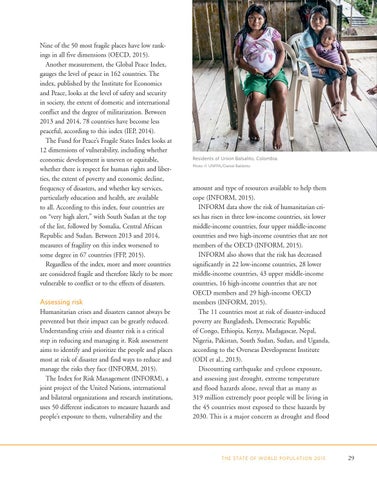
Residents of Union Balsalito, Colombia. Photo © UNFPA/Daniel Baldotto
amount and type of resources available to help them cope (INFORM, 2015). INFORM data show the risk of humanitarian crises has risen in three low-income countries, six lower middle-income countries, four upper middle-income countries and two high-income countries that are not members of the OECD (INFORM, 2015). INFORM also shows that the risk has decreased significantly in 22 low-income countries, 28 lower middle-income countries, 43 upper middle-income countries, 16 high-income countries that are not OECD members and 29 high-income OECD members (INFORM, 2015). The 11 countries most at risk of disaster-induced poverty are Bangladesh, Democratic Republic of Congo, Ethiopia, Kenya, Madagascar, Nepal, Nigeria, Pakistan, South Sudan, Sudan, and Uganda, according to the Overseas Development Institute (ODI et al., 2013). Discounting earthquake and cyclone exposure, and assessing just drought, extreme temperature and flood hazards alone, reveal that as many as 319 million extremely poor people will be living in the 45 countries most exposed to these hazards by 2030. This is a major concern as drought and flood
THE STATE OF WORLD POPULATION 2015
29