The forces of fragility
Co-operation and Development, “a fragile region or State has weak capacity to carry out basic governance functions, and lacks the ability to develop mutually constructive relations with society.” Fragile States are more vulnerable to internal or external shocks, such as economic crises or natural disasters (OECD, 2013). The relationship between state and society can break down as a result of both internal and external stress factors including demographic shifts, technological innovation and climate change. A decade ago, most fragile States were low income. According to recent estimates, about half of fragile and conflict-affected States are now
Why are there so many crises in our world today? Why does the world suddenly seem so fragile? There are many explanations of fragility and its causes. But regardless of the definition, fragility is closely linked to forces such as poverty, inequality and exclusion, which disproportionately affect women and girls. Fragile States home to one in three poor people
Fragility can manifest in several different forms and in countries at any income level. According to the Organisation for Economic
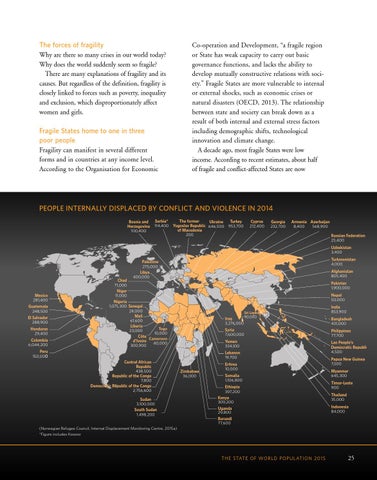
PEOPLE INTERNALLY DISPLACED BY CONFLICT AND VIOLENCE IN 2014 Bosnia and Herzegovina 100,400
Serbia* 114,400
The former Ukraine Yugoslav Republic 646,500 of Macedonia 200
Turkey 953,700
Cyprus 212,400
Georgia 232,700
Armenia Azerbaijan 568,900 8,400 Russian Federation 25,400 Uzbekistan 3,400 Turkmenistan 4,000
Palestine 275,000 Chad 71,000 Mexico 281,400 Guatemala 248,500 El Salvador 288,900 Honduras 29,400 Colombia 6,044,200
Afghanistan 805,400
Libya 400,000
Pakistan 1,900,000
Niger 11,000
Nepal 50,000
Nigeria 1,075,300 Senegal 24,000 Mali 61,600 Liberia 23,000
Iraq 3,276,000
Togo 10,000 Côte Cameroon d’Ivoire 40,000 300,900
Peru 150,000 Central African Republic 438,500 Republic of the Congo 7,800 Democratic Republic of the Congo 2,756,600 Sudan 3,100,000 South Sudan 1,498,200
Sri Lanka 90,000
Bangladesh 431,000
Syria 7,600,000
Philippines 77,700
Yemen 334,100
Lao People’s Democratic Republic 4,500
Lebanon 19,700 Zimbabwe 36,000
India 853,900
Eritrea 10,000 Somalia 1,106,800 Ethiopia 397,200 Kenya 309,200 Uganda 29,800
Papua New Guinea 7,500 Myanmar 645,300 Timor-Leste 900 Thailand 35,000 Indonesia 84,000
Burundi 77,600
(Norwegian Refugee Council, Internal Displacement Monitoring Centre, 2015a) *Figure includes Kosovo
THE STATE OF WORLD POPULATION 2015
25