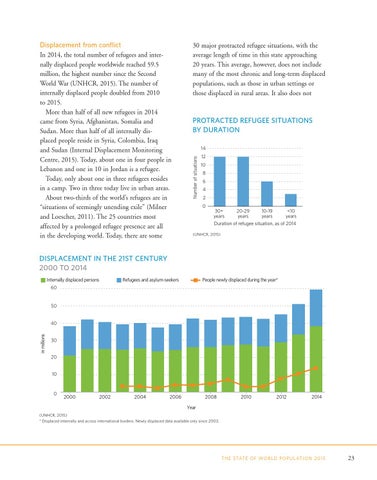
In 2014, the total number of refugees and internally displaced people worldwide reached 59.5 million, the highest number since the Second World War (UNHCR, 2015). The number of internally displaced people doubled from 2010 to 2015. More than half of all new refugees in 2014 came from Syria, Afghanistan, Somalia and Sudan. More than half of all internally displaced people reside in Syria, Colombia, Iraq and Sudan (Internal Displacement Monitoring Centre, 2015). Today, about one in four people in Lebanon and one in 10 in Jordan is a refugee. Today, only about one in three refugees resides in a camp. Two in three today live in urban areas. About two-thirds of the world’s refugees are in “situations of seemingly unending exile” (Milner and Loescher, 2011). The 25 countries most affected by a prolonged refugee presence are all in the developing world. Today, there are some
30 major protracted refugee situations, with the average length of time in this state approaching 20 years. This average, however, does not include many of the most chronic and long-term displaced populations, such as those in urban settings or those displaced in rural areas. It also does not
PROTRACTED REFUGEE SITUATIONS BY DURATION 14 Number of situations
Displacement from conflict
12 10 8 6 4 2 0
30+ years
20-29 years
10-19 years
<10 years
Duration of refugee situation, as of 2014 (UNHCR, 2015)
DISPLACEMENT IN THE 21ST CENTURY 2000 TO 2014 Internally displaced persons
Refugees and asylum-seekers
People newly displaced during the year*
60
50
in millions
40
30
20
10
0
2000
2002
2004
2006
2008
2010
2012
2014
Year (UNHCR, 2015) * Displaced internally and across international borders. Newly displaced data available only since 2003.
THE STATE OF WORLD POPULATION 2015
23