immediate basic survival needs, such as food, 2014, affecting nearly 2.5 billion people. Storms water, shelter, sanitation or immediate medical were the second most frequent type of disaster, assistance. Those affected by a disaster often lose killing a total of more than 244,000 people and their homes and livelihoods, become separated costing $936 billion in recorded damage over that from families, face a lifetime of nine-year period. This makes illness, disability or restricted storms the most expensive type opportunities, and are disof disaster during the past two placed from their communities. decades and the second most For each person who dies in Controlling for population common killer. a disaster, there are hundreds growth, the likelihood of being Earthquakes (including tsumore who are affected by it displaced by a disaster today namis) killed more people than and require immediate basic is 60 per cent higher than it all other types of disaster comsurvival needs, such as food, was four decades ago. Over the bined, claiming nearly 750,000 water, shelter, sanitation or last 20 years, there have been lives between 1994 and 2013. health care. an average of 340 disasters per Tsunamis were the most deadly year, affecting 200 million peosub-type of earthquake, with an ple annually, taking an average average of 79 deaths for every of 67,500 lives a year. 1,000 people affected, compared to four deaths Flooding caused 43 per cent of reported disasper 1,000 for ground movements. This makes ters in the Centre for Research on Epidemiology tsunamis almost 20 times deadlier than land-based of Disasters’ EM-DAT database between 1994 and earthquakes.
The mobile clinic also offers contraception, though few take advantage of it, says Vesna Matevska, a programme coordinator for HERA. The refugees and migrants she sees tend to be very private people who are reluctant to ask for or accept condoms or the pill, even though they are free of charge and available from non-judgmental service providers. She says this sense of privacy, along with language barriers, also make it difficult for many women to talk about or report gender-based violence. In addition to services provided by nongovernmental organizations and the country’s ministry of health, there are those offered informally by individuals like Lence Zdravkin, 48, a self-described activist, who says she has helped hundreds of pregnant women as they
walked north across the country to reach the Serbian border.
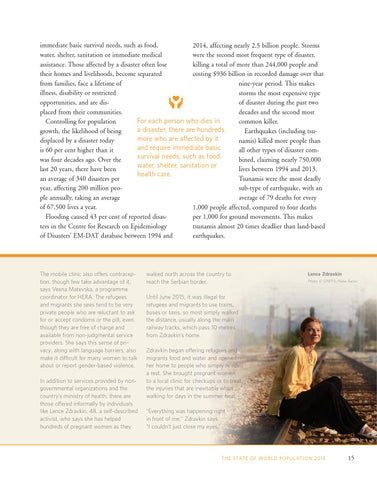
Lence Zdravkin Photo © UNFPA/Nake Batev
Until June 2015, it was illegal for refugees and migrants to use trains, buses or taxis, so most simply walked the distance, usually along the main railway tracks, which pass 10 metres from Zdravkin’s home. Zdravkin began offering refugees and migrants food and water and opened her home to people who simply needed a rest. She brought pregnant women to a local clinic for checkups or to treat the injuries that are inevitable when walking for days in the summer heat. “Everything was happening right in front of me,” Zdravkin says. “I couldn’t just close my eyes.”
THE STATE OF WORLD POPULATION 2015
15