state of world population 2015
United Nations Population Fund 605 Third Avenue New York, NY 10158 Tel. +1 212 297 5000 www.unfpa.org
ISBN 978-0-89714-987-7
SHELTER FROM THE STORM: A TRANSFORMATIVE AGENDA FOR WOMEN AND GIRLS IN A CRISIS-PRONE WORLD
Delivering a world where every pregnancy is wanted every childbirth is safe and every young person's potential is fulfilled
state of world population 2015
SHELTER FROM THE STORM A transformative agenda for women and girls in a crisis-prone world
Sales No.E.15.III.H.1 E/7,025/2015
Printed on recycled paper.
HUMANITARIAN GLOSSARY
The State of World Population 2015 SENIOR RESEARCHER Therese McGinn Heilbrunn Department of Population and Family Health, Mailman School of Public Health, Columbia University
EDITORIAL TEAM Editor: Richard Kollodge
RESEARCHERS AND AUTHORS Jacqueline Bhabha Harvard T.H. Chan School of Public Health; François-Xavier Bagnoud Center for Health and Human Rights, Harvard University; Harvard Law School
Publication and web interactive design and production: Prographics, Inc.
Richard Garfield Emergency Response and Recovery Branch, United States Centers for Disease Control and Prevention; Columbia and Emory Universities Kirsten Johnson, M.D. Department of Family Medicine, McGill University, Montreal Canada; Humanitarian U Gretchen Luchsinger
Digital developer: Hanno Ranck
ACKNOWLEDGMENTS Mengjia Liang, Edilberto Loaiza and Rachel Snow in the UNFPA Population and Development Branch analysed and aggregated data in the indicators section of the report and provided estimated numbers of pregnant women in countries affected by conflict or natural disaster. Source data for the report’s indicators section were provided by the Population Division of the United Nations Department of Economic and Social Affairs, the United Nations Educational, Scientific and Cultural Organization and the World Health Organization.
COMPLEX EMERGENCY A multifaceted humanitarian crisis in a country, region or society where there is a total or considerable breakdown of authority resulting from internal or external conflict and which requires a multi-sectoral, international response that goes beyond the mandate or capacity of any single agency and/or the ongoing United Nations country programme. Such emergencies have, in particular, a devastating effect on children and women, and call for a complex range of responses.
Ramiz Alakbarov, Björn Andersson and Arthur Erken at UNFPA reviewed drafts and helped shape the report.
Lisa Oddy Humanitarian U Monica Adhiambo Onyango Boston University School of Public Health, Department of Global Health Sarah Shteir and Louise Searle Humanitarian Advisory Group RESEARCH SUPPORT Amiya Bhatia Harvard T.H. Chan School of Public Health Chantilly Wijayasinha Boston University School of Public Health, Department of Global Health Mélanie Coutu Humanitarian Studies Initiative, McGill University UNFPA ADVISORY TEAM Prudence Chaiban Henia Dakkak Ugochi Daniels Abubakar Dungus Danielle Engel
Editorial associate and digital edition manager: Katheline Ruiz
Howard Friedman Ann Leoncavallo Jacqueline Mahon Rachel Snow
Colleagues from UNFPA offices in Amman, Bangkok, Bogota, Cairo, Dakar, Istanbul, Johannesburg, Kathmandu, Monrovia, Panama City and Skopje supported or guided the development of feature stories and photographs included in the report: Ghifar Al Alem, Tamara Alrifai, Daniel Baker, Mile Bosnjakovski, Santosh Chhetri, Jens-Hagen Eschenbaecher, Adebayo Fayoyin, Gema Granados, Habibatou M. Gologo, Calixte Hessou, Ruba Hikmat, Jorge Parra, Elina Rivera, Shible Sahbani, Alvaro Serrano, Sonja Tanevska, Giulia Vallese and Roy Wadia. Anna Maltby wrote the feature about the Ebola crisis in Liberia. Assignment photographers and videographers: Nake Batev (Former Yugoslav Republic of Macedonia) Daniel Baldotto (Colombia) Abbas Dulleh, AP Images (Liberia) Salah Malkawi (Jordan) MAPS AND DESIGNATIONS The designations employed and the presentation of material in maps in this report do not imply the expression of any opinion whatsoever on the part of UNFPA concerning the legal status of any country, territory, city or area or its authorities, or concerning the delimitation of its frontiers or boundaries. A dotted line approximately represents the Line of Control in Jammu and Kashmir agreed upon by India and Pakistan. The final status of Jammu and Kashmir has not been agreed upon by the parties. Cover photo: © UNFPA/Nake Batev
UNFPA Delivering a world where every pregnancy is wanted every childbirth is safe and every young person’s potential is fulfilled ©The United Nations Population Fund, 2015
DIRECT AND INDIRECT EFFECT A direct effect is a death or other outcome which occurred directly and primarily because of a catastrophic event. An indirect effect is a death or other outcome which occurred as an eventual, but not immediate, result of a single destructive act. Often these outcomes can be identified only on a population basis, where direct effects can be specified to the individual. For example, if the mortality rate rises after an event and there is no other cause identified, these additional deaths are considered the indirect effect of the event.
HUMAN RIGHTS All human rights derive from the dignity and worth inherent in the human person. The concept of human rights acknowledges that every single human being is entitled to enjoy his or her human rights without distinction as to race, colour, sex, language, religion, political or other opinion, national or social origin, property, birth or other status.
HUMANITARIAN ACTION Humanitarian action provides lifesaving services and facilitates the return to normalcy for people and communities affected by natural and human-made disasters. It also seeks to lessen the destructive impact of disasters and complex emergencies.
HUMANITARIAN CRISIS An event or series of events that represents a critical threat to the health, safety, security or well-being of a community or other large group of people, usually over a wide area. Armed conflicts, epidemics, famine, natural disasters and other major emergencies may all involve or lead to a humanitarian crisis.
HUMANITARIAN RESPONSE Material and logistical assistance to people due to needs created by conflict or disaster, and provided on the basis of an appeal by the government or international organizations.
INTERNALLY DISPLACED PERSONS Individuals who have been forced or obliged to flee or to leave their homes or places of habitual residence, in particular as a result of, or in order to avoid, the effects of armed conflict, situations of generalized violence, violations of human rights or natural or human-made disasters, and who have not crossed an internationally recognized State border.
NATURAL DISASTER A large-scale event where life and/ or property is destroyed. For an event to be recorded as a disaster in the internationally recognized Centre for Research on the Epidemiology of Disasters database, at least one of the following criteria must be met: • Ten or more people reported killed. • One hundred or more people reported affected. • A declaration of a state of emergency. • A call for international assistance. Natural disasters include droughts, earthquakes, epidemics, extreme heat or cold, floods, storms, tsunamis, volcanic eruptions and wildfires.
PEOPLE AFFECTED BY CONFLICT OR DISASTER Individuals requiring immediate assistance during a period of emergency, i.e., requiring basic survival needs such as food, water, shelter, sanitation and immediate medical assistance as the result of the emergency.
REFUGEE A person who, owing to a well-founded fear of being persecuted for reasons of race, religion, nationality, membership of a particular social group or political opinion, is outside the country of his or her nationality, and is unable to, or owing to such fear, is unwilling to avail himself or herself of the protection of that country.
state of world population 2015
SHELTER FROM THE STORM A transformative agenda for women and girls in a crisis-prone world Foreword
page 2
Overview
page 4
1 A fragile world 2 The disproportionate toll on women and adolescent girls 3 Evolving response: from basic to comprehensive 4 Resilience and bridging the humanitarian-development divide 5 New directions in financing sexual and reproductive health in humanitarian settings 6 A transformative vision for risk reduction, response and resilience
page 12
page 36
page 56
page 74 page 90
page 102
Indicators
page 115
Bibliography
page 131
Photo Š Panos Pictures/Brian Sokol
Foreword More than 100 million people are in need of humanitarian assistance—more than at any time since the end of the Second World War. Among those displaced by conflict or uprooted by disaster are tens of millions of women and adolescent girls. This report is a call to action to meet their needs and ensure their rights.
W
hile remarkable progress has been achieved during the past decade protecting the health and rights of women and adolescent girls in humanitarian settings, the growth in need has outstripped the growth in funding and services. Yet, these services are of critical importance, especially for very young adolescent girls, who are the most vulnerable and least able to confront the many challenges they face, even in stable times. Under normal circumstances in some developing countries, a 10-year-old girl, for example, may be married off against her will, trafficked, separated from her family and all social support and have limited access to education, health or opportunities for a better life. When a crisis strikes, these risks multiply, and so do that girl’s vulnerabilities. Her prospects go from bad to worse. She may become the target of sexual violence, infected with HIV, or pregnant the moment she reaches puberty. Her future is derailed. Every 10-year-old girl, no matter where she is, has a right to health, dignity and safety, and 179 governments pledged in 1994 at the International Conference on Population and Development to uphold that right—in any
2
C HR FO AEPWO T E RR D 1
A FRAG I LE WO RLD
and every situation. Yet for too many years, humanitarian assistance has left the 10-year-old girl behind, vulnerable to unsafe childbirth, and violence with devastating consequences. Sexual and reproductive health and access to information are essential for any girl’s safe transition from adolescence to adulthood. Imagine that 10-year-old 15 years later with her rights and health intact; now imagine her in a world where armed conflict, devastation and dislocation deny her every human right, every opportunity, every dignity. Abandoning her, or her community or country, is not an option. We are, in the end, one world, and governments have a responsibility to protect human rights and abide by international law. As global citizens, we have a duty to provide support and solidarity. Today about three fifths of all maternal deaths take place in humanitarian and fragile contexts. Every day 507 women and adolescent girls die from complications of pregnancy and childbirth in emergency situations and in fragile States. And gender-based violence continues to take a brutal toll, shattering lives and prospects for peace and recovery.
Together we must transform humanitarian action by placing the health and rights of women and young people at the centre of our priorities. At the same time, we must invest heavily in institutions and actions that build girls’ and women’s human capital and agency and in the resilience of communities and nations over the long run so that when a new crisis strikes, disruption and dislocation may be minimized and recovery may be accelerated. For its part, UNFPA remains committed to the full realization of the sexual and reproductive health and rights of all women and girls, wherever they live, and under all conditions, crisis or otherwise, at all times. The surfeit of conflicts and disasters all around us today means that UNFPA is delivering a larger share of its services in crisis settings.
deliberately tackle inequalities, the benefits of interventions grow exponentially and carry over from the acute phase of a crisis well into the future as countries and communities rebuild and people reclaim their lives. Together we must strive for a world where women and girls are no longer disadvantaged in multiple ways but are equally empowered to realize their full potential, and contribute to the development and stability of their communities and nations—before, during or after a crisis.
Dr. Babatunde Osotimehin United Nations Under-Secretary-General and Executive Director UNFPA, the United Nations Population Fund
When women and girls can obtain sexual and reproductive health services, along with a variety of humanitarian programmes that
Photo © UNFPA/Nezih Tavlas
THE STATE OF WORLD POPULATION 2015
3
Overview More than a billion people alive today have seen their lives upended by crisis. War, instability, epidemics and disasters have left a long trail of turmoil and destruction.
R
ight now, more people are displaced by crisis than at any time since the cataclysm of the Second World War: an estimated 59.5 million. Natural disasters now affect 200 million people a year. For some, the setbacks are temporary. For others, they may consume a lifetime. Refugees now spend an average of 20 years away from home. Pregnancy and childbirth are additional vulnerabilities for women and girls in conflicts and crises. Sixty per cent of preventable maternal deaths take place among women struggling to survive conflicts, natural disasters and displacement. In a series of international agreements, the world has affirmed the sexual and reproductive health and rights of women and girls. That promise
RISK Photo Š UNFPA/Sawiche Wamunza
4
OV ERV IE W
encompasses upholding and delivering on these rights in all cases, at all times; humanitarian crises do not diminish this responsibility. Keeping that promise means guaranteeing that women and girls have access to comprehensive services before, during and after a crisis. What’s needed in many crisis-affected countries are scaled-up commitment and action. In a fragile world, women and girls pay a disproportionate price
By many measures, more countries are considered fragile than five or six years ago, leaving them more vulnerable to conflict or the effects of disasters. Many factors make people and countries vulnerable. Being poor is one—over 1 billion people still live
in extreme poverty. This traps individuals and even whole countries so far down the ladder of development as to make any upward climb the most distant dream. It means decent work is unavailable, and the quality of services is unpredictable. Geography is another factor. Some countries lie squarely in the path of natural disasters, which are increasing dramatically through climate change. Historic levels of urbanization have raised risks for city dwellers, especially the poor, many of whom live in poorly constructed informal settlements in fragile areas, such as on hillsides prone to mudslides. For women and girls, compounding these and other factors are discrimination and gender inequality. To start with, women and girls have less of almost everything: income, land and other assets, access to health services, education, social networks, a political voice, equal protection under the law, and the realization of basic human rights.
When a crisis strikes, they are thus disproportionately disadvantaged and less prepared or empowered to survive or recover. During and after any kind of crisis, gender-based violence may soar, including in its use as a weapon of war. Extreme financial hardship stemming from disaster or conflict can lead women to transactional sex or make them vulnerable to trafficking. A lack of even basic sexual and reproductive health
When a crisis strikes, women and girls are disproportionately disadvantaged and less prepared or empowered to survive or recover.
WOMEN AND GIRLS ARE DISPROPORTIONATELY DISADVANTAGED
More than
100 MILLION
people in need of humanitarian assistance,
ONE QUARTER ARE WOMEN AND GIRLS, AGES 15 TO 49.
At heightened risk of • Sexually transmitted infections, including HIV • Unintended, unwanted pregnancy • Maternal death and illness • Sexual- and gender-based violence
THE STATE OF WORLD POPULATION 2015
5
services makes giving birth in crisis settings a potentially deadly proposition, even more so for adolescent girls. All of these dangers share a common cause: a lack of respect for the human rights to which everyone is entitled, no matter their sex, age or any other distinguishing characteristic. These rights include the reproductive rights agreed by 179 governments at the 1994 International Conference on Population and Development, culminating in a groundbreaking Programme of Action, which guides the work of UNFPA, the United Nations Population Fund. Women and girls face obstacles to sexual and reproductive health before, during and after crises
Of the more than 100 million people in need of humanitarian assistance in 2015, an estimated one quarter were women and adolescent girls of reproductive age. Assistance that fails to meet all of their needs, including those specific to gender and age, can hardly be considered effective.
RESPONSE Photo © Panos Pictures/Chris de Bode
6
CHA OV ERV PTE IERW1
A FRAG I LE WO RLD
To date, the supply of assistance aimed at meeting the sexual and reproductive health needs of women and girls has not kept pace with the demand. Remarkable progress in targeting humanitarian services to women and girls has been achieved in the past decade. Still, large gaps remain, in action and in funding. Gender inequality and discrimination—by sex, age or other factors—are among the explanations, manifesting even in well-intentioned humanitarian responses. Interventions that fail to account for the different ways disasters and conflicts can affect different groups can end up perpetuating inequalities, such as when general health care is provided in a crisis, but not services related to pregnancy, childbirth or contraception, leaving alreadydisadvantaged women and girls in an even more precarious situation. In the tumultuous early phase of a crisis, food, shelter and care for acute physical trauma often seem the most compelling needs, with gender or any other kind of discrimination something that
can be put off for a safer day. Thinking this way, however, can make a response blind to realities on the ground—including those that shut women and girls off from assistance or leave them vulnerable to violence. A lack of concerted attention is fed in part by a very limited amount of data broken down by sex or other parameters, and by a lack of gender expertise among many first responders. Given the scale of crisis in the world today, and given who most victims are, it is time to transform the conventional approach into one that takes account of diversity in crisis-affected populations, and wields that diversity for the benefit of reduced risk, faster recovery and greater resilience. Move sexual and reproductive health to the centre of humanitarian action
Until only 20 years ago, sexual and reproductive health took a back seat to priorities such as water, food and shelter in humanitarian response. But
Remarkable progress in targeting humanitarian services to women and girls has been achieved in the past decade. Still, large gaps remain, in action and in funding.
a wealth of research and evidence since the early 1990s has helped make the health of women and girls far more visible. Many humanitarian interventions now meet needs associated with pregnancy and childbirth, and seek to prevent and address vulnerabilities to sexual or gender-based violence and sexually transmitted infections, including HIV. Not only is it more widely accepted that meeting these needs is a humanitarian imperative and a matter of upholding and respecting human
ESSENTIAL ACTIONS AND SERVICES FROM THE ONSET OF A CRISIS
PRIORITY SERVICES • Emergency obstetric and newborn care • Referral system for obstetric emergencies • Supplies for clean and safe deliveries
OBJECTIVES Prevent maternal and infant mortality Reduce transmission of HIV
• Contraception • Condoms • Anti-retrovirals • Clinical care for survivors of rape
Prevent and manage the consequences of sexual violence
THE STATE OF WORLD POPULATION 2015
7
rights, but it is also clear that ensuring access to sexual and reproductive health is a pathway to recovery, risk reduction and resilience. The benefits extend to women and girls—and beyond. When they can obtain sexual and reproductive health care, along with a variety of humanitarian programmes that deliberately tackle inequalities, positive effects ripple throughout all aspects of humanitarian action. Unsustainable funding calls for the transformation of humanitarian action
The lion’s share of humanitarian action is coordinated and managed by major international players, including the United Nations, and has been traditionally funded by donor nations that are members of the Organisation for Economic Co-operation and Development, but other countries and private donations are beginning to play an important role too. The demand for humanitarian assistance has grown every year since 2011, but funding has not increased at the same pace, leaving unprecedented
RESILIENCE Photo Š UNFPA/Ben Manser
8
CHA OV ERV PTE IERW1
A FRAG I LE WO RLD
A fundamental shift is needed: away from reacting to disasters and conflicts as they unfold and sometimes linger for decades, towards prevention, preparedness and empowerment of individuals and communities to withstand and recover from them.
gaps, translating into inadequate or insufficient responses for millions of people in need. The ever-enlarging gaps suggest current funding arrangements may be unsustainable. So, too, may be a business-as-usual approach to humanitarian action.
Crises will continue to happen; acute needs will always need to be met. But a fundamental shift is needed: away from reacting to disasters and conflicts as they unfold and sometimes linger for decades, towards prevention, preparedness and empowerment of individuals and communities to withstand and recover from them. Tip the balance from reaction and response towards preparedness, prevention and resilience
We must aim for a more resilient, less vulnerable world. Such a world would be one where development, within and across countries, is fully inclusive and equitable, and upholds all rights for all people. Where women and girls are no longer disadvantaged in multiple ways but are equally empowered to realize their full potential, and contribute to the development and stability of their communities and nations. It would be a world where every country can manage its economy and its polity to guarantee
everyone’s access to decent work and high quality essential services, including sexual and reproductive health care. Among those who set the course of public policies, there would be a sound understanding that investment in equitable, inclusive development is about the best and certainly the fairest and most humane investment that can be made. Far-reaching benefits include reducing the risks and impacts of crisis. Transformation to a more resilient, less vulnerable world also depends on better management of risks and institutions with sufficient capacities in place long before a crisis strikes. Risks first need to be comprehensively understood; only then can effective investments be made in measures to reduce them. For those risks not fully avoidable, proactive preparation is critical to limit the worst consequences. One of the most central strategies in reducing risks in all countries is making sure people are resilient in the face of them. Those who are healthy, educated, have adequate income and enjoy all human rights have far better prospects when risks become reality.
PREVENTION, PREPAREDNESS AND EMPOWERMENT Manage risks better
Rectify gender inequality
Foster individuals’ resilience through education and health
Build capacities of institutions before disaster strikes
Enable realization of sexual and reproductive health and rights
Strive for long-term, inclusive and equitable development
THE STATE OF WORLD POPULATION 2015
9
Break the vicious cycle of discrimination and inequality
One of the weakest areas of resilience currently is among women and girls, and the institutions that serve them. As long as inequality and inequitable access short-circuit their rights,
As long as inequality and inequitable access short-circuit their rights, abilities and opportunities, women and girls will remain among those most in need of humanitarian assistance and least equipped to contribute to recovery or resilience.
MOVING FORWARD Photo Š Panos Pictures/Sven Torfinn
10
CHA OV ERV PTE IERW1
A FRAG I LE WO RLD
abilities and opportunities, women and girls will remain among those most in need of humanitarian assistance and least equipped to contribute to recovery or resilience. Transformation can begin, in part, in the aftermath of a crisis, but that largely depends on the response. If it mainly replicates existing discriminatory patterns, such as by failing to provide quality sexual and reproductive health services from the first moments, it is not transformative. It will fail as well on all scores of effectiveness and human rights. All humanitarian issues involve some kind of gender perspective, because men and women, girls and boys experience the world in markedly different ways. All types of humanitarian action therefore need to recognize and respond to these differences, and actively correct any disparities. Wherever feasible, humanitarian assistance can challenge existing forms of discrimination, such as through providing comprehensive services for survivors of gender-based violence.
It can enlist men and boys in building acceptance of new social norms, such as around women’s inherent rights and the peaceful resolution of differences.
for long-term development. Development that benefits all, enabling everyone to enjoy their rights, including reproductive rights, can help individuals, institutions and communities withstand crisis. It can also help accelerate recovery. Equitable, inclusive and rights-based development, and the resilience fostered by it, can in many cases obviate the need for humanitarian interventions. As the globally agreedEffective Agenda 2030 for sustainable development response begins, and the World Humanitarian Summit approaches in 2016, now is the time to act on this understanding and re-envision humanitarian action, with the health and rights of women and girls at its core.
Tear down the artificial divide between humanitarian action and development
The surfeit of crisis and upheaval around the world today demands that we do much better. We need better development, better humanitarian action, better risk management, better attention to prevention, preparedness and resilience, and better connections among all of these. Running through them is a common thread: gender and all other forms of equality, achieved in part through full realization of sexual and reproductive health and rights, leads to far less vulnerability and much greater resilience for individuals and societies as a whole. The distinction between humanitarian response and development today is a false one. Humanitarian action can lay the foundations
Recovery
Equitable, inclusive development
Prevention and preparedness
A NEW VISION FOR HUMANITARIAN ACTION
Prevention and preparedness
Effective response
Resilience
SEXUAL AND REPRODUCTIVE HEALTH AND RIGHTS
Equitable, inclusive development
At the core of the interrelated elements of humanitarian action, from response to resilience and development, are sexual and reproductive health and rights
Recovery THE STATE OF WORLD POPULATION 2015
11
CHAPTER 1
A fragile world Natural disasters, especially floods and storms, occur twice as frequently today as 25 years ago. Conflicts, especially those within national boundaries, are driving millions from their homes. Conflict, violence, instability, extreme poverty and vulnerability to disasters are deeply interrelated conditions, which today prevent more than 1 billion people from enjoying the massive social and economic gains achieved since the end of the Second World War.
When time won’t wait: meeting basic health needs for pregnant women on the move
Ashur and family, Gevgelija. Photo © UNFPA/Nake Batev
12
CHAPTER 1
“I was three months pregnant and worried about what this trip would do to my baby, but I didn’t have a choice. We had to go,” says Leyla Ashur, one of the few hundred Syrians allowed to cross into the former Yugoslav Republic of Macedonia from Greece one day in August. Ashur, 35, says she, her husband and their four sons had fled fighting in their home town of Dayr Az-Zawr, Syria, in 2012 and lived for about a year in Iraq. But the fear of violence from the selfproclaimed Islamic State in Iraq and the Levant, or ISIL, drove them across yet another border, into Turkey, where they stayed for three years until even that situation became untenable. She says not only were they afraid of escalating violence along the border, but they also
A FRAG I LE WO RLD
felt exploited and unwelcome in their host community. “When they saw we were Syrians, we had to pay three times the rent everyone else was paying,” she says. “And everyone kept telling us, ‘Go away, go away.’” And so the family of six left with a few belongings crammed into backpacks. The journey across Turkey took 10 days, with little rest and very little to eat along the way. “We didn’t receive help from anyone,” Ashur says. When she and her family reached the Turkish coastal city of Bodrum, they and about 20 others together paid a smuggler €10,000 to carry the group in a rubber raft across the Aegean Sea to
Leyla Ashur and family. Photo © UNFPA/Nake Batev
the Greek island of Ios. From there, they made their way to the former Yugoslav Republic of Macedonia. From the southern city of Gevgelija, Ashur and her family began the next leg of their journey north, with the aim of crossing through Serbia and Hungary and then on to Belgium, where her husband’s sister lives. “We will reach our destination or die on the way.” While hundreds piled onto overcrowded trains and buses, or simply walked the 178 kilometres to the northern frontier city of Kumanovo, Ashur and her family found a taxi to take them for €100. Her two younger sons waved goodbye from the back window.
Syrians like Ashur and her family account for about 80 per cent of the people transiting through the country. Afghans and Iraqis each account for about 5 per cent. The others are from Pakistan, Somalia, Palestine and five countries in sub-Saharan Africa. Between June and August 2015, an average of 700 refugees and migrants followed the same path to northern Europe through the former Yugoslav Republic of Macedonia every day. Of that number, about one in four is a woman, and on average, 6 per cent of those women are pregnant. Many of the pregnant women have health concerns stemming from walking long distances in the heat, poor nutrition, dehydration and the absence of sanitation, all
of which can lead to pregnancy complications or even miscarriage. And many are traumatized, says Suzana Paunovska of the Red Cross in the capital, Skopje. “You see it immediately in their faces.” The Government in June declared that refugees and migrants could access health care, including obstetric and gynaecological services, for free from public health centres and hospitals, including the one in Gevgelija. But because refugees and migrants are in a hurry to reach the border with Serbia within the 72 hours the Government allows for transiting through the country, most choose not to take advantage of free services rather than risk missing one of the few trains or buses traveling north.
THE STATE OF WORLD POPULATION 2015
13
O
ur world is in the midst of a paroxysm of violence, instability and upheaval not seen since the end of the Second World War. Over the past two decades, disasters, including ones related to extreme weather events, have affected billions of people. Today, crises, such as mass movements of people in response to extreme as poverty and unstable societies, are increasingly visible. Whole regions of the world seem to be in turmoil, and in a more connected world, even people in the stable zones feel more insecure than they once did. Many crises linger for decades, with no real solutions in sight. Refugees are living away from home for 20 years on average, with no access to durable solutions and sustainable livelihoods. In some cases, crises have persisted over generations (Milner and Loescher, 2011). Each crisis, whether a war, a deadly epidemic, earthquake or flood, brings unique challenges to the health, safety, livelihoods and rights of individuals, families and communities.
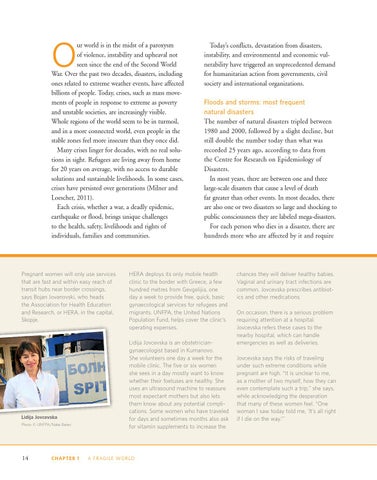
Pregnant women will only use services that are fast and within easy reach of transit hubs near border crossings, says Bojan Jovanovski, who heads the Association for Health Education and Research, or HERA, in the capital, Skopje.
Lidija Jovcevska Photo © UNFPA/Nake Batev
14
CHAPTER 1
Today’s conflicts, devastation from disasters, instability, and environmental and economic vulnerability have triggered an unprecedented demand for humanitarian action from governments, civil society and international organizations. Floods and storms: most frequent natural disasters
The number of natural disasters tripled between 1980 and 2000, followed by a slight decline, but still double the number today than what was recorded 25 years ago, according to data from the Centre for Research on Epidemiology of Disasters. In most years, there are between one and three large-scale disasters that cause a level of death far greater than other events. In most decades, there are also one or two disasters so large and shocking to public consciousness they are labeled mega-disasters. For each person who dies in a disaster, there are hundreds more who are affected by it and require
HERA deploys its only mobile health clinic to the border with Greece, a few hundred metres from Gevgelijia, one day a week to provide free, quick, basic gynaecological services for refugees and migrants. UNFPA, the United Nations Population Fund, helps cover the clinic’s operating expenses. Lidija Jovcevska is an obstetriciangynaecologist based in Kumanovo. She volunteers one day a week for the mobile clinic. The five or six women she sees in a day mostly want to know whether their foetuses are healthy. She uses an ultrasound machine to reassure most expectant mothers but also lets them know about any potential complications. Some women who have traveled for days and sometimes months also ask for vitamin supplements to increase the
A FRAG I LE WO RLD
chances they will deliver healthy babies. Vaginal and urinary tract infections are common. Jovcevska prescribes antibiotics and other medications. On occasion, there is a serious problem requiring attention at a hospital. Jovcevska refers these cases to the nearby hospital, which can handle emergencies as well as deliveries. Jovcevska says the risks of traveling under such extreme conditions while pregnant are high. “It is unclear to me, as a mother of two myself, how they can even contemplate such a trip,” she says, while acknowledging the desperation that many of these women feel. “One woman I saw today told me, ‘It’s all right if I die on the way.’”
immediate basic survival needs, such as food, 2014, affecting nearly 2.5 billion people. Storms water, shelter, sanitation or immediate medical were the second most frequent type of disaster, assistance. Those affected by a disaster often lose killing a total of more than 244,000 people and their homes and livelihoods, become separated costing $936 billion in recorded damage over that from families, face a lifetime of nine-year period. This makes illness, disability or restricted storms the most expensive type opportunities, and are disof disaster during the past two placed from their communities. decades and the second most For each person who dies in Controlling for population common killer. a disaster, there are hundreds growth, the likelihood of being Earthquakes (including tsumore who are affected by it displaced by a disaster today namis) killed more people than and require immediate basic is 60 per cent higher than it all other types of disaster comsurvival needs, such as food, was four decades ago. Over the bined, claiming nearly 750,000 water, shelter, sanitation or last 20 years, there have been lives between 1994 and 2013. health care. an average of 340 disasters per Tsunamis were the most deadly year, affecting 200 million peosub-type of earthquake, with an ple annually, taking an average average of 79 deaths for every of 67,500 lives a year. 1,000 people affected, compared to four deaths Flooding caused 43 per cent of reported disasper 1,000 for ground movements. This makes ters in the Centre for Research on Epidemiology tsunamis almost 20 times deadlier than land-based of Disasters’ EM-DAT database between 1994 and earthquakes.
The mobile clinic also offers contraception, though few take advantage of it, says Vesna Matevska, a programme coordinator for HERA. The refugees and migrants she sees tend to be very private people who are reluctant to ask for or accept condoms or the pill, even though they are free of charge and available from non-judgmental service providers. She says this sense of privacy, along with language barriers, also make it difficult for many women to talk about or report gender-based violence. In addition to services provided by nongovernmental organizations and the country’s ministry of health, there are those offered informally by individuals like Lence Zdravkin, 48, a self-described activist, who says she has helped hundreds of pregnant women as they
walked north across the country to reach the Serbian border.
Lence Zdravkin Photo © UNFPA/Nake Batev
Until June 2015, it was illegal for refugees and migrants to use trains, buses or taxis, so most simply walked the distance, usually along the main railway tracks, which pass 10 metres from Zdravkin’s home. Zdravkin began offering refugees and migrants food and water and opened her home to people who simply needed a rest. She brought pregnant women to a local clinic for checkups or to treat the injuries that are inevitable when walking for days in the summer heat. “Everything was happening right in front of me,” Zdravkin says. “I couldn’t just close my eyes.”
THE STATE OF WORLD POPULATION 2015
15
RECORDED NATURAL DISASTERS, WORLDWIDE, BY TYPE 1994 TO 2014 Earthquake
Drought
Flood
Epidemic
Other types*
Storm
Number of disasters per disaster type
600
500 400
300 200
100
0 1994
1995
1996
1997
1998
1999
2000 2001 2002 2003 2004 2005 2006 2007 2008 2009 2010
2011
2012
2013
2014
2012
2013
2014
Year *Figures include disasters such as insect infestation, extreme temperature, landslide, volcanic activity and wildfire. (CRED, 2015a)
ESTIMATED NUMBER OF PEOPLE AFFECTED BY NATURAL DISASTERS, BY TYPE 1994 TO 2014 Earthquake
Drought
Flood
Epidemic
Other types*
Storm
Number of people affected in millions
700 600 500 400 300 200 100 0 1994
1995
1996
1997
1998
1999
2000 2001 2002 2003 2004 2005 2006 2007 2008 2009 2010
Year *Figures include disasters such as insect infestation, extreme temperature, landslide, volcanic activity and wildfire. (CRED, 2015a)
16
CHAPTER 1
A FRAG I LE WO RLD
2011
Drought affected more than 1 billion people between 1994 and 2014, or about one in four people affected by all natural disasters. Yet droughts accounted for just 5 per cent of disaster events. Some 41 per cent of drought disasters in that period were in Africa. In absolute numbers, the United States and China recorded the most natural disasters between 1994 and 2014, due mainly to their size, varied landmasses and high population densities. Among the continents, Asia bore the brunt of disasters, with 3.3 billion people affected in China and India alone. If data are standardized to reflect the numbers of people affected per 100,000, Eritrea and Mongolia were the world’s worst-affected countries that are not island States. Haiti suffered the largest number of people killed both in absolute terms and relative to the size of its population due to the toll of the 2010 earthquake. While disasters have been recorded more frequently during the past 20 years, the average number of people affected has actually fallen from one in 23 between 1994 and 2003, to about one in 39 between 2004 and 2014.
43% Flooding caused 43 per cent of reported disasters between 1994 and 2014, affecting nearly 2.5 BILLION PEOPLE
Drought affected more than 1 BILLION people between 1994 and 2014, or about ONE IN FOUR PEOPLE affected by all natural disasters
Disaster-related deaths higher in poorer countries
TSUNAMIS
EARTHQUAKE
79 4 VS. DEATHS DEATHS per
1,000 people affected Photo © UNFPA/Ben Manser
The Centre for Research on Epidemiology of Disasters’ data also show how income levels impact disaster death tolls. On average, more than three times as many people died per disaster in low-income countries (332 deaths) than in high-income ones (105 deaths). A similar pattern is evident when low- and lower-middleincome countries are grouped together and compared to high- and upper-middle-income countries. Taken together, higher-income countries experienced 56 per cent of disasters but lost 32 per cent of lives, while lower-income
Making tsunamis almost 20 TIMES deadlier than land-based earthquakes, over two decades
THE STATE OF WORLD POPULATION 2015
17
RECORDED NATURAL DISASTERS, BY REGION 1994 TO 2014 Asia
Americas
Africa
Oceania
Europe
600
Number of disasters per continent
500 400
300 200
100
0 1994
1995
1996
1997
1998
1999
2000 2001 2002 2003 2004 2005 2006 2007 2008 2009 2010
2011
2012
2013
2014
2013
2014
Year
(CRED, 2015a)
ESTIMATED NUMBER OF PEOPLE AFFECTED BY NATURAL DISASTERS, BY REGION 1994 TO 2014 Asia
Americas
Africa
Oceania
Europe
Total affected persons per continent in millions
700 600 500 400 300 200 100 0 1994
1995
1996
1997
1998
1999
2000 2001 2002 2003 2004 2005 2006 2007 2008 2009 2010
Year (CRED, 2015a)
18
CHAPTER 1
A FRAG I LE WO RLD
2011
2012
countries experienced 44 per cent of disasters but suffered 68 per cent of deaths. This demonstrates that levels of economic development, rather than exposure to hazards per se, are major determinants of mortality. Rise in conflicts within borders pushes civilian death toll upward
Today, about ONE IN THREE refugees resides in a camp. Two in three live in urban areas
Today 1 BILLION PEOPLE or about 14 per cent of the world’s population live in areas of conflict
74%
Photo © Panos Pictures/Mikkel Ostergaard
The Second World War, the largest conflict in the modern world, remains humanity’s reference point for mass harm. About 3 per cent of the world’s people died as a direct result of that conflict or its prelude and aftermath. Meanwhile, more than one third of the world’s people were affected by it. For each death, therefore, 10 other lives were radically disrupted. After the Second World War, the number of international conflicts declined dramatically, while conflicts within national boundaries and wars of decolonization increased in the 1950s and 1960s. The increase in intra-State conflicts and the decrease in international wars help explain an increase in civilian deaths and a decrease in deaths among combatants. Regardless of whether a conflict occurs within or across a national boundary, it invariably has an insidious impact on the lives of many people, through chronic insecurity and uncertainty, which in turn affect the quality of life, social cohesion, livelihoods, rights and development potential for all. At the end of the Second World War, 940 million people—or 40 per cent of the world’s population at that time—lived in areas of conflict. By 1956, the number fell precipitously to 210 million, or 8 per cent of the world’s population. Afterward, the number continued to rise, reaching about 1 billion people today (Garfield et al., 2012).
Seventy-four per cent of direct conflict deaths between 1989 and 2008 occurred in Central Africa, East Africa, the Middle East and North Africa and South Asia
THE STATE OF WORLD POPULATION 2015
19
GLOBAL TRENDS IN ARMED CONFLICT 1946 TO 2014 200 Warfare totals
Magnitude of conflict*
160
120 Intra-state warfare
80
Interstate warfare
40
0 1950
1955
1960
1965
1970
1975
1980
1985
1990
1995
2000
2005
2010
Year (Center for Systemic Peace, 2015) * The magnitude of a conflict is measured by the comprehensive effects on the State or States directly affected by warfare, including numbers of combatants and casualties, affected area, dislocated population and extent of infrastructure damage.
DEATHS DIRECTLY RELATED TO CONFLICT High & low adjusted estimates
Adjusted estimate
900,000 800,000
Direct deaths
700,000 600,000 500,000 400,000 300,000 200,000 100,000 0
1989 1990 1991 1992 1993 1994 1995 1996 1997 1998 1999 2000 2001 2002 2003 2004 2005 2006 2007 2008
Year
(Garfield and Blore, 2009)
20
CHAPTER 1
A FRAG I LE WO RLD
CONFLICT’S IMPACT ON WOMEN AND MEN Global conflict-related data disaggregated by sex are scarce, and when they are available, they are often unreliable. Still, small area-specific surveys yield some insights showing that men are much more likely to die directly and during conflicts, whereas women die or are otherwise harmed more often of indirect causes after a conflict (Ormhaug, 2009). Every estimate of direct conflict deaths suggests that more than 90 per cent of all casualties occur among young adult males (Cummings et al., n.d.).
DIRECT IMPACTS MEN
INDIRECT IMPACTS
• Higher rates of morbidity and mortality from battle deaths • Higher likelihood to be detained or missing • Sexual and gender-based violence: sex-selective massacres; forcibly conscripted or recruited; subjected to torture, rape and mutilation; forced to commit sexual violence upon others
• Risk of ex-combatants’ involvement in criminal or illegal activities and difficulties in finding livelihoods • Increased prevalence of other forms of violence—particularly domestic violence
• Higher rates of disability from injury
COMMON
• Depression, trauma and emotional distress
• Asset and income loss • Tendency towards increased migration • Disrupted patterns of marriage and fertility • Loss of family and social networks, including insurance mechanisms • Interrupted education • Eroded well-being, particularly poor health and disability from poverty and malnutrition
WOMEN
• Higher likelihood to be internally displaced persons and refugees • Gender-based violence: being subjected to rape, trafficking and prostitution; forced pregnancies and marriages
• Reproductive health problems • Women’s reproductive and care-giving roles under stress • Changed labour market participation from death of family members and “added worker effect” • Higher incidence of domestic violence • Possibility for greater political participation
(Anderlini, 2010)
• Women’s increased economic participation due to changing gender roles during conflict
THE STATE OF WORLD POPULATION 2015
21
Direct conflict deaths average 168,100 a year
2014). In 2012, two out of five people worldwide who died in battle were in Syria. In addition, deaths that result from conflict but are not directly due to fighting outnumber direct conflict deaths, in some countries by a rate of three to one. Most of these indirect deaths occur in lowincome countries, where vulnerable civilians are cut off from vital lifelines to immunization, child nutrition and clean water.
The number of deaths is one indicator for intensity or magnitude of a conflict. A generation of researchers has tried to establish reliable estimates of the number of people killed in conflict. Arriving at such estimates is especially complicated because conflicts are increasingly waged by non-State actors in remote areas and often in countries with institutions ill-equipped to accurately track casualties. Between 1989 and 2008, there were an estimated total 3,362,000 direct conflict deaths, or an average of 168,100 deaths per year (Garfield and Blore, 2009). Seventy-four per cent of direct conflict deaths between 1989 and 2008 occurred in Central Africa, East Africa, the Middle East and North Africa and South Asia. Since 2008, increasing conflict in the Middle East raised the total level of direct conflict deaths to more than 200,000 per year (Price et al.,
Other armed violence
Armed violence not associated with conflict also takes a heavy toll on lives. The Global Burden of Armed Violence in 2011 attempted to account for all deaths due to firearms recorded through civil systems in countries throughout the world, arriving at an estimate of 400,000 firearms-related deaths outside of conflict situations. Insecurity and fear of armed violence have been major drivers of displacement and migration in some countries in recent years, sparking a situation that resembles a humanitarian crisis.
MAJOR SOURCE COUNTRIES OF REFUGEES
Syrian Arab Republic Top 3
Afghanistan
53%*
Somalia
62%*
Sudan South Sudan
Top 10
Democratic Republic of the Congo
77%*
Myanmar Central African Republic Iraq Eritrea 0.0
0.5
1.0
* Reflects proportion out of global number of refugees at end-2014
CHAPTER 1
1.5
2.0 Millions
(UNHCR, 2015)
22
Top 5
A FRAG I LE WO RLD
2.5
3.0
3.5
4.0
In 2014, the total number of refugees and internally displaced people worldwide reached 59.5 million, the highest number since the Second World War (UNHCR, 2015). The number of internally displaced people doubled from 2010 to 2015. More than half of all new refugees in 2014 came from Syria, Afghanistan, Somalia and Sudan. More than half of all internally displaced people reside in Syria, Colombia, Iraq and Sudan (Internal Displacement Monitoring Centre, 2015). Today, about one in four people in Lebanon and one in 10 in Jordan is a refugee. Today, only about one in three refugees resides in a camp. Two in three today live in urban areas. About two-thirds of the world’s refugees are in “situations of seemingly unending exile” (Milner and Loescher, 2011). The 25 countries most affected by a prolonged refugee presence are all in the developing world. Today, there are some
30 major protracted refugee situations, with the average length of time in this state approaching 20 years. This average, however, does not include many of the most chronic and long-term displaced populations, such as those in urban settings or those displaced in rural areas. It also does not
PROTRACTED REFUGEE SITUATIONS BY DURATION 14 Number of situations
Displacement from conflict
12 10 8 6 4 2 0
30+ years
20-29 years
10-19 years
<10 years
Duration of refugee situation, as of 2014 (UNHCR, 2015)
DISPLACEMENT IN THE 21ST CENTURY 2000 TO 2014 Internally displaced persons
Refugees and asylum-seekers
People newly displaced during the year*
60
50
in millions
40
30
20
10
0
2000
2002
2004
2006
2008
2010
2012
2014
Year (UNHCR, 2015) * Displaced internally and across international borders. Newly displaced data available only since 2003.
THE STATE OF WORLD POPULATION 2015
23
include millions of Palestinian refugees under the mandate of the United Nations Relief and Works Administration.
remained broadly constant in recent years, climate-related events, such as floods and storms, are increasing. From 2000 to the present, there have been an average of 341 climate-related disasters per year, up 44 per cent from the average recorded between 1994 and 2000. The Centre for Research on the Epidemiology of Disasters estimates that 19.3 million people were displaced because of disasters in 2014. Over the last seven years, 85 per cent of these disaster-induced movements have been caused by weather-related events, mainly flooding and storms. About 15 per cent are due to earthquakes.
Disasters displace 26.4 million people annually
According to the United Nations High Commissioner for Refugees, an average of 26.4 million people worldwide have been displaced by disasters per year since 2008. Most of the displacement occurred in low- and middle-income countries. While the frequency of geophysical disasters— earthquakes, tsunamis, volcanic eruptions—has
NUMBER OF DISPLACED PERSONS BY REGION 2005 TO 2014
Middle East
Far East Asia
Africa, south of Sahara
North and Central America
South America
Africa, north of Sahara
South and Central Asia
Oceania
Europe
Displaced persons in millions*
14 12 10 8 6 4 2 0 2005 2006 2007 2008 2009 2010
2011
2012
2013
2014
(Development Initiatives, 2015)
Photo © Ali Arkady/VII Mentor Program
24
CHAPTER 1
A FRAG I LE WO RLD
*‘Displaced persons’ includes refugees and people in refugee-like situations, internally displaced persons and asylum seekers. Internally displaced persons include only those persons protected/assisted by United Nations High Commissioner for Refugees. Data are organized according to definitions of country/territory of asylum. Countries are organized according to the Organisation for Economic Co-operation and Development’s classification of regions.
The forces of fragility
Co-operation and Development, “a fragile region or State has weak capacity to carry out basic governance functions, and lacks the ability to develop mutually constructive relations with society.” Fragile States are more vulnerable to internal or external shocks, such as economic crises or natural disasters (OECD, 2013). The relationship between state and society can break down as a result of both internal and external stress factors including demographic shifts, technological innovation and climate change. A decade ago, most fragile States were low income. According to recent estimates, about half of fragile and conflict-affected States are now
Why are there so many crises in our world today? Why does the world suddenly seem so fragile? There are many explanations of fragility and its causes. But regardless of the definition, fragility is closely linked to forces such as poverty, inequality and exclusion, which disproportionately affect women and girls. Fragile States home to one in three poor people
Fragility can manifest in several different forms and in countries at any income level. According to the Organisation for Economic
PEOPLE INTERNALLY DISPLACED BY CONFLICT AND VIOLENCE IN 2014 Bosnia and Herzegovina 100,400
Serbia* 114,400
The former Ukraine Yugoslav Republic 646,500 of Macedonia 200
Turkey 953,700
Cyprus 212,400
Georgia 232,700
Armenia Azerbaijan 568,900 8,400 Russian Federation 25,400 Uzbekistan 3,400 Turkmenistan 4,000
Palestine 275,000 Chad 71,000 Mexico 281,400 Guatemala 248,500 El Salvador 288,900 Honduras 29,400 Colombia 6,044,200
Afghanistan 805,400
Libya 400,000
Pakistan 1,900,000
Niger 11,000
Nepal 50,000
Nigeria 1,075,300 Senegal 24,000 Mali 61,600 Liberia 23,000
Iraq 3,276,000
Togo 10,000 Côte Cameroon d’Ivoire 40,000 300,900
Peru 150,000 Central African Republic 438,500 Republic of the Congo 7,800 Democratic Republic of the Congo 2,756,600 Sudan 3,100,000 South Sudan 1,498,200
Sri Lanka 90,000
Bangladesh 431,000
Syria 7,600,000
Philippines 77,700
Yemen 334,100
Lao People’s Democratic Republic 4,500
Lebanon 19,700 Zimbabwe 36,000
India 853,900
Eritrea 10,000 Somalia 1,106,800 Ethiopia 397,200 Kenya 309,200 Uganda 29,800
Papua New Guinea 7,500 Myanmar 645,300 Timor-Leste 900 Thailand 35,000 Indonesia 84,000
Burundi 77,600
(Norwegian Refugee Council, Internal Displacement Monitoring Centre, 2015a) *Figure includes Kosovo
THE STATE OF WORLD POPULATION 2015
25
Two of three unattended births are in fragile States
Despite global economic and social progress in recent decades, there is a large and growing portion of humanity living with greater insecurity and instability. It is from these countries that the major challenges to stability, development, and achievement of social progress exist. Gates et al. (2010) summarized the impact with data showing that close to half the people in low-income countries in 2010 were in States that are fragile, in conflict, or recovering from conflict. These same areas accounted for 60 per cent of the world’s people who are undernourished, 77 per cent of the children not attending primary school, 70 per cent of infant deaths and 64 per cent of unattended births.
26
CHAPTER 1
A FRAG I LE WO RLD
When States’ fragility is matched against key reproductive health indicators, correlations emerge, showing that extremely fragile countries are likely to have fewer births assisted by skilled attendants, higher rates of adolescent pregnancy and greater unmet need for family planning. Measuring fragility
A number of groups have developed means for measuring whether a State is fragile, and thus vulnerable to conflict or the effects of disasters. (OECD, 2015). The Organisation for Economic Co-operation and Development (OECD) each year issues a Fragile States Index, which shows countries’ and territories’ vulnerability to conflict and disaster by looking at five key dimensions: the level of violence, the extent to which there is access to justice and rule of law, whether national institutions are effective, accountable and inclusive, the level of economic stability, and the level of resilience to withstand and adapt to shocks and disasters.
PERCENTAGE OF BIRTHS ATTENDED BY SKILLED HEALTH PERSONNEL LOWER IN FRAGILE STATES 100
Percentage of births attended by skilled health personnel
middle-income countries. Despite this change in income level, poverty remains concentrated in fragile States (OECD, 2013). Fragile middle-income countries share common characteristics such as high levels of urban and criminal violence, growth of violent megacities and large, underemployed youth populations (Castillejo, 2015). Fragile States are home to one third of the world’s poor. More than 1 billion people, or about 15 per cent of the world’s population, are in extreme poverty, according to estimates from the World Bank (World Bank, 2015a). Extreme poverty, previously concentrated in East Asia, has shifted to sub-Saharan Africa and South Asia, which today accounts for 80 per cent of the world’s poor, the majority of which are women and children (World Bank 2015b). The poor are especially vulnerable to the effects of conflict, and various measurements of fragility suggest that high levels of poverty and income inequality can contribute to instability. The poor have fewer economic, social and other resources to help them withstand or recover from conflicts, which can in turn exacerbate poverty.
80
60
40
20
0 0
20
40 60 80 100 Level of state fragility
120
140
Sapana Suwal, 25, with her children in shelter for earthquake survivors, Bhaktapur, Nepal Photos Š Panos Pictures/Brian Sokol
ADOLESCENT BIRTH RATES TEND TO BE HIGHER IN FRAGILE STATES
UNMET NEED FOR FAMILY PLANNING GENERALLY GREATER AMONG MORE FRAGILE STATES
250
45
Unmet need for family planning, women aged 15-49
Adolescent birth rate per 1,000 women aged 15 to 19
40
200
150
100
50
35 30 25 20 15 10 5
0
0
0
20
40 60 80 100 Level of state fragility
120
140
0
20
40 60 80 100 Level of state fragility
120
140
THE STATE OF WORLD POPULATION 2015
27
DIMENSIONS OF FRAGILITY THE ORGANISATION FOR ECONOMIC CO-OPERATION FRAGILE STATES INDEX 2015 This index shows countries’ and territories’ vulnerability to conflict and disaster by looking at five key dimensions: the level of violence, the extent to which there is access to justice and rule of law, whether national institutions are effective, accountable and inclusive, the level of economic stability, and the level of resilience to withstand and adapt to shocks and disasters.
VULNERABILITY IN DIMENSIONS:
26 COUNTRIES
Algeria Syrian Arab Republic
22 COUNTRIES
Cameroon Lao People’s Democratic Republic
India Panama Serbia (Kosovo)
Angola Liberia
Iran Iraq
Kenya Uganda
Djibouti
VIOLENCE JUSTICE
INSTITUTIONS
13 COUNTRIES
Comoros Madagascar Republic of the Congo Sierra Leone
Papua New Guinea Solomon Islands Zambia
RESILIENCE
ECONOMIC FOUNDATIONS
9 COUNTRIES
Central African Republic Chad Democratic Republic of the Congo Côte d’Ivoire Guinea Haiti Sudan Swaziland Yemen
5 DIMENSIONS
28
CHAPTER 1
Equatorial Guinea Eritrea Guinea-Bissau Mauritania Togo Zimbabwe
Bangladesh Libya Myanmar Pakistan Venezuela
Benin Burkina Faso Kiribati São Tomé and Principe Suriname
Afghanistan Burundi Nepal South Sudan
Gambia Malawi Mozambique Niger Timor-Leste
Cambodia Fiji Tajikistan Turkmenistan
Ethiopia Nigeria Somalia
Honduras Lesotho Mali Palestine
Colombia Guatemala Paraguay Rwanda
4 DIMENSIONS
A FRAG I LE WO RLD
3 DIMENSIONS
2 DIMENSIONS
Nine of the 50 most fragile places have low rankings in all five dimensions (OECD, 2015). Another measurement, the Global Peace Index, gauges the level of peace in 162 countries. The index, published by the Institute for Economics and Peace, looks at the level of safety and security in society, the extent of domestic and international conflict and the degree of militarization. Between 2013 and 2014, 78 countries have become less peaceful, according to this index (IEP, 2014). The Fund for Peace’s Fragile States Index looks at 12 dimensions of vulnerability, including whether economic development is uneven or equitable, whether there is respect for human rights and liberties, the extent of poverty and economic decline, frequency of disasters, and whether key services, particularly education and health, are available to all. According to this index, four countries are on “very high alert,” with South Sudan at the top of the list, followed by Somalia, Central African Republic and Sudan. Between 2013 and 2014, measures of fragility on this index worsened to some degree in 67 countries (FFP, 2015). Regardless of the index, more and more countries are considered fragile and therefore likely to be more vulnerable to conflict or to the effects of disasters. Assessing risk
Humanitarian crises and disasters cannot always be prevented but their impact can be greatly reduced. Understanding crisis and disaster risk is a critical step in reducing and managing it. Risk assessment aims to identify and prioritize the people and places most at risk of disaster and find ways to reduce and manage the risks they face (INFORM, 2015). The Index for Risk Management (INFORM), a joint project of the United Nations, international and bilateral organizations and research institutions, uses 50 different indicators to measure hazards and people’s exposure to them, vulnerability and the
Residents of Union Balsalito, Colombia. Photo © UNFPA/Daniel Baldotto
amount and type of resources available to help them cope (INFORM, 2015). INFORM data show the risk of humanitarian crises has risen in three low-income countries, six lower middle-income countries, four upper middle-income countries and two high-income countries that are not members of the OECD (INFORM, 2015). INFORM also shows that the risk has decreased significantly in 22 low-income countries, 28 lower middle-income countries, 43 upper middle-income countries, 16 high-income countries that are not OECD members and 29 high-income OECD members (INFORM, 2015). The 11 countries most at risk of disaster-induced poverty are Bangladesh, Democratic Republic of Congo, Ethiopia, Kenya, Madagascar, Nepal, Nigeria, Pakistan, South Sudan, Sudan, and Uganda, according to the Overseas Development Institute (ODI et al., 2013). Discounting earthquake and cyclone exposure, and assessing just drought, extreme temperature and flood hazards alone, reveal that as many as 319 million extremely poor people will be living in the 45 countries most exposed to these hazards by 2030. This is a major concern as drought and flood
THE STATE OF WORLD POPULATION 2015
29
2015 RISK The overall risk index identifies countries at risk from humanitarian crises and disasters that could overwhelm national response capacity. It is made up of three dimensions—hazards and exposure, vulnerability and lack of coping capacity. This map shows details for the 12 countries with the highest overall risk.
Sudan
Syrian Arab Republic
Iraq
Afghanistan
3-year trend: Hazard: 7.29 Vulnerability: 7.18 Lack of coping capacity: 7.26
3-year trend: Hazard: 8.39 Vulnerability: 5.99 Lack of coping capacity: 5.92
3-year trend: Hazard: 8.21 Vulnerability: 5.98 Lack of coping capacity: 7.02
3-year trend: Hazard: 8.71 Vulnerability: 6.87 Lack of coping capacity: 8.19
Risk: 7.24
Risk: 6.67
Risk: 7.01
Risk: 7.88
Chad
Risk: 6.84
3-year trend: Hazard: 4.58 Vulnerability: 7.80 Lack of coping capacity: 8.95
Mali
Risk: 6.73
3-year trend: Hazard: 6.01 Vulnerability: 6.51 Lack of coping capacity: 7.80
Central African Republic
Myanmar
Risk: 8.16
Risk: 6.77
3-year trend: Hazard: 7.78 Vulnerability: 8.15 Lack of coping capacity: 8.56
3-year trend: Hazard: 8.22 Vulnerability: 5.41 Lack of coping capacity: 7.00
Democratic Republic of Congo Risk: 7.00
South Sudan
Somalia
Yemen
3-year trend: Hazard: 6.96 Vulnerability: 7.72 Lack of coping capacity: 8.92
3-year trend: Hazard: 8.63 Vulnerability: 8.36 Lack of coping capacity: 9.55
3-year trend: Hazard: 7.95 Vulnerability: 5.65 Lack of coping capacity: 8.19
Risk: 7.83
3-year trend: Hazard: 5.42 Vulnerability: 7.60 Lack of coping capacity: 8.33
Risk: 8.83
Risk: 7.17
INFORM RISK INDEX 3.29
2.30
0
4.64
10 KEY
Low
Medium
High
Very high
Not included
(INFORM, 2015)
30
CHAPTER 1
A FRAG I LE WO RLD
Increasing risk
Stable
Decreasing risk
2015 VULNERABILITY This dimension measures the susceptibility of people to potential hazards. It is made up of two categories—socio-economic vulnerability and vulnerable groups. This map shows details for the 12 countries with the highest values in the vulnerability dimension.
Niger
Chad
Sudan
Afghanistan
3-year trend: Socioeconomic vulnerability: 7.71 Vulnerable groups: 5.61
3-year trend: Socioeconomic vulnerability: 6.79 Vulnerable groups: 8.58
3-year trend: Socioeconomic vulnerability: 5.44 Vulnerable groups: 8.39
3-year trend: Socioeconomic vulnerability: 6.89 Vulnerable groups: 6.86
Vulnerability: 6.78
Vulnerability: 7.80
Vulnerability: 7.18
Vulnerability: 6.87
Mali
Vulnerability: 6.51
3-year trend: Socioeconomic vulnerability: 7.06 Vulnerable groups: 5.88
Liberia
Vulnerability: 6.73
3-year trend: Socioeconomic vulnerability: 7.66 Vulnerable groups: 5.55
Central African Republic
Somalia
3-year trend: Socioeconomic vulnerability: 7.81 Vulnerable groups: 8.45
3-year trend: Socioeconomic vulnerability: 7.19 Vulnerable groups: 9.17
Vulnerability: 8.36
Vulnerability: 8.15
Democratic Republic of Congo
Burundi
South Sudan
Ethiopia
3-year trend: Socioeconomic vulnerability: 7.01 Vulnerable groups: 8.11
3-year trend: Socioeconomic vulnerability: 6.66 Vulnerable groups: 6.61
3-year trend: Socioeconomic vulnerability: 6.59 Vulnerable groups: 8.57
3-year trend: Socioeconomic vulnerability: 6.28 Vulnerable groups: 6.51
Vulnerability: 6.63
Vulnerability: 7.60
Vulnerability: 7.72
Vulnerability: 6.40
INFORM VULNERABILITY INDEX 3.20
1.83
0
5.06
10 KEY
Low
Medium
High
Very high
Increasing risk
Stable
Decreasing risk
Not included
(INFORM, 2015)
THE STATE OF WORLD POPULATION 2015
31
FIVE-YEAR RISK TRENDS BY WORLD BANK INCOME GROUP, 2011 TO 2015 5 Year Inform Risk Trends By World Bank Income Group 2011-2015 Low income (35)
Lower middle income (47)
Upper middle income (55)
High income: non OECD (22)
High income: OECD (31)
Significant increase (>0.5)
3
6
4
2
0
Stable (<0.5 / >-0.5)
10
13
8
4
2
Significant decrease (<-0.5)
22
28
43
16
29
(INFORM, 2015)
hazards are among the most potent shocks when it comes to causing long-term impoverishment (ODI et al., 2013). Worldwide, natural disasters are increasing in severity and becoming more costly. Classified as either climate-related or geophysical, natural disasters occur when natural hazards affect human lives and livelihoods. Natural disasters today are mainly attributed to rising climate-related disasters, including storms and floods (CRED, 2015). A World Bank report, Turn Down the Heat, highlights the dramatic effects of global climate and weather extremes as global temperatures rise (World Bank, 2013). The impact of rising global temperatures is disproportionately concentrated in low- and middle-income countries and small island developing States. The poor and most vulnerable populations are likely to be the hardest hit and have the least capacity or access to resources to enable them to adapt and recover. The frequency of droughts has gradually increased in East Africa over the past 50 years, but has declined in West Africa. Somalia, Burundi, Niger, Ethiopia, Mali and Chad were classified as countries with highest relative vulnerability to drought based on a drought vulnerability indicator (Shiferaw et al., 2014).
32
CHAPTER 1
A FRAG I LE WO RLD
In sub-Saharan Africa, 90 per cent of food and fodder is produced through rain fed agriculture, which also accounts for more than 70 per cent of the population’s principal livelihood (Shiferaw et al., 2014). The lives and livelihoods of poor populations, especially women, who account for up to 70 per cent of food production in the region, are most threatened by drought as they possess the lowest adaptive capacities to drought as a result of high levels of chronic poverty. (Gawaya, 2008). Gender, urbanization and humanitarian crises
Urbanization is reshaping our world and the nature of humanitarian crises and response. For the first time in history, more than half of the world’s population lives in cities. As more people settle in the slums of megacities in developing countries, they are in turn increasingly on the front lines of disaster. The rapid growth of urban populations, unprecedented influx of displaced populations and increasing possibility of severe weather events increase the risk of urban humanitarian disasters. Urban population growth has become increasingly concentrated in developing countries, where 1.2 million people are migrating to cities every week (UN-HABITAT, 2013). Sub-Saharan Africa and Asia
are experiencing unprecedented levels of urbanization but are also the least developed regions and are most unprepared and ill-equipped to manage the influx. Rapid urbanization, inadequate planning and scarce land have forced poor and vulnerable populations to live in slums or informal settlements in areas with greater vulnerabilities to disasters. An estimated 1 billion people live in informal settlements, 90 per cent of which are located in developing countries (Norwegian Refugee Council, Internal Displacement Monitoring Centre, 2015a). Migrants, refugees and internally displaced people represent a significant and increasing proportion of urban informal settlers as they are unable to afford better housing. Many of the settlements are located in poorly serviced areas that lack basic infrastructure such as health services, access to fresh water and sanitation. Informal settlers are more vulnerable to the consequences of natural hazards such as earthquakes than the general population as they are often forced to live in poor-quality housing not built to withstand shocks. These makeshift dwellings are mostly located in hazardous areas more likely to be affected by natural disasters such as industrial waste lands, flood plains and unstable cliffs. A trend is emerging whereby increasing numbers of women are migrating from rural areas to urban centres on their own. The underlying driving forces of urban migration for women and its consequences are related to issues of social inequality and gender. Both men and women migrate to cities in search of a better life, in terms of economic opportunities and access to services. Several gender-specific factors may push women to migrate to cities, ranging from forced eviction, to increased domestic violence, harmful practices such as child marriage, or health problems associated with HIV and AIDS (COHRE, 2008).
Women and girls are disproportionately affected by the poor living conditions of urban slums and the substandard housing as they spend more time in the home and community caring for their families. Women’s health and security is a major issue in urban informal settlements as they are exposed to poor sanitation conditions, security risks, increased sexual violence, and the impact of disasters such as floods and fire outbreaks (COHRE, 2008). Poor street lighting, inadequate public transport, a lack of security patrols and an absence of doors with locks on dwellings contribute to gender-based violence and make women more vulnerable to rape (UN-HABITAT, 2013). The proportion of the urban population living in slums continues to grow in countries affected by or emerging from conflict. A recent study found that in 41 of 75 countries where sex-disaggregated data were available, women are more likely to live in poverty.
Magbenteh Ebola Treatment Centre, Sierra Leone. Photo Š UN Photo/Martine Perset
THE STATE OF WORLD POPULATION 2015
33
Weak health sectors and fragility
Fragile countries have the poorest health indicators, and poor health outcomes can contribute to fragility. But State fragility can in turn cause high disease and mortality rates as a result of ineffective service delivery (Haar and Rubenstein, 2012). The largest Ebola epidemic in history hit West Africa in 2014. The worst-affected countries, Guinea, Liberia and Sierra Leone are fragile States (UNDP, 2015a). A devastating 14-year conflict destroyed much of Liberia’s infrastructure, so by the time the Ebola epidemic began, the health sector was ill-equipped and understaffed to manage the crisis (UNDP, 2015a). Reproductive health indicators are poor in fragile contexts as a result of weakened health service infrastructure and understaffed facilities, which together can lead to reduced access to reproductive health services, supplies and information. Only $1.30 per
capita was spent annually on reproductive health in 18 conflict-affected countries between 2003 and 2006 (Patel, et al. 2009). Crises hobbling development and leading to profound vulnerability
Conflict, violence, instability, extreme poverty and vulnerability to disasters are deeply interrelated conditions, which today prevent more than 1 billion people from enjoying the massive social and economic gains since the end of the Second World War. A complex mix of overlapping hazards contributes to displacement and determines patterns of movement and needs in fragile and conflictaffected countries. Other additional aspects of vulnerability—gender, ethnicity, income and residence—appear to be associated with heightened chances for long-term harm and complicate
WOMEN FACE A GREAT RISK OF LIVING IN POVERTY Ratio of women to men of working age (20 to 59) in the lowest wealth quintile of all households, selected developing countries, 2000–2013 In 41 countries, women are more likely than men to live in poor households
In 17 countries, women are equally likely as men to live in poor households
In 17 countries, women are less likely than men to live in poor households
130 120 110 100 90 80 70
0
15
30
45
60
75
Notes: This indicator is weighted by the ratio of females to males aged 20–59 in all households to reflect the fact that women may be overrepresented in the e ntire population. It uses the wealth asset index in the Demographic and Health Surveys and Multiple Indicator Cluster Surveys as a proxy measure for poverty. Values above 103 indicate that women are overrepresented in the lowest wealth quintile while values below 97 indicate that men are overrepresented in the lowest wealth quintile. Values between 97 and 103 indicate parity. (United Nations, 2015a) Reprinted with permission of the United Nations.
34
CHAPTER 1
A FRAG I LE WO RLD
Boat in the Strait of Sicily, 40 miles from the Libyan coast. Photo Š Franco Pagetti/VII
recovery. And overlaying all aspects of social exclusion, poverty and low educational achievement create profound vulnerability. It is mainly the fragile, conflict, or disasteraffected countries that fell short in their pursuit of the Millennium Development Goals. And, it is among fragile States where the majority of maternal deaths in the world occur, as emergent life-saving care or access to it is lacking. The refugee and migrant crises of 2015 and the Ebola epidemic are reminders of how crises and emergencies take, disrupt and undermine lives, jeopardize prospects for countries’ development and can have an impact on the entire international community. Abandoning the countries and communities wracked by conflicts and disasters is not an option. While the number of disasters and conflicts has not risen in recent years, the scale, complexity and impact have, particularly in the poorest countries,
and women and girls have been disproportionately affected because they are disproportionately disadvantaged in terms of their access to services, including sexual and reproductive health and family planning, and their access to economic and social resources and institutions they need to build their social capital and better equip them to withstand and recover from crises. Fragility and vulnerability to conflict or the effects of disaster are exacerbated by many forces, including poverty, unequal development, denial of human rights and weak institutions. Fragility is a multi-dimensional challenge, requiring a multi-dimensional response. One way or another, we are, finally, one world, and our progress in moving forward will be forever hobbled until instability, conflict, and disaster are better mitigated or prevented and managed.
THE STATE OF WORLD POPULATION 2015
35
Indicators Monitoring ICPD goals: selected indicators
page 116
Demographic indicators
page 122
Technical notes
page 128
THE STATE OF WORLD POPULATION 2015
115
Monitoring ICPD Goals – Selected Indicators
Monitoring ICPD goals: selected indicators Maternal and Newborn Health
Country, territory or other area
Births attended by skilled health personnel, per centa 2006-2014
Adolescent birth rate per 1,000 women aged 15-19 1999-2014
Sexual and Reproductive Health Contraceptive prevalence rate, women aged 15-49, any method 2015†
Contraceptive prevalence rate, women aged 15-49, modern method 2015†
Unmet need for family planning, women aged 15-49 2015†
Education Proportion of demand satisfied, women aged 15-49 2015†
Adjusted primary school enrolment, net per cent of primary school-age children, 1999-2014 male female
Gender parity index, primary education 1999-2014
Secondary school enrolment, net per cent of secondary school-age children, 1999-2014 male female
Gender parity index, secondary education 1999-2014
Afghanistan
39
90
29
24
27
52
–
–
–
60
33
0.55
Albania
99
18
66
19
13
84
93
90
0.96
66
64
0.96
Algeria
97
12
59
51
13
82
98
96
0.98
–
–
–
Angola
47
191
19
13
28
40
97
74
0.77
15
12
0.81
100
67
63
60
14
82
87
85
0.98
88
94
1.07
Antigua and Barbuda Argentina
97
70
62
58
15
80
100
99
0.99
86
92
1.07
Armenia
100
23
59
30
13
82
89
98
1.10
83
96
1.16
Aruba Australia
–
34
–
–
–
–
94
98
1.04
73
81
1.10
99
14
68
65
10
87
97
98
1.00
85
86
1.01
Austria
99
8
68
65
10
87
–
–
–
–
–
–
Azerbaijan
97
47
57
22
14
80
90
88
0.98
88
86
0.98
Bahamas
98
40
67
65
12
85
94
99
1.06
80
86
1.07
100
15
66
43
11
85
100
98
0.99
95
92
0.97
Bangladesh
Bahrain
42
83
64
57
12
84
94
98
1.05
44
51
1.16
Barbados
98
49
60
57
16
79
97
97
0.99
84
96
1.15
100
22
65
54
11
86
92
94
1.02
96
97
1.01
–
8
69
67
9
88
99
99
1.00
96
97
1.01
Belarus Belgium Belize
96
64
58
54
17
78
100
100
1.00
72
77
1.08
Benin
77
98
17
10
31
36
100
88
0.88
50
34
0.68
Bhutan
75
28
68
66
11
86
89
92
1.03
56
64
1.15
Bolivia (Plurinational State of)
85
89
63
40
18
78
82
81
0.99
71
72
1.02
100
11
48
17
17
74
–
–
–
–
–
– 1.16
Bosnia and Herzegovina Botswana
95
39
56
55
17
77
90
92
1.02
56
65
Brazil
98
65
79
75
8
91
–
–
–
–
–
–
Brunei Darussalam
100
17
–
–
–
–
95
95
1.00
91
93
1.02
Bulgaria
100
43
67
48
14
83
96
97
1.00
89
86
0.97
Burkina Faso
66
136
19
18
27
41
69
67
0.96
23
20
0.87
Burundi
60
65
28
23
30
48
100
90
0.90
22
21
0.93
Cabo Verde
78
92
62
58
15
81
99
97
0.98
65
75
1.14
Cambodia
89
57
58
40
13
82
100
97
0.97
40
36
0.92
Cameroon, Republic of
64
128
29
17
22
56
100
89
0.89
43
37
0.87
Canada
98
13
73
71
8
90
99
100
1.01
–
–
–
Central African Republic
54
229
24
13
23
50
81
64
0.79
18
10
0.52
Chad
23
203
6
3
23
21
96
75
0.78
16
5
0.33
Chile
100
50
65
62
13
83
92
92
1.00
86
89
1.03
China
100
6
83
83
4
96
–
–
–
–
–
–
China, Hong Kong SAR
–
4
80
75
5
94
100
99
0.99
87
87
1.00
China, Macao SAR
–
3
–
–
–
–
–
–
–
77
80
1.04
Colombia
99
85
78
72
8
91
91
91
1.00
71
77
1.08
Comoros
82
71
24
17
31
43
86
81
0.95
46
49
1.07
116
CATORS I NDI NDI ICATO RS
Monitoring ICPD goals: selected indicators Maternal and Newborn Health
Education
Contraceptive prevalence rate, women aged 15-49, modern method 2015†
Unmet need for family planning, women aged 15-49 2015†
80
135
23
9
27
Congo, Republic of the
93
147
47
23
18
73
88
96
1.09
–
–
–
Costa Rica
99
67
79
76
6
93
90
91
1.01
71
76
1.07
Côte d'Ivoire Croatia Cuba Curaçao Cyprus Czech Republic Denmark Djibouti
45
Adjusted primary school enrolment, net per cent of primary school-age children, 1999-2014 male female
Gender parity index, secondary education 1999-2014
Contraceptive prevalence rate, women aged 15-49, any method 2015†
Congo, Democratic Republic of the
Proportion of demand satisfied, women aged 15-49 2015†
Secondary school enrolment, net per cent of secondary school-age children, 1999-2014 male female
Adolescent birth rate per 1,000 women aged 15-19 1999-2014
Country, territory or other area
Births attended by skilled health personnel, per centa 2006-2014
Sexual and Reproductive Health
37
35
Gender parity index, primary education 1999-2014
0.95
–
–
–
59
125
20
15
24
46
81
75
0.93
–
–
–
100
12
66
42
11
85
98
100
1.02
92
95
1.03
99
50
74
72
9
90
96
97
1.00
88
89
1.01
–
–
–
–
–
–
–
–
–
–
–
– 1.02
99
4
–
–
–
–
98
98
1.00
91
93
100
11
78
69
7
92
–
–
–
–
–
–
98
2
71
66
9
88
98
99
1.01
90
93
1.03
87
21
24
23
30
44
69
60
0.86
29
21
0.72
100
47
63
60
14
82
96
99
1.03
76
82
1.07
98
90
72
69
11
87
90
88
0.98
58
66
1.15
Ecuador
94
100
73
61
9
89
96
98
1.02
82
85
1.04
Egypt
92
56
60
58
12
83
100
97
0.97
86
85
1.00
Dominica Dominican Republic
El Salvador
98
63
71
64
12
86
92
92
1.01
61
64
1.03
Equatorial Guinea
68
177
16
11
33
33
62
62
0.99
25
19
0.77
Eritrea
34
85
20
16
29
41
–
–
–
–
–
–
Estonia
99
16
65
59
13
84
97
97
1.01
88
90
1.02
Ethiopia
16
71
36
36
25
59
69
63
0.92
18
11
0.61
Fiji
100
28
50
43
19
72
98
100
1.02
79
88
1.11
Finland
100
7
75
72
8
91
99
99
1.01
94
94
1.01
France
97
9
74
72
6
92
99
99
1.01
97
98
1.02
French Guiana
–
84
–
–
–
–
–
–
–
–
–
–
French Polynesia
–
40
–
–
–
–
–
–
–
–
–
–
89
115
34
21
25
57
–
–
–
–
–
–
Gabon Gambia
57
88
11
10
28
28
67
72
1.07
–
–
–
Georgia
100
40
52
37
17
75
96
97
1.01
92
92
1.00
Germany
99
8
67
62
10
87
99
99
1.00
–
–
–
Ghana
68
65
22
20
34
40
89
89
1.00
55
54
0.97
Greece Grenada Guadeloupe Guam
–
9
69
46
10
87
99
100
1.01
99
99
1.00
99
53
64
60
13
83
98
98
1.00
80
81
1.02
–
21
58
51
16
78
–
–
–
–
–
–
–
60
54
45
17
76
–
–
–
–
–
–
Guatemala
63
92
57
48
17
77
88
88
0.99
49
45
0.92
Guinea
45
154
8
5
25
23
82
71
0.86
37
23
0.63
Guinea-Bissau
45
137
17
13
22
44
73
69
0.95
11
6
0.56
Guyana
92
97
45
44
27
63
70
80
1.14
86
100
1.16
Haiti
37
65
38
34
33
53
–
–
–
–
–
–
Honduras
83
99
73
64
11
87
89
91
1.02
45
53
1.19
Hungary
99
20
75
68
8
90
96
96
1.00
92
92
1.00
–
7
–
–
–
–
98
98
1.01
89
89
1.00
India
52
39
60
52
13
82
92
89
0.97
–
–
–
Indonesia
87
47
63
59
11
85
95
96
1.01
77
76
0.98
Iceland
THE STATE OF WORLD POPULATION 201 5
117
Monitoring Selectedindicators Indicators Monitoring ICPD ICPD Goals goals: –selected Maternal and Newborn Health
Country, territory or other area
Births attended by skilled health personnel, per centa 2006-2014
Adolescent birth rate per 1,000 women aged 15-19 1999-2014
Sexual and Reproductive Health Contraceptive prevalence rate, women aged 15-49, any method 2015†
Contraceptive prevalence rate, women aged 15-49, modern method 2015†
Unmet need for family planning, women aged 15-49 2015†
Education Proportion of demand satisfied, women aged 15-49 2015†
Adjusted primary school enrolment, net per cent of primary school-age children, 1999-2014 male female
Gender parity index, primary education 1999-2014
Secondary school enrolment, net per cent of secondary school-age children, 1999-2014 male female
Gender parity index, secondary education 1999-2014
Iran (Islamic Republic of)
96
35
77
59
7
92
98
96
0.98
84
79
0.95
Iraq
91
68
55
38
14
79
97
86
0.89
49
40
0.81
Ireland Israel Italy Jamaica
100
9
67
62
11
86
100
100
1.00
99
100
1.01
–
10
71
53
9
89
97
98
1.01
97
100
1.03
100
6
65
49
11
85
99
98
0.99
91
92
1.01
99
72
72
68
10
88
92
91
1.00
72
76
1.05
Japan
100
4
57
50
16
78
100
100
1.00
99
100
1.01
Jordan
100
27
62
43
12
84
98
96
0.98
86
89
1.03
Kazakhstan
100
31
56
52
16
78
98
100
1.02
91
92
1.01
Kenya
62
101
57
56
19
76
83
87
1.04
57
55
0.97
Kiribati
80
49
28
22
27
51
–
–
–
66
73
1.11
Korea, Democratic People's Republic of
100
1
70
63
11
87
–
–
–
–
–
–
Korea, Republic of
100
2
79
69
6
93
98
97
0.99
98
97
0.99
Kuwait
99
8
56
44
16
78
99
98
0.99
86
88
1.03
Kyrgyzstan
98
42
42
39
17
71
99
98
0.99
82
83
1.00
Lao People's Democratic Republic
42
94
54
46
18
75
98
96
0.98
46
43
0.95
Latvia
99
15
68
60
12
85
97
98
1.01
86
88
1.01
–
18
63
40
13
83
99
93
0.94
67
68
1.00
Lebanon Lesotho
78
94
60
59
18
77
78
82
1.05
27
42
1.56
Liberia
61
147
20
20
32
39
39
37
0.95
18
15
0.83
100
4
49
28
20
71
–
–
–
–
–
–
Lithuania
100
14
63
53
13
83
97
97
1.00
97
96
0.99
Luxembourg
100
6
–
–
–
–
95
96
1.01
84
87
1.04
Libya
Madagascar
44
147
46
37
19
71
77
78
1.00
30
31
1.02
Malawi
87
143
58
56
19
75
90
97
1.07
32
30
0.96
Malaysia
99
13
57
42
15
79
98
95
0.96
71
67
0.95
Maldives
99
14
42
34
25
63
93
94
1.01
46
53
1.14
Mali
56
178
12
11
27
31
78
68
0.88
39
32
0.80 1.05
100
16
81
59
5
94
95
95
1.00
80
84
Martinique
Malta
–
20
60
54
15
80
–
–
–
–
–
–
Mauritania
65
71
14
13
31
31
72
75
1.05
23
20
0.87
Mauritius
100
31
76
53
7
92
98
98
1.00
80
81
1.01
96
84
73
67
11
87
97
99
1.02
66
69
1.04
100
33
–
–
–
–
82
84
1.02
–
–
–
99
25
63
45
13
83
91
91
1.00
77
78
1.01 1.11
Mexico Micronesia (Federated States of) Moldova, Republic of Mongolia
99
40
58
52
14
80
96
94
0.98
78
86
Montenegro
99
12
34
10
24
59
98
99
1.01
–
–
–
Morocco
74
32
68
58
10
88
99
98
0.99
59
53
0.90
Mozambique
54
166
18
16
28
39
90
85
0.95
19
18
0.98
Myanmar
71
17
52
49
16
76
–
–
–
46
48
1.05
Namibia
88
78
57
57
17
77
87
90
1.04
45
57
1.27
Nepal
56
87
52
48
24
69
98
97
0.99
58
62
1.06
–
5
68
65
10
87
97
97
1.00
92
93
1.01
Netherlands
118118
CATORS I NDI NDI ICATO RS
Monitoring ICPD Goals – Selected Monitoring ICPD goals: selected Indicators indicators Maternal and Newborn Health
Country, territory or other area New Caledonia New Zealand
Births attended by skilled health personnel, per centa 2006-2014
Adolescent birth rate per 1,000 women aged 15-19 1999-2014
Sexual and Reproductive Health Contraceptive prevalence rate, women aged 15-49, any method 2015†
Contraceptive prevalence rate, women aged 15-49, modern method 2015†
Unmet need for family planning, women aged 15-49 2015†
Education Proportion of demand satisfied, women aged 15-49 2015†
Adjusted primary school enrolment, net per cent of primary school-age children, 1999-2014 male female
Gender parity index, primary education 1999-2014
Secondary school enrolment, net per cent of secondary school-age children, 1999-2014 male female
Gender parity index, secondary education 1999-2014
–
23
–
–
–
–
–
–
–
–
–
–
97
22
71
67
9
89
98
98
1.00
97
98
1.01
Nicaragua
88
92
80
75
7
92
93
94
1.01
42
49
1.14
Niger
29
210
15
10
18
47
69
58
0.84
15
10
0.66
Nigeria
38
123
16
11
22
42
71
60
0.84
–
–
–
Norway
99
6
79
72
6
93
100
100
1.00
95
95
1.00
Oman
99
12
37
25
28
57
97
98
1.02
77
91
1.19
Pakistan
52
48
39
28
20
65
77
67
0.87
43
32
0.74
100
67
57
43
15
79
93
94
1.01
77
84
1.10 1.08
Palestine1 Panama
92
89
61
58
16
80
92
91
0.99
74
79
Papua New Guinea
53
65
37
29
25
60
90
83
0.92
–
–
–
Paraguay
96
63
77
68
6
92
81
81
0.99
63
68
1.07
Peru
90
68
74
52
9
89
95
94
1.00
76
77
1.01
Philippines
73
59
55
38
18
75
91
91
1.00
60
70
1.16
100
14
69
48
10
87
97
97
1.00
92
93
1.01
Poland Portugal
–
12
77
70
7
92
95
97
1.01
93
97
1.04
Puerto Rico
–
45
78
69
6
93
83
87
1.05
72
77
1.07
Qatar Reunion Romania Russian Federation Rwanda Saint Kitts and Nevis
100
16
44
37
19
69
99
95
0.96
91
100
1.10
–
43
72
70
9
89
–
–
–
–
–
–
99
36
69
54
10
88
90
90
1.00
–
–
–
100
27
69
56
10
88
97
98
1.01
–
–
–
91
41
54
47
20
73
92
95
1.03
–
–
–
100
75
59
55
16
79
81
84
1.04
82
88
1.07
Saint Lucia
99
50
57
54
17
77
95
93
0.97
80
81
1.01
Saint Vincent and the Grenadines
99
70
65
62
13
84
97
95
0.98
84
87
1.03
Samoa
81
39
32
31
42
43
95
97
1.03
75
84
1.12
–
1
–
–
–
–
93
93
1.00
–
–
–
82
110
41
36
33
55
93
92
0.99
46
53
1.17
San Marino São Tomé and Príncipe Saudi Arabia
97
7
37
31
24
60
96
99
1.03
101
101
1.01
Senegal
59
80
18
17
30
38
76
83
1.08
24
18
0.76
Serbia
98
22
58
22
13
81
96
97
1.01
92
94
1.03
Seychelles
99
62
–
–
–
–
96
95
0.99
61
66
1.07
60
131
17
15
26
39
–
–
–
40
36
0.92
Singapore
Sierra Leone
100
3
66
58
11
86
–
–
–
–
–
–
Slovakia
100
21
71
59
10
88
–
–
–
–
–
–
Slovenia
100
5
75
64
8
90
97
98
1.01
94
95
1.01
Solomon Islands
86
62
39
32
21
64
82
79
0.97
33
29
0.88
Somalia
33
123
24
6
29
44
–
–
–
–
–
– 1.10
South Africa
94
54
65
64
12
84
95
95
1.00
62
69
South Sudan
19
158
7
3
30
19
48
34
0.71
–
–
–
–
9
67
63
12
85
98
99
1.00
95
97
1.02
Spain Sri Lanka
99
24
72
56
7
91
94
94
1.00
83
87
1.05
Sudan
23
102
16
13
29
36
53
56
1.05
–
–
–
STAT EOF OF WORLD WOR L D POPU L AT ION 20 1201 2 5 THE STATE POPULATION
119 119
Maternal and Newborn Health
Country, territory or other area
Births attended by skilled health personnel, per centa 2006-2014
Adolescent birth rate per 1,000 women aged 15-19 1999-2014
Sexual and Reproductive Health Contraceptive prevalence rate, women aged 15-49, any method 2015†
Contraceptive prevalence rate, women aged 15-49, modern method 2015†
Unmet need for family planning, women aged 15-49 2015†
Education Proportion of demand satisfied, women aged 15-49 2015†
Adjusted primary school enrolment, net per cent of primary school-age children, 1999-2014 male female
Gender parity index, primary education 1999-2014
Secondary school enrolment, net per cent of secondary school-age children, 1999-2014 male female
Gender parity index, secondary education 1999-2014
Suriname
91
66
52
51
19
73
80
81
1.01
48
57
1.20
Swaziland
82
89
64
62
15
81
84
86
1.02
32
39
1.20
Sweden
–
3
70
62
10
88
100
100
1.00
95
94
0.99
Switzerland
–
3
77
72
6
92
100
100
1.00
82
80
0.97
Syrian Arab Republic
96
75
58
41
15
79
66
65
0.98
44
44
0.99
Tajikistan
87
47
33
30
22
60
100
97
0.97
88
79
0.90
Tanzania, United Republic of
49
128
41
34
23
64
83
86
1.03
–
–
–
100
60
79
77
6
93
96
95
0.99
77
82
1.06
The former Yugoslav Republic of Macedonia
98
19
49
17
18
73
92
92
1.00
79
77
0.97
Timor-Leste, Democratic Republic of
29
54
29
26
26
53
92
91
0.98
36
40
1.11
Thailand
Togo
59
77
21
19
34
39
98
87
0.89
32
15
0.48
Tonga
98
30
35
30
28
56
83
86
1.03
67
71
1.05 1.07
100
36
50
44
19
72
99
98
0.99
70
75
Tunisia
Trinidad and Tobago
99
7
64
53
11
86
100
100
1.00
–
–
–
Turkey
97
29
74
48
6
92
96
95
0.99
90
87
0.97
100
21
57
51
15
79
–
–
–
–
–
–
–
29
–
–
–
–
77
84
1.08
–
–
–
98
42
34
27
28
55
85
87
1.02
70
89
1.28
Uganda
57
140
30
28
33
47
90
93
1.03
23
22
0.95
Ukraine
99
27
67
51
10
87
97
99
1.02
87
87
1.00
100
34
48
39
20
71
99
97
0.98
73
79
1.09
Turkmenistan Turks and Caicos Islands Tuvalu
United Arab Emirates United Kingdom United States of America United States Virgin Islands Uruguay Uzbekistan
–
21
81
80
5
94
100
100
1.00
98
98
1.01
99
27
75
69
7
92
92
92
1.00
86
88
1.02
–
59
69
62
11
87
–
–
–
–
–
–
98
60
77
74
8
91
100
99
0.99
68
76
1.12
100
26
67
61
10
88
93
90
0.97
–
–
–
Vanuatu
89
78
47
37
24
66
98
97
0.99
51
53
1.04
Venezuela (Bolivarian Republic of)
96
101
70
64
12
85
95
93
0.98
72
78
1.09
Viet Nam
94
36
77
65
7
92
–
–
–
–
–
–
–
–
–
–
–
–
–
–
–
–
–
–
45
67
38
28
27
58
95
81
0.85
51
34
0.66
Western Sahara Yemen Zambia
64
145
51
45
20
72
93
93
1.01
–
–
–
Zimbabwe
80
120
66
65
11
85
93
95
1.02
44
44
1.01
120120
CATORS I NDI NDI ICATO RS
Monitoring ICPD Goals – Selected Monitoring ICPD goals: selected Indicators indicators Maternal and Newborn Health
World and regional data
Births attended by skilled health personnel, per centa 2006-2014
Sexual and Reproductive Health
Adolescent birth rate per 1,000 women aged 15-19 1999-2014
Contraceptive prevalence rate, women aged 15-49, any method 2015†
Contraceptive prevalence rate, women aged 15-49, modern method 2015†
Unmet need for family planning, women aged 15-49 2015†
Education Proportion of demand satisfied, women aged 15-49 2015†
Adjusted primary school enrolment, net per cent of primary school-age children, 1999-2014 male female
Gender parity index, primary education 1999-2014
Secondary school enrolment, net per cent of secondary school-age children, 1999-2014 male female
Gender parity index, secondary education 1999-2014
Arab States
75
56
51
43
17
76
86
82
0.95
64
58
0.92
Asia and the Pacific
71
33 b
69
63
10
87
95
95
1.00
69
65
0.94
Eastern Europe and Central Asia
98
30
65
47
11
86
95
94
1.00
89
89
0.99
Latin America and the Caribbean
93
76 c
73
67
11
87
93
94
1.00
73
78
1.06
East and Southern Africa
56
112
39
34
24
62
86
84
0.97
35
33
0.93
West and Central Africa
48
128
18
13
24
42
78
69
0.89
38
31
0.83
More developed regions
–
18
70
61
10
88
96
96
1.00
90
91
1.01
70
56
63
57
12
84
91
90
0.98
64
61
0.95
–
113
40
34
22
64
–
–
–
–
–
–
71
51
64
57
12
84
92
90
0.99
67
65
0.96
Less developed regions Least developed regions World
NOTES – Data not available. † Women currently married/in union. a Figures include surveys conducted between 2006-2014 only. Live births for 2010-2015 is used as this is the mid-year of the included surveys. b Figures exclude Cook Islands, Marshall Islands, Nauru, Niue, Palau, Tokelau, and Tuvalu due to data availability. c Figures excludes Anguilla, Bermuda, British Virgin Islands, Cayman Islands, Dominica, Montserrat, Netherlands Antilles, Saint Kitts and Nevis, and Turks and Caicos Islands due to data availability. 1 On 29 November 2012, the United Nations General Assembly passed Resolution 67/19, which accorded Palestine “non-member observer State status in the United Nations…”
STAT EOF OF WORLD WOR L D POPU L AT ION 20 1201 2 5 THE STATE POPULATION
121 121
Monitoring ICPD Goals – Selected Indicators Demographic indicators Population
Country, territory or other area Afghanistan
Total population in millions 2015
32.5
Life expectancy
Average annual rate of population change, per cent 2010–2015
3.0
Population aged 10-24, per cent 2015
35
Population aged 0-14, per cent 2015
44
Population aged 15-64, per cent 2015
Population aged 65 and older, per cent 2015
54
3
Fertility
Dependency ratio
Life expectancy at birth (years), 2010-2015
Total fertility rate, per woman
2015
male
2010-2015
87.0
59
female
61
5.1
Albania
2.9
0.0
25
19
69
12
44.8
75
80
1.8
Algeria
39.7
1.9
24
29
66
6
52.6
72
77
2.9
Angola
25.0
3.3
33
48
50
2
99.9
50
53
6.2
0.1
1.0
25
24
69
7
45.7
73
78
2.1
Argentina
Antigua and Barbuda
43.4
1.0
24
25
64
11
56.5
72
80
2.3
Armenia
3.0
0.4
20
18
71
11
41.3
71
78
1.6 1.7
Aruba
0.1
0.4
21
18
70
12
44.0
73
78
24.0
1.6
19
19
66
15
50.9
80
84
1.9
Austria
8.5
0.4
17
14
67
19
49.2
78
84
1.5
Azerbaijan2
9.8
1.4
23
22
73
6
38.0
68
74
2.3
Australia1
Bahamas
0.4
1.5
23
21
71
8
41.2
72
78
1.9
Bahrain
1.4
1.8
22
22
76
2
31.4
76
77
2.1
161.0
1.2
30
29
66
5
52.5
70
72
2.2
Bangladesh Barbados
0.3
0.3
20
19
67
14
50.4
73
78
1.8
Belarus
9.5
0.0
16
16
70
14
43.0
65
77
1.6
Belgium
11.3
0.7
17
17
65
18
54.2
78
83
1.8
Belize
0.4
2.2
32
33
64
4
56.8
67
73
2.6
Benin
10.9
2.7
32
42
55
3
82.0
58
61
4.9
Bhutan
0.8
1.5
29
27
68
5
46.9
69
69
2.1
10.7
1.6
30
32
61
7
63.7
65
70
3.0
Bosnia and Herzegovina
3.8
–0.1
16
14
71
15
40.7
74
79
1.3
Botswana
2.3
2.0
29
32
64
4
55.3
62
67
2.9
207.8
0.9
25
23
69
8
44.7
70
78
1.8
Bolivia (Plurinational State of)
Brazil Brunei Darussalam
0.4
1.5
25
23
73
4
38.0
77
80
1.9
Bulgaria
7.1
–0.7
14
14
66
20
51.9
71
78
1.5
Burkina Faso
18.1
2.9
33
46
52
2
92.2
57
59
5.6
Burundi
11.2
3.3
31
45
53
3
89.7
54
58
6.1
0.5
1.2
31
30
66
5
52.0
71
75
2.4
15.6
1.6
30
32
64
4
55.6
66
70
2.7
Cabo Verde Cambodia Cameroon, Republic of
23.3
2.5
33
43
54
3
84.3
54
56
4.8
Canada
35.9
1.0
18
16
68
16
47.3
80
84
1.6
Central African Republic Chad Chile China3 China, Hong Kong SAR4 China, Macao SAR
4.9
2.0
33
39
57
4
75.2
48
51
4.4
14.0
3.3
34
48
50
3
100.7
50
52
6.3
17.9
1.1
22
20
69
11
45.2
78
84
1.8
1376.0
0.5
19
17
73
10
36.6
74
77
1.6
7.3
0.8
15
12
73
15
37.0
81
87
1.2
0.6
1.9
16
13
78
9
28.2
78
83
1.2
Colombia
48.2
1.0
26
24
69
7
45.6
70
77
1.9
Comoros
0.8
2.4
32
40
57
3
75.6
61
65
4.6
77.3
3.2
32
46
51
3
95.9
57
60
6.2
5
Congo, Democratic Republic of the Congo, Republic of the
4.6
2.6
31
43
54
4
86.2
60
63
5.0
Costa Rica
4.8
1.1
24
22
69
9
45.4
77
82
1.9
22.7
2.4
33
43
55
3
83.5
50
52
5.1
Côte d'Ivoire
122 122
I NDI CATORS
I ND ICATO R S
Demographic indicators Population Country, territory or other area Croatia
Total population in millions 2015
4.2
Cuba
Life expectancy
Average annual rate of population change, per cent 2010–2015
–0.4
Population aged 10-24, per cent 2015
16
Population aged 0-14, per cent 2015
15
Population aged 15-64, per cent 2015
66
Population aged 65 and older, per cent 2015
19
Fertility
Dependency ratio
Life expectancy at birth (years), 2010-2015
Total fertility rate, per woman
2015
male
2010-2015
51.1
74
female
80
1.5
11.4
0.1
18
16
70
14
43.4
77
81
1.6
Curaçao
0.2
1.3
19
19
66
15
51.1
75
81
2.1
Cyprus6
1.2
1.1
20
17
71
13
41.6
78
82
1.5
10.5
0.1
15
15
67
18
49.5
75
81
1.5
Denmark
Czech Republic
5.7
0.4
19
17
64
19
55.9
78
82
1.7
Djibouti
0.9
1.3
31
33
63
4
58.5
60
63
3.3
Dominica Dominican Republic
0.1
0.4
–
–
–
–
–
–
–
–
10.5
1.2
28
30
63
7
57.8
70
76
2.5
Ecuador
16.1
1.6
28
29
64
7
55.6
73
78
2.6
Egypt
91.5
2.2
27
33
62
5
62.3
69
73
3.4
El Salvador
6.1
0.3
30
27
65
8
54.3
68
77
2.0
Equatorial Guinea
0.8
3.0
30
39
58
3
72.9
56
59
5.0
Eritrea
5.2
2.2
32
43
55
3
83.2
61
65
4.4
Estonia
1.3
–0.3
15
16
65
19
53.5
72
81
1.6
Ethiopia
99.4
2.5
35
41
55
4
81.6
61
65
4.6
0.9
0.7
26
29
65
6
52.8
67
73
2.6
Fiji Finland
7
France
5.5
0.5
17
16
63
21
58.3
78
83
1.7
64.4
0.5
18
19
62
19
60.3
79
85
2.0
French Guiana
0.3
2.8
27
34
61
5
63.2
76
83
3.5
French Polynesia
0.3
1.1
25
22
70
8
42.2
74
79
2.1
Gabon
1.7
2.2
31
37
58
5
73.1
63
64
4.0
Gambia
2.0
3.2
32
46
52
2
94.2
59
61
5.8
Georgia8
4.0
–1.2
18
17
69
14
45.7
71
78
1.8
Germany
80.7
0.1
15
13
66
21
51.8
78
83
1.4
Ghana
27.4
2.4
31
39
58
3
73.0
60
62
4.2
Greece
11.0
–0.4
15
15
64
21
56.2
78
84
1.3 2.2
Grenada
0.1
0.4
27
27
66
7
50.7
71
76
Guadeloupe9
0.5
0.5
20
22
63
15
57.6
77
84
2.2
Guam
0.2
1.3
26
26
66
9
52.0
76
81
2.4
Guatemala
16.3
2.1
33
37
59
5
70.9
68
75
3.3
Guinea
12.6
2.7
32
43
54
3
83.8
58
58
5.1
Guinea-Bissau
1.8
2.4
32
41
56
3
78.4
53
57
5.0
Guyana
0.8
0.4
34
29
66
5
51.1
64
69
2.6
10.7
1.4
31
34
62
5
62.3
60
64
3.1
Honduras
Haiti
8.1
1.5
33
32
63
5
57.8
70
75
2.5
Hungary
9.9
–0.3
16
15
68
18
47.9
71
79
1.3
Iceland India Indonesia
0.3
0.7
21
20
66
14
51.6
81
84
2.0
1311.1
1.3
28
29
66
6
52.4
66
69
2.5
257.6
1.3
26
28
67
5
49.0
67
71
2.5
Iran (Islamic Republic of)
79.1
1.3
23
24
71
5
40.2
74
76
1.7
Iraq
36.4
3.3
31
41
56
3
78.7
67
71
4.6
Ireland
4.7
0.3
18
22
65
13
53.7
78
83
2.0
Israel
8.1
1.7
23
28
61
11
64.1
80
84
3.1
Italy
59.8
0.1
14
14
64
22
56.5
80
85
1.4
THE STATE OF WORLD POPULATION 201 5
123
Monitoring ICPD Demographic indicators Goals – Selected Indicators Population Country, territory or other area Jamaica
Total population in millions 2015
Life expectancy
Average annual rate of population change, per cent 2010–2015
Population aged 10-24, per cent 2015
Population aged 65 and older, per cent 2015
Fertility
Dependency ratio
Life expectancy at birth (years), 2010-2015
Total fertility rate, per woman
2015
male
2010-2015
48.6
73
female
0.4
126.6
–0.1
14
7.6
3.1
30
Kazakhstan
17.6
1.6
22
27
Kenya
46.1
2.7
32
42
55
3
80.9
59
62
4.4
Kiribati
0.1
1.8
29
35
61
4
63.0
63
69
3.8
Korea, Democratic People's Republic of
25.2
0.5
23
21
69
10
44.3
66
73
2.0
Korea, Republic of
Japan
24
Population aged 15-64, per cent 2015
2.8
Jordan
28
Population aged 0-14, per cent 2015
67
9
78
2.1
13
61
26
64.5
80
86
1.4
36
61
4
64.8
72
76
3.5
67
7
50.3
64
74
2.6
50.3
0.5
18
14
73
13
37.2
78
85
1.3
Kuwait
3.9
4.8
19
22
76
2
32.1
73
76
2.2
Kyrgyzstan
5.9
1.7
27
31
64
4
55.3
66
74
3.1
Lao People's Democratic Republic
6.8
1.7
33
35
61
4
62.8
64
67
3.1
Latvia
2.0
–1.2
15
15
66
19
52.2
69
79
1.5
Lebanon
5.9
6.0
28
24
68
8
47.3
77
81
1.7
Lesotho
2.1
1.2
34
36
60
4
67.3
49
50
3.3
Liberia
4.5
2.6
32
42
55
3
82.9
59
61
4.8
Libya
6.3
0.0
25
30
66
5
52.4
69
74
2.5
Lithuania
2.9
–1.6
17
15
67
19
50.1
67
79
1.6
Luxembourg
0.6
2.2
18
16
70
14
43.7
79
84
1.6
Madagascar
24.2
2.8
33
42
56
3
80.3
63
66
4.5
Malawi
17.2
3.1
33
45
51
3
94.5
60
62
5.3
Malaysia
10
Maldives Mali
30.3
1.5
27
25
70
6
43.6
72
77
2.0
0.4
1.8
28
28
68
5
47.4
75
77
2.2
17.6
3.0
32
48
50
3
100.2
57
57
6.4
Malta
0.4
0.3
18
14
66
19
50.8
79
82
1.4
Martinique
0.4
0.1
19
17
64
19
57.0
78
84
2.0
Mauritania
4.1
2.5
31
40
57
3
76.1
61
64
4.7
Mauritius11
1.3
0.4
23
19
71
10
40.6
71
78
1.5
127.0
1.4
28
28
66
7
51.7
74
79
2.3
Micronesia (Federated States of)
Mexico
0.1
0.2
36
34
62
4
62.4
68
70
3.3
Moldova, Republic of12
4.1
–0.1
19
16
74
10
34.6
67
75
1.3
Mongolia
3.0
1.7
24
28
68
4
47.6
65
73
2.7
Montenegro
0.6
0.1
20
19
68
14
47.7
74
78
1.7
34.4
1.4
26
27
67
6
50.1
73
75
2.6
Morocco Mozambique
28.0
2.8
33
45
51
3
94.8
53
56
5.5
Myanmar
53.9
0.8
28
28
67
5
49.1
64
68
2.3
2.5
2.3
32
37
60
4
67.3
62
67
3.6
Namibia Nepal
28.5
1.2
33
33
62
6
61.8
68
70
2.3
Netherlands
16.9
0.3
18
17
65
18
53.3
79
83
1.8
New Caledonia
0.3
1.3
23
22
68
10
47.9
74
79
2.1
New Zealand
4.5
0.7
21
20
65
15
54.0
80
83
2.1
Nicaragua Niger Nigeria Norway
13
124
124124
I NDI CATORS
CATO I NDI NDI ICATO RS RS
6.1
1.2
30
30
65
5
54.1
71
77
2.3
19.9
4.0
31
51
47
3
113.0
60
62
7.6
182.2
2.7
31
44
53
3
87.7
52
53
5.7
5.2
1.3
19
18
66
16
52.2
79
83
1.8
Demographic indicators Population Total population in millions 2015
Country, territory or other area Oman Pakistan
Life expectancy
Average annual rate of population change, per cent 2010–2015
Population aged 10-24, per cent 2015
Population aged 0-14, per cent 2015
Population aged 15-64, per cent 2015
Population aged 65 and older, per cent 2015
Fertility
Dependency ratio
Life expectancy at birth (years), 2010-2015
Total fertility rate, per woman
2015
male
2010-2015
female
4.5
8.4
21
21
77
3
30.0
75
79
2.9 3.7
188.9
2.1
30
35
61
5
65.3
65
67
Palestine14
4.7
2.7
34
40
57
3
76.0
71
75
4.3
Panama
3.9
1.6
26
27
65
8
53.4
74
80
2.5
Papua New Guinea
7.6
2.1
31
37
60
3
67.1
60
64
3.8
Paraguay
6.6
1.3
30
30
64
6
56.6
71
75
2.6
31.4
1.3
27
28
65
7
53.2
72
77
2.5
Peru
100.7
1.6
30
32
64
5
57.6
65
72
3.0
Poland
Philippines
38.6
0.0
16
15
70
16
43.8
73
81
1.4
Portugal
10.3
–0.4
16
14
65
21
53.5
77
84
1.3
Puerto Rico
3.7
–0.1
22
19
67
15
50.0
75
83
1.6
Qatar
2.2
4.7
19
16
83
1
20.1
77
80
2.1
Reunion
0.9
0.7
23
24
66
10
51.2
76
83
2.2
Romania
19.5
–0.8
16
16
67
17
48.9
71
78
1.5
Russian Federation Rwanda Saint Kitts and Nevis
143.5
0.0
16
17
70
13
43.1
64
76
1.7
11.6
2.4
32
41
56
3
78.1
60
66
4.1
0.1
1.2
–
–
–
–
–
–
–
–
Saint Lucia
0.2
0.8
26
23
68
9
47.3
72
78
1.9
Saint Vincent and the Grenadines
0.1
0.0
26
25
68
7
46.8
71
75
2.0
Samoa
0.2
0.8
31
37
58
5
74.0
70
76
4.2
San Marino
0.0
0.7
–
–
–
–
–
–
–
–
São Tomé and Príncipe
0.2
2.2
32
43
54
3
84.2
64
68
4.7
Saudi Arabia
31.5
2.3
24
29
69
3
45.9
73
75
2.9
Senegal
15.1
3.1
32
44
53
3
87.6
64
68
5.2
Serbia15
8.9
–0.5
19
16
67
17
50.1
72
78
1.6
Seychelles
0.1
0.7
21
23
70
7
43.5
69
78
2.3
Sierra Leone
6.5
2.2
33
42
55
3
81.9
50
51
4.8
Singapore
5.6
2.0
19
16
73
12
37.4
80
86
1.2
Slovakia
5.4
0.1
17
15
71
14
40.8
72
80
1.4
Slovenia
2.1
0.1
14
15
67
18
48.7
77
83
1.6
0.6
2.1
32
40
57
3
75.1
66
69
4.1
Somalia
Solomon Islands
10.8
2.4
33
47
51
3
98.1
53
57
6.6
South Africa
54.5
1.1
29
29
66
5
52.1
55
59
2.4 5.2
South Sudan
12.3
4.1
33
42
54
4
83.7
54
56
Spain16
46.1
–0.2
14
15
66
19
50.8
79
85
1.3
Sri Lanka
20.7
0.5
23
25
66
9
51.2
71
78
2.1
Sudan
40.2
2.2
32
41
56
3
78.0
62
65
4.5
Suriname
0.5
0.9
26
27
66
7
50.8
68
74
2.4
Swaziland
1.3
1.5
35
37
59
4
69.3
50
49
3.4
Sweden
9.8
0.8
18
17
63
20
59.3
80
84
1.9
Switzerland Syrian Arab Republic Tajikistan Tanzania, United Republic of Thailand
17
8.3
1.2
16
15
67
18
48.8
80
85
1.5
18.5
–2.3
33
37
59
4
70.0
64
76
3.0
8.5
2.2
30
35
62
3
60.9
66
73
3.6
53.5
3.2
32
45
52
3
93.8
63
66
5.2
68.0
0.4
19
18
72
11
39.2
71
78
1.5
STATE OF OF WORLD POPULATION 20 1201 5 5 THE STATE WORLD POPULATION
125 125
Monitoring ICPD Demographic indicators Goals – Selected Indicators Population Country, territory or other area
Total population in millions 2015
Life expectancy
Average annual rate of population change, per cent 2010–2015
Population aged 10-24, per cent 2015
Population aged 0-14, per cent 2015
Population aged 15-64, per cent 2015
Population aged 65 and older, per cent 2015
Fertility
Dependency ratio
Life expectancy at birth (years), 2010-2015
Total fertility rate, per woman
2015
male
2010-2015
female
The former Yugoslav Republic of Macedonia
2.1
0.2
20
17
71
12
41.4
73
77
1.5
Timor-Leste, Democratic Republic of
1.2
2.3
32
42
52
6
92.3
66
70
5.9
Togo
7.3
2.7
32
42
55
3
81.8
58
60
4.7
Tonga
0.1
0.4
32
37
57
6
74.3
70
76
3.8
Trinidad and Tobago
1.4
0.5
20
21
70
9
43.2
67
74
1.8
Tunisia
11.3
1.1
23
23
69
8
44.8
72
77
2.2
Turkey
78.7
1.7
25
26
67
8
49.7
72
78
2.1
5.4
1.3
28
28
68
4
47.9
61
70
2.3
Turkmenistan Turks and Caicos Islands
0.0
2.1
–
–
–
–
–
–
–
–
Tuvalu
0.0
0.2
–
–
–
–
–
–
–
–
Uganda
39.0
3.3
34
48
49
3
102.3
56
59
5.9
Ukraine
44.8
–0.4
15
15
70
15
43.3
66
76
1.5
9.2
1.9
17
14
85
1
17.8
76
78
1.8
United Arab Emirates United Kingdom United States of America United States Virgin Islands Uruguay Uzbekistan Vanuatu
64.7
0.6
18
18
65
18
55.1
78
82
1.9
321.8
0.8
20
19
66
15
50.9
76
81
1.9
0.1
0.0
20
20
62
18
61.2
77
83
2.3
3.4
0.3
22
21
64
14
55.9
73
80
2.0
29.9
1.5
27
29
67
5
49.7
65
72
2.5
0.3
2.3
29
37
59
4
68.7
70
74
3.4
Venezuela (Bolivarian Republic of)
31.1
1.4
27
28
66
6
52.4
70
78
2.4
Viet Nam
93.4
1.1
24
23
70
7
42.5
71
80
2.0
Western Sahara Yemen
0.6
2.2
25
26
71
3
40.2
66
70
2.2
26.8
2.6
34
40
57
3
75.6
62
65
4.4
Zambia
16.2
3.1
33
46
51
3
95.4
57
60
5.5
Zimbabwe
15.6
2.2
33
42
55
3
80.4
54
56
4.0
126126
I ND ICATO R S
Monitoring ICPD Goals Demographic – Selected Indicators indicators Population
World and regional data Arab States
Total population in millions 2015
Life expectancy
Average annual rate of population change, per cent 2010–2015
Population aged 10-24, per cent 2015
Population aged 0-14, per cent 2015
Population aged 15-64, per cent 2015
Population aged 65 and older, per cent 2015
Fertility
Dependency ratio
Life expectancy at birth (years), 2010-2015
Total fertility rate, per woman
2015
male
female
2010-2015
339
2.0
29
34
61
5
63.9
67
71
3.5
3865
1.0
25 b
25 b
68 b
7b
46.3
68
72
2.2
Eastern Europe and Central Asia
265
0.8
22
22
68
47.7
68
76
2.0
Latin America and the Caribbean
629 a
1.1
26 c
26 c
67 c
8 c
50.1
71
78
2.2
East and Southern Africa
547
2.7
32
42
54
3
84.2
58
61
4.8
West and Central Africa
403
2.7
32
44
53
3
87.3
54
56
5.5
More developed regions
1251
0.3
17
16
66
18
51.5
76
82
1.7
Less developed regions
6098
1.4
26
28
66
6
52.5
68
72
2.6
Least developed regions
954
2.4
32
40
57
4
77.1
63
66
4.3
7349
1.2
25
26
66
8
52.3
69
74
2.5
Asia and the Pacific
World
10
NOTES – Data not available. a Figures exclude Netherlands Antilles due to data availability. b Figures exclude Cook Islands, Marshall Islands, Nauru, Niue, Palau, Tokelau, and Tuvalu due to data availability. c Figures exclude Anguilla, Bermuda, British Virgin Islands, Cayman Islands, Dominica, Montserrat, Netherlands Antilles, Saint Kitts and Nevis, and Turks and Caicos Islands due to data availability. 1 Figures include Christmas Island, Cocos (Keeling) Islands and Norfolk Island. 2 Figures include Nagorno-Karabakh. 3 For statistical purposes, the data for China do not include Hong Kong and Macao, Special Administrative Regions (SAR) of China, and Taiwan Province of China. 4 As of 1 July 1997, Hong Kong became a Special Administrative Region (SAR) of China. 5 As of 20 December 1999, Macao became a Special Administrative Region (SAR) of China.
6 Figures include Northern-Cyprus. 7 Figures include Åland Islands. 8 Figures include Abkhazia and South Ossetia. 9 Figures include Saint-Barthélemy and Saint-Martin (French part). 10 Figures include Sabah and Sarawak. 11 Figures include Agalega, Rodrigues and Saint Brandon. 12 Figures include Transnistria. 13 Figures include Svalbard and Jan Mayen Islands. 14 Figures include East Jerusalem. On 29 November 2012, the United Nations General Assembly passed Resolution 67/19, which accorded Palestine “nonmember observer State status in the United Nations…” 15 Figures include Kosovo. 16 Figures include Canary Islands, Ceuta and Melilla. 17 Figures include Zanzibar.
STAT EOF OF WORLD WOR L D POPU L AT ION 20 1201 2 5 THE STATE POPULATION
127 127
Monitoring ICPD Goals – Selected Indicators Indicators of Mortality
Infant Life expectancy Technical notes mortality M/F Total per Data sources and definitions 1,000 live
Indicators of Education Maternal mortality ratio
Primary enrolment (gross) M/F
Proportion reaching grade 5 M/F
Reproductive Health Indicators Secondary enrolment (gross) M/F
% Illiterate (>15 years) M/F
births
The statistical tables in The State of World Population 2015 include indicators that track progress toward the goals of the Programme of Action of the International Conference on Population and Development (ICPD) and the Millennium Development Goals (MDGs) in the areas of maternal health, access to education, reproductive and sexual health. In addition, these tables include a variety of demographic indicators. The statistical tables support UNFPA’s focus on progress and results towards delivering a world where every pregnancy is wanted, every birth is safe, and every young person’s potential is fulfilled. Different national authorities and international organizations may employ different methodologies in gathering, extrapolating or analyzing data. To facilitate the international comparability of data, UNFPA relies on the standard methodologies employed by the main sources of data. In some instances, therefore, the data in these tables differ from those generated by national authorities. Data presented in the tables are not comparable to the data in previous issues of The State of World Population due to regional classifications updates, methodological updates, and revisions of time series data. The statistical tables draw on nationally representative household surveys such as Demographic and Health Surveys (DHS) and Multiple Indicator Cluster Surveys (MICS), United Nations organizations estimates, and inter-agency estimates. They also include the latest population estimates and projections from World Population Prospects: The 2015 revision and Model-based Estimates and Projections of Family Planning Indicators 2015 (United Nations Department of Economic and Social Affairs, Population Division). Data are accompanied by definitions, sources, and notes. The statistical tables in The State of World Population 2015 generally reflect information available as of August 2015.
Monitoring ICPD goals: selected indicators Maternal and newborn health Maternal mortality ratio, per 100,000 live births. Updated maternal mortality ratios are not included in this report because they were not yet available when this publication went to press. Births attended by skilled health personnel, per cent, 2006/2014. Source: United Nations Inter-Agency and Expert Group on Millennium Development Goals Indicators. Regional aggregates calculated by UNFPA based on data from United Nations Inter- Agency and Expert Group on Millennium Development Goals Indicators. Percentage of births attended by skilled health personnel (doctors, nurses or midwives) is the percentage of deliveries attended by health personnel trained in providing life-saving obstetric care, including giving the necessary supervision, care and advice to women during pregnancy, labour and the post-partum period; conducting deliveries on their own; and caring for newborns. Traditional birth attendants, even if they receive a short training course, are not included.
128128
CATORS T ECI NDI HNICA L NOTES
Births per Contraceptive 1,000 Prevalence women Any Modern aged method methods 15-19
HIV prevalence rate (%) (15-49) M/F
Adolescent birth rate, per 1,000 women aged 15-19, 1999/2014. Source: United Nations Population Division and United Nations Inter-Agency and Expert Group on Millennium Development Goals Indicators. UNFPA regional aggregates calculated by UNFPA based on data from United Nations Population Division. The adolescent birth rate represents the risk of childbearing among adolescent women 15 to 19 years of age. For civil registration, rates are subject to limitations which depend on the completeness of birth registration, the treatment of infants born alive but dead before registration or within the first 24 hours of life, the quality of the reported information relating to age of the mother, and the inclusion of births from previous periods. The population estimates may suffer from limitations connected to age misreporting and coverage. For survey and census data, both the numerator and denominator come from the same population. The main limitations concern age misreporting, birth omissions, misreporting the date of birth of the child, and sampling variability in the case of surveys.
Sexual and reproductive health The United Nations Population Division produces a systematic and comprehensive set of annual, model-based estimates and projections for a range of family planning indicators for a 60-year time period. Indicators include contraceptive prevalence, unmet need for family planning, total demand for family planning and the percentage of demand for family planning that is satisfied among married or in-union women for the period from 1970 to 2030. A Bayesian hierarchical model combined with country-specific time trends was used to generate the estimates, projections and uncertainty assessments. The model advances prior work and accounts for differences by data source, sample population, and contraceptive methods included in measures of prevalence. More information on family planning model-based estimates, methodology and updates can be found at <http://www.un.org/ en/development/desa/population>. The estimates are based on the country-specific data compiled in World Contraceptive Use 2015. Contraceptive prevalence rate, women currently married/in union aged 15-49, any method and any modern method, 2015. Source: United Nations Population Division. Model-based estimates are based on data that are derived from sample survey reports. Survey data estimate the proportion of married women (including women in consensual unions), aged 15-49, who are currently using, respectively, any method or modern methods of contraception. Modern or clinic and supply methods include male and female sterilization, IUD, the pill, injectables, hormonal implants, condoms and female barrier methods. Unmet need for family planning, women aged 15-49, 2015. Source: United Nations Population Division. Unmet need for family planning. Women with unmet need for spacing births are those who are fecund and sexually active but are not using any method of contraception, and report wanting to delay the next child. This is a subcategory of total unmet need for family planning, which also includes unmet need for limiting births. The concept of unmet need
points to the gap between women’s reproductive intentions and their contraceptive behavior. For MDG monitoring, unmet need is expressed as a percentage based on women who are married or in a consensual union. Proportion of demand satisfied, women currently married/ in union aged 15-49, 2015. Source: United Nations Population Division. Percentage of total demand for family planning among married or in-union women aged 15 to 49 that is satisfied. Proportion of demand satisfied (PDS) = Contraceptive prevalence (CPR) divided by total demand for family planning (TD). Where total demand = Contraceptive prevalence rate plus unmet need for contraception rate (UNR), that is TD = CPR + UNR and PDS = CPR /(CPR+UNR)
Education Male and female adjusted primary school enrolment, net per cent of primary school-age children, 1999/2014. Source: UNESCO Institute for Statistics (UIS). The adjusted primary school net enrolment ratio indicates the percentage of children of the official primary age group who are enrolled in primary or secondary education. Male and female secondary school enrolment, net per cent of secondary school-age children, 1999/2014. Source: UNESCO Institute for Statistics (UIS). The secondary school net enrolment ratio indicates the percentage of children of the official secondary age group who are enrolled in secondary education. Gender parity index, primary education, 1999/2014. Source: UNESCO Institute for Statistics (UIS). The gender parity index (GPI) refers to the ratio of female to male values of adjusted primary school net enrolment ratio. Gender parity index, secondary education, 1999/2014. Source: UNESCO Institute for Statistics (UIS). The gender parity index (GPI) refers to the ratio of female to male values of secondary school net enrolment ratio.
Demographic indicators
Division. These figures refer to the average exponential rate of growth of the population over a given period, based on a medium variant projection. Population aged 10-24, per cent, 2015. Source: UNFPA calculation based on data from United Nations Population Division. These indicators present the proportion of the population between age 10 and age 24. Population aged 0-14, per cent, 2015. Source: UNFPA calculation based on data from United Nations Population Division. These indicators present the proportion of the population between age 0 and age 14. Population aged 15-64, per cent, 2015. Source: UNFPA calculation based on data from United Nations Population Division. These indicators present the proportion of the population between age 15 and age 64. Population aged 65 and older, per cent, 2015. Source: UNFPA calculation based on data from United Nations Population Division. These indicators present the proportion of the population between aged 65 and older. Dependency ratio, 2015. Source: United Nations Population Division. Regional aggregates calculated by UNFPA based on data from United Nations Population Division. These indicators present the ratio of dependents (people younger than 15 or older than 64) to the working-age population (those ages 15-64). Data are shown as the proportion of dependents per 100 working-age population. Male and female life expectancy at birth (years), 2010/2015. United Nations Population Division. Regional aggregates calculated by UNFPA based on data from United Nations Population Division. These indicators present the number of years newborn children would live if subject to the mortality risks prevailing for the cross section of population at the time of their birth. Total fertility rate, 2010/2015. United Nations Population Division. Regional aggregates calculated by UNFPA based on data from United Nations Population Division. These indicators present the number of children who would be born per woman if she lived to the end of her childbearing years and bore children at each age in accordance with prevailing age-specific fertility rates.
Total Population, in millions, 2015. Source: United Nations Population Division. Regional aggregates calculated by UNFPA based on data from United Nations Population Division. These indicators present the estimated size of national populations at mid-year. Average annual rate of population change, per cent, 2010/2015. Source: United Nations Population Division. Regional aggregates calculated by UNFPA based on data from United Nations Population
THE STATE OF WORLD POPULATION 201 5
129
Monitoring ICPD Goals – Selected Indicators Regional Classification Indicators of Mortality
Indicators of Education
Infant Life expectancy Maternal Primary enrolment Proportion Secondary mortality M/F mortality (gross) M/F reaching grade 5 enrolment UNFPA averages presented atTotal theperend of the statisticalratio tables are calculated using data from countries M/F (gross) M/F 1,000 live The regional classifications include only the countries where UNFPA works. births
Arab States Region Algeria; Djibouti; Egypt; Iraq; Jordan; Lebanon; Libya; Morocco; Oman; Palestine; Somalia; Sudan; Syrian Arab Republic; Tunisia; Yemen Asia and Pacific Region Afghanistan; Bangladesh; Bhutan; Cambodia; China; Cook Islands; Fiji; India; Indonesia; Iran (Islamic Republic of); Kiribati; Korea, Democratic People’s Republic of; Lao People’s Democratic Republic; Malaysia; Maldives; Marshall Islands; Micronesia (Federated States of); Mongolia; Myanmar; Nauru; Nepal; Niue; Pakistan; Palau; Papua New Guinea; Philippines; Samoa; Solomon Islands; Sri Lanka; Thailand; Timor-Leste, Democratic Republic of; Tokelau; Tonga; Tuvalu; Vanuatu; Viet Nam Eastern Europe and Central Asia Region Albania; Armenia; Azerbaijan; Belarus; Bosnia and Herzegovina; Bulgaria; Georgia; Kazakhstan; Kyrgyzstan; Moldova, Republic of; Romania; Serbia; Tajikistan; The former Yugoslav Republic of Macedonia; Turkey; Turkmenistan; Ukraine. East and Southern Africa Region Angola; Botswana; Burundi; Comoros; Congo, Democratic Republic of the; Eritrea; Ethiopia; Kenya; Lesotho; Madagascar; Malawi; Mauritius; Mozambique; Namibia; Rwanda; Seychelles; South Africa; South Sudan; Swaziland; Tanzania, United Republic of Uganda; Zambia; Zimbabwe Latin American and the Caribbean Region Anguilla; Antigua and Barbuda; Argentina; Aruba; Bahamas; Barbados; Belize; Bermuda; Bolivia (Plurinational State of); Brazil; British Virgin Islands; Cayman Islands; Chile; Colombia; Costa Rica; Cuba; Dominica; Dominican Republic; Ecuador; El Salvador; Grenada; Guatemala; Guyana; Haiti; Honduras; Jamaica; Mexico; Montserrat; Netherlands Antilles; Nicaragua; Panama; Paraguay; Peru; Saint Kitts and Nevis; Saint Lucia; Saint Vincent and the Grenadines; Suriname; Trinidad and Tobago; Turks and Caicos Islands; Uruguay; Venezuela (Bolivarian Republic of)
130130
CATORS T ECI NDI HNICA L NOT ES
% Illiterate (>15 years)
Births per 1,000
Contraceptive Prevalence
aged 15-19
Any method
and below. M/Fareas as classified women
Modern methods
HIV prevalence rate (%) (15-49) M/F
West and Central Africa Region Benin; Burkina Faso; Cameroon, Republic of; Cape Verde; Central African Republic; Chad; Congo, Republic of the; Côte d’Ivoire; Equatorial Guinea; Gabon; Gambia; Ghana; Guinea; Guinea-Bissau; Liberia; Mali; Mauritania; Niger; Nigeria; São Tomé and Príncipe; Senegal; Sierra Leone; Togo More developed regions comprise Europe, Northern America, Australia/New Zealand and Japan. Less developed regions comprise all regions of Africa, Asia (except Japan), Latin America and the Caribbean plus Melanesia, Micronesia and Polynesia. The least developed countries, as defined by the United Nations General Assembly in its resolutions (59/209, 59/210, 60/33, 62/97, 64/L.55, 67/L.43) included 49 countries in June 2013: 34 in Africa, 9 in Asia, 5 in Oceania and one in Latin America and the Caribbean. The group includes 49 countries —Afghanistan, Angola, Bangladesh, Benin, Bhutan, Burkina Faso, Burundi, Cambodia, Central African Republic, Chad, Comoros, Democratic Republic of the Congo, Djibouti, Equatorial Guinea, Eritrea, Ethiopia, Gambia, Guinea, Guinea-Bissau, Haiti, Kiribati, Lao People’s Democratic Republic, Lesotho, Liberia, Madagascar, Malawi, Mali, Mauritania, Mozambique, Myanmar, Nepal, Niger, Rwanda, Samoa, São Tomé and Príncipe, Senegal, Sierra Leone, Solomon Islands, Somalia, South Sudan, Sudan, Timor-Leste, Togo, Tuvalu, Uganda, United Republic of Tanzania, Vanuatu, Yemen and Zambia. These countries are also included in the less developed regions.
Bibliography
Monitoring ICPD Goals – Selected Indicators Indicators of Mortality
Infant Life expectancy mortality M/F ALNAP. 2015. Future Total Humanitarian per 1,000 live Financing: Looking Beyond the Crisis. births
www.alnap.org/resource/20157. Accessed 3 November 2015.
Amnesty International. 2014. Escape from Hell: Torture and Sexual Slavery in Islamic State Captivity in Iraq. London: Amnesty International. Anderlini, S. 2010. WDR Gender Background Paper, Background Paper for World Development Report 2011 (draft). Barnett, M., and P. Walker. 2015. “Regime Change for Humanitarian Aid: How to Make Relief More Accountable.” Foreign Affairs, July/August. Bond for International Development. 2015. “State of the World’s Emergencies: A Briefing for New UK Parliamentarians.” A briefing prepared by Bond’s Humanitarian and Conflict Policy groups, London, July. Bradshaw, S. 2015. “Engendering Development and Disasters.” Disasters 39 (s1): s54–s75. doi:10.1111/disa.12111. Bradshaw, S., and M. Fordham. 2013. Women, Girls and Disasters: A Review for DFID. Middlesex University and Northumbria University and Gender and Disaster Network. Burke, J. 2015. “Nepal Quake Survivors Face Threat from Human Traffickers Supplying Sex Trade.” The Guardian, May 5. www.theguardian.com/ world/2015/may/05/nepal-quakesurvivors-face-threat-from-humantraffickers-supplying-sex-trade. Accessed 15 August 2015. Callimachi, R., and M. Limaaug. 2015. “ISIS Enshrines a Theology of Rape.” The New York Times. www.nytimes. com/2015/08/14/world/middleeast/ isis-enshrines-a-theology-of-rape. html?hp&action=click&pgtype=H omepage&module=first-columnregion®ion=top-news&WT. nav=top-news&_r=0. Accessed 14 August 2015.
Maternal mortality CARE. ratio
Indicators of Education
Reproductive Health Indicators
Primary enrolment (gross) M/F
Proportion Secondary reaching grade 5 enrolment Protect Her Honor” M/F (gross) M/F
2015. “To Child Marriage in Emergencies—The Fatal Confusion between Protecting Girls and Sexual Violence. CARE International.
CARE. 2015b. CARE Rapid Gender Analysis: Cyclone Pam Vanuatu 2015. CARE. 2014. “The Girl Has No Rights”: Gender-based Violence in South Sudan. Casey, S. E. 2015. “Evaluations of Reproductive Health Programs in Humanitarian Settings: A Systematic Review.” Conflict and Health 9 (Suppl 1): S1. doi:10.1186/1752-1505-9-S1-S1. Casey, S. E. et al. 2015. “Progress and Gaps in Reproductive Health Services in Three Humanitarian Settings: Mixed Methods Case Studies. Conflict and Health 9 (Suppl 1): S3. doi:10.1186/1752-1505-9-S1-S3. Castillejo, C. 2015. Fragile States: An Urgent Challenge for EU Foreign Policy. Madrid: Fundación para las Relaciones Internacionales y el Diálogo Exterior (FRIDE).
% Illiterate Births per Contraceptive HIV (>15 years) 1,000 prevalence Prevalence Consortium. 2015. Sexual and M/F women rate (%) Any Modern aged (15-49) Reproductive Health and methodDisability: methods M/F 15-19
Examining the Needs, Risks and Capacities of Refugees with Disabilities in Kenya, Nepal and Uganda. Summary Report. The Women’s Refugee Commission, The Association of Medical Doctors of Asia-Nepal, The International Rescue Committee, The Refugee Law Project.
CRED (Centre for Research on the Epidemiology of Disasters). 2015. The Human Cost of Natural Disasters: A Global Perspective. Brussels: CRED. CRED (Centre for Research on the Epidemiology of Disasters). 2015a. EM-DAT database. http://www. emdat.be/. Accessed 3 November 2015. Cummings, R. et al., n.d. “Data on Health in the Syrian Conflict: An NGO Perspective, 2013-2014.” Unpublished.
Center for Reproductive Rights. 2014. A Global View of Abortion Rights. New York: Center for Reproductive Rights.
Delaney, S. 2007. Protecting Children from Sexual Exploitation & Sexual Violence in Disaster & Emergency Situations. Bangkok: ECPAT International (End Child Prostitution, Child Pornography and Trafficking of Children for Sexual Purposes).
Center for Systemic Peace. 2015. Global Conflict Trends. www. systemicpeace.org/conflicttrends.html. Accessed 8 September 2015.
Development Initiatives. 2015. Global Humanitarian Assistance Report. www. globalhumanitarianassistance.org. Accessed 5 September 2015.
Child Protection and Gender-Based Violence Sub-Working Group, Jordan. 2013. Findings from the Inter-agency Child Protection and Gender-based Violence Assessment in the Za’atari Refugee Camp.
DFID (United Kingdom Department for International Development). 2013. Briefing Paper: Violence against Women and Girls in Humanitarian Emergencies. London: DFID.
Chynoweth, S. K. 2015. “Advancing Reproductive Health on the Humanitarian agenda: The 2012-2014 Global Review.” Journal of Conflict and Health 9 (1): I1. doi:10.1186/1752-15059-S1-I1. COHRE (Centre on Housing Rights and Evictions) 2008. Women, Slums and Urbanization: Examining the Causes and Consequences. Geneva: COHRE.
DFID (United Kingdom Department for International Development). 2011. Defining Disaster Resilience. London: DFID. Diggins, J., and E. Mills. 2015. “The Pathology of Inequality: Gender and Ebola in West Africa.” IDS Practice Paper in Brief #23. Institute of Development Studies Brighton.
STAT EOF OF WORLD WOR L D POPU L AT ION 20 1201 2 5 THE STATE POPULATION
131 131
Monitoring ICPD Goals – Selected Indicators Indicators of Mortality Infant mortality Total per Erakit, J. 2014. “UNICEF Recovery 1,000 live Efforts Still Strong in Aftermath births
of Typhoon Haiyan.” IPS, May 20. www.ipsnews.net/2014/05/ unicef-recovery-efforts-still-strongaftermath-typhoon-haiyan/. Accessed 28 August 2015. Feldman-Jacobs, C., and S. Ryniak. 2006. Abandoning Female Genital Mutilation/Cutting: An In-depth Look at Promising Practices. Washington, DC: Population Reference Bureau. FFP (Fund for Peace). 2015. The Fragile States Index 2015. Washington, DC: Fund for Peace. Foreman, M. 2015. Improving Reproductive Health Services for Forcibly Displaced Women.” Population Reference Bureau, Washington, DC. Garfield, R., and J. Blore.2009. “Direct Conflict Deaths 1989-2008.” Calculations Based on Combined Count and Underreporting Estimates. Unpublished. Garfield, R. et al. 2012. “Changes in Size of Populations and Level of Conflict since World War II: Implications for Health and Health Services.” Disaster Medicine and Public Health Preparedness 6 (3): 241–246. doi:10.1001/dmp.2012.37. Gates, S. et al. 2010. Consequences of Civil Conflict. Background paper for the World Development Report 2011. Washington, D.C.: World Bank. Gawaya, R. 2008. “Investing in Women Farmers to Eliminate Food Insecurity in Southern Africa: Policyrelated Research from Mozambique.” Gender & Development 16 (1): 147–159. doi:10.1080/13552070701876367. Gingerich, T., and M. J. Cohen. 2015. Turning the Humanitarian System on its Head: Saving Lives and Livelihoods by Strengthening Local Capacity and Shifting Leadership to Local Actors, Oxfam Research Reports, Oxfam America, Boston, MA, July.
132132
CATORS B IBILNDI IOG R A P HY
Indicators of Education
Reproductive Health Indicators
Life expectancy M/F
Maternal Primary enrolment Proportion Secondary % Illiterate Births per Contraceptive mortality (gross) M/F reaching grade 5 enrolment (>15 years) 1,000 Prevalence IASC (Inter-Agency Standing Global Education (gross) M/F ratio Coalition to ProtectM/F M/F women Any Modern Committee). 2015.aged Guidelines from Attack. 2015. Lessons in War. method formethods 15-19
Military Use of Schools and Universities during Armed Conflict. New York: Global Coalition to Protect Education from Attack.
Haar, R. J., and L. S. Rubenstein. 2012. Health in Post Conflict and Fragile States. United States Institute of Peace Special Report 301. January 2012. Harris, K. et al. 2013. When Disasters and Conflicts Collide: Improving Links between Disaster Resilience and Conflict Prevention. London: ODI. Hillier, D., and G. E. Castillo. 2013. No Accident: Resilience and the Inequality of Risk. Oxford: Oxfam International. Holmes, R., and D. Bhuvanendra. 2014. Humanitarian Practice Network: Preventing and Responding to Genderbased Violence in Humanitarian Crises. London: Overseas Development Institute. Howard, N. et al. 2011. “Reproductive Health for Refugees by Refugees in Guinea III: Maternal Health.” Conflict and Health 5 (1): 5. doi:10.1186/17521505-5-5. Human Rights Watch. 2015a. Iraq: ISIS Escapees Describe Systematic Rape—Yezidi Survivors in Need of Urgent Care. https://www.hrw.org/ news/2015/04/14/iraq-isis-escapeesdescribe-systematic-rape. Accessed 3 August 2015. Human Rights Watch. 2015b. Country Summary: Somalia. Human Rights Watch. 2010. ‘As if We Weren’t Human’: Discrimination and Violence against Women with Disabilities in Northern Uganda. Human Security Report Project. 2012. Human Security Report 2012: Sexual Violence, Education, and War: Beyond the Mainstream Narrative. Vancouver: Human Security Press IASC (Inter-Agency Standing Committee). 2015. Humanitarian Crisis in West Africa (Ebola) Gender Alert.
Integrating Gender-based Violence Interventions in Humanitarian Action: Reducing Risk, Promoting Resilience and Aiding Recovery. Geneva: Inter-Agency Standing Committee.
HIV prevalence rate (%) (15-49) M/F
IASC (Inter-Agency Standing Committee). 2014. “Making the Links Work: How the Humanitarian and Development Community can Help Ensure No One is Left Behind.” Paper presented at the 87th IASC Working Group Meeting, Geneva. IASC (Inter-Agency Standing Committee). 2005. Guidelines for Gender-based Violence Interventions in Humanitarian Settings. Geneva: Inter-Agency Standing Committee. IAWG (Inter-agency Working Group on Reproductive Health in Crises). 2014. Inter-agency Working Group for Reproductive Health in Crises Information Sheet. 7. iawg.net/ wp-content/uploads/2012/04/6.IAWG-One-Pager-2015_English.pdf. Accessed 5 September 2015. IAWG (Inter-agency Working Group on Reproductive Health in Crises). 2010. Inter-agency Field Manual on Reproductive Health in Humanitarian Settings. New York: Inter-agency Working Group on Reproductive Health in Crises. IEP (Institute for Economics and Peace). 2014. Global Terrorism Index 2014: Measuring and Understanding the Impact of Terrorism. Sydney: IEP. IFRC (International Federation of Red Cross and Red Crescent Societies). 2012. The Road to Resilience: Bridging Relief and Development for a More Sustainable Future. Geneva: International Federation of Red Cross and Red Crescent Societies. INFORM (Information for Risk Management) 2015. INFORM Database. 2015. www.inform-index. org/Portals/0/InfoRM/INFORM%20 2015%20Report%20Print.pdf. Accessed 3 September 2015.
Monitoring ICPD Goals – Selected Indicators Indicators of Mortality Infant Life expectancy mortality M/F Total per for Inomata, T. 2012. Financing 1,000 live Humanitarian Operations births in the United
Indicators of Education Maternal mortality Kim, ratio
Reproductive Health Indicators
Primary enrolment (gross) M/F
Proportion Secondary reaching grade 5 enrolment 2015.M/F“Overview(gross) M/F
Internal Displacement Monitoring Centre. 2015. Global Figures. www. internal-displacement.org/globalfigures. Accessed 5 September 2015.
S. E., et al. of Natural Disasters and their Impacts in Asia and the Pacific, 1970–2014.” United Nations ESCAP Technical Paper, Information and Communications Technology and Disaster Risk Reduction Division, March. www.unescap.org/sites/ default/files/Technical%20paperOverview%20of%20natural%20 hazards%20and%20their%20 impacts_final.pdf. Accessed September 4.
Internal Displacement Monitoring Centre, International Rescue Committee. 2015. Philippines: Longterm Recovery Challenges Remain in The Wake of Massive Displacement.
Klasing, A. M. 2011. “Nobody Remembers Us”: Failure to Protect Women’s and Girls’ Right to Health and Security in Post-Earthquake Haiti. Human Rights Watch.
International Committee of the Red Cross. 2015. Violent Incidents Affecting the Delivery of Health Care: January 2012-December 2014. Third Interim Report of the ICRC Health Care in Danger project. Geneva: ICRC.
Krause, S. et al. 2015. “Reproductive Health Services for Syrian Refugees in Zaatri Camp and Irbid City, Hashemite Kingdom of Jordan: An Evaluation of the Minimum Initial Services Package.” Conflict and Health 9 (Suppl 1): S4. doi:10.1186/1752-1505-9-S1-S4.
Nations System, Joint Inspection Unit, United Nations, Geneva. Inter-cluster Coordination Group for the Humanitarian Country Team. 2014. 2014: Final Periodic Monitoring Report — Typhoon Haiyan (Yolanda).
International Organization for Migration. 2015. Addressing Human Trafficking and Exploitation in Times of Crisis: Evidence and Recommendations for Further Action to Protect Vulnerable and Mobile Populations. Geneva: International Organization for Migration. International Rescue Committee. 2015. Private Violence, Public Concern: Intimate Partner Violence in Humanitarian Settings. Practice Brief. International Rescue Committee. 2013. Syria: A Regional Crisis—The IRC Commission on Syrian Refugees. New York: IRC. International Rescue Committee. 2012. The Condition of Women Girls in Yida Refugee Camp, South Sudan: A Reproductive Health and Gender-based Violence Rapid Assessment Yida Refugee Camp, Unity State, South Sudan, IRC South Sudan Program, New York, February. Kieny, M. P., and D. Dovlo. 2015. “Beyond Ebola: A New Agenda for Resilient Health Systems.” The Lancet 385 (9963): 91–92. doi:10.1016/ S0140-6736(14)62479-X.
Kruk, M., et al. 2015. “What is a Resilient Health System? Lessons from Ebola.” The Lancet 385 (9980): 1910–1912. doi:10.1016/S01406736(15)60755-3. Leaning, J., and D. Guha-Sapir. 2013. “Natural Disasters, Armed Conflict, and Public Health.” New England Journal of Medicine 369 (19): 1836– 1842. doi:10.1056/NEJMra1109877. Lwambo, D. 2011. Before the War, I was a Man: Men and Masculinities in Eastern DR Congo. Goma: HEAL Africa. Manyena, S. B. 2014. “Disaster Resilience: A Question of ‘Multiple Faces’ and ‘Multiple Spaces’?” International Journal of Disaster Risk Reduction 8: 1–9. doi:10.1016/j. ijdrr.2013.12.010. Matyas, D., and M. Pelling 2015. “Positioning Resilience for 2015: The Role of Resistance, Incremental Adjustment and Transformation in Disaster Risk Management Policy.” Disasters 39 (s1): s1–s18. doi:10.1111/ disa.12107.
% Illiterate Births per Contraceptive HIV (>15 years) 1,000 prevalence Prevalence Mazurana, D. et al. 2011. Sex andrate (%) M/F women Any Modern (15-49) Age Matter: aged Improving Humanitarian method methods M/F 15-19
Response in Emergencies. Boston, MA: Feinstein International Center. McAslan, A. 2010. Resilience Origins and Utility. Adelaide: Torrens Resilience Institute.
McDonell, N. 2015. “Dollars to Disasters: The Gamble of Emergency Relief.” The New Yorker, August 18, New York. McGinn, T. 2000. “Reproductive Health of War-affected Populations: What Do We Know?” International Family Planning Perspectives 26 (4):174–180. doi:10.2307/2648255. Milner, J., and G. Loescher. 2011. Responding to Protracted Refugee Situations: Lessons from a Decade of Discussion. Refugee Studies Centre: Forced Migration Policy Brief 6. Oxford: University of Oxford. Ministère du Plan et al. 2014. Enquête Démographique et de Santé en République Démocratique du Congo 2013-2014. Rockville, MD: MPSMRM, MSP et ICF International. Norwegian Refugee Council, Internal Displacement Monitoring Centre. 2015. Global Overview 2015: Internally Displaced by Conflict and Violence. Geneva: IDMC and NRC. Norwegian Refugee Council, Internal Displacement Monitoring Centre. 2015a. Urban Informal Settlers Displaced by Disasters: Challenges to Housing Responses. Geneva: IDMC and NRC. ODI (Overseas Development Institute) et al. 2013. The Geography of Poverty, Disasters and Climate Extremes in 2030. London: ODI. OECD (Organisation for Economic Co-operation and Development). 2015. States of Fragility 2015: Meeting Post-2015 Ambitions. Paris: Organisation for Economic Co-operation and Development. OECD (Organisation for Economic Co-operation and Development). 2013. Fragile States: 2013: Resource Flows and Trends in Shifting World. Paris: Organisation for Economic Co-operation and Development.
STAT EOF OF WORLD WOR L D POPU L AT ION 20 1201 2 5 THE STATE POPULATION
133 133
Monitoring ICPD Goals – Selected Indicators Indicators of Mortality
Indicators of Education
Reproductive Health Indicators
Infant Life expectancy Maternal Primary enrolment Proportion Secondary % Illiterate Births per Contraceptive M/F (gross) M/F reaching grade 5 (>15 years) 1,000 Prevalence Shiferaw, B. et al. 2014. “Managing Planmortality International. 2013. Because I am enrolment OECD-DAC (Organisation mortality for Total per ratio M/F (gross) M/F M/F women Any Modern 1,000 live aged Vulnerability to Drought and a Girl: The State of the World’s Girls Economic Co-operation, Development method methods births 15-19
Assistance Committee). 2014. DAC Members’ Net Official Development Assistance in 2014, Tabulated OECD statistical data. www.oecd.org/dac/ stats/documentupload/ODA%20 2014%20Tables%20and%20Charts. pdf. Accessed 4 September 2015.
OHCHR (Office of the High Commissioner for Human Rights). 2015. “Report of the Office of the United Nations High Commissioner for Human Rights on the Human Rights Situation in Iraq in the Light of Abuses Committed by the So-called Islamic State in Iraq and the Levant and Associated Groups.” A/HRC/28/18. March 13. Ormhaug, C. 2009. Armed Conflict Deaths Disaggregated by Gender. Oslo: PRIO. Ortoleva, S., and H. Lewis. 2012. “Forgotten Sisters—A Report on Violence Against Women with Disabilities: An Overview of its Nature, Scope, Causes and Consequences.” Northeastern University School of Law Research Paper No. 104. Osotimehin, B. 2015. Young People on Frontlines of Humanitarian Response. The Huffington Post. www.huffingtonpost. com/dr-babatunde-osotimehin/youngpeople-on-frontline_b_8072870.html. Accessed 5 September 2015. Oxfam. 2008. Evaluation of ‘Integrated Action on Poverty and Early Marriage’ Programme in Yemen. London: Oxfam. Patel, P. et al. 2009 “Tracking Official Development Assistance for Reproductive Health in Conflictaffected Countries.” PLoS Medicine 6 (6): e1000090. doi:10.1371/journal. pmed.1000090.t006. Peek, L. 2008. “Children and Disasters: Understanding Vulnerability, Developing Capacities, and Promoting Resilience—An Introduction.” Children Youth and Environments 18 (1): 1–29. doi:10.7721/chilyoutenvi.18.1.0001. Pincha, C. 2008. Gender Sensitive Disaster Management: A Toolkit for Practitioners. Mumbai: Oxfam America and NANBAN Trust.
134134
CATORS B IBILNDI IOG R A P HY
2013: In Double Jeopardy: Adolescent Girls and Disasters. Surrey: Plan International.
Plan International. 2011. Weathering the Storm: Adolescent Girls and Climate Change. Plan International. Price, M. et al. 2014. Updated Statistical Analysis of Documentation of Killings in the Syrian Arab Republic. Human Rights Data Analysis Group for OHCHR. RAISE Initiative. 2015. Safe Abortion in Emergencies, June 2015. New York: RAISE Initiative. Reinl, J. 2015. Q&A: Probing Islamic State’s sex atrocities with the United Nations. www.middleeasteye.net/ news/qa-probing-islamic-states-sex-atrocities-united-nations1064004421#sthash.jhyNuFVp.dpuf. Accessed 4 August 2015. Save the Children. 2014. State of the World’s Mothers 2014: Saving Mothers and Children in Humanitarian Crises. Westport, CT: Save the Children. Save the Children and UNFPA. 2009. Adolescent and Sexual Reproductive Health Toolkit for Humanitarian Settings: A Companion to the Inter-agency Field Manual on Reproductive Health in Humanitarian Settings. New York: Save the Children and UNFPA. Schafer, A. et al. 2010. “Psychological first aid pilot: Haiti emergency response.” Intervention, 8(3): 245-254. Searle, L. n.d..”Healing Communities, Transforming Society: Exploring the Interconnectedness between Psychosocial Needs, Practice and Peacebuilding.” Unpublished conference proceedings. Shaikh, M. A. 2008. “Nurses’ Use of Global Information Systems for Provision of Outreach Reproductive Health Services for Internally Displaced Persons.” Prehospital Disaster Medicine 23 (3): s35–s38.
HIV prevalence rate (%) (15-49) M/F
Enhancing Livelihood Resilience in Sub-Saharan Africa: Technological, Institutional and Policy Options.” Weather and Climate Extremes 3: 67–79. doi:10.1016/j.wace.2014.04.004. Shteir, S. 2014. Conflict-related Sexual and Gender-based Violence. Australian Civil-Military Centre. START Network. 2014. Crisis Briefing September 2014 Humanitarian Funding Analysis: Kurdish Refugees from Syria into Turkey, Briefing note in collaboration with Global Humanitarian Assistance, September. www.globalhumanitarianassistance. org/wp-content/uploads/2014/09/ Kurdish-Refugees-Turkey-23Sept-2014_for-upload.pdf. Accessed 5 September 2015. Stoianova, V. 2013. Private Funding for Humanitarian Assistance: Filling the Gap? Global Humanitarian Assistance Development Initiatives, August. www.globalhumanitarianassistance. org/wp-content/uploads/2013/08/ private-funding-2013-online1.pdf. Accessed 4 September 2015. Tanabe, M. et al., 2015. “Tracking Humanitarian Funding for Reproductive Health: A Systematic Analysis of Health and Protection Proposals from 2002-2013.” Journal of Conflict and Health 9 (1): S2. doi:10.1186/1752-1505-9-S1-S2. Twigg, J. 2009. Characteristics of a Disaster-Resilient Community. London: University College London. UNAIDS. 2015. HIV in Emergency Contexts: Background Note. Agenda Item 9. Thirty-sixth Meeting, 30 June–2 July. Programme Coordinating Board. Geneva: UNAIDS. UNDP (United Nations Development Programme). 2015. Confronting the Gender Impact of Ebola Virus Disease in Guinea, Liberia and Sierra Leone. UNDP Africa Policy Note. 2(1).
Monitoring ICPD Goals – Selected Indicators Indicators of Mortality Infant Life expectancy mortality M/F UNDP (United Nations Development Total per live Programme). 2015a. 1,000 Recovering births
from the Ebola Crisis. www.undp.org/ content/undp/en/home/librarypage/ crisis-prevention-and-recovery/ recovering-from-the-ebola-crisis---fullreport.html. Accessed 7 October 2015. UNFPA. n.d. HIV/AIDS and Gender Factsheets. UNFPA. 2015. Abu Dhabi Declaration. www.unfpa.org/events/third-unitednations-world-conference-disasterrisk-reduction. Accessed November 3. UNFPA. 2015a. Women & Girls Safe Spaces: A Guidance Note on the Lessons Learned from the Syrian Crisis. New York: UNFPA. UNFPA. 2015b. Young People on the Frontlines of Crisis. https://www. worldhumanitariansummit.org/ file/504128/download/549328. Accessed 11 September 2015. UNFPA. 2014. UNFPA Situation Report for the Gaza Crisis—November 2014. UNFPA. 2012. Managing Gender-based Violence Programmes in Emergencies. New York: UNFPA. UNFPA. 2012a. Marrying Too Young. New York: UNFPA. UNFPA. 2010. State of World Population 2010—From Conflict and Crisis to Renewal: Generations of Change. New York: UNFPA. UNFPA and Save the Children. 2009. Adolescent Sexual and Reproductive Health Toolkit for Humanitarian Settings. New York: UNFPA. UNFPA and Women’s Refugee Commission. 2015. Young People on the Frontlines of Crisis. UNFTS (United Nations Financial Tracking System). 2015. www.fts. unocha.org. Accessed 5 September 2015. UN-HABITAT (United Nations Human Settlements Programme) 2013. State of the World’s Cities Report 2012/2013: Prosperity of Cities. Nairobi: UN-HABITAT.
Indicators of Education Maternal Primary enrolment Proportion mortality M/F reaching grade 5 UNHCR(gross) (United Nations High ratio M/F
Reproductive Health Indicators Secondary enrolment (gross) M/F
Commissioner for Refugees). 2015. Global Trends: Forced Displacement in 2014. Geneva: United Nations High Commissioner for Refugees.
UNHCR (United Nations High Commissioner for Refugees). 2011. Driven by Desperation: Transactional Sex as a Survival Strategy in Port-au-Prince IDP Camps. UNHCR (United Nations High Commissioner for Refugees). 2011a. Working with Persons with Disabilities in Forced Displacement. Need to Know Guidance 1. Geneva: UNHCR. UNICEF. 2015. Humanitarian Action for Children. New York: UNICEF. UNIFEM. 2010. Pakistan Floods 2010—Summary Report: Rapid Gender Needs Assessment of Flood-affected Communities. UNISDR (United Nations International Strategy for Disaster Reduction). 2015. Making Development Sustainable: The Future of Disaster Risk Management. Global Assessment Report on Disaster Risk Reduction. Geneva: United Nations Office for Disaster Risk Reduction (United Nations International Strategy for Disaster Reduction). UNISDR (United Nations International Strategy for Disaster Reduction). 2015a. Sendai Framework for Disaster Risk Reduction 2015-2030. Geneva: United Nations Office for Disaster Risk Reduction. UNISDR (United Nations International Strategy for Disaster Risk Reduction). 2014. UNISDR’s Annual Report 2014, Geneva: United Nations, March 2015. UNISDR (United Nations International Strategy for Disaster Reduction). 2005. Hyogo Framework for Action 2005-2015: Building the Resilience of Nations and Communities to Disasters. New York: United Nations Office for Disaster Risk Reduction. United Nations. 2015. Addis Ababa Action Agenda of the Third International Conference on Financing for Development, Conference report, Addis Ababa, July.
% Illiterate (>15 years) United M/F
Births per Contraceptive HIV 1,000 prevalence Prevalence Nations. 2015a. Millennium women rate (%) Any Modern (15-49) Developmentaged Goals Report 2015. method methods 15-19 M/F
New York: United Nations.
United Nations. 2015b. Report of the Secretary-General International Cooperation on Humanitarian Assistance in the Field of Natural Disasters, from Relief to Development. New York: United Nations General Assembly. United Nations. 2015c. Strengthening of the Coordination of Emergency Humanitarian Assistance of the United Nations. Report of the Secretary-General. New York: United Nations General Assembly, Economic and Social Council. United Nations. 2015d. Transforming Our World: The 2030 Agenda for Sustainable Development. United Nations. 1995. Report of the Fourth World Conference on Women, Beijing, 4–15 September. New York: United Nations. United Nations. 1994. International Conference on Population and Development Programme of Action. New York: United Nations. United Nations Human Rights Council. 2012. Thematic study on the issue of violence against women and girls and disability: Report of the Office of the United Nations High Commissioner for Human Rights. Twentieth session. A/HRC/20/5. United Nations Human Rights Council. 2011. Report of the Special Rapporteur on violence against women, its causes and consequences, Rashida Manjoo. Seventeenth session. A/HRC/17/26. United Nations Intergovernmental Committee of Experts on Sustainable Development Financing. 2014. Report of the Intergovernmental Committee of Experts on Sustainable Development Financing, New York, August. https:// sustainabledevelopment.un.org/ content/documents/4588FINAL%20 REPORT%20ICESDF.pdf. Accessed 5 September 2015.
STATE OF OF WORLD POPULATION 20 1201 5 5 THE STATE WORLD POPULATION
135 135
Monitoring ICPD Goals – Selected Indicators Indicators of Mortality
Indicators of Education
Reproductive Health Indicators
Infant Life expectancy Maternal Primary enrolment Proportion Secondary % Illiterate Births per Contraceptive mortality M/F mortality (gross) M/F reaching grade 5 enrolment (>15 years) 1,000 Prevalence per ratio Nations Security Council. M/F M/F Refugeewomen Women’s Commission United 2015.(gross) M/F United Nations Iraq. 2014.Total SRSG Any Modern 1,000 live aged method and methods et al. 2012. Adolescent “Conflict-related sexual violence: Bangura and SRSG Mladenov Gravely births 15-19 Sexual
Concerned by Reports of Sexual Violence against Internally Displaced Persons. Statement. www.uniraq. org/index.php?option=com_ k2&view=item&id=2373:srsgbangura-and-srsg-mladenov-gravelyconcerned-by-reports-of-sexualviolence-against-internally-displacedpersons&Itemid=605&lang=en. Accessed 28 August 2015.
UNOCHA (United Nations Office for the Coordination of Humanitarian Affairs). 2015. “Humanitarian Assistance.” www.un.org/en/sections/ priorities/humanitarian-assistance/ index.html. Accessed 1 September 2015. UNOCHA (United Nations Office for the Coordination of Humanitarian Affairs). 2014. World Humanitarian Data and Trends 2014, Geneva, March, 2013. www.unocha.org/data-andtrends-2014/downloads/World%20 Humanitarian%20Data%20and%20 Trends%202014.pdf. Accessed 5 September 2015. UN Women. 2015. Reaching Out to Survivors of Violence in Post-earthquake Nepal. www.unwomen.org/en/ news/stories/2015/7/reaching-outto-survivors-of-violence-in-postearthquake-nepal#sthash.bRG48Ej3. dpuf. Accessed 12 August 2015. UN Women. 2015a. The Effect of Gender Equality Programming on Humanitarian Outcomes. New York: UN Women. UN Women. 2013. “Gender-based violence and child protection among Syrian refugees in Jordan, with a focus on early marriage.” Inter-agency assessment. Amman: UN Women.
136136
RS B IBILNDI I O GCATO R A P HY
Report of the Secretary-General.” S/2015/203.
WHO (World Health Organization). 2012. Integrating Sexual and Reproductive Health into Health Emergency and Disaster Risk Management. Geneva: World Health Organization. WHO (World Health Organization). 2002. Gender and Health in Disasters. Geneva: Department of Gender and Women’s Health. Winderl, T. 2014. Disaster Resilience Measurements—Stocktaking of Ongoing Efforts in Developing Systems for Measuring Resilience. Wisner, B. 2006. Let our children teach us! A review of the role of education and knowledge in disaster risk reduction. A report by the ISDR System Thematic Cluster/Platform on Knowledge and Education. Bangalore: Books for Change. Women’s Refugee Commission. 2014. I’m here: Adolescent Girls in Emergencies: Approach and tools for improved response. New York: WRC. Women’s Refugee Commission. 2014a. The Woman can Decide for Herself”: The Intersection of Sexual and Reproductive Health and Disability for Refugees in Kakuma Refugee Camp, Kenya.” New York: Women’s Refugee Commission. Women’s Refugee Commission. 2013. Gender-based Violence among Displaced Women and Girls with Disabilities: Findings from Field Visits 2011—2012. Women’s Refugee Commission. 2004. Life Saving Reproductive Health Care in Chad: Ignored and Neglected. New York: Women’s Refugee Commission.
HIV prevalence rate (%) (15-49) M/F
Reproductive Health Programs in Humanitarian Settings: An In-depth Look at Family Planning Services. New York: Women’s Refugee Commission, Save the Children, UNHCR and UNFPA.
Wood, E. J. 2015. Conflict-related sexual violence and the policy implications of recent research. International Review of the Red Cross. World Bank. 2015a. Fragility, Conflict and Violence. www.worldbank.org/ en/topic/fragilityconflictviolence/ overview#1. Accessed 5 September 2015. World Bank. 2015b. Global Monitoring Report 2014/2015: Ending Poverty and Sharing Prosperity. Washington, DC: World Bank. World Bank. 2013. Turn Down the Heat: Climate Extremes, Regional Impacts, and the Case for Resilience. Washington, DC: World Bank. World Vision. n.d. Global Health— Nutrition: Supporting Breastfeeding in Emergencies: The Use of Baby-Friendly Tents. World Vision UK. 2013. Untying the Knot: Exploring Early Marriage in Fragile States.” World Vision UK Research Report. London: World Vision UK. Wulf, D. 1994. Refugee Women and Reproductive Health Care: Reassessing Priorities. New York: Women’s Commission for Refugees.
HUMANITARIAN GLOSSARY
The State of World Population 2015 SENIOR RESEARCHER Therese McGinn Heilbrunn Department of Population and Family Health, Mailman School of Public Health, Columbia University
EDITORIAL TEAM Editor: Richard Kollodge
RESEARCHERS AND AUTHORS Jacqueline Bhabha Harvard T.H. Chan School of Public Health; François-Xavier Bagnoud Center for Health and Human Rights, Harvard University; Harvard Law School
Publication and web interactive design and production: Prographics, Inc.
Richard Garfield Emergency Response and Recovery Branch, United States Centers for Disease Control and Prevention; Columbia and Emory Universities Kirsten Johnson, M.D. Department of Family Medicine, McGill University, Montreal Canada; Humanitarian U Gretchen Luchsinger
Digital developer: Hanno Ranck
ACKNOWLEDGMENTS Mengjia Liang, Edilberto Loaiza and Rachel Snow in the UNFPA Population and Development Branch analysed and aggregated data in the indicators section of the report and provided estimated numbers of pregnant women in countries affected by conflict or natural disaster. Source data for the report’s indicators section were provided by the Population Division of the United Nations Department of Economic and Social Affairs, the United Nations Educational, Scientific and Cultural Organization and the World Health Organization.
COMPLEX EMERGENCY A multifaceted humanitarian crisis in a country, region or society where there is a total or considerable breakdown of authority resulting from internal or external conflict and which requires a multi-sectoral, international response that goes beyond the mandate or capacity of any single agency and/or the ongoing United Nations country programme. Such emergencies have, in particular, a devastating effect on children and women, and call for a complex range of responses.
Ramiz Alakbarov, Björn Andersson and Arthur Erken at UNFPA reviewed drafts and helped shape the report.
Lisa Oddy Humanitarian U Monica Adhiambo Onyango Boston University School of Public Health, Department of Global Health Sarah Shteir and Louise Searle Humanitarian Advisory Group RESEARCH SUPPORT Amiya Bhatia Harvard T.H. Chan School of Public Health Chantilly Wijayasinha Boston University School of Public Health, Department of Global Health Mélanie Coutu Humanitarian Studies Initiative, McGill University UNFPA ADVISORY TEAM Prudence Chaiban Henia Dakkak Ugochi Daniels Abubakar Dungus Danielle Engel
Editorial associate and digital edition manager: Katheline Ruiz
Howard Friedman Ann Leoncavallo Jacqueline Mahon Rachel Snow
Colleagues from UNFPA offices in Amman, Bangkok, Bogota, Cairo, Dakar, Istanbul, Johannesburg, Kathmandu, Monrovia, Panama City and Skopje supported or guided the development of feature stories and photographs included in the report: Ghifar Al Alem, Tamara Alrifai, Daniel Baker, Mile Bosnjakovski, Santosh Chhetri, Jens-Hagen Eschenbaecher, Adebayo Fayoyin, Gema Granados, Habibatou M. Gologo, Calixte Hessou, Ruba Hikmat, Jorge Parra, Elina Rivera, Shible Sahbani, Alvaro Serrano, Sonja Tanevska, Giulia Vallese and Roy Wadia. Anna Maltby wrote the feature about the Ebola crisis in Liberia. Assignment photographers and videographers: Nake Batev (Former Yugoslav Republic of Macedonia) Daniel Baldotto (Colombia) Abbas Dulleh, AP Images (Liberia) Salah Malkawi (Jordan) MAPS AND DESIGNATIONS The designations employed and the presentation of material in maps in this report do not imply the expression of any opinion whatsoever on the part of UNFPA concerning the legal status of any country, territory, city or area or its authorities, or concerning the delimitation of its frontiers or boundaries. A dotted line approximately represents the Line of Control in Jammu and Kashmir agreed upon by India and Pakistan. The final status of Jammu and Kashmir has not been agreed upon by the parties. Cover photo: © UNFPA/Nake Batev
UNFPA Delivering a world where every pregnancy is wanted every childbirth is safe and every young person’s potential is fulfilled ©The United Nations Population Fund, 2015
DIRECT AND INDIRECT EFFECT A direct effect is a death or other outcome which occurred directly and primarily because of a catastrophic event. An indirect effect is a death or other outcome which occurred as an eventual, but not immediate, result of a single destructive act. Often these outcomes can be identified only on a population basis, where direct effects can be specified to the individual. For example, if the mortality rate rises after an event and there is no other cause identified, these additional deaths are considered the indirect effect of the event.
HUMAN RIGHTS All human rights derive from the dignity and worth inherent in the human person. The concept of human rights acknowledges that every single human being is entitled to enjoy his or her human rights without distinction as to race, colour, sex, language, religion, political or other opinion, national or social origin, property, birth or other status.
HUMANITARIAN ACTION Humanitarian action provides lifesaving services and facilitates the return to normalcy for people and communities affected by natural and human-made disasters. It also seeks to lessen the destructive impact of disasters and complex emergencies.
HUMANITARIAN CRISIS An event or series of events that represents a critical threat to the health, safety, security or well-being of a community or other large group of people, usually over a wide area. Armed conflicts, epidemics, famine, natural disasters and other major emergencies may all involve or lead to a humanitarian crisis.
HUMANITARIAN RESPONSE Material and logistical assistance to people due to needs created by conflict or disaster, and provided on the basis of an appeal by the government or international organizations.
INTERNALLY DISPLACED PERSONS Individuals who have been forced or obliged to flee or to leave their homes or places of habitual residence, in particular as a result of, or in order to avoid, the effects of armed conflict, situations of generalized violence, violations of human rights or natural or human-made disasters, and who have not crossed an internationally recognized State border.
NATURAL DISASTER A large-scale event where life and/ or property is destroyed. For an event to be recorded as a disaster in the internationally recognized Centre for Research on the Epidemiology of Disasters database, at least one of the following criteria must be met: • Ten or more people reported killed. • One hundred or more people reported affected. • A declaration of a state of emergency. • A call for international assistance. Natural disasters include droughts, earthquakes, epidemics, extreme heat or cold, floods, storms, tsunamis, volcanic eruptions and wildfires.
PEOPLE AFFECTED BY CONFLICT OR DISASTER Individuals requiring immediate assistance during a period of emergency, i.e., requiring basic survival needs such as food, water, shelter, sanitation and immediate medical assistance as the result of the emergency.
REFUGEE A person who, owing to a well-founded fear of being persecuted for reasons of race, religion, nationality, membership of a particular social group or political opinion, is outside the country of his or her nationality, and is unable to, or owing to such fear, is unwilling to avail himself or herself of the protection of that country.
state of world population 2015
United Nations Population Fund 605 Third Avenue New York, NY 10158 Tel. +1 212 297 5000 www.unfpa.org
ISBN 978-0-89714-987-7
SHELTER FROM THE STORM: A TRANSFORMATIVE AGENDA FOR WOMEN AND GIRLS IN A CRISIS-PRONE WORLD
Delivering a world where every pregnancy is wanted every childbirth is safe and every young person's potential is fulfilled
state of world population 2015
SHELTER FROM THE STORM A transformative agenda for women and girls in a crisis-prone world
Sales No.E.15.III.H.1 E/7,025/2015
Printed on recycled paper.