CHAPTER 1
A fragile world Natural disasters, especially floods and storms, occur twice as frequently today as 25 years ago. Conflicts, especially those within national boundaries, are driving millions from their homes. Conflict, violence, instability, extreme poverty and vulnerability to disasters are deeply interrelated conditions, which today prevent more than 1 billion people from enjoying the massive social and economic gains achieved since the end of the Second World War.
When time won’t wait: meeting basic health needs for pregnant women on the move
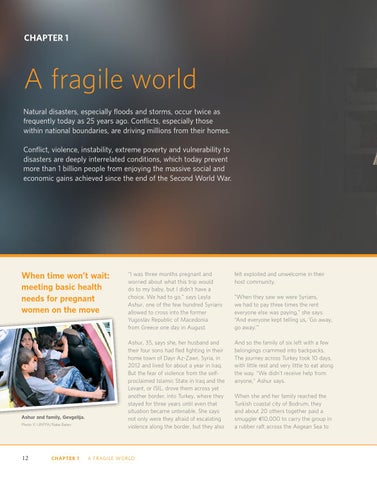
Ashur and family, Gevgelija. Photo © UNFPA/Nake Batev
12
CHAPTER 1
“I was three months pregnant and worried about what this trip would do to my baby, but I didn’t have a choice. We had to go,” says Leyla Ashur, one of the few hundred Syrians allowed to cross into the former Yugoslav Republic of Macedonia from Greece one day in August. Ashur, 35, says she, her husband and their four sons had fled fighting in their home town of Dayr Az-Zawr, Syria, in 2012 and lived for about a year in Iraq. But the fear of violence from the selfproclaimed Islamic State in Iraq and the Levant, or ISIL, drove them across yet another border, into Turkey, where they stayed for three years until even that situation became untenable. She says not only were they afraid of escalating violence along the border, but they also
A FRAG I LE WO RLD
felt exploited and unwelcome in their host community. “When they saw we were Syrians, we had to pay three times the rent everyone else was paying,” she says. “And everyone kept telling us, ‘Go away, go away.’” And so the family of six left with a few belongings crammed into backpacks. The journey across Turkey took 10 days, with little rest and very little to eat along the way. “We didn’t receive help from anyone,” Ashur says. When she and her family reached the Turkish coastal city of Bodrum, they and about 20 others together paid a smuggler €10,000 to carry the group in a rubber raft across the Aegean Sea to