Stories Engaging Youth
Sparking Creativity
The question of how to deliver solutions to places where the need is greatest and assure acceptance and uptake there remains sorely underexplored, with grave consequences for vulnerable children. – James Radner, Karlee Silver and Nathaniel Foote
[VIDEO] TENDEKAYI KATSIGA, Director of Operations at Deaftronics, produced Solar Ear, the world’s first solar hearing-aid battery charger. The device lasts for 2–3 years and can be used in 80 per cent of hearing aids on the market today. It was developed to meet the needs of communities lacking regular access to electricity; it can be charged via the sun, household light or a cell phone plug. The technology has spread to Brazil and Jordan, and the product is being sold in at least 40 African countries. In Zimbabwe, it is benefitting children who would otherwise be missing out on education because of their hearing impairment.
Working with Communities
Adapting Solutions
Reaching all Children
Rethinking Structures JAMES RADNER, Assistant Professor at the School of Public Policy and Governance, University of Toronto; KARLEE SILVER, Vice President of Targeted Challenges for Grand Challenges Canada; and NATHANIEL FOOTE, Senior Fellow at the Harvard University Center on the Developing Child, write about collaboration between scientists and communities to generate local solutions that reduce poverty and improve children’s lives. We need innovation to create delivery strategies that respond to local needs by bringing to bear the knowledge and capacity of all relevant actors, from village mothers to multinational businesses. ‘Integrated innovation’ engages social, scientific and business innovators for better, sustainable results at scale.
16
[VIDEO] THE CHILD WELFARE PROJECT was started in 2010 in five rural provinces of China to reach poor and remote children in a cost-effective and efficient way. This video follows 8-year-old Panpan, who lives with her elderly grandparents, and Mei Hongfang, a ‘barefoot social worker’ trained to offer assistance to families like Panpan’s. Mei monitors the family’s use of a monthly government subsidy, ensuring that guardians and caregivers spend it as intended.
THE STATE OF THE WORLD’S CHILDREN 2015: Executive Summary
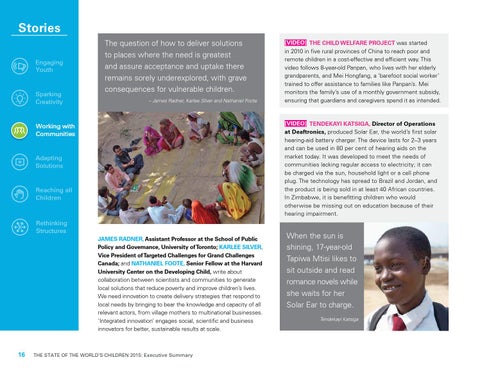
When the sun is shining, 17-year-old Tapiwa Mtisi likes to sit outside and read romance novels while she waits for her Solar Ear to charge. Tendekayi Katsiga