THE STATE OF THE WORLD’S CHILDREN 2015: Executive Summary
Reimagine the future Innovation for every child
How are innovators creating a better world? Will rapid change accentuate or diminish the extremes that separate children who want for almost nothing and those who are deprived of almost everything? In an increasingly connected world, problems cross borders – and solutions must do the same, linking global and local problem solvers to push the boundaries of the possible, try out unconventional approaches in new places, and accelerate progress towards a future in which all children can enjoy their rights. As the global development community plots its course for the post-2015 era beyond the Millennium Development Goals, the choice is ours to make.
THE STATE OF THE WORLD’S CHILDREN 2015: Executive Summary
Reimagine the future Innovation for every child
PHOTO CREDITS
© United Nations Children’s Fund (UNICEF) November 2014 Permission is required to reproduce any part of this publication. Permission will be freely granted to educational or non-profit organizations. Others will be requested to pay a small fee. Please contact: Division of Communication, UNICEF Attn: Permissions 3 United Nations Plaza, New York, NY 10017, USA Tel: +1 (212) 326-7434 Email: nyhqdoc.permit@unicef.org The State of the World’s Children 2015: Reimagine the Future: Innovation for Every Child digital report is available at <http://sowc2015.unicef.org>. The ‘Stories’ essays included in the report and summarized in the present Executive Summary represent the personal views of the authors and do not necessarily reflect the position of the United Nations Children’s Fund (UNICEF).
For latest data, please visit <www.childinfo.org>. ISBN: 978-92-806-4780-8
Cover and page i: © UNICEF/UNI161865/Holt Page iii: © UNICEF/NYHQ2011-1485/Friedman Page 1: © UNICEF/NYHQ2014-1956/Pirozzi Page 3: © UNICEF/UKLA2013-04413/Brooks Page 5: © UNICEF/UGDA201300462/Nakibuuk Page 6: © T. Woodson Page 7: © UNICEF/BANA2014-01619/Mawa Page 8: © UNICEF/SLRA2013-0102/Asselin Page 9: © UNICEF Kenya/2013/Huxta Page 11: © UNICEF/NYHQ2011-1645/Pirozzi Page 13: © S. Banerjee Page 14: © UNICEF/CHNA2014-00011/Liu Page 15: © S. Collins Page 16, left: © J. Radner Page 16, right: © T. Katsiga Page 17: © M. Rezwan Page 18: © GreenWood Page 19: © M. Rezwan Page 20, left: © C. Wong Page 20, right: © UNICEF/NYHQ2007-2363/LeMoyne Page 21: © UNICEF/NYHQ2013-1479/Pirozzi Page 22: © J. Sutz Page 23: © UNICEF/NYHQ2014-1870/Khizanis Page 24: © UNICEF/ETHA2013_00312/Ose Page 25: © UNICEF/PFPG2014P-0951/Boughan Page 26: © Raspberry Pi Foundation
ABOUT THE REPORT A
s the world marks 25 years of the Convention on the Rights of the Child, The State of the World’s Children calls for brave and fresh thinking to address age-old problems that still affect the most disadvantaged children. In particular, the report calls for innovation – and for the best and brightest solutions coming from communities to be taken to scale to benefit every child. The Convention itself was an innovation that recognized children as people with rights that must be respected equally to the rights of adults. It has helped drive remarkable progress for millions of children, but far too many are still being left behind. The report highlights how new ways of solving problems – often emerging from local communities and young people themselves – can help us overcome age-old inequities that prevent millions of children from surviving, thriving and making the most of their potential.
To finish unfinished business, we need to innovate. This means creating interconnected systems and new networks of problemsolvers that cross sectors, generations and geographies. It means scaling up local solutions to solve global challenges – and adapting them in new contexts. It means shaping new markets and spurring the private sector to design for development. It means creating solutions together with communities, and with a view to including all their members – preventing innovation from widening gaps. It means doing things differently, to drive change for children. In that spirit, this year’s State of the World’s Children is different. It is inspired by the remarkable work unfolding in countries and communities around the world. It is guided by the principles for inclusive innovation that UNICEF is helping to develop. And much of its content is crowdsourced – emerging out of the experiences and insights of people who are actively working to make the world better for every child.
Reimagine the future: Innovation for every child
iii
Over the past year, UNICEF has convened a continuing series of Activate Talks, global symposia that are bringing together young inventors, innovators, business people, artists and others to talk about the innovation they see, need and are helping to drive. Many of their stories are included in the essays and ideas presented here. In fact, this year’s report includes the greatest number of essays – by the greatest number of young people – since UNICEF published the first State of the World’s Children in 1980. This is also the first fully digital State of the World’s Children, with interactive, multimedia and traditional content. Users are invited to personalize their experience by browsing through categories or by tailoring the content with a series of tags, allowing them to engage with the ideas that mean the most to them. The digital platform also connects them to an innovation community and a constellation of open-source ideas through an interactive world map. We invite you to join this conversation, share your own ideas and experience, and create connections that might just bring about exponential change for the most disadvantaged children. Who knows what ideas you might inspire, what actions you might inform, what collaborators you might find, what change you might make. Don’t think of this as UNICEF’s report. Think of it as yours.
iv
THE STATE OF THE WORLD’S CHILDREN 2015: Executive Summary
CONTENTS
Part 1:
Shaping change to benefit all children ...........1
Part 2:
An unfairly distributed future ..........................3
Part 3:
Innovating for equity ........................................5 Many voices, many stories ..............................8 Statistical tables .............................................27
PART 1 Shaping change to benefit all children The world is changing rapidly. Where there were around 5 billion people in 1990, by 2050 there will nearly 10 billion – more than 2.6 billion of them younger than 18. Many children born today will enjoy vast opportunities unavailable 25 years ago. But not all will have an equal chance to grow up healthy, educated and able to fulfil their potential and become fully participating citizens, as envisioned in the Convention on the Rights of the Child. The magnitude of change and the scope of new ideas we witness today are remarkable – but they also often represent extreme disparity. Consider this: today, Internet giants can instantly identify you, predict your likes and dislikes, and build a detailed profile of who you are by using sophisticated algorithms. Yet, one child in three doesn’t have a
legal identity – because the simple process of registering her or his birth did not occur. In some places, cars operate on electricity alone – or even without a human being behind the wheel. Yet, elsewhere, critical medical forms must be filled out by hand – and a lack of infrastructure means the forms can take 30 days to travel from a rural clinic to a laboratory in the capital. As the global development community plots its course for the post-2015 era beyond the Millennium Development Goals, it must ask: will rapid change accentuate or diminish the extremes that separate children who want for almost nothing and those who are deprived of almost everything?
Reimagine the future: Innovation for every child
1
The answer to this question is not predetermined; there is a choice to be made. Will governments, the development and humanitarian communities, and partners in civil society, business and academia continue on the same path, recording incremental improvements in the situations of children but not closing the gaps? Or can we be bolder, trying out unconventional approaches and looking for solutions in new places to accelerate progress towards a future in which all children can enjoy their rights? Children are being born into an increasingly connected world where lines between local and global problems are blurred. Global warming brings flooding to coastal towns even as it afflicts inland farms with drought. Disease and conflict spill over international borders. Curbs on migration or remittances rob migrant workers’ children in faraway countries of the means to eat well and go to school. Solutions, too, are increasingly interwoven. In our hyper-connected, globalized world, people, technologies and ideas move more fluidly than ever before, generating unprecedented opportunities for collaboration to create large-scale change. Indeed, a global infrastructure of exploration is beginning to emerge – with innovators sharing ideas across borders and among groups of people previously excluded from the marketplace of knowledge and ideas. These innovators are pushing the boundaries of the possible, often starting with small solutions to local problems that have the potential to spark change and help more children gain access to the services and opportunities that are theirs by right – but not always in reality.
2
THE STATE OF THE WORLD’S CHILDREN 2015: Executive Summary
To expand the impact of these innovations, we need to unleash systems that can help bring the most promising new ideas to scale. Greater interconnectivity is already facilitating broader collaboration between the private sector, with its speed, agility and drive to reinvent, and the development world, with its ability to convene partnerships, inform policies and implement solutions on the ground. The same connectivity needs to be accessible to grass roots problem-solvers – helping create a truly global collaborative workspace capable of forging solutions that bring more equal access to goods, services and opportunities to millions of people. To minimize the risks of change and maximize its benefits for the most disadvantaged children, we need new products and processes, new partners and new models of partnership. These must be accessible to and influenced by disadvantaged and vulnerable people, and grounded in a better understanding of their realities and needs. For innovation alone is not enough; we need innovation that both embodies and advances inclusion and opportunity for all children. The good news – as shown in this year’s State of the World’s Children – is that innovation is already happening, in places you might not always imagine, delivering solutions today that have the potential to change the lives of millions of children for years to come. The future is already present. What we make of it is up to us.
PART 2 An unfairly distributed future Twenty-five years ago, the United Nations General Assembly adopted the Convention on the Rights of the Child. Since then, millions of children have benefited from progress. When governments, their international partners, businesses and communities have matched their obligations under the Convention with money and energy, they have saved and improved the lives of hundreds of millions of children. While the magnitude of progress has been profound in key areas – child survival, education, access to clean water – too many children still confront the future with their needs unaddressed, their rights unrealized and their potential thwarted.
The world’s low-income countries remain home to concentrations of poverty and disadvantage, but many impoverished children live in middle-income countries – countries plagued with large income inequalities. Here, as elsewhere, deprivation is disproportionately concentrated in urban slums and remote rural areas and among such marginalized groups as ethnic minorities and people with disabilities. Even the safety of a child’s arrival in this world remains subject to the lottery of where she was born and whether her family is well off – and the inequity extends throughout childhood and beyond.
Reimagine the future: Innovation for every child
3
The richest 20 per cent of the world’s women are 2.7 times more likely than the poorest 20 per cent to have a skilled attendant present at delivery. In South Asia, the richest women are nearly four times more likely than the poorest to have this benefit. Worldwide, 79 per cent of the richest children under the age of 5 have their births registered but only 51 per cent of the poorest enjoy the right to an official identity. And while 80 per cent of children living in cities are registered, this is true for only 51 per cent of those living in the countryside. The poorest 20 per cent of the world’s children are twice as likely as the richest 20 per cent to be stunted by poor nutrition and to die before their fifth birthday. Children in rural areas are at a similar disadvantage compared to those who live in urban areas. Nearly 9 in 10 children from the wealthiest 20 per cent of households in the world’s least developed countries attend primary school – compared to only about 6 in 10 from the poorest households. The gap can be dramatic even in lower-middle-income countries. In Nigeria, for example, 94 per cent of children in the wealthiest households attended school, compared to 34 per cent of children in the poorest households.
from the progress of the past 25 years. The cost of these inequities is paid most immediately – and most tragically – by children themselves. But the long-term impact affects generations to come, undermining the strength of their societies. So addressing these inequities and reducing disparities is not only the right thing to do – honoring the spirit of the Convention on the Rights of the Child – it is also the strategic thing to
Regardless of wealth, girls continue to be held back from schooling. For every 100 boys enrolled in primary school in West and Central Africa, only 90 girls are admitted. The exclusion is worse in secondary school, where only 76 girls are enrolled for every 100 boys.
do, yielding practical gains.
Adolescent girls are more likely to be married or in union by age 19 than their male counterparts, and less likely than boys to have comprehensive knowledge of HIV. In South Asia, boys are almost twice as likely as girls to have this knowledge with which to protect themselves.
agenda, dismantling the financial,
Nearly three quarters (or around 1.8 billion) of the 2.5 billion people around the world who still have no access to improved sanitation live in rural areas. Data from Bangladesh, India and Nepal, for example, show little progress between 1995 and 2008 in improved sanitation coverage among the poorest 40 per cent of households.
4
Too many children remain excluded
THE STATE OF THE WORLD’S CHILDREN 2015: Executive Summary
As the global community begins to shape – and act on – the post-2015 political, institutional and cultural barriers that stand between children and their rights must be a central priority.
PART 3 Innovating for Equity For all children to have an equal chance to make the most of their potential, innovation must not only benefit those who can afford it the most. It must also meet the needs and advance the rights of those who have the least. We call this innovating for equity, and it is already happening: in tech studios and university laboratories; in government, business and development organizations; and in kitchens, classrooms and community centres around the world. Innovators are drawing on unconventional sources of knowledge and collaboration, disrupting established processes and structures, and using available resources creatively to produce practical solutions that deliver higher quality or greater impact at lower cost. But how
is one to determine whether an innovation, and the process of innovation itself, serves to advance equal opportunity for all children, regardless of the circumstances into which they were born? UNICEF and partners in governments, businesses, philanthropic organizations and the United Nations system have endorsed principles of innovation for equity. In our experience, this kind of innovation is: Targeted to reach children not reached by traditional approaches.
Reimagine the future: Innovation for every child
5
Designed with and for the user to address the specific needs of marginalized and vulnerable children and families, and priced so they can benefit from it.
Based on sound evidence and subject to rigorous monitoring, evaluation and revision to increase the benefit to the most deprived and vulnerable children and families.
Anchored in the principles of children’s rights, including nondiscrimination, so that all children and their families have an equal chance to enjoy high-quality goods and services.
Sustainable within countries’ or communities’ financial and environmental constraints; not reliant on subsidies or on the degradation of natural resources.
Participatory – engaging children, young people and their communities as agents of change. Rooted in local social, cultural, economic, institutional and political circumstances – and adaptable to differing contexts.
Scalable, to bring benefits to as many as possible within each specific context. Since circumstances vary between settings, not everything will be appropriate everywhere. Unafraid to fail, because failure is both a natural consequence of testing new ideas and a critical part of creating successful innovations.
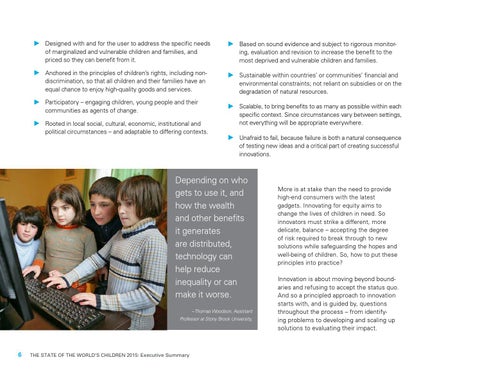
Depending on who gets to use it, and how the wealth and other benefits it generates are distributed, technology can help reduce inequality or can make it worse. – Thomas Woodson, Assistant Professor at Stony Brook University,
6
THE STATE OF THE WORLD’S CHILDREN 2015: Executive Summary
More is at stake than the need to provide high-end consumers with the latest gadgets. Innovating for equity aims to change the lives of children in need. So innovators must strike a different, more delicate, balance – accepting the degree of risk required to break through to new solutions while safeguarding the hopes and well-being of children. So, how to put these principles into practice?
Innovation is about moving beyond boundaries and refusing to accept the status quo. And so a principled approach to innovation starts with, and is guided by, questions throughout the process – from identifying problems to developing and scaling up solutions to evaluating their impact.
Key questions for innovators and facilitators of innovation to consider include: Assessing the context ◗◗ What barriers are keeping the poorest children and families from the goods, services and opportunities they need to realize their rights?
Evaluating solutions ◗◗ Is the solution environmentally and financially sustainable? ◗◗ Will all users have an equal voice in providing feedback?
◗◗ What has been tried before? Why hasn’t it worked?
◗◗ What risks are involved in implementing the solution? Are they acceptable?
◗◗ Are there potential home-grown solutions available that could be developed with support? What kind of support do local innovators need?
◗◗ What happens if it fails? What kind of support will communities get to help them deal with the failure?
◗◗ How can communities – and especially their most marginalized members, like women and girls or ethnic minorities – be engaged in developing and implementing solutions?
Developing solutions ◗◗ Does the solution meet applicable quality standards? ◗◗ Will the poorest be able to afford it? ◗◗ Will it be equally accessible to children with disabilities or those from other disadvantaged groups? ◗◗ Is the solution appropriate to the intended age group and prevailing social and cultural norms? ◗◗ Do the institutions, infrastructure, legal framework, resources and capacities needed to make the solution work exist? How can gaps be filled? ◗◗ Is the solution financially sustainable or will it need more money to keep going?
◗◗ How will lessons from the failure inform future efforts?
Scaling and adapting solutions ◗◗ How do you know if a solution is scalable? ◗◗ What will it take to bring the solution to scale? ◗◗ If a solution is not scalable, what is its value? ◗◗ When adapting a solution to a new context, what needs to be changed?
Engaging children and young people ◗◗ How can children and young people be engaged in the process of innovation? ◗◗ What measures must be taken to protect children involved in the process of developing and implementing solutions? How should children be compensated for their time and effort? ◗◗ What kinds of education or training can help foster children’s creativity and critical thinking? How to ensure that the poorest and most marginalized children are not excluded from such opportunities?
Reimagine the future: Innovation for every child
7
Many voices, many stories
In countries and communities across the globe, people are doing remarkable things to make the world better for every child – by pushing boundaries, challenging assumptions and sharing their creative solutions. The 2015 State of the World’s Children presents many of these innovators’ experiences and insights, in their own words. Using the categories below, readers of the online report can explore their work. The following pages present some of the stories included in each category in the digital report. Engaging youth Young people are finding new ways to participate and claim their rights. Sparking creativity Young people need support and quality education to foster their potential as innovators. Working with communities Inclusive and sustainable solutions, by and for local people, are emerging. Adapting solutions Innovators around the world are closing gaps and crafting solutions tailored to local needs. Reaching all children Reorienting innovation towards greater equality and the needs of the poorest takes deliberate effort. Rethinking structures What are the nuts and bolts of delivering innovation to the world’s poorest children?
8
THE STATE OF THE WORLD’S CHILDREN 2015: Executive Summary
INNOVATION MAP The interactive ‘Innovation Map’ lets you explore what others are doing to solve challenges affecting children around the globe. We want to hear from you too – tell us about something innovative that you’re doing, or that people you know are doing. Put those innovations on the map – and help us discover the next big idea that could change the world for children.
Engaging youth <http://SOWC2015.unicef.org/topics/engaging-youth>
Young people are finding new ways to participate and claim their rights.
Around the world, children and young people are enjoying unprecedented opportunities to connect with each other and share experiences and information. Innovative projects, some initiated or implemented by young people themselves, are helping to turn these connections into change. Young people are using the Internet and mobile technologies to track issues they are concerned about and speak directly to decision makers. Children living and working on the streets are finding resources to help themselves plan for the future. Meanwhile, adults are beginning to realize that it’s important to listen to children. Designers of technologies recognize that children’s input is critical to making products that speak to what children actually need and want – and that draw on children’s imagination and creativity to expand the realm of the possible. Humanitarian initiatives, though slower on the uptake, are also starting to consult children to make complex and intimidating bureaucratic processes respond better to their needs. Asking children what they want and need simply leads to better results. Affordable Internet-enabled mobile phones are allowing more Kenyans to go online.
Stories Reimagine the future: Innovation for every child
9
Stories Engaging Youth
Sparking Creativity
Working with Communities
Adapting Solutions
Reaching all Children
Rethinking Structures
NATHANAEL CHRISTENSON, 19, KEVIN CHOW, 17, and LUKE SCHUSTER, 18, recount how they developed Seeing Eye Pad, a navigation assistance app for the visually impaired. They started out wondering how to make computer experiences more realistic – and concluded that the results of their research had potential to aid people with visual impairments in moving about the world. The software uses a tablet’s camera to scan the environment and plays sounds to alert the user to doors, stairs, drop-offs and other common hazards. They designed the software to work on lowerpowered machines that those in need are more likely to have access to.
ALISON DRUIN, Chief Futurist and Director of the Future of Information Alliance at the University of Maryland, describes her work with children as partners in research and development of new technologies. As a 9-year-old boy involved in the research explained, designing technologies for children without giving them opportunities to express their unique perspectives is “like making clothes for someone you don’t know the size of.” Druin’s process of ‘cooperative inquiry’ gives rise to all sorts of ideas, some outlandish and others practical – and from these, innovation is born. RITA PANICKER PINTO, Founder and Director of Butterflies, describes the Children’s Development Khazana, a cooperative bank run by and for working children, including those living on the street. The bank empowers clients to save their money, earn interest, and finance their own businesses and education. To help children raise themselves out of poverty, it also provides life skills education, teaching them how to set priorities, manage their money in ways that help them achieve their goals and operate their businesses effectively and ethically. VIRAJ PURI, 14, explains how he created Bullyvention, a way to leverage the power of people and technology to track and advocate against cyberbullying. Based on algorithms that analyse social media messages, the bullying heat map raises awareness by showing, in
10
THE STATE OF THE WORLD’S CHILDREN 2015: Executive Summary
real time, where bullying is happening – while partnerships with members of government help turn awareness into action. ANNA SKEELS, Project Manager for Measuring Separation in Emergencies, hosted by Save the Children, discusses refugee children’s participation in designing child protection programmes. Current procedures pay little attention to children’s particular needs and can be overly formal and intimidating to kids – creating barriers that prevent them from sharing their concerns openly. When asked, children have come up with simple ways to make these procedures more child friendly – for instance, peer support for newly arrived children or opportunities for play while waiting for interviews. [VIDEO] In Chile, the annual ‘fiiS’ festival of social innovation is about showcasing how everyone – not just experts – can solve problems. At its core is the belief that solving pressing social ills makes sense when done hand-in-hand with those most affected and with diverse partners focused on concrete results. At the festival, young people see popular music bands and participate in sessions in which people from different walks of life imagine and begin building solutions together.
[VIDEO] The story of Josephine, a bright 21-year-old young woman from Lusaka, Zambia, is one of bravery and innovation. Born in the slums of Lusaka into a family of 10 siblings, Josephine managed to get herself into and through school, and is now on a mission to change the world. As one of Zambia’s 65,000-plus U-Reporters, she is part of a community that uses rapid SMS to provide adolescents and young people with confidential, free-of-charge counselling on sexually transmitted diseases and HIV. In addition to the SMS counselling, periodic polls gather the opinions of young people and allow them to participate in their country’s future.
Sparking creativity <http://SOWC2015.unicef.org/topics/sparking-creativity>
Young people need support and quality education to foster their potential as innovators.
Children and young people are natural innovators. They are also acutely aware and deeply concerned about the challenges facing their communities. Nurturing their creativity and critical thinking is key to helping them develop their potential to address these problems. Similarly, expanding access to quality education equips them with concrete knowledge and skills in disciplines like science and engineering, which are in demand in this technologically driven world. It’s especially important that the children whom society has kept at a disadvantage – because of gender, disability, ethnic minority status or poverty – have equal opportunities to learn and participate. Around the world, innovators are trying out unconventional approaches to education – like using simple toys to illustrate principles of science, or setting up innovation labs to give children a space in which to tinker with models and machines. Such initiatives impart critical knowledge and skills, while giving children opportunities to build their confidence as thinkers, makers and problem solvers. These experiences can change children’s lives – and children, in turn, have the potential to change the world. A boy who previously lived on the streets paints at the Umid Yeri (‘Place of Hope’) Children’s Shelter and Rehabilitation Centre in Baku, Azerbaijan.
Stories Reimagine the future: Innovation for every child
11
Stories Engaging Youth
Sparking Creativity
Working with Communities
Adapting Solutions
Reaching all Children
Rethinking Structures
SHUBHAM BANERJEE, 13, recounts his creation of Braigo, a Braille printer made from Lego bricks that costs $350 (compared to $2,000 average). To make a Braille printer for the masses, do-it-yourself assembly is key. The young inventor built seven different models before settling on one that was able to print the six dots in a desired sequence according to Braille grade 1 standards. “I always closed my eyes and used my fingers to feel the bumps on the paper,” he writes. The building instructions and software are open source, which will provide a low-cost solution for the visually impaired community. OSAMA BROSH, young inventor, talks about how he and classmate Omar Turk designed a mobile phone application that uses vibration to alert deaf people to loud sounds. Their ‘eureka’ moment was inspired by a scene Osama had seen on TV as a young kid, in which a hearing-impaired character could not hear a knock at the door. That tiny spark, he relates, spawned ideas upon ideas. The essay recounts the exhilarating process of developing the idea into a software application with the support of their mentors and presenting it at StartUp Weekend, where their prototype won first place. EMILY CUMMINS, young inventor, describes her experience as an inventor and advocate for young people, especially girls, to become engineers, scientists and technologists. She writes about her decision to open source all her designs – including a water carrier that can transport multiple containers in a single trip and a sustainable refrigerator powered by dirty water and solar heat – and makes the case that providing free access to the design plans is key to ensuring that poor people benefit from the products she has created.
12
THE STATE OF THE WORLD’S CHILDREN 2015: Executive Summary
ARVIND GUPTA, science educator and inventor at the University of Pune, describes how simple, everyday objects – from bicycle tubes and broken slippers to straws and matchboxes – can be wrought into simple machines that captivate children, and in the process teach them fundamental principles of science. In many countries, science education focuses on rote learning – but Gupta’s active, concrete and creative approach has much greater potential to capture children’s imagination and get them excited about science. DESMOND MITCHELL, CEO of Cornerstone Innovation and board member of Global Minimum, talks about how innovation labs are enhancing education through active learning. Offering opportunities for tinkering, making and modeling, the innovation labs’ curriculum promotes children’s cognitive development, creativity and critical thinking as well as building self-confidence and empowering them to imagine, experiment with and build solutions to the problems they see in the world around them. DAVID SENGEH, President and Co-Founder of Global Minimum, describes the experiences that shaped his life as a young innovator – from fleeing rebels during Sierra Leone’s civil war, flanked by columns of child soldiers, to talking with amputees in a camp in Freetown and later incorporating the insights he gleaned there into designs for cutting-edge prosthetics at MIT’s Media Lab. Children and young people, he argues, have the potential and passion to innovate and solve the problems that plague their communities – but they need to be not only equipped with the right tools, platforms and skills, but also taught to question the status quo and feel empowered to do something to change it.
Sparking creativity
BALAZS ZSOMBORI, young inventor, talks about developing PictoVerb, an application for tablets and smartphones that transforms universally recognizable symbols into audio sentences, helping people with speech impairments communicate. Balazs was inspired to create his application after meeting a woman who lost her voice due to disease and seeing how not being able to speak cut her off from human connections. Down the road, he plans to expand his invention into a family of products to help adapt the world to meet the needs of people with disabilities. [VIDEO] Education is more than just exam results and grades on paper. Nowhere is that more clear than in Jamaica, where the prevailing teaching method is known as ‘chalk and talk’. MARVIN HALL, a former mathematics teacher, believes there’s a better way to teach children. Since 2008, he has conducted a series of summer camps and workshops known as Lego Yuh Mind. The workshops involve building robots from Lego, but they encompass much more than that, including inspiring creative thinking and problem solving, encouraging financial intelligence, developing skills in buying and selling, profit and loss, entrepreneurial thinking and participation in a market economy. [VIDEO] Think ‘innovation space’ and what comes to mind? Perhaps an incubator in Silicon Valley, or a high-tech hacker space in Berlin. Lusaka, Zambia probably doesn’t spring readily to mind – but that’s just what is happening in a small house on a quiet, tree-lined street behind one of the capital’s main shopping malls. In 2011, four local entrepreneurs founded BONGOHIVE to bring young people together to learn technology skills, share co-working space and be part of a community dedicated to the ideals of innovation, creativity and sustainability.
Existing assistive technologies are either too expensive or difficult to obtain for normal people without a government or non-profit sponsorship. Technological advances should help humanity and not become a burden due to cost. – Shubham Banerjee
Reimagine the future: Innovation for every child
13
Working with communities <http://SOWC2015.unicef.org/topics/working-with-communities>
Inclusive and sustainable solutions, by and for local people, are emerging.
Children, families and communities are autonomous agents, and acknowledging them as such is key to respecting their human rights – and to creating solutions that succeed and can be sustained. Ventures that spring from the initiative of community members and proceed with their participation are more likely to address their needs in ways that are acceptable and sensitive to local social, cultural and political factors that outsiders may well miss. A variety of innovative projects are achieving results by putting local participation and agency at the centre. In some countries, social protection programmes stimulate demand for goods and services by providing cash in exchange for changes in behaviour, like buying more nutritious food and visiting the doctor regularly. Rigorous evaluations have shown that when parents are empowered to invest in their children, the children reap lasting benefits. This lesson has been borne out also by humanitarian initiatives that focus on demand, directly giving parents the goods they need to help their own children. When scientists partner with communities, the resulting exchange of knowledge enriches both sides and can lead to more effective solutions. And community members’ ownership and empowerment give interventions a greater chance of creating change that endures. The Child Welfare Project in China uses community-based social workers to reach poor and remote children in a cost-effective and efficient way. 14 THE STATE OF THE WORLD’S CHILDREN 2015: Executive Summary
Stories
Workin Comm
MOHAMED BANGURA, young inventor, tells of inventing a low-cost sharpening machine for his community’s craftsmen after noticing that the tools they used would regularly wear out. Mohamed put himself in their shoes, imagining how he would feel if the circuit boards he needed to pursue his passion for building electronics were always breaking down. He developed his machine in close consultation with the craftsmen, and seeing them use the finished product boosted his confidence in his own abilities to create solutions.
STEVE COLLINS, Co-Founder and Director of Valid Nutrition, discusses his pioneering development of the community-based management of acute malnutrition (CMAM) – a model of care that moved away from the traditional, expensive and low-coverage model of inpatient therapeutic feeding centres run by aid agencies, to treating people in their homes with the support of local clinics and using ready-to-use therapeutic foods. By empowering parents with the tools to care for their own children, CMAM revolutionized the treatment of acute malnutrition. KAREN MACOURS, Associate Professor at the Paris School of Economics and Researcher at the French Agricultural Research Institute, surveys innovative conditional cash transfer programmes that bypass the traditional supply-side approach focusing on service provision, to instead address the demand side by providing families in poor and vulnerable communities with cash in exchange for changes in nutrition- and health-related behaviours. Such social protection initiatives empower families to invest in their own children. And they work: rigorous, randomized evaluations have shown that they produce sustained improvements in young children’s cognitive development.
Fostering an environment that promotes the use of evidence and transparency to provoke change is an important challenge to which we must all rise.
– Steve Collins
OLIVIER NYIRUBUGARA, Lecturer in Journalism and New Media at Erasmus University Rotterdam and Senior Coach at the Voices of Africa Media Foundation, discusses his experience training young people in eight African countries to use mobile phones to produce audiovisual reports about issues that undermine the realization of children’s rights – from child labour to violence to lack of access to quality education. The young reporters show the videos to local administrators and decision makers, voicing their concerns and trying to find solutions. Voices of Africa also trains them in journalistic ethics – especially regarding any potential risks to the children featured in their stories.
Reimagine the future: Innovation for every child
15
Stories Engaging Youth
Sparking Creativity
The question of how to deliver solutions to places where the need is greatest and assure acceptance and uptake there remains sorely underexplored, with grave consequences for vulnerable children. – James Radner, Karlee Silver and Nathaniel Foote
[VIDEO] TENDEKAYI KATSIGA, Director of Operations at Deaftronics, produced Solar Ear, the world’s first solar hearing-aid battery charger. The device lasts for 2–3 years and can be used in 80 per cent of hearing aids on the market today. It was developed to meet the needs of communities lacking regular access to electricity; it can be charged via the sun, household light or a cell phone plug. The technology has spread to Brazil and Jordan, and the product is being sold in at least 40 African countries. In Zimbabwe, it is benefitting children who would otherwise be missing out on education because of their hearing impairment.
Working with Communities
Adapting Solutions
Reaching all Children
Rethinking Structures JAMES RADNER, Assistant Professor at the School of Public Policy and Governance, University of Toronto; KARLEE SILVER, Vice President of Targeted Challenges for Grand Challenges Canada; and NATHANIEL FOOTE, Senior Fellow at the Harvard University Center on the Developing Child, write about collaboration between scientists and communities to generate local solutions that reduce poverty and improve children’s lives. We need innovation to create delivery strategies that respond to local needs by bringing to bear the knowledge and capacity of all relevant actors, from village mothers to multinational businesses. ‘Integrated innovation’ engages social, scientific and business innovators for better, sustainable results at scale.
16
[VIDEO] THE CHILD WELFARE PROJECT was started in 2010 in five rural provinces of China to reach poor and remote children in a cost-effective and efficient way. This video follows 8-year-old Panpan, who lives with her elderly grandparents, and Mei Hongfang, a ‘barefoot social worker’ trained to offer assistance to families like Panpan’s. Mei monitors the family’s use of a monthly government subsidy, ensuring that guardians and caregivers spend it as intended.
THE STATE OF THE WORLD’S CHILDREN 2015: Executive Summary
When the sun is shining, 17-year-old Tapiwa Mtisi likes to sit outside and read romance novels while she waits for her Solar Ear to charge. Tendekayi Katsiga
Around the world, an innovation revolution for children is growing – often in the most unexpected places – and increasingly led by young people themselves. Fueled by creativity, connectivity and collaboration, new ways of solving problems are emerging – in tech design studios and university laboratories, in development organizations and corporations, and in kitchens and community centres. To mark the 25th anniversary of the Convention of the Rights of the Child, this edition of The State of the World’s Children highlights the work of remarkable young innovators who are already reimagining the future – and invites the world to join this rising movement to advance the rights of every child.
#EVERYchild
Published by UNICEF Division of Communication 3 United Nations Plaza New York, NY 10017, USA pubdoc@unicef.org www.unicef.org http://data.unicef.org ISBN: 978-92-806-4780-8 The State of the World’s Children 2015: Reimagine the Future: Innovation for Every Child digital report is available at <http://sowc2015.unicef.org>
© United Nations Children’s Fund (UNICEF) November 2014