Central Asia (Kyrgyzstan and Tajikistan) Kyrgyzstan and Tajikistan are among the most vulnerable countries in Central Asia: landlocked, low income and highly dependent on the outside world for food and energy. In Kyrgyzstan, almost 40 per cent of people are below the poverty line, and one third struggle to feed themselves. Kyrgyzs frequently face earthquakes, floods, landslides and extreme winters, as well as political instability, ethnic tensions and a lack of investment in infrastructure or basic services. In 2010, political demonstrations in the south evolved into extremely violent ethnic clashes in Osh and Jalal-Abad, killing almost 500 people and displacing more than 400,000 ethnic Uzbeks. Grievances included insufficient clean water, the decline of agricultural economy, a lack of clarity over grazing rights and poor access to education. In Tajikistan, almost half the population lives on less than $1.50 a day and 17 per cent on less than $1 a day. Most people spend between 60 and 80 per cent of their income on food, and one third are food insecure. Remittances– mostly from workers in the Russian Federation– account for almost 50 per cent of GDP, and they are the main income source for almost 55 per cent of rural households.
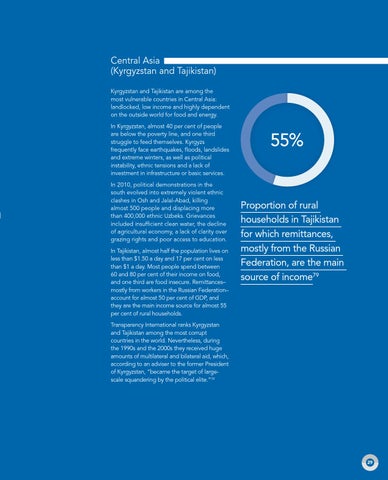
55%
Proportion of rural households in Tajikistan for which remittances, mostly from the Russian Federation, are the main source of income79
Transparency International ranks Kyrgyzstan and Tajikistan among the most corrupt countries in the world. Nevertheless, during the 1990s and the 2000s they received huge amounts of multilateral and bilateral aid, which, according to an adviser to the former President of Kyrgyzstan, “became the target of largescale squandering by the political elite.”78
29
29