From global risk to local crisis
insecurity, poverty, inequality and mass migration all contribute to an increased risk of humanitarian crises.
Disasters and conflict have been understood as the main drivers of humanitarian need, but a number of global trends are changing the humanitarian risk landscape (figure 8). Climate change, population growth, rapid and unplanned urbanization, food and water
Climate change is contributing to weather and climate extremes and is expected to do so more over time. For example, the maximum wind speed of tropical cyclones is likely to increase. Typhoon Haiyan, which destroyed parts of the Philippines in November 2013, was the most powerful
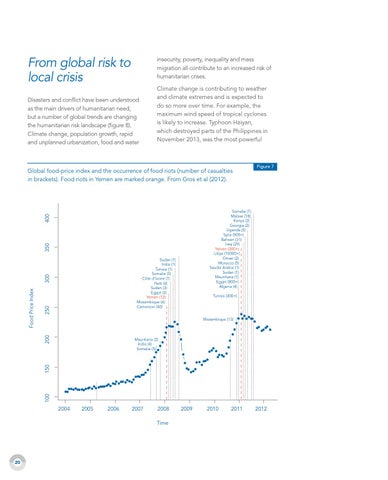
Global food-price index and the occurrence of food riots (number of casualties in brackets). Food riots in Yemen are marked orange. From Gros et al (2012).
400
350
250
Somalia (1) Malawi (18) Kenya (2) Georgia (2) Uganda (5) Syria (900+) Bahrain (31) Iraq (29) Yemen (300+) Libya (10000+) Oman (2) Morocco (5) Saudia Arabia (1) Sudan (1) Mauritiana (1) Egypt (800+) Algeria (4) Tunisia (300+)
Mozambique (13)
200
Food Price Index
300
Sudan (1) India (1) Tunisia (1) Somalia (5) Côte d’Ivoire (1) Haiti (6) Sudan (3) Egypt (3) Yemen (12) Mozambique (6) Cameroon (40)
Figure 7
100
150
Mauritiana (2) India (4) Somalia (5)
2004
2005
2006
2007
2008 Time
2020
2009
2010
2011
2012