Global challenges and the changing risk landscape Worldwide, there is an increase in the number of people who need humanitarian assistance and the cost of helping them.20 The number of armed conflicts has declined over the past 20 years, but more people are being uprooted by violence. Forty-five million people were displaced at the end of 2012–the most since 1994.21
Natural disasters are increasing. Over the last 10 years there was an average of 320 recorded disasters a year, compared with 290 in the previous 10 years.22 Mortality risk related to floods, winds and droughts is decreasing thanks to investment in early warning systems, better preparedness and economic development. But the number of people exposed to severe weather is increasing. Between 1970 and 2010, the world’s population increased by 87 per cent, but the population exposed to flooding increased by 114 per cent. Mortality risk relating to earthquakes and tsunamis is also growing due to a rise in people living in areas at risk.23
Figure 5
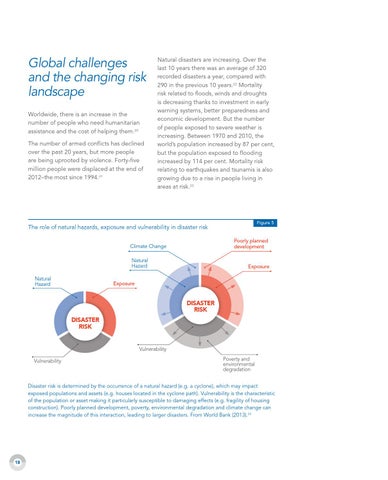
The role of natural hazards, exposure and vulnerability in disaster risk
Poorly planned development
Climate Change Natural Hazard Natural Hazard
Exposure
Exposure
Disaster Risk Disaster Risk
Vulnerability Vulnerability
Poverty and environmental degradation
Disaster risk is determined by the occurrence of a natural hazard (e.g. a cyclone), which may impact exposed populations and assets (e.g. houses located in the cyclone path). Vulnerability is the characteristic of the population or asset making it particularly susceptible to damaging effects (e.g. fragility of housing construction). Poorly planned development, poverty, environmental degradation and climate change can increase the magnitude of this interaction, leading to larger disasters. From World Bank (2013).24
1818