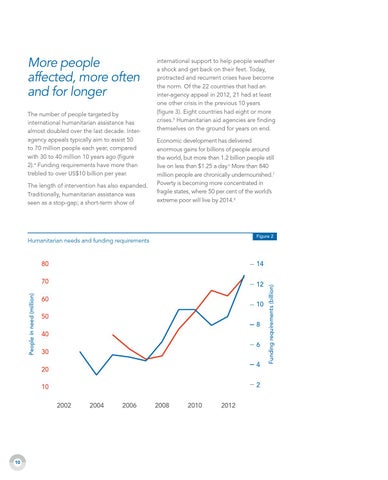
The number of people targeted by international humanitarian assistance has almost doubled over the last decade. Interagency appeals typically aim to assist 50 to 70 million people each year, compared with 30 to 40 million 10 years ago (figure 2).4 Funding requirements have more than trebled to over US$10 billion per year. The length of intervention has also expanded. Traditionally, humanitarian assistance was seen as a stop-gap; a short-term show of
international support to help people weather a shock and get back on their feet. Today, protracted and recurrent crises have become the norm. Of the 22 countries that had an inter-agency appeal in 2012, 21 had at least one other crisis in the previous 10 years (figure 3). Eight countries had eight or more crises.5 Humanitarian aid agencies are finding themselves on the ground for years on end. Economic development has delivered enormous gains for billions of people around the world, but more than 1.2 billion people still live on less than $1.25 a day.6 More than 840 million people are chronically undernourished.7 Poverty is becoming more concentrated in fragile states, where 50 per cent of the world’s extreme poor will live by 2014.8
Figure 2
People in need (million)
Humanitarian needs and funding requirements
80
14
70
12
60
10
50 8 40 6
30
4
20
2
10 2002
1010
2004
2006
2008
2010
2012
Funding requirements (billion)
More people affected, more often and for longer