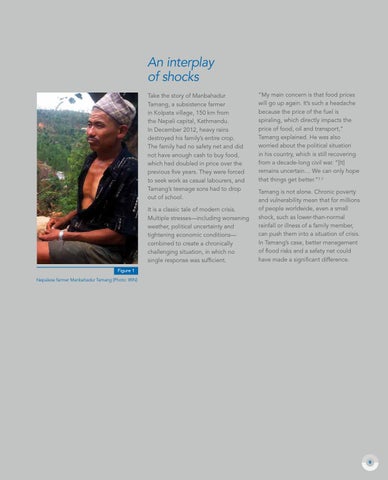
An interplay of shocks Take the story of Manbahadur Tamang, a subsistence farmer in Kolpata village, 150 km from the Nepali capital, Kathmandu. In December 2012, heavy rains destroyed his family’s entire crop. The family had no safety net and did not have enough cash to buy food, which had doubled in price over the previous five years. They were forced to seek work as casual labourers, and Tamang’s teenage sons had to drop out of school. It is a classic tale of modern crisis. Multiple stresses—including worsening weather, political uncertainty and tightening economic conditions— combined to create a chronically challenging situation, in which no single response was sufficient.
“My main concern is that food prices will go up again. It’s such a headache because the price of the fuel is spiraling, which directly impacts the price of food, oil and transport,” Tamang explained. He was also worried about the political situation in his country, which is still recovering from a decade-long civil war. “[It] remains uncertain… We can only hope that things get better.”2 3 Tamang is not alone. Chronic poverty and vulnerability mean that for millions of people worldwide, even a small shock, such as lower-than-normal rainfall or illness of a family member, can push them into a situation of crisis. In Tamang’s case, better management of flood risks and a safety net could have made a significant difference.
Figure 1 Nepalese farmer Manbahadur Tamang (Photo: IRIN)
9
9