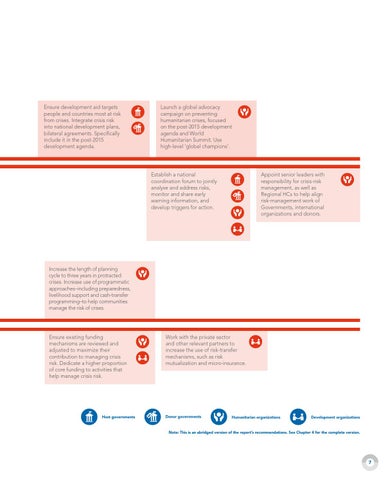
Ensure development aid targets people and countries most at risk from crises. Integrate crisis risk into national development plans, bilateral agreements. Specifically include it in the post-2015 development agenda.
Launch a global advocacy campaign on preventing humanitarian crises, focused on the post-2015 development agenda and World Humanitarian Summit. Use high-level ‘global champions’.
Appoint senior leaders with responsibility for crisis-risk management, as well as Regional HCs to help align risk-management work of Governments, international organizations and donors.
Establish a national coordination forum to jointly analyse and address risks, monitor and share early warning information, and develop triggers for action.
Increase the length of planning cycle to three years in protracted crises. Increase use of programmatic approaches–including preparedness, livelihood support and cash-transfer programming–to help communities manage the risk of crises.
Ensure existing funding mechanisms are reviewed and adjusted to maximize their contribution to managing crisis risk. Dedicate a higher proportion of core funding to activities that help manage crisis risk.
Host governments
Work with the private sector and other relevant partners to increase the use of risk-transfer mechanisms, such as risk mutualization and micro-insurance.
Donor governments
Humanitarian organizations
Development organizations
Note: This is an abridged version of the report’s recommendations. See Chapter 4 for the complete version.
7
7