The Millennium Development Goals Report 2014
asdf UNITED NATIONS
This report is based on a master set of data that has been compiled by an Inter-Agency and Expert Group on MDG Indicators led by the Department of Economic and Social Affairs of the United Nations Secretariat, in response to the wishes of the General Assembly for periodic assessment of progress towards the MDGs. The Group comprises representatives of the international organizations whose activities include the preparation of one or more of the series of statistical indicators that were identified as appropriate for monitoring progress towards the MDGs, as reflected in the list below. A number of national statisticians and outside expert advisers also contributed.
ECONOMIC AND SOCIAL COMMISSION FOR ASIA AND THE PACIFIC ECONOMIC AND SOCIAL COMMISSION FOR WESTERN ASIA ECONOMIC COMMISSION FOR AFRICA ECONOMIC COMMISSION FOR EUROPE
Cover Inside AND THE CARIBBEAN ECONOMIC COMMISSION FOR LATIN AMERICA FOOD AND AGRICULTURE ORGANIZATION OF THE UNITED NATIONS INTERNATIONAL LABOUR ORGANIZATION INTERNATIONAL MONETARY FUND INTERNATIONAL TELECOMMUNICATION UNION INTERNATIONAL TRADE CENTRE INTER-PARLIAMENTARY UNION JOINT UNITED NATIONS PROGRAMME ON HIV/AIDS ORGANISATION FOR ECONOMIC CO-OPERATION AND DEVELOPMENT SECRETARIAT OF THE PACIFIC COMMUNITY THE WORLD BANK UNITED NATIONS CHILDREN’S FUND UNITED NATIONS CONFERENCE ON TRADE AND DEVELOPMENT UNITED NATIONS DEVELOPMENT PROGRAMME UNITED NATIONS EDUCATIONAL, SCIENTIFIC AND CULTURAL ORGANIZATION UNITED NATIONS ENTITY FOR GENDER EQUALITY AND THE EMPOWERMENT OF WOMEN - UN WOMEN UNITED NATIONS ENVIRONMENT PROGRAMME UNITED NATIONS FRAMEWORK CONVENTION ON CLIMATE CHANGE UNITED NATIONS HIGH COMMISSIONER FOR REFUGEES UNITED NATIONS HUMAN SETTLEMENTS PROGRAMME UNITED NATIONS INDUSTRIAL DEVELOPMENT ORGANIZATION UNITED NATIONS POPULATION FUND WORLD HEALTH ORGANIZATION WORLD TRADE ORGANIZATION
The Millennium Development Goals Report 2014
asdf
United Nations New York, 2014
2 | The Millennium Development Goals Report 2014
Foreword  | 3
Foreword At the turn of the century, world leaders came together at the United Nations and agreed on a bold vision for the future through the Millennium Declaration. The Millennium Development Goals (MDGs) were a pledge to uphold the principles of human dignity, equality and equity, and free the world from extreme poverty. The MDGs, with eight goals and a set of measurable timebound targets, established a blueprint for tackling the most pressing development challenges of our time. This report examines the latest progress towards achieving the MDGs. It reaffirms that the MDGs have made a profound difference in people’s lives. Global poverty has been halved five years ahead of the 2015 timeframe. Ninety per cent of children in developing regions now enjoy primary education, and disparities between boys and girls in enrolment have narrowed. Remarkable gains have also been made in the fight against malaria and tuberculosis, along with improvements in all health indicators. The likelihood of a child dying before age five has been nearly cut in half over the last two decades. That means that about 17,000 children are saved every day. We also met the target of halving the proportion of people who lack access to improved sources of water.
The concerted efforts of national governments, the international community, civil society and the private sector have helped expand hope and opportunity for people around the world. But more needs to be done to accelerate progress. We need bolder and focused action where significant gaps and disparities exist. Member States are now fully engaged in discussions to define Sustainable Development Goals (SDGs), which will serve as the core of a universal post-2015 development agenda. Our efforts to achieve the MDGs are a critical building block towards establishing a stable foundation for our development efforts beyond 2015.
Ban Ki-moon Secretary-General, United Nations
4 | The Millennium Development Goals Report 2014
Overview Fourteen years ago, the Millennium Declaration articulated a bold vision and established concrete targets for improving the existence of many and for saving the lives of those threatened by disease and hunger. There has been important progress across all goals, with some targets already having been met well ahead of the 2015 deadline. All stakeholders will have to intensify and focus their efforts on the areas where advancement has been too slow and has not reached all.
Several MDG targets have been met •• The world has reduced extreme poverty by half In 1990, almost half of the population in developing regions lived on less than $1.25 a day. This rate dropped to 22 per cent by 2010, reducing the number of people living in extreme poverty by 700 million. •• Efforts in the fight against malaria and tuberculosis have shown results Between 2000 and 2012, an estimated 3.3 million deaths from malaria were averted due to the substantial expansion of malaria interventions. About 90 per cent of those averted deaths—3 million—were children under the age of five living in sub-Saharan Africa. The intensive efforts to fight tuberculosis have saved an estimated 22 million lives worldwide since 1995. If the trends continue, the world will reach the MDG targets on malaria and tuberculosis. •• Access to an improved drinking water source became a reality for 2.3 billion people The target of halving the proportion of people without access to an improved drinking water source was achieved in 2010, five years ahead of schedule. In 2012, 89 per cent of the world’s population had access to an improved source, up from 76 per cent in 1990. Over 2.3 billion people gained access to an improved source of drinking water between 1990 and 2012. •• Disparities in primary school enrolment between boys and girls are being eliminated in all developing regions Substantial gains have been made towards reaching gender parity in school enrolment at all levels of education in all developing regions. By 2012, all developing regions have achieved, or were close to achieving, gender parity in primary education.
•• The political participation of women has continued to increase In January 2014, 46 countries boasted having more than 30 per cent female members of parliament in at least one chamber. More women are now holding some of the so-called “hard” ministerial portfolios—such as Defence, Foreign Affairs and the Environment. •• Development assistance rebounded, the trading system stayed favourable for developing countries and their debt burden remained low Official development assistance stood at $134.8 billion in 2013, the highest level ever recorded, after two years of declining volumes. However, aid is shifting away from the poorest countries. 80 per cent of imports from developing countries entered developed countries duty-free and tariffs remained at an all-time low. The debt burden of developing countries remained stable at about 3 per cent of export revenue.
Substantial progress has been made in most areas, but much more effort is needed to reach the set targets •• Major trends that threaten environmental sustainability continue, but examples of successful global action exist Global emissions of carbon dioxide (CO2) continued their upward trend and those in 2011 were almost 50 per cent above their 1990 level. Millions of hectares of forest are lost every year, many species are being driven closer to extinction and renewable water resources are becoming scarcer. At the same time, international action is on the verge of eliminating ozone-depleting substances and the proportion of terrestrial and coastal marine areas under protection has been increasing. •• Hunger continues to decline, but immediate additional efforts are needed to reach the MDG target The proportion of undernourished people in developing regions has decreased from 24 per cent in 1990–1992 to 14 per cent in 2011–2013. However, progress has slowed down in the past decade. Meeting the target of halving the percentage of people suffering from hunger by 2015 will require immediate additional effort, especially in countries which have made little headway.
Overview | 5
•• Chronic undernutrition among young children declined, but one in four children is still affected In 2012, a quarter of all children under the age of five years were estimated to be stunted—having inadequate height for their age. This represents a significant decline since 1990 when 40 per cent of young children were stunted. However, it is unacceptable that 162 million young children are still suffering from chronic undernutrition. •• Child mortality has been almost halved, but more progress is needed Worldwide, the mortality rate for children under age five dropped almost 50 per cent, from 90 deaths per 1,000 live births in 1990 to 48 in 2012. Preventable diseases are the main causes of under-five deaths and appropriate actions need to be taken to address them. •• Much more needs to be done to reduce maternal mortality Globally, the maternal mortality ratio dropped by 45 per cent between 1990 and 2013, from 380 to 210 deaths per 100,000 live births. Worldwide, almost 300,000 women died in 2013 from causes related to pregnancy and childbirth. Maternal death is mostly preventable and much more needs to be done to provide care to pregnant women. •• Antiretroviral therapy is saving lives and must be expanded further Access to antiretroviral therapy (ART) for HIV-infected people has been increasing dramatically, with a total of 9.5 million people in developing regions receiving treatment in 2012. ART has saved 6.6 million lives since 1995. Expanding its coverage can save many more. In addition, knowledge about HIV among youth needs to be improved to stop the spread of the disease.
defecation, which poses a huge risk to communities that are often poor and vulnerable already. Much greater effort and investment will be needed to redress inadequate sanitation in the coming years. •• 90 per cent of children in developing regions are attending primary school The school enrolment rate in primary education in developing regions increased from 83 per cent to 90 per cent between 2000 and 2012. Most of the gains were achieved by 2007, after which progress stagnated. In 2012, 58 million children were out of school. High dropout rates remain a major impediment to universal primary education. An estimated 50 per cent of out-of-school children of primary school age live in conflict-affected areas.
The MDGs show that progress is possible, providing the platform for further action The MDGs brought together governments, the international community, civil society and the private sector to achieve concrete goals for development and poverty eradication. Much has been accomplished through the concerted and focused efforts of all, saving and improving the lives of many people, but the agenda remains unfinished. The analysis presented in this report points to the importance of intensifying efforts to meet all MDG targets. The post-2015 development agenda is slated to carry on the work of the MDGs and integrate the social, economic and environmental dimensions of sustainable development. Continued progress towards the MDGs in the remaining year is essential to provide a solid foundation for the post-2015 development agenda.
•• Over a quarter of the world’s population has gained access to improved sanitation since 1990, yet a billion people still resorted to open defecation Between 1990 and 2012, almost 2 billion people gained access to an improved sanitation facility. However, in 2012, 2.5 billion people did not use an improved sanitation facility and 1 billion people still resorted to open
Wu Hongbo Under-Secretary-General for Economic and Social Affairs
6 | The Millennium Development Goals Report 2014
Data for development Reliable and robust data are critical for devising appropriate policies and interventions for the achievement of the MDGs and for holding Governments and the international community accountable. The MDG framework has fostered the strengthening of statistical systems at both national and international levels to enable the production of quality data for monitoring progress towards the set of concrete, time-bound Goals. Despite considerable advancements in recent years, reliable statistics for monitoring development remain inadequate in many countries. Data gaps, data quality, compliance with methodological standards and non-availability of disaggregated data are among the major challenges to MDG monitoring.
MDG monitoring is driving development policy decision making XX MDG monitoring has generated public support and funding for development The number of Member States submitting country progress reports to the Global AIDS Response Progress Reporting (GARPR) increased from 102 in 2004 to 186 in 2012. The monitoring of HIV and AIDS has helped to galvanise global efforts and to increase the allocation of aid to the fight against HIV and AIDS. Funding for HIV programmes has more than tripled compared to a decade ago, and about ten million people living with HIV were accessing antiretroviral treatment in 2012.
XX Reliable and timely data allow targeted measures against poverty The Government of Tanzania has established a comprehensive, MDG-based poverty-monitoring system and has used this information to hone its Poverty Reduction Strategy. Evidence of growing urban-rural disparities has led the Government to increase funding to agriculture, in order to address rural poverty and food security. Similarly, evidence on trends in education and health has prompted the Government into fully meeting the budgetary requirements for primary education and basic health. Abolition of primary school fees, a measure introduced with the Poverty Reduction Strategy, has boosted the enrolment of children in primary school substantially—from less than 50 per cent in 1999 to nearly universal enrolment by 2008.
XX Disaggregated data can identify problems in local areas and specific population groups, thus allowing effective interventions Disaggregated data help to track progress accurately in local areas and across marginalized and disadvantaged groups to map out inequalities. For example, household surveys in Bosnia and Herzegovina found that only 32 per cent of the poorest fifth of the Roma population had access to an improved drinking water source, compared to 82 per cent of the poorest fifth of the general population. Thus, data disaggregation makes the invisible visible and allows monitoring progress towards the elimination of inequalities that have undermined the full realization of the Human Right to Water and Sanitation by all.
The MDG monitoring framework has helped to improve statistical capacity and data availability XX Statistical capacity has been strengthened to produce internationally comparable development indicators In many developing countries, the need to track MDG progress gave national statistical systems the opportunity to develop their capacity to produce and deliver the necessary information. The international statistical community has helped to improve methodologies, produce guidelines, and define priorities and strategies to support countries in data collection, analysis, and reporting on MDGs. Household surveys—such as the Demographic and Health Surveys (DHS) and the Multiple Indicator Cluster Surveys (MICS), supported by the international statistical community and undertaken by national authorities—have enabled developing countries to produce statistically sound and internationally comparable estimates on MDG indicators in the areas of health, education, child protection, and HIV and AIDS.
XX Coordination within countries has improved and the national statistics office has strengthened its coordination role In Mexico, a specialized technical committee has been set up to coordinate the integration of the MDG indicators into the National Development Plan. All Government Ministries are involved in the process, providing basic data and reviewing and updating metadata. The National Institute of Statistics and Geography was assigned the role of coordinator. Consequently, MDG monitoring has improved the cooperation between Government offices
Data for Development | 7
and strengthened the role of the national statistics office, resulting in improved reporting of development indicators at both national and subnational levels.
XX Statistical standardization and information systems have improved In Cambodia, the implementation of MDG monitoring has facilitated the development of common statistical standards on core indicators across the national statistical system. Efforts include the establishment of a repository for development indicators and the development of a metadata handbook to further promote agreed standards and to create greater transparency for users of the data.
XX Data availability and quality of development indicators have improved The MDG monitoring framework has helped to improve data availability for the majority of the internationally monitored MDG indicators. An analysis of a subset of 22 MDG indicators showed that the number of developing countries that had two or more data points for at least 16 of those indicators rose from 4 countries in 2003 to 129 countries in 2013. For instance, barely half of the countries in developing regions had at least one data point available to measure skilled attendance at birth accurately in 19901994, whereas 90 per cent of those countries had this type of data available by 2005–2009.
Lack of data hampers effective policymaking XX Basic data for development are missing Important data on development—such as the number of births and deaths, the number and quality of jobs, and data on agricultural productivity—are still missing in many developing countries. Most sub-Saharan African countries and many other developing countries still lack complete civil registration systems, which can be the basis for the reporting on births and deaths. It is estimated that nearly 230 million children worldwide under age five have never been registered—approximately one of every three children under age five. Children unregistered at birth or lacking identifying documents are often excluded from access to education, health care and social security.
XX Data gaps for MDG monitoring remain The availability, frequency, and quality of povertymonitoring data have remained low, especially in small States and countries and territories in fragile situations. Institutional, political, and financial obstacles have continued to hamper data collection, analysis, and public access. There is an urgent need to improve household
survey programmes for poverty monitoring in these countries. Between 2000 and 2012, malaria reporting improved in many of the 103 countries which had ongoing cases of malaria transmission. However, in 41 countries where 85 per cent of the estimated number of cases have occurred, the data generated by national health information systems has continued to be incomplete or inconsistent, making it difficult to assess trends in malaria occurrence over time. Surveillance systems are weakest—and case detection rates lowest—in countries where the disease burden is highest. In 2012, routine health information systems detected only 14 per cent of the world’s malaria cases.
XX Existing data are underutilized Data sources used to produce development indicators have not been exploited sufficiently. For instance, the wealth of information available from population censuses and household surveys, such as MICS and DHS, has remained underutilized. Limited efforts have been made to fully analyse and effectively use these data sources, especially on the disaggregated information by wealth quintile, sex, specific population groups and place of residence, which will be helpful in addressing persistent inequality issues in a society.
Sustainable data are needed for sustainable development As the 2015 deadline for the MDGs approaches, the international community has started to work on a new development framework. The Report of the High Level Panel of Eminent Persons on the Post-2015 Development Agenda called for a ‘Data Revolution’, which reflects the growing demand for better, faster, more accessible, and more disaggregated data for bringing poverty down and achieving sustainable development. The new data demand requires country ownership and Government commitment to increasing resources for the statistical system and building statistical capacity, with the support of the international community. It also asks to bring new information technologies and existing data infrastructure together to produce improved development data. In harnessing the potential of technological advances, there must be continual reinforcement of the existing data infrastructure, such as the registration of births and deaths, health and education information systems, and survey systems. In addition, promoting open access to and effective use of data is essential. The monitoring experience of the MDGs has shown that data will play a central role in advancing the new development agenda. We need sustainable data to support sustainable development.
8 | The Millennium Development Goals Report 2014
Target 1.A
Goal 1 Eradicate extreme poverty and hunger
Halve, between 1990 and 2015, the proportion of people whose income is less than $1 a day
The extreme poverty rate has been halved, but major challenges remain Proportion of people living on less than $1.25 a day, 1990 and 2010 (Percentage) Sub-Saharan Africa 56 48 Southern Asia 51 30 Southern Asia (excluding India) 52 22 South-Eastern Asia 45 14 Eastern Asia (China only) 60
Quick facts XX About one in five persons in developing regions lives on less than $1.25 per day. XX Vulnerable employment accounted for 56 per cent of all employment in developing regions, compared to 10 per cent in developed regions. XX About 173 million fewer people worldwide suffered from chronic hunger in 2011–2013 than in 1990–1992.
12 Latin America and the Caribbean 12 6 Caucasus and Central Asia 10 4 Western Asia 5 4 Northern Africa 5 1 Developing regions (excluding China) 41 26
XX One in four children under age five in the world has inadequate height for his or her age. XX Every day in 2013, 32,000 people had to abandon their homes to seek protection due to conflict.
Developing regions 47 22 World 36 18 0
20 1990
40 2010
60
80
100
2015 target
Note: Available country data are not sufficient to calculate the aggregate values for Oceania.
Goal 1: Eradicate extreme poverty and hunger | 9
The world has made remarkable progress in reducing extreme poverty. In 1990, close to half of the people in developing regions lived on less than $1.25 a day. This rate dropped to 22 per cent by 2010. This means that the world reached the MDG target—of halving the proportion of people living in extreme poverty—five years ahead of the 2015 deadline. Meantime, the absolute number of people living in extreme poverty fell from
1.9 billion in 1990 to 1.2 billion in 2010. Despite this overall achievement, progress on poverty reduction has been uneven. Some regions, such as Eastern Asia and SouthEastern Asia, have met the target of halving the extreme poverty rate, whereas other regions, such as sub-Saharan Africa and Southern Asia, still lag behind. According to World Bank projections, sub-Saharan Africa will be unlikely to meet the target by 2015.
The majority of the extreme poor live in a few countries Top five countries with the largest share of the global extreme poor, 2010 (Percentage)
32.9%
India China
35.5%
12.8% 8.9%
4.6% 5.3%
Nigeria Bangladesh Congo, Democratic Republic
The overwhelming majority of people living on less than $1.25 a day belong to two regions: Southern Asia and sub-Saharan Africa. In 2010, one third of the world’s 1.2 billion extreme poor lived in India alone. China, despite much progress in poverty reduction, ranked second, and was home to about 13 per cent of the global extreme poor. Nigeria (9 per cent), Bangladesh (5 per cent) and the Democratic Republic of the Congo (5 per cent) followed. Nearly two thirds of the extreme poor lived in those five countries in 2010. Aside from those populous countries with large numbers of the extreme poor, high poverty rates are often found in small, fragile and conflict-affected countries. However, such countries often lack frequent, quality household surveys that could capture details on income or consumption, thus hampering efforts to design and implement appropriate policies and programmes that will tackle poverty.
Other countries
32.9%
35.5%
4.6%
12.8% 8.9%
5.3%
India
32.9%
China
12.8%
Nigeria
8.9%
Bangladesh
5.3%
Congo, Democratic Republic Remaining countries
4.6% 35.5%
10 | The Millennium Development Goals Report 2014
In 2013, global economic growth slowed to its lowest rate since 2009. The weak and uneven global economic recovery continued to take its toll on labour markets, particularly in the developing world. This was reflected in limited progress in the reduction of low-quality employment, which has been widespread in most developing countries.
Target 1.B Achieve full and productive employment and decent work for all, including women and young people
Slow economic growth takes its toll on labour markets Changes in proportion of own-account and contributing family workers in total employment, 2003–2008 and 2008–2013 (Percentage) Latin America and the Caribbean -4.3 0.3 Sub-Saharan Africa -1.7 -0.5 Northern Africa -0.5
The slowdown in the decrease in vulnerable employment affected most regions, and was most pronounced in Western Asia. In that region, the vulnerable employment rate decreased by only 1.2 percentage points in 2008– 2013, compared to more than 8 percentage points in 2003–2008. The vulnerable employment rate increased in Latin America and the Caribbean, while Oceania experienced a significantly larger decrease in 2008–2013 than in the preceding period.
-0.5 Western Asia -8.3 -1.2 Caucasus and Central Asia -5.6 -1.8 South-Eastern Asia -4.0 -2.4 Southern Asia -2.4 -2.4 Oceania -0.1 -2.7 Eastern Asia -5.5 -5.6 Developed regions -0.5 -0.1 Developing regions -4.0 -2.8 -10
-9
-8
-7
2003–2008
-6
-5
-4
2008–2013
-3
-2
-1
0
Vulnerable employment rate—defined as the percentage of own-account and unpaid family workers in total employment—accounted for an estimated 56 per cent of all employment in developing regions in 2013, compared to 10 per cent in developed regions. This rate decreased by 2.8 percentage points in the period of 2008–2013, compared to a decrease of 4.0 percentage points in the preceding five-year period (2003–2008). A high proportion of workers in vulnerable employment signifies widespread informal working arrangements. Workers in such situations usually lack adequate social protection and suffer low incomes and arduous working conditions under which their fundamental rights may be violated.
1
Goal 1: Eradicate extreme poverty and hunger | 11
Women are more engaged in vulnerable employment than men
Limited improvement in job quality is accompanied by slowdown in productivity growth
Proportion of own-account and contributing family workers in total employment, women and men, 2013 (Percentage)
Average annual growth in output per worker, 2003–2008 and 2008–2013 (Percentage)
Western Asia
Western Asia
19
2.6 31
0.3
Latin America and the Caribbean 32
Northern Africa 1.5
32
0.8 Latin America and the Caribbean 2.3
Caucasus and Central Asia 40 41
0.9 Sub-Saharan Africa
Northern Africa
3.2
27 48
1.3 South-Eastern Asia
Eastern Asia
3.9
42 2.9
49 Oceania
South-Eastern Asia
1.6
56
3.1
63
Caucasus and Central Asia
Oceania
7.8
68 3.6
80 Southern Asia
Southern Asia
5.5
73
4.6
80 Eastern Asia
Sub-Saharan Africa
9.4
70
7.2
85 Developed regions 1.4
Developed regions 11
0.8
9
Developing regions
Developing regions
5.6
54
4.0
60 0 0
20 Men
40
60
80
100
1
2
2003–2008
3
4
5
6
7
8
9
10
2008–2013
Women
Vulnerable employment rates continued to be higher for women than for men. In developing regions, 60 per cent of women were in vulnerable employment in 2013, compared to 54 per cent of men. The largest gender gaps (all exceeding 10 percentage points) were found in Northern Africa, sub-Saharan Africa, Western Asia and Oceania. The gender gap has closed in Latin America and the Caribbean in recent years and was very small (1 percentage point) in Caucasus and Central Asia.
Labour productivity is a key measure of economic performance. It measures the amount of goods and services that a worker produces in a given amount of time. Average annual labour productivity growth rates slowed down markedly in most developing regions in the period 2008–2013, compared to the period 2003–2008. On average, productivity growth in developing regions slowed down from 5.6 per cent annually to 4.0 per cent annually. The slowdown affected Caucasus and Central Asia and Western Asia, in particular. Only Oceania experienced stronger productivity growth in the most recent period.
12 | The Millennium Development Goals Report 2014
Target 1.C Halve, between 1990 and 2015, the proportion of people who suffer from hunger
Hunger continues to decline, but major efforts are needed to achieve the hunger target globally by 2015
Progress in reducing undernourishment is uneven across regions and countries Proportion of undernourished people, 1990–1992 and 2011–2013 (Percentage)
Proportion of undernourished people in developing regions, 1990–2013 (Percentage)
Sub-Saharan Africa 33
25
25 23.6
Southern Asia
22.2
20
26 17
19.7
18.7
Oceania
18.1 15
14
16.7
12
15.5 14.3 10
Eastern Asia 11.8
22 11 South-Eastern Asia 31
5
11 Western Asia 7
0
15 20
3 ¬1
0 ¬1
11 20
08
20
05
¬0 7
04
Prevalence of undernourishment
20
02 ¬
20
¬0
1
8 ¬9
99 19
95
96 19
93 ¬
19
19
90
¬9 2
10 Latin America and the Caribbean 15
MDG target
A total of 842 million people, or about one in eight people in the world, were estimated to be suffering from chronic hunger in 2011–2013. The vast majority of those people (827 million) resided in developing regions. Since 1990–1992, significant progress towards the MDG hunger target has been recorded in those regions. The proportion of undernourished people—those individuals not being able to obtain enough food regularly to conduct an active and healthy life—decreased from 23.6 per cent in 1990–1992 to 14.3 per cent in 2011–2013. However, progress during the past decade was slower compared to that recorded in the 1990s. Should the average annual decline of the past 21 years continue on to 2015, the prevalence of undernourishment would barely exceed the target by about 1 percentage point. Meeting the target, therefore, will require considerable— and immediate—additional effort, especially in countries which have showed little headway.
8 Caucasus and Central Asia 14 7 Northern Africa <5 <5 Developed regions <5 <5 Developing regions 24 14 0
10 1990–1992
20 2011–2013
30
40 2015 target
50
Goal 1: Eradicate extreme poverty and hunger | 13
Despite overall progress, marked differences in reducing undernourishment have persisted across regions. There have been significant reductions in both the estimated prevalence of undernourishment and the number of undernourished in most countries in South-Eastern Asia, Eastern Asia, Caucasus and Central Asia, and Latin America and the Caribbean in which the target of halving the hunger rate has been reached, or almost reached. In comparison, sub-Saharan Africa has shown limited progress in recent years, remaining the region with the highest prevalence of undernourishment. Western Asia witnessed a rise in the prevalence of undernourishment compared to 1990–1992, and Southern Asia and Oceania showed progress insufficient to meet the MDG hunger target by 2015.
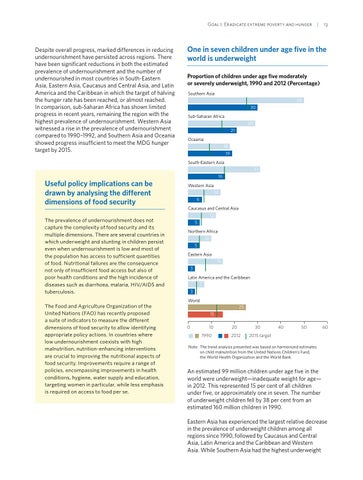
One in seven children under age five in the world is underweight Proportion of children under age five moderately or severely underweight, 1990 and 2012 (Percentage) Southern Asia 50 30 Sub-Saharan Africa 29 21 Oceania 18 19 South-Eastern Asia 31
Useful policy implications can be drawn by analysing the different dimensions of food security The prevalence of undernourishment does not capture the complexity of food security and its multiple dimensions. There are several countries in which underweight and stunting in children persist even when undernourishment is low and most of the population has access to sufficient quantities of food. Nutritional failures are the consequence not only of insufficient food access but also of poor health conditions and the high incidence of diseases such as diarrhoea, malaria, HIV/AIDS and tuberculosis. The Food and Agriculture Organization of the United Nations (FAO) has recently proposed a suite of indicators to measure the different dimensions of food security to allow identifying appropriate policy actions. In countries where low undernourishment coexists with high malnutrition, nutrition-enhancing interventions are crucial to improving the nutritional aspects of food security. Improvements require a range of policies, encompassing improvements in health conditions, hygiene, water supply and education, targeting women in particular, while less emphasis is required on access to food per se.
16 Western Asia 14 6 Caucasus and Central Asia 12 5 Northern Africa 10 5 Eastern Asia 15 3 Latin America and the Caribbean 7 3 World 25 15 0
10 1990
20 2012
30
40
50
60
2015 target
Note: The trend analysis presented was based on harmonized estimates on child malnutrition from the United Nations Children’s Fund, the World Health Organization and the World Bank.
An estimated 99 million children under age five in the world were underweight—inadequate weight for age— in 2012. This represented 15 per cent of all children under five, or approximately one in seven. The number of underweight children fell by 38 per cent from an estimated 160 million children in 1990. Eastern Asia has experienced the largest relative decrease in the prevalence of underweight children among all regions since 1990, followed by Caucasus and Central Asia, Latin America and the Caribbean and Western Asia. While Southern Asia had the highest underweight
14 | The Millennium Development Goals Report 2014
prevalence in 2012, it has also experienced the largest absolute decrease since 1990 and has contributed significantly to the decreased global burden over the same time period. Sub-Saharan Africa, despite a modest reduction in the prevalence of underweight children since 1990, was the only region where the number of undernourished children increased, from an estimated 27 million to 32 million, between 1990 and 2012. Oceania has demonstrated the least progress of all regions.
Despite steady gains, one in four children around the world remains stunted Proportion of children under age five moderately or severely stunted, and moderately or severely underweight, 1990–2012 (Percentage) 50
40 40
36 33
30
29 25
26 23
25
21 18
20
16
15
10
Stunted
Underweight
12
10
20
20
05 20
00 20
95 19
19
90
0
Stunting—defined as inadequate length or height for age—can reflect better than underweight the cumulative effects of child undernutrition and infection during the critical 1,000-day period covering pregnancy and the first two years of a child’s life. Stunting is more common than underweight, with one in four children affected globally in 2012. Although the prevalence of stunting fell from an estimated 40 per cent in 1990 to 25 per cent in 2012, an estimated 162 million children under the age of five remain at risk of diminished cognitive and physical development associated with this chronic form of undernutrition. As with underweight, all regions have experienced a decline in the number of children affected by stunting, except sub-Saharan Africa, where the number of stunted children increased alarmingly by one third, from 44 million to 58 million between 1990 and 2012. Reductions in stunting and other forms of undernutrition can be achieved through proven interventions. These include improving maternal nutrition, especially before, during and immediately after pregnancy; early and exclusive breastfeeding; and timely, safe, appropriate and high-quality complementary food for infants, accompanied by appropriate micronutrient interventions.
Goal 1: Eradicate extreme poverty and hunger | 15
The number of newly displaced persons has tripled since 2010 Average number of newly displaced persons* per day, 2003–2013
32,000
35,000
30,000
10,900
12,500
13,000
More than half of the world’s refugees nowadays are housed in urban areas and not in camps, compared to approximately only one third a decade ago.
14,200
22,200
5,000
7,900
10,800
11,400
15,000
15,800
20,000
10,000
23,300
25,000
13
12
20
11
20
10
20
09
20
20
08
07
20
06
20
05
20
04
20
20
03
0
20
Developing countries, many of them poverty stricken, continue to shoulder the largest burden. They hosted 86 per cent of refugees under the UNHCR mandate, compared to 70 per cent a decade ago. Afghanistan (2.55 million), the Syrian Arab Republic (2.47 million) and Somalia (1.12 million) were the three main source countries of refugees under UNHCR responsibility, accounting for more than half of the total. The Syrian Arab Republic became a main source of refugees during 2013 as a result of the dramatic humanitarian situation in that country.
* Displaced internally or across international borders.
The year 2013 was marked by a continuation of multiple refugee crises, resulting in numbers unseen since 1994. Conflicts during the year such as those in the Central African Republic, the Democratic Republic of the Congo, Mali, the Syrian Arab Republic, and the border area between South Sudan and Sudan, among others, have forced an average 32,000 people per day to abandon their homes and seek protection elsewhere. By the end of 2013, a record high of 51 million people were displaced forcibly worldwide as a result of persecution, conflict, generalized violence and humanrights violations. These displaced consisted of 16.7 million refugees, of whom 11.7 million fell under the responsibility of the United Nations High Commissioner for Refugees (UNHCR) and 5 million were Palestinian refugees registered with the United Nations Relief and Works Agency for Palestine Refugees in the Near East (UNRWA). An additional more than 1.1 million individuals were waiting for decisions on their asylum applications by year-end. Another 33.3 million people uprooted by violence and persecution remained within the borders of their own countries.
54 | The Millennium Development Goals Report 2014
A note to the reader Measuring progress towards the MDGs
The basis for this analysis
Progress towards the eight Millennium Development Goals is measured through 21 targets and 60 official indicators.1 This report presents an accounting to date of how far the world has come in meeting the goals using data available as of June 2014. 2
Regional and subregional figures presented in this report are compiled by members of the United Nations InterAgency and Expert Group on MDG Indicators (IAEG). In general, the figures are weighted averages of country data, using the population of reference as a weight. For each indicator, individual agencies were designated as official providers of data and as leaders in developing methodologies for data collection and analysis (see page 56 for a list of contributing organizations). Data are typically drawn from official statistics provided by governments to the international agencies responsible for the indicator. To fill data gaps, data for many of the indicators are supplemented by or derived exclusively from data collected through surveys sponsored and carried out by international agencies.
Most of the MDG targets have a deadline of 2015, using 1990 as the baseline against which progress is gauged. Country data are aggregated at the subregional and regional levels to show overall advances over time. The composition of MDG regions and subregions is based on UN geographical divisions, with some modifications necessary to create—to the extent possible—groups of countries for which a meaningful analysis can be carried out. In addition to the MDG regional groupings, the report also shows data for subregions in Africa, based on the classification adopted by the United Nations Economic Commission for Africa. 3 Although the aggregate figures are a convenient way to track progress, the situation of individual countries within a given region may vary significantly from regional averages. Data for individual countries, along with the composition of all regions and subregions, are available at http://mdgs.un.org.
1
The complete list of goals, targets and indicators is available at http://mdgs.un.org. 2 Given the time lag between collecting data and analysing them, few indicators can be compiled for the current year. Most of them are based on data from earlier years— generally up to 2012 or 2013. 3 The composition of these subregions is shown in the next section “Regional groupings”.
These include many of the health indicators, which are compiled, for the most part, from Multiple Indicator Cluster Surveys (MICS) and Demographic and Health Surveys (DHS). In some cases, countries may have more recent data that have not yet become available to the relevant specialized agency. In other cases, countries do not produce the data required to compile the indicator, and the responsible international agencies estimate the missing values. Even when national data are available, adjustments are often needed to ensure international comparability. Data from international sources, therefore, often differ from those available within countries. The United Nations Statistics Division maintains the official website of the IAEG and its database (http://mdgs.un.org). In an effort to improve transparency, the country data series in the database are given colour codes to indicate whether the figures are estimated or provided by national agencies; they are also accompanied by metadata with a detailed description of how the indicators are produced and the methodologies used for regional aggregations.
Regional groupings | 55
Regional groupings
Developed regions Northern Africa Sub-Saharan Africa South-Eastern Asia Eastern Asia Southern Asia Western Asia Caucasus & Central Asia Oceania Latin America & the Caribbean
This report presents data on progress towards the Millennium Development Goals for the world as a whole and for various country groupings. These are classified as “developing” regions and “developed” regions.* The developing regions are further broken down into the subregions shown on the map above. These regional groupings are based on United Nations geographical divisions, with some modifications necessary to create, to the extent possible, groups of countries for which a meaningful analysis can be carried out. A complete list of countries included in each region and subregion is available at mdgs.un.org. The designations employed and the presentation of the material in the present publication do not imply the expression of any opinion whatsoever on the part of the Secretariat of the United Nations concerning the legal status of any country, territory, city or area of its authorities, or concerning the delimitation of its frontiers or boundaries.
*
Since there is no established convention for the designation of “developed” and “developing” countries or areas in the United Nations system, this distinction is made for the purposes of statistical analysis only.
African subregions For some MDG indicators, data are presented separately for smaller subregions in Africa, based on the classification adopted by the United Nations Economic Commission for Africa.
North Africa West Africa Central Africa Eastern Africa Southern Africa
56 | The Millennium Development Goals Report 2014
Contributing agencies Contributions on data and analysis for each target presented under the eight goals were provided by individual agencies as indicated below:
For more information visit the UN Statistics Division Millennium Development Goals website at http://mdgs.un.org Visit the UN Millennium Development Goals website at www.un.org/millenniumgoals
•• Goal 1: Eradicate extreme poverty and hunger Target 1.A: World Bank Target 1.B: ILO Target 1.C: FAO and UNICEF Additional contribution: UNHCR
Visit the UN Millennium Campaign Office website at www.endpoverty2015.org
•• Goal 2: Achieve universal primary education Target 2.A: UNESCO
Cover
•• Goal 3: Promote gender equality and empower women Target 3.A: ILO, IPU, UNESCO and UN WOMEN
Photo credits: © UNICEF/Asselin
Page 2 © Stanislas Fradelizi / World Bank Page 9 © UNICEF/Asselin Page 10 © Ray Witlin / World Bank Page 14 © Erly Tatontos / World Bank
•• Goal 4: Reduce child mortality Target 4.A: UNICEF, United Nations Population Division, World Bank and WHO
Page 15 © UNICEF/Noorani
•• Goal 5: Improve maternal health Target 5.A: UNFPA, UNICEF, United Nations Population Division, World Bank and WHO Target 5.B: UNFPA, UNICEF, and United Nations Population Division
Page 26 © UNICEF/Mawa
•• Goal 6: Combat HIV/AIDS, malaria and other diseases Target 6.A: UNAIDS, UNICEF and WHO Target 6.B: UNAIDS and WHO Target 6.C: UNICEF and WHO
Page 46 © UNICEF/Asselin
•• Goal 7: Ensure environmental sustainability Target 7.A: CDIAC, FAO, UNEP and UNFCCC Target 7.B: IUCN and UNEP-WCMC Target 7.C: UNICEF Target 7.D: UN-Habitat
Editor: Tessa Too-Kong
•• Goal 8: Develop a global partnership for development Target 8.A: ITC, UNCTAD and WTO Target 8.B and 8.C: OECD Target 8.D: World Bank Target 8.F: ITU
Copyright © United Nations, 2014 All rights reserved.
Page 19 © UNICEF/Pirozzi Page 22 © Simone D. McCourtie / World Bank Page 31 © UNICEF/Pirozzi Page 33 © UNICEF/Le Moyne Page 44 © UNICEF/Asselin Page 45 © UNICEF/Estey Page 49 © Salahaldeen Nadir/World Bank Page 51 © Dominic Sansoni / World Bank
2 | The Millennium Development Goals: Report 2010
“The Millennium Development Goals have shown that we can make profound differences in people’s lives. The journey we started in the year 2000 has seen us build a solid foundation for further progress.” — UN Secretary-General Ban Ki-moon
14-27027
ISBN 978-92-1-101308-5