Chapter 2 – THE HALAL SECTOR
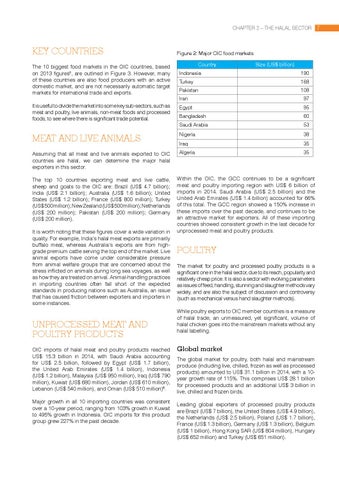
Key countries The 10 biggest food markets in the OIC countries, based on 2013 figures5, are outlined in Figure 3. However, many of these countries are also food producers with an active domestic market, and are not necessarily automatic target markets for international trade and exports.
Figure 2: Major OIC food markets Country
Size (US$ billion)
Indonesia
190
Turkey
168
Pakistan
108
Iran
97
It is useful to divide the market into some key sub-sectors, such as meat and poultry, live animals, non-meat foods and processed foods, to see where there is significant trade potential.
Egypt
95
Bangladesh
60
Saudi Arabia
53
Meat and live animals
Nigeria
38
Iraq
35
Assuming that all meat and live animals exported to OIC countries are halal, we can determine the major halal exporters in this sector.
Algeria
35
The top 10 countries exporting meat and live cattle, sheep and goats to the OIC are: Brazil (US$ 4.7 billion); India (US$ 2.1 billion); Australia (US$ 1.6 billion); United States (US$ 1.2 billion); France (US$ 800 million); Turkey (US$ 500 million); New Zealand (US$ 500 million); Netherlands (US$ 200 million); Pakistan (US$ 200 million); Germany (US$ 200 million). It is worth noting that these figures cover a wide variation in quality. For example, India’s halal meat exports are primarily buffalo meat, whereas Australia’s exports are from highgrade premium cattle serving the top end of the market. Live animal exports have come under considerable pressure from animal welfare groups that are concerned about the stress inflicted on animals during long sea voyages, as well as how they are treated on arrival. Animal-handling practices in importing countries often fall short of the expected standards in producing nations such as Australia, an issue that has caused friction between exporters and importers in some instances.
Unprocessed meat and poultry products OIC imports of halal meat and poultry products reached US$ 15.3 billion in 2014, with Saudi Arabia accounting for US$ 2.5 billion, followed by Egypt (US$ 1.7 billion), the United Arab Emirates (US$ 1.4 billion), Indonesia (US$ 1.2 billion), Malaysia (US$ 950 million), Iraq (US$ 790 million), Kuwait (US$ 680 million), Jordan (US$ 610 million), Lebanon (US$ 540 million), and Oman (US$ 510 million)6. Major growth in all 10 importing countries was consistent over a 10-year period, ranging from 103% growth in Kuwait to 495% growth in Indonesia. OIC imports for this product group grew 227% in the past decade.
Within the OIC, the GCC continues to be a significant meat and poultry importing region with US$ 6 billion of imports in 2014. Saudi Arabia (US$ 2.5 billion) and the United Arab Emirates (US$ 1.4 billion) accounted for 66% of this total. The GCC region showed a 150% increase in these imports over the past decade, and continues to be an attractive market for exporters. All of these importing countries showed consistent growth in the last decade for unprocessed meat and poultry products.
Poultry The market for poultry and processed poultry products is a significant one in the halal sector, due to its reach, popularity and relatively cheap price. It is also a sector with evolving parameters as issues of feed, handling, stunning and slaughter methods vary widely, and are also the subject of discussion and controversy (such as mechanical versus hand slaughter methods). While poultry exports to OIC member countries is a measure of halal trade, an unmeasured, yet significant, volume of halal chicken goes into the mainstream markets without any halal labelling.
Global market The global market for poultry, both halal and mainstream produce (including live, chilled, frozen as well as processed products) amounted to US$ 31.1 billion in 2014, with a 10year growth rate of 115%. This comprises US$ 28.1 billion for processed products and an additional US$ 3 billion in live, chilled and frozen birds. Leading global exporters of processed poultry products are Brazil (US$ 7 billion), the United States (US$ 4.9 billion), the Netherlands (US$ 2.5 billion), Poland (US$ 1.7 billion), France (US$ 1.3 billion), Germany (US$ 1.3 billion), Belgium (US$ 1 billion), Hong Kong SAR (US$ 804 million), Hungary (US$ 652 million) and Turkey (US$ 651 million).
7