GLOBAL STUDY on Homicide
30
Americas
25 20 15 5 0
Asia
1995 1995 1996 1996 1997 1997 1998 1998 1999 1999 2000 2000 2001 2001 2002 2002 2003 2003 2004 2004 2005 2005 2006 2006 2007 2007 2008 2008 2009 2009 2010 2010 2011 2011 2012 2012
Rate per per 100,000 100,000 population population Rate
South America (10 countries) Central America (8 countries) Caribbean (15 countries/territories) Northern America (4 countries/territories)
14 15 14 13 12 12 11 10 10 89 8 67 6 5 44 3 22 1 00
Europe
1995 1995 1996 1996 1997 1997 1998 1998 1999 1999 2000 2000 2001 2001 2002 2002 2003 2003 2004 2004 2005 2005 2006 2006 2007 2007 2008 2008 2009 2009 2010 2010 2011 2011 2012 2012
Rate Rateper per100,000 100,000population population
South-Eastern Asia (5 countries) Western Asia (10 countries) Central Asia (4 countries) Central Asia (4 countries) Southern Asia (3 countries) Eastern Asia (6 countries/territories) Western Asia (10 countries) South-Eastern (5 countries) Eastern Asia (6Asia countries/territories) Southern Asia (3 countries) 15 14 14 13 12 12 11 10 10 9 88 7 66 5 44 3 22 1 00
Eastern Europe (10 countries) Eastern Europe (10 countries) Northern Europe (10 countries) Northern Europe (10 countries) Southern Europe (10 countries) Southern Europe (10 countries) Western Europe (8 countries) Western Europe (8 countries)
Source: UNODC Homicide Statistics (2013). Lines represent population-weighted average homicide rate.
34
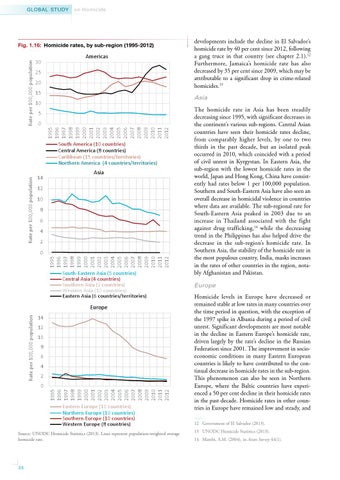
developments include the decline in El Salvador’s homicide rate by 40 per cent since 2012, following a gang truce in that country (see chapter 2.1).12 Furthermore, Jamaica’s homicide rate has also decreased by 35 per cent since 2009, which may be attributable to a significant drop in crime-related homicides.13
Asia
10
1995 1996 1997 1998 1999 2000 2001 2002 2003 2004 2005 2006 2007 2008 2009 2010 2011 2012
Rate per 100,000 population
Fig. 1.16: Homicide rates, by sub-region (1995-2012)
The homicide rate in Asia has been steadily decreasing since 1995, with significant decreases in the continent’s various sub-regions. Central Asian countries have seen their homicide rates decline, from comparably higher levels, by one to two thirds in the past decade, but an isolated peak occurred in 2010, which coincided with a period of civil unrest in Kyrgystan. In Eastern Asia, the sub-region with the lowest homicide rates in the world, Japan and Hong Kong, China have consistently had rates below 1 per 100,000 population. Southern and South-Eastern Asia have also seen an overall decrease in homicidal violence in countries where data are available. The sub-regional rate for South-Eastern Asia peaked in 2003 due to an increase in Thailand associated with the fight against drug trafficking,14 while the decreasing trend in the Philippines has also helped drive the decrease in the sub-region’s homicide rate. In Southern Asia, the stability of the homicide rate in the most populous country, India, masks increases in the rates of other countries in the region, notably Afghanistan and Pakistan.
Europe Homicide levels in Europe have decreased or remained stable at low rates in many countries over the time period in question, with the exception of the 1997 spike in Albania during a period of civil unrest. Significant developments are most notable in the decline in Eastern Europe’s homicide rate, driven largely by the rate’s decline in the Russian Federation since 2001. The improvement in socioeconomic conditions in many Eastern European countries is likely to have contributed to the continual decrease in homicide rates in the sub-region. This phenomenon can also be seen in Northern Europe, where the Baltic countries have experienced a 50 per cent decline in their homicide rates in the past decade. Homicide rates in other countries in Europe have remained low and steady, and 12 Government of El Salvador (2013). 13 UNODC Homicide Statistics (2013). 14 Mutebi, A.M. (2004), in Asian Survey 44(1).