THE BIG PICTURE
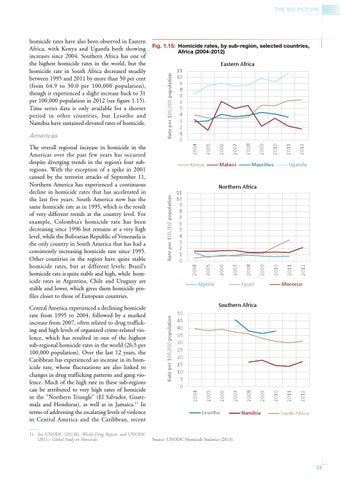
Fig. 1.15: Homicide rates, by sub-region, selected countries, Africa (2004-2012)
Kenya
2012
2011
2009
2008
2007
2006
2010
Uganda
Egypt
2012
2011
2010
2009
2008
2007
2005
2004
2006
Northern Africa
11 10 9 8 7 6 5 4 3 2 1 0
Rate per 100,000 population
Mauritius
Morocco
Namibia
South Lesotho SouthAfrica Africa
Namibia Namibia
Lesotho Lesotho South Africa
2008
2007
2006
2012 2005 2012
2011 2004 2011
50 45 40 35 30 25 20 15 10 5 0
2010 2010
2009 2009
2008 2008
2007 2007
2012 2006 2006
2011 2005 2005
2010 2004 2004
2009
Rate per per 100,000 100,000 population population Rate
50 50 45 45 40 40 35 35 30 30 25 25 20 20 15 15 10 10 55 00
Rate per 100,000 population
Southern Africa
2007
2006
2005
2004
Malawi
Algeria
Rate per 100,000 population
11 See UNODC (2013b). World Drug Report; and UNODC (2011). Global Study on Homicide.
2005
2004
The overall regional increase in homicide in the Americas over the past few years has occurred despite diverging trends in the region’s four subregions. With the exception of a spike in 2001 caused by the terrorist attacks of September 11, Northern America has experienced a continuous decline in homicide rates that has accelerated in the last five years. South America now has the same homicide rate as in 1995, which is the result of very different trends at the country level. For example, Colombia’s homicide rate has been decreasing since 1996 but remains at a very high level, while the Bolivarian Republic of Venezuela is the only country in South America that has had a consistently increasing homicide rate since 1995. Other countries in the region have quite stable homicide rates, but at different levels: Brazil’s homicide rate is quite stable and high, while homicide rates in Argentina, Chile and Uruguay are stable and lower, which gives them homicide profiles closer to those of European countries. Central America experienced a declining homicide 50 rate from 1995 to 2004, followed by a marked 45 to drug traffickincrease from 2007, often related 40 crime-related vioing and high levels of organized 35 one of the highest lence, which has resulted in sub-regional homicide rates 30 in the world (26.5 per 100,000 population). Over 25 the last 12 years, the 20 Caribbean has experienced an increase in its hom15 are also linked to icide rate, whose fluctuations 10 changes in drug trafficking patterns and gang violence. Much of the high rate5in these sub-regions 0 can be attributed to very high rates of homicide in the “Northern Triangle” (El Salvador, Guatemala and Honduras), as well as in Jamaica.11 In terms of addressing the escalating levelsAfrica of violence South in Central America and the Caribbean, recent
Eastern Africa
11 10 9 8 7 6 5 4 3 2 1 0
Rate per 100,000 population
Americas
2008
homicide rates have also been observed in Eastern Africa, with Kenya and Uganda both showing increases since 2004. Southern Africa has one of the highest homicide rates in the world, but the homicide rate in South Africa decreased steadily between 1995 and 2011 by more than 50 per cent (from 64.9 to 30.0 per 100,000 population), though it experienced a slight increase back to 31 per 100,000 population in 2012 (see figure 1.15). Time series data is only available for a shorter period in other countries, but Lesotho and Namibia have sustained elevated rates of homicide.
Namibia
Source: UNODC Homicide Statistics (2013).
33