GLOBAL STUDY on Homicide
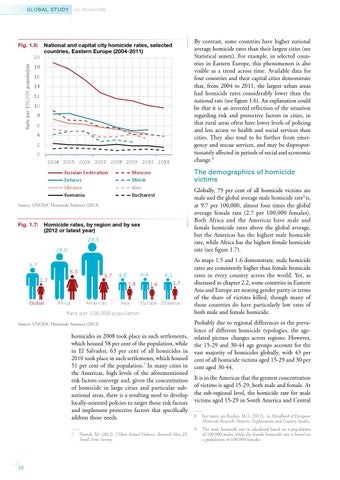
By contrast, some countries have higher national average homicide rates than their largest cities (see Statistical annex). For example, in selected countries in Eastern Europe, this phenomenon is also visible as a trend across time. Available data for four countries and their capital cities demonstrate that, from 2004 to 2011, the largest urban areas had homicide rates considerably lower than the national rate (see figure 1.6). An explanation could be that it is an inverted reflection of the situation regarding risk and protective factors in cities, in that rural areas often have lower levels of policing and less access to health and social services than cities. They also tend to be further from emergency and rescue services, and may be disproportionately affected in periods of social and economic change.8
Rate per 100,000 population
Fig. 1.6: National and capital city homicide rates, selected countries, Eastern Europe (2004-2011) 20
18 16 14 12 10 8 6 4 2 0 2004 2005 2006 2007 2008 2009 2010 2011 Russian Federation Belarus Ukraine Romania
The demographics of homicide victims
Moscow Minsk Kiev Bucharest
Globally, 79 per cent of all homicide victims are male and the global average male homicide rate9 is, at 9.7 per 100,000, almost four times the global average female rate (2.7 per 100,000 females). Both Africa and the Americas have male and female homicide rates above the global average, but the Americas has the highest male homicide rate, while Africa has the highest female homicide rate (see figure 1.7).
Source: UNODC Homicide Statistics (2013).
Fig. 1.7: Homicide rates, by region and by sex (2012 or latest year)
29.3 19.0 9.7
6.0
3.7
2.7
Global
4.4
4.0 1.8
Africa
Americas
Asia
4.2 1.6
1.7
Europe Oceania
Rate per 100,000 population Source: UNODC Homicide Statistics (2013).
homicides in 2008 took place in such settlements, which housed 58 per cent of the population, while in El Salvador, 63 per cent of all homicides in 2010 took place in such settlements, which housed 51 per cent of the population.7 In many cities in the Americas, high levels of the aforementioned risk factors converge and, given the concentration of homicide in large cities and particular subnational areas, there is a resulting need to develop locally-oriented policies to target those risk factors and implement protective factors that specifically address those needs. 7 Nowak, M. (2012). Urban Armed Violence, Research Note 23, Small Arms Survey.
28
As maps 1.5 and 1.6 demonstrate, male homicide rates are consistently higher than female homicide rates in every country across the world. Yet, as discussed in chapter 2.2, some countries in Eastern Asia and Europe are nearing gender parity in terms of the share of victims killed, though many of those countries do have particularly low rates of both male and female homicide. Probably due to regional differences in the prevalence of different homicide typologies, the agerelated picture changes across regions. However, the 15-29 and 30-44 age groups account for the vast majority of homicides globally, with 43 per cent of all homicide victims aged 15-29 and 30 per cent aged 30-44. It is in the Americas that the greatest concentration of victims is aged 15-29, both male and female. At the sub-regional level, the homicide rate for male victims aged 15-29 in South America and Central 8
For more, see Kaylen, M.T. (2012), in Handbook of European Homicide Research: Patterns, Explanations and Country Studies.
9 The male homicide rate is calculated based on a population of 100,000 males, while the female homicide rate is based on a population of 100,000 females.