THE BIG PICTURE
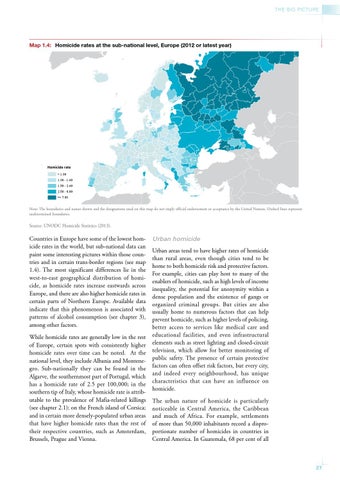
Map 1.4: Homicide rates at the sub-national level, Europe (2012 or latest year)
Homicide rate < 1.00 1.00 - 1.49 1.50 - 2.49 2.50 - 6.99 >= 7.00
Note: The boundaries and names shown and the designations used on this map do not imply official endorsement or acceptance by the United Nations. Dashed lines represent undetermined boundaries. Note: The boundaries names shown and the designations used on this map do not imply oďŹ&#x192;cial endorsement or acceptance by the United Nations. Source: UNODC HomicideandStatistics (2013).
Countries in Europe have some of the lowest homicide rates in the world, but sub-national data can paint some interesting pictures within those countries and in certain trans-border regions (see map 1.4). The most significant differences lie in the west-to-east geographical distribution of homicide, as homicide rates increase eastwards across Europe, and there are also higher homicide rates in certain parts of Northern Europe. Available data indicate that this phenomenon is associated with patterns of alcohol consumption (see chapter 3), among other factors. While homicide rates are generally low in the rest of Europe, certain spots with consistently higher homicide rates over time can be noted. At the national level, they include Albania and Montenegro. Sub-nationally they can be found in the Algarve, the southernmost part of Portugal, which has a homicide rate of 2.5 per 100,000; in the southern tip of Italy, whose homicide rate is attributable to the prevalence of Mafia-related killings (see chapter 2.1); on the French island of Corsica; and in certain more densely-populated urban areas that have higher homicide rates than the rest of their respective countries, such as Amsterdam, Brussels, Prague and Vienna.
Urban homicide Urban areas tend to have higher rates of homicide than rural areas, even though cities tend to be home to both homicide risk and protective factors. For example, cities can play host to many of the enablers of homicide, such as high levels of income inequality, the potential for anonymity within a dense population and the existence of gangs or organized criminal groups. But cities are also usually home to numerous factors that can help prevent homicide, such as higher levels of policing, better access to services like medical care and educational facilities, and even infrastructural elements such as street lighting and closed-circuit television, which allow for better monitoring of public safety. The presence of certain protective factors can often offset risk factors, but every city, and indeed every neighbourhood, has unique characteristics that can have an influence on homicide. The urban nature of homicide is particularly noticeable in Central America, the Caribbean and much of Africa. For example, settlements of more than 50,000 inhabitants record a disproportionate number of homicides in countries in Central America. In Guatemala, 68 per cent of all
27