GLOBAL STUDY on Homicide
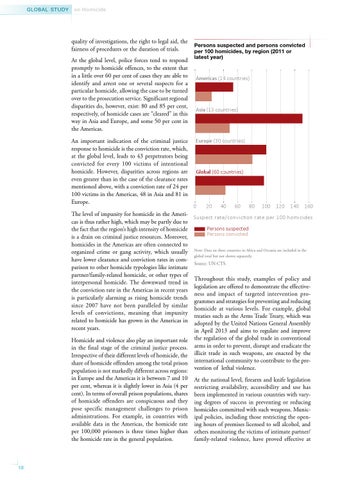
quality of investigations, the right to legal aid, the fairness of procedures or the duration of trials. At the global level, police forces tend to respond promptly to homicide offences, to the extent that in a little over 60 per cent of cases they are able to identify and arrest one or several suspects for a particular homicide, allowing the case to be turned over to the prosecution service. Significant regional disparities do, however, exist: 80 and 85 per cent, respectively, of homicide cases are “cleared� in this way in Asia and Europe, and some 50 per cent in the Americas. An important indication of the criminal justice response to homicide is the conviction rate, which, at the global level, leads to 43 perpetrators being convicted for every 100 victims of intentional homicide. However, disparities across regions are even greater than in the case of the clearance rates mentioned above, with a conviction rate of 24 per 100 victims in the Americas, 48 in Asia and 81 in Europe.
Persons suspected and persons convicted per 100 homicides, by region (2011 or latest year)
Americas (14 countries)
Asia (13 countries)
Europe (30 countries)
Global (60 countries)
0
20
40
60
80
100
120
140
160
The level of impunity for homicide in the AmeriSuspect rate/conviction rate per 100 homicides cas is thus rather high, which may be partly due to Persons suspected the fact that the region’s high intensity of homicide Persons convicted is a drain on criminal justice resources. Moreover, homicides in the Americas are often connected to organized crime or gang activity, which usually Note: Data on three countries in Africa and Oceania are included in the global total but not shown separately. have lower clearance and conviction rates in comSource: UN-CTS. parison to other homicide typologies like intimate partner/family-related homicide, or other types of Throughout this study, examples of policy and interpersonal homicide. The downward trend in legislation are offered to demonstrate the effectivethe conviction rate in the Americas in recent years ness and impact of targeted intervention prois particularly alarming as rising homicide trends grammes and strategies for preventing and reducing since 2007 have not been paralleled by similar homicide at various levels. For example, global levels of convictions, meaning that impunity treaties such as the Arms Trade Treaty, which was related to homicide has grown in the Americas in adopted by the United Nations General Assembly recent years. in April 2013 and aims to regulate and improve Homicide and violence also play an important role the regulation of the global trade in conventional in the final stage of the criminal justice process. arms in order to prevent, disrupt and eradicate the Irrespective of their different levels of homicide, the illicit trade in such weapons, are enacted by the share of homicide offenders among the total prison international community to contribute to the prepopulation is not markedly different across regions: vention of lethal violence. in Europe and the Americas it is between 7 and 10 per cent, whereas it is slightly lower in Asia (4 per cent). In terms of overall prison populations, shares of homicide offenders are conspicuous and they pose specific management challenges to prison administrations. For example, in countries with available data in the Americas, the homicide rate per 100,000 prisoners is three times higher than the homicide rate in the general population.
18
At the national level, firearm and knife legislation restricting availability, accessibility and use has been implemented in various countries with varying degrees of success in preventing or reducing homicides committed with such weapons. Municipal policies, including those restricting the opening hours of premises licensed to sell alcohol, and others monitoring the victims of intimate partner/ family-related violence, have proved effective at