EXECUTIVE SUMMARY
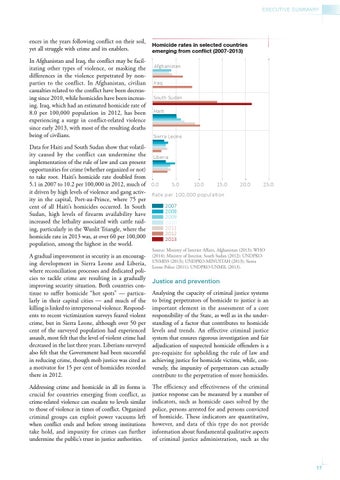
ences in the years following conflict on their soil, yet all struggle with crime and its enablers. In Afghanistan and Iraq, the conflict may be facilitating other types of violence, or masking the differences in the violence perpetrated by nonparties to the conflict. In Afghanistan, civilian casualties related to the conflict have been decreasing since 2010, while homicides have been increasing. Iraq, which had an estimated homicide rate of 8.0 per 100,000 population in 2012, has been experiencing a surge in conflict-related violence since early 2013, with most of the resulting deaths being of civilians.
Homicide rates in selected countries emerging from conflict (2007-2013)
Afghanistan Iraq South Sudan Haiti
Sierra Leone
Data for Haiti and South Sudan show that volatility caused by the conflict can undermine the Liberia implementation of the rule of law and can present opportunities for crime (whether organized or not) to take root. Haiti’s homicide rate doubled from 5.0 10.0 15.0 5.1 in 2007 to 10.2 per 100,000 in 2012, much of 0.0 it driven by high levels of violence and gang activ- Rate per 100,000 population ity in the capital, Port-au-Prince, where 75 per 2007 cent of all Haiti’s homicides occurred. In South 2008 Sudan, high levels of firearm availability have 2009 increased the lethality associated with cattle raid2010 2011 ing, particularly in the Wunlit Triangle, where the 2012 homicide rate in 2013 was, at over 60 per 100,000 2013 population, among the highest in the world. A gradual improvement in security is an encouraging development in Sierra Leone and Liberia, where reconciliation processes and dedicated policies to tackle crime are resulting in a gradually improving security situation. Both countries continue to suffer homicide “hot spots” — particularly in their capital cities — and much of the killing is linked to interpersonal violence. Respondents to recent victimization surveys feared violent crime, but in Sierra Leone, although over 50 per cent of the surveyed population had experienced assault, most felt that the level of violent crime had decreased in the last three years. Liberians surveyed also felt that the Government had been successful in reducing crime, though mob justice was cited as a motivator for 15 per cent of homicides recorded there in 2012. Addressing crime and homicide in all its forms is crucial for countries emerging from conflict, as crime-related violence can escalate to levels similar to those of violence in times of conflict. Organized criminal groups can exploit power vacuums left when conflict ends and before strong institutions take hold, and impunity for crimes can further undermine the public’s trust in justice authorities.
20.0
25.0
Source: Ministry of Interior Affairs, Afghanistan (2013); WHO (2014); Ministry of Interior, South Sudan (2012); UNDPKOUNMISS (2013); UNDPKO-MINUSTAH (2013); Sierra Leone Police (2011); UNDPKO-UNMIL (2013).
Justice and prevention Analysing the capacity of criminal justice systems to bring perpetrators of homicide to justice is an important element in the assessment of a core responsibility of the State, as well as in the understanding of a factor that contributes to homicide levels and trends. An effective criminal justice system that ensures rigorous investigation and fair adjudication of suspected homicide offenders is a pre-requisite for upholding the rule of law and achieving justice for homicide victims, while, conversely, the impunity of perpetrators can actually contribute to the perpetration of more homicides. The efficiency and effectiveness of the criminal justice response can be measured by a number of indicators, such as homicide cases solved by the police, persons arrested for and persons convicted of homicide. These indicators are quantitative, however, and data of this type do not provide information about fundamental qualitative aspects of criminal justice administration, such as the
17