GLOBAL STUDY on Homicide
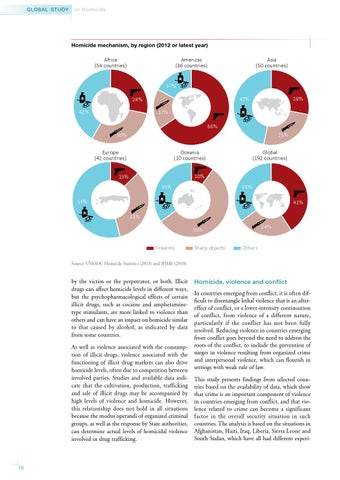
Homicide mechanism, by region (2012 or latest year)
Africa (54 countries)
Asia (50 countries)
Americas (36 countries) 17%
42%
28%
47%
28% 17% 66% 30%
25%
Europe (42 countries)
Oceania (10 countries)
Global (192 countries)
10%
13% 35%
35%
54%
41% 33% 24%
55%
Firearms
Sharp objects
Others
Source: UNODC Homicide Statistics (2013) and IHME (2010).
by the victim or the perpetrator, or both. Illicit drugs can affect homicide levels in different ways, but the psychopharmacological effects of certain illicit drugs, such as cocaine and amphetaminetype stimulants, are more linked to violence than others and can have an impact on homicide similar to that caused by alcohol, as indicated by data from some countries. As well as violence associated with the consumption of illicit drugs, violence associated with the functioning of illicit drug markets can also drive homicide levels, often due to competition between involved parties. Studies and available data indicate that the cultivation, production, trafficking and sale of illicit drugs may be accompanied by high levels of violence and homicide. However, this relationship does not hold in all situations because the modus operandi of organized criminal groups, as well as the response by State authorities, can determine actual levels of homicidal violence involved in drug trafficking.
16
Homicide, violence and conflict In countries emerging from conflict, it is often difficult to disentangle lethal violence that is an aftereffect of conflict, or a lower-intensity continuation of conflict, from violence of a different nature, particularly if the conflict has not been fully resolved. Reducing violence in countries emerging from conflict goes beyond the need to address the roots of the conflict, to include the prevention of surges in violence resulting from organized crime and interpersonal violence, which can flourish in settings with weak rule of law. This study presents findings from selected countries based on the availability of data, which show that crime is an important component of violence in countries emerging from conflict, and that violence related to crime can become a significant factor in the overall security situation in such countries. The analysis is based on the situations in Afghanistan, Haiti, Iraq, Liberia, Sierra Leone and South Sudan, which have all had different experi-