EXECUTIVE SUMMARY
At the opposite end of the spectrum, in countries with some of the lowest homicide rates in the world, mostly located in Europe and Eastern Asia, homicide levels continue to decline. Many of those countries had low levels of homicide in 1995 and have subsequently recorded continuous decreases in their homicide rates. On the other hand, a worrying development is that homicide levels in Northern Africa are rising, probably as a result of political violence, which may in turn foster lethal violence related to criminal activities, and should be monitored. The same can be said for parts of Southern Asia and Eastern Africa.
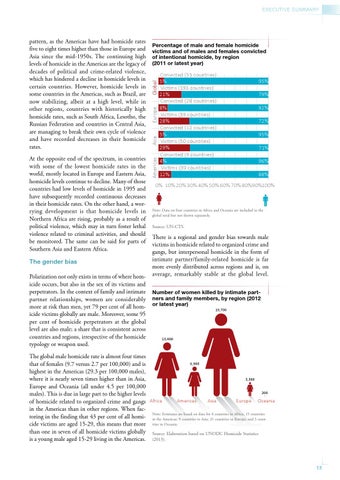
The gender bias Polarization not only exists in terms of where homicide occurs, but also in the sex of its victims and perpetrators. In the context of family and intimate partner relationships, women are considerably more at risk than men, yet 79 per cent of all homicide victims globally are male. Moreover, some 95 per cent of homicide perpetrators at the global level are also male; a share that is consistent across countries and regions, irrespective of the homicide typology or weapon used.
Asia
Europe
Global
Percentage of male and female homicide victims and of males and females convicted of intentional homicide, by region (2011 or latest year)
Americas
pattern, as the Americas have had homicide rates five to eight times higher than those in Europe and Asia since the mid-1950s. The continuing high levels of homicide in the Americas are the legacy of decades of political and crime-related violence, which has hindered a decline in homicide levels in certain countries. However, homicide levels in some countries in the Americas, such as Brazil, are now stabilizing, albeit at a high level, while in other regions, countries with historically high homicide rates, such as South Africa, Lesotho, the Russian Federation and countries in Central Asia, are managing to break their own cycle of violence and have recorded decreases in their homicide rates.
Convicted (53 countries) 5% Victims (193 countries) 21% Convicted (28 countries) 8% Victims (39 countries) 28% Convicted (12 countries) 5% Victims (50 countries) 29% Convicted (9 countries) 4% Victims (39 countries) 12%
95% 79% 92% 72% 95% 71% 96% 88%
0% 10% 20% 30% 40% 50% 60% 70% 80%90%100%
Note: Data on four countries in Africa and Oceania are included in the global total but not shown separately.
Source: UN-CTS.
There is a regional and gender bias towards male victims in homicide related to organized crime and gangs, but interpersonal homicide in the form of intimate partner/family-related homicide is far more evenly distributed across regions and is, on average, remarkably stable at the global level. Number of women killed by intimate partners and family members, by region (2012 or latest year) 19,700
13,400
The global male homicide rate is almost four times 6,900 that of females (9.7 versus 2.7 per 100,000) and is highest in the Americas (29.3 per 100,000 males), 3,300 where it is nearly seven times higher than in Asia, Europe and Oceania (all under 4.5 per 100,000 200 males). This is due in large part to the higher levels Africa Americas Asia Europe Oceania of homicide related to organized crime and gangs in the Americas than in other regions. When facNote: Estimates are based on data for 4 countries in Africa, 15 countries toring in the finding that 43 per cent of all homi- in the Americas; 9 countries in Asia; 21 countries in Europe; and 3 councide victims are aged 15-29, this means that more tries in Oceania. than one in seven of all homicide victims globally Source: Elaboration based on UNODC Homicide Statistics is a young male aged 15-29 living in the Americas. (2013).
13