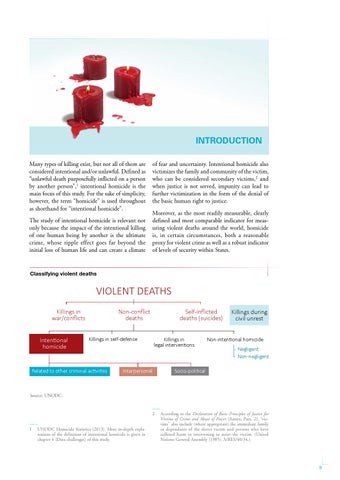
INTRODUCTION Many types of killing exist, but not all of them are considered intentional and/or unlawful. Defined as “unlawful death purposefully inflicted on a person by another person”,1 intentional homicide is the main focus of this study. For the sake of simplicity, however, the term “homicide” is used throughout as shorthand for “intentional homicide”. The study of intentional homicide is relevant not only because the impact of the intentional killing of one human being by another is the ultimate crime, whose ripple effect goes far beyond the initial loss of human life and can create a climate
of fear and uncertainty. Intentional homicide also victimizes the family and community of the victim, who can be considered secondary victims,2 and when justice is not served, impunity can lead to further victimization in the form of the denial of the basic human right to justice. Moreover, as the most readily measurable, clearly defined and most comparable indicator for measuring violent deaths around the world, homicide is, in certain circumstances, both a reasonable proxy for violent crime as well as a robust indicator of levels of security within States.
Classifying violent deaths
VIOLENT DEATHS Killings in war/conflicts Intentional homicide
Non-conflict deaths
Self-inflicted deaths (suicides)
Killings in self-defence
Related to other criminal activities
Killings in legal interventions
Interpersonal
Killings during civil unrest
Non-intentional homicide Negligent Non-negligent
Socio-political
Source: UNODC.
1 UNODC Homicide Statistics (2013). More in-depth explanations of the definition of intentional homicide is given in chapter 6 (Data challenges) of this study.
2 According to the Declaration of Basic Principles of Justice for Victims of Crime and Abuse of Power (Annex, Para. 2), “victims” also include (where appropriate) the immediate family or dependants of the direct victim and persons who have suffered harm in intervening to assist the victim. (United Nations General Assembly (1985). A/RES/40/34.).
9