United Nations
ST/ESA/SER.A/342
DEPARTMENT OF ECONOMIC AND SOCIAL AFFAIRS POPULATION DIVISION
International Migration Policies Government Views and Priorities
United Nations New York, 2013
DESA The Department of Economic and Social Affairs of the United Nations Secretariat is a vital interface between global policies in the economic, social and environmental spheres and national action. The Department works in three main interlinked areas: (i) it compiles, generates and analyses a wide range of economic, social and environmental data and information on which States Members of the United Nations draw to review common problems and take stock of policy options; (ii) it facilitates the negotiations of Member States in many intergovernmental bodies on joint courses of action to address ongoing or emerging global challenges; and (iii) it advises interested Governments on the ways and means of translating policy frameworks developed in United Nations conferences and summits into programmes at the country level and, through technical assistance, helps build national capacities.
Notes The designations employed and the presentation of the material in this publication do not imply the expression of any opinion whatsoever on the part of the Secretariat of the United Nations concerning the legal status of any country, city or area or of its authorities, or concerning the delimitation of its frontiers or boundaries. The designations “developed” and “developing” countries, “developed” and “developing” regions, “more developed” and “less developed” regions, and “North” and “South” are intended for statistical convenience and do not necessarily express a judgment about the stage reached by a particular country or area in the development process. The term “country” as used in the text of this publication also refers, as appropriate, to Observer States and non-member States of the United Nations. The size and direction of arrows on the cover of this publication are stylized, and not intended to indicate the actual magnitude or direction of migration flows. This publication has been issued without formal editing.
ST/ESA/SER.A/342
UNITED NATIONS PUBLICATION Sales No. E.14.XIII.3 ISBN 978-92-1-151512-1 eISBN 978-92-1-056427-4 Price USD: $15.00
Copyright United Nations, 2013 All rights reserved
PREFACE The report International Migration Policies: Government Views and Priorities delineates Governments’ views and policies concerning international migration for 196 countries, including all 193 Member States of the United Nations, one Observer State (the Holy See) and two non-member States (Niue and Cook Islands). This report provides information on levels and trends in international migration, policies to influence the level of immigration, policies to promote immigration of highly skilled workers, policies to foster the integration of migrants into the host society, including naturalization policies, and other policies designed by Governments in countries of origin, such as policies on emigration, acceptance of dual citizenship, policies to encourage the return of citizens, and measures to promote involvement of diaspora in countries of origin. The report also discusses issues related to irregular migration, human trafficking and refugees. All the United Nations international population conferences held since 1974 have emphasized monitoring the implementation of their goals and recommendations. The systematic monitoring of population policies at the international level began after the World Population Plan of Action adopted at the World Population Conference held at Bucharest in 1974. 1 The Plan of Action, the first global intergovernmental instrument on population policy, called upon the United Nations to monitor national population trends and policies. The most recent United Nations population conference, the International Conference on Population and Development, held at Cairo in 1994, recommended that actions be taken “to measure, assess, monitor and evaluate progress towards meeting the goals of its Programme of Action”.2 The Population Division of the Department of Economic and Social Affairs of the United Nations Secretariat is responsible for providing the international community with up-to-date, accurate and scientifically objective information on population and development. The Population Division provides guidance to the United Nations General Assembly, the Economic and Social Council, and the Commission on Population and Development on population and development issues. In addition, the Division undertakes studies on population levels and trends, population estimates and projections, population policies, and population and development interrelationships. The Population Division has been implementing the United Nations Inquiry among Governments on Population and Development every five years since 1963 to gather information about Governments’ views and policies about population issues. The responsibility for preparation of this report rests with the Population Division of the Department of Economic and Social Affairs. The report is based primarily on two major sources of data compiled by the Population Division: the World Population Policies Database and the Global Migration Database. Detailed information about these data sources is available from the website of the Population Division (www.unpopulation.org). Compilation of these data was facilitated by the cooperation of Member States and non-member States of the United Nations, the regional commissions, and the agencies, funds and programmes of the United Nations system. Questions and comments concerning this publication should be addressed to the Director, Population Division, Department of Economic and Social Affairs, United Nations Secretariat, New York, NY 10017, phone: 212-963-3209, fax: 212-963-2147, e-mail: population@un.org. 1
Report of the United Nations World Population Conference, Bucharest, 19–30 August 1974 (United Nations publication, Sales No. E.75.XIII.3), chap. I. 2 Report of the International Conference on Population and Development, Cairo, 5–13 September 1994 (United Nations publication, Sales No. E.95.XIII.18), chap. I, resolution 1, annex, para. 13.6.
United Nations Department of Economic and Social Affairs ׀Population Division
3
CONTRIBUTORS This report was prepared by Ms. Lina Bassarsky, Ms. Yumiko Kamiya, Ms. Julia Ferre, Mr. Victor Gaigbe-Togbe and Mr. Vinod Mishra. Mr. John Kanakos provided programming and data analysis support and Ms. Theresa Nguyen provided editorial and formatting support. The work on this report was led by the Policy Section of the Population Division.
ACKNOWLEDGEMENTS Mr. Bela Hovy and Mr. John Wilmoth reviewed and provided useful comments on the draft report.
4
United Nations Department of Economic and Social Affairs ׀Population Division
HIGHLIGHTS International migration is a global phenomenon that is growing in complexity, scope and impact. Today, most countries are simultaneously countries of origin, destination and transit of migrants, so that countries in both less and more developed regions face various challenges and opportunities associated with migration. Since the International Conference on Population and Development (ICPD) in 1994, there has been a growing consensus that migration is an integral feature of global development in both sending and receiving countries. Most recently, the 2013 High-level Dialogue on International Migration and Development has reaffirmed the importance of migration for development. Migration policies play an important role in determining the flows, conditions and consequences of international migration. Using the information gathered in the World Population Policies Database for all Member and non-member States of the United Nations, this report describes Government views and policy priorities related to immigration and emigration, and how these have evolved in recent years with changing international migration patterns. The highlights of the report are listed below:
TRENDS IN INTERNATIONAL MIGRATION •
In 2013, the number of international migrants worldwide reached 232 million, up from 154 million in 1990. Currently, the global population of international migrants is growing at about 1.6 per cent per year. Between 1990 and 2013, the migrant stock has increased more than twice as fast in the global North (by 53 million) as in the global South (by 24 million).
•
The origin of international migrants has become increasingly diversified over the past two decades. By 2013, South-South migration was as common as South-North migration. Between 1990 and 2013, the migrant stock born in the global South and residing in the global North doubled—from 40 million to 82 million, while that from South to South increased from 59 million to 82 million.
•
In 2013, 23 per cent of all international migrants in the world (54 million) were born in the North and resided in the North, whereas only 6 per cent of all migrants (14 million) who were born in the North resided in the South.
•
Major regions of the world account for different shares of the global stock of immigrants and emigrants. In 2013, Europe hosted 31 per cent of the global migrant stock, whereas it was the origin of 25 per cent of all emigrants (of whom 65 per cent were living within Europe). In comparison, Asia and Northern America hosted 31 and 23 per cent of the global migrant stock, respectively, while they were the origin of 40 per cent and 2 per cent of all emigrants.
IMMIGRATION POLICIES •
A growing number of Governments have shown openness to regular immigration in the last two decades. In 2011, among the 195 countries with available data, a large majority of Governments (73 per cent) either had policies to maintain the current level of immigration or they were not intervening to change it, while 16 per cent had policies to lower it and 11 per cent had policies to raise it.
•
At the global level, the percentage of Governments with policies to lower immigration declined from 40 per cent in 1996 to 16 per cent in 2011, while the percentage seeking to raise immigration increased from just 4 per cent in 1996 to 11 per cent in 2011.
United Nations Department of Economic and Social Affairs ׀Population Division
5
International Migration Policies: Government Views and Priorities
•
The receiving countries have shown greater selectivity towards highly skilled workers. A growing number of Governments have adopted policies to raise the immigration of highly skilled workers. The percentage of Governments with policies to raise the immigration of highly skilled workers increased from 22 per cent in 2005 to 39 per cent in 2011.
•
In 2011, few Governments had policies to raise immigration for permanent settlement (6 per cent) or for family reunification (9 per cent). On the contrary, more than three quarters of all Governments had policies to maintain their current levels of immigration for permanent settlement and family reunification or they were not intervening to influence them.
POLICIES TO ENCOURAGE INTEGRATION, NATURALIZATION AND RETURN OF MIGRANTS •
The majority of Governments recognize that successful integration of migrants into the host society is essential to maximize the opportunities afforded by migration. Globally, 62 per cent of Governments had policies in place in 2011 to promote the integration of non-nationals, an increase from 44 per cent in 1996.
•
In 2011, 91 per cent of Governments in more developed regions had policies to promote integration of non-nationals, compared with less than one half of Governments in less developed regions (47 per cent) and less than one third in least developed countries (29 per cent).
•
In 2011, 65 per cent of all Governments in the world had less restrictive naturalization policies, and another 32 per cent allowed naturalization under more restrictive conditions. Five countries—Kuwait, Lebanon, Myanmar, Nauru and the United Arab Emirates—did not allow naturalization under any conditions. Seventy-eight per cent of Governments in more developed regions allowed less restrictive acquisition of naturalized citizenship in 2011, compared with 61 per cent of Governments in less developed regions and 47 per cent of least developed countries.
•
Among 58 countries with available data in 2011, 40 countries had programmes to facilitate the return of migrants to their home countries. Thirty-two out of 40 countries with data in more developed regions had such programmes, compared with 8 out of 18 countries with data in less developed regions.
EMIGRATION POLICIES •
In 2011, one out of four Governments worldwide had policies to lower the level of emigration, two thirds desired to maintain the current level of emigration or did not intervene to influence emigration, and the remaining 9 per cent had policies to encourage emigration.
•
Since the mid-1990s, the proportion of Governments with policies to lower emigration has remained virtually unchanged, while the proportion with policies to raise emigration has increased steadily.
•
A growing number of Governments have instituted policies to encourage the return of their citizens. The proportion of countries with such policies has increased consistently since the mid-1990s, from 43 per cent in 1996 to 51 per cent in 2005, and 63 per cent in 2011.
•
In 2011, slightly over half of all Governments (53 per cent) had policies that allowed their citizens abroad to retain their citizenship of origin without restriction when acquiring a second country’s citizenship, another 19 per cent allowed dual citizenship under certain conditions, and the remaining 28 per cent did not have any provisions to allow dual citizenship. A much smaller proportion of
6
United Nations Department of Economic and Social Affairs ׀Population Division
International Migration Policies: Government Views and Priorities
Governments in more developed regions had a total prohibition of dual citizenship (12 per cent) than in less developed regions (34 per cent) or least developed countries (37 per cent).
•
Many Governments have set up diaspora units and implemented policy measures to encourage investment by diaspora. In 2011, out of the 144 countries with available data, 114 countries had established special governmental units to deal with the matters of interest to emigrants and their families living abroad.
•
Among the 101 countries with available data in 2011 on measures to attract investment by diaspora, only 46 countries had instituted at least one of the six key measures. Among these, streamlined bureaucratic procedures for investment and provision of tax exceptions or breaks were the most frequently adopted measures (23 per cent and 19 per cent of the countries, respectively). Governments in less developed regions were more likely to have adopted diaspora investment measures than those in more developed regions.
IRREGULAR MIGRATION, HUMAN TRAFFICKING AND REFUGEES •
The actual number of migrants in irregular situation is difficult to determine, but it is believed to be significant. Irregular migration is a major concern for countries of origin, transit and destination of international migrants.
•
In 2011, out of 146 countries with data, three out of four Governments viewed irregular migration in their countries as a major concern. Governments of 22 of the 25 countries with the largest migrant stocks regarded irregular migration as a major concern. A growing number of Governments have responded to address irregular migration by reforming their immigration laws, promoting the return of irregular migrants and implementing regularization programmes.
•
Smuggled migrants and victims of trafficking are extremely vulnerable to severe infringements to their human rights. The exact number of victims of human trafficking is not known. In 2012, the International Labour Organization estimated that globally 20.9 million people were victims of forced labour, which included victims of human trafficking.
•
According to the United Nations Office on Drugs and Crime, between 2007 and 2010, people from at least 136 different nationalities were trafficked and detected in 118 countries. During this time, women accounted for 55–60 per cent of all trafficking victims detected globally, and 27 per cent of all victims were children.
•
Refugees and asylum seekers constitute an important component of migration flows. By the end of 2012, an estimated 15.4 million people were refugees, including 10.5 million under the mandate of the Office of the United Nations High Commissioner for Refugees (UNHCR) and 4.9 million Palestinian refugees registered by the United Nations Relief and Works Agency for Palestine Refugees in the Near East (UNRWA). Another nearly 1 million (937,000) people were asylum seekers.
United Nations Department of Economic and Social Affairs ׀Population Division
7
CONTENTS Page PREFACE ............................................................................................................................................. HIGHLIGHTS ....................................................................................................................................... CONTENTS .......................................................................................................................................... DEFINITIONS OF MIGRATION POLICY VARIABLES .............................................................................. EXPLANATORY NOTES........................................................................................................................
3 5 9 13 17
INTRODUCTION...................................................................................................................... TRENDS IN INTERNATIONAL MIGRATION ............................................................................. 1.1. OVERALL TRENDS IN INTERNATIONAL MIGRATION....................................................... 1.2. REGIONAL DIFFERENTIALS IN INTERNATIONAL MIGRATION ......................................... 1.3. CONTRIBUTION OF NET MIGRATION TO OVERALL POPULATION CHANGE ..................... 1.4. CHARACTERISTICS OF INTERNATIONAL MIGRANTS ...................................................... IMMIGRATION POLICIES ........................................................................................................ 2.1. GOVERNMENT VIEWS AND POLICIES ON REGULAR IMMIGRATION ................................ 2.2. PERMANENT MIGRATION ............................................................................................... 2.3. TEMPORARY MIGRATION ............................................................................................... 2.4. MIGRATION FOR FAMILY REUNIFICATION ..................................................................... 2.5. HIGHLY SKILLED MIGRATION ........................................................................................ POLICIES TO ENCOURAGE INTEGRATION, NATURALIZATION AND RETURN OF MIGRANTS . 3.1. PROMOTING THE INTEGRATION OF MIGRANTS .............................................................. 3.2. NATURALIZATION POLICIES .......................................................................................... 3.3. ENCOURAGING THE RETURN OF MIGRANTS TO THEIR COUNTRIES OF ORIGIN ............... EMIGRATION POLICIES .......................................................................................................... 4.1. GOVERNMENT VIEWS AND POLICIES ON EMIGRATION .................................................. 4.2. EMIGRATION OF HIGHLY SKILLED WORKERS ................................................................ 4.3. DUAL CITIZENSHIP POLICIES.......................................................................................... 4.4. POLICIES TO ENCOURAGE THE RETURN OF CITIZENS ..................................................... 4.5. CREATING INCENTIVES FOR INVESTMENT BY DIASPORA............................................... IRREGULAR MIGRATION, HUMAN TRAFFICKING AND REFUGEES ......................................... 5.1. IRREGULAR MIGRATION ................................................................................................ 5.2. HUMAN TRAFFICKING.................................................................................................... 5.3. REFUGEES AND ASYLUM SEEKERS ................................................................................ REFERENCES .........................................................................................................................
19 23 23 24 25 27 29 30 36 37 38 39 53 53 55 56 65 65 69 70 72 74 91 91 93 95 101
1.
2.
3.
4.
5.
United Nations Department of Economic and Social Affairs ׀Population Division
9
International Migration Policies: Government Views and Priorities
FIGURES 1.1. 1.2. 1.3. 1.4. 1.5. 2.1. 2.2. 2.3. 2.4. 2.5. 2.6.
3.1. 3.2.
4.1. 4.2. 4.3. 4.4. 4.5. 4.6. 4.7.
10
TRENDS IN INTERNATIONAL MIGRATION Distribution of international migrants by origin and by destination, 2013 ........................... International migrant stock (millions) by major area of origin and destination, 2013.......... Contribution of natural increase and net migration to population change by major area, 1950–1960 to 2000–2010 ..................................................................................................... Median age of international migrants and total population by major area, 2013.................. Number of international migrants by age group, 2013 ......................................................... IMMIGRATION POLICIES Government policies to influence the level of immigration, 1996–2011.............................. Government policies to influence the level of immigration, by level of development, 1996–2011 ............................................................................................................................ Immigration policies of the 25 countries with the highest numbers of international migrants, 2011 ...................................................................................................................... Immigration policies of the 25 countries with the highest percentages of migrants in the total population, 2011 ........................................................................................................... Immigration policies of the 25 countries with the highest annual rates of change (per cent) in migrant stock, 2011 .......................................................................................... Governments with policies to encourage the immigration of highly skilled workers, by level of development, 2005 and 2011 ................................................................................... POLICIES TO ENCOURAGE INTEGRATION, NATURALIZATION AND RETURN OF MIGRANTS Governments with policies to integrate non-nationals, by level of development, 1996–2011 ............................................................................................................................ Governments with less restrictive naturalization policies for immigrants, by level of development, 2011 ................................................................................................................ EMIGRATION POLICIES Governments with policies to influence the level of emigration, 1996–2011 ...................... Governments with policies to influence the level of emigration, by level of development, 1996–2011 ............................................................................................................................ Emigration policies of the 25 countries with the highest numbers of emigrants, 2011 ........ Emigration policies of the 25 countries with the highest emigration rates of tertiary-educated persons to the OECD countries, 2011 ....................................................... Governments with policies to allow dual citizenship, by level of development, 2011 ......... Governments with policies to encourage the return of citizens, by level of development, 1996–2011 ............................................................................................................................ Governments with measures to attract investment by diaspora in less developed regions, 2011 .........................................................................................................................
24 25 26 27 28 31 32 33 34 35 41
54 56 66 67 68 70 71 73 75
United Nations Department of Economic and Social Affairs ׀Population Division
International Migration Policies: Government Views and Priorities
SUMMARY TABLES 2.1. 2.2. 2.3. 2.4. 2.5. 2.6. 3.1. 3.2. 3.3.
4.1. 4.2. 4.3. 4.4. 4.5. 4.6. 5.1.
IMMIGRATION POLICIES Government views on the level of immigration, 1976–2011................................................ Government policies on immigration, 1976–2011 ............................................................... Government policies on immigration for permanent settlement, 2005 and 2011 ................. Government policies on immigration of temporary workers, 2005 and 2011 ...................... Government policies on immigration for family reunification, 2005 and 2011 ................... Government policies on immigration of highly skilled workers, 2005 and 2011 ................. POLICIES TO ENCOURAGE INTEGRATION, NATURALIZATION AND RETURN OF MIGRANTS Governments with policies to integrate non-nationals, 1996–2011 ...................................... Governments with naturalization policies for immigrants, 2011 .......................................... Governments with programmes to facilitate the return of migrants to their home countries, 2011 ...................................................................................................................... EMIGRATION POLICIES Government views on the level of emigration, 1976–2011 .................................................. Government policies on emigration, 1976–2011 .................................................................. Governments with policies to allow dual citizenship, 2011 ................................................. Governments with policies to encourage the return of citizens, 1976–2011 ........................ Governments with a special unit dealing with diaspora matters, 2011 ................................. Governments with measures to attract investment by diaspora, 2011 .................................. IRREGULAR MIGRATION, HUMAN TRAFFICKING AND REFUGEES Government level of concern about irregular migration, 2011 .............................................
United Nations Department of Economic and Social Affairs ׀Population Division
44 46 48 49 50 51 60 62 63 78 80 83 84 87 88 99
11
DEFINITIONS OF MIGRATION POLICY VARIABLES Variable name
Variable definition
Response categories
View on immigration
Indicates how the Government perceives the overall level of documented or regular immigration into the country. It includes immigration for permanent settlement, temporary work or family reunification. Government views towards asylum seekers, refugees and undocumented immigrants are not considered.
Too low Satisfactory Too high
Policy on immigration
Indicates Government’s policy to influence the level of documented immigration into the country.
Raise Maintain Lower No intervention
Policy on permanent settlement
Indicates Government’s policy to influence the level of immigration for permanent settlement into the country.
Raise Maintain Lower No intervention
Policy on highly skilled workers
Indicates Government’s policy to influence the level of immigration of highly skilled workers into the country. Highly skilled migrants generally include highly qualified workers with post-secondary technical or professional education or job experience, especially with qualifications or skills in demand in the host country.
Raise Maintain Lower No intervention
Policy on temporary workers
Indicates Government’s policy to influence the level of immigration of temporary workers into the country. Temporary labour migration may include seasonal workers, contract and project-linked workers, guest workers and other cross-border workers that are admitted for a fixed duration without the expectation of obtaining permanent resident status.
Raise Maintain Lower No intervention
Policy on family reunification
Indicates Government’s policy to influence the level of immigration for family reunification. Migration for family reunification mostly includes family members considered dependants, usually the spouse and minor children (even if the spouse is not financially dependent).
Raise Maintain Lower No intervention
United Nations Department of Economic and Social Affairs ׀Population Division
13
International Migration Policies: Government Views and Priorities
Variable name
Variable definition
Response categories
Policy on integration of non-nationals
Indicates whether the Government has policies or programmes aimed at integrating non-nationals into society. These may include provisions for social services, involvement in civil and community activities, language training, and legal provisions to ensure non-discrimination of foreigners.
Yes No
Policy on naturalization
Indicates whether there are legal provisions to allow immigrants to become naturalized citizens under certain conditions. Countries where naturalization was available to only certain categories of immigrants or where the residency requirement was 10 years or longer were categorized as having “more restrictive” naturalization policies.
Yes, less restrictive Yes, more restrictive No
Programmes to facilitate Indicates whether the Government has return of migrants to instituted programmes to encourage or their home countries facilitate the return of immigrants to their home countries. Such programmes may include assisted return programmes and schemes to reintegrate return migrants in their countries of origin.
Yes No
Level of concern about irregular migration
Indicates the extent to which the Government considers the undocumented or irregular immigration into the country to be a concern. Migrants in irregular situation are those who have either entered a country without proper documents or authorization or who have stayed beyond their authorized time period. Government’s concerns about its own citizens living abroad in irregular conditions are not considered.
Major concern Minor concern Not a concern
View on emigration
Indicates how the Government perceives the level of emigration from the country.
Too low Satisfactory Too high
Policy on emigration
Indicates Government’s policy to influence the level of emigration from the country.
Raise Maintain Lower No intervention
14
United Nations Department of Economic and Social Affairs ׀Population Division
International Migration Policies: Government Views and Priorities
Variable name Acceptance of dual citizenship
Variable definition Indicates whether the Government permits its citizens to retain their original citizenship upon acquiring citizenship of another country, and if yes, under what conditions or restrictions. The conditions may refer to (i) the countries involved (acceptance of dual citizenship when some specific countries are involved but not others) or (ii) the rights involved (acceptance of dual citizenship with some restrictions to full citizenship rights).
Response categories Yes, non-restrictive Yes, restrictive No
Policy to encourage the return of citizens
Indicates whether the Government has instituted policies or programme initiatives to encourage the return of their citizens living abroad.
Yes No
Special governmental unit dealing with diaspora
Indicates whether the Government has a special unit, department or ministry to deal with the matters concerning the country’s diaspora.
Yes No
Measures to attract investment by diaspora
Indicates specific policy measures, including financial incentives that the Government has adopted to encourage or facilitate investment in the country by their diaspora.
1. Tax exceptions or breaks 2. Reduction of tariffs on goods or import duties for diaspora companies 3. Preferential treatment in providing credit 4. Preferential treatment in allotment of licences 5. Streamlined bureaucratic procedures for investment 6. Diaspora bond/ mutual fund None of these
United Nations Department of Economic and Social Affairs ׀Population Division
15
EXPLANATORY NOTES International Migration Policies: Government Views and Priorities provides information on Governments’ views and policies related to immigration and emigration for 196 countries, including all 193 Member States, one Observer State (the Holy See) and two non-member States (Cook Islands and Niue) of the United Nations. Countries are grouped geographically into six major areas: Africa; Asia; Europe; Latin America and the Caribbean; Northern America; and Oceania. Those major areas are further divided geographically into 21 regions. In addition, the regions are classified as belonging to either of the two general groups: more developed and less developed regions. The more developed regions comprise all regions of Europe plus Northern America, Australia, New Zealand and Japan. The terms “more developed regions” and “developed regions” are used interchangeably. Countries in more developed regions are also denominated “developed countries” or “North”. The less developed regions comprise all regions of Africa, Asia (excluding Japan), Latin America and the Caribbean plus Melanesia, Micronesia and Polynesia. The terms “less developed regions” and “developing regions” are used interchangeably. Countries in less developed regions are also denominated “developing countries” or “South”. The designations “developed” and “developing” countries, “developed” and “developing” regions, “more developed” and “less developed” regions, and “North” and “South” are intended for statistical convenience and do not necessarily express a judgment about the stage reached by a particular country or area in the development process. The least developed countries include 49 countries (34 in Africa, 9 in Asia, 5 in Oceania and 1 in Latin America and the Caribbean), as defined by United Nations General Assembly resolutions 59/209, 59/210, 60/33, 62/97, 64/295 and 67/136: Afghanistan, Angola, Bangladesh, Benin, Bhutan, Burkina Faso, Burundi, Cambodia, Central African Republic, Chad, Comoros, Democratic Republic of the Congo, Djibouti, Equatorial Guinea, Eritrea, Ethiopia, the Gambia, Guinea, Guinea-Bissau, Haiti, Kiribati, Lao People’s Democratic Republic, Lesotho, Liberia, Madagascar, Malawi, Mali, Mauritania, Mozambique, Myanmar, Nepal, Niger, Rwanda, Samoa, Sao Tome and Principe, Senegal, Sierra Leone, Solomon Islands, Somalia, South Sudan, Sudan, Timor-Leste, Togo, Tuvalu, Uganda, the United Republic of Tanzania, Vanuatu, Yemen and Zambia. The term “country” as used in this publication also refers, as appropriate, to Observer States and non-member States of the United Nations. Symbols of United Nations documents are composed of capital letters combined with figures.
United Nations Department of Economic and Social Affairs ׀Population Division
17
International Migration Policies: Government Views and Priorities
Use of en dash (–) between years, for example, 2005–2010, signifies the full period involved, from 1 July of the starting year to 1 July of the ending year. Use of en dash (–) between any other pair of numbers, for example, dates: 5–13 September and page numbers: pp. 90–101, signifies the full range inclusive of both the starting and the ending numbers. Use of “n.d.” indicates that no publication date was available for the citation, as is often the case for information obtained from websites. Percentages in tables and figures do not necessarily add to 100 per cent because of rounding.
18
United Nations Department of Economic and Social Affairs ׀Population Division
INTRODUCTION The world has witnessed a remarkable growth in international migration since around the time of the International Conference on Population and Development (ICPD) in 1994, both within and between less developed and more developed regions. The global stock of international migrants is estimated to have more than doubled since the year 2000 (United Nations, 2013). In an increasingly interconnected and interdependent world, with improved means of transportation and communication, international migration has been growing in not only magnitude but also scope, complexity and impact. Today, most countries are simultaneously countries of origin, transit and destination of migrants. Countries in both less and more developed regions face various challenges and opportunities associated with migration. Much of the growth in international migration has been regular migration, typified by the mobility of workers and their family members. The magnitude of undocumented migrants or migrants in irregular situation 3 has also increased, while there are growing concerns that dislocations caused by environmental degradation and climate change could add to involuntary movements of people across international borders in the coming decades. There has been a growing consensus that migration is an integral feature of global development. It is generally recognized that, if properly managed, migration can contribute to poverty reduction and improvements in human well-being in both sending and receiving countries. In sending countries, emigration can boost development through the beneficial use of remittances and diaspora investments, the alleviation of labour market pressures, and the contributions of the diaspora through knowledge, technology and skills transfer (Global Migration Group, 2010). Returnees can also contribute to their countries of origin through innovation and investment capacities acquired abroad. Destination countries, on the other hand, can benefit from immigration through the alleviation of labour shortages, stimulation of job growth, and innovative behaviour of immigrants. International migration also contributes to social, cultural and value exchanges between origin and destination countries. However, if not well managed, international migration can also have negative consequences, such as the loss of valuable human resources and skills in countries of origin or rising xenophobia, which can lead to poor integration, discrimination, exploitation or even abuse in countries of destination (IOM, 2010). The Programme of Action of the ICPD recognized migration as an intrinsic part of global development and encouraged “cooperation and dialogue between countries of origin and countries of destination in order to maximize the benefits of migration for the development of both sending and receiving countries” (United Nations, 1995). The first High-level Dialogue on International Migration and Development in 2006 reaffirmed that “international migration could be a positive force for development in both countries of origin and countries of destination, provided that it was supported by the right set of policies” (United Nations, General Assembly, 2006). In the recently concluded second High-level Dialogue on International Migration and Development in 2013, Governments have adopted a Declaration that has re-emphasized the 3
Migrants in irregular situation are those who have either entered a country without proper documents or authorization or who have stayed beyond their authorized time period.
United Nations Department of Economic and Social Affairs ׀Population Division
19
International Migration Policies: Government Views and Priorities
importance of international migration for development and reaffirmed the commitment of all Member States to promote and protect the human rights of all migrants, regardless of their migration status (United Nations, General Assembly, 2013a). Moreover, the United Nations has outlined an eight-point agenda for action on migration that emphasizes the protection of the human rights of migrants, including action against human trafficking, and provides a framework for integrating migration into the post-2015 development agenda (United Nations, General Assembly, 2013b). Migration policies in both origin and destination countries, as well as patterns and degrees of international cooperation, play an important role in determining the flows, conditions and consequences of international migration. In managing international migration flows, Governments typically focus on different types of migrants, of which the most salient are migrant workers, including highly skilled workers, dependants of migrant workers, migrants in irregular situation, and refugees and asylum seekers. Moreover, increasing attention is being paid to transnational communities or diasporas, because of their potential role in the development of countries of origin (OECD, 2006). There is general consensus that the contribution of international migrants to development in both countries of origin and destination depends crucially on policies to ensure that migration occurs in safe and legal conditions, with full respect and safeguards for the human rights of migrants. This report describes Government views and policy priorities related to immigration and emigration, and how these have evolved along with changing international migration patterns since around the time of the ICPD. It provides information on regular and irregular migration, policies to promote immigration of highly skilled workers, policies to foster the integration of migrants into the host society, including naturalization policies, and other policies designed by Governments in countries of origin, such as policies on emigration, acceptance of dual citizenship, policies to encourage the return of citizens, and measures to promote involvement of diaspora in countries of origin. The report is based primarily on information available from the World Population Policies Database. The Database, updated biennially, provides information on Government views and policies with respect to population size and growth, age structure, fertility, reproductive health and family planning, health and mortality, spatial distribution and internal migration, and international migration for all Member, Observer and non-member States of the United Nations. The information on Government views and policies is compiled by the Population Division of the United Nations using four broad types of sources: 1. official Government responses to the United Nations Inquiry among Governments on Population and Development, which has been conducted every five years since 1963 to gather information from all Governments on their views and policies related to population issues; 2. publications, documents, statements and other materials issued by Governments, including development plans, sectoral programmes, laws, regulations and proclamations; 3. materials provided by international organizations, such as regional commissions, funds, programmes and agencies of the United Nations system, as well as other regional intergovernmental organizations; and 4. materials from non-governmental sources, including articles in academic journals, proceedings of conferences and seminars, reports and studies prepared by research centres and non-governmental
20
United Nations Department of Economic and Social Affairs ‍ ׀‏Population Division
International Migration Policies: Government Views and Priorities
organizations, clippings from the world press, as well as correspondence and personal communication with experts. The report also uses information available in the Global Migration Database, which provides estimates of the number (stock) of international migrants by country of birth and citizenship, sex and age for more than 200 countries and areas in the world. Detailed information about the World Population Policies Database and the Global Migration Database is available from the website of the Population Division (www.unpopulation.org). The report is divided into five chapters: Chapter 1 provides a brief overview of global and regional patterns and trends in international migration, as well as characteristics of international migrants; Chapter 2 presents information about Government views and policy objectives on immigration in their countries, including policy objectives related to migration for permanent settlement, temporary labour migration, migration for family reunification and migration of highly skilled workers; Chapter 3 provides a description of Government policies on integration of non-nationals, policies on naturalization and policies to facilitate the return of migrants to their home countries; Chapter 4 describes Government views and policies on the level of emigration, as well as policies on acceptance of dual citizenship, policies to encourage the return of citizens, and measures to attract investment by diaspora; and Chapter 5 provides estimates of migrants in irregular situation, victims of human trafficking and refugees. It also discusses Government concerns about irregular migration, and major conventions with respect to human trafficking and refugees and asylum seekers.
United Nations Department of Economic and Social Affairs ‍ ׀‏Population Division
21
1. TRENDS IN INTERNATIONAL MIGRATION This chapter provides a brief overview of global and regional patterns and trends in international migration since 1990. It also describes selected characteristics of international migrants and the contribution of migration to overall population change.
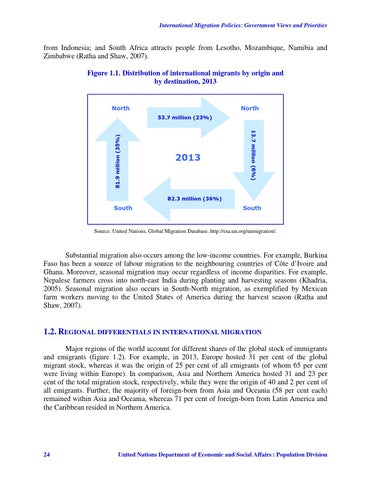
1.1. OVERALL TRENDS IN INTERNATIONAL MIGRATION The total estimated number of international migrants4 in the world (global migrant stock) has increased from 154 million in 1990 to 232 million in 2013, and is expected to continue to rise in the foreseeable future (United Nations, 2013). Although this represents a considerable increase in the global migrant stock, the percentage of international migrants compared to the global population has changed only slightly in the 23-year period, from 2.9 per cent in 1990 to 3.2 per cent in 2013. Between 1990 and 2013, the migrant stock has increased more than twice as fast in countries in more developed regions (by 53 million) as that in countries in less developed regions (by 24 million). Between 1990 to 2013, the migrant stock born in the global South and residing in the global North has doubled—from 40 million to 82 million. Over the same period, the migrant population from the South and residing in the South grew from 59 million to 82 million. Despite a more rapid rise in the number of international migrants living in the North in the past two decades, South-South migration was as common as South-North migration (figure 1.1). In 2013, more than one third (36 per cent or 82.3 million) of the global migrant stock originated in the South and was living in the South, and a similar proportion (35 per cent or 81.9 million) of the global migrant stock was born in the South but resided in the North. Further, about one quarter (23 per cent or 53.7 million) of all international migrants in the world were born in the North and resided in the North. The percentage of international migrants who were born in the North but resided in the South was relatively small (only 6 per cent of all international migrants or 13.7 million). South-North migration is usually driven by income disparities, geographic proximity and historical links such as common language and colonial ties. However, in the case of South-South migration, income differentials are relatively modest, and the role of income seems more complex as proximity and networks are more likely to have a greater impact (Ratha and Shaw, 2007). Among the middle-income countries,5 for example, Argentina, the Bolivarian Republic of Venezuela and Chile attract migrants from Bolivia, Paraguay and Peru; Malaysia draws migrants 4
The number of international migrants is defined as the midyear (1 July) estimate of the number of people living in a country other than that in which they were born. If the number of foreign-born was not available, the estimate refers to the number of people living in a country other than that of their citizenship. 5 The World Bank classification of countries into low-income, middle-income and high-income groups is based on gross national income (GNI) per capita (World Bank, n.d.). More information is available from http://data.worldbank.org/about/country-classifications.
United Nations Department of Economic and Social Affairs ׀Population Division
23
International Migration Policies: Government Views and Priorities
from Indonesia; and South Africa attracts people from Lesotho, Mozambique, Namibia and Zimbabwe (Ratha and Shaw, 2007). Figure 1.1. Distribution of international migrants by origin and by destination, 2013
North
North
2013
13.7 million (6%)
81.9 million (35%)
53.7 million (23%)
82.3 million (36%)
South
South
Source: United Nations, Global Migration Database. http://esa.un.org/unmigration/.
Substantial migration also occurs among the low-income countries. For example, Burkina Faso has been a source of labour migration to the neighbouring countries of Côte d’Ivoire and Ghana. Moreover, seasonal migration may occur regardless of income disparities. For example, Nepalese farmers cross into north-east India during planting and harvesting seasons (Khadria, 2005). Seasonal migration also occurs in South-North migration, as exemplified by Mexican farm workers moving to the United States of America during the harvest season (Ratha and Shaw, 2007).
1.2. REGIONAL DIFFERENTIALS IN INTERNATIONAL MIGRATION Major regions of the world account for different shares of the global stock of immigrants and emigrants (figure 1.2). For example, in 2013, Europe hosted 31 per cent of the global migrant stock, whereas it was the origin of 25 per cent of all emigrants (of whom 65 per cent were living within Europe). In comparison, Asia and Northern America hosted 31 and 23 per cent of the total migration stock, respectively, while they were the origin of 40 and 2 per cent of all emigrants. Further, the majority of foreign-born from Asia and Oceania (58 per cent each) remained within Asia and Oceania, whereas 71 per cent of foreign-born from Latin America and the Caribbean resided in Northern America.
24
United Nations Department of Economic and Social Affairs ׀Population Division
International Migration Policies: Government Views and Priorities
Figure 1.2. International migrant stock (millions) by major area of origin and destination, 2013 Origin
Africa 15.3
Asia 1.1
Europe 0.8
LA&C 0.0
Northern America 0.1
Oceania 0.0
Various 1.4
Total 18.6
Retention by destination (%) 82
Asia Europe
4.6 8.9
53.8 18.6
7.6 37.8
0.7 4.5
0.6 0.9
0.1 0.3
3.4 1.3
70.8 72.4
76 52
LA&C Northern America
0.0 2.0
0.3 15.7
1.2 7.9
5.4 25.9
1.3 1.2
0.0 0.3
0.2 0.0
8.5 53.1
64 2 14
Destination
Africa
Oceania Total Retention by origin (%)
0.5
2.9
3.1
0.1
0.2
1.1
0.1
7.9
31.3
92.5
58.4
36.7
4.3
1.9
6.4
231.5
49
58
65
15
28
58
Source: United Nations, Global Migration Database. http://esa.un.org/unmigration/. Note: “LA&C” stands for “Latin America and the Caribbean”. Retention by destination is calculated as the number of persons residing in a destination (major area) who were also born in the same major area. Retention by origin is calculated as the number of persons from an origin (major area) who were also residing in the same major area.
The origin of international migrants has become increasingly diversified over the past two decades. In 2013, India (14 million), Mexico (13 million), the Russian Federation (11 million), China (9 million) and Bangladesh (8 million) were the top five emigration countries. The number of migrants from China living in Africa, Europe, Northern America and Oceania more than tripled between 1990 and 2013, while the number of migrants from Mexico and the Philippines living outside their country of birth has doubled during the same period. Despite the increased diversification of migratory flows, international migration remains highly concentrated. In 2013, of the 232 million international migrants worldwide, more than half were living in just 10 countries, namely, the United States of America (46 million), the Russian Federation (11 million), Germany (10 million), Saudi Arabia (9 million), the United Arab Emirates (8 million), the United Kingdom (8 million), France (7 million), Canada (7 million), Australia (6 million) and Spain (6 million).
1.3. CONTRIBUTION OF NET MIGRATION TO OVERALL POPULATION CHANGE Over time, a population grows and declines due to natural increase (births minus deaths) and net migration (immigrants minus emigrants). Migration affects population change directly by adding to or subtracting from the population in countries of destination and origin. It also affects population indirectly by impacting, for example, mortality and fertility in the respective countries. Given the age selectivity of migration, it also affects the age structure of the population in countries of origin and destination. Although natural increase remains the main component of population change in the majority of countries worldwide, net migration has become increasingly important for countries in more developed regions.
United Nations Department of Economic and Social Affairs ׀Population Division
25
International Migration Policies: Government Views and Priorities
In Europe, where the number of deaths has exceeded the number of births since the late 1990s, positive net migration has so far offset population decline (figure 1.3). In both Northern America and Oceania net migration played a positive and important role in population growth over the last 60 years, a trend that is generally expected to continue. Over the same period, the populations of Africa, Asia and Latin America and the Caribbean continued to grow due to natural increase, however, at a declining rate. Negative net migration was more than offset by natural increase, which will remain the major factor behind population growth in these major regions in the future.
250
Millions
Millions
Figure 1.3. Contribution of natural increase and net migration to population change by major area, 1950–1960 to 2000–2010 Africa 200 150
700
Asia
600 500 400 300
100
200 50 100 0
0 -100
-50
1950-1960 1960-1970 1970-1980 1980-1990 1990-2000 2000-2010
1950-1960 1960-1970 1970-1980 1980-1990 1990-2000 2000-2010 Net migration
Net change
Natural increase
100
70
Europe
60 50
Millions
Millions
Net change
Net migration
Natural increase
Latin America and the Carribbean
80 60
40 30
40
20 20
10 0
0
-10 -20
-20
1950-1960 1960-1970 1970-1980 1980-1990 1990-2000 2000-2010
1950-1960 1960-1970 1970-1980 1980-1990 1990-2000 2000-2010 Net migration
Northern America
35
Net change
Natural increase
30
Millions
Millions
Net change
Net migration
6
Natural increase
Oceania
5
25
4 20
3 15
2
10
1
5 0 1950-1960 1960-1970 1970-1980 1980-1990 1990-2000 2000-2010 Net change
Net migration
Natural increase
0 1950-1960 1960-1970 1970-1980 1980-1990 1990-2000 2000-2010 Net change
Net migration
Natural increase
Source: United Nations, Global Migration Database. http://esa.un.org/unmigration/. Note: The graphs included in figure 1.3 have different scales.
26
United Nations Department of Economic and Social Affairs ׀Population Division
International Migration Policies: Government Views and Priorities
1.4. CHARACTERISTICS OF INTERNATIONAL MIGRANTS Migration tends to be selective by age, sex, level of education and other characteristics. Migrants tend to be younger and healthier than their non-migrating counterparts. For instance, in a sample of seven European countries, immigrants between 20 and 29 years of age constituted between one third and one half of all immigrants arriving in 2008 and 2009 (Roig et al., 2008). At the global level, in 2013, the median age of all international migrants is 38.4 years, compared with 29.2 years in the total population. The median age of migrants is higher than that of the general population due to a smaller proportion of children among migrants. Moreover, in some destination countries newborns are not considered immigrants (principle of jus soli). The median age of migrants is higher in countries in more developed regions (42.2 years) than in less developed regions (33.2 years). Examining by region, international migrants living in Africa and Asia tend to be younger (median age of 29.9 and 33.6 years, respectively) than in Europe, Northern America and Oceania (median age is 42.3, 42.2 and 43.4 years, respectively) (figure 1.4). Figure 1.4. Median age of international migrants and total population by major area, 2013
50
International migrants 42.3
Total population 43.4
42.2
40.9
40
37.7
36.7
Median age (years)
33.6 30
20
29.9
32.8 29.7
28.3
19.4
10
0 Africa
Asia
Europe
Latin America Northern America and the Caribbean
Oceania
Source: United Nations, Global Migration Database. http://esa.un.org/unmigration/.
Globally, seven out of ten international migrants are of working age (20 to 64 years) (figure 1.5). Because international migrants tend to comprise higher proportions of working-age persons compared to the overall population, migration contributes to reducing old-age dependency ratios (the number of persons aged 65 years or over divided by the number of persons aged 20 to 64 years) in destination countries. Despite this effect, the old-age dependency ratios of countries in more developed regions are projected to continue to increase.
United Nations Department of Economic and Social Affairs ‍ ׀‏Population Division
27
International Migration Policies: Government Views and Priorities
Figure 1.5. Number of international migrants by age group, 2013 200
171
Number of migrants (millions)
150
100
50 35 25
0 0-19
20-64
65+
Age group
Source: United Nations, Global Migration Database. http://esa.un.org/unmigration/.
Among international migrants worldwide, in 2013, approximately half are women— 52 per cent in countries in more developed regions and 43 per cent in less developed regions. Since women often live longer than men, they tend to be overrepresented among older migrants. The large labour movements in Europe and the United States of America in the 1960s and 1970s were male dominated and women and children migrated as dependants. Changes in the migratory behaviour of women first appeared in the 1980s and 1990s with the development of service sector employment and, in particular, the growing need for nurses and teachers. Women are now also likely to seek employment opportunities abroad in domains previously dominated by men. Increasingly, women are migrating on their own or as heads of households and principal wage earners for themselves and their families. For instance, data from labour emigration permits in South and South-East Asia show that some countries, such as Indonesia, the Philippines and Sri Lanka, allocate 70 per cent or more of such permits to prospective female migrants.
28
United Nations Department of Economic and Social Affairs ׀Population Division
REFERENCES Abella, Manolo (2006). Policies and Best Practices for Management of Temporary Migration. Paper presented at the United Nations International Symposium on International Migration and Development. Turin, 9 June. Available from: http://www.un.org/esa/ population/migration/turin/Symposium_Turin_files/P03_SYMP_Abella.pdf. Agunias, Dovelyn and Kathleen Newland (2012). Building Diaspora Institutions: Carving a Niche in the Inner Workings of Government. Developing a Road Map for Engaging Diasporas in Development: A Handbook for Policymakers and Practitioners in Home and Host Countries. Geneva: International Organization for Migration (IOM). Arango, Joaquin (2013). Exception in Europe? Spain’s Experience with Immigration and Integration. Washington, DC: Migration Policy Institute. Australia, Department of Immigration and Border Protection (2013). Fact Sheet 87 – Initiatives to Combat Illegal Work in Australia. Available from http://www.immi.gov.au/media/factsheets/87illegal.htm. Borooah, Vani K. and John Mangan (2009). Multiculturalism versus Assimilation: Attitudes towards Immigrants in Western Countries. International Journal of Economic Sciences and Applied Research, vol. 2, No. 2, pp. 33–50. Brazil, Ministry of Justice (2013). Trafico de Pessoas. Available from http://portal.mj.gov.br/ data/Pages/MJ16B51547PTBRNN.htm. Brazil, Ministry of Labour (2012). Presentation “Haitian Immigration to Brazil”. Available from http://www.iom.int/jahia/webdav/shared/shared/mainsite/microsites/IDM/workshops/mov ing-to-safety-complex-crises-2012/speeches-presentations/Session-3-Paulo-De-AlmeidaHaitian-Migration-to-Brazil.pdf. Chaloff, Jonathan and George Lamaitre (2009). Managing Highly- Skilled Labour Migration: A Comparative Analysis of Migration Policies and Challenges in OECD Countries. OECD Social, Employment and Migration Working Papers, No. 79. Paris: Organisation for Economic Co-operation and Development (OECD). Chinese Academy of Sciences (2009). “100 Talents Program” Recruitment in DICP. Available from http://english.cas.cn/JU/PO/200909/t20090917_38741.shtml. CLANDESTINO (2009). Size of Irregular Migration. Comparative Policy Brief. October. The CLANDESTINO Research Project. Available from http://clandestino.eliamep.gr/category/irregular-migration-in-the-eu/comparativeanalysis/. D’Orsi, Cristiano (2012). The AU Convention on Refugees and the Concept of Asylum. Pace International Law Review. Online Companion, vol. 3, No.7, pp 220–255. Drechsler, Denis (2008). International Labour Mobility Opportunity or Risk for Developing Countries? Policy Insights, No. 69. Paris: OECD.
United Nations Department of Economic and Social Affairs ׀Population Division
101
International Migration Policies: Government Views and Priorities
Entzinger, Han (2006). Changing the rules while the game is on: From multiculturalism to assimilation in the Netherlands. In: Migration, Citizenship, Ethnos: Incorporation Regimes in Germany, Western Europe and North America. Y. Michal Bodemann and Gökçe Yurdakul, eds. New York: Palgrave MacMillan, pp. 121–144. European Commission (2011a). Green Paper on the right to family reunification of third-country nationals living in the European Union (Directive 2003/86/EC). Available from http://eur-lex.europa.eu/LexUriServ/LexUriServ.do?uri=COM:2011:0735:FIN:en:PDF. ______(2011b). Consultation on the right to family reunification of third-country nationals living in the EU. Available from http://ec.europa.eu/dgs/home-affairs/what-isnew/public-consultation/2012/consulting_0023_en.htm. ______(2013). Together against Trafficking in Human Being: EU Policy. Available from http://ec.europa.eu/anti-trafficking/EU+Policy/;jsessionid=SQQpSGxPZVD7HW ft7vQ7Ww4sbkkYYdJx8zFcjJnmLZy7RQfYTydS!-1181792443. European Commission and Education, Audiovisual and Culture Executive Agency (EACEA) (2009). Integrating Immigrant Children into Schools in Europe. Brussels: Eurydice Network. Available from http://eacea.ec.europa.eu/education/eurydice/documents/ thematic_reports/101EN.pdf. European Union (2009). Council Directive 2009/50/EC. Available from http://eurlex.europa.eu/LexUriServ/LexUriServ.do?uri=OJ:l:2009:155:0017:0029:en:PDF. ______(2010).
Summaries of EU Legislation: Return Fund (2008-13). Available from http://europa.eu/legislation_summaries/justice_freedom_security/free_movement_of_per sons_asylum_immigration/l14570_en.htm.
Fabbrini, Frederico (2010). The Right to Vote for Non-citizen in the European Multilevel System of Fundamental Right Protection: A Case Study in Inconsistency. The Eric Stein Working Papers. Available from http://www.ericsteinpapers.eu/images/doc/eswp-2010-04fabbrini.pdf. Germany, Federal Minister of the Interior (2011). Migration and Integration: Residence law and policy on migration and integration in Germany. Available from http://www.bmi.bund.de/SharedDocs/Downloads/EN/Broschueren/Migration_und_Integr ation_en.pdf?__blob=publicationFile. Georgia (2011). IOM 100th Council Statement: Georgia. Available from http://www.iom.int/ jahia/webdav/shared/shared/mainsite/about_iom/en/council/100/Georgia-Statement100th-Council.pdf. Global Forum on Migration and Development (GFMD) (2011a). Taking Action on Migration and Development–Coherence, Capacity and Cooperation. Geneva. Available from http://www.gfmdcivilsociety.org/downloads/Geneva%20Background/Outcomes%20and %20Recommendations%20States’%20GFMD%202011.pdf. ______(2011b). Concluding Debate: Cluster II Summary Report 1–Working Session on Addressing irregular migration through coherent migration and development strategies. Geneva, 1–2 December 2011. Available from http://www.gfmd.org/documents/ switzerland/gfmd_swiss11_cluster_summary2.pdf.
102
United Nations Department of Economic and Social Affairs ׀Population Division
International Migration Policies: Government Views and Priorities
Global Migration Group (2010). Mainstreaming Migration into Development Planning: A Handbook for Policy-makers and Practitioners. Geneva: International Organization for Migration (IOM). Sales No. E.10.III.B.32. Available from http://publications from.iom.int/bookstore/free/GMG2010.pdf. India, Ministry of Overseas Indian Affairs (2013). Annual Report 2012–2013. New Delhi: Government of India. Available from http://moia.gov.in/writereaddata/pdf/ Annual_Report_2012-2013.pdf. International Labour Organization (ILO) (n.d.). Conventions and Recommendations by Subject and Status. Available from http://www.ilo.org/dyn/normlex/en/f?p=1000:12030:0::NO:::. Accessed on 29 December 2013. ______(2012). New ILO Global Estimate of Forced Labour: 20.9 million victims. Available from http://www.ilo.org/global/about-the-ilo/newsroom/news/WCMS_182109/lang-en/index.htm. Accessed on 19 December 2013. International Organization for Migration (IOM) (2010). World Migration Report 2010 – The Future of Migration: Building Capacities for Change. Geneva: IOM. Available from http://publications.iom.int/bookstore/free/WMR_2010_ENGLISH.pdf. ______(2011a). International Migration Law No 25: Glossary on Migration. Geneva: IOM. Available from http://publications.iom.int/bookstore/free/Glossary%202nd% 20ed%20web.pdf. ______(2011b). World Migration Report 2011 – Communicating Effectively about Migration. Geneva: IOM. Available from http://publications.iom.int/bookstore/free/ WMR2011_English.pdf. ______(2013a). PICUM Submission to the UN Committee on the Protection of the Rights of All Migrant Workers and Members of their Families. Geneva: IOM. Available from http://www2.ohchr.org/english/bodies/cmw/docs/DGD/2013/DGDMigrationData_PICU M_2013.pdf. ______(2013b). One million Myanmar migrants targeted in massive info campaign. Geneva: IOM. Available from http://www.iom.int/cms/en/sites/iom/home/news-and-views/pressbriefing-notes/pbn-2013/pbn-listing/one-million-myanmar-migrants-tar.html. Accessed on 19 December 2013 International Organization for Migration & Migration Policy Institute (2012). Developing a Roadmap for Engaging Diasporas in Development. Geneva: IOM and Washington, DC: MPI. Available from http://publications.iom.int/bookstore/free/Diaspora_Handbook_ EN_For_Web_28May2013.pdf. Ionescu, Dina (2006). Engaging Diasporas as Development Partners for Home and Destination Countries: Challenges for Policymakers. IOM Migration Research Series, No. 26. Geneva: International Organization for Migration. Israel, Ministry of Foreign Affairs (2009). Communicated by the Cabinet Secretariat. Available from http://www.mfa.gov.il/MFA/Government/Communiques/2009/ Cabinet_+communique_6_Sep_2009.htm?DisplayMode=print.
United Nations Department of Economic and Social Affairs ׀Population Division
103
International Migration Policies: Government Views and Priorities
Jonkers, Koen (2008). A comparative study of return migration policies targeting the highly skilled in four major sending countries. Firenzi: European University Institute. Available from http://cadmus.eui.eu/bitstream/handle/1814/9454/MIREM%20AR 2008_05.pdf?sequence=1. Kern, Soeren (2011). The Netherlands to Abandon Multiculturalism. Gatestone Institute. Available from http://www.gatestoneinstitute.org/2219/netherlands-abandonsmulticulturalism. Khadria, Binod (2005). Migration in South and South-West Asia. Available from https://www.iom.int/jahia/webdav/site/myjahiasite/shared/shared/mainsite/ policy_and_research/gcim/rs/RS6.pdf. Lima Garaza, Gonzalo (2011). Maximizing the Development Impact of Remittances. UNCTAD Single-year expert meeting on maximizing the development impact of remittances. Geneva, 14–15 February 2011. Available from http://archive.unctad.org/sections/wcmu/ docs/ciem4_S4_Lima_en.pdf. Marshall, Thomas Humphrey (1964). Citizenship and social class. Class, citizenship, and social development: Essays. T. H. Marshall. New York: Abchor Books. Mexico, Consejo Nacional de Población (n.d.). Programa Nacional de Población 2008-2012. Available from http://www.hsph.harvard.edu/population/policies/mexiico.pop3.pdf. Mexico, Consejo Nacional de Ciencia y Tecnologia (CONACYT) (2013). Convocatoria de Apoyos Complementarios para la Consolidación Institucional de Grupos de Investigación (Repatriación, Retención y Estancias de Consolidación). Available from http://www.conacyt.gob.mx/FormacionCapitalHumano/RetencionesyRepatriaciones/Pagi nas/Convocatoria.aspx. National Natural Science Foundation of China (NSFC) (2011). International (Regional) Cooperation and Exchange. Available from http://www.nsfc.gov.cn/english/03re/01/ pdf/2011/101.pdf. Office of the United Nations High Commissioner for Refugees (UNHCR) (n.d.). Syria Regional Refugee Response. Available from http://data.unhcr.org/syrianrefugees/ regional.php#doc_3. Accessed on 03 December 2013. ______(1984). Declaración de Cartagena sobre los Refugiados. Available from http://www.unhcr.org/45dc19084.html. ______(2011). Convention and protocol relating to the status of refugees. Available from http://www.unhcr.org/3b66c2aa10.html. ______(2013). UNHCR Global Trends 2012: Displacement. The New 21st Century Challenge. Available from http://www.unhcr.org/statistics. Official Journal of the European Union (2013). Regulation (EU) No. 604/2013 of the European Parliament and the Council of 26 June 2013. Available from http://eurlex.europa.eu/LexUriServ/LexUriServ.do?uri=OJ:L:2013:180:0031:0059:EN:PDF. Organisation for Economic Co-operation and Development (OECD) (2001). Trends in International Migration: Continuous Reporting System on Migration. Paris: OECD. Available from http://www.oecd.org/els/mig/2508596.pdf.
104
United Nations Department of Economic and Social Affairs ׀Population Division
International Migration Policies: Government Views and Priorities
Organisation for Economic Co-operation and Development (2006). International Migration Outlook 2006. Paris: OECD. Available from http://www.oecd-ilibrary.org/social-issuesmigration-health/international-migration-outlook-2006_migr_outlook-2006-en. ______ (2008). International Migration Outlook 2008. Paris: OECD. Available from http://www.oecd.org/els/mig/43999382.pdf. ______(2011). International Migration Outlook 2011. Paris: OECD. Available from http://www.iadb.org/intal/intalcdi/PE/2012/11325.pdf. ______(2012). International Migration Outlook 2012. Paris: OECD. Available from http://www.oecd-ilibrary.org/social-issues-migration-health/international-migrationoutlook-2012_migr_outlook-2012-en. ______(2013). International Migration Outlook 2013. Paris: OECD. Available from http://www.oecd-ilibrary.org/social-issues-migration-health/international-migrationoutlook_1999124x;jsessionid=4491q0vl74i17.x-oecd-live-01. Organization for Security and Cooperation in Europe (OSCE) (2009). Thailand’s Efforts in the Prevention and Suppression of Trafficking in Persons. Compiled by the Ministry of Foreign Affairs of Thailand, Distributed at the 2009 OSCE Human Dimension Implementation meeting 28 September–9 October 2009, Warsaw. Available from http://www.osce.org/odihr/39444. Pakistan (2013). Statement at the 46th Session of the Commission on Population and Development. United Nations. New York, 23 April. Available from http://www.un.org/ en/development/desa/population/pdf/commission/2013/country/Agenda%20item%204/Pa kistan_Item4.pdf. Papademetriou, Demetrious and Madeleine Sumption (2011). Rethinking Points Systems and Employer-selected Immigration. Washington, DC: Migration Policy Institute. Pew Research Center (2013). Population Decline of Unauthorized Immigrants Stalls, May Have Reversed. Washington, DC: Pew Research Center, Hispanic Trends Project. Available from http://www.pewhispanic.org/files/2013/09/Unauthorized-Sept-2013-FINAL.pdf. Piore, Michal J. (1979). Birds of Passage: Migrant Labor and Industrial Societies. London: Cambridge University Press. Qatar Foundation for Combating Human Trafficking (n.d.). The Arab Initiative for building national capacities for combating human trafficking. Available from http://qatarfcht.com/en/. Accessed on 13 November 2013. Ratha, Dilip, Sanket Mohapatra and Elina Scheja (2011). Impact of Migration on Economic and Social Development. A Review of Evidence and Emerging Issues. Policy Research Working Paper 5558. Geneve: IOM. Available from http://www.iom.int/cms/en/sites/ iom/home/what-we-do/migration-policy-and-research/migration-policy-1/migrationpolicy-practice/issues/octobernovember-2011/impact-of-migration-on-economic-andsoci.html. Ratha, Dilip and Willian Shaw (2007). South-South Migration and Remittances. Available from http://www.migrationinformation.org/Feature/display.cfm?ID=641.
United Nations Department of Economic and Social Affairs ׀Population Division
105
International Migration Policies: Government Views and Priorities
RIA Novosti (2013). Russia Reports 3 Mln Illegal Migrants. Available from http://en.ria.ru/ russia/20130322/180185997.html. Roig, Martha, Keiko Osaki and J. Singelman (2008). Internal migration in developing countries: Evidence from demographic and health surveys. Paper prepared for the United Nations, Department of Economic and Social Affairs, Population Division. Unpublished manuscript. United Nations Development Programme (UNDP) (2009). Human Development Report 2009. Overcoming barriers: Human mobility and development. Available from http://hdr.undp.org/en/media/HDR_2009_EN_Complete.pdf. United Nations (n.d.). Treaty Collection: Chapter V – Refugees and Stateless Persons. Available from https://treaties.un.org/Pages/Treaties.aspx?id=5&subid=A&lang=en. Accessed on 29 December 2013. ______ (1975). Report of the United Nations World Population Conference, Bucharest, 19-30 August 1974. Sales No. E.75.XIII.3. ______(1995). Report of the International Conference on Population and Development, Cairo, 5–13 September 1994. Sales No. E.95.XIII.18. ______(2011). Concluding observations of the Committee on the Protection of the Rights of all Migrant Workers and Members of Their Families – Argentina. CMW/C/ARG/CO/1. ______(2012). Report of the Secretary-General on international migration and development. A/67/254. ______(2013). Trends in International Migrant Stock: Migrants by Destination and Origin. United Nations Database, POP/DB/MIG/Stock/Rev.2013. United Nations, General Assembly (1990). International Convention on the Protection of the Rights of All Migrant Workers and Members of Their Families. A/RES/45/158. ______ (2006). Summary of the High-level Dialogue on International Migration and Development by the President of the General Assembly. A/61/515. ______(2013a). Declaration of High-level Dialogue on International Migration and Development. A/RES/68/4. ______(2013b). Report of the Secretary-General on International Migration and Development. A/68/190. United Nations News Centre (2013). European Union must guarantee human rights of migrants - UN expert, 28 May 2013. Available from http://www.un.org/apps/news/ story.asp?NewsID=45020#Umk_d_mkqOw. United Nations Office on Drugs and Crimes (UNODC) (n.d.). Available from http://www.unodc.org/unodc/en/human-trafficking/what-is-human-trafficking.html?ref= menuside#What_is_Human_Trafficking. Accessed on 07 October 2013. ______(2012). Global Report on Trafficking of Persons. Available from http://www.unodc.org/documents/data-and-analysis/glotip/ Trafficking_in_Persons_2012_web.pdf.
106
United Nations Department of Economic and Social Affairs ׀Population Division
International Migration Policies: Government Views and Priorities
United Nations Relief and Works Agency for Palestine Refugees in the Near East (UNRWA) (n.d.). Palestine Refugees. Available from http://www.unrwa.org/palestine-refugees. United States, Citizenship and Immigration Services (n.d.). EB-5 Immigrant Investor. Available from http://www.uscis.gov/working-united-states/permanent-workers/employmentbased-immigration-fifth-preference-eb-5/eb-5-immigrant-investor. Accessed on 10 December 2013. Widmaier, Sarah and Jean-Christophe Dumont (2011). Are recent immigrants different? A new profile of immigrants in the OECD based on DIOC 2005/06. OECD Social, Employment and Migration Working Papers No. 126. Paris: OECD. Available from http://www.un.org/esa/population/meetings/tenthcoord2012/49205584.pdf. World Bank (n.d.). How We Classify Countries. Available from http://data.worldbank.org/about/ country-classifications. Accessed on 17 December 2013.
United Nations Department of Economic and Social Affairs ׀Population Division
107
13-54186 ISBN 978-92-1-151512-1