South Africa
emissions and removals. South Africa proposes innovative methodologies for adaptation, both impacts and investments required, also noting that methodologies can be improved.
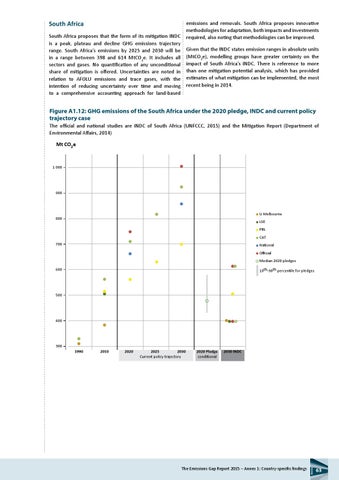
South Africa proposes that the form of its mitigation INDC is a peak, plateau and decline GHG emissions trajectory range. South Africa’s emissions by 2025 and 2030 will be in a range between 398 and 614 MtCO2e. It includes all sectors and gases. No quantification of any unconditional share of mitigation is offered. Uncertainties are noted in relation to AFOLU emissions and trace gases, with the intention of reducing uncertainty over time and moving to a comprehensive accounting approach for land-based
Given that the INDC states emission ranges in absolute units (MtCO2e), modelling groups have greater certainty on the impact of South Africa’s INDC. There is reference to more than one mitigation potential analysis, which has provided estimates of what mitigation can be implemented, the most recent being in 2014.
Figure A1.12: GHG emissions of the South Africa under the 2020 pledge, INDC and current policy trajectory case The official and national studies are INDC of South Africa (UNFCCC, 2015) and the Mitigation Report (Department of South Africa Environmental Affairs, 2014)
Mt CO2e
1 000
900
U.Melbourne
800
LSE PBL CAT
700
National Official Median 2020 pledges 10th-90th percentile for pledges
600
500
400
300 1990
2010
2020
2025 2030 Current policy trajectory
2020 Pledge conditional
2030 INDC
The Emissions Gap Report 2015 – Annex 1: Country-specific findings
63