Republic of Korea
applies to five sectors (energy, industrial processes and product use, agriculture, LULUCF and waste) and six gases (CO2, CH4, N2O, HFCs, PFCs and SF6).
The Republic of Korea put forward an economy-wide target to reduce its GHG emissions by 37 per cent from businessas-usual (BAU) by 2030. The Republic of Korea intends to achieve a 25.7 per cent emissions reduction from BAU domestically. The INDC covers energy, industrial processes and product use, agriculture and waste, and states that “[…] a decision will be made at a later stage on whether to include greenhouse gas emissions and sinks of the land sector as well as the method for doing so” (UNFCCC, 2015). The target
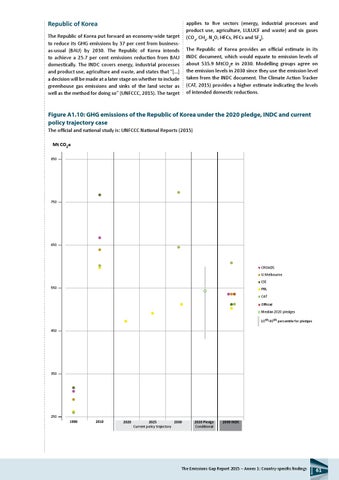
The Republic of Korea provides an official estimate in its INDC document, which would equate to emission levels of about 535.9 MtCO2e in 2030. Modelling groups agree on the emission levels in 2030 since they use the emission level taken from the INDC document. The Climate Action Tracker (CAT, 2015) provides a higher estimate indicating the levels of intended domestic reductions.
Figure A1.10: GHG emissions of the Republic of Korea under the 2020 pledge, INDC and current policy trajectory case The official and national study is: UNFCCC National Reports (2015)
South Korea
Mt CO2e 850
750
650
CROADS U.Melbourne LSE 550
PBL CAT Official Median 2020 pledges 10th-90th percentile for pledges
450
350
250 1990
2010
2020
2025 2030 Current policy trajectory
2020 Pledge Conditional
2030 INDC
The Emissions Gap Report 2015 – Annex 1: Country-specific findings
61