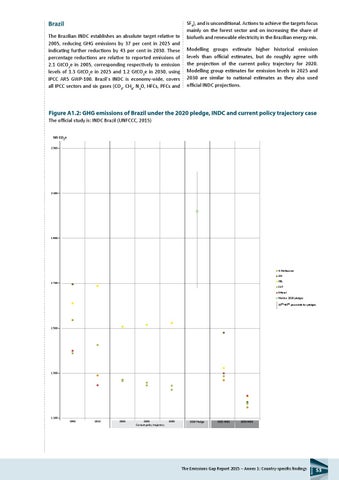
Brazil The Brazilian INDC establishes an absolute target relative to 2005, reducing GHG emissions by 37 per cent in 2025 and indicating further reductions by 43 per cent in 2030. These percentage reductions are relative to reported emissions of 2.1 GtCO2e in 2005, corresponding respectively to emission levels of 1.3 GtCO2e in 2025 and 1.2 GtCO2e in 2030, using IPCC AR5 GWP-100. Brazil´s INDC is economy-wide, covers all IPCC sectors and six gases (CO2, CH4, N2O, HFCs, PFCs and
SF6), and is unconditional. Actions to achieve the targets focus mainly on the forest sector and on increasing the share of biofuels and renewable electricity in the Brazilian energy mix. Modelling groups estimate higher historical emission levels than official estimates, but do roughly agree with the projection of the current policy trajectory for 2020. Modelling group estimates for emission levels in 2025 and 2030 are similar to national estimates as they also used official INDC projections.
Figure A1.2: GHG emissions of Brazil under the 2020 pledge, INDC and current policy trajectory case The official study is: INDC Brazil (UNFCCC, 2015)
Brazil
Mt CO2e 2 300
2 100
1 900
U.Melbourne LSE PBL
1 700
CAT Official Median 2020 pledges 10th-90th percentile for pledges
1 500
1 300
1 100
1990
2010
2020
2025 Current policy trajectory
2030
2020 Pledge
2025 INDC
2030 INDC
The Emissions Gap Report 2015 – Annex 1: Country-specific findings
53