Australia Australia intends to reduce GHG emissions by 26–28 per cent from 2005 levels including land use, land use change and forestry (LULUCF) by 2030. Australia’s target covers all sectors (energy, industrial processes and product use, agriculture, LULUCF, and waste) and gases (CO2, CH4, N2O, HFCs, PFCs, SF6 and NF3).
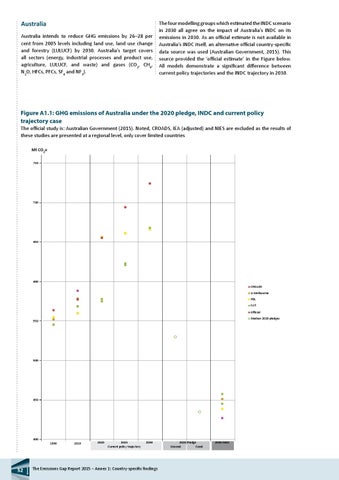
The four modelling groups which estimated the INDC scenario in 2030 all agree on the impact of Australia’s INDC on its emissions in 2030. As an official estimate is not available in Australia’s INDC itself, an alternative official country-specific data source was used (Australian Government, 2015). This source provided the ‘official estimate’ in the Figure below. All models demonstrate a significant difference between current policy trajectories and the INDC trajectory in 2030.
Figure A1.1: GHG emissions of Australia under the 2020 pledge, INDC and current policy trajectory case The official study is: Australian Government (2015). Noted, CROADS, IEA (adjusted) and NIES are excluded as the results of Australia these studies are presented at a regional level, only cover limited countries Mt CO2e 750
700
650
600 CROADS U.Melbourne PBL CAT Official Median 2020 pledges
550
500
450
400 1990
52
2010
2020
2025 Current policy trajectory
2030
The Emissions Gap Report 2015 – Annex 1: Country-specific findings
2020 Pledge Uncond. Cond.
2030 INDC