A number of new studies have examined the major initiatives and this report presents an assessment of these studies and their estimates of the emission reduction potential for each category of initiative. The studies list a number of challenges related to the analyzed ICIs including elements of overlap between initiatives and comparability of transparent monitoring, reporting and verification (MRV) of results. It is therefore difficult to assess whether all the international initiatives actually deliver on promises, as most initiatives propose only voluntary commitments and hence make it difficult for accountability and compliance to be enforced and sometimes lack robust Monitoring, Reporting and Verification (MRV). Many initiatives can, however, play important roles to advance climate action, as they: •
• • • • •
Encourage or facilitate emission reductions at the city and regional level, via knowledge sharing, capacity building and technical support for project planning and implementation Identify partnerships and support local communities to become climate resilient Represent common city-level interests to influence policymakers at other levels Help implement climate plans and low-carbon and climate-resilient economic development projects Achieve transparency and accountability by encouraging best practice in GHG emission reporting Help overcome financial barriers and attract investors and accelerate additional capital flows into cities for low carbon projects.
The studies compare the emissions reduction potential for the different categories of initiatives compared to a current trajectory baseline (noting that studies are not necessarily using same baseline approaches). Even if uncertainties are quite large, it is interesting that results are quite comparable at the aggregate level, even if the assessment of the different groups of initiatives varies significantly. The assessment notes that the impact of non-state climate commitments can be significant, most likely in the range between 2.5 and 4 GtCO2e in 2020 (taking into account that not all initiatives are included in all assessments). These numbers include an estimate of overlaps between the various initiatives, in terms of actual actions, sectors, greenhouse gases and regions. It is harder to estimate the overlap between these nonstate initiatives and government emission reduction pledges for 2020. The recent studies examined in this assessment suggest that the overlap ranges between 33 and 70 per cent, resulting in possible additional net contributions of the order of 0.75 to 2 GtCO2e in 2020. Even if ICIs are not necessarily additional to national 2020 pledges, they can be an important component of actually implementing these and at the same time facilitate or even drive increased national ambition. Only one study extrapolates the potential reductions to 2030, so it is not possible to present numbers here, but the study indicates that the mitigation contribution from existing ICIs would be substantial.
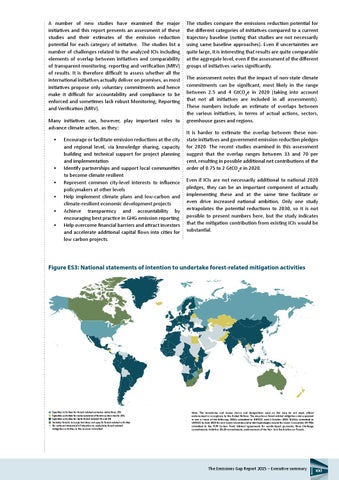
Figure ES3: National statements of intention to undertake forest-related mitigation activities
Specifies activities for forest-related emission reductions (ER) Specifies activities for enhancement of forest carbon stocks (EN) Specifies activities for both forest-related ER and EN Includes forests in scope but does not specify forest-related activities No national statement of intention to undertake forest-related mitigation activities in the sources consulted
Note: The boundaries and names shown and designations used on this map do not imply official endorsement or acceptance by the United Nations. The map shows forest-related mitigation aims expressed in one or more of the following: INDCs submitted to UNFCCC until 1 October 2015; NAMAs submitted to UNFCCC by June 2013 for non-Annex countries and to the Copenhagen Accord for Annex 1 countries; ER-PINs submitted to the FCPF Carbon Fund; bilateral agreements for results-based payments; Bonn Challenge commitments; Initiative 20x20 commitments; endorsement of the New York Declaration on Forests.
The Emissions Gap Report 2015 – Executive summary
xxi