during relevant international fora as well as on the UNEP Live website. The governments of the countries with specific mention in the report have been invited to comment on the assessment findings.
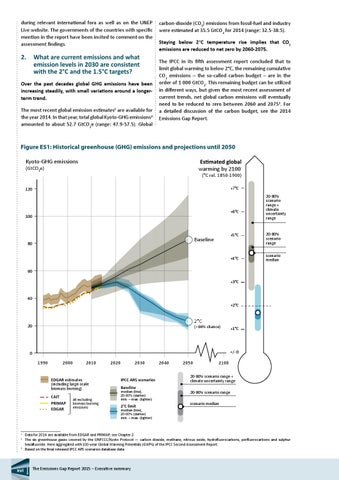
2. What are current emissions and what emission levels in 2030 are consistent with the 2°C and the 1.5°C targets? Over the past decades global GHG emissions have been increasing steadily, with small variations around a longerterm trend. The most recent global emission estimates1 are available for the year 2014. In that year, total global Kyoto-GHG emissions2 amounted to about 52.7 GtCO2e (range: 47.9-57.5). Global
carbon-dioxide (CO2) emissions from fossil-fuel and industry were estimated at 35.5 GtCO2 for 2014 (range: 32.5-38.5). Staying below 2°C temperature rise implies that CO2 emissions are reduced to net zero by 2060-2075. The IPCC in its fifth assessment report concluded that to limit global warming to below 2°C, the remaining cumulative CO2 emissions – the so-called carbon budget – are in the order of 1 000 GtCO2. This remaining budget can be utilized in different ways, but given the most recent assessment of current trends, net global carbon emissions will eventually need to be reduced to zero between 2060 and 20753. For a detailed discussion of the carbon budget, see the 2014 Emissions Gap Report.
Figure ES1: Historical greenhouse (GHG) emissions and projections until 2050 Kyoto-GHG emissions (GtCO2e)
warming by 2100
(°C rel. 1850-1900) +7°C
120
+6°C
100
+5°C
Baseline
80
+4°C
20-80% scenario range + climate uncertainty range 20-80% scenario range scenario median
60 +3°C 40 +2°C
2°C
20
(> 66% chance)
+1°C
+/- 0
0
1990
2000
2010
EDGAR estimates (including large-scale biomass burning) CAIT PRIMAP EDGAR
all excluding biomass burning emissions
2020
2030 IPCC AR5 scenarios Baseline
median (line), 20-80% (darker) min. – max. (lighter)
2°C limit
2040
2050
2100
20-80% scenario range + climate uncertainty range 20-80% scenario range scenario median
median (line), 20-80% (darker) min. – max. (lighter)
____________________ 1 Data for 2014 are available from EDGAR and PRIMAP, see Chapter 2. 2 The six greenhouse gases covered by the UNFCCC/Kyoto Protocol — carbon dioxide, methane, nitrous oxide, hydrofluorocarbons, perfluorocarbons and sulphur hexafluoride. Here aggregated with 100-year Global Warming Potentials (GWPs) of the IPCC Second Assessment Report. 3 Based on the final released IPCC AR5 scenarios database data.
xvi
The Emissions Gap Report 2015 – Executive summary