THE STATE OF THE WORLD’S CHILDREN 2013
United Nations Children’s Fund 3 United Nations Plaza New York, NY 10017, USA Email: pubdoc@unicef.org Website: www.unicef.org
THE STATE OF THE WORLD’S CHILDREN 2013
XX%
Cert no. XXX-XXX-XXX
US $25.00 ISBN: 978-92-806-4656-6 eISBN: 978-92-806-4662-7 United Nations publication sales no.: E.13.XX.1
© United Nations Children’s Fund (UNICEF) May 2013
CHILDREN WITH DISABILITIES
To read this report online, scan this QR code or go to www.unicef.org/sowc2013
Children with Disabilities
© United Nations Children’s Fund (UNICEF) May 2013 Permission is required to reproduce any part of this publication. Permission will be freely granted to educational or non-profit organizations. Others will be requested to pay a small fee. Please contact: Division of Communication, UNICEF Attn: Permissions H6F 3 United Nations Plaza, New York, NY 10017, USA Tel: +1 (212) 326-7434 Email: nyhqdoc.permit@unicef.org This report and additional online content are available at <www.unicef.org/ sowc2013>. Perspective and Focus essays represent the personal views of the authors and do not necessarily reflect the position of the United Nations Children’s Fund. For corrigenda subsequent to printing, please see <www.unicef.org/sowc2013>. For latest data, please visit <www.childinfo.org>. ISBN: 978-92-806-4656-6 eISBN: 978-92-806-4662-7 United Nations publication sales no.: E.13.XX.1 Cover photo: Schoolchildren queue to enter their classroom in this 2007 photograph from the Syrian Arab Republic. © UNICEF/HQ2007-0745/Noorani
UNICEF Headquarters UNICEF House 3 United Nations Plaza New York, NY 10017, USA
UNICEF Latin America and the Caribbean Regional Office P.O. Box 0843-03045 Panama City, Panama
UNICEF Regional Office for Europe Palais des Nations CH-1211 Geneva 10, Switzerland
UNICEF East Asia and Pacific Regional Office P.O. Box 2-154 Bangkok 10200, Thailand
UNICEF Central and Eastern Europe/ Commonwealth of Independent States Regional Office Palais des Nations CH-1211 Geneva 10, Switzerland UNICEF Eastern and Southern Africa Regional Office P.O. Box 44145 Nairobi, Kenya 00100 UNICEF West and Central Africa Regional Office P.O. Box 29720, Yoff Dakar, Senegal
UNICEF Middle East and North Africa Regional Office P.O. Box 1551 Amman 11821, Jordan UNICEF South Asia Regional Office P.O. Box 5815 Lekhnath Marg Kathmandu, Nepal
THE STATE OF THE WORLD’S CHILDREN 2013
ACKNOWLEDGEMENTS This report is the result of collaboration among too many individuals and institutions to acknowledge here. The editorial and research team thanks all who gave so willingly of their time, expertise and energy, in particular: Vesna Bosnjak (International Social Services); Shuaib Chalklen (UN Special Rapporteur on Disability); Maureen Durkin (University of Wisconsin); Nora Groce and Maria Kett (Leonard Cheshire Disability and Inclusive Development Centre, University College London); Nawaf Kabbara (Arab Organization of Disabled People); Lisa Jordan (Bernard van Leer Foundation); Connie Laurin-Bowie (International Disability Alliance); Barbara LeRoy (Wayne State University); Charlotte McClain-Nhlapo (United States Agency for International Development); Helen Meekosha (Women with Disabilities Australia); Peter Mittler (University of Manchester); Roseweter Mudarikwa (Secretariat of the African Decade on Persons with Disabilities); David Mugawe (African Child Policy Forum); Ghulam Nabi Nizamani (Pakistan Disabled Peoples’ Organization); Victor Santiago Pineda (Victor Pineda Foundation); Tom Shakespeare (World Health Organization); Aleksandra Posarac (World Bank); Shantha Rau Barriga (Human Rights Watch); Eric Rosenthal (Disability Rights International); Albina Shankar (Mobility India); and Armando Vásquez (Pan American Health Organization) for serving on the External Advisory Board. Judith Klein (Open Society Foundations); Gerrison Lansdown (independent); Malcolm MacLachlan and Hasheem Mannan (Trinity College Dublin); Susie Miles (independent); Daniel Mont (Leonard Cheshire Disability); and Diane Richler (International Disability Alliance) for authoring background papers. Sruthi Atmakur (City University of New York); Parul Bakshi and Jean-Francois Trani (Washington University in St. Louis); Nazmul Bari and Amzad Hossain (Centre for Disability in Development); Simone Bloem and Mihaylo Milovanovitch (Organization for Economic Co-operation and Development); Johan Borg (Lund University); Megan Burke, Stephane De Greef and Loren Persi Vicentic (Landmine and Cluster Munition Monitor); James Conroy (Center for Outcome Analysis); Audrey Cooper, Charles Reilly and Amy Wilson (Gallaudet University); Alexandre Cote (International Disability Alliance); Marcella Deluca, Sunanda Mavillapalli, Alex Mhando, Kristy Mitchell, Hannah Nicolls and Diana Shaw (Leonard Cheshire Disability/Young Voices); Avinash De Souza (De Souza Foundation); Catherine Dixon (Handicap International); Fred Doulton (Secretariat of the Convention on the Rights of Persons with Disabilities); Natasha Graham (Global Partnership for Education); Jean Johnson (University of Hawaii); Chapal Khasnabis and Alana Officer (World Health Organization); Darko Krznaric (Queen’s University); Gwynnyth Llewellyn (University of Sydney); Mitch Loeb (Centers for Disease Control and Prevention/ National Center for Health Statistics); Rosemay McKay (Australian Agency for International Development); Amanda McRae (Human Rights Watch); Sophie Mitra (Fordham University); David Morissey, Sherzodbek Sharipoo and Andrea Shettle (United States International Council on Disabilities); Zelda Mycroft (The Chaeli Campaign); Emma Pearce (Women’s Refugee Commission); Natalia Raileanu (Keystone Human Services); Richard Rieser (World of Inclusion); Marguerite Schneider (Stellenbosch University); Morsheda Akter Shilpi (Organization for the Poor Community Advancement); Silje Vold (Plan Norway) for writing background material or providing advice and information. Tracy Achieng; Grace Okumu Akimi; Sophia Rose Akoth; Abeida Onica Anderson; Washinton Okok Anyumba; Beatrice Atieno; Ssentongo Deo; Ivory Duncan; Argie Ergina; Mary Charles Felix; Michael Salah Hosea; Amna Hissein Idris; Tiffany Joseph; Hannah Wanja Maina; Saitoti Augustin Maina; Dianne Mallari; Modesta Mbijima; Shida Mganga; Nicole Mballah Mulavu; Joseph Kadiko Mutunkei; Ann Napaashu Nemagai; Rachael Nyaboke Nyabuti; Alice Akoth Nyamuok; Sarah Omanwa; Benson Okoth Otieno; Nakafu Phiona; Shalima Ramadhani; Rosemarie Ramitt; Nambobi Sadat; Veronicah Shangutit Sampeke; Ladu Michel Seme; Josephine Kiden Simon; Muhammad Tarmizi bin Fauzi; Elizabeth Mamunyak Tikami; Shemona Trinidad; and the 20 other young people who participated anonymously in surveys and focus groups conducted specially for this report by facilitators from the Leonard Cheshire Disability Young Voices network. Bora Shin and Matthew Manos (veryniceDesign) for the infographic on universal design published online at <www.unicef.org/sowc2013>. UNICEF country and regional offices and headquarters divisions contributed to this report or to related online content or advocacy materials by submitting findings or photographs, taking part in formal reviews or commenting on drafts. Many UNICEF offices and national committees arranged to translate or adapt the report for local use. Programme, policy, communication and research advice and support were provided by Yoka Brandt, Deputy Executive Director; Geeta Rao Gupta, Deputy Executive Director; Gordon Alexander, Director, Office of Research and colleagues; Nicholas Alipui, Director, Programme Division and colleagues; Ted Chaiban, Director, Office of Emergency Operations and colleagues; Colin Kirk, Director, Office of Evaluation and colleagues; Jeffrey O’Malley, Director, Division of Policy and Strategy and colleagues; and Edward Carwardine, Deputy Director, Division of Communication and colleagues. This edition also benefited from the close cooperation of Rosangela Berman-Bieler, Chief, and colleagues in the Disability Section of UNICEF’s Programme Division. Special thanks to David Anthony, Chief, Policy Advocacy Section; Claudia Cappa, Statistics and Monitoring Specialist; Khaled Mansour, Director of Communication until January 2013; and Julia Szczuka, deputy editor of this report until September 2012, for their generosity of intellect and spirit.
REPORT TEAM
EDITORIAL AND RESEARCH
PUBLISHING AND DISSEMINATION
Abid Aslam, Editor Christine Mills, Project Manager Nikola Balvin, Sue Le-Ba, Ticiana Maloney, Research Officers Anna Grojec, Perspectives Editor Marc Chalamet, French Editor Carlos Perellon, Spanish Editor Hirut Gebre-Egziabher (Lead), Lisa Kenney, Ami Pradhan, Research Assistants Charlotte Maitre (Lead), Carol Holmes, Pamela Knight, Natalie Leston, Kristin Moehlmann, Copy Editors Anne Santiago, Nogel S. Viyar, Judith Yemane, Editorial support
Catherine Langevin-Falcon, Chief, Publications Section; Jaclyn Tierney, Production Officer; Germain Ake; Christine Kenyi; Maryan Lobo; Jorge Peralta-Rodriguez; Elias Salem
STATISTICAL TABLES Tessa Wardlaw, Associate Director, Statistics and Monitoring Section, Division of Policy and Strategy; David Brown; Claudia Cappa; Liliana Carvajal; Archana Dwivedi; Anne Genereux; Elizabeth Horn-Phathanothai; Priscilla Idele; Claes Johansson; Rouslan Karimov; Rolf Luyendijk; Colleen Murray; Jin Rou New; Holly Newby; Khin Wityee Oo; Nicole Petrowski; Tyler Porth; Chiho Suzuki; Andrew Thompson; Danzhen You Design by Prographics, Inc. Printed by Hatteras Press, Inc.
ii
THE STATE OF THE WORLD’S CHILDREN 2013: Children with Disabilities
FOREWORD Is there a child who does not dream of being counted and having her or his gifts and talents recognized? No. All children have hopes and dreams – including children with disabilities. And all children deserve a fair chance to make their dreams real. This edition of The State of the World’s Children includes contributions by young people and parents who show that, when given that chance, children with disabilities are more than capable of overcoming barriers to their inclusion, of taking their rightful place as equal participants in society and of enriching the life of their communities. But for far too many children with disabilities, the opportunity to participate simply does not exist. Far too often, children with disabilities are among the last in line for resources and services, especially where these are scarce to begin with. Far too regularly, they are the objects simply of pity or, worse, discrimination and abuse. The deprivations faced by children and adolescents with disabilities are violations of their rights and the principle of equity, at the heart of which lies a concern for the dignity and rights of all children – including the most vulnerable and marginalized members of society. As this report documents, the inclusion of children with disabilities in society is possible – but it requires first a change of perception, a recognition that children with disabilities hold the same rights as others; that they can be agents of change and self-determination, not merely the beneficiaries of charity; that their voices must be heard and heeded in our policymaking and programmes. We contribute to their exclusion by failing to gather enough data to inform our decisions. When we fail to count these children, we are failing to help them count for all they should in their societies. Fortunately, progress is being made – albeit unevenly. This report not only examines the challenges involved in ensuring that children with disabilities have the fair access to services that is their right. It also explores initiatives that show promise in such areas as health, nutrition, education and emergency programming – and in the data collection and analysis needed to improve policies and operations in all these fields. Other chapters also discuss principles and approaches that can be adapted to advance these children’s inclusion. Somewhere, a child is being told he cannot play because he cannot walk, or another that she cannot learn because she cannot see. That boy deserves a chance to play. And we all benefit when that girl, and all children, can read, learn and contribute. The path forward will be challenging. But children do not accept unnecessary limits. Neither should we.
Anthony Lake Executive Director, UNICEF
iii
CONTENTS ACKNOWLEDGEMENTS.................................................. ii
CHAPTER 4
FOREWORD
Abuse and violence..................................................................... 41
Anthony Lake, Executive Director, UNICEF............................... iii
Institutions and inappropriate care........................................... 42
ESSENTIALS OF PROTECTION............................ 41
Inclusive justice........................................................................... 43 CHAPTER 1
INTRODUCTION................................................................. 1 From exclusion to inclusion......................................................... 1
CHAPTER 5
HUMANITARIAN RESPONSE................................ 49
On the numbers............................................................................. 3 A framework for action................................................................ 3
CHAPTER 6
CHAPTER 2
Evolving definitions.................................................................... 63
MEASURING CHILD DISABILITY........................ 63
FUNDAMENTALS OF INCLUSION.................... 11
Putting disability in context ...................................................... 64
Changing attitudes...................................................................... 12
Data collection............................................................................. 65
It’s about ability........................................................................... 13
Questionnaire design.................................................................. 66
Supporting children and their families..................................... 13
Purpose and consequences........................................................ 67
Community-based rehabilitation............................................... 16
A way forward............................................................................. 68
Assistive technology................................................................... 18 Universal design.......................................................................... 18
CHAPTER 7
AN AGENDA FOR ACTION..................................... 75 CHAPTER 3
Ratify and implement the Conventions.................................... 75
A STRONG FOUNDATION....................................... 23
Fight discrimination.................................................................... 75
Inclusive health............................................................................ 23
Dismantle barriers to inclusion.................................................. 77
Immunization............................................................................... 23
End institutionalization.............................................................. 80
Nutrition....................................................................................... 24
Support families.......................................................................... 81
Water, sanitation and hygiene.................................................... 25
Move beyond minimum standards........................................... 81
Sexual and reproductive health and HIV/AIDS......................... 26
Coordinate services to support the child................................. 81
Early detection and intervention................................................ 26
Involve children with disabilities in making decisions............ 84
Inclusive education..................................................................... 27
Global promise, local test.......................................................... 85
Starting early............................................................................... 29 Working with teachers................................................................ 32 Involving parents, communities and children ......................... 33 Lines of responsibility................................................................. 36
iv
THE STATE OF THE WORLD’S CHILDREN 2013: Children with Disabilities
FOCUS
FIGURES
Violence against children with disabilities............................... 44
Estimated rates of primary school completion........................ 12
Risk, resilience and inclusive humanitarian action.................. 52
Community-based rehabilitation............................................... 16
Explosive remnants of war........................................................ 54
Assistive technology products................................................... 19
Lessons learned........................................................................... 69
Children with disabilities and secondary education............... 42
From screening to assessment.................................................. 70
Last to benefit.............................................................................. 43 Child casualties in countries heavily affected by mines and explosive remnants of war, 2011............................ 56
PERSPECTIVE From pioneer to advocate for inclusion Nancy Maguire.............................................................................. 4 Living with albinism, discrimination and superstition Michael Hosea............................................................................... 6 I want good memories Nicolae Poraico.............................................................................. 8
Child casualties in the most affected countries (1999–2011)................................................................. 57 Child casualties by type of explosive........................................ 59 Four case studies: Percentage of population reporting some form of disability.............................................. 64 Convention on the Rights of Persons with Disabilities and Optional Protocol: Signatures and ratifications............... 76
For deaf young people, language is the key Krishneer Sen.............................................................................. 20 My son Hanif Mohammad Absar ...................................................................... 30
REFERENCES........................................................................ 88
The new normal Claire Halford............................................................................... 34
STATISTICAL TABLES................................................. 93
Adjusting, adapting and empowering Yahia J. Elziq................................................................................ 38
Under-five mortality rankings.................................................... 99
Overview...................................................................................... 94
Segregation and abuse in institutions Eric Rosenthal and Laurie Ahern............................................... 46
Table 1. Basic indicators........................................................... 100
One bite of the elephant at a time Chaeli Mycroft.............................................................................. 60
Table 3. Health........................................................................... 108
From invisibility to inclusion for indigenous children with disabilities Olga Montufar Contreras............................................................ 72
Table 5. Education..................................................................... 116
Table 2. Nutrition....................................................................... 104 Table 4. HIV/AIDS...................................................................... 112 Table 6. Demographic indicators............................................. 120
Open the doors to education – and employment Ivory Duncan................................................................................ 78
Table 7. Economic indicators................................................... 124
End the ‘book famine’ with better technology, attitudes and copyright law Kartik Sawhney............................................................................ 82
Table 9. Child protection........................................................... 132
Children with disabilities and universal human rights Lenín Voltaire Moreno Garcés.................................................... 86
Table 8. Women......................................................................... 128 Table 10. The rate of progress................................................. 136 Table 11. Adolescents............................................................... 140 Table 12. Disparities by residence........................................... 144 Table 13. Disparities by household wealth............................. 148
Additional Focus and Perspective essays are available online at <www.unicef.org/sowc2013>.
Table 14. Early childhood development.................................. 152
A NOTE ON TERMS Conventions, optional protocols, signatures and ratifications................................................................................ 154
v
Victor, a 13-year-old with cerebral palsy, has fun in the water in Brazil. Š Andre Castro/2012
CHAPTER 1
INTRODUCTION Reports such as this typically begin with a statistic designed to highlight a problem. The girls and boys to whom this edition of The State of the World’s Children is dedicated are not problems. Rather, each is a sister, brother or friend who has a favourite dish, song or game; a daughter or son with dreams and the desire to fulfil them; a child with a disability who has the same rights as any other girl or boy. Given opportunities to flourish as others might, children with disabilities have the potential to lead fulfilling lives and to contribute to the social, cultural and economic vitality of their communities – as the personal essays in this volume attest. Yet surviving and thriving can be especially difficult for children with disabilities. They are at greater risk of being poor than peers without disabilities. Even where children share the same disadvantages – of poverty or membership in a minority group, say – children with disabilities confront additional challenges as a result of their impairments and the many barriers that society throws in their way. Children living in poverty are among the least likely to enjoy the benefits of education and health care, for example, but children who live in poverty and have a disability are even less likely to attend their local school or clinic. In many countries, responses to the situation of children with disabilities are largely limited to institutionalization, abandonment or neglect. These responses are the problem, and they are rooted in negative or paternalistic assumptions
of incapacity, dependency and difference that are perpetuated by ignorance. Unless this changes, children with disabilities will continue to have their rights neglected; to experience discrimination, violence and abuse; to have their opportunities restricted; to be excluded from society. What is needed is a commitment to these children’s rights and their futures, giving priority to the most disadvantaged – as a matter of equity and for the benefit of all.
From exclusion to inclusion Children with disabilities encounter different forms of exclusion and are affected by them to varying degrees, depending on factors such as the type of disability they have, where they live and the culture or class to which they belong. Gender is also a crucial factor: Girls are less likely than boys to receive care and food and are more likely to be left out of family interactions and activities. Girls and young women with disabilities are ‘doubly disabled’. They confront not only the prejudice and inequities encountered by many persons with disabilities, but are also constrained by traditional gender roles and barriers. 1 Girls with disabilities are also less likely to get an education, receive vocational training or find employment than are boys with disabilities or girls without disabilities. 2
INTRODUCTION
1
At the heart of these differing forms and degrees of exclusion, however, lies the shared experience of being defined and judged by what one lacks rather than by what one has. Children with disabilities are often regarded as inferior, and this exposes them to increased vulnerability: Discrimination based on disability has manifested itself in marginalization from resources and decision-making, and even in infanticide.3 Exclusion is often the consequence of invisibility. Few countries have reliable information on how many of their citizens are children with disabilities, what disabilities they have or how these disabilities affect their lives. In some countries, families raising children with disabilities face ostracism. Because of this, even loving parents and family members can be reluctant to report that a child of theirs has a disability – whether because they are trying to avoid being shunned, because they are being overprotective of the
child, or both. If the child is born with an impairment, its birth might not even be registered. Children excluded in this way are unknown to, and therefore cut off from, the health, education and social services to which they are entitled. Childhood deprivations can have lasting effects – by limiting access to gainful employment or participation in civic affairs later in life, for example. Conversely, access to and use of supportive services and technology can position a child with a disability to take her or his place in the community and contribute to it. Indeed, the future is far from grim. Effective means are available to build inclusive societies in which children with and without disabilities can enjoy their rights equally. Physical, attitudinal and political barriers are being dismantled, although the process is uneven and has far to go.
Rahmatuallah, 14, who lost his leg in a landmine explosion, takes part in a training workshop for electricians at a centre for war-affected children in Kandahar, Afghanistan. © UNICEF/AFGA2007-00420/Noorani
2
THE STATE OF THE WORLD’S CHILDREN 2013: Children with Disabilities
Under the Convention on the Rights of the Child (CRC) and the Convention on the Rights of Persons with Disabilities (CRPD), governments around the world have taken upon themselves the responsibility of ensuring that all children, irrespective of ability or disability, enjoy their rights without discrimination of any kind. As of February 2013, 193 countries had ratified the CRC and 127 countries and the European Union had ratified the CRPD. These two Conventions bear witness to a growing global movement dedicated to the inclusion of children with disabilities in community life. Concern for inclusion is rooted in the recognition that all children are full members of society: that each child is a unique individual who is entitled to be respected and consulted, who has skills and aspirations worth nurturing and needs that demand fulfilment and whose contributions are to be valued and encouraged. Inclusion requires society to make physical infrastructure, information and the means of communication accessible so all can use them, to eliminate discrimination so none is forced to suffer it and to provide protection, support and services so every child with a disability is able to enjoy her or his rights as do others. Inclusion goes beyond ‘integration’. The latter implies that children with disabilities are to be brought into a pre-existing framework of prevailing norms and standards. In the context of education, for example, integration might be attempted simply by admitting children with disabilities to ‘regular’ schools. This would fall short of inclusion, which is possible only when schools are designed and administered so that all children can experience quality learning and recreation together. This would entail providing students with disabilities with such needed accommodations as access to Braille, sign language and adapted curricula that allow them equal opportunity to learn and interact. Inclusion benefits everyone. To continue with the example of education, ramps and wide doorways
On the numbers By one widely used estimate, some 93 million children – or 1 in 20 of those aged 14 or younger – live with a moderate or severe disability of some kind. Such global estimates are essentially speculative. They are dated – this one has been in circulation since 2004 – and derived from data of quality too varied and methods too inconsistent to be reliable. In order to provide a context for and illustrate the issues under discussion, this report presents the results of national surveys and independent studies, but even these must be interpreted with caution and should not be compared to one another. This is because definitions of disability differ by place and time, as do study design, methodology and analysis. These issues, and promising initiatives aimed at improving the quality and availability of data, are discussed in Chapter 6 of this report.
can enhance access and safety for all children, teachers, parents and visitors in a school, not just those who use wheelchairs. And an inclusive curriculum – one that is child-centred and that includes representations of persons with disabilities in order to reflect and cater to a true cross section of society – can broaden the horizons not only of children whose disabilities would otherwise limit their ambitions or options, but also of those without disabilities who stand to gain an appreciation of diversity and of the skills and preparedness necessary to build a society inclusive of all. Where educational attainment leads to a job or other means of earning a living, the child with a disability is able to advance and to take her or his place as a full and equal member of the adult world, one who produces as well as consumes.
A framework for action Children with disabilities should not be treated or regarded simply as the recipients of charity. They have the same rights as others – among these, the right to life and to the opportunities that flow from good health care, nutrition and education, (continued on p. 9)
INTRODUCTION
3
PERSPECTIVE
From pioneer to advocate for inclusion By Nancy Maguire
Nancy Maguire is a disability activist from the United Kingdom. She is a qualified social worker but, after travelling abroad, decided to campaign for the rights of people with disabilities, especially young women. She has worked with disabled people’s organizations in Asia and Southern Africa, and hopes to obtain a Master’s degree in policy and development.
I was born in London in 1986 and have a condition called osteogenesis imperfecta, commonly known as brittle bones. Many children with brittle bones grow up protected – overprotected, some might say – from any possibility of hurting themselves. My parents wanted me to be safe, but they also wanted me to have the opportunity to play, make friends and lead as normal a childhood as possible.
4
In the 1980s, inclusive education was still a fairly new concept. Like most parents of a disabled child, mine were advised to send me to a special school. My mother is a teacher, and after visiting the recommended school she was convinced that it would provide a substandard education. My parents have always used my older sister Katy, who did not have a disability, to gauge what is acceptable for me: If they thought something wasn’t good enough for Katy, then it wasn’t good enough for me. I was the first child with a disability to attend my primary school, and in many ways I felt like a guinea pig for inclusion. For example, despite having a positive attitude towards including me in all aspects of school life, my teachers lacked experience in how to adapt physical education so that I could get involved in a meaningful way. Like most childhoods, mine wasn’t always easy. I spent a lot of time in hospital, and even within an ‘inclusive’ mainstream education system, there were times when I was excluded. For example, I wasn’t allowed to go to my nursery Christmas party because the teachers were worried I would break a bone.
THE STATE OF THE WORLD’S CHILDREN 2013: Children with Disabilities
Also, at high school they had a separate table in the canteen for children with disabilities and the teachers could not understand why I refused to sit at it. Despite setbacks and obstacles, however, I managed to flourish both educationally and socially. I was always encouraged to try new things. My extracurricular activities included swimming, ballet, wheelchair tennis, drama and singing. In many of these, I was also the only child with a disability. Interestingly, I often found these groups more inclusive than school in terms of how much I could participate and contribute. I felt wanted and people found creative ways for me to get involved. Nonetheless, there were many things I found difficult to do because of my limited mobility. I would sometimes feel upset because I couldn’t do things as well as the other children, and as I grew older and more selfconscious, I became reluctant to put myself in situations where my difficulties were on show. In my teenage years a lot of my friends went through phases of being a ‘goth’ or a ‘rude girl’, which involved dressing or behaving in ways designed to attract attention. Whilst they were doing everything they
People with disabilities are becoming more visible in many walks of life – in politics and the media, for example. This is instrumental in improving children’s perceptions of what they can achieve.
could to stand out and be different, I was desperate to be ‘normal’ and fit in. Growing up with a disability, I received a lot of attention. People in the street would often stare at me, make comments and ask my parents, “What’s wrong with her?” I had days when I was able to brush it off, but no amount of resilience or family support can stop that from affecting you. I developed extremely low selfesteem and poor body image, made worse because I was significantly overweight. I found exercise difficult, and like many girls my age, I ate to comfort myself. I had also internalized the medical terminology that was used to describe me – in particular the word ‘deformed’ (I had a curvature of the spine, since corrected). When I was 14, I developed an eating disorder, partly because I wanted to lose weight – but also because my weight felt like one aspect of my physical appearance that I could actually control. Although I had incredibly supportive family and friends, being disabled was never something I viewed as a positive thing. I thought I had to overcome it, like adversity. I became obsessed with being as ‘undisabled’ as possible, and I was
convinced that if I could walk, my life would be a lot better. Ironically, although I no longer use a wheelchair, in many ways I feel more aware of my disability than ever. People still make comments about me because I have small stature, and make assumptions about my life and ability; I always have to prove myself, particularly in the workplace. Though I am not defined by my disability, it has been pivotal in shaping who I am and what I have achieved. Having a disability is now something I embrace: I no longer see it as a negative thing or something I should be embarrassed about. In many ways being disabled has worked to my advantage and created opportunities that might never have been available to me – like writing this article.
People with disabilities are becoming more visible in many walks of life – in politics and the media, for example. This is instrumental in improving children’s perceptions of what they can achieve. When I was growing up, the only role model I had was Stevie Wonder. I admired him because he was a successful and respected musician despite being blind. However, it would have helped me to see people with disabilities doing everyday jobs – as teachers, doctors or shopkeepers. I think that would also have helped my parents. My mum said that when I was a child, she tried not to think about my future because it made her scared. She knew that I was capable but feared that my options would be limited.
Every child’s experience is different. I come from a lowermiddle-class family in the United Kingdom, where I had access to free health care and a good education. But I strongly believe that the issues of belonging, self-esteem and aspiration transcend such distinctions as gender, class and nationality. To develop a greater sense of self-worth, children with disabilities need the opportunity to participate and contribute in all aspects of their lives.
As it turns out, my disability has not prevented me from achieving any of the important things. I am a qualified social worker, passed my driving test when I was 16, left home when I was 19 and have lived and worked in Asia and Africa. In the future I hope to be an advocate for children with disabilities on an international level, as I passionately believe in the inalienable human rights and untapped potential of these children.
INTRODUCTION
5
PERSPECTIVE
Living with albinism, discrimination and superstition By Michael Hosea
to protect my eyes. I also have troubles at school. Sometimes I can’t see the blackboard, and I always have to sit in the shade. This country does not have sufficient visionenhancing technology, such as glasses, magnifiers and special computer equipment, and without it children with albinism have a hard time graduating from school and finding employment. My family is poor, so getting money for school fees is also difficult.
Michael Hosea was born in 1995. He is the eldest of six children and one of three persons with albinism in his immediate family. He lives in Dodoma, United Republic of Tanzania, and is about to graduate from school. He advocates for the rights of young people with disabilities, particularly those with albinism, through the Leonard Cheshire Disability Young Voices network.
6
I was born in Mwanza, the second largest city in the United Republic of Tanzania. I am the eldest son and live with my siblings and parents in Dodoma, the capital. There are six children in our family; one of my sisters and one of my brothers are also albinos. The impairments caused by my condition make life very difficult. I always have trouble with the sun and have to cover up with heavy, long-sleeved clothing and wear sunglasses
THE STATE OF THE WORLD’S CHILDREN 2013: Children with Disabilities
Life is complicated even more by the way people treat us. There is a lot of discrimination against people with albinism, and I sometimes lack the company of friends. Some people also believe horrible myths about us: that we are not human and never die, that albinism is a curse from the gods and that anyone who touches us will be cursed. Worst of all, practitioners of witchcraft hunt and kill us to use our hair, body parts and organs in charms and potions. For centuries some people have believed that if they go to a witch doctor with albino
Education is the key to stopping the murder, abuse and discrimination. It is important that others – even members of my extended family – learn that we are people just like them.
body parts, they will become rich and prosperous. Even though it is illegal to kill people with albinism, it still happens – it’s greed that makes people do it. But it’s all based on lies: There are people who have done these terrible things, yet their lives have remained the same. A few months ago, thanks to a friend of my father, my siblings and I escaped being the victims of murder for witchcraft. My father’s friend came to warn him that his three albino children were in danger of being hunted, and he begged my father to leave Mwanza. This wasn’t easy because my parents’ financial situation was not good, but we packed up everything and left at 3 a.m. that night. We travelled over 500 kilometres to Dodoma and after two days received news from home that people had broken into our house in Mwanza looking to kill us. When these people found that we had escaped, they went to our next-door neighbour’s house. He was our local albino
representative and had done so much to help us and advocate for albino rights in our community. They cut off his genitals and arms, and left him there to die. We later received a phone call from another neighbour telling us what they did to him. This news hurt me so much that I cried a lot, but what could I do? This is the way things are. I don’t understand why people do such things to fellow human beings. But I think education is the key to stopping the murder, abuse and discrimination. It is important that others – even members of my extended family – learn that we are people just like them. We are all the same.
Note: Albinism is a rare, genetically inherited condition found in all ethnicities. People with albinism have little or no pigmentation in their eyes, hair and skin owing to a lack of melanin. They are sensitive to bright light and have a higher than average risk of skin cancer from sun exposure. Most people with albinism are also visually impaired. Under the Same Sun, a Canadian nongovernmental organization, estimates that albinism affects 1 in 2,000 Tanzanians. Although the medical condition itself does not affect life expectancy, in the United Republic of Tanzania the average lifespan of a person with albinism is around 30 years.
To escape life’s difficulties, I love to write songs and sing. I have just written a song about albinos and our struggle. My dream is to one day be able to record my music in a studio and spread my message. I pray that people around the world can one day understand that albinos are no different from them. We are all human beings and deserve to be treated with love and respect.
INTRODUCTION
7
PERSPECTIVE
I want good memories By Nicolae Poraico
I was 11 when I went to the institution with my brother Grisha. I am now 16. Our mother sent us there because we did not have enough money to buy or rent a house, and she had to work nights. She came to see us often.
Nicolae Poraico and his brother Grisha spent several years in a residential home for children with mental disabilities in the Republic of Moldova. Nicolae was diagnosed with a moderate intellectual disability and his brother with a severe intellectual disability. In 2010 Nicolae and Grisha reunited with their mother in the village of Lapusna. This was made possible with the assistance of the Community for All – Moldova programme, which is implemented by the Keystone Human Services International Moldova Association with financial support from the Open Society Mental Health Initiative and the Soros Foundation Moldova.
I do not remember the day I went to the institution. I even forgot some of my memories of being there, and I hope in time I will forget the other ones. I want new memories, good memories. At holidays the food was good. It was also good on other days; we were fed four times a day. After eating I cleaned the kitchen. The teachers taught us to recite poems and sing songs and showed us different games. I know a poem about Gigel and two about Mother. We had naptime from 1 to 4 p.m. I would not sleep: I laughed, talked to other boys. I put my head on the pillow, kept my eyes open and looked at the boys. We were all living in one room, all 16 boys from my class. There was one boy, Victor. He worked in the kitchen. We went to the stadium nearby. He took just me to the stadium; he had bread and sour milk, and we ate together. When my mother took
8
THE STATE OF THE WORLD’S CHILDREN 2013: Children with Disabilities
me and my brother home, Victor did not know as he was sleeping. He gave me his picture so I would not forget him, but I forgot it there. Sometimes the staff beat us. I do not know why. They beat me so much with different sticks that my back was injured. I was not the only one. Other boys were injured, too. And some boys had knives. Some boys hit others, and sometimes I fought with them, with fists. What could I do? If I did not defend myself, they could kill me. They beat Grisha, but I defended him. I didn’t want to stay there. If my mother had left us there, the administration could have sent us to different families and my mother would never find us. But I want to visit the institution, just to see Victor and take his phone number. At home, it is very good. I now play with Colea, Igor and Dima. Here, nobody beats me. Sometimes we discuss problems with our mother and ask for advice. We get along very well and I go to school every day. I like physical education and Romanian language classes. I am glad I came here. I am happy that I am in Lapusna.
(continued from p. 3)
the right to express their views and participate in making decisions, and the right to enjoy equal protection under the law. They belong at the centre of efforts to build inclusive and equitable societies – not only as beneficiaries, but as agents of change. After all, who is in a better position to comprehend their needs and evaluate the response? In any effort to promote inclusion and fairness, children with disabilities should be able to enlist the support of their families, disabled people’s organizations, parents’ associations and community groups. They should also be able to count on allies further afield. Governments have the power to help by aligning their policies and programmes with the spirit and stipulations of the CRPD, CRC and other international instruments that address or affect child disability. International partners can provide assistance compatible with the Conventions. Corporations and other entities in the private sector can advance inclusion – and attract the best talent – by embracing diversity in hiring. The research community is working to improve data collection and analysis. Their work will help to overcome ignorance and the discrimination that often stems from it. Furthermore, because data help to target interventions and gauge their effects, better collection and analysis helps in ensuring an optimal allocation of resources and services. But decision-makers need not wait for better data to begin building more inclusive infrastructure and services: As some have already found, inclusion involves and benefits entire communities, and its elements can be applied to new projects across the board. All that is needed is for these efforts to remain flexible so they can be adapted as new data come to light. The next chapter of this report discusses exclusion and the factors that propagate it, along with some philosophical and practical fundamentals of inclusion. Subsequent chapters – each of which applies the same approach of exploring barriers as well as solutions that show
promise – are dedicated to specific aspects of the lives of children with disabilities. Chapter 3 examines the health, nutritional and educational services that can provide a strong foundation on which children with disabilities can build full and fulfilling lives. Chapter 4 explores the opportunities and challenges of ensuring legal recognition and protection against exploitation or abuse. Chapter 5 discusses inclusion in the context of humanitarian crises. Many of the deprivations endured by children with disabilities stem from and are perpetuated by their invisibility. Research on child disability is woefully inadequate, especially in low- and middle-income countries. The resulting lack of evidence hinders good policymaking and service delivery for children who are among the most vulnerable. Therefore, Chapter 6 of this report examines the challenges and opportunities confronting researchers – and ways in which children with disabilities can be rendered visible through sound data collection and analysis. Chapter 7, which concludes this edition of The State of the World’s Children, outlines necessary and feasible actions that will enable governments, their international partners, civil society and the private sector to advance equity through the inclusion of children with disabilities.
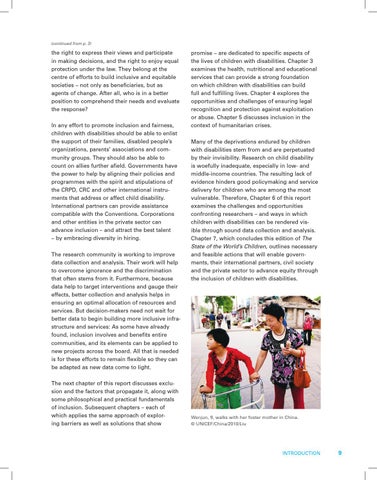
Wenjun, 9, walks with her foster mother in China. © UNICEF/China/2010/Liu
INTRODUCTION
9
Children with and without disabilities participate in school festivities in Bangladesh. Š UNICEF/BANA2007-00655/Siddique
Conventions, optional protocols, signatures and ratifications A note on terms used in this report A Convention is a formal agreement between States parties. The term ‘Convention’ is used (rather than its synonym, ‘treaty’) to denote a multilateral instrument with a large number of States parties, including one open to participation by the international community as a whole and negotiated under the auspices of an international organization. An Optional Protocol to a Convention is a legal instrument intended to supplement the original agreement by establishing additional rights or obligations. It may be used to address in greater detail a matter mentioned in the original agreement, to speak to a new concern relevant to any of its topics, or to add procedures for operation or enforcement. Such a protocol is optional in the sense that States parties to a Convention are not automatically bound by its provisions, but must ratify it independently. Thus, a State may be party to a Convention but not to its Optional Protocols. The process by which a State becomes party to a Convention comprises, in most cases, two steps: signature and ratification. By signing a Convention, a State indicates its intention to take steps to examine the Convention and its compatibility with domestic law. A signature does not create a legal obligation to be bound by a Convention’s provisions; however, it does indicate that a State will act in good faith and will not take actions that would undermine the purpose of the Convention. Ratification is the concrete action by which a State agrees to be legally bound by the terms of a Convention. The procedure varies according to each country’s particular legislative structure. After a State has determined that a Convention is consistent with domestic laws and that steps may be taken to comply with its provisions, the appropriate national organ (e.g., a parliament) makes a formal decision to ratify. Once the instrument of ratification – a formal, sealed letter signed by the responsible authority (e.g., a president) – is deposited with the United Nations Secretary-General, the State becomes party to the Convention. In some cases, a state will accede to a Convention or Optional Protocol. Essentially, accession is like ratifying without first having to sign. For further information and more detailed definitions of these and related terms, see <http://treaties.un.org/Pages/Overview.aspx?path=overview/definition/page1_en.xml>. The Convention on the Rights of Persons with Disabilities is available at <http://treaties.un.org/doc/Publication/CTC/Ch_IV_15.pdf>. The Optional Protocol is available at <http://treaties.un.org/doc/Publication/CTC/Ch-15-a.pdf>.
154
THE STATE OF THE WORLD’S CHILDREN 2013: Children with Disabilities
THE STATE OF THE WORLD’S CHILDREN 2013
United Nations Children’s Fund 3 United Nations Plaza New York, NY 10017, USA Email: pubdoc@unicef.org Website: www.unicef.org
THE STATE OF THE WORLD’S CHILDREN 2013
XX%
Cert no. XXX-XXX-XXX
US $25.00 ISBN: 978-92-806-4656-6 eISBN: 978-92-806-4662-7 United Nations publication sales no.: E.13.XX.1
© United Nations Children’s Fund (UNICEF) May 2013
CHILDREN WITH DISABILITIES
To read this report online, scan this QR code or go to www.unicef.org/sowc2013
Children with Disabilities