ACTION FOR
ACTION FOR
10
DISARMAMENT
DISARMAMENT
ACTION FOR DISARMAMENT
THINGS
YOU CAN DO!
09-54678
ISBN 978-92-1-142287-0
UNITED NATIONS
J045223_cvr.indd 1
10 THINGS YOU CAN DO
draws the attention of young people around the world to the promotion of international peace and security through disarmament. Young people, in every country of the world, have a critical role to play in getting the public at large to participate in developing new strategies to reduce the threats posed by weapons of mass destruction as well as small and light weapons. This publication helps teenagers and young adults make the public aware of why disarmament is so important to keep the world safe for the future of humankind. In ten practical steps, this publication will help them mobilize, act and promote the disarmament ideals of the United Nations at the local and national level. This publication argues that disarmament is an absolute necessity that can be actively promoted by the world's future generations.
UNITED NATIONS
3/17/14 11:01 AM
10 THINGS
YOU CAN DO!
09-54678_Action for Disarmament_interior_FINAL_to Printer_correx.indd 1
3/20/14 12:58 PM
09-54678_Action for Disarmament_interior_FINAL_to Printer_correx.indd 2
3/20/14 12:58 PM
ACTION FOR DISARMAMENT
10
THINGS
YOU CAN DO!
UNITED NATIONS
09-54678_Action for Disarmament_interior_FINAL_to Printer_correx.indd 3
3/20/14 12:58 PM
09-54678_Action for Disarmament_interior_FINAL_to Printer_correx.indd 4
3/20/14 12:58 PM
Unexploded ordnance being prepared for destruction by explosive disposal technicians in a remote desert area of Libya.
09-54678_Action for Disarmament_interior_FINAL_to Printer_correx.indd 5
3/20/14 12:58 PM
TABLE OF CONTENTS
Action for Disarmament: 10 Things You Can Do Published by the United Nations Department of Public Information in cooperation with the United Nations Office for Disarmament Affairs New York, New York 10017 Copyright Š 2014 United Nations All rights reserved All queries on rights and licences, including subsidiary rights, should be addressed to: United Nations Publications, 300 East 42nd Street, New York, NY 10017, United States of America; e-mail: publications@un.org; website: unp.un.org/ ISBN: 978-92-1-142287-0 eISBN: 978-92-1-054111-4 United Nations Publication Sales No. E.13.IX.6 The views expressed in this book along with the references and resources mentioned are those of the contributors and do not necessarily reflect the views of the United Nations. Design: Graphic Design Unit, Department of Public Information, United Nations, New York Special thanks to Kathleen Sullivan and Peter Lucas who were the primary authors of this book. We are grateful for the permission granted by the Nagasaki Atomic Bomb Museum and the Nagasaki Foundation for the Promotion of Peace to use photographs and atomic bomb survivors’ artwork in this book.
09-54678_Action for Disarmament_interior_FINAL_to Printer_correx.indd 6
3/20/14 12:58 PM
I
INTRODUCTION Foreword.......................................... 14 Preface............................................. 16 Categories of Weapons........................20
II
10 THINGS YOU CAN DO ACTION 1: Stay Informed...................28 ACTION 2: Start a Club.....................44 ACTION 3: Facilitate a Discussion .......52 ACTION 4: Express Yourself ..............64 ACTION 5: Host a Film Screening........76 ACTION 6: Voice Your Concern.......... 88 ACTION 7: Create an Event................98 ACTION 8: Sign Up..........................108 ACTION 9: Plan a Presentation..........1 16 ACTION 10: Reach Out......................126
III
CONCLUSION The United Nations Secretary-General’s Call to Nuclear Disarmament...............138 Note to Educators.............................142 Photo Credits....................................148
09-54678_Action for Disarmament_interior_FINAL_to Printer_correx.indd 7
3/20/14 12:58 PM
BEFORE BEFORE 09-54678_Action for Disarmament_interior_FINAL_to Printer_correx.indd 8
3/20/14 12:58 PM
US Army photographs of Nagasaki City before and after the atomic bombing
AFTER
09-54678_Action for Disarmament_interior_FINAL_to Printer_correx.indd 9
3/20/14 12:58 PM
09-54678_Action for Disarmament_interior_FINAL_to Printer_correx.indd 10
3/20/14 12:58 PM
Survivor’s artwork after the atomic bombing in Nagasaki City
09-54678_Action for Disarmament_interior_FINAL_to Printer_correx.indd 11
3/20/14 12:58 PM
AC T ION FOR DIS A RM A MENT: 10 T H INGS YOU C A N DO
“We must not only control the weapons that can kill us, we must bridge the great disparities of wealth and opportunity among the peoples of the world, the vast majority of whom live in poverty without hope, opportunity or choices in life. These conditions are a breeding ground for division that can cause a desperate people to resort to nuclear weapons as a last resort. Our only hope lies in the power of our love, generosity, tolerance and understanding and our commitment to making the world a better place for all.�
Muhammad Ali, former United Nations Messenger of Peace
12
09-54678_Action for Disarmament_interior_FINAL_to Printer_correx.indd 12
3/20/14 12:58 PM
09-54678_Action for Disarmament_interior_FINAL_to Printer_correx.indd 13
3/20/14 12:58 PM
FOREWORD
AC T ION FOR DIS A RM A MENT: 10 T H INGS YOU C A N DO
With 1.8 billion young people between the ages of 10 and 24 in the world today, you make up the largest generation of youth the world has ever known. Access to education, employment, human rights, the threat of climate change are but a few of the challenges you face. The UN Secretary-General has made “working with and for young people” one of his top five priorities. In support of his youth agenda, I am working throughout the UN system to ensure that you, as young people, are included in the decision-making process on policy issues that affect your lives. This book draws your attention to another global issue of importance—the need to promote peace and security in the world through disarmament. One aspect of disarmament focuses on nuclear weapons. People born after the end of the Cold War have been spared growing up under the fear of a nuclear attack. Yet the risk posed by nuclear weapons still exists today. As SecretaryGeneral Ban Ki-moon noted, “Sadly, we know the terrible humanitarian consequences from the use of even one [nuclear] weapon. As long as such weapons exist, so, too, will the risks of use and proliferation.” Another aspect of disarmament addresses the illicit trade in small arms and light weapons. Most present-day conflicts
14
09-54678_Action for Disarmament_interior_FINAL_to Printer_correx.indd 14
3/20/14 12:58 PM
are fought with small arms and light weapons. They are the weapons of choice in civil wars, organized crime, gang warfare and terrorist attacks. They are easy to use, to carry, and to conceal. Illicit flows of small arms and light weapons undermine security and the rule of law, undermine economic and social development, and are often a factor behind the forced displacement of civilians and massive human rights violations. Youth have a critical role to play in getting the public at large to participate in developing new strategies to reduce the threats to international peace and security posed by these weapons. The disarmament agenda cannot be ignored. The future of humanity depends upon it. Youth have shown time and again that they are the drivers of change. We are counting on you to make your voices heard on this critical issue. To give you some important tools, we have prepared this book, Action for Disarmament: 10 Things You Can Do, which is filled with ideas and resources to help you make the public aware of why disarmament is important. I look forward to working with you to make our planet safer for us, and for generations to come!
—Ahmad Alhendawi, United Nations Secretary-General’s Envoy on Youth
FOREWORD
15
09-54678_Action for Disarmament_interior_FINAL_to Printer_correx.indd 15
3/20/14 12:58 PM
PREFACE
AC T ION FOR DIS A RM A MENT: 10 T H INGS YOU C A N DO
The outbreak of World War I in 1914 was a watershed for the technological advancement of modern weapons. Never before was a major war fought with weapons forged from the industrial revolution. There was the machine gun, as well as artillery capable of firing exploding shells from several miles away. Landmines were planted in the fields. There were armoured tanks, battleships, and even submarines firing torpedoes. From above, warplanes were dropping bombs. As a harbinger of things to come, mustard gas was also released as a chemical weapon. For four years, there was an average of five and a half thousand casualties per day. In the end, 10 million people died and 30 million were wounded, maimed, disfigured, and incapacitated for the rest of their lives. The world had changed: mankind had the technical means to mass-produce destruction. World War II continued that trend—now widening the annihilation to civilian populations. This war also saw the birth of the nuclear age with the emergence of nuclear weapons. The mere existence of nuclear weapons—which can wipe out civilizations, even life on earth—has changed our world forever. In the decades after World War II, the Cold War between the major powers sometimes led to proxy wars in other parts of the world. The two largest nuclear-weapon States, the United States and the Soviet Union, provided conventional arms to countries who then fought wars sometimes for independence and sometimes for ideological reasons, which resulted in millions of casualties. After 1990, when the Cold War ended, the number of conflicts went down, and their character changed. Inter-State warfare (soldiers from different countries fighting each other) had been largely replaced by ethnic and religious strife, with armed groups mixing economic and political objectives, mainly using small arms and light weapons. All too often those handling guns
16
09-54678_Action for Disarmament_interior_FINAL_to Printer_correx.indd 16
3/20/14 12:58 PM
Weapons being burnt during the official launch of the “Disarmament, Demobilization, Rehabilitation and Reintegration” process in Burundi.
PREFACE
had acquired them illegally, often from the excessively large Cold War stocks left around the world. All in all, nowadays the world’s governments are spending well over US$ 1.5 trillion a year on their militaries, a level of spending not seen since the end of World War II. This amounts to roughly $250 for each person in the world. Whereas 2.5% of the world’s gross domestic product goes to the military, only 0.3%—eight times less—is spent on development aid. People born after the Cold War have grown up without the persistent cloud of living under the threat of a global nuclear war. Instead of some 60,000 nuclear warheads that were around in 1991, there are now approximately 17,000 of them. The threat of two global powers entering a full-scale nuclear war has receded, but because of the ability of nuclear arms to obliterate whole societies—and the risk of misuse, loss, or unforeseen political developments—the problem is not in the numbers, but in the mere existence of these weapons. Disarmament education is needed more than ever to make us grasp the present-day reality of these threats. The goal of Action for Disarmament is to encourage dialogue among, and provide disarmament and non-proliferation resources to, all who care about the future. It also aims to spread the message that disarmament provides a foundation for promoting peace and development around the world. All people, especially youth, can play a valuable role by taking action to create a safer world—from nuclear weapons abolition to curbing gun violence. Before deciding which aspect of disarmament and non-proliferation you are most interested in, it is important to know the many types of weapons that exist in the world today—to understand how they have evolved and continue to proliferate.
17
09-54678_Action for Disarmament_interior_FINAL_to Printer_correx.indd 17
3/20/14 12:58 PM
“There can be no development without peace and no peace without development. Disarmament can provide the means for both. With your voice and strong support, we can get this message across and advance the international disarmament agenda.”
AC T ION FOR DIS A RM A MENT: 10 T H INGS YOU C A N DO
United Nations Secretary-General Ban Ki-moon—message to the Religions for Peace Global Youth Campaign on Disarmament for Shared Security in San José, Costa Rica, November 2009
18
09-54678_Action for Disarmament_interior_FINAL_to Printer_correx.indd 18
3/20/14 12:58 PM
09-54678_Action for Disarmament_interior_FINAL_to Printer_correx.indd 19
3/20/14 12:58 PM
CATEGORIES
D A Radiation Warning symbol
Biohazard symbol
NUCLEAR WEAPONS: The most dangerous weapons in the
world are nuclear weapons: a threat to all life on earth. These weapons cause a massive explosion through what is called nuclear fission: the splitting of an atom, which creates a sudden, tremendous release of energy. The effects of a nuclear explosion include blast, heat, and radiation, producing destruction on an unimaginable scale. Immense light and thermal heat—comparable to the interior of the sun—cause what is called a firestorm, depleting oxygen from the environment and creating hurricane-like winds that attract debris and feed the storm itself, causing super-infernos. Another effect of a nuclear explosion is radiation. Once released, radioactive elements can hang around for millennia, putting future generations at risk of cancer and genetic mutations. The destructive power of nuclear weapons has been described as “unthinkable”.
AC T ION FOR DIS A RM A MENT: 10 T H INGS YOU C A N DO
BIOLOGICAL AND CHEMICAL WEAPONS: Biological weapons have existed since antiquity: historical accounts from medieval Europe detail the use of infected animal carcasses thrown over besieged cities’ walls and in wells to infect enemy combatants and civilian populations. More recently, in World War I, both sides fired projectiles that released poisonous gases such as mustard gas, which is a mix of carbon, chlorine, hydrogen, and sulfur. Biological and toxin weapons differ from chemical weapons in that biological weapons use bacteria or viruses, or in some cases toxins that come directly from bacteria, to kill people. An example is ebola, a highly contagious bacterial agent which can be disseminated through a variety of delivery systems. Chemical, biological and toxin weapons are so lethal that their development, production, stockpiling and use are prohibited through international treaties. The stockpiling of
20
09-54678_Action for Disarmament_interior_FINAL_to Printer_correx.indd 20
3/20/14 12:58 PM
OF WEAPONS these kinds of weapons poses great risks because of their potential to be deployed within a relatively short period of time. RADIOLOGICAL WEAPONS: Also called radiological dispersion
devises (RDDs) or “dirty bombs”, radiological weapons could be used to spread economic and social disruption through the dispersal of invisible radioactive contaminants. Although they are capable of extensive, long-term damage, have the potential to be used for spreading terror and panic, RDDs have not been used in war, but the fear that they might be used has increased in recent years. Anxiety about radiological weapons has fuelled a debate about the operation of nuclear power plants. Nuclear power plants utilize and create radioactive materials in the form of spent fuel storage and other on-site radioactive waste that could be fashioned into radiological weapons. A growing concern is that these radioactive materials might be stolen and used to cause damage to people and the environment. Some people argue that nuclear power plants themselves could be used as radiological weapons. For example, in the event of war, nuclear power plants could be used as primary bombing targets, having the potential to release widespread radioactive material. There is no agreement on the actual damage that a radiological weapon could produce because that would depend upon the type of radioactive materials used, and how they were dispersed.
weapons and war, we’re usually thinking about conventional weapons systems. Think of battle tanks, armoured combat vehicles, artillery systems, attack helicopters, combat aircraft, warships, and missile systems. Each year, countries spend an enormous amount of money on these weapons; the trade in
CATEGORIES OF WEAPONS
MAJOR CONVENTIONAL WEAPONS: When we talk about
The plutonium bomb “Fat Man” that was dropped over the City of Nagasaki on 9 August 1945, killing more than 70,000 people, and causing radiation sickness in survivors that continues to this day.
21
09-54678_Action for Disarmament_interior_FINAL_to Printer_correx.indd 21
3/20/14 12:58 PM
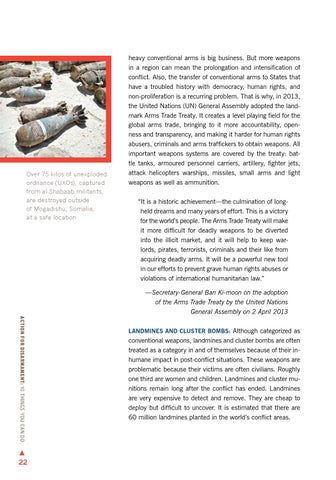
Over 75 kilos of unexploded ordnance (UXOs), captured from al-Shabaab militants, are destroyed outside of Mogadishu, Somalia, at a safe location.
heavy conventional arms is big business. But more weapons in a region can mean the prolongation and intensification of conflict. Also, the transfer of conventional arms to States that have a troubled history with democracy, human rights, and non-proliferation is a recurring problem. That is why, in 2013, the United Nations (UN) General Assembly adopted the landmark Arms Trade Treaty. It creates a level playing field for the global arms trade, bringing to it more accountability, openness and transparency, and making it harder for human rights abusers, criminals and arms traffickers to obtain weapons. All important weapons systems are covered by the treaty: battle tanks, armoured personnel carriers, artillery, fighter jets, attack helicopters warships, missiles, small arms and light weapons as well as ammunition. “It is a historic achievement—the culmination of longheld dreams and many years of effort. This is a victory for the world’s people. The Arms Trade Treaty will make it more difficult for deadly weapons to be diverted into the illicit market, and it will help to keep warlords, pirates, terrorists, criminals and their like from acquiring deadly arms. It will be a powerful new tool in our efforts to prevent grave human rights abuses or violations of international humanitarian law.” —Secretary-General Ban Ki-moon on the adoption of the Arms Trade Treaty by the United Nations General Assembly on 2 April 2013
AC T ION FOR DIS A RM A MENT: 10 T H INGS YOU C A N DO
LANDMINES AND CLUSTER BOMBS: Although categorized as
conventional weapons, landmines and cluster bombs are often treated as a category in and of themselves because of their inhumane impact in post-conflict situations. These weapons are problematic because their victims are often civilians. Roughly one third are women and children. Landmines and cluster munitions remain long after the conflict has ended. Landmines are very expensive to detect and remove. They are cheap to deploy but difficult to uncover. It is estimated that there are 60 million landmines planted in the world’s conflict areas.
22
09-54678_Action for Disarmament_interior_FINAL_to Printer_correx.indd 22
3/20/14 12:58 PM
The International Campaign to Ban Landmines estimates that landmines cause over 4,000 casualties each year—that is 11 to 12 per day. Women and children are often the victims losing their lives, limbs, or eyesight from accidentally contacting an explosive device. Like landmines, cluster bombs are almost impossible to target only military, and they are often still set to explode long after the fighting has ended. Cluster bombs are shot with artillery or dropped from airplanes, containing sub-munitions or “bomblets”, which disperse over a wide area. The colourful explosive duds have often killed and maimed children who mistake them for a toy or a ball. SMALL ARMS AND LIGHT WEAPONS: Most armed violence in
CATEGORIES OF WEAPONS
the world is perpetrated with small arms and light weapons, which is why they are sometimes called “the real weapons of mass destruction”. Technically, “small arms” refers to firearms that can be easily carried by a single person. These include handguns, rifles, carbines, submachine guns, assault rifles, and light hand-held machine guns. Light weapons need to be operated by two or three people. These include grenade launchers, mortars, light missiles, portable anti-tank and anti-aircraft guns, heavy machine guns, cannons, and various explosive devices. Like major conventional arms, the international trade in light weapons in principle involves government-to-government transfers—but there seems to be a large international black market for them. Most present-day conflicts are fought mainly with small arms, which are broadly used in inter-State conflict. They are the weapons of choice in civil wars and for terrorism, organized crime and gang warfare because they are cheap, light, and easy to handle, transport and conceal. The proliferation of small arms and light weapons can encourage conflicts, undermine peace initiatives, and exacerbate human rights abuses. Armed conflict causes people to flee their homes and is the most common cause of food insecurity. In addition, armed violence also diverts energy and resources away from efforts to improve human development. As the violence in a conflict zone becomes more lethal and lasts longer,
United Nations “Blue Helmets” help disarm militias in Côte d’Ivoire.
23
09-54678_Action for Disarmament_interior_FINAL_to Printer_correx.indd 23
3/20/14 12:58 PM
a sense of insecurity grows, which in turn leads to a greater demand for weapons. Since 2001, the UN has recognized the grave threat posed by small arms and light weapons in the wrong hands. The UN Programme of Action on the illicit trade in small arms and light weapons provides a framework for activities to counter this global threat. It is not about banning small arms or prohibiting people from owning legal weapons and it does not suggest any action against the legal trade, manufacture, possession or ownership of weapons. Its sole focus is on countering the illicit trade in small arms and light weapons and preventing the diversion of weapons into black markets. A section of ground is cordoned off during an exercise held by the United Nations Mine Action Service in Mogadishu, Somalia, as part of the International Day of Mine Awareness.
AC T ION FOR DIS A RM A MENT: 10 T H INGS YOU C A N DO
Today, disarmament is increasingly important because military spending and the proliferation of weapons have never been higher. Students can engage in exciting and empowering activities to increase awareness about disarmament and non-proliferation and also to take action based on their knowledge and analysis of the subject. This book aims to take learning beyond the classroom, providing a range of suggested activities with you, the student, in mind, so that you can find inspiration in what you have learned and be a part of making a difference. The United Nations’ shared vision for all students is this —that you help alleviate violence in the world through raising awareness and taking action. Action for Disarmament: 10 Things You Can Do is meant to help you become an agent for social change. Many of you may know these educational strategies, but they may be slightly different in relation to disarmament. Besides disarmament, these steps can also be used in the context of other important social and environmental issues. Feel free to choose and select which aspects best fit your learning environment. These Ten Things are not meant to be done in any particular order. Mix and match. Be creative in choosing which strategy is best for you.
24
09-54678_Action for Disarmament_interior_FINAL_to Printer_correx.indd 24
3/20/14 12:58 PM
WORLD MILITARY EXPENDITURE 2.0
1.5
1.0
0.5
0
2012 2011 2010 2009 2008 2007 2006 2005 2004 2003 2002 2001 2000 1999 1998 1997 1996 1995 1994 1993 1992 1991 1990
The totals are based on the data on 172 states in the SIPRI Military Expenditure Database, www.sipri.org/databases/milex. The absence of data for the Soviet Union in 1991 means that no total can be calculated for that year.
1989 1988
Constant US$ Trillion
09-54678_Action for Disarmament_interior_FINAL_to Printer_correx.indd 25
3/20/14 12:58 PM
STAY INFORMED
START A CLUB
FACILITATE A DISCUSSION
EXPRESS YOURSELF
HOST A FILM SCREENING
VOICE YOUR CONCERN
09-54678_Action for Disarmament_interior_FINAL_to Printer_correx.indd 26
3/20/14 12:58 PM
CREATE AN EVENT
SIGN UP
10
THINGS
PLAN A PRESENTATION
09-54678_Action for Disarmament_interior_FINAL_to Printer_correx.indd 27
YOU CAN DO!
REACH OUT
3/20/14 12:58 PM
ACTION 09-54678_Action for Disarmament_interior_FINAL_to Printer_correx.indd 28
3/20/14 12:58 PM
09-54678_Action for Disarmament_interior_FINAL_to Printer_correx.indd 29
3/20/14 12:58 PM
ST INFO 09-54678_Action for Disarmament_interior_FINAL_to Printer_correx.indd 30
3/20/14 12:58 PM
AY RMED 09-54678_Action for Disarmament_interior_FINAL_to Printer_correx.indd 31
3/20/14 12:58 PM
1 AC T ION FOR DIS A RM A MENT: 10 T H INGS YOU C A N DO
Disarmament issues provide opportunities for organizing and outreach, but as ever the first step is to become informed. Going online to find reputable sources is a good starting point. There are many useful websites where you can read the latest information on nuclear weapons, small arms and light weapons. Most of these sites have breaking news stories, regional reports, fact sheets, in-depth studies, timelines, calendars of events, and many additional links to facilitate networking and further study. First up, to stay informed, is an exploration of the role that the United Nations plays for disarmament, followed by a select grouping of non-governmental organizations working on issues related to the arms trade and nuclear disarmament.
32
09-54678_Action for Disarmament_interior_FINAL_to Printer_correx.indd 32
3/20/14 12:58 PM
DISARMAMENT AT THE UNITED NATIONS AND RELATED BODIES
The “Non-Violence” (or “Knotted Gun”) sculpture by Swedish artist Carl Fredrik Reuterswärd on display at the UN Visitors’ Plaza in New York City.
ACTION 1: STAY INFORMED
The United Nations is the leading organization dealing with global non-proliferation and disarmament issues. Several UN bodies have different tasks. The General Assembly (www. un.org/en/ga), where all UN Member States meet, was given the chief responsibility for considering “the general principles of cooperation in the maintenance of international peace and security, including the principles governing disarmament and the regulation of armaments”. The General Assembly has divided its work over several committees. The First Committee (www.un.org/en/ga/first) deals with disarmament and international security. The resolutions on disarmament that pass through this committee are taken up by the General Assembly in its plenary sessions and, once adopted, guide the agenda of the UN on specific disarmament themes. The UN Disarmament Commission (bit.ly/1m2ScWt) is a more reflective body, where States discuss, not decide, on more general questions of disarmament and arms control. The 15-member Security Council (un.org/en/sc), with five permanent members, bears “the primary responsibility for the establishment and maintenance of international peace and security” in our world. The Charter also mandates the Security Council to formulate plans for the regulation of weapons and their use. The Security Council also has the power to deploy UN peacekeepers to conflict regions to prevent war and the escalation of armed violence. The Council focuses on crises, but increasingly has an eye for the root causes of conflict and war. Its resolutions are legally binding for all UN States. They can range from establishing an arms embargo on a specific country, to ensuring that terrorists do not acquire weapons of mass destruction, to setting the standards for how to tackle the small arms problem in countries coming out of conflict. The Conference on Disarmament (CD) (www.unog.ch/ disarmament), based in Geneva, Switzerland, is not formally a
33
09-54678_Action for Disarmament_interior_FINAL_to Printer_correx.indd 33
3/20/14 12:58 PM
NUCLEAR LEXICON The Treaty on the Non-Proliferation of Nuclear Weapons (NPT) was born in 1968 out of mounting global concerns over the spread of nuclear weapons from 1945 into the mid 1960s. Under the Treaty, non-nuclear weapon States are forbidden to manufacture, possess or otherwise acquire nuclear weapons in exchange for the right to develop nuclear energy for peaceful purposes, including power generation as well as medical and industrial applications. The NPT remains the only legally binding commitment to achieving a world without nuclear weapons. Every five years the Treaty is “reviewed” and progress on disarmament is assessed by States parties to the NPT. The next NPT Review Conference will provide excellent opportunities for students to get informed and get involved.
AC T ION FOR DIS A RM A MENT: 10 T H INGS YOU C A N DO
UN body. It is the world’s single multilateral forum for negotiating disarmament treaties. It was in the CD that the Chemical Weapons Convention and the Comprehensive Nuclear-TestBan Treaty (www.ctbto.org) were concluded. It is linked to the UN through a personal representative of the UN SecretaryGeneral. Its meetings are also supported by the UN financially. In New York and Geneva, the Office for Disarmament Affairs (UNODA) promotes: nuclear disarmament and non-proliferation; disarmament of other weapons of mass destruction, including chemical and biological weapons; and combatting the illicit trade in small arms and light weapons. It is responsible for implementing the decisions of the General Assembly on matters concerning disarmament. It fosters dialogue, transparency and confidence-building measures and encourages regional disarmament efforts. It also coordinates the disarmament-related work of other parts of the UN system. It supports education, research, conferences on disarmament, and engages with the public at large through publications and an interactive and informative website (www.un.org/disarmament). The Vienna-based International Atomic Energy Agency (IAEA) (www.iaea.org) was founded in 1957 to promote the
34
09-54678_Action for Disarmament_interior_FINAL_to Printer_correx.indd 34
3/20/14 12:58 PM
TIP A great way to keep informed of the lastest news on disarmament is to use Google Alerts (www.google. com/alerts) or Google News (news. google.com) and customize them to your interests. Google Alerts will search the web and send email updates that match your queries.
ACTION 1: STAY INFORMED
transfer of peaceful nuclear energy technology. It is a UN-related body established as an autonomous organization for safeguarding nuclear-weapon materials and the monitoring of the proliferation of nuclear technology that might be used for developing weapon systems. IAEA staff are the frontline negotiators and inspectors who oversee the development, production, stockpiling, and proliferation of nuclear-weapons-useable materials. Also located in Vienna is the Preparatory Commission for the Comprehensive Nuclear-Test-Ban Treaty (CTBTO). While the Treaty itself has not yet entered into force, the CTBTO has been working to establish a global verification regime to monitor compliance with the Treaty’s aims, banning nuclear explosions by everyone, everywhere: on the Earth’s surface, in the atmosphere, underwater and underground. The CTBTO provides the technical support and infrastructure to ensure that a nuclear-weapon test can be detected and verified. The Organisation for the Prohibition of Chemical Weapons (www.opcw.org) is the Secretariat of the Chemical Weapons Convention (bit.ly/1e0LLy2) that monitors compliance by States that are parties to the Convention and oversees the destruction of existing stocks of chemical weapons. Though there is no independent international organization affiliated with the Biological Weapons Convention (BWC), the BWC bans the production, stockpiling and use of biological weapons. As a confidence-building measure, States that have signed on to the Convention exchange detailed information each year on such items as the high-risk biological research facilities that are located in their respective countries or territories. In Geneva, the United Nations Institute for Disarmament Research (UNIDIR) (unidir.org) is responsible for conducting independent research on disarmament and arms control. The Advisory Board on Disarmament Matters (bit.ly/1dJWpK7) advises the Secretary General on matters relating to arms limitation and disarmament, and serves as the Board of Trustees of UNIDIR. It also advises on the implementation of the recommendations of the United Nations Disarmament Information Programme. The United Nations Mine Action Service (UNMAS) (www. mineaction.org/unmas) of the Department of Peacekeeping Operations (http://www.un.org/en/peacekeeping) acts as the
35
09-54678_Action for Disarmament_interior_FINAL_to Printer_correx.indd 35
3/20/14 12:58 PM
DID YOU KNOW THAT… Most of the nuclear weapons in today’s arsenal would explode with a force roughly 8 to 100 times stronger than the bombs dropped at Hiroshima and Nagasaki.
focal point for landmine–related issues and coordinates all mine-related activities within the UN. UNMAS focuses on mine clearance, mine awareness, risk reduction education, victim assistance, advocacy, and stockpile destruction.
NGOs AND RESEARCH ORGANIZATIONS A non-governmental organization (NGO) is an organization independent from any government or the business sector that works at the local, national or international level to seek social change directly by funding projects or indirectly by influencing the political system. The term NGO first emerged with the founding of the United Nations and was used to distinguish national and international groups working on issues related to the UN. In terms of disarmament and non-proliferation, NGOs help influence government policy and create innovative solutions for the many problems that face us in our world. The work of NGOs often consists of: writing and research, education and outreach, media campaigns to raise awareness, and social action to create change. Listed here is a brief annotated list of NGOs working on disarmament. Although the UN does not endorse any of these groups, their websites can be good resources where students can learn more about disarmament issues. You will no doubt realize that each website usually leads to other related projects.
AC T ION FOR DIS A RM A MENT: 10 T H INGS YOU C A N DO
NGOs AND OTHER ORGANIZATIONS WORKING ON SMALL ARMS Amnesty International (www.amnesty.org): Based in London and founded in 1961, Amnesty International is one of the most influential NGOs in the world for their campaigns on human rights. They were awarded the Nobel Peace Prize in 1977. Amnesty was a key NGO in bringing about the Arms Trade Treaty.
36
09-54678_Action for Disarmament_interior_FINAL_to Printer_correx.indd 36
3/20/14 12:58 PM
ControlArms (www.controlarms.org): ControlArms is a global civil society campaign that worked to build support for an Arms Trade Treaty. Its website is available in Arabic, English, French and Spanish. Human Rights Watch (www.hrw.org): Human Rights Watch is an international NGO based in New York that works to protect human rights throughout the world. International Action Network on Small Arms (www.iansa.org): IANSA brings a network of 800 grassroots organizations in 120 countries, all working to stop the proliferation of small arms and light weapons and to legislate for stricter gun control and treaties on the global arms trade. International Committee of the Red Cross (www.icrc.org): The ICRC, established in 1863, works worldwide to provide humanitarian help for people affected by conflict and armed violence and to promote the laws that protect victims of war. An independent and neutral organization, the ICRC has a mandate that stems essentially from the Geneva Conventions of 1949.
Mushroom cloud after “Fat Man” exploded over Nagasaki on 9 August 1945.
International Peace Bureau (www.ipb.org): Founded in 1891 and based in Geneva, the International Peace Bureau has worked for a world without war through its 282 member organizations in 70 countries. In 1910 the organization received the Nobel Peace Prize. The current programme focuses on disarmament and development.
Stimson (www.stimson.org): Stimson conducts in-depth research and analysis to provide policy alternatives and to overcome obstacles to a more peaceful and secure world.
ACTION 1: STAY INFORMED
Saferworld (www.saferworld.co.uk): Established in 1989, working in Africa, Asia and Europe, and based in London and Nairobi, Saferworld focuses on policy research and technical support to governments and NGOs. Saferworld works to draw attention to, and to make safer, those places affected by violence and the impact of small arms and light weapons.
37
09-54678_Action for Disarmament_interior_FINAL_to Printer_correx.indd 37
3/20/14 12:58 PM
NUCLEAR LEXICON The Comprehensive Nuclear-Test-Ban Treaty (CTBT) bans nuclearweapon test explosions, and all other nuclear explosions, in the air, underwater, on land, underground and in space. The CTBT was adopted in 1996 but will only enter into force when all 44 States mentioned in its Annex II have signed and ratified it. They possess either nuclear power or nuclear research reactors—8 of these States also possess nuclear weapons, and one more is believed to possess nuclear weapons. Those countries that are required and have not yet ratified the Treaty are: China, the Democratic People’s Republic of Korea, Egypt, India, the Islamic Republic of Iran, Israel, Pakistan and the United States.
The Stockholm International Peace Research Institute (www.sipri.org): Based in Stockholm, SIPRI is an independent international institute dedicated to research about conflict, armaments, arms control and disarmament. Founded in 1966, SIPRI provides data, analysis and recommendations, based on open sources, to policymakers, researchers, media and the interested public. AC T ION FOR DIS A RM A MENT: 10 T H INGS YOU C A N DO
Small Arms Survey (www.smallarmssurvey.org): Situated in Geneva, the Small Arms Survey is an independent research project that provides public information on small arms— including its authoritative yearbook—and is a highly regarded resource for governments, policymakers, researchers, and NGOs. Viva Rio (www.vivario.org.br): Located in Brazil, Viva Rio works on human security and small arms disarmament throughout Latin America. It combines research with action campaigns and participatory media platforms to network and share research. Its website is in Portuguese, Spanish, French and English.
38
09-54678_Action for Disarmament_interior_FINAL_to Printer_correx.indd 38
3/20/14 12:58 PM
NGOS AND RESEARCH ORGANIZATIONS WORKING ON NUCLEAR DISARMAMENT AND NON-PROLIFERATION Abolition 2000 (www.abolition2000.org): Founded in 1995 at the Non-Proliferation Treaty Review and Extension Conference, Abolition 2000 is open to all organizations endorsing the Abolition 2000 Statement. It is a international network of over 2,000 organizations in more than 90 countries worldwide working for a global treaty to eliminate nuclear weapons. The network aims to provide groups concerned about nuclear issues with a forum for the exchange of information and the development of joint initiatives. The Abolition 2000 network meets once a year and communicates, on an ongoing basis, via a number of list serves and through conferences, teleconferencing, and periodic mailings.
Painting by survivor, Kazuo Kawaguchi, of the destruction in Nagasaki, Japan, in the aftermath of the atomic bombing on 9 August 1945.
Bulletin of the Atomic Scientists (www.thebulletin.org): In-depth information and analysis about current proliferation issues, weighing in on both nuclear weapons and nuclear energy. The journal was founded in 1945 by Albert Einstein and other prominent scientists from the atomic research and development programme called the Manhattan Project as a response to the secrecy surrounding the bomb, and the urgency for nuclear disarmament.
International Association of Lawyers Against Nuclear Arms (en.ialana.de): IALANA works to prevent nuclear war and
ACTION 1: STAY INFORMED
Institute for Energy and Environmental Research (www.ieer. org/ensec/index.html): IEER’s Energy and Security newsletter comprises first-rate research on nuclear non-proliferation, disarmament and energy sustainability, and is available online in English, French, Spanish and Russian, with select articles in Korean, Chinese and Japanese.
39
09-54678_Action for Disarmament_interior_FINAL_to Printer_correx.indd 39
3/20/14 12:58 PM
abolish nuclear weapons through implementing international law and examining nuclear policy from a legal viewpoint—with a special emphasis on the International Court of Justice decision that found nuclear weapons “generally illegal”. International Campaign to Abolish Nuclear Weapons (www.icanw.org): ICAN is a global grassroots campaign dedicated to engaging a new generation in nuclear disarmament. Photos, videos and teaching tools that incorporate writing, art and drama are some of the ways people are engaged to build support for a treaty banning nuclear weapons. This piece of chimney slate marks ground zero at Nagasaki. Here temperatures would have exceeded 3,000 degrees Celsius, instantly incinerating everything.
International Physicians for the Prevention of Nuclear War (www.ippnw.org): Focusing on health and medical issues, IPPNW was founded by Soviet and American doctors during the height of the Cold War. Convinced that nuclear war would be the “final epidemic”, they joined together to alert the public to the dangers of nuclear weapons and radiation. In 1985, they were awarded the Nobel Peace Prize. The Nuclear Weapons Inheritance Project (www.ippnw-students.org/NWIP/) is IPPNW’s youth project with young doctors taking action for disarmament. With a special focus on non-confrontational dialogue with nuclear decision makers, the project connects young medical professionals around the globe as they embark on their careers as healers and disarmament activists.
AC T ION FOR DIS A RM A MENT: 10 T H INGS YOU C A N DO
Pugwash Conferences on Science and World Affairs (www.pugwash.org): Since 1957, the Pugwash Conferences on Science and World Affairs have brought together influential policy officials, scientists and public figures to seek ways of eliminating nuclear weapons and reducing the threat of war. With its founder and then-President, the physicist Joseph Rotblat, Pugwash was jointly awarded the 1995 Nobel Peace Prize. Nuclear Darkness (www.nucleardarkness.org/): A project led by Steven Starr for the Missouri Nuclear Weapons Education Fund, Nuclear Darkness is a comprehensive primer on the environmental effects of nuclear war, particularly relating to fire and climate change. Filled with a wide range of content on nuclear weapons, articles, videos and many links to other
40
09-54678_Action for Disarmament_interior_FINAL_to Printer_correx.indd 40
3/20/14 12:58 PM
resources, this site also has a firestorm “simulator” that details what might happen in regions throughout the world if nuclear weapons were used. The website is available in English, Russian, Chinese and Hebrew. Nuclear Files (www.nuclearfiles.org): The site includes an annotated history of the nuclear age reaching back to the discovery of the atom. There is also an impressive collection of archival material including photographs, video and audio recordings. An excellent resource for teachers, the Nuclear Files is a project of the Nuclear Age Peace Foundation, and is part of the National Science Digital Library. The Oxford Research Group (bit.ly/1doQJVs): A United Kingdom–based think tank and dialogue centre that builds trust between policymakers, military personnel, civil society and academics, the Oxford Research Group works to address the toughest security questions using detailed research and drawing on a deep understanding of how human beings behave. Creating a sustainable security approach to counter the consequences of insecurity (such as terrorism and nuclear proliferation), the Oxford Research Group examines how current policies can better address these underlying trends rather than treat their symptoms.
The ruins of the Urakami Cathedral. In 1945, Nagasaki was home to the largest population of Christians in all of Asia. Ninety percent of the 20,000 Catholics living in Nagasaki died from the atomic blast.
Reaching Critical Will (www.reachingcriticalwill.org): Reaching Critical Will is the one-stop shop for basic facts on disarmament treaties, including treaty language and analysis, plus an excellent nuclear inventory tracking the countries that have nuclear power and nuclear weapon technology. Reaching Critical Will is a project of the Women’s International League for Peace and Freedom (www.wilpfinternational.org).
ACTION 1: STAY INFORMED
41
09-54678_Action for Disarmament_interior_FINAL_to Printer_correx.indd 41
3/20/14 12:58 PM
AC T ION FOR DIS A RM A MENT: 10 T H INGS YOU C A N DO
“For decades, we believed that the terrible effects of nuclear weapons would be sufficient to prevent their use. The superpowers were likened to a pair of scorpions in a bottle, each knowing a first strike would be suicidal. Today’s expanding nest of scorpions, however, means that no one is safe. The presidents of the Russian Federation and the United States—holders of the largest nuclear arsenals—recognize this. They have endorsed the goal of a world free of nuclear weapons…”
United Nations Secretary-General Ban Ki-moon, excerpt from “A five pointplan to rid the world of nuclear weapons”
42
09-54678_Action for Disarmament_interior_FINAL_to Printer_correx.indd 42
3/20/14 12:58 PM
09-54678_Action for Disarmament_interior_FINAL_to Printer_correx.indd 43
3/20/14 12:58 PM
09-54678_Action for Disarmament_interior_FINAL_to Printer_correx.indd 137
3/20/14 1:00 PM
CONCLUSION UNITED NATIONS SECRETARY GENERAL’S CALL TO NUCLEAR DISARMAMENT
AC T ION FOR DIS A RM A MENT: 10 T H INGS YOU C A N DO
There are certainly more than Ten Things we can do for disarmament and non-proliferation. This work is not only for young people, but for all people. The UN Secretary-General, Ban Ki-moon has a five-point proposal that he calls “My Plan to Drop the Bomb”. He wants disarmament to be verifiable, legally binding and re-invigorated by action through the UN Security Council. He is calling on countries to complete the ratification process for the Comprehensive Nuclear-Test-Ban Treaty so that the CTBT can enter into force. The Secretary-General has also emphasized the importance of transparency and accountability in order that those countries with nuclear weapons come clean about the size and location of their arsenals, and finally, that all weapons of mass destruction and their delivery systems be destroyed, including limiting missiles and conventional weapons so that other non-nuclear forces do not take away the real peace dividend that disarmament affords. In an effort to drop the bomb, we might not only think about ridding the world of nuclear weapons and ending the
138
09-54678_Action for Disarmament_interior_FINAL_to Printer_correx.indd 138
3/20/14 1:00 PM
illegal trafficking of small arms, we should also aim to drop war altogether. According to Article 26 of the UN Charter, we should establish “international peace and security with the least diversion for armaments of the world’s human and economic resources”. This is a step in the right direction. However, as we realize that no nation can solve today’s threats to peace and security on its own, we will come to understand that war is ineffective and peace is not only possible but necessary. We are at a critical crossroads between reducing nuclear arsenals and seeing them proliferate. Similarly, timing is crucial to end the illicit movement of small arms which fuel conflict and insecurity around the globe. After years of stagnation, momentum is building to disarm now. There has never been a better time to get involved!
Sadako’s statue in Hiroshima: Sadako Sasaki (7 January 1943-25 October 1955) was a Japanese girl who was two years old when the atomic bomb was dropped on 6 August 1945, near her home in Hiroshima, Japan. Sadako is remembered through the story of a thousand origami cranes before her death, and is to this day a symbol of innocent victims of war. Students continue to make these origami cranes in memory of her.
CONCLUSION
139
09-54678_Action for Disarmament_interior_FINAL_to Printer_correx.indd 139
3/20/14 1:00 PM
140
09-54678_Action for Disarmament_interior_FINAL_to Printer_correx.indd 140
3/20/14 1:00 PM
UN CHARTER:
ARTICLE
26 “In order to promote the establishment and maintenance of international peace and security with the least diversion for armaments of the world’s human and economic resources, the Security Council shall be responsible for [...] the establishment of a system for the regulation of armaments.”
141
09-54678_Action for Disarmament_interior_FINAL_to Printer_correx.indd 141
3/20/14 1:00 PM
NOTE TO
AC T ION FOR DIS A RM A MENT: 10 T H INGS YOU C A N DO
In August 2002, the United Nations published a report on disarmament and non-proliferation (DNP) education. In the foreword, former Secretary-General Kofi Annan touched upon an important truth when he wrote that an entire generation was growing up without having known the terror of living under the threat of a global nuclear disaster. Disarmament education plays an important role in helping us to remember that this threat still exists. That remembering can be used as a powerful tool to build a clear understanding of the concepts and issues on how best to achieve international peace and security. The goal of Action for Disarmament: 10 Things You Can Do is to provide resources to help empower young people to participate in making decisions “both public and private� about disarmament and non-proliferation, and to hopefully increase their safety and security and ultimately the security of all humanity. Disarmament education has changed a few times over the last decades. While the initial focus during the Cold War was on nuclear weapons, the geopolitical changes that took place in the 1990s opened the doors of multilateral disarmament to include the conventional arms trade, in particular small arms, light weapons and landmines. Today, DNP education has expanded to include the threat of terrorism. In particular, nuclear smuggling has become a source of concern. With the proliferation of nuclear technology, the potential for nuclear materials to be stolen or diverted has increased. Since 1993 there have been a number of confirmed cases of nuclear smuggling involving radioactive materials that could be used to make a radiological weapon. New threats demand new thinking. DNP education has the potential to play a critical role in engaging public participation to develop new strategies to reduce this threat. Too often, information about conflict and the proliferation of weapons is retrospective, meaning the violence has already happened. Disarmament education asks: what can we do in the future to bring about a culture of peace, security, and
142
09-54678_Action for Disarmament_interior_FINAL_to Printer_correx.indd 142
3/20/14 1:00 PM
EDUCATORS human rights? We encourage you to approach this book in a proactive manner, and to use the various strategies for disarmament and non-proliferation in the future tense, to bring about change and transformation. Youth action is critical in this future tense, and empowering young people to become teachers and learners themselves is one of the goals of this book. Education for disarmament breaks with the entrenched passivity of learning and waiting for teachers to tell students what to do. This book is more a user manual of how young people can take action themselves to create change in the world. We encourage you to use any part of the book and to select the strategies that best fit your situation and concerns. These ideas are meant to help us all imagine a more peaceful world for the future, and make it happen in the present.
THE UN EXPERT GROUP ON DISARMAMENT AND NON-PROLIFERATION EDUCATION
NOTE TO EDUCATORS
The UN Expert Group on Disarmament and Non-Proliferation Education was convened in accordance with General Assembly resolution 55/33 E to outline the future direction of DNP education. The six-point mandate of the Study produced by the UN Expert Group encouraged defining new methods for DNP education, and making recommendations for the implementation of this education at all levels of society. It encourages not only education about disarmament, but education for disarmament. DNP education, as defined by the study, is concerned with the development of skills and knowledge to empower people to contribute to the process of disarmament, particularly nuclear
A teacher warns children about the threats of landmines and unexploded ordnance.
143
09-54678_Action for Disarmament_interior_FINAL_to Printer_correx.indd 143
3/20/14 1:00 PM
Children wave the United Nations flag.
weapons but also about better control of illicit small arms. DNP seeks to enhance both national and international security, by promoting the reduction of armaments to mutually agreed levels under effective controls, and by making connections between peace, security, and sustainable development. The study outlines several useful pedagogical ideas for DNP education, which recognize that each student is a resource of information, experiences, regional perspectives and insights. The pedagogy of DNP education prefers interactive learning techniques that support students’ inquiries into disarmament and non-proliferation issues. These participatory strategies include: inquiry-based research to deepen knowledge, problem solving, small group discussions, critical listening, an appreciation of the complexity of issues and diversity of perspectives, clarification and reframing to create shared knowledge, and extension of learning and the application of understandings to different circumstances. This book aims to contribute to the emergence of critical consciousness and the development of skills and capacities to create social change.
THREATS TO SECURITY
AC T ION FOR DIS A RM A MENT: 10 T H INGS YOU C A N DO
The idea that armed violence and war should be prevented or at least controlled is enshrined into the very essence of the UN Charter. The Preamble states that future generations should be saved from the scourge of war. The system of collective security that the UN founders adopted focused exclusively on military threats to security. Today, peace and security are no longer viewed in terms of the absence of military conflict alone. The common security interests of all people are also seen to be affected by poverty, hunger, environmental degradation and human rights violations, which are often at the heart of national and international tensions. The collective search for global stability is grounded in the complex interactions between security, development and human rights. They are inseparable. International security is complex and many creative strategies are often needed at the same time to resolve conflicts and achieve peace. There are numerous reasons to advocate for disarmament and non-proliferation but the most important issue is the preservation of life—the life of individual human beings and the natural environment that sustains us all.
144
09-54678_Action for Disarmament_interior_FINAL_to Printer_correx.indd 144
3/20/14 1:00 PM
PREAMBLE TO THE
CHARTER OF
THE UNITED NATIONS WE THE PEOPLES OF THE UNITED NATIONS DETERMINED
• to save succeeding generations from the scourge of war, which twice in our lifetime has brought untold sorrow to mankind, and • to reaffirm faith in fundamental human rights, in the dignity and worth of the human person, in the equal rights of men and women and of nations large and small, and • to establish conditions under which justice and respect for the obligations arising from treaties and other sources of international law can be maintained, and • to promote social progress and better standards of life in larger freedom,
AND FOR THESE ENDS • to practice tolerance and live together in peace with one another as good neighbours, and • to unite our strength to maintain international peace and security, and to ensure, by the acceptance of principles and the institution of methods, that armed force shall not be used, save in the common interest, and • to employ international machinery for the promotion of the economic and social advancement of all peoples • have resolved to combine our efforts to accomplish these aims. 145
09-54678_Action for Disarmament_interior_FINAL_to Printer_correx.indd 145
3/20/14 1:00 PM
09-54678_Action for Disarmament_interior_FINAL_to Printer_correx.indd 146
3/20/14 1:00 PM
Weapons and ammunition lie on the ground at a demobilization centre in the town of Bunia in the eastern region of Ituri, Democratic Republic of the Congo (DRC).
09-54678_Action for Disarmament_interior_FINAL_to Printer_correx.indd 147
3/20/14 1:00 PM
PHOTO CREDITS
AC T ION FOR DIS A RM A MENT: 10 T H INGS YOU C A N DO
pg.4-5 © UNSMIL/Iason Foounten
pg.8 © National Archives
pg.9 © National Archives
pg.10 © Shigenobu Tsukiji
pg.10 © Kazuo Kawaguchi
pg.10 © Hiroko Yoshiyama
pg.13 © UNICEF/NYHQ2011-2415/ Jan Grarup
pg.17 © UN Photo/Martine Perret
pg.19 © UN Photo/Victoria Hazou
pg.21 © National Archives
pg.22 © UN Photo/Tobin Jones
pg.23 © UN Photo/Ky Chung
148
09-54678_Action for Disarmament_interior_FINAL_to Printer_correx.indd 148
3/20/14 1:01 PM
pg.28-29 © UNICEF/NYHQ20111980/Roger Lemoyne
pg.33 © UN Photo/Rick Bajornas
pg.37 © National Archives
pg.39 © Kazuo Kawaguchi
pg.40 © Shiego Hayashi
pg.41 © Hidetsugu Aihara
pg.43 © UN Photo/Mark Garten
pg.44-45 © UNICEF/INDA201100314/Niklas Halle’n
pg.49 © UN Photo/Paulo Filgueiras
pg.52-53 © UNICEF/NYHQ20041150/Giacomo Pirozzi
pg.57 © UNMAS/S. Carmichael
PHOTO CREDITS
pg.24 © UN Photo/Tobin Jones
149
09-54678_Action for Disarmament_interior_FINAL_to Printer_correx.indd 149
3/20/14 1:01 PM
AC T ION FOR DIS A RM A MENT: 10 T H INGS YOU C A N DO
pg.58 © UNMAS Palestine
pg.63 © UNICEF/INDA2011-00208/ Niklas Halle’n
pg.64-65 © UN Photo/Martine Perret
pg.69 © REUTERS/Danish Siddiqui
pg.70 © UN Photo/Mark Garten
pg.73 © UN Photo/Tobin Jones
pg.75 © UNICEF/NYHQ2002-0440/ Giacomo Pirozzi
pg.76-77 © UNICEF/NYHQ20072869/Giacomo Pirozzi
pg.81 © UNICEF/NYHQ2010-2852/ Brent Stirton
pg.82 © Viva Rio
pg.83 © UNICEF/NYHQ2007-2693/ Giacomo Pirozzi
pg.88-89 © UNICEF/BANA201300314/Habibul Haque
150
09-54678_Action for Disarmament_interior_FINAL_to Printer_correx.indd 150
3/20/14 1:01 PM
pg.98-99 © UNICEF/NYHQ20111561/Iyad el Baba
pg.103 © Yin Ling
pg.108-109 © UNICEF/INDA201100430/Prashanth Vishwanathan
pg.113 © UNMAS/Sasha Logie
pg.115 © UN Photo/Marie Frechon
pg.116-117 © UNICEF/NYHQ20121041/Shehzad Noorani
pg.121 © UNICEF/NYHQ2004-0763/ Dan Thomas
pg.125 © UNICEF/NYHQ2011-0051/ Olivier Asselin
pg.126-127 © UN Photo/ Martine Perret
pg.131 © UN Photo/Evan Schneider
pg.137 © UN Photo/John Isaac
PHOTO CREDITS
pg.93 © UNICEF/NYHQ1992-0327/ John Isaac
151
09-54678_Action for Disarmament_interior_FINAL_to Printer_correx.indd 151
3/20/14 1:01 PM
pg.139 © International Network of Universtities
pg.140 © UN Photo/Ryan Brown
pg.144 © UNMIT/Martine Perret
pg.146-147 © UNICEF/NYHQ20051260/Roger Lemoyne
pg.143 © UNMAS/Jacob Simkin
AC T ION FOR DIS A RM A MENT: 10 T H INGS YOU C A N DO
152
09-54678_Action for Disarmament_interior_FINAL_to Printer_correx.indd 152
3/20/14 1:01 PM
ACTION FOR
ACTION FOR
10
DISARMAMENT
DISARMAMENT
ACTION FOR DISARMAMENT
THINGS
YOU CAN DO!
09-54678
ISBN 978-92-1-142287-0
UNITED NATIONS
J045223_cvr.indd 1
10 THINGS YOU CAN DO
draws the attention of young people around the world to the promotion of international peace and security through disarmament. Young people, in every country of the world, have a critical role to play in getting the public at large to participate in developing new strategies to reduce the threats posed by weapons of mass destruction as well as small and light weapons. This publication helps teenagers and young adults make the public aware of why disarmament is so important to keep the world safe for the future of humankind. In ten practical steps, this publication will help them mobilize, act and promote the disarmament ideals of the United Nations at the local and national level. This publication argues that disarmament is an absolute necessity that can be actively promoted by the world's future generations.
UNITED NATIONS
3/17/14 11:01 AM