VALUING plastic The Business Case for Measuring, Managing and Disclosing Plastic Use in the Consumer Goods Industry
Citation: UNEP (2014) Valuing Plastics: The Business Case for Measuring, Managing and Disclosing Plastic Use in the Consumer Goods Industry. Copyright © United Nations Environment Programme (UNEP), 2014 This publication may be reproduced in whole or part and in any form for educational or non-profit purposes whatsoever without special permission from the copyright holder, provided that acknowledgement of the source is made.
This publication is a contribution to the Global Partnership on Marine Litter (GPML). UNEP acknowledges the financial contribution of the Ministry of Foreign Affairs, Norway toward the GPML and this publication.
The Global Programme of Action for the Protection of the Marine Environment from Land-based Activities (GPA), as Secretariat for the GPML, the Plastic Disclosure Project, its parent organisation Ocean Recovery Alliance, and Trucost have collaborated and co-funded this publication. Thank you to the project contributors (Alice Sireyjol Trucost, Anna Georgieva Trucost, Sarah Wainwright Trucost, Apurvee Haridwaj Trucost, Siddartha Joshi Trucost, Steven Bullock Trucost, Chaoni Huang Trucost, Amudha Gunasekaran Trucost, Bindhya Manoj Trucost); methodology reviewers (Chelsea Rochman Aquatic Health Program University of California Davis, Mark Browne National Center for Ecological Analysis & Synthesis University of California Santa Barbara, Heather Leslie Institute for Environmental Studies VU University Amsterdam); editorial reviewers (Vincent Sweeney UNEP, Heidi Savelli UNEP, Tessa Goverse UNEP, Elisa Tonda UNEP, Aihnoa Carpenter UNEP, Doug Woodring Ocean Recovery Alliance, Emily Utter PDP, Erik Floyd PDP, Pua Mench PDP, Nathaniel John Maynard PDP, Conrad MacKerron As You Sow, Saskia van Gendt Method Home, James Ewell Green Blue, Leila Munroe NRDC, Darby Hoover NRDC, Ben Ridley Credit Suisse, J.Robert Gibson City University of Hong Kong, Antony Wood AK Partners, Jill Boughton W2Worth Innovations, José Miguel Friz Valor Sustentable Chile). Author: Julie Raynaud (Trucost), Editor: James Richens (Trucost), Andrew Russell (PDP), Designer: Rebecca Edwards (Trucost) Cover photo © Sablin - iStockphoto
ISBN: 978-92-807-3400-3 Job Number: DEP/1819/NA Division of Environmental Policy Implementation
Disclaimer The designations employed and the presentation of the material in this publication do not imply the expression of any opinion whatsoever on the part of the United Nations Environment Programme concerning the legal status of any country, territory, city or area or of its authorities, or concerning delimitation of its frontiers or boundaries. Moreover, the views expressed do not necessarily represent the decision or the stated policy of the United Nations Environment Programme, nor does citing of trade names or commercial processes constitute endorsement. Whilst every care has been taken by Trucost in compiling this report, Trucost accepts no liability whatsoever for any loss (including without limitation direct or indirect loss and any loss of profit, data, or economic loss) occasioned to any person nor for any damage, cost, claim or expense arising from any reliance on this report or any of its content (save only to the extent that the same may not be in law excluded). The information in this report does not constitute or form part of any offer, invitation to sell, offer to subscribe for or to purchase any shares or other securities and must not be relied upon in connection with any contract relating to any such matter.
2
VALUING plastic The Business Case for Measuring, Managing and Disclosing Plastic Use in the Consumer Goods Industry
3
ABOUT UNEP Established in 1972, the United Nations Environment Programme is the voice for the environment within the United Nations system. UNEP acts as a catalyst, advocate, educator and facilitator to promote the wise use and sustainable development of the global environment. UNEP’s Global Programme of Action for the Protection of the Marine Environment from Land-based Activities (GPA) was adopted by the international community in 1995 and “aims at preventing the degradation of the marine environment from landbased activities by facilitating the realization of the duty of States to preserve and protect the marine environment.”
ABOUT THE GLOBAL PARTNERSHIP ON MARINE LITTER The Global Partnership on Marine Litter (GPML) is a new global partnership that acts as a coordinating forum, bringing together diverse organizations working in the same field and encouraging governments, non-governmental organizations, scientists and academics to collaborate on marine litter issues. The new partnership, led by UNEP, was announced in June 2012 at a launch event during the Rio+20 conference in Rio de Janeiro. It builds on the Honolulu Strategy and seeks to protect human health and the global environment by the reduction and management of marine litter as its main goal. To join or learn more about the GPML visit www.gpa.unep.org or contact the secretariat (UNEP/GPA) at gpml@unep.org
ABOUT PLASTIC DISCLOSURE PROJECT The Plastic Disclosure Project asks organisations to measure, manage, disclose and benefit from more sustainable use of plastic. It seeks a world in which plastic adds value for consumers and businesses without negatively impacting the environment. The PDP requests annual reporting regarding the production, use, handling and management of plastic and plastic waste by organisations. By measuring the amount of plastic that flows through an organisation, efficiencies can be gained in cost and waste reduction, new design, new materials, and better recycling. By reviewing how the material is managed, organisations can recognise risks and seize opportunities that their competitors may miss. By disclosing, organisations demonstrate leadership, and attract benefits in employee engagement, supplier management, customer loyalty, and access to capital. Initially designed for large corporates, institutions such as hospitals, universities, government offices, stadia, clubs, facilities, events, sports associations and teams participate and benefit. Interested parties are welcome to contact PDP at info@plasticdisclosure.org.
ABOUT OCEAN RECOVERY ALLIANCE Ocean Recovery Alliance is a not-for-profit organisation based in Hong Kong and California. It is focused on bringing innovation, technologies, creativity and collaborations together to address some of the challenges that face the ocean and our broader environment. The Ocean Recovery Alliance has three global projects focussed on plastic waste issues, namely the PDP and Global Alert - both of which were announced as Clinton Global Initiatives; and the Plasticity Forum - a creative discussion on how to harness plastic in new ways, both “pre” and “post” consumer use.
ABOUT TRUCOST Trucost has been helping companies, investors, governments, academics and thought leaders to understand the economic consequences of natural capital dependency for over 12 years. Our world leading data and insight enables our clients to identify natural capital dependency across companies, products, supply chains and investments; manage risk from volatile commodity prices and increasing environmental costs; and ultimately build more sustainable business models and brands. Key to our approach is that we not only quantify natural capital dependency, we also put a price on it, helping our clients understand environmental risk in business terms.
4
contents Message from UNEP
p.7
Message from the Plastic Disclosure Project
p.8
Message from Trucost
p.9
Executive summary
p.10
•
Objectives
p.10
•
Methodology
p.10
•
Findings
p.10
•
Recommendations
p.14
Introduction
p.15
•
Objectives of the report
p.16
•
The environmental and social impacts
p.16
•
The business case for managing plastic
p.18
•
Cutting costs and improving efficiency
p.19
Innovation in products and processes
p.19
Regulation
p.20
Reputation
p.21
Investor interest
p.21
The concept of natural capital as a tool to assess risks and opportunities
p.22
High-level methodology
p.23
Results
p.26
•
Which sectors are the most plastic intensive?
p.26
•
What is the magnitude of the natural capital cost?
p.28
•
What are the most significant impacts?
p.30
•
Where do impacts occur?
p.33
•
What is the state of disclosure?
p.35
•
What are the natural capital benefits of good plastic management?
p.38
•
Summary
p.39
Case study - Raising awareness through innovation: Fishing for litter and the latest uses of ocean plastic
p.41
Roadmap for plastic footprint management
p.43
•
Measuring, reporting and monitoring
p.43
•
Product and packaging design
p.45
•
End-of-life management
p.47
Recommendations
p.48
Glossary
p.51
Acronyms
p.53
Appendix 1: Sector-specific results
p.54
Appendix 2: Types of plastic
p.77
Appendix 3: Methodology
p.78
Appendix 4: Focus on natural capital valuation
p.91
Appendix 5: Company analysis
p.101
References
p.108
Contact information
p.114
5
figures and tables Figure 1: Total natural capital cost ($) and percentage of revenue at risk for each sector
p.11
Figure 2: Total natural capital cost of plastic in the ocean ($) and percentage contribution to total natural capital cost per sector
p.12
Figure 3: Percentage on companies that disclose on at least one data point
p.13
Figure 4: Plastic production per region, 2012
p.15
Figure 5: Business risks and opportunities related to plastic management
p.19
Figure 6: High-level methodology steps
p.23
Figure 7: Plastic intensity per sector (tonnes per $1m revenue)
p.27
Figure 8: Total natural capital cost ($) and revenue at risk (natural capital intensity) per sector
p.28
Figure 9: Total natural capital cost ($) and revenue at risk (natural capital intensity) per sector, normalised by service year
p.29
Figure 10: Upstream and downstream impact distribution
p.30
Figure 11: Plastic-in-packaging natural capital costs compared
p.32
Figure 12: Plastic-in-product natural capital costs compared
p.32
Figure 13: Total natural capital cost of plastic in marine ecosystems ($)
p.33
Figure 14: Natural capital intensity distribution ($ per tonne of plastic)
p.34
Figure 15: Distribution Natural capital impacts, by business sector
p.34
Figure 16: Percentage of companies disclosing on at least one data point
p.37
Figure 17: Percentage of companies disclosing on plastic use quantity
p.37
Figure 18: Percentage of companies disclosing on recycled and bio-based content
p.37
Figure 19: Natural capital cost savings due to current recycling and incineration with energy recovery rate
p.38
Figure 20: Natural capital savings due to the use of recycled content
p.39
Figure 21: Natural capital savings from selected Lush's initiatives
p.68
Figure 22: Scope and boundary
p.81
Figure 23: Focus on the environmental impact of different plastic types
p.84
Figure 24: Air pollution valuation
p.93
Figure 25: Impact pathway approach
p.93
Figure 26: Components of the total economic value of water
p.94
Figure 27: Disamenity costs (PPP adjusted) versus percentage of waste collected
p.97
Figure 28: Plastic chemical impacts framework
p.97
Figure 29: Impacts of macro and micro plastic
p.99
Table 1: Sector selection
p.23
Table 2: Plastic intensity per sector (tonnes per $1m revenue)
p.27
Table 3: Total natural capital cost ($) and natural capital intensity
p.29
Table 4: Total natural cost per sector split between product and packaging, upstream and downstream
p.31
Table 5: Companies assessed
p.35
Table 6: Disclosure analysis
p.36
Table 7: Types of plastic
p.77
Table 8: Selected sectors for Analysis
p.78
Table 9: Impact inclusion and exclusion
p.82
Table 10: Treatment routes sources and assumptions
p.85
Table 11: Impacts for each end-of-life route
p.86
Table 12: Credits and burdens allocation for each end-of-life route
p.87
Table 13: Valuation methodology summary
p.88
Table 14: Environmental Impacts considered
p.93
Table 15: Percentage of littered product and packaging reaching the ocean Table 16: Companies’ sector, countries of sales, disclosure and source
p.96 p.101
6
message from unep It is estimated that 10 to 20 million tonnes of plastic is finding its way into the world’s oceans each year, costing approximately US$13 billion per year in environmental damage to marine ecosystems. This includes financial losses incurred by fisheries and tourism as well as time spent cleaning up beaches. The total natural capital cost of plastic used in the consumer goods industry is estimated to be more than US$75 billion per year. The cost comes from a range of environmental impacts including those on oceans and the loss of valuable resources when plastic waste is sent to landfill rather than being recycled. The most significant upstream impact is greenhouse gas emissions released from producing plastic feedstock, which is responsible for almost a third of the total natural capital costs. Oceans are critical to sustaining life’s natural support systems. They contribute to the livelihoods, culture and well-being of communities around the world. They also play a vital role in the global economy by providing food and a source of income for millions of people. Yet, with a fast-growing world population, the production of waste continues to increase faster than the efforts to curtail it and prevent it from degrading the environment. More waste means more marine litter; and one of the main types of marine litter is plastic debris. About 280 million tonnes of plastic is produced globally each year and only a very small percentage is recycled. As society has developed new uses for plastic, the variety and quantity of plastic items found in the environment, and this includes the marine environment, has increased dramatically. Once in the ocean, plastic does not go away: it fragments, eventually breaking down into smaller pieces known as microplastics, and acts as a vector for chemicals such as persistent organic pollutants that may be transferred into the food chain upon ingestion by marine organisms. Transported by ocean currents, few places around the globe have not been infested by this material. Proper measurement, management and disclosure of information on the use and disposal of plastic will help companies to optimize its use and reduce its end-of-life impacts by fully incorporating environmental management within their business frameworks. Forward-looking companies can improve their management of plastic by, for example, cutting costs through their more efficient use, developing “closed loop” business models that recover the resources locked up in plastic, and winning customers by creating sustainable products. Good management of plastic could save consumer goods companies up to US$4 billion per year. Valuing Plastic: The Business Case for Measuring, Managing and Disclosing Plastic Use in the Consumer Goods Industry is a highly informative publication on the valuation of plastic that allows us, for the first time, to put a figure on the costs companies would incur if the damage caused by waste plastic was included in their accounting. The report highlights the urgent need for businesses to measure, manage and disclose information on their annual use and disposal of plastic, as many companies already do with carbon emissions. It also provides a series of recommendations for companies that are designed to help ensure a sustainable future for plastic. The report additionally provides companies with guidance on how to achieve the same economic output with fewer inputs and less waste, leading to greater cost savings; all of which can further expand the global economy in years to come. Through the Global Partnership on Marine Litter and other relevant initiatives, UNEP is committed to working with all stakeholders to reduce the influx of waste into the ocean and to prevent plastic from getting into the environment in general. Progress on plastic pollution will require companies to work in partnership with other stakeholders. This includes collaborating with governments to develop effective legislation and waste management infrastructure, especially in developing countries. I encourage all involved parties, particularly businesses, to fully digest the findings of this report and consider appropriate actions aimed at implementing the recommendations in order to save money, boost profits and reduce the impact of plastic waste on the environment. Achim Steiner UN Under-Secretary General and Executive Director, UNEP
7
message from plastic disclosure project Andrew Russell, Director, Plastic Disclosure Project The Plastic Disclosure Project (PDP) is delighted to share the findings in this report. The findings reveal concerning impacts to natural capital stemming from plastic use in the consumer goods industry. The true impacts are likely to be much more severe, as the report calculates only those that can be quantified. As science catches up with plastic use, the magnitude of impacts omitted or conservatively assessed will surely increase. Moreover, this report highlights the risks and opportunities that plastic poses to business. The objective is to help companies respond to these challenges and become more sustainable businesses. There is an opportunity at hand for businesses to act before legislators, consumers, investors, and community and activist NGOs force action, eroding business value. Sustainable use of plastic, as with many other resources, makes good business sense. Business opportunities will be unique from company to company. Reviewing how plastic and its waste are managed; the design of products or packaging, including its recycled content or recyclability; and reducing the impacts of plastic on operations, communities and society at large, can unlock previously unrecognised benefits. Such benefits are often good for business, for example, saving input costs and recovering value from waste; customer loyalty, such as preferred products and enhanced brand value; employee engagement; community satisfaction, and improved access to capital. The failure of a business to consider these benefits and/or to demonstrate action on these issues may bring about negative impacts. Regulatory risk, reputational damage and loss of competitive advantage are all very real threats. Companies in plastic intensive sectors theoretically have the most value-at-risk, and greatest opportunities ahead of them. Yet all companies are in a position to mitigate risks and seize opportunities in relation to proactive plastic management. Indeed, PDP recommends that all organisations measure and manage their ‘plastic footprint’. Disclosure is an important step towards sustainable plastic use. This can be accomplished through a standalone declaration, or as part of a sustainability report. Such action demonstrates an organisation’s commitment to the issue and demonstrating year-on-year progress. Whether a company chooses to formally sign on to the Plastic Disclosure Project, or follow its guidance informally, we ask companies to become more aware of their plastic footprint. Measure it, consider the implications and explore better management practices. We hope this report is a clarion call for action on plastic, and that it compels organisations to take action. We wish to thank UNEP, Trucost, all the contributors and reviewers, and the Oak Foundation for their support.
8
message from trucost Dr. Richard Mattison, Chief Executive, Trucost This is an exciting time for Trucost, the world’s leading natural capital valuation company, to be working with the Plastic Disclosure Project (PDP) and the UN Environment Programme. Plastic is an essential material for many businesses, yet its environmental impacts cannot be ignored. Nor would any responsible company want to. This report lays the foundations for the Plastic Disclosure Project’s drive to convince companies of the need to disclose information on their annual use and disposal of plastic. Trucost’s analysis demonstrates a sound business case for disclosure as the first step on the road to making companies’ use of plastic environmentally sustainable. This business case includes a range of risks and opportunities for intensive users of plastic. For the consumer goods sector, protecting brand reputation is crucial and plastic is an issue that presents significant reputational risk. There are also bottom-line benefits from cutting the costs of excessive packaging and turning plastic waste into a useful resource. Yet plastic is just one of a host of environmental issues that companies must cope with alongside climate change, water scarcity and air pollution. Of course companies should measure and report data on plastic, just as they already do on these other impacts. But how can they make sense of this blizzard of information? How can they turn it to their advantage? Companies need a single tool that measures environmental impacts in an integrated way together with other business issues. This is where natural capital valuation comes in. As demonstrated in this report, the technique enables companies to put a financial value on a range of impacts, including plastic, so environmental management can be fully embedded within the business. Investors can also use it to assess their exposure to environmental impacts through the equity they own in companies. One of the most important insights revealed by natural capital valuation in this study is the ‘value at risk’ in consumer goods companies. This is the proportion of revenue that could be lost if companies are held accountable for the damage caused by plastic use and disposal. Toy manufacturers have the highest plastic intensity in the consumer goods sector, at 48 tonnes of CO2 equivalents per US$1 million revenue, due to their use of plastic in products. As a result, they have the highest value at risk at 3.9% of annual revenue. This would wipe out the profits of several companies if they had to pay the full cost of environmental damage caused by plastic. That is a finding that should make the chief financial officer sit up and take note. Companies can also use natural capital valuation to identify ‘hotspots’ of pollution or resource use in their supply chains. This report shows that sectors such as retail and food have the highest supply chain plastic intensity, while soft drinks and personal products have the highest plastic-in-packaging intensity. This analysis can be used by companies to target efforts to optimise plastic use and reduce end-of-life impacts. We all urgently need to address the issue of irresponsible production, consumption and disposal of plastic. I encourage businesses to embrace the Plastic Disclosure Project’s ethos of measuring, managing and disclosing their plastic use; and welcome the businesses interest in using natural capital valuation to weigh their impacts on the environment.
9
Executive summary This research was conducted by natural capital analysts Trucost on behalf of the Plastic Disclosure Project (PDP). It was supported by the United Nations Environment Programme and the Global Partnership on Marine Litter (GPML).
OBJECTIVES Plastic is one of the most useful and important materials in modern society. Life without the vast range of products and technologies it enables is almost unthinkable. Plastic preserves and protects food and medicine helping us lead healthy lives. It is used to make electronic devices like computers and smartphones that bring people together, and it helps make transport more fuel efficient through its use in vehicles. The versatility and low price of plastic compared with alternatives is reflected in the rapid growth of the market for the material.1,2 But the environmental impacts of plastic cannot be ignored. Concerns are growing about its impact on the world’s ecosystems. Marine wildlife is particularly vulnerable, and harmed through entanglement and ingestion of plastic. There is a risk of microscopic particles of plastic transferring toxins into the food chain. Fields, streets and beaches are increasingly littered with plastic bottles, bags and other trash. Plastic manufacturing processes use non-renewable resources, such as oil, and release greenhouse gases into the atmosphere contributing to climate change. In addition, the use of chemical additives in plastic may be hazardous to human health. All of these impacts are gaining increased attention from stakeholders such as non-governmental organisations (NGOs), international institutions, governments, and the general public.3,4,5,6 The objective of this report is to help companies manage the opportunities and risks associated with plastic use. It articulates the business case for companies to improve their measurement, disclosure and management of plastic use in their designs, operations and supply chains. In order to provide a sense of scale, the report sets out to quantify the physical impacts of plastic use translated into monetary terms. This metric can be seen as the current value-at-risk to a company, should these external impacts be realised internally through mechanisms like strengthened regulation, loss of market share, or increased price of raw materials and energy. This metric can also be used to help understand the magnitude of the opportunities, and the tangible benefits to stakeholders, including shareholders, of using plastic in an environmentally sustainable way.
METHODOLOGY The use of plastic causes environmental and social impacts. For example, incinerating plastic at its end-of-life has associated air pollution impacts. Applying ‘natural capital valuation’ allows these impacts to be expressed in monetary terms, reflecting the scale of damage caused. The overall value or ‘natural capital cost’ gives an indication of the financial cost to companies were they to internalise impacts associated with their current practices. These costs can also be factored into business and investment decision making. In order to quantify the natural capital cost of the impacts of plastic, the high-level methodology follows six steps: sector selection, plastic use quantification, scope and boundary selection, impact quantification, and natural capital valuation and application. As with any innovative research, there are some limitations. For instance, while the upstream impacts of producing plastic feedstock are included, the impacts of the manufacturing stage are excluded due to their diversity. Downstream impacts, in particular of plastic waste reaching the ocean when littered, are likely to be underestimated due to the absence of robust data and scientific research, for example around the impact of microplastics. Finally, this report looks at plastic in isolation. It was beyond the scope of this study to identify alternatives, and contrast the impacts of plastic with each of these alternatives. For example, the reduced greenhouse gas emissions due to lighter transport of plastic bottles, or the high reuse rates and low toxicology of glass are not considered here.
RESULTS The analysis identifies a range of risks and opportunities facing companies that are intensive users of plastic. Institutional investors are also exposed through the shares they own in these companies as well as the project finance they provide. Pension funds, for instance, have a fiduciary duty to protect the value of their investments. Risks include the impact of tougher environmental legislation such as bans on disposable plastic bags, carbon pricing schemes and chemicals regulation, damage done to the reputation of brands targeted by campaigners over their association with plastic litter, clean-up costs and disruption to
10
the plastic supply chain caused by resource scarcity and price volatility. Opportunities include cutting costs through more efficient use of plastic, developing new revenue streams through ‘closed loop’ business models that recover plastic as a useful resource, and winning customers by demonstrating more sustainable products. The research identifies where plastic is used most intensively by focusing on 16 consumer goods sectors where plastic is commonly used. The data is presented by sector, and divided into the plastic used directly within products and packaging, and indirectly within their supply chain. This information provides valuable insights to help companies focus their efforts to manage plastic. The toy, athletic goods and durable household goods sectors use the most plastic in products per US$1 million revenue. The soft drinks, personal products and pharmaceutical sectors are among the most intensive users of plastic in packaging. The retail, restaurant and tobacco sectors use the most plastic per $1m revenue in their supply chains. This could be explained by their position down the supply chain and their reliance on the agricultural sector. This research then analyses the exposure of companies to these risks and opportunities by expressing quantities of plastic used as a natural capital cost. The results show that the total natural capital cost of plastic used in the consumer goods industry is over $75bn per year. Broken down by sector, food companies are by far the largest contributor to this cost, responsible for 23% of the total natural capital cost (see figure 1).The results also show each sector’s natural capital intensity – or its natural capital cost per $1m of annual revenue. The toy sector has by far the highest intensity, at 3.9% of revenue. Figure 1: Total natural capital cost and intensity of selected sectors TOTAL NATURAL CAPITAL COST
23%
4%
16,000 14,000
3%
12,000 10,000
12% 10%
8,000
9% 8%
6,000
6%
4,000 2,000
6%
5%
4%
3%
1% 2%
O D
1%
1%
0%
D
R IN
FO
1%
O KS LD G O AU O D TO S M O B D I L FU U ES R R AB N IT LE U H R O E U SE R ET C H LO O AI LD L TH G IN O G O FO D AN S O D TW AC EA C ES R SO PE R I ES R SO C N O AL N T SU PR OY M S O ER D U EL C TS EC M TR AT ED H O LE IC N IC AL TI S C AN G R O D ES O PH D TA S AR U M R AC AN EU TS TO TI BA C AL C C PR O O D U C TS
1%
0
N
O N
-D
U
R AB
LE
H
O U
SE H
SO FT
$75bn
2% 9%
PERCENTAGE OF REVENUE AT RISK
TOTAL NATURAL CAPITAL COST ($m)
18,000
The natural capital cost of plastic in the consumer goods sector per year
PERCENTAGE OF REVENUE AT RISK
Corresponds approximately to over 80 million tonnes of plastic. Trucost calculations derived from, but not limited to, World Bank [7]; PlasticsEurope [8]; Eurostat [9], and the US EPA [10] datasets (full set of references and methodologies available in appendices 3 and 4 of this report).
These findings hold significant impacts for companies. On the one hand, companies in the food, soft drinks and non-durable household goods sectors have the largest natural capital costs in absolute terms and thus are more likely to face reputational and legislative risks from their association with the environmental impacts of plastic, especially litter from packaging. On the other hand, companies in the toy, athletic goods and footwear sectors have the highest natural capital intensity, meaning that a higher proportion of their revenue is at risk. Economic, reputational, legislative and other risks, or missing related opportunities, could extract significant value from these businesses if they had to internalise the full cost of their plastic use impacts. The research compares the natural capital cost of plastic for sectors depending on the longevity of the product they make. Companies in sectors such as food and non-durable household goods, which make disposable plastic products and use plastic packaging, may face
11
With current knowledge, across all consumer goods sectors, over 30% of the natural capital costs come from greenhouse gas emissions released upstream in the supply chain from the extraction of raw materials and manufacturing of plastic feedstock. The most significant downstream impact is marine pollution, which has a natural capital cost of at least $13bn (see figure 2). This study is the first to apply natural capital valuation to impacts of plastic on the marine environment. Trucost supplemented its existing modelling techniques by gathering and analysing academic studies on the impact of plastic on marine ecosystems. Impacts include economic losses incurred by fisheries and tourism as well as time spent cleaning up beaches.
PERCENTAGE CONTRIBUTION TO TOTAL NATURAL CAPITAL COSTS
OCEAN COST
25%
TOTAL NATURAL CAPITAL COST ($m)
6,000 5,000
20%
4,000 15% 3,000 10% 2,000 5%
1,000
0% S BI O M TO
EC EL
LE
S
E N
IC
R U
TR
N R FU
O
IT
C
BA
TO
H
ER
SE
AU
C
AI
O
L
S R
ET
D
R O
LD
G
O
O
EA
YS TO
O FO
SU M
U
C
O
N
H O LE
D
D
U
R
AB
M AR PH
TW
TS
R U
TA
TI
ES
R
LE H
AN
D
S
D
O G C
O AT
N SO
O
O
TS C
FO
U
C
D
U AL
PR
PR
O
D
R D FT
AL C
TI EU
PE R
AC
TS
KS IN
R SO
C
D
G IN
TH
LO
R U
AN
N
-D
C
AB
LE
H O
AN
U
SE
H
AC
O
LD
ES
G
SO
O
O
D
IE
S
S
0
PERCENTAGE CONTRIBUTION TO TOTAL NATURAL CAPITAL COSTS
FIGURE 2: TOTAL NATURAL CAPITAL COST OF PLASTIC IN THE OCEAN ($) AND PERCENTAGE CONTRIBUTION TO TOTAL NATURAL CAPITAL COST PER SECTOR
O
AL IC ED M
The total natural capital cost to marine ecosystems of plastic littering per year
The research drills down into and assesses the main quantifiable impacts of plastic use in products and packaging. It relies upon the best available research to date. However, because of the nascent science in this field, several known or suspected impacts could not be fully assessed. This is particularly true regarding downstream impacts, i.e. impacts relating to littering and disposal.
N
$13bn
much higher risks than those in sectors such as cars and athletic goods where products have a much longer lifetime. This is because the use of plastic in these instances may not seem efficient, given the durability of the material and the short service life of the product and packaging types they manufacture.
Total natural capital costs corresponds approximately to over 80 million tonnes of plastic. Trucost calculations derived from, but not limited to, World Bank [7]; PlasticsEurope [8]; Eurostat [9], and the US EPA [10] datasets (full set of references and methodologies available in appendices 3 and 4 of this report).
The impacts of plastic vary around the world, based on background conditions and management practices. Companies face higher natural capital costs if they purchase or treat plastic at its end-of-life in Asia as opposed to North America, Europe or Oceania. This is due to higher pollution intensity levels of manufacturing in Asia and its lack of adequate waste management facilities. The finding is of concern given the growth in Asian economies. A limitation of this study is that transboundary waste trade has not been taken into account. The downstream, or end-of-life, natural capital costs of certain regions, such as Oceania shipping part of its waste to other countries, may thus have been underestimated. This study focuses on plastic impacts in absolute terms, not in comparison to any alternatives. However it should be noted that recent studies commissioned by plastic manufacturers associations, such as the American Chemistry Council (ACC) and Plastics Europe, suggest that there are significant benefits (in terms of energy used and greenhouse gas emissions) associated with the use of plastic (mainly in packaging) such as reduced food waste and lower fuel use in transportation.11,12 Similarly, this report suggests that current recycling and energy recovery practices save consumer goods companies around $4bn per year. The emphasis should not be on systematically moving away from plastic but rather in using it in an efficient and environmentallysustainable way.
12
The research also shows whether companies disclose information on plastic. Due to low disclosure levels, most of the data has been modelled and should only be considered indicative of the magnitude. As the impacts of plastic gain more prominence, companies may be expected by their stakeholders to improve rates of disclosure. For example, this information is useful to inform institutional investors interested in protecting the value of their investments. Asset managers could engage with these companies to find out how they plan to manage the risks and opportunities of plastic. Levels of disclosure on plastic are poor. Only around half of the 100 companies assessed reported at least one item of quantitative data on plastic (see figure 3). Disclosure rates vary widely with no companies in the footwear and athletic goods sectors reporting any useable quantitative data points, compared with 88% of firms in the durable household goods sector and 71% in the personal products sector. Quantitative data points span from total quantity of plastic used per year by the company to tonnage of plastic saved due to one recycling initiative; data coverage varies widely and is often poor. Even when a company is classified as a “discloser”, it may mean that this company disclosed only one data point with limited coverage. Disclosed data was used in the research where available. FIGURE 3: PERCENTAGE Of COMPANIES THAT DISCLOSE ON AT LEAST ONe DATA POINT
100% PERCENTAGE OF COMPANIES DISCLOSING ON A LEAST ONE DATA POINT
90% 80% 70% 60% 50% 40% 30% 20%
ER
PE
M
SU N
O C
LE AB
-D
U
R
R AB
LE
H
H
O
O
U
U SE
SE
H
H
O
O LD
LD
G O
O D
S G EL O O EC R SO TR DS N O AL N IC PR S O D U C C LO TS M TH ED I F N IC O G AL O AN D AN D R D AC ET PH AI C ES AR L SO M AC SO R IE EU FT S TI D C R AL IN KS PR O D U C TS R TO ES YS TA U R AN FU TS R AU NIT U TO R E M O BI LE S AT TO H B LE AC TI C C O G O O FO D S O TW EA R
10% 0
O N
Over a quarter of these savings were generated through initiatives in the food sector and 17% in the soft drinks sector.
The research assesses the largest publicly-listed companies of each of the 16 target sector by revenue - 100 in total. Each company’s plastic usage is estimated, using industry data, modelling, and any disclosures specific to that company. The report contains 16 analyses that offer sector-specific results and company-level insight.
D U
The amount saved by consumer goods companies through good management of plastic, through recycling for example.
N
$4bn
Good management of plastic, through recycling for example, saves consumer goods companies $4bn per year. Over a quarter of these savings were generated through initiatives in the food sector and 17% in the soft drinks sector.
Trucost calculations derived from companies’ public disclosures (full set of references and methodologies available in appendices 3 and 4 of this report).
Currently, there is no correlation between a sector’s disclosure rate and its plastic intensity or absolute natural capital cost due to plastic. This means that sectors which face the most significant risks to their revenues from legislation, competition and consumer demand regarding plastic need to consider being more transparent about how they are managing the potentially material issue. It also suggests that disclosure may be more driven by external factors, such as legislation and reputation, rather than an internal understanding of risks and opportunities.
13
RECCOMMENDATIONS Based on these findings, the research makes a series of recommendations to companies. Taking action to reduce the risks of plastic while benefiting from the opportunities first involves raising the awareness of a company’s executive board. The findings of this research provide the information needed to build a business case for the board to sanction action. The research recommends that companies establish a strategy to reduce the impacts of plastic, including setting targets with deadlines. Companies can mitigate plastic-related risks and take advantage of the opportunities by improving their measurement, management and disclosure of plastic. Initially, this means measuring and reporting their use of plastic, as many companies already do with carbon emissions and other environmental impacts. Best practice frameworks to support companies in doing this in a standardised way include the Plastic Disclosure Project. In order to properly identify the risks and opportunities, and manage these properly, this study recommends that companies greatly improve the quantity and quality of the information they gather and report on plastic. Relevant data includes the tonnage of plastic used in a company’s operations and supply chain. This figure could be broken down into different types of plastic, such as polyethylene terephthalate used in drinks bottles and polystyrene used in hamburger boxes, as well the amount of recycled plastic or bio-plastic used (although bio-plastics do not always provide an environmentally-positive alternative to conventional plastics). Companies could also disclose how plastic is used in products and packaging. Reporting on the fate of plastic at the end of its life is relevant, such as whether it is disposed of to landfill or incineration with or without energy recovery, or whether it is recycled or reused. By publicly reporting on plastic management, companies can demonstrate to stakeholders including governments, investors and campaign groups that they take their environmental responsibilities seriously. Companies that move quickest to report are most likely to gain credit by being seen as a leader on the issue. In the longer term, progress on plastic is likely to require companies to work in partnership. The research recommendations identify a range of organisations and suggest broad areas for collaboration. This includes working with governments to develop effective legislation and waste management infrastructure, especially in developing countries. Innovation often requires a range of participants along the supply chain to work together, possibly with an official body acting as coordinator. Companies could also support research institutions in their efforts to deepen our understanding of the impacts of plastic in the environment. An example of identified action is to reduce the weight of plastic used in products and packaging through improved design. Companies could also switch to using recycled plastic and form joint ventures to ensure sufficient supplies. In addition they could investigate the potential of bio-based plastic, although there is much uncertainty about its benefits and impacts. Users of plastic could engage with suppliers on issues such as phasing out hazardous substances. The research includes several case studies of companies striving to implement good practice on plastic management, including Lush cosmetics, electronics companies Apple, Dell and Hewlett Packard, and soft drink company Coca Cola, as well as awareness-raising initiatives working through innovation to collect and reuse oceans plastic (e.g. Interface and Method).
Key recommendations for companies: •
Raise awareness of the risks and opportunities of plastic at executive board level.
•
Measure plastic use in products, packaging, operations and supply chains and publish the results in annual reports and, for example, through the PDP.
•
Commit to reducing the environmental impact of plastic and set targets with deadlines to ensure this goal is achieved.
•
Innovate products and processes to increase resource efficiency and recycling of plastic.
•
Collaborate with governments to develop legislation to facilitate sustainable management of plastic, such as through extended producer responsibility and waste management infrastructure, especially in developing countries.
•
Support data collection and further research into the impacts of plastic, especially in the marine environment, in partnership with academic institutions and conservation groups.
14
introduction Plastic is an all-encompassing word referring to a family of synthetic materials. While this report refers to plastic in general, there are different types of plastic with a range of different properties and applications, from polyethylene terephthalate in soft drink bottles to acrylonitrile butadiene styrene in toys. Table 7 in Appendix 2 highlights this diversity. FIGURE 4: PLASTIC PRODUCTION PER REGION, 2012
7%
5%
3% 24% 20%
16%
Latin America
Japan
NAFTA
Middle East, Africa
Rest of Asia
CIS
China
Europe
20% 5% Based on PlasticsEurope data [1]
Plastic’s strength, low weight and malleability makes it the preferred option for a range of applications such as cars, window frames, smartphones and packaging. The versatility and low price of plastic compared with alternatives is reflected in the rapid growth of the market for the material in a context of increased consumerism and drive for convenience. Plastic production has increased by 8.7% year on year from 1.7 million tonnes in 1950 to 288m tonnes in 2012. China is the world’s biggest producer, accounting for almost a quarter of output.1 Consumption is forecast to increase, with regions like Asia leading the growth. Plastic has many social benefits. Plastic packaging keeps food fresh and safe for human consumption and prevents food waste. Plastic helps save lives through a wide range of medical applications such as packaging for pharmaceuticals and manufacturing healthcare equipment. There is also large potential for future applications in renewable energy generation and improving transportation.2 In addition, the plastic industry makes an important contribution to employment. In 2012, the European plastic industry employed more than 1.4m people and earned revenues of ₏300 billion (or $390m), according to Plastics Europe.1 Studies commissioned by the plastic industry have found that plastic can help reduce some environmental impacts. A study commissioned by Plastics Europe found that if other materials were used instead of plastic in packaging, the packaging mass would on average increase by a factor of 3.6 and greenhouse gas emissions by a factor of 2.7 or 61m tonnes of C02-equivalent per year over the full life cycle, in particular during the use phase through decreased food losses and fuel use in transportation.12 The same study commissioned by the American Chemistry Council (ACC) found that the use of plastic for packaging applications in the United States had a greenhouse gas emissions benefit over other materials of 75.8m tonnes of C02-equivalent per year and a cumulative energy demand benefit of 1,110bn MJ.13 While these figures depend on a number of assumptions and could be debated, they illustrate the point that plastic has some benefits for the environment, in this case compared to using other packaging materials. Despite these positives, plastic has a range of negative environmental and social impacts throughout its lifecycle which must be properly managed. Negative impacts include the use of chemicals which can potentially escape in the environment and harm local populations, customers and workers, the aesthetic, health, economic and ecological impacts of plastic litter, and the consumption of non-renewable petroleum products as an ingredient and fuel in manufacturing.
15
objectives of the report Good management of plastic across its lifecycle from production to end of life is lacking in many businesses and places around the world. By measuring and understanding plastic and its associated impacts, businesses can identify context-specific measures to maximise the benefits of the material while decreasing its negative consequences. The first step on the road to good management of plastic is for companies to measure, elaborate and implement appropriate management plans, in collaboration with other stakeholders. Disclosure underpins any robust plastic management strategy. While some companies can choose to act but not report publicly, reporting is a central transparency, communication and collaboration tool. Reporting targets and achievements reassure stakeholders about the transparency of a company’s approach and add credibility to an overall company’s sustainability programme. It is also useful as a communication tool, in order to keep stakeholders updated on the progresses made. By extension, disclosure may trigger collaboration, by supporting the identification of common areas of interest and challenges. The objective of this report is to demonstrate the business case for plastic measurement, disclosure and management by quantifying the risks of plastic to a company’s activities. The use of plastic causes environmental and social impacts that can be expressed in monetary terms to reflect the scale of damage caused – the ‘natural capital cost’. Natural capital encompasses natural resources such as clean air and water, and environmental services such as food and climate regulating services. Economic activity depends on these resources and services; however, they are not often factored into corporate accounting. Natural capital valuation translates physical environmental impacts, such as tonnes of plastic reaching the ocean, into a monetary value. Put simply, it puts a price on pollution and use of resources. This allows companies to make informed decisions, for instance, over how best to reduce their environmental impacts, or whether to invest in new equipment and what technology to use. It serves as a representation of the value-at-risk to a business through its plastic use. In particular, the report: •
Identifies the main impacts of plastic use within 16 consumer goods sectors.
•
Maps the plastic supply chain upstream and downstream from raw material extraction, manufacturing and use to the end of its life.
•
Assesses the plastic-related natural capital cost and intensity of the largest puclicly-listed companies per sector, 100 in total.
•
Estimates the impact of companies’ plastic use based on disclosure from public sources and data modelling in the absence of company disclosure.
•
Highlights the natural capital benefits of more sustainable use of plastic, such as recycling.
•
Presents three case studies of business excellence in plastic disclosure and management.
•
Provides recommendations for companies.
The next section highlights the impacts of plastic, followed by a discussion of the business case for the proper management of plastic and natural capital valuation as a useful tool to assess risks and opportunities.
the environmental and social impacts Approximately 4% of oil production is used as feedstock and another 4% is used to fuel the plastic manufacturing process as well as other resources such as natural gas, water and chemicals.2 Extracting and processing these raw materials into plastic feedstock generates carbon emissions and other air, land and water pollutants. Plastic pellets from the manufacturing process may also enter the waste stream and the ocean in the form of microplastics, which are small particles of plastic with a maximum diameter no greater than 5mm. Microplastics are easily ingested by sea life, and now even outweigh plankton in some areas of the high seas.3 Initiatives from the plastic industry to tackle this issue include Operation Clean Sweep which promotes the better handling of plastic pellets at the manufacturing stage.14 Finally, there is an opportunity cost associated with the use of these non-renewable resources which may not be available to future generations. Impacts may also arise from chemical additives used in manufacturing plastic items. Chemical additives are added to plastic feedstock in order to enhance their performance, in terms of strength and heat resistance for example. These include fillers, plasticisers, stabilisers, flame retardants and colourings. Some of these substances are toxic, bioaccumulative, and persistent in
16
the environment. These substances can leach out of plastic into the environment, affecting the health of wildflife.2 Some additives are also of concern to human health. An example is the potential leaching of bisphenol A from plastic containers into the food it contains. Another is the possible migration of flame retardants from plastic computer enclosures into dust that humans breathe. Workers can also be exposed to additive leachate during the manufacturing stage. For example, trimethlytin chloride due to the use of methlytin stabilising agents in PVC products is linked to the increased risk of developing kidney stones in workers in the United States and China.15 Plastic presents further risks and costs once it is thrown away at the end of its life. Globally, between 22% and 43% of plastic waste is disposed of in landfills, where the resources it contains are wasted. Landfill sites can blight local communities due to their undesirable nature and by using up valuable space. If plastic is mixed with other materials, sorting the waste to collect useful materials becomes more complex, costly and dangerous. Some plastic waste goes to incineration – up to 21% in developed countries where most incineration plants are designed to generate energy. However, generating such energy from these waste plants is in some cases inefficient, requires pollution abatement to control air emissions, and the incinerator ash is classified as a hazardous waste. Waste management, while necessary and better than littering, is costly and wastes resources that could be put to good use through recycling. Inadequate waste management is expensive to society and often not internalised by businesses. Collection costs range from $20 to $250 per tonne depending on the region, while landfill costs $10- $100/tonne and incineration with energy recovery $40-200/tonne.8 According to the World Bank, the quantity of waste and related cost is likely to double by 2025.8 With many countries un-prepared to handle this increase, waste and resource management will be an increasingly important issue in the years to come for companies, particularly those who operate across borders. Plastic is one of the toughest waste streams to handle, and though the weight of plastic waste might not be as big as that of other materials, its durability and volume often account for a large proportion of a country’s waste issues. The highest profile impact of waste plastic is when it is littered. Once littered, it is costly to recover and becomes a multigenerational problem due to its long degradation time. Although it is typically only considered an eyesore, its impact is felt throughout our communities, environment and increasingly the ocean. Litter has an impact on land use, transport, animal and human health, safety, flooding, community spirit and clean-up costs. It often makes its way to the ocean over time, due to its light weight and durability, blown by the wind or via rivers and drains. While there is much uncertainty about the extent of the problem, a report by the United Nations Environment Programme (UNEP) estimates that 6.4m tonnes of litter enter the ocean every year – some eight million items every day.5 This figure is likely to be an underestimate as the underlying research was published in 1975. Other studies suggest between 10m and 20m tonnes a year.16,17 Plastic is the most common type of marine litter, comprising up to 80% of total waste in marine litter surveys. Most (over 80%) comes from land-based sources, with marine-based activities such as shipping, cruise lines and fishing accounting for the remainder.5 Studies show that levels of litter in the ocean are increasing in spite of efforts to control the problem. Industry bodies, businesses, governments, civil society and international institutions are recognizing the magnitude of the issue and the need to tackle it. As an example, many joined UNEP’s Global Partnership on Marine Litter (GPML) and the global plastic associations have signed a declaration to develop solutions to marine litter.18 Over two thirds of plastic litter ends up on the seabed with half of the remainder washed up on beaches and the other half floating on or under the surface, according to a report from UNEP.5 Over time, ocean currents drive plastic waste on the surface of the sea together into vast ‘ocean gyres’ such as the ‘North Pacific Gyre’, which has been nicknamed the ‘Plastic Vortex’ or the ‘Great Pacific Garbage Patch’. In reality, these gyres are more like a soup than a patch.19 Even the great depths of the ocean are polluted with plastic. Researchers using a remotely operated underwater vehicle to explore an area of seabed covering less than 1% of Monterey Bay in surface recorded over 380 pieces of plastic debris, with similar findings in the Mediterranean and North Sea.20,21,22 Plastic litter in the ocean kills, injures and harms wildlife. Larger items such as plastic bags, plastic strapping for packages and abandoned fishing gear can strangle marine animals. Bottle caps, plastic cutlery, pens and cigarette lighters can be ingested and harm animals through internal damage and starvation. There has been a 40% increase in the number of species reported to be affected by ingestion and entanglement between 1997 and 2012, across all marine debris types. Of 319 publications reviewed in the same 2012 report, the majority of reports (76%) described encounters with plastic debris as opposed to other types of material.6 Ingestion of microplastics may also have
17
severe impacts on wildlife. In addition to intentionally manufactured microplastics, microplastics are created as larger items of plastic break down in the environment. Other microplastics have been deliberately designed for use in products, such as facial scrubs, and cannot be caught in sewage treatment works before they are discharged into the sea.23 Plastic waste found in the marine environment can potentially leach chemicals into the environment as well as attract and communicate hazardous chemicals from the ocean to wildlife. For example, plastic waste in the Pacific Gyre has become contaminated with persistent bioaccumulative toxic pollutants (PBTs) including polychlorinated biphenols.19 PBTs are chemicals which degrade slowly in the environment and as a consequence accumulate in the tissues of organisms. Due to its chemical characteristics, plastic absorbs PBTs present in the ocean.24,25 Marine life then receives a concentrated exposure to PBTs, when the marine plastic is consumed, building up the food chain to potentially reach humans. Plastic waste in the ocean has a direct economic impact. The Asia-Pacific Economic Cooperation (APEC) estimates that the cost to the tourism, fishing and shipping industries was $1.3bn in that region alone. For example, vessel damage can be caused by plastic waste becoming snarled up in a ship’s propellers.26 In Scotland, the approximate economic cost of marine litter is £17m per annum, or $28m per annum.27 Local authorities have to bear the cost of cleaning up plastic litter from beaches. In the UK, the annual costs are put at $24m.28 In the US, communities on the west coast spend more than $520m per year to curtail litter.29 Another study found that closing a Lake Michigan beach could cost as much as $ 37,030 per day.30
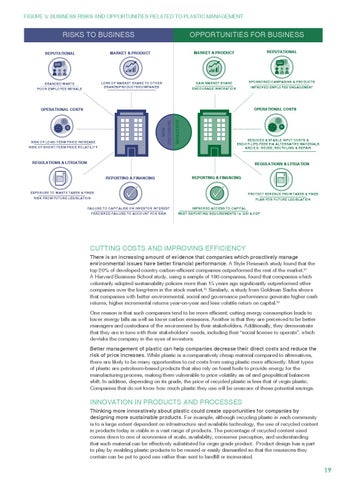
the business case for managing plastic In spite of the impacts described in the previous section, compared to climate change, awareness of the environmental impacts of plastic is low among most companies. Yet the case for addressing emerging risks and seizing opportunities is strong and growing. Many of the challenges of plastic could be addressed by improving management of the material across its lifecycle. This does not mean companies should stop using plastic. But there is a case to use less plastic through improving efficiency. There is also a case for making much better use of waste plastic through reuse and recycling. Major risks and opportunities can be grouped in five categories: operational costs, innovation in products and processes, regulation and litigation, reputational, and investor interest. These risks and opportunities are dynamic and may vary depending on the region, industry sector and over time. As science on the impact of plastic develops further, these risks may acquire a higher profile among external stakeholders. Where there are risks, there are opportunities which businesses can turn to their advantage. Measurement and disclosure underpin any effective management strategy to mitigate risks and realise opportunities associated with environmental impacts. Measurement is vital so that companies have accurate information on the performance of their business. And disclosure builds trust with stakeholders within the business, supply-chain, government, financial markets and conservation. Plastic is no exception. Just as for carbon, greenhouse gases, water and forestry, businesses can improve their own sustainability by measuring, managing and disclosing their “plastic footprint”.
18
FIGURE 5: BUSINESS RISKS AND OPPORTUNITIES RELATED TO PLASTIC MANAGEMENT
MEASURING, REPORTING AND MANAGING PLASTIC
RISKS TO BUSINESS
OPPORTUNITIES FOR BUSINESS
MARKET & PRODUCT
REPUTATIONAL
LOSS OF MARKET SHARE TO OTHER BRANDS/PRODUCTS/COMPANIES
BRANDED WASTE POOR EMPLOYEE MORALE
MARKET & PRODUCT
REPUTATIONAL
GAIN MARKET SHARE
SPONSORED CAMPAIGNS & PRODUCTS IMPROVED EMPLOYEE ENGAGEMENT
ENCOURAGE INNOVATION
OPERATIONAL COSTS
RISK OF LONG-TERM PRICE INCREASE RISK OF SHORT-TERM PRICE VOLATILITY
DISCLOSURE
NON DISCLOSURE
OPERATIONAL COSTS
REDUCED & STABLE INPUT COSTS & END-OF-LIFE-FEES VIA ALTERNATIVE MATERIALS AND E.G. REUSE, RECYCLING & REPAIR
REGULATIONS & LITIGATION
REGULATIONS & LITIGATION
REPORTING & FINANCING
REPORTING & FINANCING
EXPOSURE TO WASTE TAXES & FINES
PROTECT REVENUE FROM TAXES & FINES
RISK FROM FUTURE LEGISLATION
PLAN FOR FUTURE LEGISLATION
FAILURE TO CAPITALISE ON INVESTOR INTEREST
IMPROVED ACCESS TO CAPITAL
PERCIEVED FAILURE TO ACCOUNT FOR RISK
MEET REPORTING REQUIREMENTS i.e. GRI & CDP
CUTTING COSTS AND IMPROVING EFFICIENCY There is an increasing amount of evidence that companies which proactively manage environmental issues have better financial performance. A Style Research study found that the top 20% of developed country carbon-efficient companies outperformed the rest of the market.31 A Harvard Business School study, using a sample of 180 companies, found that companies which voluntarily adopted sustainability policies more than 15 years ago significantly outperformed other companies over the long-term in the stock market.32 Similarly, a study from Goldman Sachs shows that companies with better environmental, social and governance performance generate higher cash returns, higher incremental returns year-on-year and less volatile return on capital.33 One reason is that such companies tend to be more efficient; cutting energy consumption leads to lower energy bills as well as lower carbon emissions. Another is that they are perceived to be better managers and custodians of the environment by their stakeholders. Additionally, they demonstrate that they are in tune with their stakeholders’ needs, including their “social license to operate”, which de-risks the company in the eyes of investors. Better management of plastic can help companies decrease their direct costs and reduce the risk of price increases. While plastic is a comparatively cheap material compared to alternatives, there are likely to be many opportunities to cut costs from using plastic more efficiently. Most types of plastic are petroleum-based products that also rely on fossil fuels to provide energy for the manufacturing process, making them vulnerable to price volatility as oil and geopolitical balances shift. In addition, depending on its grade, the price of recycled plastic is less that of virgin plastic. Companies that do not know how much plastic they use will be unaware of these potential savings.
INNOVATION IN PRODUCTS AND PROCESSES Thinking more innovatively about plastic could create opportunities for companies by designing more sustainable products. For example, although recycling plastic in each community is to a large extent dependent on infrastructure and available technology, the use of recycled content in products today is viable in a vast range of products. The percentage of recycled content used comes down to one of economies of scale, availability, consumer perception, and understanding that such material can be effectively substituted for virgin grade product. Product design has a part to play by enabling plastic products to be reused or easily dismantled so that the resources they contain can be put to good use rather than sent to landfill or incinerated.
19
Innovative production processes could also be considered, reducing costs and improving supplies of raw materials. Concerns around the quality and quantity of recycled plastic have led companies to implement in-house recycling systems. For example, Interface’s ReEntry process allows the company to recycle a higher quantity of post-consumer material while achieving lower contamination rates. The process constitutes a real innovation in the sector, with the lowest embodied energy than any other recycling system in the carpet sector.34 Companies that act first are usually the ones to profit most. Cosmetics company Lush benefits from its campaign asking people to bring back items to recycle by increasing customer foot fall in its stores. Replenish multi-surface cleaner, which is sold in concentrated form for dilution at home, results in 90% less plastic, oil and CO2 emissions than a pre-mixed cleaner. The product has achieved double-digit market share and international reward recognition not simply because of its environmental credentials but because of its innovative design and ability to deliver a quality product at a lower cost.35
REGULATION As concern about the impacts of plastic on the environment and human health grows, so does pressure on policymakers to introduce tougher regulations. Companies that produce or consume large quantities of plastic, but which fail to prepare for tighter controls, are exposed to risks such as lower sales due to restrictions or bans on products and packaging, or chemicals used in their manufacture. For example, there have been concerns over the use of bisphenol A (BPA) used widely in hard, clear plastic commonly found in food and drink containers. Canada was the first country to declare BPA toxic in 2009. From March 2011, the European Commission banned the use of BPA in plastic feeding bottles, followed by the US in 2012.36 There is an increasing range of global and national legislation covering the environmental impacts of waste including plastic. An important focus is preventing damage done by marine litter in the world’s oceans. Historically, marine pollution has been addressed by regulating disposal of waste at sea, for example, with the 1972 Convention on the Prevention of Marine Pollution by Dumping of Waste and other Matter (with its London Protocol) and the 1973 International Convention for the Prevention of Pollution from Ships (Annex V of MARPOL).37 However, these initiatives do not address the impact of plastic litter which enter the sea from land and is said to account for over 80% of plastic waste in the marine environment.5 The Global Programme of Action for the Protection of the Marine Environment from Land-based Activities (GPA) has had marine litter as one of its priority source categories since 1995. The GPA is implemented at the regional level by the Regional Seas Conventions and Action Plans, several of which have Protocols on Land-based sources/activities of pollution.38 More stringent legislation is likely to be introduced at national levels to control land-based sources of plastic pollution. This could affect not only users of plastic but the entire plastic supply chain. In March 2011 the Fifth International Marine Debris Conference (5IMDC), organised by the UNEP and the National Oceanic and Atmospheric Administration, contributed to the development and subsequent finalisation of a global framework strategy to prevent and manage marine litter. The ‘Honolulu Strategy’ identified several areas of focus, including helping develop, strengthen and enact legislation, improving regulatory frameworks, and promoting best practice among industry. Emphasis was also put on market-based mechanisms.39 In 2012, representatives of 64 Governments and the European Commission emphasized the importance of the Honolulu Strategy in the Manila Declaration on Furthering the Implementation of the Global Programme of Action for the Protection of the Marine Environment from Land-based Activities (GPA). They also recommended the establishment of a Global Partnership on Marine Litter (GPML) which was launched in June 2012. UNEP GPA provides the Secretariat. UNEP’s marine litter related activities also feed into the workplan of the UNEP-led Global Partnership on Waste Management. This ensures that marine litter issues, goals and strategies are tied to global efforts to reduce and manage waste. The GPML seeks to protect human health and the global environment by the reduction and management of marine litter as its main goal. In March 2013, the European Commission published a green paper seeking views on how to tackle the problem of plastic waste as part of a review of waste legislation to be completed in 2014.16 Despite a number of European Union (EU) laws directly pertaining to packaging where plastic use is most prominent, there appears to be an ongoing realisation that plastic is underregulated. The commission stated its intention to introduce more legislation in the near future. In a resolution agreed by Parliament in January 2014, members of the European Parliament stressed that plastic waste is damaging the environment due both to weak enforcement of EU legislation on waste and the lack of specific EU laws on plastic waste. Among their aims is to ban the most hazardous plastic and certain types of plastic bags by 2020, and to introduce specific and binding targets for recycling, the economic potential of which is said to be largely unexploited.40
20
Plastic bags are one of the most obvious sources of pollution and are the subject of national legislation in many countries. In November 2013, the EU Commission published proposals to amend the EU packaging waste directive by requiring member states to reduce consumption of lightweight plastic bags using measures such as taxes, national reduction targets or bans. A number of EU countries such as Italy, as well as China and South Africa, have already banned some types of plastic bags. In 2014 the European Parliament called for a ban on single use plastic bags by 2020.40 Ireland has a plastic bag tax, with Belgium, England, Germany, Spain and Norway following suit. In the United States, more than 17 states have passed ordinances banning plastic bags in several hundred municipalities.41 Similar activity is likely regarding microplastics. These are small plastic particles, either directly used in products such as cosmetics, or broken down from larger plastic pieces which can be swallowed by marine wildlife causing harm and potentially transferring toxins into our own food chain. Mounting concern over this issue is likely to result in more stringent regulations already proposed in New York and passed in California.42,43,44
REPUTATION The risk of damage to corporate and brand reputation is one of the main reasons why companies should take early action on managing their plastic footprint. Brand valuation studies have found than in certain cases, brand accounts for over 70% of the total value of the company.45 Environmental campaign groups often call for consumer boycotts of well-known brands to raise awareness about an issue, such as Greenpeace’s campaign against Coca-Cola’s opposition of container deposit taxes aimed at stimulating recycling in Australia. As part of the campaign, the organisation emphasised the wildlife damage caused by plastic bottles though organised protests outside the company’s headquarters, boycotts of the product, and negative social media campaigns.46 In the past, campaigns portraying a corporation’s negative impact on biodiversity have been known to threaten profitability. A recent example is the high profile 2010 Greenpeace campaign against Nestlé’s palm oil sourcing practices using flagship brand Kit Kat as target, which resulted in Nestle changing its policy and severing contracts with its major palm oil producer Sinar Mas. Greenpeace then campaigned against HSBC who eventually dropped their investment in Sinar Mas.47,48 In the age of social media, images of plastic litter washed up on a beach or linked to the death of whales and dolphins can spread across the world in seconds. Although in many cases brand origin is unidentifiable, the potential for negative publicity on plastic in general could affect companies. Other times, brand origin is identifiable. #Litterati social media photo campaign encourages users to photograph litter before disposing of it and share the image on Instagram. The resulting “digital landfill” is expected to be used to work with communities and large corporations to prevent litter.49 Another example includes the Plastic Soup Foundation’s “Beat the Bead” application which allows the user to know whether there are microplastic within the product they are about to buy.50 By using social media and other communication tools, companies can demonstrate they are part of the solution to these problems. For example, in 2012 a group of California elementary school students gathered more than 90,000 signatures on a petition asking marker pen company Crayola to “make its mark” on recycling its used products. Crayola initially responded that it had no way to do so. The campaign inspired a competitor, Dixon Ticonderoga, to launch its own program for recycling used marker pens. The publicity and potential loss of business led to Crayola to announce its own recycling programme for used plastic markers.51,52
INVESTOR INTEREST There is growing interest among investors in how companies manage environmental risks and opportunities. For instance, the UN’s Principles for Responsible Investment (PRI) has some 1,200 signatories among asset owners and investment managers which collectively control almost $35 trillion.53 Its members are committed to incorporating consideration of environmental, social and governance issues into their investment decisions. The investor-led CDP (formerly the Carbon Disclosure Project) has had enormous success encouraging companies around the world to disclose their carbon emissions and plans to reduce them. Its climate change program is backed by 722 investors with $87tr in assets under management. In 2013, 81% of the world’s 500 largest stock-exchange listed companies reported to the CDP. The CDP has widened its efforts to encourage disclosure on other issues such as water, forests and supply chain impacts.54 A survey commissioned by the Plastic Disclosure Project found strong interest among investors in encouraging companies to disclose their plastic consumption. Almost 90% of those surveyed said they would support the Plastic Disclosure Project including respondents from
21
HSBC, BNP Paribas, Credit Suisse, Bank of America, JPMorgan and First State Investments and others. Together they control assets worth some $5.8tr.55 Companies can demonstrate leadership and engage with investors by proactively disclosing on their plastic use before they are asked to do so.
the concept of natural capital as a tool to assess risks and opportunities Plastic use has impacts associated with it, depending on how well it is understood and managed. These impacts can potentially translate into risks, or opportunities, to businesses. In order to understand the potential magnitude of these risks and opportunities, this report uses a technique called “natural capital valuation”. This technique translates physical impacts into a monetary figure, which expresses the potential value that companies would have to internalise if they were held accountable for their impacts. As such, natural capital valuation helps assess the magnitude of the financial risks and opportunities faced by companies. Natural capital is the term used to describe the renewable and non-renewable natural resources that companies rely on to produce goods and deliver services. Businesses depend on natural assets that are non-renewable (e.g. fossil fuels and minerals), as well as renewable ecosystem goods and services, such as freshwater, timber and a stable climate. Business decisions around site operations, supply chains and products drive the use of natural resources. The capacity for renewable natural resources to regenerate over time affects the availability of stocks. Their ability to absorb unwanted by-products of production such as pollution and waste is limited. But the value of access to land, clean air and plants that provide critical inputs such as food, energy and fibre is usually excluded from financial accounts. Business activities such as extraction and production can damage natural capital and cause economic costs that are largely external to market prices. Increasing environmental degradation and resource depletion combined with growing demand are highlighting the need to value natural capital. Companies need to improve the way they manage annual flows of natural capital to reduce economy-wide costs. To do this, they need to understand sources of value and risk. Measuring physical flows of resource use, pollution and waste provides a starting point to evaluate which ecosystem goods and services businesses depend on. Natural capital valuations convert physical impacts measured in terms of cubic metres of water used or tonnes of plastic entering the marine environment into a monetary value, expressing the damage caused to the environment and society. Valuation is essential to understand the true value of environmental assets, according to an authoritative study by The Economics of Ecosystem and Biodiversity (TEEB) initiative. It says that despite uncertainties, economic valuations of ecosystem services can improve decisions around risk management.56 Trucost research for the PRI and UNEP Finance Initiative (UNEP FI) valued resource use, pollution and waste linked to the 3,000 largest publicly-listed companies at over $2tr in 2008.57 In addition, several companies have already conducted and publicly disclosed environmental profit and loss accounts (EP&L) such as Puma, Becker Underwood and Novo Nordisk. Applying economic valuations to these quantities is one approach that is gaining ground to strengthen decision-making and risk management. Initiatives such as TEEB and World Business Council for Sustainable Development (WBCSD) Guide to Corporate Ecosystems Valuation encourage businesses to evaluate natural capital so that decisions consider related financial risks and benefits. To make this possible, companies need to measure and report relevant information. In June 2012, 196 governments at the UN Conference on Sustainable Development committed to taking steps to encourage companies to consider integrating sustainability information into reporting cycles. Fifty-seven countries and the European Commission, along with 86 companies, backed an initiative to factor the value of natural assets such as clean air and water, forests and other ecosystems into business decision-making and national accounting.58 This approach to environmental economics and accounting underpins the methodologies used by Trucost in this report. The natural capital valuation of plastic impacts allows companies to: •
Understand the potential materiality of environmental impacts.
•
Prioritise environmental issues to address in operations, supply chains and investments.
•
Identify opportunities to reduce risk and optimise capital allocations and expenditure.
•
Develop strategies to reduce the environmental impacts of plastic use.
•
Build the case for monetary incentives to reduce environmental impacts.
In order to quantify the natural capital cost of these impacts, the methodology followed six steps: sector selection, plastic use quantification, scope and boundary selection, impact quantification, and natural capital valuation and application (see figure 6). Appendices 3 and 4 explains the methodology in more detail.
22
APPENDIX 4: NATURAL CAPITAL VALUATION This appendix explains in detail how natural capital valuations were derived for greenhouse gases, air pollutants, water use, land and water pollutants, managed waste and littered waste. For an explanation of how they were integrated in the analysis, refer to Appendix 3.
GREENHOUSE GAS EMISSIONS A greenhouse gas is a gas in the atmosphere that absorbs and emits radiation within the thermal infrared range. The primary greenhouse gases are water vapour, carbon dioxide, methane, nitrous oxide and ozone. Greenhouse gas emissions can be valued using a marginal abatement cost, a market price or the social cost of carbon. This section defines these three methods and justifies why the social cost of carbon is the preferred valuation method. It then describes the valuation study used to derive the natural capital valuation applied in this study. STEP 1: SELECTING AN APPROACH FOR VALUing GREENHOUSE GAS EMISSIONS Three approaches for valuing the marginal or incremental cost of an additional tonne of GHG emitted are summarised below. Marginal abatement cost (MAC) Definition: Valuing carbon using the known costs to reduce carbon to achieve an emissions reduction target, for example through energy efficiency improvements, renewable energy, materials substitution and/or carbon capture and storage technology. Advantages: Based on the known actual costs of existing reduction efforts. Disadvantages: Costs of reduction will fluctuate over time, by sector and by geography. Different reduction targets will translate into different MACs for each country. Estimates of the costs or benefits of increasing energy efficiency or switching to renewable energy are influenced by fossil fuel prices, carbon prices and other policy measures. The policies and technologies used to support carbon abatement will therefore influence pricing. Market price Definition: The value of traded carbon emissions rights under policies which constrain the supply of emissions permits, credits or allowances. The market price should be equal to the MAC for a given target, if the carbon market covers all emissions sources and is competitive. In the absence of a comprehensive international emissions trading scheme, a cap consistent with the optimal stabilization goal would result in a market price of carbon equal to both the MAC and social cost of carbon. Advantage: Market prices are easily accessible. Disadvantages: Market-based mechanisms have been slow and fragmented so companies are unlikely to pay market prices for emissions across global operations. Traded market prices do not reflect non-traded carbon costs, nor the impact of other market-based mechanisms such as carbon/fuel taxes, subsidies for removal of fossil fuels, or support for low carbon technologies (i.e. feed-in-tariffs for renewable energy supplies). Current market prices are too low to induce the level of emissions reductions required and are not representative of future abatement costs of the expected costs of damages from climate change impacts. Social cost of carbon (SCC) Definition: The global cost of damages resulting from GHG emission-induced climate change. The value is based on the present value of each metric tonne of carbon dioxide equivalent (CO2e) emitted now, taking into account the full global cost of the damage that it imposes during its time in the atmosphere. Advantages: The SCC signals what society should be willing to pay now to avoid the future damage caused by carbon emissions and therefore best reflects the total damage caused by emitting one tonne of CO2e. In theory, climate policy would set emissions reduction targets that result in a MAC equal to the SCC and, in perfect markets the price of carbon should equal the SCC. SCC is therefore the most complete measure of the damage generated by the emission of GHGs and is the method used by Trucost. Disadvantages: SCC valuations are highly contingent on assumptions, in particular the discount rate chosen, emission scenarios and equity weighting. Please see the next section for a discussion of each. Trucost uses the Social Cost of Carbon method as it best reflects the total damage by the emission of one tonne of CO2e. In theory, optimal climate policies would set emissions reduction targets that result in a MAC equal to the SCC. Further, in perfect markets, the price of carbon should be equal to its damage cost (i.e. to the SCC). Therefore, the SCC is the most complete measure of the damage generated by GHG emissions.
91
STEP 2: CALCULATING THE SOCIAL COST OF CARBON Over 300 studies attempt to put a price on carbon, valuing the impacts of climate change on agriculture, forestry, water resources, coastal zones, energy consumption, air quality, tropical and extratropical storms, and human health. Estimates across studies vary from below-zero to four-figure estimates, mainly due to four factors: Emissions scenarios: In order to derive the social cost of carbon, assumptions need to be made on future emissions, the extent and pattern of warming, and other possible impacts of climate change, so as to translate climate change to economic consequences. Tol identified three methodological approaches undertaken by the literature – expert review, enumerative method, and statistical method – and conducted a meta-analysis of the results.176 Studies are in broad agreements on the fact that the negative effects of climate change outweigh the short-run benefits of inaction. Discount rate: The discount rate used to calculate the present value of future economic damages resulting from carbon emitted today can be the most significant source of variation in estimates of the social cost of carbon. Higher discount rates result in lower present day values for the future damage costs of climate change. Variations in discount rates can be due to differences in assumptions about factors such as the rate of pure time preference, the growth rate of per capita consumption and the elasticity of marginal utility of consumption. Equity weighting: A global SCC can take into account variations in the timings and locations at which the costs of climate change impacts will be internalized, which may differ from the locations where the GHGs are emitted. Some studies including Stern and Tol take account of equity weightings – corrected for differences in the valuations of impacts in poor countries.176,177 Uncertainties: Variations in valuations are influenced by uncertainties surrounding estimates of climate change damages and related costs. However climate change studies since 1995 tend to take account of net gains as well as losses due to climate change.The mean estimate of the social cost of carbon, as well as the standard deviation, have declined since 2001, suggesting decreasing uncertainty in the understanding of climate change impacts. Further, GDP loss estimates in relation to climate change have declined over time, as later studies focus on the positive and negative effects of climate change and take adaptation into account. A social cost of 113 US$ 2012 per metric tonne of CO2e was used to value GHG emissions, which is the value identified in the UK Government’s Stern report as the central, business-as-usual scenario value, adjusted for inflation to 2012 prices using a global weighted average consumer price index (CPI).177
AIR POLLUTANTS EMISSIONS The main air pollutants include sulphur dioxide (SO2), nitrogen oxides (NOx), particulate matter (PM), ammonia (NH3), carbon monoxide (CO) and volatile organic compounds (VOCs). Each pollutant impacts human health and/or crop and forest yields in a unique way. The economic damage caused per unit of pollutant depends on the specific location, and is driven by population and crop and forest density. Each pollutant is associated with different but overlapping types of external costs. Some effects are caused directly by the primary pollutant emitted (e.g. health impacts of particulates) and some are caused by secondary pollutants formed in the atmosphere from pollutants that acts as precursors (e.g. sulphur dioxide forming sulphuric acid as well as sulphate compounds which contribute to smog). As each pollutant has a unique set of effects, each pollutant is valued using an individual methodology (although there is overlap between methodologies).
92
FIGURE 24: AIR POLLUTION VALUATION
VOCs
CO
NOx
NH3
HEALTH
PM10
CROPS
IMPACTS
VALUATION
TIMBER
SO2
CORROSION
WATER ACIDIFICATION
COSTS PER TON
$
Studies of the costs of damages from air pollution use the Impact Pathway Approach (IPA) to identify burdens (e.g. emissions), assess their impacts and value them in monetary terms.178 In this approach, emissions are translated into physical impacts using dose–response functions (DRFs) which use peer-reviewed scientific data to measure the relationship between a concentration of a pollutant (the dose) and its impact on human health, building materials, crops, etc (the receptor). A financial value is then assigned to each impact.
FIGURE 25: IMPACT PATHWAY APPROACH
EMISSION Specification of relevant pollutants
PHYSICAL IMPACTS
DISPERSION Increase in concentration at receptor sites
Damage to health, infrastructure, crops, etc. established by the DRFs
MONETARY VALUATION Cost of reversing the physical impacts
STEP 1: IDENTIFYING THE MAIN IMPACTS FOR EACH AIR POLLUTANT Trucost identified which environmental impacts to consider for each air pollutant using the Impact Pathway Approach. Where impacts are excluded, such as the impact of particulate matter on crops and forestry, it was due to immateriality relative other effects. The table below summarizes which impacts are included for each air pollutant.
TABLE 14: ENVIRONMENTAL IMPACTS CONSIDERED Air Pollutant
Environmental Impacts
Particulate Matter (PM10)
Health
Ammonia (NH3)
Health and forestry
Nitrous Oxides (NOx)
Health, crops and forestry
Volatile Organic Compounds (VOCs)
Health, crops and forestry
Sulphur dioxide (SO2)
Health, freshwater, forestry and materials
93
STEP 2: BUILDING COUNTRY SPECIFIC VALUATIONS Air pollutant impacts on health The health costs developed by Trucost include the cost mortality; chronic bronchitis; hospital admission; asthma attacks; restricted activity days; respiratory symptom days; congestive heart failure; chronic cough; cough and wheeze; and bronchodilator use. These costs were calculated as follow: Calculation of number of end points Trucost compiled data on the number of end points (number of health impacts) generated by the emission of one tonne of each air pollutant. In the context of health impacts, the number of end points is driven by population density, which is country specific. Development of global average health costs Trucost conducted a literature review to identify country specific studies calculating the willingness to pay to avoid the different health impacts listed above. Using these studies, Trucost built a country specific model and calculated a global average cost weighted by population for each health impact. A global average was chosen to avoid the ethical considerations of applying different values to health and life across countries. Application of global average costs Natural capital valuation coefficients for each air pollutant are obtained by multiplying the number of end points by the global health costs. Environmental impacts of other air pollutants impacts Natural capital valuations of air pollutant impacts on crops, timber, water and building materials are country specific and were calculated as follow: Literature compilation Trucost compiled data from IPA studies on the cost of air pollutants’ damages on crops, timber, water and building materials. Adjustment of the cost based on receptor densities factors Trucost adjusted the country-specific data obtained from the literature based on receptor densities such as percentage of crop or forest cover in a country. Impacts on building materials use maintenance costs which have been adjusted using purchasing power parity. Impacts on water acidification, included in the valuation of SO2 is a global average.
WATER CONSUMPTION Pressures are growing on water resources, with risks from climate change impacts increasing the unpredictability and security of supplies. Information on the benefits of water and the costs of damages from depleting resources are usually not recognised in market prices or in risk analysis. According to the Total Economic Value (TEV) framework, the value of water can be broken down into “use” values and “non-use” values (Figure 26). Use values can be further broken down into direct use, indirect use, and option values. Within direct use, the values can apply to “consumptive” or “non-consumptive” uses.179
FIGURE 26: COMPONENTS OF THE TOTAL ECONOMIC VALUE OF WATER
TOTAL ECONOMIC VALUE
USE VALUE
NON-USE VALUE
DIRECT
INDIRECT
OPTION
ALTRUISTIC
EXISTENCE
BEQUEST
CONSUMPTIVE
ECOSYSTEM FUNCTIONS
FUTURE DIRECT AND INDIRECT USE VALUES
KNOWLEDGE OF USE OF THE RESOURCE BY OTHERS
KNOWLEDGE OF EXISTENCE OF THE RESOURCE
KNOWLEDGE OF PASSING THE RESOURCE TO OTHER GENERATIONS
NON-CONSUMPTIVE
94
However, in this report, only values shaded in green have been included in Trucost’s water valuation model. The valuation of water is based on the opportunity cost of water or the value generated by water when it is not abstracted. Consumptive uses (for agriculture or industry) of water have therefore been excluded. Option and non-use values have also been excluded given the difficulty inherent in their valuation. Values for direct non-consumptive uses (including hydro-electric power, recreation, navigation and cultural activities) and indirect uses (including ecosystem services such as flood control, regulation of water flows and supplies, carbon sequestration, nutrient retention and climate regulation) were identified in academic literature in different geographical locations.180,181 A function of water value (in $ per m3) relative to water scarcity (% of internal renewable water resources abstracted) was developed based on the values estimated in the academic literature.179,180,181 This function was then used to estimate the opportunity cost of water in any geographic location where water scarcity is known, by adjusting the function for purchasing power parity at that location.
LAND AND WATER POLLUTANTS STEP 1: QUANTIFICATION OF IMPACTS Life cycle analysis characterization models, such as Recipe, calculate the human, terrestrial, freshwater and marine toxicity of thousands of substances when released in different media. Trucost used a global adaption of Recipe by EUSES-LCA to model land and water pollutants. Human toxicity impacts are expressed in Disability Adjusted Life Years (DALYs) and terrestrial, freshwater and marine toxicity are expressed in Ecosystem Damage Potential (EDP).182,183,184,185,186 While it is hard to state an order of magnitude, toxicity data are among the most uncertain in lifecycle analysis characterization models. Trucost based its analysis on the best available data, but recognizes this weakness in the underlying data. STEP 2: VALUATION OF ENVIRONMENTAL TOXICITY The NEEDS Project approach developed a formula to estimate the monetary cost per kilogram of toxic substances deposited in natural ecosystems.187 Within the NEEDS project, a regression analysis between willingness-to-pay and several variables were performed. The EDP valuation is known to have a positive correlation with population – as more people live close to an area with high biodiversity there will be more people that value biodiversity. The EPD value is known to have a negative correlation with the ecosystem size – if an ecosystem covers a larger area, the value per unit area will be less. Similarly, as biodiversity change increases, the value per unit of biodiversity diminishes. Using these variables, the formula below calculates the value of EDP in different regions.
The value of ecosystem damage is a function of the change in biodiversity due to the emission of the toxic substance and the willingness to pay for biodiversity (adjusted for purchasing power parity). STEP 3: VALUATION OF human TOXICITY In order to put a value on the years of life lost, Trucost used the NEEDS project approach. The results of this approach are based on a contingent valuation questionnaire applied in nine European countries: France, Spain, UK, Denmark, Germany, Switzerland, Czech Republic, Hungary and Poland. The value was adapted to other countries based on country-specific income levels. To avoid ethical criticisms on the value of life and disease incidence in different countries, Trucost applied the global median value to value DALYs in different countries.
MANAGED PLASTIC As explained in appendix 3, plastic can be collected and treated through different routes. Treatment routes considered here are landfill, incineration with and without energy recovery and recycling. One should note that even if impacts are generated by the treatment of waste, treatment is a necessity and its impact is small compared to those of littered plastic. In order to apply natural capital valuations on these treatment routes, Trucost calculated the quantity of greenhouse gas and other air, land and water pollutants emitted, and water used in these processes as per Appendix 3 and Tables 9 and 10, and applied the relevant valuations as described above.
LITTERED PLASTIC When littered in an unregulated manner, Trucost assumed two possible pathways depending on the sector under consideration, namely reaching or not reaching marine environments. The following table summarises the pathway of each product. It is understood that a significant amount will be transported over time by the winds, streams, waterways, and eventually partially end up in the ocean. While there are estimates of the total volume of plastic from land reaching the ocean per year, there
95
is insufficient data to model this accurately. For the purpose of this report, conservative assumptions have been taken so as to not overstate the problem. For example, the report assumes, that in the fullness of time, all tobacco filters and packaging materials that were littered eventually reach the ocean due to their lightweight, while heavier plastic such as car parts are assumed to remain on terrestrial environments (see table 15).
TABLE 15: PERCENTAGE OF LITTERED PRODUCT AND PACKAGING REACHING THE OCEAN sectors included
% of littered packaging reaching the ocean
% of littered product reaching the ocean
Automobiles
0%
Soft drinks and ice
NR
Clothing and accessories
50%
Consumer electronics
0%
Durable household goods
0%
Food
NR
Personal products
NA
Athletic goods
50% 100%
Toys
50%
Tobacco
100%
Furniture
0%
Non-durable household goods
50%
Footwear
50%
Medical and pharmaceutical products
NR
Retail
NR
Restaurants and bars
NR
No consensus and very little data exist on the percentage of plastic reaching the marine environment, let alone on different types of plastic/products made of plastic in different countries. Trucost thus had to make assumptions and use best-guess estimates. The valuation for waste ending up in the ocean includes the disamenity caused to society, and the ocean valuation (explained in greater detail in the following part). The valuation for waste not reaching the ocean include the air, land, and water emissions generated in the open-dump and the leachate of additives, as well as the disamenity caused to society. Other ecological, economic and society impacts of litter on freshwater and terrestrial ecosystems are not included for lack of data.
DISAMENITY Disamenity does not have one agreed upon definition in the literature, however, it generally refers to the localised impacts of landfill activity that generate negative reactions from those located in the immediate vicinity.188 The European Commission specifies disamenity impact as referring to the ‘nuisance’ caused locally as a result of the presence of landfill – noise, dust, litter, odour, the presence of vermin, visual intrusion and enhanced perceptions of risk. The magnitude of the effects will depend on distance from the site, type of waste (non-hazardous or hazardous), status of the site (existing, new, or proposed), management practices, topography and prevailing wind directions. Only a limited number of valuation studies of disamenity have been undertaken for the waste sector.189,190 A number of studies were conducted in the US in the 1980s and early 1990s (especially for landfills). Only two European studies have been identified. Disamenity impacts were excluded completely from the Exiopol study in 2009 because it said that disamenity impacts were site specific. The study only indicates an order of magnitude based on a study from 2006 by Walton (1 Euro per tonne).191 Hedonic pricing studies require information on house prices near to a landfill site and specific information on sales of houses in this radius. Conducting a primary hedonic pricing study is not appropriate for this study as the location of the landfill sites is unknown and the number of sites is very large, making this technique beyond the scope of this valuation.
96
It is likely that disamenity effects would be higher in countries where waste is managed poorly (as the disamenity effects such as noise, nuisance, vermin, etc are likely to be higher). Most studies have been carried out in countries with high quality waste management. A recent study is the only study found from a country with a lower collection rate (South Africa, where approximately 60% of waste is formally collected).192 When disamenity (adjusted for PPP to adjust for differences in house prices) was plotted against formal waste collection rates, it indicated a negative relationship between percentage of waste formally collected and disamenity cost (see Figure 27 below).
FIGURE 27: DISAMENITY COSTS (PPP ADJUSTED) VERSUS PERCENTAGE OF WASTE COLLECTED
Due to the large number of regions included in this analysis, and the fact that the specific locations are unknown, a disamenity scale was derived from the figures provided in the literature, plotted against formal waste collection rates in each region. The disamenity cost for a tonne of waste in a particular region is then estimated based on the collection rate in the region in question. The resulting figure for each region is then adjusted for PPP to take account of differences in house prices. Adjusting for PPP is a widely used technique, especially for transfers between countries or regions189
ADDITIVES Additives are chemicals added to plastic during the manufacturing process to enhance its properties, such as heat resistance and flexibility. Recently, there has been growing concerns on the leaching of these substances and their impacts on human health and the environment. The impacts additives leachate follows the following framework.
FIGURE 28: quantification of the PLASTIC CHEMICAL IMPACTS FRAMEWORK
QUANTIFICATION OF TOXIC CONSTITUENTS
LEACHING
QUANTIFICATION OF TOXIC IMPACTS
VALUATION OF TOXIC IMPACTS
97
Trucost calculated the quantity of additives per type of plastic based on an Organisation for Economic Co-operation and Development report focusing on plastic additives.175
LEACHING Data regarding the leaching of additives from plastic into its environment is nascent and the results are highly uncertain. Furthermore, few data points exist on the leaching rate of plastics’ constituents into a marine environment. Hence, Trucost used the leaching rate calculated by Organisation for Economic Co-operation and Development for plastics “outdoor, leaching to environment”.175 The annual leaching rate is 0.16% per year. At this rate, it would take 625 years for 100% of the additives to be released from the plastics. Trucost discounted the total natural capital cost using this timeframe, thereby producing what is believed to be a conservative estimate of the impact. Future studies may reveal more accurate leaching rates, including in the marine environment, which would likely revise upwards the impacts calculated in this report.
VALUATION OF TOXIC IMPACTS Depending on whether plastic is likely to reach marine environments or not (see table 5), Trucost either quantified marine, land or freshwater toxicity impacts. Lifecycle analysis characterization models calculate the human, terrestrial, freshwater and marine toxicity of thousands of substances when released in different media. Trucost used a global adaption of Recipe by EUSES-LCA to model the marine and human impacts additives.182,183,184,185,186 Human toxicity impacts are expressed in Disability Adjusted Life Years (DALYs) and terrestrial, freshwater and marine toxicity are expressed in Ecosystem Damage Potential (EDP). These toxicity impacts were then valued using same methodology as for land and water pollutants (described earlier).
MARINE LITTER Important quantities of plastic reach the ocean every year. Media’s attention has been particularly focused on entanglements from fishing nets or ingestion of plastic bags. More and more reports and scientific literature assess these impacts which are diverse, economic as well as ecological, and come from plastics as well as microplastics. The objective of this methodology is to obtain a value in monetary terms per kilo of plastics reaching the ocean.
STEP 1: IDENTIFYING THE IMPACTS OF PLASTICS IN THE OCEAN The impacts of plastics into the ocean are complex for various reasons: •
Plastics degrade very slowly over time, and this degradation depends on the type, shape and location of the plastics. As a consequence, plastics accumulate and it is difficult to quantify the amount of plastic which is today in the ocean.
•
Macroplastics and microplastics have some overlapping and some distinct impacts.
•
Water flows makes it challenging to track plastic geographically. For this reason, Trucost built a global average valuation of plastic rather than a location specific one.
Due to the complexity of plastics impacts, Trucost built a valuation model based on a simplified interpretation of these impacts. The figure below presents these impacts. Light arrows represent potential impacts which have been excluded from the valuation. For example, the valuation excludes primary microplastics impact for lack of adequate data, even though this area of research has been receiving more attention recently.
Where do microplastics come from? There are primary and secondary forms of microplastics. Primary forms of microplastics are found in personal care products such as toothpaste and skin care products, synthetic textiles such as blankets, fleeces or shirts, and industrial sources such as plastic resin pellets used in industrial feedstocks. These primary microplastics are problematic as they are not filtered during sewage treatment and can be released directly into the ocean or other water bodies (e.g. personal care products and textiles) or lost through poor management operations and during transport (e.g. pre-production plastic resin pellets). Secondary microplastics are formed when plastic items fragment and disintegrate; the rate at which fragmentation occurs is highly dependent on the environmental setting.193 In the marine environment larger plastic items can break into secondary microplastics through combined effects of wave action and photo-degradation from sunlight. The key to stemming flows of plastic debris to the ocean is to prevent this debris entering the environment. Larger items are much easier to identify and potentially to control than small ones.
98
FIGURE 29: IMPACTS OF MACRO AND MICRO PLASTIC
FISHERIES AND AQUACULTURE
MARINE TOURISM ECONOMIC IMPACTS SHIPPING
MACROPLASTICS
PLASTICS IN THE OCEAN
SECONDARY MICROPLASTICS
CLEAN UP COST
ENTANGLEMENT
INGESTION: DIGESTIVE SYSTEM IMPACTS
PRIMARY MICROPLASTICS
PHYSICAL IMPACTS
TRANSPORTATION OF INVASIVE SPECIES
PBTs SUBSTANCES DESORPTION
INCLUDED IN THE VALUATION MODEL MATERIAL BUT NOT INCLUDED IN THE VALUATION MODEL
ADDITIVES LEACHATE
CHEMICAL IMPACTS
MONOMER LEACHATE
ECOLOGICAL IMPACTS Plastics in the ocean generate economic impacts which are often paid by those affected rather than plastic producers or consumers. Economic impacts relate to the loss of revenue caused by marine plastics. Industries concerned by this issue are fisheries and aquaculture, marine tourism and shipping. Additionally, plastics litter on beaches will imply clean-up costs.5 ECOLOGICAL IMPACTS Ecological impacts refer to the morbid or lethal effects endured by marine biodiversity. These impacts can be broken down into physical impacts, referring to the impacts coming from the shape of plastics objects, and into chemical impacts, referring to the impacts coming from the toxic substances present in the plastic. PHYSICAL IMPACTS Entanglement: marine biodiversity such as marine mammals can be entangled, which can lead to suffocation, starvation, drowning or increased vulnerability to predators. Ingestion: marine species can ingest plastic by mistaking it for food. This can lead to starvation, malnutrition or internal injury.6 Transportation of invasive species: floating plastic can act as vector of invasive species which would alter community structure.6 This impact has not been included in the valuation model due its complexity and for lack of quantitative data. CHEMICAL IMPACTS Persistent Bioaccumulative Toxic substances (PBTs) desorption: plastics can act as a carrier for the ingestion of PBTs.25 PBTs are chemicals that degrade slowly in the environment and accumulate in organism tissues. Due to industrial activity, the oceans now have varying concentrations of PBTs to which marine life is already exposed. However, due to its chemical characteristics, plastic in the ocean absorb these PBTs increasingly over time. If the plastic is then ingested by marine wildlife, PBTs can be transferred to the animal and potentially bio-accumulate further through the food chain. While PBTs absorption and desorption impacts are likely to be more material that additives leachate, the data available was specific to certain situations, and did not lend itself to broad-based application through the valuation model. Research in this field is constantly evolving. Additives leachate: additives are chemicals added to plastic feedstock in order to enhance their properties including but not limited to heat and corrosion resistance, hardness and colours. The quantity of additives varies based on the type of plastic and its usage – for example plasticisers are often used in PVC products to improve flexibility and flame retardants in electronics and automobiles for safety reasons.
99
Monomers leachate: the molecules bonded together to form plastics are called monomers. When plastic degrades, these monomers can leach and be ingested by biodiversity. Some of the monomers are hazardous, such as styrene which is the monomer of polystyrene. This impact has not been included in the valuation model due to its complexity and for lack of quantitative data.
STEP 2: BUILDING THE VALUATION MODEL ECONOMIC IMPACTS The main approach to value economic impacts generated by marine plastics is based on calculating the yearly revenue loss attributable to plastic litter. Fisheries and aquaculture According to Mouat et al., marine fisheries and aquaculture lose every year respectively 2% and 0.03% of their revenue.28 Trucost assumed that the same percentage of revenue loss was applicable at a global level. It was estimated that marine fisheries and aquaculture generated in 2009 revenue of approximately 52 and 1 billion 2012 US$.194 Considering that plastics comprise between 50% and 80% of marine waste, Trucost calculated that plastics were responsible for a yearly revenue loss of 794 and 7 million 2012 US$ for fisheries and aquaculture activities. Marine tourism Marine tourism includes seawater and freshwater angling, sailing and boating, water sports, and inland cruises. Studies estimated that beach litter in Sweden was responsible for a tourism decrease between 1 and 5%. Based on these numbers, Trucost assumed that 3% of global marine tourism revenue was lost because of marine litter. As result, Trucost calculated that plastic litter was responsible for a yearly revenue loss of 4 million US$. Clean-up cost To calculate the clean-up cost imposed by plastics litter on beaches, Trucost based its model on the number of volunteers estimated globally by the Ocean Conservancy.120 In 2012, more than 5 million volunteers helped clean beaches around the world. To put a value on the time spent by these volunteers on cleaning beaches, Trucost calculated the opportunity cost of their time, based on the global average income per capita per year and on the assumption that each volunteers dedicates half a day per year. As a result, the global opportunity cost of volunteers is 74 billion 2012 US$. While there could be a benefit to collection – volunteers becoming more aware of the environment for example – this has not been included in the analysis. To obtain the economic values per kilo, the annual values calculated must be divided by the quantity of plastics reaching the ocean every year. UNEP estimates that 6.4 million tonnes of litter enter the ocean every year – this figure is likely to be an underestimate, as it is based on research published in 1975.5 In 2013, a European Commission Green Paper suggested 10 million tonnes per year.16 No consensus exists today on this quantity which is highly complex to estimate. Trucost decided to use the figure which would give the more conservative result and based its calculation on a study done by Raveender Vannela in 2012, according to which 20 million tonnes of plastics reach the ocean every year.17 ECOLOGICAL IMPACTS Physical impacts: entanglement and ingestion According to the Secretariat of the Convention on Biological Diversity and the Scientifc and Technical Advisory Panel—GEF, the number of species with entanglement and ingestion records is 45% and 26% for marine mammals, 0.39% and 0.24% for fish and 21% and 28% for seabirds.6 To value these impacts, Trucost based its analysis on a contingent valuation, a survey-based economic technique where people are asked directly their willingness to pay for the preservation of an ecosystem good or service. This technique is often applied to capture non-use values such as the existence of species. Trucost applied a benefit transfer technique to a study done by Ressurreição A. et al., which assessed how much people would be willing to pay to avoid a loss of 10% and 25% of different categories of marine species.195 This study ignores the actual ecosystem services provided by each individual species. Yet, contingent valuations indirectly include the perceived services that these animals render to society. Chemical impacts As the only chemical impact considered, additive leachate is handled as per the valuation methodology described earlier in this appendix.
100
APPENDIX 5: company analysis This appendix provides more information on the companies for which plastic natural capital cost and intensity were calculated. The first column highlights which sectors of activity of the company were included in the analysis. The second column identifies the regions where sales occur, which is used for downstream modelling. The third column displays quantitative data points that Trucost was able to include in the analysis. Most companies disclose some data around plastic use and disposal; however, data could be integrated in the model only in half of cases due to insufficient coverage and details. Finally, the last column provides the source for this information. Refer to Appendix 3 for a more detailed explanation of how total natural capital cost and intensity were modelled at a company level. TABLE 16: COMPANIES’ SECTOR, COUNTRIES OF SALES, DISCLOSURE AND SOURCE Sectors included
main Regions of sales
Disclosure used
Source
Imperial Tobacco
Tobacco (100%)
Europe, Asia
NA
Imperial Tobacco. 2013. Focused on Sustainable Growth. Annual Report and Accounts 2013. [report].
Japan Tobacco
Tobacco (80%), Soft drinks (18%), Medical and pharmaceutical products (2%)
Asia, Europe
Quantity used, Recycled content
Japan Tobacco. 2012. CSR Report 2012. [report].
Philip Morris International
Tobacco (100%)
Europe, Asia
NA
Philip Morris International. 2014. Environmental Performance. [online] Available at: http://www.pmi.com/ eng/sustainability/pages/environmental_performance.aspx [Accessed: 31 Jan 2014].
Altria Group
Tobacco (100%)
North America
NA
Altria. 2012. Corporate Responsibility Progress Report. [report].
Reynolds American
Tobacco (100%)
North America
NA
Reynolds American. 2014. Reynolds American Inc.. [online] Available at: http://www.reynoldsamerican.com/ [Accessed: 31 Jan 2014].
British American Tobacco
Tobacco (100%)
Europe, Asia
NA
British American Tobacco. 2012. Annual Report 2012. [report].
Daimler
Automobile (100%)
Europe, Asia
NA
Daimler. 2012. Sustainability Report 2012. [report].
Fiat
Automobile (100%)
North America, Europe
NA
Fiat. 2012. Sustainability Report 2012. [report].
Ford Motor
Automobile (100%)
North America, Europe
Quantitative measures
Ford Motor. 2013. Sustainability 2012/13. [report].
General Motors
Automobile (100%)
North America, Europe
NA
General Motors. 2012. 2012 Sustainability Report. [report].
Nissan Motors
Automobile (100%)
Asia, North America
Quantitative measures
Nissan Motors. 2012. Sustainability Report 2012. [report].
Toyota Motors
Automobile (100%)
Asia, North America
NA
Toyota Motor Corporation. 2012. Sustainability Report 2012. [report].
101
Sectors included
main Regions of sales
Disclosure used
Source
Volkswagen
Automobile (100%)
Europe, Asia
NA
Volkswagen. 2012. Sustainability 2012. [report].
Britvic
Soft drinks (100%)
Europe
Quantitative measures
Britvic. 2012. Sustainable Business Report 2012. [report].
China Huiyuan
Soft drinks (100%)
Asia
NA
China Huiyuan. 2014. China Huiyuan Juice Group Ltd.. [online] Available at: http://www.huiyuan.com.cn [Accessed: 31 Jan 2014].
Coca-Cola
Soft drinks (100%)
Asia, Latin America, North America
Recycled content, Bio-plastic content
Coca-Cola. 2012. 2011/2012 GRI Report. [report].
Dr Pepper Snapple
Soft drinks (100%)
North America
Quantitative measures
Dr Pepper Snapple Group. 2012. Sustainability Report 2012. [report].
Lotte Chilsung
Soft drinks (100%)
Asia
Quantitative measures
Lotte Chilsung Bev. 2012. Sustainability Report 2012. [report].
Tingyi
Soft drinks (100%)
Asia
NA
Tingyi (Cayman Islands) Hold Group. 2012. 2012 Annual Report. [report].
Uni-President
Soft drinks (54%), Food (46%)
Asia
NA
Uni-President. 2014. [online] Available at: http://www.uni-president.com [Accessed: 31 Jan 2014].
Want Want China Holdings
Soft drinks (66%), Food (34%)
Asia
NA
Want Want China Ho. 2012. Annual Report 2012. [report].
Apple
Consumer electronics (100%)
North America, Asia
Quantity used
Apple. 2014. Apple and the Environment. [online] Available at: http://www.apple.com/uk/environment/ [Accessed: 31 Jan 2014].
Canon
Consumer electronics (100%)
Asia, Europe
NA
Canon. 2012. Canon Sustainability Report 2012. [report].
Hewlett Packard
Consumer electronics (100%)
North America, Asia
Quantity used
HP. 2012. HP 2012 Global Citizenship Report. [report].
LG Electronics
Consumer electronics (75%), Durable household goods (25%)
Asia, North America
Recycled content
LG Electronics. 2012. 2012 - 2013 LG Electronics Sustainability Report. [report].
Ricoh
Consumer electronics (100%)
Asia, North America
NA
Ricoh. 2013. Ricoh Group Sustainability Report 2013. [report].
Samsung Electronics
Consumer electronics (69%), Durable household goods (31%)
Asia, Europe
Quantity used, recycled content
Samsung Electronics. 2012. Global Harmony with People , Society and Environment. [report].
Sony
Consumer electronics (100%)
Asia, North America
Recycled content, Quantitative measures
Sony. 2012. CSR Reporting 2012. [report].
Arcelik
Durable household goods (100%)
Africa, Europe
Quantity used
Arcelik A.S. 2012. Sustainability Report 2012. [report].
Electrolux
Durable household goods (100%)
North America, Europe
Quantity used, recycled content
Electrolux. 2014. [online] Available at: http://www.electrolux.com/ [Accessed: 31 Jan 2014].
102
Sectors included
main Regions of sales
Disclosure used
Source
Husqvarna
Durable household goods (100%)
North America, Europe
Quantity used
Husqvarna Group. 2012. Sustainability Report 2012. [report].
Indesit
Durable household goods (100%)
Europe
Quantity used, recycled content, quantitative measures
Indesit. 2014. Indesit – efficient, reliable and functional household appliances for modern living. [online] Available at: http://www.indesit.com [Accessed: 31 Jan 2014].
Makita
Durable household goods (100%)
Europe, Asia
NA
Makita. 2012. Company Profile/Sustainability Report. [report].
Panasonic
Durable household goods (55%), consumer electronics (45%)
Asia, North America
Recycled content
Panasonic Corporation. 2012. Sustainability Report 2012. [report].
Seb
Durable household goods (100%)
Europe, Asia
Quantity used
Groupe SEB. 2012. Business and Sustainable Development Report 2012. [report].
Whirlpool
Durable household goods (100%)
North America, Latin America
Quantitative measures
Whirlpool Corporation. 2012. 2012 Sustainability Report. [report].
Clorox
Non-durable household goods (100%)
North America
Quantitative measures
The Clorox Company. 2013. 2013 Integrated Annual Report. [report].
Colgate Palmolive
Non-durable household goods (87%), Food (13%)
Latin America, Europe
Quantitative measures
Colgate-Palmolive. 2012. Sustainability Report 2012. [report].
Kao Corp
Non-durable household goods (72%), Personal products (28%)
Asia
Quantity used
Kao. 2012. Sustainability Report 2012. [report].
Kimberly Clark
Non-durable household goods (100%)
North America, Asia
Quantity used, Recycled content
Kimberly-Clark. 2012. 2012 Sustainability Report. [report].
Procter and Gamble
Non-durable household goods (52%), Personal products (24%), Medical and pharmaceutical products (15%), Durable household goods (10%)
North America, Europe
Recycled content, Quantitative measures
P&G. 2012. 2012 Sustainability Report. [report].
Reckitt Beckinser
Non-durable household goods (66%), Personal products (22%), Medical and pharmaceutical products (9%), Food (3%)
Europe, North America
NA
Reckitt Benckiser. 2012. Sustainability Report 2012. [report].
Svenska Cellulosa
Non-durable household goods (100%)
Europe, North America
NA
Svenska Cellulosa Aktiebolaget. 2012. Sustainability Report 2012. [report].
103
Sectors included
main Regions of sales
Disclosure used
Source
Fast Retailing
Clothing and accessories (100%)
Asia, Europe
Quantity used, Quantitative measures
Fast Retailing. 2012. CSR Report 2012. [report].
Gap
Clothing and accessories (100%)
North America
NA
Gap Inc. 2012. 2011-2012 Social & Environmental Responsibility Report. [report].
Hanesbrands
Clothing and accessories (100%)
North America
Recycled content, Quantitative measures
Hanes. 2014. [online] Available at: http://www.hanes.com/corporate [Accessed: 31 Jan 2014].
Hennes and Mauritz
Clothing and accessories (100%)
Europe
Recycled content
H&M. 2012. Sustainability Report 2012. [report].
Inditex
Clothing and accessories (100%)
Europe
NA
Inditex. 2012. Annual Report 2012. [report].
Kering
Clothing and accessories (100%)
Asia, Europe
Quantity used, bio-based content, quantitative measures
Kering. 2012. Reference Document 2012 - Annual Report. [report].
VF Corp
Clothing and accessories (100%)
North America, Europe
NA
VF Corporation. 2012. 2012 Annual Review & Performance Update. [report].
Danone
Food (83%), Soft drinks (17%)
Europe, North America
Recycled content, Quantitative measures
Danone. 2012. Sustainability Report 2012. [report].
Kellogg
Food (100%)
North America, Europe
NA
Kellogg Company. 2012. Corporate Responsibility Report. [report].
Meiji Holdings
Food (89%), Medical and pharmaceutical products (11%)
Europe, Asia
Quantity used
Meiji. 2014. Meiji Holdings Co., Ltd.. [online] Available at: http://www. meiji.com/english/ [Accessed: 31 Jan 2014].
Mondelez
Food (100%)
North America, Europe
NA
Mondelez International. 2014. Mondelez International, Inc. [online] Available at: http://www.mondelezinternational.com/ [Accessed: 31 Jan 2014].
Nestlé
Food (100%)
North America, Europe
Quantity used, recycled content
Nestlé. 2012. Nestlé in society. Creating Shared Value and meeting our commitments 2012. [report].
PepsiCo
Food (67%), Drinks (33%)
North America, Europe
Recycled content, Quantitative measures
PepsiCo. 2012. Sustainability Report 2011/2012. [report].
Carrefour
Retail (100%)
Europe
Quantitative measures
Carrefour. 2012. Registration Document Annual Financial Report. [report].
Costco
Retail (100%)
North America
NA
Costco Wholesale. 2012. Annual Report 2012. [report].
CVS
Retail (100%)
North America
Quantitative measures
CVS Caremark. 2012. 2012 Corporate Social Responsibility Report. [report].
Kroger
Retail (100%)
North America
Quantitative measures
Kroger. 2013. 2013 Sustainability Report. [report].
104
Sectors included
main Regions of sales
Disclosure used
Source
Tesco
Retail (100%)
Europe, Asia
NA
Tesco. 2012. Corporate Responsibility Review 2012. [report].
Walmart
Retail (100%)
North America, Latin America
Quantitative measures
Walmart. 2012. 2012 Global Responsibility Report. [report].
Bidvest
Restaurants and bars (92%), Durable household goods (8%)
Europe, Asia
NA
Bidvest Group. 2012. Annual Integrated Report. [report].
Compass
Restaurants and bars (100%)
North America, Asia
NA
Compass Group. 2013. Our formula for growth. Annual Report 2013. [report].
McDonald’s
Restaurants and bars (100%)
North America, Europe, Asia
Recycled content
McDonald’s. 2012. 2012 Global Sustainability Highlights. [report].
Sodexo
Restaurants and bars (100%)
Europe, North America
NA
Sodexo. 2013. Better Tomorrow Plan Progress Review. [report].
Starbucks
Restaurants and bars (100%)
North America, Asia
Reusable content
Starbucks. 2012. 2012 Global Responsibility Report. [report].
Sysco
Restaurants and bars (100%)
North America
NA
Sysco Corporation. 2012. 2012 Sustainability Summary Report. [report].
Abbott
Medical and pharmaceutical products (80%), Food (20%)
North America, Europe
Quantitative measures
Abbott. 2012. 2011 Abbott Global Citizenship Report. [report].
Johnson and Johnson
Medical and pharmaceutical products (80%), Personal products (15%), Non-durable household goods (5%)
North America, Europe
NA
Johnson & Johnson. 2012. 2012 Citizenship & Sustainability Report. [report].
Merck
Medical and pharmaceutical products (100%)
North America, Europe
NA
Merck. 2012. Corporate Responsibility Report 2012. [report].
Novartis
Medical and pharmaceutical products (100%)
Europe, North America
Quantitative measures
Novartis. 2012. Annual Report 2012. [report].
Pfizer
Medical and pharmaceutical products (100%)
North America, Europe
NA
Pfizer. 2012. Annual Review 2012. [report].
Sanofi
Medical and pharmaceutical products (100%)
North America, Europe
Quantitative measures
Sanofi. 2012. Corporate Social Responsibility 2012. [report].
Asics
Footwear (100%)
Asia, Europe
NA
Asics. 2012. CSR Report 2012. [report].
Belle International
Footwear (64%), Clothing and Accessories (26%)
Asia
NA
Belle International. 2014. [online] Available at: http://www.belleintl.com/ [Accessed: 31 Jan 2014].
Daphne Holdings
Footwear (100%)
Europe, North America
NA
Daphne Holdings. 2014. [online] Available at: http://www.daphneholdings.com/ [Accessed: 31 Jan 2014].
105
Sectors included
main Regions of sales
Disclosure used
Source
Salvattore Ferragamo
Footwear (65%), Clothing and Accessories (35%)
Asia, Europe
NA
Salvatore Ferragamo. 2014. Salvatore Ferragamo. [online] Available at: http://www.ferragamo. com [Accessed: 31 Jan 2014].
Stella International
Footwear (100%)
North America, Europe
NA
Stella.com.hk, (2014). Stella International. [online] Available at: http:// www.stella.com.hk/index.html [Accessed 4 Apr. 2014].
Tod’s
Footwear (100%)
Europe, Asia
NA
Tod’s. 2012. Annual Report 2012. [report].
Hasbro
Toys (100%)
North America, Europe
Quantitative measures
Hasbro. 2014. Products and the Environment. [online] Available at: http://csr.hasbro.com/sus12-product-life-cycle.php [Accessed: 31 Jan 2014].
Hornby
Toys (100%)
Europe
NA
Hornby. 2014. [online] Available at: http://www.hornby.com/ [Accessed: 31 Jan 2014].
Mattel
Toys (100%)
North America, Europe
NA
Mattel. 2012. Global Citizenship Report. [report].
Avon
Personal products (100%)
Latin America, Europe
Quantitative measures
Avon. 2014. Corporate Responsibility Report. [online] Available at: http:// www.avoncompany.com/pdfreportbuilder/default.aspx [Accessed: 31 Jan 2014].
Beierdorf
Personal products (100%)
Europe, Asia
NA
Beiersdorf, (2014). Sustainability. [online] Available at: http://www.beiersdorf.com/sustainability/overview [Accessed 31 Jan. 2014].
Estée Lauder
Personal products (100%)
Europe, North America
NA
Estée Lauder. 2012. Corporate Responsibility Report 2012. [report].
L'Oréal
Personal products (100%)
Europe, North America
Quantitative measures
L’Oréal. 2012. RAPPORT DÉVELOPPEMENT DURABLE. [report].
Natura Cosmeticos
Personal products (100%)
Latin America
Recycled content, Quantitative measures
Natura. 2012. Report 2012 Full GRI Version. [report].
Shiseido
Personal products (99%), Medical and pharmaceutical products (1%)
Asia, North America
Packaging used, Quantitative measures
Shiseido. 2014. Environmental Activity Results Data | Social Responsibility | Shiseido group website. [online] Available at: http://group.shiseido. com/csr/performance/env/index.html [Accessed: 31 Jan 2014].
Unilever
Personal products (35%), Food (47%), Non-durable household goods (18%)
Europe, North America
Recycled content, Quantitative measures
Unilever. 2012. Sustainable Living Plan. [report].
Ekornes
Furniture (100%)
Europe, North America
NA
Ekornes Asa. 2012. Annual Report 2012. [report].
Fortune Brands
Furniture (100%)
North America
NA
FBHS. 2014. Fortune Brands Home & Security. [online] Available at: http://www.fbhs.com/ [Accessed: 31 Jan 2014].
106
Sectors included
main Regions of sales
Disclosure used
Source
Interface
Furniture (100%)
North America, Europe
Recycled content, Biobased content
Interface Global. 2014. Interface - Sustainability. [online] Available at: http://www.interfaceglobal.com/ sustainability.aspx [Accessed: 31 Jan 2014].
Leggett and Platt
Furniture (100%)
North America, Asia
NA
Leggett & Platt. 2012. Annual Report 2012. [report].
Mohawk
Furniture (100%)
North America, Europe
Quantitative measures
Mohawk. 2012. Corporate Responsibility and Sustainability Report. [online] Available at: http://www.mohawksustainability.com/ [Accessed: 31 Jan 2014].
Samson Holdings
Furniture (100%)
North America
NA
Samson Holding. 2014. Samson Holding LTD. [online] Available at: http://www.samsonholding.com/ [Accessed: 31 Jan 2014].
Amer Sports
Athletic Goods (100%)
Europe, North America
NA
Amer Sports. 2014. Amer Sports Product. [online] Available at: http:// www.amersports.com/responsibility/ environmental/product [Accessed: 31 Jan 2014].
Anta Sports
Athletic Goods (100%)
Asia
NA
Anta. 2014. [online] Available at: http://www.anta.com.cn [Accessed: 31 Jan 2014].
Jarden Corp
Athletic Goods (42%), Non-durable household goods (58%)
North America, Asia
NA
Jarden. 2014. [online] Available at: http://www.jarden.com/ [Accessed: 31 Jan 2014].
Peak Sport
Athletic Goods (100%)
Asia
NA
Peak Sport. 2012. 2012 Annual Report. [report].
107
references 1.
PlasticsEurope. 2013. Plastics - the Facts 2013. [report] Brussels: PlasticsEurope.
2.
Thompson, R. C., Moore, C. J., Vom Saal, F. S. and Swan, S. H. 2009. Plastics, the environment and human health: current consensus and future trends. Philosophical Transactions of the Royal Society B: Biological Sciences, 364 (1526), pp. 2153—2166
3.
Gyres Institute. 2013. Microplastics in consumer products and in the marine environment. Position Paper. [report]
4.
Gyres Institute, Plastic Soup Foundation, Surfrider Foundation, Plastic Free Seas, Clean Seas Coalition.
5.
UNEP. 2005. Marine Litter, An Analytical Overview. [report] Nairobi: United Nations Environment Program.
6.
Secretariat of the Convention on Biological Diversity and the Scientific and Technical Advisory Panel - GEF. 2012. Impacts of Marine Debris on Biodiversity: Current Status and Potential Solutions. Technical Series.[report] Montreal.
7.
NOAA, UNEP. 2011. The Honolulu Strategy: A Global Framework for Prevention and Management of Marine Debris. [report]
8.
Hoornweg, D. and Bhada-Tata, P. 2012. What a Waste, A Global Review of Solid Waste Management. Urban Development Series Knowledge Papers. [report] Washington: World Bank
9.
Plasticseurope. 2014. PlasticsEurope - Eco-profiles - PlasticsEurope. [online] Available at: http://www.plasticseurope.org/plasticssustainability/eco-profiles.aspx [Accessed: 31 Jan 2014].
10. Eurostat. 2014. Introduction. [online] Available at:http://epp.eurostat.ec.europa.eu/portal/page/portal/waste/introduction/ [Accessed: 31 Jan 2014]. 11. EPA.gov. 2014. Wastes Homepage | US EPA. [online] Available at: http://www.epa.gov/osw/ [Accessed: 3 Mar 2014]. 12. Pilz, H., Brandt, B. and Fehringer, R. 2010. The Impact of Plastics on Life Cycle Energy Consumption and Greenhouse Gas Emissions in Europe. [report] Vienna: PlasticsEurope. 13. Franklin Associates. 2014. Impact of Plastics Packaging on Life Cycle Energy Consumption & Greenhouse GasEmissions in the United States and Canada. [report] The American Chemistry Council and the Canadian Plastics Industry Association. 14. Opcleansweep.org. 2014. Operation Clean Sweep. [online] Available at: http://www.opcleansweep.org/ [Accessed: 3 Mar 2014]. 15. Tang, X., Li, N., Kang, L., Dubois, A. M., Gong, Z., Wu, B., Lai, G., Yang, A., Ruan, X., Gao, H. and Others. 2013. Chronic low level trimethyltin exposure and the risk of developing nephrolithiasis. Occupational and environmental medicine. 16. European Commission. 2013. On a European Strategy on Plastic Waste in the Environment. Green Paper. [report] Brussels: European Commission. 17. Raveender Vannela, Are We “Digging Our Own Grave” Under the Oceans? Biosphere Level Effects and Global Policy Challenge from Plastic(s) in Oceans, 46(15) ENVTL. SCI. & TECH. 7932, 7932 (2012), available at https://sustainability.water.ca.gov/documents/18/3334111/Ocean+Pollution.pdf. 18. The Declaration of the Global Plastics Associations for Solutions on Marine Litter. 2012. Progress Report. [report] 19. Plasticsoupfoundation.org. 2014. Plastic Soup Foundation. [online] Available at: http://plasticsoupfoundation.org/ [Accessed: 3 Mar 2014]. 20. Truthout. 2014. Pacific Ocean Floor Is a Huge Underwater Garbage Dump. [online] Available at: http://www.truth-out.org/news/item/17386-pacific-ocean-floor-is-ahuge-underwater-garbage-dump [Accessed: 3 Mar 2014]. 21. Schlining, K., Von Thun, S., Kuhnz, L., Schlining, B., Lundsten, L., Jacobsen Stout, N., Chaney, L. and Conor, J. 2013. Debris in the deep: Using a 22-year video annotation database to survey marine litter in Monterey Canyon, central California, USA. [report] Deep Sea Research Part I: Oceanographic Research Papers. 22. Mbari.org. 2014. MBARI News Release: MBARI research shows where trash accumulates in the deep sea. [online] Available at: http://www.mbari.org/news/news_ releases/2013/deep-debris/deep-debris-release.html [Accessed: 3 Mar 2014]. 23. Kinver, M. 2013. Microplastics ‘pose toxic threat to marine biodiversity’. BBC News, 2 December 2013. 24. Rios, L. M., Moore, C. and Jones, P. R. 2007. Persistent organic pollutants carried by synthetic polymers in the ocean environment. Marine Pollution Bulletin, 54 (8), pp. 1230--1237. 25. Rochman C.M., et al, 2013, Ingested plastic transfers hazardous chemicals to fish and induces hepatic stress, Scientific reports. 26. Mcilgorm, A., Campbell, H. and Rule, M. 2008. Understanding the Economic Benefits and Costs of Controlling Marine Debris in the APEC Region. [report] Coffs Harbour: APEC Marine Resources Conservation Working Group. 27. Scotland.gov.uk. 2014. Marine Litter Issues, Impacts and Actions. [online] Available at: http://www.scotland.gov.uk/Publications/2012/09/6461/4 [Accessed: 31 Jan 2014]. 28. Mouat, J., Lopez Lozano, R. and Bateson, H. 2010. Economic Impacts of Marine Litter. [report] KIMO. 29. B.H., S., A, J. and W, K. 2012. The Cost to West Coast Communities of Dealing with Trash, Reducing Marine Debris. [report] US Environmental Protection Agency. 30. Nrdc.org. 2014. Testing The Waters: Health and Economic Impacts | NRDC. [online] Available at: http://www.nrdc.org/water/oceans/ttw/health-economic.asp [Accessed: 3 Mar 2014]. 31. StyleResearch. 2013. Conscientious ESG Investing. [report]. 32. Eccles, R., Ioannou, I. and Serafeim, G. 2013. The Impact of Corporate Sustainability on Organization Processes and Performance. Working Paper. [report] Harvard Business School. 33. Goldman Sachs. 2010. Crossing the Rubicon: Our Investment Framework for the Next Decade. GS Sustain. [report] Goldman Sachs. 34. Interface Global. 2014. Interface - Sustainability. [online] Available at: http://www.interfaceglobal.com/sustainability.aspx [Accessed: 31 Jan 2014].
108
35. Packagingdigest.com. 2014. Packaging Materials, Equipment, and News | Packaging Digest. [online] Available at: http://www.packagingdigest.com/smart-packaging/replenish-concentrates-conserving [Accessed: 3 Mar 2014]. 36. BBC News. 2010. EU bans chemical in baby bottles. [online] Available at: http://www.bbc.co.uk/news/world-europe-11843820 [Accessed: 28 Feb 2014]. 37. Gold, M., Mika, K., Horowitz, C., Herzog, M. and Leitner, L. 2013. Stemming the Tide of Plastic Marine Litter: A Global Action Agenda. Pritzker Environmental Law and Policy Briefs. [report] Emmett Center on Climate Change and the Environment. 38. UNEP. 2014. Regional Seas. [online] Available at: http://www.unep.org/regionalseas/ [Accessed: 28 Feb 2014]. 39. 34. NOAA, UNEP. 2011. The Honolulu Strategy: A Global Framework for Prevention and Management of Marine Debris. [report] NOAA, UNEP. 40. Europarl.europa.eu. 2014. Plastic waste: Parliament sounds the alarm. [online] Available at: http://www.europarl.europa.eu/news/en/news-room/content/20140110IPR32385/html/Plastic-waste-Parliament-sounds-the-alarm [Accessed: 28 Feb 2014]. 41. Surfrider.org. 2014. Plastic Bag Bans and Fees. [online] Available at: http://www.surfrider.org/pages/plastic-bag-bans-fees [Accessed: 28 Feb 2014]. 42. Nytimes.com. 2014. Log In - The New York Times. [online] Available at: http://www.nytimes.com/2014/02/11/nyregion/ban-sought-on-microbeads-in-beauty-items. html?_r=0 [Accessed: 16 Apr 2014]. 43. Los Angeles Times Articles. 2014. State bill targets tiny plastic beads. [online] Available at: http://articles.latimes.com/2014/feb/13/business/la-fi-california-microbead-ban-20140213 [Accessed: 16 Apr 2014]. 44. Products, C., Cosmetics, N. and App, F. (2014). California Assembly Passes Historic Law to Remove Plastic Microbeads from Personal Care Products. [online] Ecowatch.com. Available at: http://ecowatch.com/2014/05/24/california-ban-plastic-microbeads/ [Accessed 24 May. 2014]. 45. Interbrand.com. 2014. Interbrand - Creating and managing brand value | Global Branding Consultancy. [online] Available at: http://www.interbrand.com/en/ [Accessed: 16 Apr 2014]. 46. Stop Coca-Cola trashing Australia. 2013. [video] http://www.youtube.com/watch?v=Q7Uxaw6YoRw: Greenpeace. 47. the Guardian. 2010. Lessons from the palm oil showdown. [online] Available at: http://www.theguardian.com/sustainable-business/palm-oil-greenpeace-social-media#_ [Accessed: 3 Mar 2014]. 48. Financial Times. 2014. How Nestlé dealt with a social media campaign against it - FT.com. [online] Available at: http://www.ft.com/cms/s/0/90dbff8a-3aea-11e2b3f0-00144feabdc0.html#axzz2tsj4Fadv [Accessed: 3 Mar 2014]. 49. WXYZ. 2014. Social media campaign Litterati helps clean the planet. [online] Available at: http://www.wxyz.com/news/social-media-campaign-litterati-helps-clean-the-planet [Accessed: 3 Mar 2014]. 50. Beat the Micro Bead. 2014. [online] Available at: http://beatthemicrobead.org/en/ [Accessed: 31 Jan 2014]. 51. Marin Independent Journal. 2014. San Rafael’s Sun Valley students get Crayola to recycle. [online] Available at: http://www.marinij.com/ci_23463498/san-rafaels-sun-valley-students-get-crayola-recycle [Accessed: 3 Mar 2014]. 52. Non-toxic Kids. 2013. Elementary School Kids Get Crayola to “ColorCycle” Used Markers - Non-toxic Kids. [online] Available at: http://non-toxickids.net/2013/06/ elementary-school-kids-get-crayola-to.html [Accessed: 3 Mar 2014]. 53. Kingston, H. 2014. Principles for Responsible Investment - An investor initiative in partnership with UNEP Finance Initiative and UN Global Compact. [online] Available at: http://www.unpri.org/ [Accessed: 31 Jan 2014]. 54. CDP. 2014. CDP - Driving sustainable economies. [online] Available at: https://www.cdp.net/en-US/Pages/HomePage.aspx [Accessed: 31 Jan 2014]. 55. Zhang, B. and Tam, W. 2010. Plastics Disclosure Project Survey Report. [report] PDP. 56. TEEB in Business and Enterprise, (2011), Available at URL: http://www.teebweb.org/publications/teeb-study-reports/business-and-enterprise/, Accessed March 2013 57. UN PRI/ UNEP FI, (2011), Universal Ownership: Why environmental externalities matter to institutional investors 58. The World Bank, (2013), Available at URL: http://www.worldbank.org/en/news/press-release/2012/06/20/massive-show-support-action-natural-capital-accounting-rio-summit, Accessed March 2013 59. EPA.gov. 2014. Toxics Release Inventory (TRI) Program | US EPA. [online] Available at: http://www2.epa.gov/toxics-release-inventory-tri-program [Accessed: 3 Mar 2014]. 60. KIMO International. 1990-2013. Fishing for Litter. [online] Available at: http://www.kimointernational.org/FishingforLitter.aspx [Accessed: 30 May 2014]. 61. European Commission. 2014. Fisheries – News and events - Reducing plastic marine litter in Mediterranean: a “Fishing for Litter” campaign in France. [online] Available at: http://ec.europa.eu/fisheries/news_and_events/press_releases/2011/20110520/index_en.htm [Accessed: 30 May 2014]. 62. Saltwater people working together. 2013. GhostNets Australia saltwater people working together – Home. [online] Available at: http://www.ghostnets.com.au/ [Accessed: 30 May 2014]. 63. Interface Magazine. 2013. Net Effect – 2013. [online] Available at: http://interfacegobeyond.com.au/documents/Net_Effect_Interface_Magazine.pdf [Accessed: 29 May 2014]. 64. Method products, pbc. 2014. Ocean Plastic. [online] Available at: http://methodhome.com/ocean-plastic/ [Accessed: 30 May 2014]. 65. Resource Media Limited. 2014. Ecover to launch recycled ocean plastic packaging. [online] Available at: http://www.resource.co/sustainability/article/ecover-launch-recycled-ocean-plastic-packaging [Accessed 30 May 2014]. 66. Ecouterre.com. 2014. Nike Outfits World Cup Teams in Jerseys Made from Recycled Bottles. [online] Available at: http://www.ecouterre.com/nike-outfits-world-cupteams-in-jerseys-made-from-recycled-bottles/ [Accessed: 30 May 2014]. 67. Parlay for the Oceans. 2014. The Vortex Project. [online] Available at: http://www.parley.tv/thevortexproject#vortex1 [Accessed: 30 May 2014]. 68. Globalreporting.org. 2014. Global Reporting Initiative. [online] Available at: https://www.globalreporting.org/Pages/default.aspx [Accessed: 31 Jan 2014]. 69. Sustainability Accounting Standards Board. 2014. Sustainability Accounting Standards Board. [online] Available at: http://www.sasb.org/ [Accessed: 7 Mar 2014]. 70. IIRC. 2014. The IIRC | INTEGRATED REPORTING. [online] Available at: http://www.theiirc.org/ [Accessed: 7 Mar 2014].
109
71. Greenpeace. 2014. A Little Story About the Monsters in Your Closet. [report] Greenpeace. 72. Clean Production Action. [online] Available at: http://www.cleanproduction.org/ [Accessed: 16 Apr 2014]. 73. Apple. 2014. Environmental Progress. [online] Available at: http://www.apple.com/uk/environment/progress/ [Accessed: 31 Jan 2014]. 74. Gesamp.org. 2014. GESAMP - Joint group of Experts on the Scientific Aspects of Marine Environmental Protection. [online] Available at: http://www.gesamp.org/ [Accessed: 31 Jan 2014]. 75. UNEP. 2011. UNEP YEAR BOOK 2011. [online] Available at: http://www.unep.org/yearbook/2011/ [Accessed: 7 Mar 2014]. 76. Dr Pepper Snapple Group. 2012. Sustainability Report 2012. [report]. 77. LG Electronics. 2012. 2012 - 2013 LG Electronics Sustainability Report. [report]. 78. Mackerron, C. 2012. Unfinished Business: The Case for Extended Producer Responsibility for Post-Consumer Packaging. [report] Oakland: As You Sow. 79. European Commission. 2012. Ensuring bio-based plastics are truly sustainable. [online] Available at: http://ec.europa.eu/environment/integration/research/newsalert/pdf/280na5.pdf [Accessed: 7 Mar 2014]. 80. Bio Intelligence Service. 2011. Plastic Waste in the Environment. [report] Paris: European Commission. 81. Natureworksllc.com. 2014. NatureWorks LLC Home Page. [online] Available at: http://www.natureworksllc.com/ [Accessed: 31 Jan 2014]. 82. The Cambridge - MIT Institute. 2013. The ImpEE Project: Recycling of Plastics. [online] Available at: http://www-g.eng.cam.ac.uk/impee/topics/RecyclePlastics/ files/Recycling%20Plastic%20v3%20PDF.pdf [Accessed: 7 Mar 2014]. 83. Coca-Cola. 2012. 2011/2012 GRI Report. [report]. 84. European Commission. 2014. REACH legislation, nanomaterials, guidance, archives - Chemicals - Enterprise and Industry. [online] Available at: http://ec.europa. eu/enterprise/sectors/chemicals/documents/reach/index_en.htm [Accessed: 31 Jan 2014] 85. Epa.gov. 2014. Basic Information| Polychlorinated Biphenyls (PCBs)| Wastes | US EPA. [online] Available at: http://www.epa.gov/osw/hazard/tsd/pcbs/about.htm [Accessed: 31 Jan 2014]. 86. Natura. 2012. Report 2012 Full GRI Version. [report]. 87. Hasbro. 2014. Products and the Environment. [online] Available at: http://csr.hasbro.com/sus12-product-life-cycle.php [Accessed: 31 Jan 2014]. 88. Ricoh. 2013. Ricoh Group Sustainability Report 2013. [report]. 89. Sony. 2012. CSR Reporting 2012. [report]. 90. Panasonic Corporation. 2012. Sustainability Report 2012. [report]. 91. Avon. 2014. Corporate Responsibility Report. [online] Available at: http://www.avoncompany.com/pdfreportbuilder/default.aspx [Accessed: 31 Jan 2014]. 92. Mbapolymers.com. 2014. Welcome to MBA Polymers—Smarter Recycled Plastics. [online] Available at: http://www.mbapolymers.com/home/ [Accessed: 16 Apr 2014]. 93. 4R Sustainability. 2011. Conversion technology: A complement to plastic recycling. [online] Available at: http://plastics.americanchemistry.com/Plastics-to-Oil [Accessed: 7 Mar 2014]. 94. The Environmental Blog. 2012. Diesel from Plastic Waste Will Fuel Plane Flight. [online] Available at: http://www.theenvironmentalblog.org/2012/10/diesel-plasticwaste-fuel-sydney-london-plane-flight/ [Accessed: 7 Mar 2014]. 95. Unilever. 2012. Sustainable Living Plan. [report]. 96. ChemEurope. 2014. Polyester. [online] Available at: http://www.chemeurope.com/en/encyclopedia/Polyester.html [Accessed: 31 Jan 2014]. 97. Technorati. 2010. Athletic Clothing Made from Recycled Plastic Bottles. [online] Available at: http://technorati.com/lifestyle/green/article/athletic-clothing-made-from-recycled-plastic/ [Accessed: 31 Jan 2014]. 98. Plastics Europe. 2012. Sport, Leisure, Design - PlasticsEurope. [online] Available at: http://www.plasticseurope.org/use-of-plastics/sport-leisure-design.aspx [Accessed: 31 Jan 2014]. 99. Szeteiova, K. n.d. Automotive Materials - Plastics in Automotive Markets Today. [report] Bratislava: Slovak University of Technology Bratislave. 100. PlasticsEurope. 2013. Automotive: The World Moves with Plastics. [report] Brussels: PlasticsEurope. 101. Food and Agriculture Organization of the United Nations and International Cotton Advisory Committee. 2013. World Apparel Fiber Consumption Survey. [report] Washington: Food and Agriculture Organization of the United Nations and International Cotton Advisory Committee. 102. Mcintyre, J. E. 2005. Synthetic fibres. Cambridge: CRC/Woodhead Pub. 103. Browne, M., Crump, P., Niven, S., Teuten, E., Tonkin, A., Galloway, T. and Thompson, R. 2011. Accumulation of Microplastic on Shorelines Worldwide: Sources and Sinks. Environmental Science Technology, 45 (21), pp. 9175-9179. 104. Balan, S., Bours, J., Daniels, S., Kausch, M., Pabo, N. and Plamthottam, S. 2012. Identifying substances of concern during informal recycling of electronics. [report] Berkeley Center for Green Chemistry. 105. Bidwell, A. 2013. U.N. Seeks to Solve Growing Global E-Waste Problem - US News. [online] Available at: http://www.usnews.com/news/articles/2013/12/16/unseeks-to-solve-growing-global-e-waste-problem [Accessed: 7 Mar 2014]. 106. Wang, F., Kuehr, R., Ahlquist, D. and Li, J. 2013. E-Waste in China: A Country Report. The StEP Green Paper Series. [report] United Nations University/StEP Initiative. 107. Yale Environment 360. 2014. In Developing World, A Push to Bring E-Waste Out of Shadows by Mike Ives: Yale Environment 360. [online] Available at: http://e360. yale.edu/feature/in_developing_world_a_push_to_bring_e-waste_out_of_shadows/2736/ [Accessed: 7 Mar 2014]. 108. Five Winds International, LP. 2001. An Environmental Scan of Toxic and Hazardous Materials in IT and Telecom Products and Waste. [report]. 109. Keller Heckman. 2014. Waste Electrical and Electronic Equipment (WEEE) Legislation. [online] Available at: http://www.khlaw.com/showpublication.aspx?Show=1500 [Accessed: 31 Jan 2014].
110
110. Speigel, R. 2014. Patchwork of state e-waste laws keeps expanding. [online] Available at: http://edn.com/electronics-news/4363788/Patchwork-of-state-e-wastelaws-keeps-expanding [Accessed: 7 Mar 2014]. 111. Foresman, C. 2012. Recyclers disagree on impact of glued-in Retina MacBook Pro batteries. [online] Available at: http://arstechnica.com/apple/2012/07/recyclersdisagree-on-impact-of-glued-in-retina-macbook-pro-batteries/ [Accessed: 7 Mar 2014]. 112. Apple. 2014. 15-inch MacBook Pro with Retina Display. Environmental Report. [report]. 113. Clancy, H. 2013. Dell Steps Up E-Waste Recycling With African Hub. [online] Available at: http://www.forbes.com/sites/heatherclancy/2013/12/05/dell-steps-up-ewaste-recycling-with-african-hub/ [Accessed: 7 Mar 2014]. 114. Environmental Leader. 2013. Dell Helps Develop E-Waste Business Model • Environmental Management & Energy News • Environmental Leader. [online] Available at: http://www.environmentalleader.com/2013/12/05/dell-helps-develop-e-waste-business-model/ [Accessed: 7 Mar 2014]. 115. GreenBiz. 2014. Innovating a sea change in reducing plastic waste. [online] Available at: http://www.greenbiz.com/blog/2012/07/09/innovating-sea-change-reducing-plastic-waste [Accessed: 7 Mar 2014]. 116. Dailey, J. 2014. Dell Will Be First Tech Company to Use Ecovative Mushroom Packaging for Shipping. [online] Available at: http://inhabitat.com/dell-will-be-firsttech-company-to-use-ecovative-mushroom-packaging-for-shipping/dell-mushroom-packaging/ [Accessed: 7 Mar 2014]. 117. HP. 2012. HP 2012 Global Citizenship Report. [report] HP. 118. Green Peace. 2011. Guide to Greener Electronics. [online] Available at: http://www.greenpeace.org/international/Global/international/publications/climate/2012/ GuideGreenerElectronics/HP.pdf [Accessed: 7 Mar 2014]. 119. World Packaging Organisation/ PIRA International. 2008. Market Statistics and Future Trends in Global Packaging. [report] World Packaging Organisation/ PIRA International. 120. Ocean Conservancy and International Coastal Cleanup. 2013. Working for Clean Beaches and Clean Water. [report] Washington: Ocean Conservancy. 121. Loughborough University. 2014. IMCRC - Working with industry - Taking steps to end footwear waste. [online] Available at: http://www.lboro.ac.uk/eng/research/ imcrc/brochure/first-edition/footwear-waste.html [Accessed: 31 Jan 2014]. 122. The Daily Green. 2014. Biodegradable Shoes. [online] Available at: http://www.thedailygreen.com/living-green/blogs/recycling-design-technology/biodegradable-shoes-461009 [Accessed: 31 Jan 2014]. 123. Trend Hunter. 2014. 12 Biodegradable Footwear Designs. [online] Available at: http://www.trendhunter.com/slideshow/biodegradable-footwear [Accessed: 31 Jan 2014]. 124. Perennial. 2014. Product Comparison - Plastic furniture versus wood furniture. [online] Available at: http://epsplasticlumber.com/index.cfm/page/p_product_comparison/product-comparison.cfm [Accessed: 31 Jan 2014 125. ChemEurope. 2014. Polyester. [online] Available at: http://www.chemeurope.com/en/encyclopedia/Polyester.html [Accessed: 31 Jan 2014]. 126. Interface Flor. 2012. On World Oceans Day, Interface and ZSL announce partnership to tackle environmental problem blighting developing world shores. [online] Available at: http://www.interfaceflor.co.uk/web/about_us/media_centre_landing_page/press_releases/press-On-World-Oceans-Day-Interface-and-ZSL-announcepartnership-to-tackle-environmental-problem-blighting-developing-world-shores [Accessed: 31 Jan 2014]. 127. Plastics Europe. 2014. PlasticsEurope - Medical & Health. [online] Available at: http://www.plasticseurope.org/use-of-plastics/medical-health.aspx [Accessed: 31 Jan 2014]. 128. Merck. 2012. Corporate Responsibility Report 2012. [report]. 129. Johnson & Johnson. 2012. 2012 Citizenship & Sustainability Report. [report]. 130. United States Environmental Protection Agency. 2011. 2011 Facts and Figures. Municipal Solid Waste in the United States. [report] US EPA. 131. P&G. 2012. 2012 Sustainability Report. [report]. 132. Colgate-Palmolive. 2012. Sustainability Report 2012. [report]. 133. CTPA. 2014. Packaging - The Facts About The Cosmetic, Toiletry and Perfumery Association. [online] Available at: http://www.thefactsabout.co.uk/content.aspx?pageid=41 [Accessed: 31 Jan 2014]. 134. England, R. 2014. Wasted beauty: Packaging in the cosmetics industry. Resource, p. http://www.resource.uk.com/article/Packaging/Wasted_beauty_Packaging_cosmetics_industry#.Uuo4ePl_urE. 135. Lush. 2014. Our Environmental Policy. [online] Available at: http://www.lush.com.au/shop/info/22/our-environmental-policy [Accessed: 31 Jan 2014]. 136. Lush. 2014. The Mighty Shampoo Bar. [online] Available at: https://www.lush.co.uk/content/view/1090 [Accessed: 31 Jan 2014]. 137. PDP. 2011. Corporate Plastic Disclosure [confidential]. 138. Lush. 2014. Lets get STATISTICAL!. [online] Available at: https://www.lush.co.uk/content/view/3816 [Accessed: 31 Jan 2014]. 139. Lush. 2014. Lush hasn’t lost its sparkle. [online] Available at: https://www.lush.co.uk/content/view/7772 [Accessed: 31 Jan 2014]. 140. Landau, E. 2014. Plastic micro beads’ to be removed from soap. [online] Available at: http://edition.cnn.com/2013/01/07/health/microplastics-soap-unilever/ [Accessed: 7 Mar 2014]. 141. Premium Beauty News. 2013. Premium Beauty News - Microplastics: Lush hot on Unilever’s heels. [online] Available at: http://www.premiumbeautynews.com/en/ microplastics-lush-hot-on-unilever,5091 [Accessed: 7 Mar 2014]. 142. Smithers, R. 2012. London restaurants launch ‘straw wars’ campaign. The Guardian, 1st Feb, Available at: http://www.theguardian.com/environment/2012/feb/01/ london-restaurants-straw-wars 143. Carbon Clear. 2014. Disposable Cups vs Reusable Cups. Solving the Carbon Intensity Question. [report] pp. http://www.carbon-clear.com/files/cup_assessment. pdf 144. Walmart. 2012. 2012 Global Responsibility Report. [report]. 145. Carrefour. 2012. Registration Document Annual Financial Report. [report].
111
146. Kroger. 2013. 2013 Sustainability Report. [report]. 147. Ethicalconsumer.org. 2014. Packaging of soft drinks. [online] Available at: http://www.ethicalconsumer.org/ethicalreports/softdrinkssectorreport/packaging.aspx [Accessed: 31 Jan 2014]. 148. Shayon, S. 2013. Greenpeace Goes After Coca-Cola in Ongoing Recycling Battle in Australia. [online] Available at: http://www.brandchannel.com/home/ post/2013/05/10/Greenpeace-Coca-Cola-051013.aspx [Accessed: 7 Mar 2014]. 149. The Coca-Cola Company. 2014. Container Deposit Schemes. [online] Available at: http://www.coca-colacompany.com/coca-cola-unbottled/container-depositschemes-not-as-simple-as-they-sound [Accessed: 7 Mar 2014]. 150. Coca-Cola. 2012. 2011/2012 GRI Report. [report]. 151. As You Sow. 2014. As You Sow - Beverage Container Recycling. [online] Available at: http://www.asyousow.org/sustainability/beverage.shtml [Accessed: 7 Mar 2014]. 152. Ekocycle. 2014. EKOCYCLE™ inspires the brands you love to create products made in part from recycled materials.. [online] Available at: http://www.ekocycle. com/ [Accessed: 7 Mar 2014]. 153. Coca-Cola. 2014. The Coca-Cola Company and Ford Unveil Ford Fusion Energi with PlantBottle Technology™ Interior. [online] Available at: http://www.coca-colacompany.com/plantbottle-technology/the-coca-cola-company-and-ford-unveil-ford-fusion-energi-with-plantbottle-technology-interior [Accessed: 31 Jan 2014]. 154. Ellen MacArthur Foundation. 2014. Circular Economy - Ellen MacArthur Foundation. [online] Available at: http://www.ellenmacarthurfoundation.org/circular-economy [Accessed: 7 Mar 2014]. 155. ENCAMS. 2006. What is the Situation with Cigarette Related Litter in England. [report] DEFRA. 156. Shevchenko, V. 2012. Characterization of Chemical Compound in Cigarette Filters Leachates. [report] San Diego: San Diego State University. 157. Novotny, T. E., Lum, K., Smith, E., Wang, V. and Barnes, R. 2009. Cigarettes butts and the case for an environmental policy on hazardous cigarette waste. International journal of environmental research and public health, 6 (5), pp. 1691--1705. 158. Slaughter, E. 2010. Toxicity of Cigarette Butts and their Chemical Components to the Marine and Freshwater Fishes, Atherinops Affinis and Pimephales Promelas. [report] San Diego: San Diego State University. 159. Imperial Tobacco. 2013. Focused on Sustainable Growth. Annual Report and Accounts 2013. [report]. 160. Japan Tobacco. 2012. CSR Report 2012. [report]. 161. Reynolds American. 2014. Reynolds American Inc.. [online] Available at: http://www.reynoldsamerican.com/ [Accessed: 31 Jan 2014]. 162. Plastipedia. 2014. The Plastics Encyclopedia - A History of Plastics. [online] Available at: http://www.bpf.co.uk/plastipedia/plastics_history/default.aspx [Accessed: 31 Jan 2014]. 163. Eco-Healthy Child Care. 2014. Plastics and Plastics Toys. [online] Available at: http://www.oeconline.org/resources/publications/factsheetarchive/Plastics%20%20 Plastic%20Toys.pdf [Accessed: 31 Jan 2014]. 164. East Sussex County Council. 2014. Facts and figures about rubbish and recycling. [online] Available at: http://www.eastsussex.gov.uk/environment/rubbishandrecycling/factsandfigures/default.htm [Accessed: 31 Jan 2014]. 165. Naics Census.Gov, S. 2014. North American Industry Classification System (NAICS) Main Page U.S. Census Bureau. [online] Available at: https://www.census. gov/eos/www/naics/ [Accessed: 16 Apr 2014]. 166. ICIS. 2014. Price Reports. [online] Available at: http://www.icis.com/about/price-reports/ [Accessed: 31 Jan 2014]. 167. Liptow, C. and Tillman, A. 2012. A comparative life cycle assessment study of polyethylene based on sugarcane and crude oil. Journal of Industrial Ecology, 16 (3), pp. 420--435. 168. Hyder Consulting. 2011. Waste and Recycling in Australia 2011. [report] Sydney: Department of Sustainability, Environment, Water, Population and Communities. 169. United States Environmental Protection Agency. 2011. 2011 Facts and Figures. Municipal Solid Waste in the United States. [report] US EPA. 170. Staudinger, J. and Keoleian, G. 2001. Management of End-of Life Vehicles in the US. [report] University of Michigan. 171. Ecoinvent. 2014. Home. [online] Available at: http://www.ecoinvent.ch/ [Accessed: 31 Jan 2014]. 172. Biddle, M. 2004. Breaking the Plastics Industry Mould. Plastics Recycling. [report] Richmond: Recycling International. 173. Franklin Associates. 2010. Life cycle inventory of 100% post consumer HDPE and PET recycled resin from post consumer containers and packaging. [report] Prairie Village: The Plastics Division of the American Chemistry Council. 174. Marketline.com. 2014. Information for the Competitive Edge. [online] Available at: http://www.marketline.com [Accessed: 31 Jan 2014]. 175. Organisation for Economic Co-operation and Development. 2009. Emission Scenario Document on Plastic Additives. OECD Series on Emission Scenario Documents. [report] Paris: OECD. 176. Tol, R. S. 2011. The social cost of carbon. Annu. Rev. Resour. Econ., 3 (1), pp. 419--443. 177. Stern, N. H. 2007. The economics of climate change. Cambridge, UK: Cambridge University Press. 178. ExternE Project (2003) Method for Estimation of Physical Impacts and Monetary Valuation for Priority Impact Pathways. Externalities of Energy. [report]. Oxfordshire, UK. 179. Eftec (2010), Scoping Study on the Economic (or Non-Market) Valuation Issues and the Implementation of the Water Framework Directive – Final Report, Prepared for the European Commission Directorate-General Environment, September 2010. 180. Moran, D. and Dann, S. (2008) The economic value of water use: Implications for implementing the Water Framework Directive in Scotland. Journal of Environmental Management, p.484-496. 181. Loomis, J (1987), The Economic Value of Instream Flow: Methodology and Benefit Estimates for Optimum Flows, Journal of Environmental Management, p.169179. 182. Van Zelm, R., Huijbregts, M.A.J., van de Meent, D., 2009. USES-LCA 2.0 – global nested multi-media fate, exposure and effects model. Int J Life Cycle Assess-
112
ment, 14: 282-284 183. Van Zelm, R., Huijbregts, M.A.J., van de Meent, D., 2009. USES-LCA 2.0 – global nested multi-media fate, exposure and effects model. Int J Life Cycle Assessment, 14: 282-284 184. Sleeswijk, A., Heijungs, R., 2010. GLOBOX: A spatially differentiated global fate, intake and effect model for toxicity assessment in LCA. Science of the Total Environment, 408: 2817-2832 185. Lijzen, J.P.A., Rikken, M.G.J. (eds.), 2004. EUSES: European Union System for the Evaluation of Substances, Version 2.0, Background Report. RIVM Report no. 601900005/2004 186. Goedkoop, M., Heijungs, R., Huijbregts, M., De Schryver, A., Struijs, J., van Zelm, R., 2013. ReCiPe 2008. Report I: Characterisation, updated May 2013. 187. New Energy Externalities Developments for Sustainability (NEEDS) (2006) Assessment of Biodiversity Losses. Sixth Framework Programme. [report] Zurich: Econcept AG. 188. DEFRA. 2014. A study to estimate the disamenity costs of landfill in Great Britain. Cambridge Econometrics in association with EFTEC and WRc. [online] Available at: http://archive.defra.gov.uk/environment/waste/strategy/legislation/landfill/documents/landfill_disamenity.pdf [Accessed: 7 Mar 2014]. 189. Eshet, T., Baron, M. and Shechter, M. 2007. Exploring Benefit Transfer: Disamenities of Waste Transfer Stations. Environmental and Resource Economics, 37 (3), pp. 521-547. Available from: doi: 10.1007/s10640-006-9047-6. 190. European Commission, DG Environment. 2000. A Study on the Economic Valuation of Environmental Externalities from Landfill Disposal and Incineration of Waste. [online] Available at: http://ec.europa.eu/environment/enveco/waste/pdf/cowi_ext_from_landfill.pdf [Accessed: 7 Mar 2014]. 191. Walton, H., Boyd, R. and Markandya, A. 2014. Explaining Variation in Amenity Costs of Landfill: Meta-Analysis and Benefit Transfer. Department of Economics and International Development, University of Bath, UK, Available at: http://www.webmeets.com/files/papers/ERE/WC3/552/Walton_WASTE_META.pdf [Accessed: 7 Mar 2014]. 192. Nahman, A. 2014. Pricing landfill externalities: emissions and disamenity costs in Cape Town, South Africa. Waste Management, 31 (9-10), pp. 2046-56. Available from: doi: 10.1016/j.wasman.2011.05.015. 193. UNEP Microplatics Brochure http://www.gpa.unep.org/index.php/global-partnership-on-nutrient-management/publications-and-resources/global-partnership-on-marine-litter-gpml/233-microplastics-brochure-english/file 194. Douglas-Westwood Limited. 2005. Marine Industries Global Market Analysis. Marine Foresight Series. [report] Kent 195. Ressurreição A. et al, 2011, Economic valuation of species loss in the open sea, Ecological Economics 70(2011) 729-73
113
contact PLASTIC DISCLOSURE PROJECT T: +852 8197 7378 E: info@plasticdisclosure.org www.plasticdisclosure.org
TRUCOST T: +44 (0) 20 7160 9800 T: +1 800 402 8774 E: info@trucost.com www.trucost.com
UNEP Secretariat of the Global Programme of Action for the Protection of the Marine Environment from Land-based Activities (GPA) E: gpa@unep.org www.gpa.unep.org
114
115