18
Chapter 2 Policies shaping forest products markets
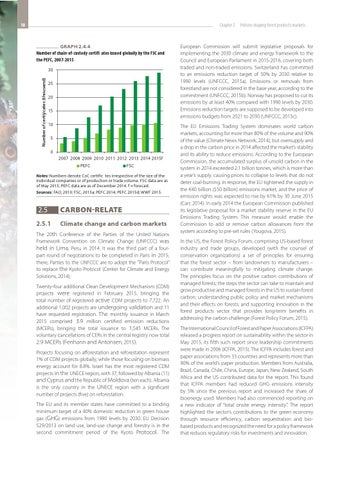
GRAPH 2.4.4 Number of chain-of-custody certifi ates issued globally by the FSC and the PEFC, 2007-2015
Number of certiÿcates (thousand)
30 25 20 15 10 5 0 2007 2008 2009 2010 2011 2012 2013 2014 2015f PEFC
FSC
Notes: Numbers denote CoC certific tes irrespective of the size of the individual companies or of production or trade volume. FSC data are as of May 2015; PEFC data are as of December 2014. f = forecast. Sources: FAO, 2010; FSC, 2015a; PEFC 2014; PEFC 2015d; WWF 2015.
2.5
CARBON-RELATE
2.5.1
Climate change and carbon markets
The 20th Conference of the Parties of the United Nations Framework Convention on Climate Change (UNFCCC) was held in Lima, Peru, in 2014. It was the third part of a fourpart round of negotiations to be completed in Paris in 2015; there, Parties to the UNFCCC are to adopt the “Paris Protocol” to replace the Kyoto Protocol (Center for Climate and Energy Solutions, 2014). Twenty-four additional Clean Development Mechanism (CDM) projects were registered in February 2015, bringing the total number of registered active CDM projects to 7,722. An additional 1,002 projects are undergoing validation and 11 have requested registration. The monthly issuance in March 2015 comprised 3.9 million certified emission reductions (MCERs), bringing the total issuance to 1,545 MCERs. The voluntary cancellations of CERs in the central registry now total 2.9 MCERs (Fenhann and Antonsen, 2015). Projects focusing on afforestation and reforestation represent 1% of CDM projects globally, while those focusing on biomass energy account for 8.8%. Israel has the most registered CDM projects in the UNECE region, with 37, followed by Albania (11) and Cyprus and the Republic of Moldova (ten each). Albania is the only country in the UNECE region with a significant number of projects (five) on reforestation. The EU and its member states have committed to a binding minimum target of a 40% domestic reduction in green house gas (GHG) emissions from 1990 levels by 2030. EU Decision 529/2013 on land use, land-use change and forestry is in the second commitment period of the Kyoto Protocol. The
European Commission will submit legislative proposals for implementing the 2030 climate and energy framework to the Council and European Parliament in 2015-2016, covering both traded and non-traded emissions. Switzerland has committed to an emissions reduction target of 50% by 2030 relative to 1990 levels (UNFCCC, 2015a). Emissions or removals from forestland are not considered in the base year, according to the commitment (UNFCCC, 2015b). Norway has proposed to cut its emissions by at least 40% compared with 1990 levels by 2030. Emissions reduction targets are supposed to be developed into emissions budgets from 2021 to 2030 (UNFCCC, 2015c). The EU Emissions Trading System dominates world carbon markets, accounting for more than 80% of the volume and 90% of the value (Climate News Network, 2014), but oversupply and a drop in the carbon price in 2014 affected the market’s stability and its ability to reduce emissions. According to the European Commission, the accumulated surplus of unsold carbon in the system in 2014 exceeded 2.1 billion tonnes, which is more than a year’s supply, causing prices to collapse to levels that do not deter coal-burning. In response, the EU tightened the supply in the €40 billion ($50 billion) emissions market, and the price of emission rights was expected to rise by 61% by 30 June 2015 (Carr, 2014). In early 2014 the European Commission published its legislative proposal for a market stability reserve in the EU Emissions Trading System. This measure would enable the Commission to add or remove carbon allowances from the system according to pre-set rules (Yougova, 2015). In the US, the Forest Policy Forum, comprising US-based forest industry and trade groups, developed (with the counsel of conservation organizations) a set of principles for ensuring that the forest sector – from landowners to manufacturers – can contribute meaningfully to mitigating climate change. The principles focus on the positive carbon contributions of managed forests; the steps the sector can take to maintain and grow productive and managed forests in the US to sustain forest carbon; understanding public policy and market mechanisms and their effects on forests; and supporting innovation in the forest products sector that provides long-term benefits in addressing the carbon challenge (Forest Policy Forum, 2015). The International Council of Forest and Paper Associations (ICFPA) released a progress report on sustainability within the sector in May 2015, its fifth such report since leadership commitments were made in 2006 (ICFPA, 2015). The ICFPA includes forest and paper associations from 33 countries and represents more than 90% of the world’s paper production. Members from Australia, Brazil, Canada, Chile, China, Europe, Japan, New Zealand, South Africa and the US contributed data for the report. This found that ICFPA members had reduced GHG emissions intensity by 5% since the previous report and increased the share of bioenergy used. Members had also commenced reporting on a new indicator of “total onsite energy intensity”. The report highlighted the sector’s contributions to the green economy through resource efficiency, carbon sequestration and biobased products and recognized the need for a policy framework that reduces regulatory risks for investments and innovation.