16
Chapter 2 Policies shaping forest products markets
The global area certified under the FSC was up by 1.1 million hectares (0.6%) compared with the previous 12 months, and the global area certified under PEFC was up by 5.1 million hectares (2%). In the case of the PEFC, data are reported to December 2014, and more forest may have been certified to May 2015. The PEFC reported a total of 263.2 million hectares in 31 countries (three countries more than in the previous survey); the FSC reported 183.3 million hectares in the same 81 countries as for the previous 12 months. The estimated overlap of 7.5 million hectares due to double certification (i.e. forest certified under both the FSC and the PEFC) was the same as reported in the previous 12 months. More than 80% of the double certification is in Europe (3.5 million hectares) and North America (2.6 million hectares). Taking this double certification into account, the world’s total certified forest area as of May 2015 was about 439 million hectares, which is 10.9% of the total global forest area (4.033 billion hectares). Although the growth of certified forest area is slowing, there are possibilities for increases in the vast forest areas of the Russian Federation, the tropics and the Southern Hemisphere. Nevertheless, substantial growth in these regions seems far away, and it may be time for diversification and new approaches to certification. For example, a monitoring tool for REDD+ is under discussion; the drivers and incentives of certification could be enhanced if certification schemes could be used simultaneously to ensure sustainable forest management, monitor illegal logging, and deliver other accountability benefits. 2.4.1.1
Internal developments in certific tion schemes
The process of developing the FSC’s international generic indicators (IGIs) has moved forward, with FSC International’s board of directors approving the IGIs in March 2015. The IGIs are now available to be used in the development of national or subregional FSC standards (FSC, 2015b). FSC International’s board decided in February 2015 to disassociate itself from the Dalhoff Larsen and Horneman (DLH) Group. This resulted in the immediate termination of DLH’s FSC membership, while the suspension of its FSC certificates was to take effect within three months. As of May 2015, the DLH Group holds FSC chain-of-custody and controlled-wood certificates for broker activities and has registered offices in Denmark, Hong Kong and Viet Nam (FSC, 2015f ). The decision to disassociate was based on evidence that DLH had been involved in illegal timber trade in Liberia (FSC, 2015d). In January 2015, the FSC also confirmed the suspension of operations at its Polish national office, effective on 30 December 2014. The suspension was based on a failure of the office to implement the required governance structure and to address stakeholder concerns. Existing Polish FSC certificates are unaffected, and responsibility for the FSC Polish National Standard has been transferred to FSC headquarters in Germany (FSC, 2015e). In North America, the Sustainable Forestry Initiative (SFI) completed a five-year standards review cycle in 2014 and launched the new 2015-2019 standard in January 2015 (SFI, 2015a). Revisions to the SFI standard include establishing
separate standards for forest management, fibre sourcing and chain of custody. Revisions to the SFI Forest Management Standard include additional requirements addressing prohibitions on forest conversion and limits on chemical use. Standards were also improved or clarified to address comprehensive water-quality protections, the conservation of biological diversity, indigenous peoples’ rights, and forest tree biotechnology. The forest area certified to the SFI Forest Management Standard now exceeds 250 million acres (100 million hectares) (SFI, 2015b). Canada’s National Standard on Sustainable Forest Management, CAN/CSA-Z809, is undergoing a revision process, which is expected to be completed by April 2016 (CSA, 2015). In March 2015, the PEFC announced the launch of a process to develop a forest certification system in India; China, Indonesia and Malaysia had previously established PEFC-endorsed systems in Asia (PEFC, 2015a). The process to develop a standard in Cameroon has progressed to the public consultation phase, one of the final steps before a standard is submitted for PEFC endorsement (PEFC, 2015b). The PEFC continues to work to expand forest certification opportunities in South America, including by convening a PEFC regional conference and workshop in Uruguay in April 2015 to bring together South American PEFC members, national system experts and stakeholders with other countries in the region who are interested in developing their own certification systems (PEFC, 2015c). 2.4.1.2
Regional aspects
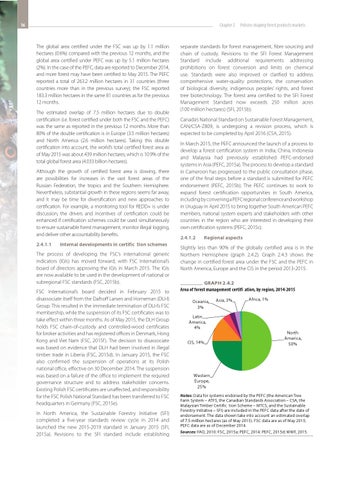
Slightly less than 90% of the globally certified area is in the Northern Hemisphere (graph 2.4.2). Graph 2.4.3 shows the change in certified forest area under the FSC and the PEFC in North America, Europe and the CIS in the period 2013-2015. GRAPH 2.4.2 Area of forest management certifi ation, by region, 2014-2015 Oceania, 3% Latin America, 4% CIS, 14%
Asia, 3%
Africa, 1%
North America, 50%
Western Europe, 25% Notes: Data for systems endorsed by the PEFC (the American Tree Farm System – ATFS, the Canadian Standards Association – CSA, the Malaysian Timber Certific tion Scheme – MTCS, and the Sustainable Forestry Initiative – SFI) are included in the PEFC data after the date of endorsement. The data shown take into account an estimated overlap of 7.5 million hectares (as of May 2015). FSC data are as of May 2015; PEFC data are as of December 2014. Sources: FAO, 2010; FSC, 2015a; PEFC, 2014; PEFC, 2015d; WWF, 2015.