15
UNECE/FAO Forest Products Annual Market Review, 2014-2015
The EU has not introduced binding criteria for the sustainability of biomass or solid and gaseous biomass used for electricity, heating and cooling and instead relies on non-binding recommendations to member states on national sustainability requirements. Belgium, Hungary, the Netherlands and the UK have introduced specific sustainable forest management criteria for forest biomass as well as land criteria for agricultural biomass. Belgium, Italy, the Netherlands and the UK have also adopted GHG-saving criteria for biomass used in electricity/ heating. A number of major European utilities that use biomass in large thermal power plants, mostly in the form of wood pellets, have established the Sustainable Biomass Partnership as an industryled project to develop sustainability standards and processes (Sustainable Biomass Partnership, 2015). A recent review of 59 published studies (Buckholz et al., 2015) concluded that the inclusion of wildfire dynamics was highly influential in determining carbon balances in forest bioenergy sources. According to the review, biomass may provide immediate carbon benefits when sourced from fire-prone regions, where the open burning of residues is common practice, and natural disturbances had greater influence on study results
than factors such as feedstock type, baseline and leakage. The review recommended the prioritization of accounting principles that provide consistent consideration of natural disturbance regimes, temporal scales, and system boundaries. Environmental groups continue to highlight the potential negative consequences of an increased reliance on biomass and to argue that biomass has only a limited role to play in reducing carbon emissions (FERN, 2015). In contrast, an extensive study of the status and future potential of global bioenergy resources, systems and markets (SCOPE, 2015) suggested that as much as 30% of the world’s fuel supply could be bio-based by 2050, although it also found that the implementation of successful bioenergy production systems will require clear sustainability metrics and monitoring programmes, stable land tenure, and effective local and national governance, conditions not yet established in many countries.
2.4
ENVIRONMENT-RELATED
2.4.1
Certified orest products
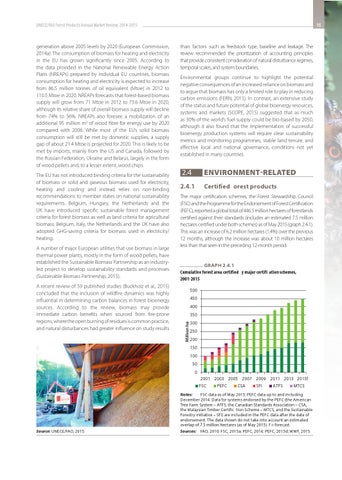
The major certification schemes, the Forest Stewardship Council (FSC) and the Programme for the Endorsement of Forest Certification (PEFC), reported a global total of 446.5 million hectares of forestlands certified against their standards (includes an estimated 7.5 million hectares certified under both schemes) as of May 2015 (graph 2.4.1). This was an increase of 6.2 million hectares (1.4%) over the previous 12 months, although the increase was about 10 million hectares less than that seen in the preceding 12-month period.
GRAPH 2.4.1 Cumulative forest area certified y major certifi ation schemes, 2001-2015 500 450 400 350 Million ha
generation above 2005 levels by 2020 (European Commission, 2014a). The consumption of biomass for heating and electricity in the EU has grown significantly since 2005. According to the data provided in the National Renewable Energy Action Plans (NREAPs) prepared by individual EU countries, biomass consumption for heating and electricity is expected to increase from 86.5 million tonnes of oil equivalent (Mtoe) in 2012 to 110.5 Mtoe in 2020. NREAPs forecasts that forest-based biomass supply will grow from 71 Mtoe in 2012 to 73.6 Mtoe in 2020, although its relative share of overall biomass supply will decline from 74% to 56%. NREAPs also foresee a mobilization of an additional 95 million m3 of wood fibre for energy use by 2020 compared with 2006. While most of the EU’s solid biomass consumption will still be met by domestic supplies, a supply gap of about 21.4 Mtoe is projected for 2020. This is likely to be met by imports, mainly from the US and Canada, followed by the Russian Federation, Ukraine and Belarus, largely in the form of wood pellets and, to a lesser extent, wood chips.
300 250 200 150 100 50 0 2001 2003 2005 2007 2009 2011 2013 2015f FSC PEFC CSA SFI ATFS MTCS
Source: UNECE/FAO, 2015.
Notes: FSC data as of May 2015; PEFC data up to and including December 2014. Data for systems endorsed by the PEFC (the American Tree Farm System – ATFS, the Canadian Standards Association – CSA, the Malaysian Timber Certific tion Scheme – MTCS, and the Sustainable Forestry Initiative – SFI) are included in the PEFC data after the date of endorsement. The data shown do not take into account an estimated overlap of 7.5 million hectares (as of May 2015). f = forecast. Sources: FAO, 2010; FSC, 2015a; PEFC, 2014; PEFC, 2015d; WWF, 2015.